in the population sciences published by the Max Planck Institute for Demographic Research Konrad-Zuse Str. 1, D-18057 Rostock · GERMANY www.demographic-research.org
DEMOGRAPHIC RESEARCH
VOLUME 26, ARTICLE 1, PAGES 1-40
PUBLISHED 11 JANUARY 2012
http://www.demographic-research.org/Volumes/Vol26/1/ DOI: 10.4054/DemRes.2012.26.1
Research Article
The influence of employment uncertainty
on childbearing in France:
A tempo or quantum effect?
Ariane Pailhé
Anne Solaz
© 2012 Ariane Pailhé & Anne Solaz.
This open-access work is published under the terms of the Creative Commons Attribution NonCommercial License 2.0 Germany, which permits use, reproduction & distribution in any medium for non-commercial purposes, provided the original author(s) and source are given credit.
1 Introduction 2
2 The French context 4
2.1 Trends in fertility 4
2.2 Trends in unemployment 5
2.3 Trends in non-permanent employment 7
3 Theoretical framework and hypotheses 9
4 Data and method 14
4.1 Data 14
4.2 Sample selection 15
4.3 Empirical strategy 16
4.4 Several indicators of employment uncertainty 17
5 Results 20
5.1 Current employment status matters in relation to fertility timing 20 5.2 Employment uncertainty depends on the period and duration 21 5.3 Employment uncertainty and educational level 23 5.4 Aggregate unemployment reduces transition to parenthood 24 5.5 Completed fertility depends on the accumulation of uncertainty for men 25
6 Discussion and conclusion 29
7 Acknowledgements 31
References 32
The influence of employment uncertainty on childbearing in France:
A tempo or quantum effect?
Ariane Pailhé1 Anne Solaz2
Abstract
This paper investigates whether unemployment and insecure employment periods merely delay fertility or also impact on completed fertility in France. It analyses both the timing of first childbearing and the fertility reached at age 40. Different indicators of declining employment security are used, i.e., current individual employment characteristics, the accumulation of unstable jobs, and aggregate-level indicators of employment uncertainty. Male unemployment has a negative influence on the timing of first childbearing, while periods of insecure employment delay fertility for women. Completed fertility is impacted by unemployment spells only for men who have faced long-term unemployment. Employment uncertainty thus tends to delay first parenthood but has a relatively weak effect on lifetime fertility in France. Generous state support to families associated with a generous unemployment insurance system, and the strong French two-child family norm, may explain why economic uncertainty affects fertility less than elsewhere.
1 Institut national d´études démographiques (INED). E-mail: [email protected]. 2
1. Introduction
The relationship between economic fluctuations and fertility was one of the first topics studied in the 16thcentury by demographers and economists. These issues gained momentum in the late 18th and 19th centuries with the work of classical economists such as Adam Smith, David Ricardo, John Stuart Mill, and Thomas R. Malthus, for whom the standard of living had a positive effect on population growth rate. But this theory has been challenged by the facts: fertility is lower in rich countries than in poor ones and the economic development of Western European countries over the past 150 years has been accompanied by a decline in fertility. The theory of fertility that has become a dominant paradigm over the last 50 years has tried to solve this paradox by using micro-economic models and hypotheses regarding household behaviour (Becker 1981). To explain the level of fertility, Gary Becker has stressed the importance of the trade-off between quantity and “quality” of children, i.e., increasing the quality of children leads to a decrease in their quantity. One way to increase the quality of children is to be more demanding in terms of fertility conditions, and to wait for particular requirements to be satisfied before deciding to become parents. Having a stable job becomes one such requirement.
Since the mid seventies fertility has declined rapidly throughout Europe. Profound social changes, such as changes of norms and values and female emancipation, in combination with the diffusion of modern contraception, have influenced childbearing behaviour (Lesthaeghe 1983). Concomitantly there has been a rise in uncertainty in the Western European labour markets. Unemployment and non-permanent employment have sharply increased and entering the labour market has become particularly difficult for young people. Employment uncertainty has been identified as one of the main explanations for postponement of fertility in Europe (Blossfeld et al. 2005; McDonald 2006). In a context of declining employment security and increasing unemployment the cost of having children may be perceived as higher, and young people may wait until they hold a permanent job before entering into parenthood (Kohler, Billari, and Ortega 2006; Adsera 2004).
continental countries such as Belgian Flanders (Impens 1989) and France (Meron, Widmer and Shapiro 2002). These contrasting results may be explained by country-specific effects, particularly differences in social welfare and unemployment protection. They may also stem from the role of men’s employment situation, which has rarely been analysed. Few studies have investigated the impact of male unemployment, but all have highlighted that men’s unemployment has a more pronounced negative effect than that of women (Kravdal 2002 for Norway; Lundström 2009 for Sweden; Tölke and Diewald 2003 and Özcan, Mayer and Luedicke 2010 for Germany; Mills, Blossfeld and Klijzing 2005 for 14 industrialised countries).
Beyond unemployment, the question of the impact of non-permanent employment has been raised only recently. Studies have mainly covered southern European countries, where these types of atypical employment are particularly widespread. They have confirmed the hypothesis that fertility is postponed when the employment time horizon is short (de la Rica and Iza 2005; Ahn and Mira 2001).
Most of the papers addressing the effect of employment uncertainty on fertility focus on the timing of childbearing. Indeed, the rising age at childbearing is considered as one of the main explanations for the decrease in fertility (Morgan 2003; Bongaarts 2001; Bongaarts and Feeney 1998; Caldwell and Schindlmayr 2003). In other words, “timing and numbers are interrelated” (Morgan and Taylor 2006). However, the demographic trends in France do not follow the suggested pattern, i.e., that delayed entry into parenthood results in lower fertility (Toulemon, Pailhé and Rossier 2008). As elsewhere in Western Europe, entry into parenthood has been delayed in France, but cohort completed fertility has remained close to the replacement level. The fertility level remains high despite a negative relationship between fertility trends and unemployment. Thus, among continental European countries, France has a particular position since it combines high fertility, increasing age at first birth, high youth unemployment, and non-permanent employment. This raises the question of the specific impact of employment uncertainty in France compared to the other European countries. Do unemployment and non-permanent employment affect fertility in France less than elsewhere in Europe? Do they merely delay fertility or also impact on completed fertility? In other words, does employment uncertainty have a tempo or quantum effect on childbearing in France?
current individual employment characteristics, accumulation of short-term employment over the life course, and aggregate-level indicators of employment uncertainty.
The paper is organised as follows. First, the French context of fertility and employment is outlined. The second section describes the theoretical background. The data and methods are presented in the third section. The last section details the results on both timing of fertility and completed fertility.
2. The French context
2.1 Trends in fertility
As elsewhere in Europe, entry into parenthood is increasingly delayed and the timing of fertility is changing rapidly. The fertility schedule is moving continuously to higher ages and the mean age at childbirth is continuing to rise. The mean age at first childbirth has increased since the mid-1970s, rising from 23.9 years in 1975 to 27.8 years in 2006. This increase results both from a decrease in fertility at young ages (before 25) and an increase at ages 28 and over (Insee, bilan démographique).
However, unlike the other European countries, this postponement seems to have little impact on completed fertility. France is one of Europe’s most fertile countries. In 2008, with 1.99 children per woman on average, France ranked second in Europe, behind Ireland (2.10). From the beginning of the 1960s fertility in France followed a similar trend to that observed in other European countries. The total fertility rate (TFR) decreased from 2.5 children per woman in 1970 to below 2 in 1975 (Figure 1). It stabilized in the 1980s and reached its lowest level in 1994 (1.66), during the economic downturn of the mid-90s. As in other European countries there was a negative relationship between fertility and unemployment. But since the end of the 1990s France has broken away from its neighbours: fertility began to increase clearly from 1996, and the period total fertility rate has remained stable at above 1.9 since 2000. The recent economic crisis has had no negative effect on fertility: the number of births continued to increase in 2010 and the TFR reached 2.00 children per woman (Pison 2011). The cohort total fertility has fallen slightly but levelled off at 2.0 (Figure 1). In metropolitan France, women born in 1957, who turned 50 in 2007, have had 2.14 children on average (Toulemon et al. 2008).
Finally, the two-child family is the norm (Regnier-Loilier 2006): 41% of women born in 1960 have two children.
Figure 1: Fertility since 1970 in France
1.4 1.6 1.8 2 2.2 2.4 2.6 19 7 0 1 942 19 7 3 1 945 19 7 6 1 948 19 7 9 1 951 19 8 2 1 954 19 8 5 1 957 19 8 8 1 960 19 9 1 1 963 19 9 4 1 966 19 9 7 1 969 20 0 0 1 972 20 0 3 1 975 20 0 6 1 978 20 0 9 1 981 C h ild re n pe r wo ma n
Period total fertility rate Cohort completed fertility
Cohort
Year
Source: Toulemon et al. 2008 (data from Insee, register data)
A noticeable characteristic of French fertility is its homogeneity by education level and social class. The most educated women have fewer children than the least educated women(1.85 and 2.42 children respectively, on average, among the female cohorts born in 1955-59), but the differences are small compared with other European countries where there is much greater polarization by education level (Ekert-Jaffé et al. 2002). Another significant feature is the small numbers of births outside a partnership: only 7% of mothers are living alone at the time of birth (Vilain et al. 2005).
2.2 Trends in unemployment
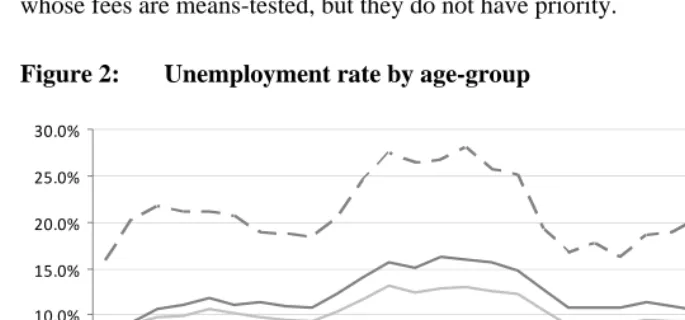
highest in Europe (behind Spain, Slovakia, and Hungary), and above the EU-27 average (7.0%). Fluctuating widely in response to economic conditions, it exceeded 20% for the 20-24 age group during periods of economic slowdown in the mid-1980s, 1990s, and 2000s, and has never fallen below 15% since the mid-1980s (Figure 2). For the 25-29 age group, it has remained above 10% since 1985 (with the only exception of 2008) and topped 15% during the economic downturn of the 1990s. Young people with lower levels of educational attainment have been particularly hard-hit (Fondeur and Minni 2005).
Another specific feature of unemployment in France is its long duration. The average length is more than one year (14 months in 2006): 40% of unemployed people have been out of work for at least one year, 21% for at least 2 years. Flows from unemployment to employment are rather low: according to LFS data, the likelihood of finding employment in 2007 if unemployed in 2006 was 34%. Long-term unemployment mainly concerns persons aged 50 and over. However, a significant share of young people is at risk of long-term joblessness, with25.8% of youth unemployed remaining out of work for a year or more in 2006 (26.8% of men, 24.6% of women).
People who have involuntarily lost their jobs are covered by the unemployment insurance scheme, on condition that they have worked at least 4 months in the last 22 months, that they are registered as a jobseeker, and are in the process of genuinely and actively seeking employment. The amount of benefit is calculated on the basis of previous earnings.3 Unemployment benefits can be claimed for a period equal to the duration of former employment, with a maximum of 24 months. Thus, school-leavers are not eligible for unemployment benefits unless they have worked for a sufficiently long period. From age 25 they are entitled to the minimum welfare benefit.
A person with social protection prior to unemployment continues to benefit from health insurance (covering illness, maternity, and death) as long as he/she is entitled to unemployment benefit. Like working people, unemployed people are also entitled to universal and means-tested family benefits. With at least one child under 3 they can get a basic allowance (a one-off payment per birth of €890, and €178 per month for 3 years). Universal family benefits are also available, but only from the second child (€124 per month for 2 children, €283 for 3 children). Unemployed people are also entitled to the parental leave allowance (€374 per month until the child’s third birthday, from the second child since 1994). Since entitlement to childcare services is linked to
employment status, unemployed parents can theoretically benefit from daycare centres, whose fees are means-tested, but they do not have priority.
Figure 2: Unemployment rate by age-group
0.0% 5.0% 10.0% 15.0% 20.0% 25.0% 30.0%
1983 1984 1985 1986 1987 1988 1989 1990 1991 1992 1993 1994 1995 1996 1997 1998 1999 2000 2001 2002 2003 2004 2005 2006 2007 2008 2009
20‐24
20‐49
25‐29
Source: Eurostat, Labour force surveys, 1983-2009
2.3 Trends in non-permanent employment
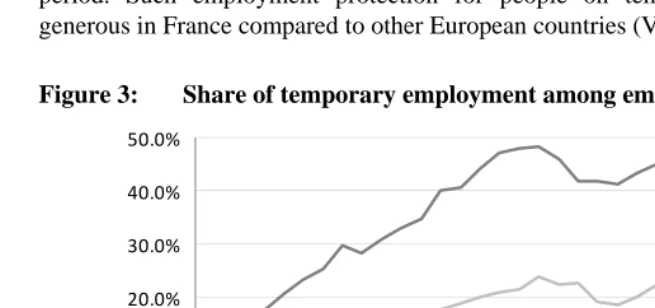
Non-permanent employment has grown, despite strict regulations on temporary forms of employment.4 These contracts must be restricted to ‘objective’ situations (replacement, seasonal work, temporary increases in company activity, training purposes, public works programmes) and the number of successive fixed-term contracts for the same person within the same company is limited. Such contracts also have a fixed duration of 3 to 18 months,5 and can be renewed only twice within the same company. Despite this protective regulation, use of this type of contract has regularly increased, especially but not exclusively for young people entering the labour market (Figure 3). Since the mid-1990s more than four in ten employment contracts of employees aged 20-24 and about two in ten contracts of those aged 25-29 have been fixed-term contracts.
4 Since the late 1970s a succession of formal regulations have been introduced to restrict fixed-term contracts to contracts of short-term duration, to limit the permissible grounds for their use and to establish a degree of equality of treatment between employees hired under such contracts and other employees.
5
Like employees on an open-ended contract, employees on fixed-term contracts are eligible for unemployment benefit, as well as parental leave and parental leave benefit, on condition that they have paid social security contributions over a long enough period. Such employment protection for people on temporary contracts is quite generous in France compared to other European countries (Venn 2009).
Figure 3: Share of temporary employment among employees, by age %
0.0% 10.0% 20.0% 30.0% 40.0% 50.0%
1
983 1985 1987 1989 1991 1993 1995 1997 1999 2001 2003 2005 2007 2009
20‐49
25‐29
20‐24
Source: Eurostat, Labour force surveys, 1983-2009
This overview of employment trends in France shows that levels of unemployment and flexible forms of employment are fairly high for young people in France compared to other European countries. Since conditions at labour market entry up to age 30 are likely to strongly influence the later career, their working lives are less continuous. Transitions into and out of unemployment have increased (Germe, Montchatre and Pottier 2003) for all categories of employees, but especially the unskilled, leading to a growing contrast between employees with a stable position in their firm and individuals engaged in frequent transitions in and out of employment. Moreover, the gap between cohorts has widened: cohorts born after 1955 have faced rising unemployment, while those born after 1965 have also experienced the deregulation of the labour market and the rise in non-permanent employment.
employment, since these statuses are not the social norm (Bourguignon and Herman 2007).6 These developments can be expected to have a spillover effect on individual decisions in private life, and particularly on family formation. This article addresses whether these two forms of employment uncertainty, i.e., unemployment and non-permanent employment, have similar impacts on fertility decisions. It analyses their impact on fertility decisions for men and women in partnership,7 but not their effect on the propensity and timing of partnership formation.8 We assume in this research that the risk of childbirth occurs once people are in partnership, and we focus specifically on them.
3. Theoretical framework and hypotheses
Economists have developed models to explain how fertility might respond to variations of income. The dominant economic approach to fertility was developed by Gary Becker (1981), who explained the negative relationship between income growth and fertility by introducing the concept of child "quality", i.e., that parents have a demand for quality as well as quantity of children. The higher the income, the higher the demand for child quality, and the lower the quantity. As is common in the literature (Kravdal 1994; Adsera 2005b; De la Rica and Iza 2005; Kreyenfeld 2005), this argument of the effect of a variation in income can be adapted to employment uncertainty, i.e., unemployment or non-permanent employment, since it involves a decrease in income and/or an uncertain future income. As men and women do not hold the same position in the family and in employment, we expect the effects of job insecurity to differ by gender. We will first present the general mechanisms of the theory and then discuss the gender differences in the effects of employment uncertainty on fertility.
6 Even if in some cases short-term employment is an individual choice, in the majority of cases it is involuntary. In a context of growing employment uncertainty, young workers, especially when they live in partnership and intend to start a family, look for job security (Bourguignon and Herman 2007).
7 Births outside a partnership are rare in France and often unplanned. The proportion of unplanned births is estimated at around 5% after age 20, but is significantly higher at very young ages (13% before 20) or when women are out of partnership (Regnier-Loilier and Solaz 2010).
The starting point of the analysis is that the parents’ fertility decision depends on trade-offs between the costs and benefits of children. These costs can be monetary but can also take the form of investment in time. An increase in income (or expected income) has two opposite effects. On the one hand, the increase in household income raises the demand for children (income effect). On the other hand, it represents an increase in the price of time spent with children – the income or career opportunities that a parent must give up to care for the child – and thus may reduce the demand for children (price effect). As the relative importance of these two effects may vary, one cannot, in theory, determine which of the two effects dominates. However, for Gary Becker, as income rises the demand for quality rises more rapidly than the demand for quantity: in other words, households have fewer children and invest more in each child. Both income and price effects play symmetrically in time of crisis. A recession may lead to a decline in household income, for example if one member becomes unemployed, compressing the demand for quantity of children when the demand for child quality is constant. Postponing childbearing may be a way to save resources otherwise spent on the child, providing a means to offset the financial losses arising from unemployment. This postponement may also reflect unemployed individuals’ anticipation of greater difficulties in finding a new job after becoming parents. Conversely, the opportunity cost (or price effect) of children is lower when unemployed. Moreover, having a child while unemployed may save childcare costs. In other words, it may be relatively less expensive to have a child when being unemployed than when working. Again, as in the case of income growth, one cannot predict ex ante which effect prevails.
The sociological approaches also highlight the adverse effects that the financial crisis may have on fertility decisions. Being in employment or attaining a status considered appropriate in individual careers may be a precondition for family formation or the birth of an additional child, providing a means to ensure social status and secure current and future economic resources. In a context of strong normative pressure regarding employment, this effect may be particularly strong. It is expected to be stronger for men if traditional gender roles prevail, i.e., if men are expected to be the main breadwinner. However, Débra Friedman, Hechter and Kanazawa (1994) argue that people facing various different types of economic uncertainty might actually decide to have children. In the same vein, Edin and Kefalas (2005) show that the poorest women in non-permanent employment may decide to have a child before marriage because entry into motherhood may increase their social status. For those with little control over their economic situation having children can be a strategy to reduce uncertainty, the private sphere seeming less uncertain than the public sphere: when the work situation or the economic environment is uncertain, becoming a parent can be a way to make the future safer. This explanation is particularly true in contexts where fertility is valued or where the time demands of work are in conflict with family formation, particularly because of a shortage of public childcare.
Both these economic and sociological theoretical aspects suggest that the effect of unemployment or non-permanent employment may differ by gender. In countries where the male breadwinner model dominates, it is more important for men than for women to establish themselves professionally before having a child (Oppenheimer et al. 1997). From an economic point of view, as men are generally the main breadwinner, the income effect should be higher than the price effect for men, thereby reducing the demand for children (Özcan, Mayer and Luedicke 2010). The variations of the price of children with income are usually higher for women than for men, since they are still the main childcare provider (Galor and Weil 1996; Pailhé and Solaz 2008). Since a decrease in women’s individual income reduces both the household income and the price of children, the income effect may be offset by the price effect. From a sociological point of view the family sphere is more valued for women than men because of gendered social norms. Indeed, according to the role theory, women receive substantial social rewards when they participate in mothering, while men receive far fewer such rewards for fathering (Van der Lippe 1994). Moreover, according to the ‘doing gender’ approach, the greater involvement of women in housework and men in market work is a way of reaffirming their gender identities (Goffman 1977). Thus, male unemployment should have a higher impact on fertility than female unemployment (Kravdal 2002).
of obtaining a long-term contract much more strongly for women than for men, particularly if having a child is interpreted by the employer as a weakening of commitment to work and if childcare provision is poor. Non-permanent employment and unemployment may affect the timing of childbearing in different ways.
Thus, we pose the following hypotheses:
H1a: For men, unemployment delays the transition to fatherhood. For women, the sign of the effect is undetermined.
H1b: For men, the negative impact of non-permanent employment is expected to be lower than that of unemployment. For women, the impact of short-term employment is likely to be negative and stronger than that of unemployment.
But the impact of employment uncertainty depends on its timing and on its duration. One can expect the impact to differ if it occurs at the beginning of the union, or later on. For example, Meron, Widmer and Shapiro (2002) showed that French women in short-term employment in the year they started their union postpone the birth of their first child. If people feel ready to form a union while exposed to employment uncertainty they are already aware of this risk at the outset, but decide to go ahead anyway. These people who start a union while one partner is unemployed might be selected, since people who experience uncertainty usually postpone partnership formation (Ekert-Jaffé and Solaz 2001). They might be less risk-averse in a context of economic uncertainty and might accept employment uncertainty more readily. By contrast, employment uncertainty that occurs later may be more destabilising for fertility decisions. These unanticipated changes in economic circumstances may affect the birth of children. Indeed, like the so-called “surprise effect” defined by Weiss and Willis (1997) in the case of divorce,9 an unanticipated unemployment spell may affect the couple’s childbearing behaviour, all the more if one partner is more risk-averse than the other.
Moreover, the impact of employment uncertainty depends on its duration (Özcan, Mayer and Luedicke 2010). A persistent period of unemployment is expected to have a strong negative effect on childbearing (Adsera 2004). However, in the case of permanent uncertainty households may re-evaluate their preferences, such as their material aspirations and child quality requirements, and review the decision whether to have a child or to postpone childbirth even further (Kravdal 2002). Since childbearing is an alternative to employment for women much more than for men, women may
9
evaluate their preferences much sooner than men in the case of long-term unemployment, and decide to centre their lives on the private sphere. We can thus formulate our second hypothesis:
H2a: Economic uncertainty has a weaker effect in delaying the transition to parenthood when it is accepted, i.e., when it occurs at couple formation. H2b: Economic uncertainty has a stronger effect when persistent, especially for men.
The effect of employment uncertainty may operate differently according to educational level. One can assume that the income effect is stronger for highly educated men and women and thus encourages postponement of childbearing, while less educated persons will accelerate the transition to parenthood. Highly educated women, giving priority to their career, may intend to get a stable job before becoming mothers, unlike those who have less control over their economic situation and who give priority to family, and who may take the opportunity of being unemployed to accelerate childbearing. Since for men getting a job is important for gaining social status, whatever their level of education, one can expect men’s behaviours to differ much less according to level of education than women’s. This leads to our third hypothesis:
H3: Highly educated women are expected to postpone childbearing much more than less educated women when facing unemployment.
The impact of education for men is lower.
H4: The higher the aggregate unemployment rate, the longer people wait before having a child.
The long-term implications of such employment uncertainty are not obvious (Bhaumik and Nugent 2005). If employment uncertainty is temporary, individuals may have the desired number of children over the rest of their lifetime. But uncertainty might affect completed fertility if employment uncertainty were to persist over a long period of time, such that childbirth is postponed a number of times. However, individuals may re-evaluate their preferences and centre their life on family. Thus, the impact of employment uncertainty on completed fertility is theoretically undetermined: it is important to measure the influence of the duration of periods of unemployment and non-permanent employment over the life course to assess this effect.
H5: The long-term implications of employment uncertainty are undetermined and depend on the recurrence of uncertainty over the life cycle.
4. Data and method
4.1 Data
The data set used here comes from the Familles et Employeurs survey conducted by the French National Institute of Demographic Studies (INED) on a representative sample of the French population from November 2004 to March 2005. The sample comprises 9,547 individuals (5,107 women and 4,440 men) aged 20-49. Two persons per household in the age range were interviewed.
non-permanent employment is defined as a period of employment lasting less than six months.10 More than one situation can be identified for a given year: firstly, some situations are not exclusive (for example, education and unemployment); secondly, a six month period can start at year t and end at year t+1 (the interviewers were instructed to tick the two years). Moreover, for each family event reported (union formation, childbearing), the individual was asked about a precise definition of his/her employment situation (wage-earner/self-employed, public/ private employment, type of contract). In this respect this survey is unique as a source of information for analysing the interaction between employment patterns and fertility decisions.
4.2 Sample selection
Since we assume that the risk of childbirth occurs once people are in partnership, we study the impact of employment instability on men and women in their first partnership (married or not). Different sub-samples relevant to the study topic are used, each one divided into men and women.
First, all women and men who have already formed a union11 are selected to test our four first hypotheses, i.e., to study the timing of the first birth. People having given birth before their first partnership are not taken into account since we concentrate on the timing of fertility after partnership.12This sample contains 7,991 observations (3,533 men and 4,358 women). The mean duration between union formation and the first birth13 is three years and two months. Most first births occur in the first five years following union formation (63% of couples already have their first child after five years of partnership). After ten years of union only 12% of couples are still childless and the risk of childbearing is very low.
Second, to test our fifth hypothesis, i.e., to study completed fertility, the sample is restricted to individuals who have already formed a union and are at least 40 years old at the date of the survey. This age limit is defined in order to focus on people who are assumed to have completed their fertility. Indeed, in France female fertility is low after age 40.14 Male fertility may not be completed, but the same age limit is chosen to
10 The aim of this restriction in the duration of non-permanent employment is to focus on the most uncertain types of short-term employment and to eliminate trial periods that usually turn into permanent employment. 11 Union is defined as cohabiting for at least six months.
12Only 125 individuals are excluded.
13 Pregnant women are not included since the outcome of pregnancy is not sure and a couple may split up during pregnancy.
14
ensure consistency and to ensure a large number of observations. This sample of completed fertility contains 3,316 observations (1,534 men and 1,782 women).
4.3 Empirical strategy
The effect of economic uncertainty on the timing of first childbearing is estimated through Cox proportional hazards models (Cox 1972). These models are estimated separately for childless men and women. The dependent variable is the transition to first birth. Childless people are followed from the start of the union and right-censored at the date of interview or at the union dissolution date. In order to analyse the effect of unemployment and short-term employment on the level of fertility an ordered polytomic model is estimated. The dependent variable is the number of children individuals have had near the end of their reproductive life, i.e., at age 40. Above four children, the modalities are grouped together.
In all these models the same set of control covariates is used.15 The level of education is introduced with four dummy variables: no education, low education (primary), medium level education (secondary), and high education (university). Three birth cohorts are distinguished: born in 1955-1964, in 1965-1974, and in 1975-1986. The age at first union formation is added, since it is usually a good indicator of the quality of the partnership match. Couples formed very young usually have a higher risk of dissolution and hence a lower risk of having children. Marital status is also included, since the formalization of the union may be a pre-condition for having children. Some background variables are also introduced, since individuals may adhere to behaviour, values, and norms that dominated during their childhood. Characteristics of the family of origin include whether the respondent has at least two siblings, and an indicator of immigrant background, separating French natives from second generation and immigrants. Having grown up in a large family is usually a good determinant and positively correlated to the family size reached since it may indicate that the respondent was raised in a family with strong family values (Michaël and Tuma 1985). Immigrant fertility is also higher than that of native French people. Moreover, fertility varies by immigrant generation, with significant declines between the first and subsequent generations. An additional indicator of the cultural context is introduced through the individual’s religiosity, i.e., if the respondent reported that religion is important in his/her daily life. Two additional variables which summarize marital life, i.e., number
30-34 [Insee, Bilan démographique]. In our sample fewer than 7% of men and 2% of women had children after age 40.
of years in partnership and the number of partnerships, are added in the regressions for completed fertility at age 40.
4.4 Several indicators of employment uncertainty
We build a number of key explanatory variables measuring different aspects of employment uncertainty in order to test our different hypotheses. In order to analyse the impact of current uncertain employment status on the timing of fertility, the current status – whether the respondent is in long-term employment, short-term employment, or is unemployed (or a homemaker for women) – is computed for each calendar year.16 This time-dependent variable is lagged by one year to take into account the time to conceive and the duration of the pregnancy (model specification 1 in Table 2).
The graphs in Figure 4 represent the frequencies of being unemployed or in short-term employment in our sample by age.17 These curves first show that a large share of the respondents has been unemployed over the life course (about 4-5% of the sample at each age). Second, they show that unemployment risk decreases with age but remains significant after age 30.18 Third, the gender discrepancy is high: women are much more likely to face unemployment. There is also a cohort effect: the birth cohort born after 1964 experienced higher unemployment than the previous cohorts. The percentage of men and women in short-term employment is much higher than the percentage that is unemployed, especially under age 26. With regard to short-term employment, the gender gap is almost invisible except at the beginning of the life course, when women are more affected than men. On the other hand, the cohort gap is even larger than for unemployment. This figure confirms that the rise of precarious contracts has massively affected the cohorts born after1964.
16 Unfortunately, unemployment and employment lasting less than six months cannot be separated in the employment calendar. Like Meron, Widmer and Shapiro (2002) we consider these insecure periods as short-term jobs.
17 The curves of unemployment frequencies do not describe the unemployment rate, since the denominator includes the entire sample (people aged 20-49 in 2004 having formed at least one union) and not the working population.
18
Figure 4: Frequencies of unemployment/ short-term employment by age, sex, and birth cohort
Unem ploym ent
0 5 10
18 20 22 24 26 28 30 32 34 36 38 40 42 44age
Short-term em ploym ent
0 5 10 15 20 25
18 20 22 24 26 28 30 32 34 36 38 40 42 44
age
to tal men wo men bo rn after 1964 bo rn befo re 1964
Source: EFE, INED, 2004-2005
In order to test our hypothesis H2a, i.e., the effect of unemployment uncertainty depends on the moment such events occur over the life course, we analyse the impact of employment status at the time of union formation on the timing of fertility (model specification 2 of Table 2). The information regarding employment status at entry into union is available from the answer to the question “At the beginning of this/your first partnership, in year, were you …
1 working?
2 in national service? 3 unemployed?
4 in school, higher education, unpaid training? 5 a homemaker or in another inactive situation?”
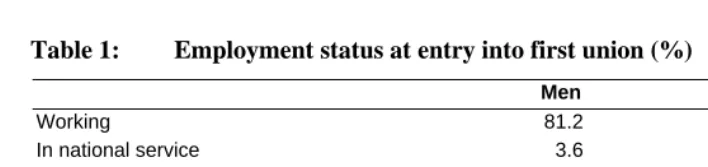
Table 1 displays the employment status of respondents at entry into union. The large majority of respondents, 81% of men and 62% of women, are in work.19 They are rarely unemployed, and men are less often unemployed than women (resp. 3.4% and 6.3%) since they may wait to find a job before forming a union (Ekert-Jaffé and Solaz 2001). A quite significant proportion of respondents (10.2% of men and 19% of women) are students at the time of first union formation. Few persons start their union
19
during their compulsory national service, so they are grouped with students in the analysis.
Table 1: Employment status at entry into first union (%)
Men Women
Working 81.2 62.3
In national service 3.6 0.1
Unemployed 3.4 6.3
Student 10.2 19.1
Homemaker or in another inactive situation 1.6 12.2
Total 100.0 100.0
Source: EFE, INED, 2004-2005
A third indicator aims to test our hypothesis H2b. It measures the influence of the accumulation of employment uncertainty over the life course on the childbearing process. For this purpose a time-varying variable for the ratio of the number of years with unemployment spells to the number of years since union formation is computed.20 A ratio is computed instead of a simple duration in unemployment, as the longer the duration since partnership formation, the higher the likelihood of having experienced unemployment. The same types of longitudinal indicators are built for spells of short-term employment and inactivity.21
In order to test our hypothesis H3, i.e., whether behaviours are related to educational level, we added interaction terms between the indicator of employment uncertainty (employment status the previous year) and the woman’s level of education.
To assess whether the timing of childbearing is responsive to both individual and societal circumstances (H4), models that incorporate both individual-level and aggregate-level data are constructed. These aggregate-level indicators, such as the local unemployment level or the country unemployment rate, may reflect the perceived risk of unemployment. Thus, the national unemployment rate of men (resp. women) aged 15-64 is introduced in the male (resp. female) specification (model specification 4 of Table 2).
Finally, to answer hypothesis H5 we analyse completed fertility at age 40, using the same kind of life-cycle ratios of short-term employment and unemployment spells. They describe, in this case, the proportion of time spent in insecure employment over
20 We also tried another specification of the ratios, which included the insecure employment or unemployment spells occurring before partnership formation and since the completion of education.
21
the period starting from first union formation and finishing at the fortieth birthday. In an alternative specification this ratio is categorized according to three dummy variables contrasting those with a ratio equal to 0, under 10%, or over 10% (Table 4). Table A1 shows the frequencies of these life-cycle ratios for unemployment: 9.8% of men and 16.9% of women were unemployed (for spells exceeding six months) for more than one year in ten over this period; 7.4% of men and 13.1% of women spent less than 10% of the years since first union formation in unemployment. The majority of the population, i.e., 82.8% of men and 70.0% of women, had no such unemployment spells. We observe the same gender gap in life-cycle ratios for short-term employment spells, with 14.1% of women having spent one year in ten in short-term employment, versus only 10.6% of men.
5. Results
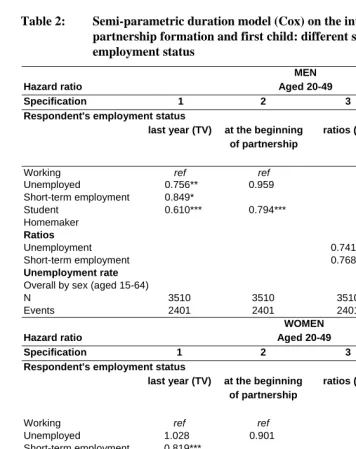
Childbearing is linked with employment uncertainty, though this does not hold for all our indicators of uncertainty. Table 2 displays the hazard ratio for our key explanatory variables. Table A2 gives complete results from the Cox regression for specification 1 of Table 2.
Our results are not pure causal effects, since in these models we control for several observables covariates, and some other unobserved factors might influence both fertility and labour market status and there might be some selection of persons facing unemployment and job insecurity. However, as the unemployment rate in France has been high for several decades, this selection effect should be somewhat lower than in countries with only frictional –and therefore more voluntary– unemployment.
5.1 Current employment status matters in relation to fertility timing
stage of the analysis it seems that for women income and price effects counterbalance each other.
The timing of childbearing reacts to non-permanent employment in a different way. Holding an insecure job postpones transition to motherhood. Thus, once they get such a job, women wait for a stable job situation before founding a family. It seems that women in short-term employment anticipate greater difficulties in keeping their job or finding a new one after becoming a mother, and thus postpone childbearing. On the other hand, short-term employment is not significant in the timing of fatherhood. Thus our hypothesis H1b is validated: the impact of short-term employment is negative and stronger than unemployment for women, and weaker for men.
5.2 Employment uncertainty depends on the period and duration
Unemployment at the time of entry into union matters very little for the timing of childbearing (specification 2, Table 2).22 Being unemployed at union formation does not affect future fertility timing. This result suggests that people having already faced unemployment at the time of union formation are highly selected and do not feel more cautious and sensitive to later unemployment risk. Inactive women still bring forward births, while being in education delays the start of a family for both men and women. While unemployment at the beginning of partnership is not significant for the timing of childbearing, we have seen in section 4.1 that unemployment occurring after couple formation matters for men. Thus our hypothesis H2a is validated for men: economic uncertainty has no effect when it is accepted, i.e., when it occurs at couple formation. It has a stronger effect when it is unexpected.
Our hypothesis H2b stated that the effects of employment uncertainty depend on the duration of the insecure periods. This is confirmed by our results, which show that, beyond current employment status, the accumulation of unemployment spells and non-permanent employment is likely to decrease the likelihood of entry into parenthood for men (specification 3, Table 2). Thus men who face either persistent or recurrent unemployment experience slower transition to first birth. For women, confirming the previous result, only the accumulation of non-permanent employment is likely to have a negative effect.
22
Table 2: Semi-parametric duration model (Cox) on the interval between partnership formation and first child: different specifications of employment status
MEN
Hazard ratio Aged 20-49
Specification 1 2 3 4
Respondent's employment status
last year (TV) at the beginning
of partnership
ratios (TV) last year (TV)+ unemployment
rate (TV)
Working ref ref ref
Unemployed 0.756** 0.959 0.763**
Short-term employment 0.849* 0.863*
Student 0.610*** 0.794*** 0.609***
Homemaker Ratios
Unemployment 0.741*
Short-term employment 0.768***
Unemployment rate
Overall by sex (aged 15-64) 0.955***
N 3510 3510 3510 3510
Events 2401 2401 2401 2401
WOMEN
Hazard ratio Aged 20-49
Specification 1 2 3 4
Respondent's employment status
last year (TV) at the beginning of partnership
ratios (TV) last year (TV)+ unemployment
rate (TV)
Working ref ref ref
Unemployed 1.028 0.901 1.046
Short-term employment 0.819*** 0.824***
Student 0.534*** 0.774*** 0.546***
Homemaker 1.340*** 1.480*** 1.376***
Ratios
Unemployment 1.106
Short-term employment 0.723***
Unemployment rate
Overall by sex (aged 15-64) 0.933***
N 4338 4338 4338 4338
Events 3244 3244 3244 3244
TV= Time-varying
*, **, *** significant at 0.01, at 0.05, at 0.001
5.3 Employment uncertainty and educational level
One can argue that unemployment is not significant for women because they form a heterogeneous group, with career prospects that differ according to their educational level. As expected, birth timing varies significantly by level of education (Table A2). Having no qualifications or a basic education accelerates the timing of a first child for both men and women, while having a university degree (or a secondary level of education for women only) postpones fertility with respect to less qualified people. This postponing effect of education is particularly strong for women. This result is quite standard: in France, as elsewhere, the more educated people remain childless for longer. The reasons are multiple: the opportunity cost of having children is higher for the highly educated, especially for women. They thus may wait to get sufficient returns from their educational investment before becoming a parent.
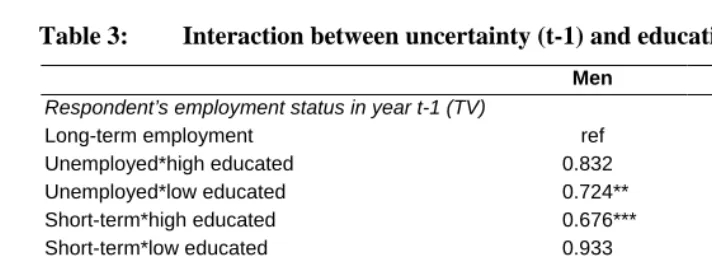
As Table 3 shows, highly educated women, assumed to be more career-oriented, do not behave differently from low educated women when they face unemployment. They do not postpone childbearing when they are unemployed, which does not validate our third hypothesis. However, highly educated women tend to delay transition to motherhood when they hold an insecure job. This is not the case for low educated women in the same situation, who might be discouraged workers. Hence, only the more career-oriented women in short term employment postpone their childbearing.
For men, the unemployment effect differs by educational level: being unemployed delays the first birth only for low educated men. There is no effect for more educated men.23 This result is not consistent with the lower income effect and lower career prospects for less educated men. However, for low educated men getting a job may be more important for gaining social status, this status effect being higher than the opportunity cost effect. With regard to short-term employment, highly educated men appear to be more cautious and wait longer before having a first child. For highly educated men, stable employment rather than short-term employment may be a way for them to assume their breadwinner role.
Table 3: Interaction between uncertainty (t-1) and education
Men Women
Respondent’s employment status in year t-1 (TV)
Long-term employment ref ref
Unemployed*high educated 0.832 0.891
Unemployed*low educated 0.724** 1.033
Short-term*high educated 0.676*** 0.696***
Short-term*low educated 0.933 0.941
Student 0.604*** 0.382***
Homemaker 2.169***
Education (ref= low educated)
High educated 0.881*** 0.925
TV= Time-varying
***, **, * significant at 1%, 5%, 10%
Controlled for type of union (time varying), belonging to a large family (number of siblings=2+), religiosity, age at first partnership, immigration status and birth cohort.
5.4 Aggregate unemployment reduces transition to parenthood
employment status remains. Thus, both micro and macro situations appear to interact with fertility decisions.
5.5 Completed fertility depends on the accumulation of uncertainty for men
Finally, we turn to our fifth hypothesis regarding the long-term implications of employment uncertainty. Figure 6 presents the total number of children by age 40 according to individual employment history, for men and women respectively. The distribution of men and women by their number of children is displayed for those who had never been unemployed since the start of their first partnership, for those who were unemployed between one year and 10% of years, and for those who were unemployed more than 10% of years. This figure suggests that for women the distribution by number of children is very similar, whatever their unemployment history. Hence, for women this result suggests that unemployment neither prevents nor encourages childbearing.
For men, on the other hand, the number of children varies a great deal with unemployment history. Men who have experienced several unemployment spells and have been jobless for more than one year out of ten are more than twice as likely to remain childless and less likely to have two children or more. Thus these descriptive statistics suggest that the probability of having children for men is lower when the number of unemployment spells increases.
Figure 5: Number of children by frequency of unemployment /short-term employment
Unemployment
0% 20% 40% 60% 80% 100%
never 0-10% >10% never 0-10% >10%
Men Women
0 1 2 3 4 and m ore
Short-term employment
0% 20% 40% 60% 80% 100%
never 0-10% >10% never 0-10% >10%
Men Women
0 1 2 3 4 and more
Source: EFE, INED, 2004-2005
Sample: Women and men born before 1965 having lived at least one partnership
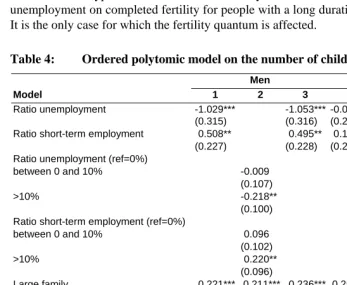
The multivariate analysis shows that, for men, these observed differences in the final number of children by degree of exposure to unemployment or short-term employment are not simply linked to structural characteristics, such as family background or level of education, which could be connected with the experience of insecure employment (Table 4). Indeed, the ratio of unemployment is significantly negative for men: the longer they have been unemployed, the fewer children they have at age 40 (specification 1, Table 4). Specification 2 shows that completed fertility is affected only for men who experience lasting unemployment over the life course (over 10% of time since union formation up to age 40). On the other hand, the ratio related to short-term employment is significantly positive, especially for those who experience short-term employment for several years (specification 2). Controlling for education, religiosity, immigrant status, and other family background, the longer the relative time in insecure employment, the higher the number of children. This result is rather puzzling since having experienced short-term employment was not significant in the timing of the first birth.24 Moreover, insecure employment was quite rare for the cohort born before 1964. Thus those who have experienced recurrent periods of insecure employment in this cohort are clearly highly selected. Descriptive statistics show that they are less educated, more likely to be manual workers and immigrants, and often entered their first union before age 20. To check whether this result is linked with a more general precariousness or poverty, we perform a third estimation including the social group as additional covariate (specification 3, Table 4). The social group was not significant; a quite standard result in France where there is little social segregation of fertility, and the coefficient for insecure employment remains significant.
Unfortunately, the dataset contains very little retrospective economic information to check this explanation further. For now we can explain this result by making two assumptions. First, having a large family may be a signal of social success that compensates for chronic difficulties in the labour market. Second, uncertainty in the labour market may be correlated with uncertainty in others fields of life, such as lower use of contraception, which might explain more unwanted births. For women, neither the ratio of unemployment nor the ratio of short-term employment is significant for the number of children reached at age 40. Thus having experienced unemployment and/or short-term employment is not likely to affect their completed fertility. This result holds for the cohorts born before 1964, for whom short-term employment was quite rare.
Our fifth hypothesis is validated, but only for men, i.e., there is an impact of unemployment on completed fertility for people with a long duration of unemployment. It is the only case for which the fertility quantum is affected.
Table 4: Ordered polytomic model on the number of children at age 40
Men Women
Model 1 2 3 1 2 3
Ratio unemployment -1.029*** -1.053*** -0.072 -0.014
(0.315) (0.316) (0.235) (0.237)
Ratio short-term employment 0.508** 0.495** 0.185 0.149
(0.227) (0.228) (0.208) (0.209)
Ratio unemployment (ref=0%)
between 0 and 10% -0.009 -0.051
(0.107) (0.079)
>10% -0.218** -0.023
(0.100) (0.072)
Ratio short-term employment (ref=0%)
between 0 and 10% 0.096 0.037
(0.102) (0.082)
>10% 0.220** 0.096
(0.096) (0.078)
Large family 0.221*** 0.211*** 0.236*** 0.252*** 0.255*** 0.266***
(0.065) (0.064) (0.065) (0.059) (0.059) (0.060)
Religiosity (ref=moderately important)
important 0.272*** 0.271*** 0.267*** 0.225*** 0.222*** 0.218***
(0.067) (0.066) (0.067) (0.056) (0.056) (0.057)
unimportant -0.202 -0.203 -0.209* -0.047 -0.043 -0.037
(0.125) (0.125) (0.126) (0.118) (0.118) (0.120)
Immigration status (ref=native)
Second generation 0.058 0.061 0.038 -0.142 -0.140 -0.148
(0.095) (0.095) (0.096) (0.096) (0.096) (0.097)
Immigrant 0.214** 0.166* 0.194* 0.374*** 0.375*** 0.324***
Table 4: (Continued)
Men Women
Model 1 2 3 1 2 3
Number of years of marital live 0.086*** 0.092*** 0.087*** 0.081*** 0.081*** 0.080***
(0.006) (0.006) (0.006) (0.006) (0.006) (0.006)
At least 2 partnerships (ref=1) -0.041 -0.040 -0.034 0.079 0.082 0.090
(0.069) (0.069) (0.069) (0.064) (0.065) (0.065)
Married 0.324*** 0.330*** 0.324*** 0.523*** 0.532*** 0.521***
(0.067) (0.067) (0.068) (0.080) (0.081) (0.081)
Education (ref=low)
high 0.217*** 0.219*** 0.265*** 0.099 0.094 0.106
(0.069) (0.069) (0.087) (0.067) (0.068) (0.086)
medium 0.105 0.093 0.146 0.102 0.097 0.112
(0.092) (0.092) (0.097) (0.073) (0.073) (0.077)
no qualifications 0.306*** 0.301*** 0.294*** 0.338*** 0.337*** 0.303***
(0.087) (0.087) (0.089) (0.075) (0.075) (0.077)
Socio-occupational category (ref= clerk)
Farmer/ self-employed -0.016 -0.006
(0.114) (0.120)
Higher-level occupation -0.058 -0.017
(0.119) (0.108)
Intermediate occupation -0.136 0.013
(0.103) (0.076)
Manual worker -0.009 0.004
(0.098) (0.087)
Always inactive 0.530***
(0.157)
Cut 1 0.439*** 0.547*** 0.422*** 0.514*** 0.532*** 0.523***
(0.121) (0.118) (0.143) (0.128) (0.127) (0.129)
Cut 2 1.280*** 1.375*** 1.264*** 1.441*** 1.457*** 1.447***
(0.123) (0.121) (0.145) (0.129) (0.129) (0.131)
Cut 3 2.463*** 2.557*** 2.449*** 2.723*** 2.739*** 2.730***
(0.129) (0.127) (0.151) (0.136) (0.136) (0.138)
Cut 4 3.488*** 3.584*** 3.479*** 3.693*** 3.710*** 3.702***
(0.139) (0.137) (0.159) (0.143) (0.143) (0.145)
Pseudo R2 0.08 0.07 0.07 0.09 0.08 0.09
Observations 1,533 1,533 1,512 1,771 1,771 1,747
6. Discussion and conclusion
One of the main aims of this paper was to examine gender differences in the effect of employment uncertainty on childbearing. The examination of fertility timing and completed fertility in France demonstrates that employment uncertainty affects timing rather than quantum, and matters in different ways for men and women.
Fertility is lower when men experience unemployment. Facing unemployment significantly influences the timing of first childbearing: men who were unemployed one year previously are likely to postpone the arrival of the first child. This result reflects the fact that, for men, it is important to get a job before becoming a father. However, being unemployed at partnership formation does not act on the timing of the first child. It thus seems that when partners have accepted an unstable employment situation and are thus prepared for it, childbearing timing is not affected, while unanticipated changes in economic circumstances do influence the birth of children. Moreover, menthatface persistent unemployment or an accumulation of periods of unemployment delay the transition to the first child for much longer than others. For the men who encountered persistent or recurrent unemployment, and only for them, quantum is likely to be reduced at the age of 40. Postponement generally has no persistent effect except for men with chaotic careers. However, one cannot exclude the possibility that such men also have unstable partnerships and that unobserved factors may explain their lower level of fertility.
limited value since the longer the time since union formation, the higher the likelihood of encountering unemployment.
This insignificant effect of unemployment for women holds true whatever their level of education. Contrary to what has been observed in Germany (Kreyenfeld 2005) or in Sweden (Hoem 2000), there is no heterogeneity of women, at least by educational level, regarding the impact of unemployment on fertility, which confirms previous results (Ekert et al. 2002).
Although women’s individual unemployment does not affect fertility, women seem to be highly sensitive to the general labour market situation, since women’s aggregate unemployment reduces transition to motherhood. This result also holds true for men, even though macro-level effects are more important for women. Thus women seem to be more sensitive to a pessimistic perception of future job prospects that may affect one or both partners, than to their current adverse personal situation. All women, and not only those who face unemployment, postpone fertility in bad times.
Precarious employment is clearly a different type of employment uncertainty Again, contrasting results are found for men and women. Such types of employment seem to have a low impact on the transition to fatherhood, except when men are affected by uncertainty over many years, which signals huge difficulties in entering the stable segment of the labour market. For women, on the other hand, insecure employment is more likely to influence fertility: being in short-term employment twelve months earlier leads to the postponement of motherhood, as does the accumulation of non-permanent contracts. This is particularly true for more educated women who have career expectations. Holding a permanent position before pregnancy guarantees that they can return to work after the birth of the child. It also allows them to accumulate enough work experience to claim parental leave benefits.
effects: women suffer the negative impact of childbearing on employment, and in terms of division of labour within the household.
Finally, the impact of employment insecurity on fertility seems to be rather low in France since it affects mainly the tempo, and only marginally the quantum. The postponement of the first birth caused by employment uncertainty appears to be recovered later. Several explanations of this finding may be advanced. First, the transition most sensitive to economic circumstances remains family formation, with the arrival of the first child. No effect is generally found for the second birth (Pailhé and Solaz 2010). In France, the two-child family is a strong social norm. The strong wish to give a brother or a sister to the first child may counter-balance the negative effect of employment uncertainty that may have delayed the first birth. Moreover, the couples are older and postponement of further children may appear riskier since fecundity decreases with age. More generally, in France those who have postponed the first child – such as the more educated or the youngest cohorts – accelerate the arrival of the second child to conform to this social norm of the two-child family. Second, public transfers may serve as a guarantee, since cash transfers to families increase significantly with the second child in France. People who are unemployed or in insecure employment may also feel more confident about the future when having children. Third, achieving parental status reduces the negative effect of unemployment. People are more likely to be better integrated in social networks when they are parents. Moreover, unemployed fathers may have better chances of finding a job, since being a father provides a positive signal to employers of an applicant’s commitment to work (François 1998). Last, in a life course perspective, the duration of exposure to unemployment is relatively short compared to that of childbearing, so people have enough time to catch up on their delay. Our results emphasise the need for indicators of both tempo and quantum, especially in a context of postponed and late fertility.
7. Acknowledgements
References
Adsera, A. (2004). Changing fertility rates in developed countries. The impact of labour market institutions. Journal of Population Economics 17(1): 17-43. doi:10.1007/ s00148-003-0166-x.
Adsera, A. (2005a). Vanishing children: From high unemployment to low fertility in developed countries. American Economic Review 95(2): 189-193. doi:10.1257/ 000282805774669763.
Adsera, A. (2005b). Where are the babies? Labour market conditions and fertility in Europe. Bonn: Institute for the Study of Labour (IZA DP 1576)
Ahn, N. and Mira, P. (2001). Job bust, baby bust? Evidence from Spain. Journal of Population Economics 14(3): 505-521. doi:10.1007/s001480100093.
Alibert, D., Bigot, R., and Foucaud, D. (2006). Les effets de l’instabilité professionnelle sur certaines attitudes et opinions des français depuis le début des années 1980..
Cahier de recherche 225. (CREDOC)
Andersson, G. (2000). The impact of labour-force participation on childbearing behaviour: Pro-cyclical fertility in Sweden during the 1980s and the 1990s.
European Journal of Population 16(4): 293-333. doi:10.1023/A: 1006454909642.
Becker, G.S. (1981). A Treatise on the Family. Cambridge, London: Harvard University Press.
Bhaumik, S.K. and Nugent, J.B. (2005). Does economic uncertainty affect the decision to bear children? Evidence from East and West Germany. Institute for the Study of Labor (IZA). (IZA Discussion Papers 1746).
Bloch, L. and Estrade, M.-A. (1999). Les formes particulières d’emploi en France: un marchepied vers les emplois stables? In: France, Portrait social 1998-1999.
Paris: INSEE.
Blossfeld, H.-P., Klijzing, E., Mills, M., and Kurz, K. (2005). Globalization, Uncertainty and Youth in Society. London, New York: Routledge Advances in Sociology Series.
Bongaarts, J. and Feeney, G. (1998). On the quantum and tempo of fertility. Population and Development Review 24(2): 271-291. doi:10.2307/2807974.
Bourguignon, D. and Herman, G. (2007). Le chômage analysé à la lumière de la stigmatisation. In: Herman, G. (ed.). Travail, chômage et stigmatisation. De Boeck Université.
Bunel, M. (2006). L'utilisation des modes de flexibilité par les établissements français.
Travail et Emploi 106: 7-24.
Caldwell, J. and Schindlmayr, T. (2003). Explanations of the fertility crisis in modern societies: A search for commonalities. Population Studies 57(3): 241‐263.
doi:10.1080/0032472032000137790.
Castel, R. (2009). La montée des incertitudes: Travail, protections, statut de l'individu. Paris: Ed. du Seuil.
Cox, D.R. (1972). Regression models and life tables. Journal of the Royal Statistical Society Series B 34(2): 187–220. http://en.wikipedia.org/wiki/JSTOR.
De la Rica, S. and Iza, A. (2005). Career planning in Spain: Do fixed-term contracts delay marriage and parenthood? Review of the Economics of the Household 3(1): 49-73. doi:10.1007/s11150-004-0979-8.
De Witte, H. (1999). Job insecurity and psychological well-being: Review of the literature and exploration of some unresolved issues. European Journal of Work and Organizational Psychology 8(2): 155-177. doi:10.1080/135943299398302.
Edin, K. and Kefalas, M. (2005). Promises I Can Keep: Why Poor Women Put Motherhood Before Marriage. University of California Press.
Ekert-Jaffé, O., Joshi, H., Lynch, K., Mougin, R., and Rendall, M. (2002). Fertility, timing of births and socio-economic status in France and Britain: Social policies and occupational polarization. Population - English edition 57(3): 475-507.
doi:10.2307/3246636.
Ekert-Jaffé, O. and Solaz, A. (2001). Unemployment, marriage and cohabitation in France. Journal of Socio-Economics 30(1): 75-98. doi:10.1016/S1053-5357(01)00088-9.
François, P. (1998). Gender discrimination without gender difference: Theory and policy responses. Journal of Public Economics 68(1): 1-32. doi:10.1016/S0047-2727(97)00061-3.
Freedman, D.S. and Thornton, A. (1982). Income and fertility: The elusive relationship.
Demography 19(1): 65-78. doi:10.2307/2061129.
Friedman, D., Hechter, M., and Kanazawa, S. (1994). A theory of the value of children.
Demography 31(3): 375-401. doi:10.2307/2061749.
Galor, O. and Weil, D.N. (1996). The gender gap, fertility, and growth. American Economic Review 86(3): 374-387.
Germe, J.-F., Montchatre, S., and Pottier, F. (2003). Les mobilités professionnelles: de l’instabilité dans l’emploi à la gestion des trajectoires. Paris: La documentation française.
Goffman, E. (1977). The arrangement between the sexes. Theory and Society 4(3): 301-331. doi:10.1007/BF00206983.
Hoem, B. (2000). Entry into motherhood in Sweden: The influence of economic factors on the rise and fall in fertility, 1986-1997. Demographic Research 2(4).
doi:10.4054/DemRes.2000.2.4.
Impens, K.K. (1989). The impact of female unemployment on fertility in Flanders. In: Cliquet, R.L., Dooghe, G., De Jong-Gierveld, J., and Van Poppel, F. (eds.).
Population and Family in Low Countries: 119-140 (VI, NIDI/CBGS Pubications nr. 18).
Kohler, H.-P., Billari, F., and Ortega, J. (2006). Low fertility in Europe: Causes, implications and policy options. In: Harris, F.R. (ed.). The Baby Bust: Who will do the Work? Who Will Pay the Taxes? Lanham, MD: Rowman & Littlefield Publishers: 48–109.
Kravdal, Ø. (1994).The importance of economic activity, economic potential and economic resources for the timing of first births in Norway. Population Studies
48(2): 249-267. doi:10.1080/0032472031000147786.
Kravdal, Ø. (2002).The impact of individual and aggregate unemployment on fertility in Norway. Demographic Research 6(10): 263-294. doi:10.4054/ DemRes.2002.6.10.