in the population sciences published by the Max Planck Institute for Demographic Research Konrad-Zuse Str. 1, D-18057 Rostock · GERMANY www.demographic-research.org
DEMOGRAPHIC RESEARCH
VOLUME 18, ARTICLE 16, PAGES 443-468
PUBLISHED 06 JUNE 2008
http://www.demographic-research.org/Volumes/Vol18/16/ DOI: 10.4054/DemRes.2008.18.16
Research Article
Not truly partnerless:
Non-residential partnerships and
retreat from marriage in Spain
Teresa Castro-Martín
Marta Domínguez-Folgueras
Teresa Martín-García
© 2008 Castro-Martín, Domínguez-Folgueras & Martín-García.
This open-access work is published under the terms of the Creative Commons Attribution NonCommercial License 2.0 Germany, which permits use, reproduction & distribution in any medium for non-commercial purposes, provided the original author(s) and source are given credit.
1 Introduction 444 2 Social context of union formation in Spain 447
3 Data and Methods 450
4 Analysis and findings 451
5 Discussion 461
6 Acknowledgements 464
Not truly partnerless:
Non-residential partnerships and retreat from marriage in Spain
Teresa Castro-Martín1 Marta Domínguez-Folgueras2
Teresa Martín-García3
Abstract
Nearly two-thirds of Spanish women aged 20-34 have not yet entered their first union. However, almost half of them have a stable partner living in a different household. Hence, the drop in marriage rates and low prevalence of cohabitation cannot be rightly interpreted as a decline in partnership formation, but rather as a postponement of co-residential unions. This article examines the prevalence and determinants of non-residential stable partnerships among women aged 20-34, in relation to cohabitation and marriage, using a multinomial logit model of current partnership type. The analysis is based on data from the 1999 Spanish Fertility Survey. We find that women’s high educational attainment and their partner’s work instability deter co-residential partnerships.
1 Institute of Economics, Geography and Demography, CSIC, Madrid. E-mail: [email protected]. 2 Dpt. of Political and Social Sciences, Universitat Pompeu Fabra, Barcelona.
E-mail: [email protected].
1. Introduction
In recent decades, Spain has witnessed significant changes in nuptiality patterns (Billari et al. 2002). A steady trend toward fewer and later marriages has been manifest since the early 1980s and in 2005 the mean age at first marriage was 29.4 for women and 31.5 for men, well above the EU-25 average. In an increasing number of societies, marriage has been gradually replaced by cohabitation as the initial stage of family formation, and marrying without prior cohabitation has become exceptional behavior in young adults’ lives (Bumpass and Lu 2000, Kiernan 2002). Yet one of the major differences between Spain and other latest-late marriage societies is that the postponement of marriage has not been offset by a parallel increase in cohabitation. Whereas in Northern Europe first union formation occurs significantly earlier than reflected in marriage statistics, in Spain late union formation is the norm, not only due to the relatively low diffusion of cohabitation but also because the age pattern of entry into cohabitation is only slightly younger than that of entry into marriage (Castro Martín 1999). Consequently, the percentage of women aged 20-34 who have not yet entered their first union is among the highest in Europe: 62.2% according to the 2001 Census (Figure 1).
Although non-marital fertility is no longer marginal –the proportion of non-marital births increased from 11% in 1995 to 27% in 2005–, the late pattern of union formation is linked to a late pattern of childbearing (Spanish women have one of the latest ages at first birth in the world: 29.3) and lowest-low fertility. Other features that characterize the transition to adulthood in Spain are the late departure from the parental home, the low incidence of independent living before union formation and the high synchronization between leaving the parental household, union formation and first birth (Baizán et al. 2003).
Figure 1: Percent distribution of women aged 20-34 by union status in Europe, according to the 2000 round of Census
63.8 62.2 61.1 59.0 58.0 57.2 54.6 52.3 52.3 51.9 51.0 46.8 46.7 46.3 45.3 44.7 44.1 43.7 43.5 43.4 42.5 40.8 39.8 38.4 38.1 37.4 34.3
0% 10% 20% 30% 40% 50% 60% 70% 80% 90% 100%
Latvia SPAIN Ireland Slovakia Slovenia Italy Austria Czech Rep. Poland Iceland Greece Estonia United Kingdom Norway Portugal Belgium Switzerland Lithuania Hungary Germany France Finland Cyprus Netherlands Denmark Bulgaria Romania % cohabiting % married
% not in union
A number of different terms have been used to allude to non-cohabiting relationships, but the term which has gained increasing acceptance in the sociological and demographic literature is “living-apart-together” or “LAT” relationships (Levin and Trost 1999). Haskey (2005) defines them as relationships between partners who live at different addresses but who regard themselves as a couple and are recognized as such by friends and relatives. There is also the understanding that, as cohabitation, LAT relationships are monogamous in nature and imply higher commitment and stability than casual relationships. In this paper, we will use indistinctly the terms LAT relationships and non-residential partnerships, and use the term union to refer to marriage or cohabitation.
maintained a stable relationship with a partner who had his own separate address. Therefore, a considerable proportion of women outside union are not actually partnerless. This study examines the prevalence and the determinants of being in a non-residential partnership, particularly among young adults, in relation to cohabitation and marriage. By focusing on stable couples who do not live together or have legal ties, we expect to provide some insights into the late pattern of marriage and an understanding of why the high acceptability of cohabitation reflected in major opinion surveys has not yet been translated into behavior.
Prior research has shown that non-residential partnerships are not just a phenomenon of youth. In Northern and Central Europe, they often take a thought-out, strategic and negotiated form (Levin 2004, Roseneil 2006). Being responsible for the care of other persons (such as children or an aging parent) is a frequent reason why adult couples choose not to move in together. In Spain, however, non-residential partnerships are only prevalent amongst younger adults. Less than 2% of women aged 35 to 49 have a stable partner living apart. For this reason, we will focus the analysis on women aged 20 to 34.
2. Social context of union formation in Spain
Early views of the second demographic transition assumed that the decline of fertility would go hand in hand with the pluralization of family forms (van de Kaa 1987). However, the emergence of lowest-low fertility in the early 1990s in Southern Europe, the region with less diversified family forms, questioned the initial assumption of convergence (Billari and Wilson 2001), led to a re-evaluation of the main theories of fertility (Kertzer et al. 2006), and strengthened the view of path dependency (Blossfeld 2003). In order to explain the “paradox” of lowest-low fertility coexisting with traditional family patterns in Southern Europe (Dalla Zuanna and Micheli 2004), some scholars have emphasized socioeconomic barriers to union formation, such as high youth unemployment (Ahn and Mira 2001), increasing uncertainty linked to unstable job positions (Simó et al. 2005), and tight housing markets (Holdsworth and Irazoqui 2002). Other scholars have focused on the institutional barriers to union formation, such as the familism embedded in the welfare system –which presumes that the family is primarily responsible for the well-being of its members–, and the lack of specific public policies directed at young adults, which reinforce their dependency on the family (Esping-Andersen 1999, Jurado Guerrero and Naldini 1996).
Another key element in the Mediterranean model of family formation is the strength of intergenerational ties, assumed to be rooted in the collective culture (Reher 1998). Strong family ties are manifest in multiple life spheres, such as the prolonged permanence in the parental home (Moreno 2003), the support from the parental family to set up a new household and buy a house, the high residential proximity afterwards, and the continuous contact, economic support and care transfers throughout the life course (Tomassini et al. 2003). In this context of strong family ties, parents’ traditional values have been hypothesized to account for the low diffusion of cohabitation (Di Giulio and Rosina 2007). Young adults, in spite of favoring cohabitation, would refrain from cohabiting in order to avoid confrontation with their parents, whose financial assistance is often needed in order to achieve residential independence (Rosina and Fraboni 2004, Schröder 2005).
Before examining the share of residential and non-residential partnerships among young adults, we shall briefly review recent social trends in Spain, focusing on some of the key factors that have been documented as underlying the broad changes in union formation and nest-leaving patterns: women’s economic independence (Bracher and Santow 1998), economic uncertainty (Blossfeld et al. 2005) and value change (Surkyn and Lesthaeghe 2004).
As regards women’s position in society, educational advancement of the female population has been notable in Spain since the second half of the 20th century (Coppola 2004, González 2000). For younger generations, access to University is no longer restricted to the upper social classes, and women have surpassed men in tertiary education enrolment since the mid-1990s. According to the 2001 Census, the proportion of college graduates among females of 25 to 34 years old was 29.1%, and this represents a remarkable advancement compared with the past –less than 4% of women born in the 1930s had access to college education.
With the improvement of education and corresponding earnings potential, women’s working aspirations and actual attachment to the labor force have changed dramatically. Aggregate indicators usually employed to illustrate the gap between Northern and Southern Europe regarding women’s social and economic position are often misleading, because they do not take into account the large differences existing between younger and older cohorts. In 2005, 77.2% of Spanish women aged 25-34 were economically active, a proportion that is slightly above the EU-25 average for this age group (75.7%).
Despite considerable progress, it should be noted that women’s unemployment rates have been persistently high. The overall unemployment rate averaged 20% in Spain in the period 1985-1998, a rate more than double the EU average. This very high level of unemployment was not evenly distributed, but largely concentrated among young adults and women. Unemployment has declined markedly in recent years and is currently around 9%, but considerable gender and age differentials still persist: in 2005, 12.2% of women compared to 7% of men were unemployed in Spain, and the corresponding rates among women and men aged 20-24 were 20.4% and 14.3%. A special module of the 2000 Labor Force Survey focusing on the transition from the education system to the labor market revealed that it took, on average, 28.6 months for young adults to get their first job after exiting the school system. The lower the educational level achieved, the longer the interval to enter the job market; however, even for college graduates, the average waiting time to get a first job was 23.2 months.
(Golsch 2003). Temporary employment increased from 10% of the salaried labor force in 1985 to 33.3% in 2005, the highest rate in the EU, and is highly concentrated among young adults. In 2005, 64% of workers aged 20 to 24 and 46% of workers aged 25 to 29 held a short-term contract.
In addition to the instability of working conditions among young adults, housing is perceived as one of the main problems in Spain, according to many opinion surveys (CIS 2005). Having access to a house, be it owned, rented or paid by the parents, is a
sine qua non requirement for independent household formation, and it is rendered
difficult by the characteristics of the Spanish housing market, namely high prices,4 few
housing allowances, scarce social housing, and a limited supply of private rental housing –12% of all dwellings, according to the 2001 Census. Housing markets differ across regions but, on average, young people were estimated to spend 55.2% of their salary in order to pay for a dwelling in 2005; 37.8% if it was a couple (OJV 2005). Difficulties in access to housing underlie the prevailing late pattern of leaving the parental home (Fernández Cordón 1997). According to the 2001 Census, 50% of Spaniards aged 28 and 35% of those aged 30 still lived with their parents.
Social transformations have occurred parallel to broad ideational changes. In many comparative studies, Spain is usually classified as a “traditional” society in terms of values, due in part to its Catholic inheritance. And this was certainly so in the past, but the Catholic Church has lost its traditional power of shaping family-related legislation in Spain –as reflected in the bill passed in 2005 by the Spanish Parliament that enables same-sex marriages–, although it retains considerable influence on the education system and social habits. Recent public opinion surveys reveal that secularization and acceptance of new family forms are now widespread. Nevertheless, preferences concerning living arrangements, collected by the 2004 Spanish Survey on Opinions and Attitudes towards Family (Table 1), reveal a wide intergenerational gap: 48.1% of
respondents aged 18 to 29 mentioned cohabitation as their ideal living arrangement compared to 6.1% of respondents older than 50, confirming that the centrality of marriage has eroded among young cohorts. However, less than 4% of respondents chose a LAT relationship as their ideal living arrangement, and this proportion did not change significantly across age groups. These data suggest that most individuals consider non-residential partnerships as a transitional state in the process of “going steady” rather than a permanent state or the outcome of a deliberate decision not to ever cohabit or marry.
Table 1: Preferences regarding living arrangements, by age group
18-29 30-39 40-49 50+
Regardless of your actual situation, which living arrangement would you prefer?
Live alone 11.7 7.6 5.6 8.5
LAT 3.2 3.4 2.5 1.1
Cohabitation with no intention to marry 28.4 14.8 8.6 2.7 Cohabitation with intention to marry 19.7 8.2 6.6 3.4 Marriage 24.8 62.1 71.5 79.8 Other 12.1 3.8 5.3 4.5
N 588 499 396 1001
Source: Survey on Opinions and Attitudes Towards Family (CIS, 2004). Study No. 2578.
In sum, we have described a context of rapid advancements towards gender equality and more tolerant family values; however, for the younger cohorts, labor force participation does not guarantee economic self-sufficiency, because of low salaries, precarious work contracts, and tight housing markets, which reinforce prolonged dependence on the parental family and deter engagement in long-term commitments, such as forming a co-residential partnership.
3. Data and Methods
In order to explore the prevalence of LAT relationships in Spain, we use data from the 1999 Fertility Survey, conducted by the National Statistics Institute, with a nationally representative sample of 7,740 women aged 15-49. The information collected allows the construction of a four-category partnership status variable: no stable partner, stable partner living apart, cohabiting, and married.5 The definition of stable partnership relies on two criteria: first, upon women’s own assessment of their degree of involvement in the corresponding relationship, and second, on the duration of the relationship. We consider LAT relationships only those romantic partnerships that have lasted for more than two years in order to focus on couples most likely to contemplate moving in together and discard less committed relationships.6
5 Although the survey included a question on the gender of women’s partners, all respondents declared to have male partners; hence, the data available refer only to heterosexual partnerships.
First, we perform a descriptive analysis to ascertain the prevalence of non-residential partnerships as well as their socio-demographic profile, household composition, and intentions to cohabit or marry, focusing on women aged 20 to 34. Next, we conduct a multinomial logit analysis of current partnership type, in order to estimate simultaneously the odds of not having a stable partner, being in a LAT relationship, cohabiting or married. We focus primarily on the effects of educational attainment –a proxy for earnings potential, modern values and higher demands for gender equality within partnerships– and labor force status –an indicator of socioeconomic resources and the degree of (un)certainty about the future– on partnership status. We expect unemployment and temporary work contracts to deter the formation of co-residential unions. On the basis of previous research on union formation (Castro Martín and Domínguez 2006), we include the following covariates as controls: age, religious practice and size of place of residence. In order to take into account the influence of partner’s characteristics, we also perform a multinomial logit analysis on current partnership type confined to partnered women.
We are aware of the fact that being in a LAT relationship is often a transitional state that is likely to be transformed into marriage or cohabitation, or be dissolved. An event history analysis would be more adequate to study partnership dynamics. Unfortunately, although the 1999 Fertility Survey provides some retrospective information, it only allows us to identify partnership type for current partnerships. Hence, our cross-sectional analysis should be taken as a first exploratory step in explaining the delay in union formation in Spain and an attempt to go beyond the conventional tripartite classification of single/cohabiting/married.
4. Analysis and findings
As mentioned above, Spain has one the highest proportion of women aged 20-34 who have not entered a first union in Europe. Although cohabitation is no longer marginal (Domínguez-Folgueras et al. 2007), it remains low from a comparative viewpoint and has not compensated the downward trend in marriage. Nonetheless, women out of union should not be assumed to be partnerless. Figure 2 presents the distribution of women by partnership status for successive age groups, according to the 1999 Fertility Survey. We can observe that the proportion of women who have a stable partner living apart is relatively high for the age group 20-24 (30.9%) and the age group 25-29 (23%); consequently, this partnership type should not be socially or statistically overlooked. In
_____________________________________
fact, more than one-third of the women aged 20 to 29 out of union do have a stable relationship that has lasted at least two years. Although the prevalence of LAT relationships diminishes sharply after that age,7 the proportion of women in the age
group 30-34 with a stable partner living apart (4.6%) is very close to the proportion of women cohabiting (5.7%), and approximately one-fourth of the women in their early thirties who are neither married nor cohabiting have a steady partnership of at least a two-year duration.
Figure 2: Distribution of women aged 15-49 by partnership type
10 .5
7 .3 3 0 .9
2 3 .0 4 .6
5 .4
13 .3 14 .5
6 .0 5 .7
6 .5 1.8
0 20 40 60 80 100
Total 15-19 20-24 25-29 30-34 35-39 40-44 45-49
%
stable partner < 2 yrs
stable partner 2+ yrs
cohabiting
married
Source: 1999 Fertility Survey.
The young age profile of LAT partnerships in Spain suggests that this type of arrangement may be mainly viewed as part of the “going steady” process, possibly leading to marriage or cohabitation. In many Western countries, LAT relationships also include more permanent living arrangements that stand as an alternative to (re)marriage or cohabitation among older adults, particularly for separated and divorced persons (Levin 2004). But the low proportion of LAT relationships among women aged 35 to 49 in Spain (less than 2%) suggests that this type of relationship is better characterized
as a prelude than as an alternative to marriage or cohabitation. The comparatively low rates of separation and divorce in Spain might be part of the explanation.
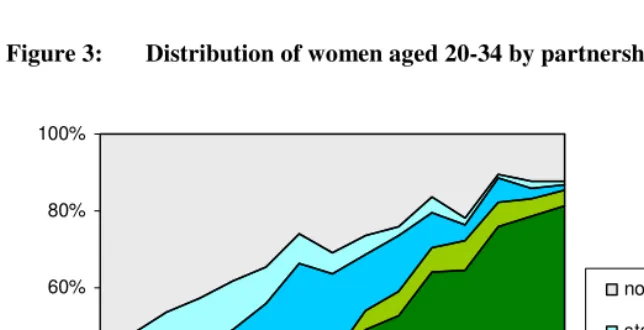
If we focus on women aged 20 to 34 (Figure 3), we observe that the prevalence of living apart stable relationships diminishes steadily with age, parallel to the increase in marriage and the decrease in unpartnered women. This graph suggests that women in their early twenties tend to favor non-residential partnerships over co-residential partnerships, although this pattern reverses at later ages. Once we include living apart relationships within the category of partnerships, the high proportion of young women out of union acquires a different meaning, since only half of them are actually partnerless.
Figure 3: Distribution of women aged 20-34 by partnership status
0% 20% 40% 60% 80% 100%
20 21 22 23 24 25 26 27 28 29 30 31 32 33 34
no stable partner
stable partner < 2 yrs
stable partner 2+ yrs
cohabiting
married
Source: 1999 Fertility Survey.
intending to marry within the next two years is somewhat lower (42%). However, a relatively high proportion of women declare to have no intention of forming a co-residential union (29.1%) or are unsure about it (22.4%). This could be because they feel too young to set up a joint household, have some doubts about the solidity of the relationship or have some external constraints. The fact that 91.7% of women responded that they intend to have children in the future suggests that childbearing aspirations are not necessarily linked to plans of union formation.
Table 2: Reported intentions of family formation among women aged 20-34 in non-residential partnerships with at least a two-year duration
Yes No Don't know
Intention to live together in the next 2 years 48.5 29.1 22.4
Intention to marry in the next 2 years 42.0 37.7 20.3
Intention to have children in the future 91.7 8.3
Source: 1999 Fertility Survey
Figure 4: Living arrangements of women aged 20-34 in a non-residential partnership
96.2 90.6 75.8
14.3
0 20 40 60 80 100
20-24 25-29 30-34
% other
with parent/s living alone
Source: 1999 Fertility Survey
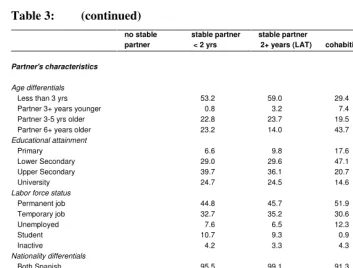
Cross-sectional data entail important limitations for describing partnership states of relatively short duration, such as living-apart-together, or for studying partnership dynamics in general. However, the comparison of the socio-demographic characteristics of those women currently with no stable partner, those with a short stable partnership and a long stable partnership, and those cohabiting and married may give us some insight into the factors associated with the delay of co-residential union formation. Table 3 presents the profile of women aged 20 to 34 in these partnership categories.
LAT relationships are less likely to have a permanent job and more likely to have a temporary job than their cohabiting and married counterparts, but the major difference is their low rate of economic inactivity compared to married women.
Table 3 also presents the socio-demographic profile of male partners in LAT relationships, cohabiting unions and marriages. The data indicate that age differentials are lower among couples that live apart than among cohabiting or married couples, and that living apart partners are better educated than cohabiting or married partners. Even though the figures are significantly lower than for women, a considerable proportion of men in LAT relationships are still enrolled in education and their temporary employment rates are higher than those of their cohabiting and married counterparts.
Table 3: Socio-demographic profile of women aged 20-34 by partnership status
no stable partner
stable partner < 2 yrs
stable partner
2+ years (LAT) cohabiting married
Marital Status
Never married 94.5 95.4 99.3 83.4
Previously married 5.5 4.6 0.7 16.6
Total number of partnerships
0 76.7
1 16.2 76.4 89.4 68.3 95.7
2+ 7.0 23.6 10.6 31.7 4.3
Children
Childless 92.2 94.4 98.3 49.9 19.6
With child(ren) 7.8 5.6 1.7 50.1 80.4
Educational attainment
Primary 7.4 4.6 5.2 15.7 19.8
Lower Secondary 25.4 29.4 25.1 42.1 42.7
Upper Secondary 42.7 47.1 44.7 30.2 22.2
University 24.5 18.9 24.9 12.0 15.3
Labor force status
Permanent job 26.2 25.8 25.4 28.9 30.5
Temporary job 26.8 29.7 27.3 21.4 14.7
Unemployed 16.2 12.5 19.5 18.9 10.6
Student 25.9 26.0 23.7 3.6 1.4
Inactive 4.9 6.0 4.1 27.3 42.9
Religiosity
Practicing 27.9 27.2 31.0 10.3 33.5
Non-practicing 72.1 72.8 69.0 89.7 66.5
Town of residence size
500000+ 21.9 21.2 20.3 15.3 12.3
50001-500000 38.8 40.6 39.4 35.1 30.8
10001-50000 19.4 22.3 21.6 30.1 29.6
Table 3: (continued)
no stable partner
stable partner < 2 yrs
stable partner
2+ years (LAT) cohabiting married
Partner's characteristics
Age differentials
Less than 3 yrs 53.2 59.0 29.4 46.3
Partner 3+ years younger 0.8 3.2 7.4 2.7
Partner 3-5 yrs older 22.8 23.7 19.5 23.0
Partner 6+ years older 23.2 14.0 43.7 28.0
Educational attainment
Primary 6.6 9.8 17.6 20.3
Lower Secondary 29.0 29.6 47.1 44.2
Upper Secondary 39.7 36.1 20.7 23.4
University 24.7 24.5 14.6 12.1
Labor force status
Permanent job 44.8 45.7 51.9 65.9
Temporary job 32.7 35.2 30.6 25.3
Unemployed 7.6 6.5 12.3 6.7
Student 10.7 9.3 0.9 0.0
Inactive 4.2 3.3 4.3 2.1
Nationality differentials
Both Spanish 95.5 99.1 91.3 97.1
At least one foreigner 4.5 0.9 8.7 2.9
Religiosity differentials
Both practicing 15.7 20.0 5.6 26.4
One non-practicing 17.4 13.5 5.1 8.0
Both non-practicing 66.8 66.5 89.3 65.5
N 935 217 565 194 1590
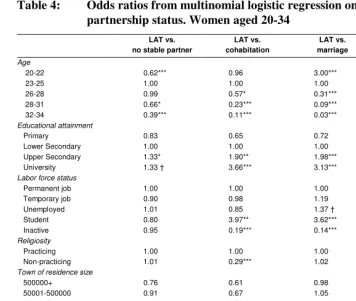
Table 4: Odds ratios from multinomial logistic regression on current partnership status. Women aged 20-34
LAT vs. no stable partner
LAT vs. cohabitation
LAT vs. marriage
LAT vs. any union
Age
20-22 0.62*** 0.96 3.00*** 1.97**
23-25 1.00 1.00 1.00 1.00
26-28 0.99 0.57* 0.31*** 0.35***
28-31 0.66* 0.23*** 0.09*** 0.11***
32-34 0.39*** 0.11*** 0.03*** 0.03***
Educational attainment
Primary 0.83 0.65 0.72 0.71
Lower Secondary 1.00 1.00 1.00 1.00
Upper Secondary 1.33* 1.90** 1.98*** 1.96***
University 1.33 † 3.66*** 3.13*** 3.19***
Labor force status
Permanent job 1.00 1.00 1.00 1.00
Temporary job 0.90 0.98 1.19 1.15
Unemployed 1.01 0.85 1.37 † 1.25
Student 0.80 3.97** 3.62*** 3.72***
Inactive 0.95 0.19*** 0.14*** 0.15***
Religiosity
Practicing 1.00 1.00 1.00 1.00
Non-practicing 1.01 0.29*** 1.02 0.88
Town of residence size
500000+ 0.76 0.61 0.98 0.92
50001-500000 0.91 0.67 1.05 0.98
10001-50000 0.98 0.56 † 0.69 † 0.68*
<10000 1.00 1.00 1.00 1.00
-2 log likelihood 6212.286 5131.529
Pseudo R2 (Nagelkerke) 0.488 0.483
N 3501 3501
† p<.10, * p<.05, ** p<.01, *** p<.001
Note: LAT refers to stable partnerships with at least a two-year duration.
As expected, age has a monotonic negative effect on the odds of being in a non-residential partnership, suggesting that it represents a transitional rather than a long-term state. As women age, the likelihood of being in a co-residential union increases significantly, although the odds of having no steady partner relative to having a stable non-residential partner are also higher among older than younger women.
the odds of having no steady partner among college graduates are somewhat lower than among women with lower levels of education. These effects suggest that highly educated women tend to postpone their entry into a co-residential union, although they are more likely to be involved in a stable relationship than less educated women. Even though they possibly have more financial resources to set up a household, they probably prioritize the consolidation of their professional career above family life and, consequently, defer marriage or cohabitation even when they have found a suitable partner.
Contrary to our expectations, women with unstable jobs or searching for a job are not significantly more likely to be in a non-residential partnership than cohabiting or married, compared to women with permanent jobs, once we control for age. Given the strong norms of incompatibility between student and spouse roles and the high level of economic dependency of students on their parents, it is no surprise to observe that women still enrolled in the education system are much more likely to have a non-residential partner than women with a stable job. In contrast, women who are economically inactive are much more likely to be in a residential conjugal union – primarily marriage– than to have a stable partner living apart, but this relationship may reflect reverse causation.
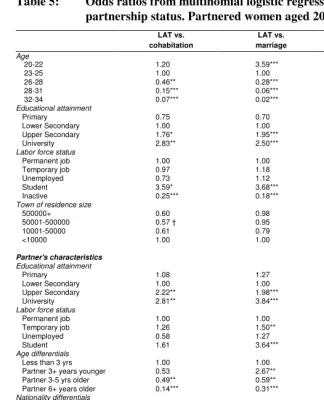
Table 5: Odds ratios from multinomial logistic regression on current partnership status. Partnered women aged 20-34
LAT vs. cohabitation LAT vs. marriage LAT vs. any union Age
20-22 1.20 3.59*** 2.39***
23-25 1.00 1.00 1.00
26-28 0.46** 0.28*** 0.30***
28-31 0.15*** 0.06*** 0.07***
32-34 0.07*** 0.02*** 0.02***
Educational attainment
Primary 0.75 0.70 0.73
Lower Secondary 1.00 1.00 1.00
Upper Secondary 1.76* 1.95*** 1.89***
University 2.83** 2.50*** 2.54***
Labor force status
Permanent job 1.00 1.00 1.00
Temporary job 0.97 1.18 1.14
Unemployed 0.73 1.12 1.03
Student 3.59* 3.68*** 3.75***
Inactive 0.25*** 0.18*** 0.19***
Town of residence size
500000+ 0.60 0.98 0.92
50001-500000 0.57 † 0.95 0.87
10001-50000 0.61 0.79 0.76
<10000 1.00 1.00 1.00
Partner's characteristics
Educational attainment
Primary 1.08 1.27 1.24
Lower Secondary 1.00 1.00 1.00
Upper Secondary 2.22** 1.98*** 2.02***
University 2.81** 3.84*** 3.68***
Labor force status
Permanent job 1.00 1.00 1.00
Temporary job 1.26 1.50** 1.47
Unemployed 0.58 1.27 1.05
Student 1.61 3.64*** 2.97
Age differentials
Less than 3 yrs 1.00 1.00 1.00
Partner 3+ years younger 0.53 2.67** 1.94 †
Partner 3-5 yrs older 0.49** 0.59** 0.59**
Partner 6+ years older 0.14*** 0.31*** 0.26***
Nationality differentials
Both Spanish 1.00 1.00 1.00
At least one foreigner 0.09*** 0.21*** 0.14***
Religiosity differentials
Both practicing 1.00 1.00 1.00
One non-practicing 0.22*** 1.33 1.07
Both non-practicing 0.79 2.99*** 2.60***
-2 log likelihood 2399.595 1381.150
Pseudo R2 (Nagelkerke) 0.565 0.603
N 2349 2349
† p<.10, * p<.05, ** p<.01, *** p<.001
In order to take into account the influence of partners’ characteristics on partnership type, Table 5 presents the results of a multinomial logistic analysis confined to partnered women aged 20 to 34. The effects of women’s covariates in this model are similar to the effects described in the preceding model: having a non-residential partner is more common among younger and better-educated women, as well as among students. Regarding partner’s characteristics, the model shows that the influence of men’s age and education is analogous to women’s. Women with an older partner are more likely to be in a co-residential union and, conversely, women with a highly educated partner are more likely to live apart. Male student status also deters co-residence. On the other hand, whereas we did not find a significant effect of women’s unstable work on partnership status, this model reveals that men’s job instability does influence partnership type. Women whose partner has a temporary job contract are more likely to be in a non-residential partnership than married, although no significant differences are found relative to cohabitation. This result suggests that although the traditional male breadwinner family model has been substantially eroded in Spain and both partners’ employment has become a prerequisite for union formation, men’s job stability still has more weight in the decision to set up a joint household than women’s working conditions. Regarding other partner’s differentials, the model shows that mixed couples in terms of nationality are more likely to be in a co-residential union and that both partners’ low religiosity deters marriage but not cohabitation.
5. Discussion
In contrast with many other societies, the retreat from marriage in Spain, evidenced by the late mean age at first marriage and the decreasing proportions married by age, has not been compensated by a corresponding increase in cohabiting unions. Cohabitation is no longer marginal among young cohorts, but its incidence is still low from an international comparative perspective and the timing of entry into cohabitation does not differ considerably from the timing of entry into marriage. Non-marital fertility has increased in recent years, but the postponement of union formation is still one of the main contributing factors to the late onset of childbearing and the low level of fertility. In this context of latest-late marriage and lowest-low fertility, partnership behavior is attracting increasing attention from scholars.
than two years. Hence, the drop in marriage rates and the low prevalence of cohabitation cannot be rightly interpreted as a decline in the propensity to form partnerships, but rather as a postponement in the formation of co-residential unions to later in the life span.
Nonetheless, the prevailing nature of LAT relationships in Spain is not that of a voluntarily assumed option for couples who do not want to share a household, as illustrated by its low prevalence among women aged 35 to 49 (less than 2%) or among previously married women. LAT relationships in Spain are better depicted as a late stage in the courtship process: most women who have a stable partner living elsewhere are young, never-married, childless, and are still living at their parent’s home; moreover, one-fourth of them are still enrolled in education. The analysis shows that, as women age, the likelihood of being in a non-residential partnership relative to cohabiting or being married diminishes significantly, suggesting that living apart partnerships can be better characterized as a transitional stage in the continuum of relationship commitment than as a long-term living arrangement.
We have also argued that the large share of LAT relationships relative to cohabiting unions among young adults is not linked to traditional values –since secularization and broad acceptance of new family forms are currently widespread among youths– but to social constraints. Previous studies have shown that the preconditions for marriage (having a stable job and a place to live) apply for cohabitation as well, and that youth unemployment, increased uncertainty in work trajectories, difficult access to housing and a lack of public policies aimed at facilitating youth transition to adulthood act as structural barriers to union formation, whether via marriage or cohabitation. In this regard, the high proportion of women aged 25 to 29 – the peak ages of cohabitation in many European countries– who have a stable partner living apart (23%) compared to those cohabiting (6.5%) probably reflects the difficulties faced by young adults in reaching economic and residential independence rather than compliance with traditional family values.
Our results show that educational attainment –both women’s and their partners’– has a strong positive effect on being in a non-residential versus a residential partnership. Although highly educated women presumably have more financial resources, they might also have higher standards to set up a household, in terms of house ownership and disposable income. Moreover, given the high opportunity cost involved in balancing family and work responsibilities in Spain, better educated women with stable partners may prefer to consolidate their career before entering a co-residential union.
jobs, once we controlled for age. It is men’s work instability what influences partnership status. That is to say, women whose partner has a temporary job contract are more likely to be in a non-residential living arrangement. Despite the rapid advancements towards gender equality, this result suggests that women’s employment conditions are not as relevant as their partners’ when it comes to setting up a joint household.
In brief, this paper has drawn attention to the fact that non-residential partnerships are widespread in Spain, a society with a late pattern of marriage and low incidence of cohabitation. The young age profile of LAT partnerships suggests that this type of arrangement should be primarily regarded as a stage of the courtship process, possibly leading to marriage or cohabitation, rather than as an alternative family form. One of the features that differentiate LAT relationships among young adults in Spain from other European countries is that partners usually remain at their respective parents’ home. The lack of specific public policies aimed at youths, low wages and precarious work contracts, as well as tight housing markets, reinforce young adults’ dependency on the family of origin and, consequently, delay their transition to living alone, with peers or with a partner.
We have no direct information on the seriousness, commitment, or likely permanence of living apart relationships, even though we have selected only those with at least a two-year duration. Longitudinal data would be desirable and necessary for examining the life trajectories of couples living apart as they progress (or not) to cohabitation or marriage. Tracking the various transitions along the commitment continuum of intimate relationships would help us to understand the continuing retreat from marriage. But such data, to our knowledge, are unavailable. As a starting point, however, cross-sectional data have given us some insights into the factors that increase the likelihood of being in a non-residential partnership.
In addition, women’s higher educational levels, more globalized labor markets, and increasing care demands from ageing parents may all contribute to a wider prevalence of non-residential partnerships in the near future. The traditional male breadwinner model is giving way to a dual-earner model in which an increasing number of working women have their own career and are less able to follow their partners in case of reallocation, as occurred in the past. More gender equality in contemporary societies may explain, to a certain degree, why some couples will choose LAT relationships as living arrangements in order to guarantee both partners’ careers, at least provisionally. In sum, living apart relationships may become a common early career stage strategy and their prevalence will probably increase as marriage looses its centrality in structuring young adults’ life course and as the diversity and flexibility of intimate relationships and lifestyle options expand.The growing variety of partnership arrangements calls for longitudinal data collection that spreads beyond the focus of co-residence.
6. Acknowledgements
References
Ahn, Namkee and Mira, Pedro (2001). Job bust, baby bust? Evidence from Spain.
Journal of Population Economics 14(3): 505-521.
Baizán Muñoz, Pau, Aassve, Arnstein and Billari, Francesco C. (2003). Cohabitation, marriage, and first birth: The interrelationship of family formation events in Spain. European Journal of Population 19(2): 147-169.
Bernardi, Fabrizio and Poggio, Teresio (2002). Propiedad de la vivienda y desigualdad social en Italia. Paper presented at Primeras Jornadas del Comité de
Investigación sobre Estratificación Social (CIES) de la Federación Española de Sociología, Facultad de Educación de la Universidad Complutense, Madrid, December 12-14, 2002.
Billari, Francesco C., Castiglioni, Maria, Castro Martin, Teresa, Michielin, Francesca, and Ongaro, Fausta (2002). Household and union formation in a mediterranean fashion: Italy and Spain. In: Klijzing, Erik and Corijn, Martine (eds.). Dynamics of fertility and partnership in Europe: Insights and lessons from comparative research. 2. New York: United Nations: 17-41.
Billari, Francesco C. and Wilson, Chris (2001). Convergence towards diversity? Cohort dynamics in the transition to adulthood in contemporary Western Europe. MPIDR working paper, WP-2001-039. http://www.demogr.mpg.de/Papers/ Working/WP-2001-039.pdf
Blossfeld, Hans-Peter (2003). Globalization, social inequality and the role of country-specific institutions. In: Conceição, Pedro, Heitor, Manuel V., and Lundvall,
Bengt-Åke (eds.). Innovation, competence building, and social cohesion in
Europe: Towards a learning society. Cheltenham, UK: Edward Elgar: 303-324.
Blossfeld, Hans-Peter, Klijzing, Erik, Mills, Melinda, and Kurz, Karin (eds.) (2005).
Globalization, uncertainty and youth in society. London: Routledge.
Bracher, Michael and Santow, Gigi (1998). Economic independence and union formation in Sweden. Population Studies 52(3): 275-294.
Bumpass, Larry and Lu, Hsien-Hen (2000). Trends in cohabitation and implications for children's family contexts in the United States. Population Studies 54(1): 29-41.
Castro Martin, Teresa and Dominguez, Marta (2006). The Southern European paradox revisited: Union formation in Spain and Portugal. Paper presented at the
European Population Conference, University of Liverpool, June 21 - 24, 2006. Centro de Investigaciones Sociológicas (CIS) (2005). Barómetro de Abril: Estudio
2602. http://www.cis.es/cis/export/sites/default/Archivos/Marginales/2600_2619 /Es2602.pdf
Coppola, Lucia (2004). Education and union formation as simultaneous processes in Italy and Spain. European Journal of Population 20(3): 219-250.
Dalla Zuanna, Gianpiero and Micheli, Giuseppe A. (eds.) (2004). Strong family and low fertility: A paradox? New perspectives in interpreting contemporary family and reproductive behaviour. Dordrecht: Kluwer.
De Jong Gierveld, Jenny (2004). Remarriage, unmarried cohabitation, living apart together: Partner relationships following bereavement or divorce. Journal of
Marriage and the Family 66(1): 236-243.
http://www.blackwell-synergy.com/doi/pdf/10.1111/j.0022-2445.2004.00017.x
Di Giulio, Paola and Rosina, Alessandro (2007). Intergenerational family ties and the diffusion of cohabitation in Italy. Demographic Research 16(14): 441-468.
http://www.demographic-research.org/volumes/vol16/14/
Dominguez, Marta, Castro Martin, Teresa and Mencarini, Letizia (2007). European latecomers: Cohabitation in Italy and Spain. Paper presented at the 72nd Annual
Meeting of the Population Association of America, New York, NY, March 29-31, 2007.
Esping-Andersen, Gøsta (1999). Social foundations of postindustrial economies.
Oxford: Oxford University Press.
Fernández Cordón, Juan Antonio (1997). Youth residential independence and autonomy: A comparative study. Journal of Family Issues 18(6): 576-607.
Golsch, Katrin (2003). Employment flexibility in Spain and its impact on transitions to adulthood. Work, Employment & Society 17(4): 691-718.
González, M. José (2000). Partnership formation in the context of women's growing educational attainment. Papers de Demografia 180. http://www.ced.uab.es/
publicacions/PapersPDF/Text180.pdf
122: 35-45. http://www.statistics.gov.uk/downloads/theme_population/PopTren ds122v1.pdf
Holdsworth, Clare and Irazoqui Solda, Mariana (2002). First housing moves in Spain: An analysis of leaving home and first housing acquisition. European Journal of Population 18(1): 1-19.
Iwasawa, Miho (2004). Partnership transition in contemporary Japan: Prevalence of childless non-cohabiting couples. The Japanese Journal of Population 2(1):
76-92. www.ipss.go.jp/webj-ad/WebJournal.files/population/2004_3/iwasawa2004 mar.pdf
Jurado Guerrero, Teresa and Naldini, Manuela (1996). Is the south so different? Italian and Spanish families in comparative perspective. Southern European Society and Politics 1(3): 42-66.
Kertzer, David I., White, Michael J., Bernardi, Laura and Gabrielli, Giuseppe (2006).
Toward a better theory of very low fertility: lessons from Italy. Paper presented
at the 71st Annual Meeting of the Population Association of America, Los Angeles, March 30 - April 1, 2006.
Kiernan, Kathleen (2002). Cohabitation in Western Europe: Trends, issues, and implications. In: Booth, Alan and Crouter, Ann C. (eds.): Just living together: Implications of cohabitation on families, children, and social policy. Mahwah,
NJ: Lawrence Erlbaum Associates: 3-31.
Levin, Irene (2004). Living apart together: A new family form. Current Sociology
52(2): 223-240. http://csi.sagepub.com/cgi/reprint/52/2/223
Levin, Irene and Trost, Jan (1999). Living apart together. Community, Work and Family
2(3): 279-294. http://dx.doi.org/10.1080/13668809908412186
Moreno Mínguez, Almudena (2003). The late emancipation of Spanish youth: Keys for understanding. Electronic Journal of Sociology 7(1). http://www.sociology.
org/content/vol7.1/minguez.html
Observatorio Joven de Vivienda en España (OJV) (2005). El acceso de los y las jóvenes a la vivienda libre y protegida. Boletín 13. http://www.cje.org/C14/C18/OBJ
OVI%2013%20(cuarto%20trimestre%2020/Document%20Library/objovi13.pdf Rallu, Jean L. and Kojima, Hiroshi (2000). Determinants of non-formation of
partnership: A French-Japanese comparison. Paper presented at the FFS
Reher, David S. (1998). Family ties in Western Europe: Persistent contrasts. Population
and Development Review 24(2): 203-234. http://www.jstor.org/page/terms
Confirm.jsp?redirectUri=/stable/pdfplus/2807972.pdf
Roseneil, Sasha (2006). On not living with a partner: Unpicking coupledom and cohabitation. Sociological Research Online 11(3).
Rosina, Alessandro and Fraboni, Romina (2004). Is marriage losing its centrality in Italy? Demographic Research 11(6): 149-172.
http://www.demographic-research.org/volumes/vol11/6/
Schröder, Christin (2005). Cohabitation in Italy: Do parents matter? MPIDR working paper, WP-2005-030. http://www.demogr.mpg.de/papers/working/wp-2005-030.pdf
Simó Noguera, Carles, Castro Martin, Teresa, and Soro Bonmati, Asunción (2005). The Spanish case: The effects of the globalization process on the transition to adulthood. In: Blossfeld, Hans-Peter, Klijzing, Erik, Mills, Melinda, and Kurz, Karin (eds.). Globalization, uncertainty and youth in society, London:
Routledge: 375-402.
Surkyn, Johan and Lesthaeghe, Ron J. (2004). Value orientations and the Second Demographic Transition (SDT) in Northern, Western and Southern Europe: An update. Demographic Research Special Collection 3(3): 45-86.
http://www.demographic-research.org/special/3/3/S3-3.pdf
Surra, Catherine A., Boettcher-Burke, Tyfany M. J., Cottle, Nathan R., West, Adam R., and Gray, Christine R. (2007). The treatment of relationship status in research on dating and mate selection. Journal of Marriage and the Family 69(1): 207-221.
http://www.blackwell-synergy.com/doi/pdf/10.1111/j.1741-3737.2006.00354.x Tobío, Constanza (2001). Marriage, cohabitation and the residential independence of
young people in Spain. International Journal of Law, Policy and the Family
15(1): 68-87. http://lawfam.oxfordjournals.org/cgi/reprint/15/1/68
Tomassini, Cecilia, Wolf, Douglas A. and Rosina, Alessandro (2003). Parental housing assistance and parent-child proximity in Italy. Journal of Marriage and the
Family 65(3): 700-715. http://www.blackwell-synergy.com/doi/pdf/10.1111/
j.1741-3737.2003.00700.x