J
ERZYH. K
ARWACKI1, A
DAMS
KALSKI1, I
RENEUSZN
AWROT2Analysis of Prior Medical Histories of Patients
Operated on for Primary Hyperparathyroidism
Analiza przeszłości chorobowej chorych operowanych
z powodu pierwotnej nadczynności przytarczyc
12ndDepartment of General and Oncological Surgery, Silesian Piasts University of Medicine in Wrocław, Poland 2Chair and Department of General, Vascular and Transplantation Surgery, Medical University of Warsaw, Poland
Adv Clin Exp Med 2007, 16, 2, 257–262 ISSN 1230−025X
ORIGINAL PAPERS
Abstract
Objectives.Selecting those symptoms and signs associated with primary hyperparathyroidism that most frequent− ly masked their main cause and had been treated as separate disease entities.
Material and Methods.The prospective study comprised 54 patients (48 women and 6 men) aged 47.4 ±15.7 years who underwent surgery for primary hyperparathyroidism from 1999 to 2004. Patients with MEN syndromes were excluded. The following data from problem−oriented history and previous discharge summaries were ana− lyzed: 1) previously reported symptoms and treatment of such diseases as osteoporosis, rheumatoid arthritis, nephrolithiasis, peptic ulcer, pruritus, pancreatitis, diabetes, arrhythmia, bone tumors, decreased muscle strength, and lowered psychomotor drive or intellectual fitness and 2) time from the first symptoms to the final diagnosis by an endocrinologist and the operation.
Results.The occurrence of different clinical masks of P−HPT was irregular. Most frequently the patients had pre− viously been diagnosed as having osteoporosis inappropriate to age, non−specific bone and joint pains, nephrolithi− asis, moderate peptic ulcer, and low psychomotor drive or intellectual fitness. The longest period of treatment before the diagnosis of P−HPT was due to nephrolithiasis (up to 17 years, including more than a dozen operations, PCNLs and ESWLs), peptic ulcer, and arthritic pains. Early−onset osteoporosis led to a quick diagnosis of P−HPT (usually within 1 year), but in elderly patients it would be underestimated by GPs. Two patients had been operat− ed on for suspected bone tumors, and the nature of the disease was elucidated by the histological diagnosis of a brown tumor. Non−specific neurological symptoms did not usually make the patients seek medical advice.
Conclusions.The symptoms and signs that build up the clinical picture of primary hyperparathyroidism are still usually treated by GPs and various specialists as separate disease entities, while their main cause remains undiag− nosed for a long time. It is advisable that all patients who present with the symptoms and signs described above have blood tests for calcium level and be referred to an endocrinologist for consultation, which could direct the diagnostics in the right way (Adv Clin Exp Med 2007, 16, 2, 257–262).
Key words:primary hyperparathyroidism, parathyroidectomy, symptoms and signs.
Streszczenie
Cel pracy.Wyodrębnienie dolegliwości i objawów w przebiegu pierwotnej nadczynności przytarczyc, które naj− częściej maskowały swoją główną przyczynę i były leczone jako samodzielne jednostki chorobowe.
Materiał i metody.Badaniami prospektywnymi objęto 54 chorych (48 kobiet i 6 mężczyzn) w wieku 47,4 ±15,7 lat, operowanych w latach 1999–2004 z powodu pierwotnej nadczynności przytarczyc (P−HPT). Z badań wyłączono chorych z zespołami MEN. Na podstawie danych z ukierunkowanego wywiadu i dokumentacji leczenia zanalizo− wano: 1) dotychczasowe objawy i leczenie takich chorób, jak: osteoporoza, choroba zwyrodnieniowa stawów, ka− mica moczowa, choroba wrzodowa, świąd skóry, zapalenie trzustki, cukrzyca, zaburzenia rytmu serca, guzy kości, osłabienie siły mięśniowej, a także obniżenie napędu psychomotorycznego i sprawności intelektualnej; 2) czas, ja− ki upłynął od wystąpienia pierwszych objawów do ustalenia rozpoznania przez endokrynologa i operacji.
Wyniki.Maski P−HPT występowały z różną częstością. U operowanych chorych najczęściej rozpoznawano uprzed− nio nieadekwatną do wieku osteoporozę, nieswoiste dolegliwości stawowe, kamicę moczową, chorobę wrzodową o umiarkowanym nasileniu oraz obniżenie sprawności intelektualnej lub napędu. Przez najdłuższy czas przed roz− poznaniem P−HPT pacjenci byli leczeni, nieskutecznie, z powodu kamicy moczowej (nawet przez 17 lat, także za
In Western Europe and the USA, i.e. in coun− tries where blood tests for serum calcium and phosphates are a part of routine practice, primary hyperparathyroidism (P−HPT) is currently diag− nosed in 1–3‰ of the population [1–3]. In Poland the correct diagnosis of this disease is still made much less frequently; its incidence in our country is estimated as 10–30/100,000 [1, 2, 4]. This may be explained by the very irregular pattern of the clinical picture of primary hyperparathyroidism and by the fact that its course is masked by a num− ber of other, more common diseases, which are therefore treated inadequately with poor result. The clinical masks of primary hyperparathy− roidism, both primary and secondary, include ne− phrolithiasis, peptic ulcer, osteoporosis, rheuma− toid arthritis, bone tumors, pancreatitis, hyperten− sion and arrhythmia, diabetes, pruritus, decreased muscle strength, lowered psychomotor drive or intellectual fitness, and even psychic disorders. The full set of symptoms and signs is exceptional− ly rare. The disease usually takes a single−organ course, most frequently involving the kidneys or bones; less often, two or more clinical masks appear together [1–8]. In its early phase, P−HPT may also be asymptomatic for a long time, pre− senting as moderate hypercalcemia; in Western countries this form of P−HPT is nowadays found in as many as about 50% cases [3, 9].
Bone tissue is one of the main targets of parathormone (PTH), as are the kidneys and the gastrointestinal tract. Hyperparathyroidism brings about decalcification of the bones. In its early stage the disease presents on X−ray as subpe− riosteal resorption, best visible particularly within the phalangae of the hands. Generalized osteo− porosis with nonspecific long bone pains develops later. In the advanced stage it takes on the form of osteitis fibrosa cystica generalisata, bone deformi− ties, pathological fractures, bone cysts, and brown tumors. Calcium deposits may imitate the symp− toms of gout, arthritis, or other joint diseases [1–4, 7, 10]. Pain and deformities of bones and joints are
commonly attributed to other causes, typically treated by rheumatologists and orthopedic sur− geons. Bone tumors and cysts, on the other hand, are primarily suspected of malignancy; they also require differentiation from fibrous dysplasia of the bone and Paget’s disease. Osteoporotic chan− ges should be differentiated from primary or sec− ondary osteoporosis.
The renal pathology of P−HPT includes nephrolithiasis, renal diabetes insipidus, or even nephrocalcinosis, due to high concentration of cal− cium and phosphates in the urine. Nephrolithiasis occurs in about 2/3 of patients with P−HPT. It usu− ally presents with frequent attacks of renal colic, though it may have the form of staghorn calculi with no significant pain. Renal stones are recurrent despite medical and surgical treatment; in time this may lead to pyelonephritis and renal insufficiency. In some patients, renal diabetes insipidus may develop due to decreased sensitivity of tubular receptors to antidiuretic hormone induced by hypercalcemia [1, 2, 4, 6, 11–13].
The elevated plasma calcium concentration stimulates gastrin secretion, which leads to peptic ulcer resistant to treatment [1–3]. Additionally, nausea and vomiting may also occur as well as loss of appetite. High calcium level may inhibit peristalsis, which presents as constipation; single cases of ileus have even been reported [1–3].
High calcium level promotes pancreatic stones and acute pancreatitis [1–3].
The influence of hypercalcemia on the central nervous system presents with lowered psychomo− tor drive and intellectual fitness, headache, diffi− culty in concentration, apathy, and depression to various degrees. In some rare cases, psychosis may even occur. There are also noticeable periph− eral neuromuscular disorders, such as decreased muscle strength, adynamia, and fatigability [1–3, 14, 15].
Progressive calcification of the arterial wall due to high hypercalcemia leads to hypertension. In time, cardiac valves also become calcified and
pomocą kilkunastu zabiegów operacyjnych, PCNL i ESWL), choroby wrzodowej i dolegliwości wiązanych z cho− robą zwyrodnieniową stawów. Osteoporoza w młodym wieku doprowadzała do szybkiego rozpoznania P−HPT (zwykle w ciągu 1 roku), a w wieku starszym bywała bagatelizowana przez lekarzy pierwszego kontaktu. 2 pa− cjentki z podejrzeniem nowotworu kości były leczone ortopedycznie, dopiero rozpoznanie histopatologiczne guza brunatnego wyjaśniło przyczynę choroby. Nieswoiste objawy neurologiczne najczęściej nie skłaniały do zasięga− nia porady lekarza.
Wnioski.Objawy składające się na obraz chorobowy pierwotnej nadczynności przytarczyc są bardzo często leczo− ne przez lekarzy podstawowej opieki zdrowotnej i specjalistów poszczególnych dziedzin jako samodzielne jed− nostki chorobowe, podczas gdy ich główna przyczyna pozostaje przez dłuższy czas nierozpoznana. U wszystkich pacjentów z opisanymi dolegliwościami powinno być wskazane rutynowe oznaczanie stężenia wapnia i konsulto− wanie się z endokrynologiem, co ułatwiłoby wczesne skierowanie diagnostyki we właściwym kierunku (Adv Clin Exp Med 2007, 16, 2, 257–262).
the myocardium is involved. Electrolyte imbal− ance with a prevalence of calcium ions may result in bradycardia, requiring implantation of a pace− maker in the most severe cases [1, 2, 16].
A higher incidence of diabetes mellitus or glu− cose intolerance has been reported among patients with P−HPT compared with the general population [3, 4, 12].
In some patients, deposits of calcium phos− phates crystallize in soft tissues, particularly the skin, which is the cause of itching [2–4].
The aim of this study was to select those symptoms and signs associated with primary hyperparathyroidism that most frequently masked their main cause in our patients and had been ini− tially treated as separate disease entities.
Material and Methods
Fifty−four patients were included in the prospective study, 48 women and 6 men (female to male ratio: 8:1) who underwent surgery for primary hyperparathyroidism (P−HPT) from 1999 to 2004. The average age at operation was 47.4 ± 15.7 years. Sporadic patients with MEN syndromes were excluded from the study. Taking into account the data from problem−oriented history and any previous discharge summaries, the symptoms and treatment of the following diseases were analyzed: osteoporosis, rheumatoid arthritis or similar prob− lems, nephrolithiasis, peptic ulcer, pruritus, pan− creatitis, diabetes, bone tumors, decreased muscle strength, and lowered psychomotor drive or intel− lectual fitness. The time that elapsed from the onset of the first symptoms to the final diagnosis by an endocrinologist and the operation was also evaluated.
Results
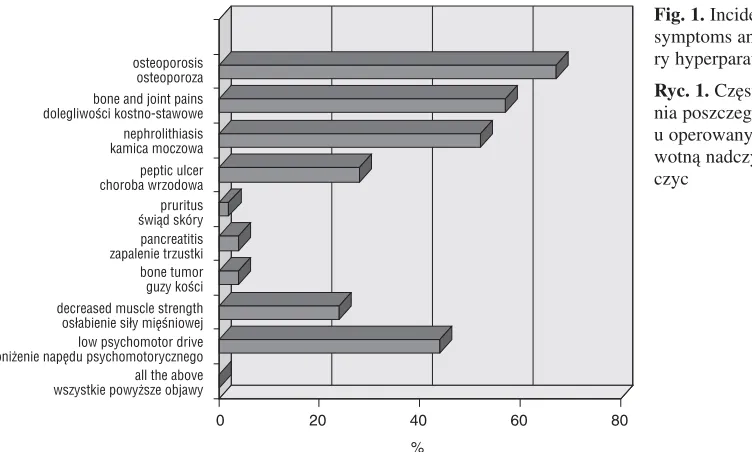
The occurrence of different clinical masks of P−HPT was irregular (Tab. 1, Fig. 1). The patients who underwent parathyroidectomy had been most commonly diagnosed as having osteoporosis inap− propriate to age (36 of 54, 67%), non−specific bone and/or joint pains (31, 57%), nephrolithiasis (28, 52%), and uncomplicated peptic ulcer (15, 28%). Muscular adynamia, perceived as weakness and fatigability, was also a quite frequent symptom (13, 24%), as well as low psychomotor drive or intellectual fitness (24, 44%). The patients were often unaware of these symptoms until the moment they quickly subsided after the operation. Two female patients (2, 4%) in a very advanced phase of hyperparathyroidism had undergone prior
surgery for suspected bone tumors (one of a rib and the other of the maxilla); only the histological diagnosis of a brown tumor explained the cause of the disease. Some manifestations of hyperparathy− roidism, i.e. pruritus and pancreatitis, were found in the analyzed group sporadically, in 1–2 individ− uals (pruritus 1, 2%; pancreatitis 2, 4%). No sig− nificant arrhythmias were noted that could be associated with high hypercalcemia. Diabetes mel− litus or glucose intolerance was also not demon− strated in any of this group. None of the patients with parathyroidectomy had the full set of the described symptoms and signs.
Hypertension, although quite common among patients who undergo parathyroidectomy, was not included in our analysis of clinical masks of P−HPT as the etiology of hypertension is com− plex and too difficult to be diagnosed precisely in
Table 1. Incidence of particular symptoms and signs of primary hyperparathyroidism
Tabela 1. Częstość występowania poszczególnych objawów pierwotnej nadczynności przytarczyc
Symptoms and signs No. of patients of primary hyperparathyroidism (Liczba (Objaw pierwotnej nadczynności chorych)
przytarczyc) n (%)
Osteoporosis – inappropriate to age 36 (67) Osteoporoza – nieadekwatna do wieku)
Non−specific bone and/or joint pains 31 (57) (Nieswoiste dolegliwości kostno−
−stawowe)
Nephrolithiasis 28 (52)
(Kamica moczowa)
Peptic ulcer 15 (28)
(Choroba wrzodowa)
Pruritus 1 (2)
(Świąd skóry)
Pancreatitis 2 (4)
(Zapalenie trzustki)
Bone tumors (histologically 2 (4) – brown tumor)
(Guzy kości (histologicznie – guz brunatny))
Decreased muscle strength 13 (24) (Osłabienie siły mięśniowej)
Lowered psychomotor drive 24 (44) or intellectual fitness
(Obniżenie napędu psychomotorycz− nego lub sprawności intelektualnej) Arrhythmia 0 (Zaburzenia rytmu serca)
Diabetes 0
(Cukrzyca)
a surgical department as secondary to P−HPT, while hypertension itself is widespread in the population. It was observed, however, that in the early postoperative period, some patients had rel− atively lower blood pressure than before while on the same doses of hypotensive drugs. Polyuria was not included in the analysis, either, as none of the patients complained of high urine output and no adequate measurements had been made before.
The longest period of ineffective treatment before the eventual diagnosis of P−HPT was due to recurrent nephrolithiasis in one patient for as long as 17 years, whose treatment included more than a dozen operations, PCNLs (percutaneous nephrolithotripsy), and ESWLs (extracorporeal shock wave lithotripsy). Peptic ulcer and bone pains erroneously attributed to arthritis had also been treated for many years (Table 2). Because of their common character, these diseases did not
Fig. 1.Incidence of particular symptoms and signs of prima− ry hyperparathyroidism
Ryc. 1. Częstość występowa− nia poszczególnych objawów u operowanych chorych z pier− wotną nadczynnością przytar− czyc
0 20 40 60 80
all the above wszystkie powyższe objawy low psychomotor drive obniżenie napędu psychomotorycznego decreased muscle strength osłabienie siły mięśniowej bone tumor guzy kości pancreatitis zapalenie trzustki pruritus świąd skóry peptic ulcer choroba wrzodowa nephrolithiasis kamica moczowa bone and joint pains dolegliwości kostno−stawowe osteoporosis osteoporoza
%
Table 2.Time from the onset of symptoms to the final diagnosis of primary hyperparathyroidism and operation
Tabela 2.Czas od wystąpienia poszczególnych objawów do rozpoznania pierwotnej nadczynności przytarczyc i operacji Symptoms and signs of primary hyperparathyroidism Time to diagnosis of P−HPT – years (Objaw pierwotnej nadczynności przytarczyc) (Czas do rozpoznania P−HPT – w latach)
average maximum
Osteoporosis – inappropriate to age 1 3
(Osteoporoza – nieadekwatna do wieku)
Non−specific bone and/or joint pains 5 7
(Nieswoiste dolegliwości kostno−stawowe)
Nephrolithiasis 11 17
(Kamica moczowa)
Peptic ulcer 6 15
(Choroba wrzodowa)
Pruritus 2 2
(Świąd skóry)
Pancreatitis 3 5
(Zapalenie trzustki)
Bone tumors; histologically – brown tumor < 1 < 1
(Guzy kości; histologicznie – guz brunatny)
Decreased muscle strength 2 3
(Osłabienie siły mięśniowej)
Lowered psychomotor drive or intellectual fitness 2 4
raise any suspicions for a long time, until they were associated with other symptoms and blood tests for calcium and phosphates were made. Non− specific neurological symptoms did not usually make the patients seek medical advice. Early onset osteoporosis led to quick diagnosis of P−HPT (usu− ally within 1 year), but in elderly patients it would be underestimated by general practitioners as a diagnostic problem. The correct diagnosis was finally made by an endocrinologist and was based on abnormal serum calcium and phosphate con− centrations and elevated parathormone (PTH). It was then confirmed by visualizing enlarged parathyroids by sonography and/or scintigraphy. The preoperative levels of serum calcium, phos− phates and PTH are presented in Table 3.
Discussion
Historically, the clinical picture of highly advanced primary hyperparathyroidism consisted mainly of devastating bone disease, presenting as osteoporosis and osteitis fibrosa cystica general− isata, with tormenting bone pains, skeletal defor− mities, brown tumors, and pathological fractures, accompanied by neurological disorders and nephrolithiasis [1, 2, 5, 8, 12, 13, 17]. Early diag− nosis of P−HPT, made possible thanks to the grow− ing understanding of this disease, has consequent− ly brought about a change in its typical clinical
picture. Nowadays the disease is usually diag− nosed before such complete and typical destruc− tion of the skeletal system develops; analogously, the full set of symptoms from different organs is seldom found in one patient. The differences in the clinical picture of P−HPT described in different regions of the world are mostly due to the possi− bilities of early diagnosis of the disease before it reaches its fully symptomatic stage. In countries where screening tests for P−HPT have become part of routine clinical practice, it is frequently detect− ed even in its clinically asymptomatic form, which enables effective operative treatment before severe complications arise [3, 9, 11, 18].
As observed above, in this country’s setting the symptoms and signs that build up the clinical picture of primary hyperparathyroidism are still usually treated by general practitioners and vari− ous specialists as separate disease entities, while their main cause remains undiagnosed for a long time. The low incidence of this rare disease and its diverse, often monosymptomatic clinical course masked by other common complaints may divert the attention of a rheumatologist, urologist, gas− trologist, neurologist, and many other medical spe− cialists from the true cause of the illness for many years. It is advisable that all the patients who pre− sent with the symptoms and signs described above have blood tests for calcium level and be referred to an endocrinologist for consultation, which could direct the diagnostics in the right way.
Table 3.Serum concentrations of calcium, phosphates, and PTH found before the operation for primary hyperparathyroidism Tabela 3.Stężenia wapnia i fosforanów oraz PTH, oznaczane u chorych przed operacją pierwotnej nadczynności przytarczyc Mean value Min. and max. values Normal range and units (Średnia wartość) (Wartość najmniejsza i największa) (Zakres norm i jednostki)
Calcium 2.91 2.31–3.78 2.0–2.55 mmol/l
(Wapń)
Inorganic phosphates 0.80 0.58–1.02 0.81–1.45 mmol/l
(Fosforany nieorganiczne)
PTH 440.5 95–1561 11–67 pg/100 ml
References
[1] Bednarek−Tupikowska G, Dunajska K, Bohdanowicz−Pawlak A:Trudności w diagnostyce i terapii pierwotnej nadczynności przytarczyc. Terapia 2001, 9, 2, 25–29.
[2] Lewiński A:Zaburzenia gospodarki wapniowo−fosforanowej ze szczególnym uwzględnieniem patologii przytar− czyc. In: Zarys endokrynologii klinicznej. Eds.: Pawlikowski M. PZWL, Warszawa 1996, 104–133.
[3] Rastad J, Lundgren E, Ljunghall S:Clinical presentation of primary hyperparathyroidism. Europe. In: The parathyroids. Basic and clinical concepts. Eds.: Bilezikian J. Academic Press, San Diego 2001, 361–374.
[4] Podwiński A, Kokot F, Niemiec A, Więcek A, Waler J, Chudek J, Podwińska E, Marcinkowski W, Nieszporek T, Bednarski P:Chirurgiczne leczenie pierwotnej nadczynności przytarczyc w świetle 260 obser− wowanych przypadków. Pol Przegl Chir 2004, 76, 2, 133–143.
[5] Tołłoczko T:Chirurgiczne leczenie nadczynności przytarczyc. Pol Przegl Chir 1989, 61, 739–743.
[7] Karwacki JH, Skalski A, Krajewska M, Weyde W:Ocena przydatności totalnej paratyreoidektomii z jed− noczasową autotransplantacją w leczeniu wtórnej nadczynności przytarczyc – materiał własny. Adv Clin Exp Med 2003, 12, 3, 321–327.
[8] Tołłoczko T, Chudziński W, Nawrot I:Surgery for primary hyperparathyroidism. Przegl Lek 2000, 57, Suppl. 5, 101–103.
[9] Harrison BJ, Wheeler MH:Asymptomatic primary hyperparathyroidism. World J Surg 1991, 25, 724–729.
[10] Filarska D, Dziewulska−Bokiniec A, Szafran P, Olszewska D:Pierwotna nadczynność przytarczyc zdiagno− zowana jako guz olbrzymiokomórkowy wieloogniskowy – opis przypadku. Przegl Lek 1998, 55, 10, 549–551.
[11] Bilezikian JP, Brandi ML, Rubin M, Silverberg SJ:Primary hyperparathyroidism: new concepts in clinical, densitometric and biochemical features. J Intern Med 2005, 257, 1, 6–17.
[12] Bilezikian JP, Silverberg SJ: Physiology of the parathyroid glands and pathophysiology of primary hyper− parathyroidism. In: Endocrine surgery. Eds.: Schwartz AE, Pertsemlidis D, Gagner M, Dekker M, Inc., New York 2004, 213–230.
[13] Dadan J, Dzięcioł J, Ładny JR, Hady HR, Puchalski Z:Chirurgiczne leczenie pierwotnej i wtórnej nadczyn− ności przytarczyc. Przegl Lek 2002, 59, 84–87.
[14] Wilhelm SM, Lee J, Prinz RA:Major depression due to primary hyperparathyroidism: a frequent and correctable disorder. Am Surg 2004, 70, 2, 175–180.
[15] Walker RP, Paloyan E, Gopalsami C:Symptoms in patients with primary hyperparathyroidism: muscle weak− ness or sleepiness. Endocr Pract 2004, 10, 5, 404–408.
[16] Andersson P, Rydberg E, Willenheimer R:Primary hyperparathyroidism and heart disease – a review. Eur Heart J 2004, 25, 20, 1776–1787.
[17] Gruca Z, Wajda Z, Łachiński A, Sworczak K, Kaska Ł, Osęka T, Czaplińska−Kałas H, Rutkowski B, Brylowska A:Chirurgiczne leczenie pierwotnej i wtórnej nadczynności przytarczyc w materiale własnym. Ann Acad Med Gedan 2000, 30, 57–67.
[18] Ohe MN, Santos RO, Barros ER, Lage A, Kunii IS, Abrahao M, Cervantes O, Hauache OM, Lazaretti− −Castro M, Vieira JG:Changes in clinical and laboratory findings at the time of diagnosis of primary hyper− parathyroidism in a University Hospital in Sao Paulo from 1985 to 2002. Braz J Med Biol Res 2005, 38, 9, 1383–1387.
Address for correspondence:
Jerzy H. Karwacki
2ndDepartment of General and Oncological Surgery
Silesian Piasts University of Medicine Skłodowskiej−Curie 66
50−369 Wrocław Poland
Conflict of interest: None declared Received: 17.02.2006