DEMOGRAPHIC RESEARCH
VOLUME 32, ARTICLE 9, PAGES 287–310
PUBLISHED 3 FEBRUARY 2015
http://www.demographic-research.org/Volumes/Vol32/9/ DOI: 10.4054/DemRes.2015.32.9
Research Article
The link between parenthood and partnership in
contemporary Norway - Findings from focus
group research
Trude Lappegård
Turid Noack
This publication is part of the Special Collection on “Focus on Partnerships: Discourses on cohabitation and marriage throughout Europe and Australia,” organized by Guest Editors Brienna Perelli-Harris and Laura Bernardi.
© 2015 Trude Lappegård and Turid Noack.
This open-access work is published under the terms of the Creative Commons Attribution NonCommercial License 2.0 Germany, which permits use, reproduction & distribution in any medium for non-commercial purposes, provided the original author(s) and source are given credit.
1 Introduction 288
2 Theoretical background 289
3 The case of Norway 291
4 Data and methods 293
4.1 Data 293
4.2 Recruitment strategy 294
4.3 The focus groups 295
5 Results 297
5.1 The meaning of children to partnership 297 5.2 The meaning of marriage for parenthood 299 5.3 Reasons for marrying other than parenthood 302
6 Discussion 305
7 Acknowledgement 307
The link between parenthood and partnership in contemporary
Norway - Findings from focus group research
Trude Lappegård1
Turid Noack2
Abstract
BACKGROUND
The increase in childbearing within cohabitation raises a question about the link between parenthood and partnership. In Norway, having the first child in cohabitation has become the most common pattern.
OBJECTIVE
The paper studies the interrelated meaning of partnership, marriage, and childbearing. We ask what children mean to partnerships, what the meaning of marriage is for childbearing, and what reasons there are for marrying besides childbearing.
METHODS
The data consist of eight focus group interviews on marriage and cohabitation. Each group had between five and nine participants aged 25 to 40 years, and was stratified by gender and education. All participants were Norwegian citizens living in Oslo. Both authors reviewed and discussed the central thematic categories relevant to the research question.
RESULTS
When people feel free to choose between cohabitation and marriage, the role of parenthood becomes more salient for forming a union. We find that the meaning of partnership has shifted from being defined around marriage to being defined around having a child, which makes the link between partnership and childbearing more interesting. Discussing whether to have children or a pregnancy can bring up the question of marriage and make it more relevant. The conclusion, however, is not that marriage is normative when parenthood occurs. Although the focus groups participants did not feel any pressure to have children in marriage, the general opinion was that
childbearing and marriage were linked. Opinions differed, however, about the nature of such a link.
1. Introduction
Children born throughout Europe and in other industrialized countries are increasingly likely to have parents who are cohabiting without being married (Perelli-Harris et al. 2012). The Nordic countries were the forerunners of this trend, and they have the highest proportion of children born within cohabitation. Nowadays, a substantial proportion of all children in these countries are born within cohabitation, although most parents seem to marry sooner or later. In Norway these behavioral changes have been thoroughly described and analyzed (Noack 2010; Statistics Norway 2014).
The increase in childbearing within cohabitation raises a question about the link between parenthood and partnership. A common view seems to be that having children may have another and more committed meaning for family formation than when marriage was the conventional family form for entering parenthood (Kiernan 2004). Although having a child together is obviously a lifelong commitment, our knowledge about how people perceive and think about children and partnership may need to be enlarged.
Despite a strong decline in Norwegian marriage rates, as across Europe, even in Norway marriage still seems to be a desirable living arrangement. Most children born into a union will have parents who are married or will marry later. Thus marriage and childbearing are still interrelated, although in a different manner than previously. When there is no specific reason to get married, this raises questions about the meaning of marriage in terms of when and why to marry. Are the shifting sequences of timing childbearing and the type of union accidental, or rather the result of conscious choices embedded in a shift in values and norms? Or are they maybe simply perceived to be less important and, in the end, irrelevant?
marriage is preferred because it is assumed that there are more advantages to marrying than to living in cohabitation than really is the case. And even if marriage is outdated as a first partnership and sometimes may seem to be a superfluous institution, many may still consider it as a desirable and ‘natural’ step in family-building. Or they may consider marriage to be a more committed type of union than cohabitation, or appreciate the symbolic meaning of a wedding as a public commitment in front of family and friends and society in more general.
In this study we use focus group research to examine the meaning of partnership for childbearing in a setting where the proportion of births within cohabitation is high. In a qualitative study, Syltevik (2010) concluded that premarital cohabitation has gradually become normative and even the proper thing to do in Norway. Using focus groups, we move a step further and investigate the link between parenthood and partnership in contemporary Norway. Thus, we are able to supplement our knowledge about the behavioral changes with more insights into how young Norwegian men and women perceive and think about the link between parenthood and partnership. We focus on three aspects of family formation. Firstly, we ask what children mean to partnerships. How does having children define family formation compared to the type of union? Secondly, we ask what the meaning of marriage is for childbearing. When the sequence of marriage and childbearing differs, the meaning of marriage may also differ. As a consequence of the two first questions, we also ask about other reasons for marrying besides childbearing.
2. Theoretical background
Giddens (1991) has also accentuated that the transition to parenthood in late modernity is characterized by being less institutionalized, and is more embarked upon on the bases of autonomous choice and control over one’s life cycle. A joint decision by a couple has unquestionable cultural value as a process in which two individuals have to negotiate ideas about their individual life courses as well as their vision of a future together as parents (Ravn and Lie 2013:86). For almost half a century many countries have witnessed a prolongation of the transition from adolescence to adulthood. Marriage and entering parenthood – the traditional transitions of starting family-building – have been postponed, and people in their twenties do not experience the same pressure to make committed and lasting decisions about family and adult life. This has been characterized as ‘emerging adulthood’, described as the period from late teens to late twenties when young people are exploring possibilities in love and work (Arnett 2004). This has become a period for self-realization and a more gradual shift into adulthood, allowing for both more flexibility and more ambiguity. In this context, cohabitation may be seen as a less definite and more practical type of union. The view of cohabitation as a less definite partnership than marriage, may, however, be different in a setting where so many children are born in cohabitation, either because cohabitation after some time is considered almost marriage-like or because having a child is supposed to make the cohabitation more stable and committed. Our first research question asks what children mean to partnerships and whether having children defines family formation differently depending on the type of union. Using focus group data, we wanted to gain more insight into how young people in a typical cohabitation land like Norway regard these issues.
In many countries the traditional chronological sequence of events appears to have weakened. The changes in the occurrence and timing of young peoples’ family behavior, a trend often referred to as destandardization, are characterized by greater flexibility and more divergence from the traditional life course; for instance, the increase in childbearing before marriage (Brückner and Mayer 2005). It has been argued that, while the normative pressure is to comply with a single family event sequencing (like marriage followed by childbearing), a larger variety in the sequence of events emerges (Billari and Liefbroer 2010).
marriage is described as a ‘reinforcement’ of the relationship, marriage functions as a formalization of the commitment and adds an additional layer of security to the union. Here, marriage is not seen as necessary for childbearing, but “… a child changes the couple’s circumstances in such a way that marriage becomes desirable” (Holland 2013:281). Finally, Holland describes marriage as the “capstone” of family-building when marriage occurs when the couples have achieved the desired family size. We wanted to investigate whether these types of marriage were present and used as arguments, beliefs, or even norms when young people discussed childbearing and marriage.
Studying the history of marriage, romantic love rather than social norms and socioeconomic factors is what characterizes modern marriage and the formation of partnerships today (Lewis 2001; Coontz 2006). It has also been argued that marriage may become more irrelevant if cohabitation provides a stable relationship in which to raise children (Heuveline and Timberlake 2004; Kiernan 2004). However, cohabitation and marriage are not mutually exclusive phenomena. Rather, union formation is more often a process, as many cohabitors marry sooner or later if they have not dissolved their union. Lewis (2001) emphasized that, when studying and discussing cohabitation, it is essential to consider changes in the institution of marriage. In fact, it has been argued that people are marrying for reasons other than conventional norms and values, and that marriage can be seen as a manifestation of individual values and preferences (Sobotka and Toulemon 2008). Moreover, even though in many countries the practical importance of marriage has decreased compared to cohabitation, its symbolic value may still be high (Cherlin 2004). Marriage can mark a new, more committed, and permanent stage in a couple’s relationship, and in this sense it can be symbolically different from cohabitation (Noack, Bernhardt and Wiik 2013). Our second research question asks about the meaning of marriage for childbearing and our third research question about reasons for marrying other than childbearing.
3. The case of Norway
(Noack, Bernhardt and Wiik 2013), and in a study of ten European countries the largest proportion of respondents who considered marriage to be irrelevant was found in Norway (Hiekel, Liefbroer and Poortman 2014). However, marriage remains a common part of the pairing process in Norway. In 2012, 77% of women and 70% of men aged 45−49 were or had been married. The large difference between intentions and marriage behavior may be a cohort effect, but it is also reasonable to believe that more people decide to get married when they reach an older age or a particular stage in their family life course.
Survey data that provide information on the acceptability of cohabitation and cohabitors having children are sparse. However data does exist that shows that the acceptance of cohabitation has significantly increased since the first decades of cohabitation. In 1984, seven of ten respondents said that cohabitation was acceptable, but when asked their opinion of unmarried couples living with children only around one third found such behavior acceptable. In 1997, however, the majority of the population viewed cohabitation positively, whether or not the couple had children (Noack 2010), and in 2007 more than four out of five were positive towards couples living together without any marriage plans (Lappegård and Noack 2009). Significant changes in the judicial equality of married couples and cohabitors did not take place until the 1990s, but debates on and reviews of the subject had begun a couple of decades earlier. As long as cohabitors were treated as single in relation to social security and tax, they often received more favourable treatment than married couples. The change in rules was for a long time primary motivated by the idea that cohabitors should not be treated more favourably than married couples. Only in recent years has the emphasis been put on the needs of cohabitors, such as entitlement to inheritance. Cohabitors themselves have never been an active and organised advocacy group in Norway, and it is difficult to find a direct connection between changes in laws and regulations and the acceptance of cohabitation. However, the rapid increase in cohabitation in all groups of the population where the new way of living together has become common in near family, among friends, and in neighbourhoods, has probably contributed to increased acceptance (Noack 2010).
Although many countries have moved towards giving cohabiting couples more rights and responsibilities, Norway is one of the most advanced in this respect (Perelli-Harris and Sanchez Gassen 2012). In Norway cohabiting couples with children or where the relationship has lasted for at least two years largely have the same tax and welfare benefit rights and obligations as married couples. The Norwegian system of welfare benefits for parenthood (parental leave entitlement, compensation from the state for parents’ lost time in paid employment, parent-friendly working hours, and special support for single parents) is extensive. Thus, a comprehensive welfare system functions as a safety net for single parents and enables most women to provide for themselves and their children, which makes it less risky to live in cohabitation instead of a more regulated and financially binding marriage. There are still differences, however, especially in relation to private law. For instance, cohabitors have a limited right to inherit from each other and, without a private cohabitation contract or a will, the children of the deceased partner will automatically be entitled to inherit the major part of the deceased’s estate.
For children, the cohabitation status of the parents has gradually become less important in Norway. Given that the couple is cohabiting and the father officially recognizes the child, both parents will automatically have joint custody from the birth of the child. Normally, a married couple in Norway has to go through a period of separation of at least one year before they are officially divorced. Counseling is mandatory for married parents who want a separation declaration. The purpose of the counseling is to arrive at an agreement that will be good for the child after the break-up of the marriage. Until recently, cohabiting parents were free to split up without any involvement of the authorities. From 2007, however, counseling is also offered, but not mandatory, for cohabiting parents who wish to break up. These parents do not need a separation period, but economic sanctions are used to make sure that most of them participate in counseling. Extra family allowances are not paid to single parents who refuse counseling, but this happens rarely since the great majority accept the offer (Noack 2010).
4. Data and methods
4.1 Data
1998) and to compare them across different groups. Discussions in focus groups also enable the participants to make associations and have thoughts that would not necessarily occur in other settings. The data for this research were collected following the research design developed by the Focus on Partnership team. Team members collaborated to create standardized focus group guidelines, which were used to direct the discussions. The focus group participants were asked a wide range of questions about cohabitation based on the demographic literature, such as why more and more couples are living together without marrying, even when they have children. The guidelines also contained questions that were more specifically about the relationship between marriage and childbearing, about the timing of events, and about whether it mattered that they married when having children. For further information about the project, see www.nonmarital.org.
The focus groups were held in Oslo between February and April 2012. Oslo is the capital of and largest city in Norway. Many young people in Oslo have moved from other parts of the country to study or work. Since many people move out of Oslo when they form a family the city has a relatively large population of young childless people, so the demographic behavior of young people in Oslo is somewhat different from that in other parts of the country, especially when it comes to timing of family formation. Such differences were acknowledged by some of the participants that originated from outside Oslo. The discussions reflected the specificities of the sample and might have been different had the focus groups been held in other parts of the country.
4.2 Recruitment strategy
Our recruitment strategy was threefold. First, we produced a flyer with information about the project and contact information for participation in the focus groups. The flyer was handed out at community centers, schools, and kindergartens. It was also posted on Facebook and Twitter by the team members and re-posted by friends and family. Secondly, we used the snowball method to recruit participants through family, friends, and colleagues. Thirdly, we contacted newspapers, asking them to write about the project and advertise the need for focus group participants. An online article was published by one of the big daily newspapers in Norway (Dagbladet). In total, these strategies resulted in close to four focus groups, almost all consisting of people with higher education.
were more familiar with focus groups as a method and how they functioned than the participants we recruited ourselves. However, we did not get the impression that there was any difference between the groups in the smoothness of the discussion or how the participants expressed their norms and attitudes about the meaning of parenthood and partnership. In line with the research design of the Focus on Partnership project, participants were provided with an incentive to the amount recommended by Statistics Norway.
4.3 The focus groups
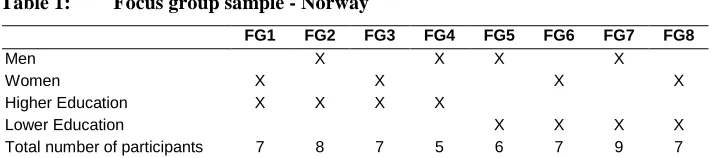
There were a total of 8 small focus groups of 5-9 participants each who were aged between 25 and 40 years. The groups were stratified by gender and education (with and without a university degree) in order to create a homogeneous and relaxed discussion environment and to allow for the possibility of different groups having different discussions. Following the research design of the project, the focus group participants were not stratified by union status or whether or not they had children. The argument for this was that relationships can be fluid and we wanted to include people in different phases of the life course.
Table 1: Focus group sample - Norway
FG1 FG2 FG3 FG4 FG5 FG6 FG7 FG8
Men X X X X
Women X X X X
Higher Education X X X X
Lower Education X X X X
Total number of participants 7 8 7 5 6 7 9 7
thus on ideals and preferences, while people with children may rely more on their experiences and thus focus more on rationalizing their behavior.
The moderator of the focus groups was a research assistant who was hired for the task. She had experience of leading focus groups and was familiar with the topic as a result of her master’s thesis on men and fertility. During the interviews only she was present with the participants, in a room designed for focus group interviews which had cameras and microphones. Next to the focus group room there was an observation room with televisions where 1-2 people were present. All the interviews were recorded and later transcribed in Norwegian by the moderator.
We used a top-down coding procedure, where the interviews were coded by the first author using the themes from the interview guide to structure the coding. Both quotes and discussions related to the themes were coded, and some of these were coded multiple times depending on the topic. Both authors reviewed and discussed the central thematic categories relevant to the research questions in this paper. Since we were two authors working on the material in parallel we were able to have detailed discussions on how to interpret the results and to check the validity of our interpretation.
The discussions in the focus groups covered the participants’ experiences of cohabitation, childbearing, and marriage, their wishes and plans for the future, and more general answers to questions presented by the moderator. There was a high level of tolerance for differences in opinions and attitudes among the participants. Although the expressed opinions were not always coherent there were no heated discussions: when participants disagreed they used moderate objection formulas such as “I see things differently…”. The topics seemed to be more natural for the women to discuss, and the conversations between the women ran more smoothly. In some of the male groups there was a tendency towards a more question-answer situation between the moderator and each participant. The women were also more willing to share personal information than the men. Another issue was that many men thought that women were more exposed than men to pressure and expectations about relationships and children.
One issue that the moderator commented on was that of being an attractive partner and parent. Many of the participants did not have a partner, and the moderator felt that many found it a challenge to find a partner. This became a ‘silent issue’.
thought that their views on cohabitation, marriage, and starting a family were different from the views one might find among young people living elsewhere in the country.
5. Results
This section is divided into three parts, following the structure of the research questions: firstly, findings about what children mean to partnerships; secondly, findings about the meaning of marriage for childbearing; and, thirdly, findings about reasons for marrying besides childbearing.
An important premise of how the participants viewed the relationship between partnership and parenthood was the freedom to choose. On the one hand the participants believed that the individual alone should make all decisions relating to parenthood and partnership formation. On the other hand many participants reported that they experienced pressure to have children, and, to a lesser extent, in relation to type of union. Expectations from partners, family, and friends could often be at variance with their own preferences and wishes as regards type of union and sequence of events.
5.1 The meaning of children to partnership
One of the most frequently discussed topics in the focus groups concerned having children, and a central question was the meaning of children for partnerships. Not only do almost all young Norwegians begin relationships in cohabitation but also the majority of parents are cohabiting when their first child is born. Children, more than the partnership as such, are what constitute a family, and the focus group discussions showed that parenthood to a large extent also defines the forming of a partnership.
I have chosen to marry. I proposed eight years ago, but he said “no” and suggested that we should have children instead. It dragged on before he proposed to me. (FG3, woman, highly educated).
Becoming parents was viewed as the beginning of a committed partnership, and during the discussion the participants brought up several interesting aspects concerning social pressure, commitment, and symbolic actions of adulthood.
Society’s expectation of marriage is not obvious. It is clearer as regards having children. (FG2, man, highly educated).
Many participants felt that family and friends expected them to have children, which sometimes was experienced as pressure. For cohabiting couples this was often experienced through direct questions or hints about babies. Having children can be considered as the natural next step for cohabiting couples and therefore something family and friends find it natural to ask about.
Commitment was frequently discussed in relation to both partnership and parenthood. There was a clear consensus that having children together were a more important and serious decision than deciding to live together or get married. The argument was that the threshold for having children is higher than for marrying and that having children was a lifelong commitment with the other parent and something you could not get out of, unlike cohabitation or marriage.
It becomes more serious when you have children – then you are in a relationship for life, even if you break up. It is a bigger commitment to have children. It should be. (FG1, woman, highly educated)
The focus group participants discussed having children as a conscious decision and not something that just happened. Unintended childbearing was not brought up in any of the groups, perhaps because there is a strong ideal that having children should always be the result of a conscious decision. To underline the distinction between parenthood and partnership, it was also emphasized that having children involved more than just signing papers and buying a ring. It is a matter of ‘blood and genes’. While a partnership can be dissolved, a parent is something you remain for life. However, a clear desire to be in a partnership when having a child was also expressed, although the type of union was less important. Women especially said that it did not matter whether they were married or cohabiting, but that they did not want to end up as a single mum. One exception was a woman who stated that this might change if she did not find the right partner within a few years.
Another mentioned way in which children contribute to changing a partnership was that it becomes a relationship between adults. According to the focus group participants, having children can be perceived as a symbolic act demonstrating that you are an adult and established individual.
Having children is seen as a symbol of the transition to adulthood. In this respect, parenthood seems to be a substitute for marriage as a marker of adulthood. Traditionally, marriage represented the main transition from adolescence to adulthood and children often came shortly after the wedding. As marriage can now occur at different stages of people’s life course, it does not have the same value as a symbol of the transition to adulthood. Transition to parenthood occurs independently of type of union and is thus a symbol of adulthood, whether you are cohabiting or married. Moreover, the costs associated with having a large wedding appear to be viewed differently from the costs associated with having children, which may mean that, if a couple cannot afford both a wedding and children, children will be given priority. The cost of weddings was much discussed in the focus groups. The general opinion was that there was no point in getting married if you could not afford a wedding reception. This can be exemplified by a participant who stated that he could not see the point of getting married during a lunch break, as a colleague of his had done. Marriage was not seen as necessary, but rather as something that could be avoided or postponed indefinitely, while having children was a natural part of family formation.
5.2 The meaning of marriage for parenthood
While there were different opinions as to how childbearing and marriage were interrelated and what the ideal sequence of events was, there was a unanimous understanding that cohabitation was completely acceptable behavior. It has even become the expected behavior, in the sense that stating reasons for it is neither expected nor required. Moving in together without marrying was simply the right thing to do, not something you had to fight for or defend. The arguments for moving in together varied, but starting with cohabitation rather than marriage was considered the norm, and to marry without living together first was considered deviant behavior. However, it was also stated that as you did not have to get married, neither did you have to be cohabiting until you turned 30.
the ‘old-fashioned’ way. For the majority, however, marriage, while preferable, could just as well take place later in life.
Nevertheless, there were many preferred sequences of events. Using the typology of the meaning of marriage in relation to childbearing suggested by Holland (2013), we present the rationale and arguments for different preferences. Starting with the most traditional thinking, that childbearing should take place in marriage, one woman said:
I like to do things in the right order, meaning that children should come after (marriage) … but I am not religious or anything. (FG3, woman, highly educated).
The statement followed a longer discussion about whether or not to marry in which many had stated that getting married was a good opportunity to celebrate the relationship with family and friends. The participant said that she thought differently about this and getting married for her was not so much about celebration as about security: being married was more important than getting married. Although many had other opinions there was no one that objected to her statement, but instead it was agreed that it would be nice to do the same as ones parents. This statement fits with Holland’s (2013) ‘family-forming’ marriage. Another argument for following the more traditional pattern was expressed as follows:
It is a fine thing. It is the complete family picture. I come from a very large family with several sets of parents and children, very few have been married… I will go in the opposite direction, have the whole healthy package. So that nobody has to be rootless in my family. (FG8, woman, low educated).
This participant emphasized that her choice was a protest against her family tradition. Her statement came in a discussion about doing things differently to your parents, and she said that she wanted to be married when she became a parent. This was not a typical argument, but, interestingly, it shows that for some people with mixed and untraditional family experiences, marrying is seen as atypical and something you can do in order to be different to your parents.
For many, marriage and childbearing occur more or less in parallel. When discussing whether or not being married when having children matters, one woman said:
Here the moderator asked the participant to explain more fully what the difference was. She explained that for her, cohabitation would not be right for a family situation with children and was more suitable for when you are 25. For instance, it would be strange to refer to someone as a ‘girlfriend’ when they had teenage children. This was followed up by another participant who said that she used ‘husband’ and ‘wife’ to describe a cohabiting couple that had been together for a long time, as ‘husband’ and ‘wife’ better suited an established family situation. This could be related to what Holland (2013) describes as a ‘legitimizing’ marriage, when marriage occurs not too long after having a child.
In both family-forming and legitimizing marriages, marriage and childbearing are closely interrelated, and the arguments for this traditional pattern were either about following ‘the right order’ or that a marriage was a better way to describe a family.
Another way of linking childbearing and marriage is getting married as a way of formalizing a commitment that has been strengthened by having a child.
Now that I have a child and she is seven months old, there is no reason not to marry. It’s a matter of time and could be in a year or two… Now, nothing stands in the way of doing it. (FG1, woman, highly educated).
Another woman had strong opinions about not getting married and responded to this by challenging the former speaker:
Not to criticize you, but I hear what you are saying, that there is no reason not to marry, but what is the reason to do it? You have to have a reason to marry.
The response to this was:
I hear what you say. It is personal. I’m from a religious family. I believe in some of the things I was raised through the Catholic Church. If you marry, you are spiritually on the right way. I have a previous cohabiting relationship. It’s a big step to get married but now there is nothing that stops me anymore.
Lastly, marriage was seen as the final event in the process of building a family. The logic behind this was romance:
We married after eleven years, but there is no difference in our status and commitment. It’s just a way of celebrating. We have survived the period with young children, so this is to celebrate love. (FG3, woman, highly educated).
Another woman responded by saying that she got married after one year in the partnership and before they had children. The first participant then elaborated and said that she hadn’t imagined herself as getting married. Her mother had never been married and she had never fantasized about a wedding, but when she had been with her partner for three months she wanted to marry him, but had waited two years before proposing, and then eleven years before they actually married. This is what Holland (2013) describes as a ‘capstone’ marriage, where marriage occurs when the couple has achieved the desired family size or survived a certain period of time.
Although the focus group participants did not feel any pressure to have children within marriage, the general opinion was that childbearing and marriage were linked. However the arguments for the nature of the link differed. Marriage was not seen as necessary for childbearing, but nor was it something that was decoupled from childbearing. In all the focus groups there were only a few participants who totally rejected conventional marriage. The common view was that marriage was irrelevant, and a decision to marry needed to be justified, to the participants themselves as well as to friends and family.
5.3 Reasons for marrying other than parenthood
In the discussions about the reasons for marrying a variety of arguments were mentioned, and no reason was considered more important and decisive than any other. Giving at least one reason seemed to be mandatory, however, and one participant often cited several arguments. No single argument stood out as the most important and common argument for marrying. The reasons presented were a mixture of describing marriage as a symbolic act and rational and financial arguments.
To me, being married is something special and romantic. You make a choice you must try to stick to for the rest of your life. (FG1, woman, highly educated).
However, it was also a strongly held opinion that celebrating the relationship by having a wedding was an important part of getting married. More women than men emphasized that they wanted a nice reception. The men often stated that this part of entering into marriage seems to be more important to women than to men, and that girls are socialized to want this from childhood. Women look forward to their wedding while men simply marry. In spite of increasing cohabitation and declining marriage rates, the celebration of weddings seems to have escalated. Although we have no solid figures confirming this impression or information about how much couples and their parents spend on the average wedding reception, the importance of having a nice wedding was often discussed in our focus groups. What we see is that a lot of the preparations for the wedding that used to be handled by the family have been outsourced to a growing wedding industry, as described in a study from the USA (Mead 2007).
According to participants, older traditions such as stag nights and more recent traditions such as hen parties are an important part of the wedding process, although they seem to function as shell institutions (Giddens 2000:76): the names of these rituals remain the same, but their traditional meanings no longer apply. The increase in cohabitation and childbearing among cohabiting couples means that most Norwegian bridegrooms and brides already live an ordinary family life and have often done so for several years. Traditions that were intended to have a symbolic meaning as a last goodbye to an uncommitted period of one’s life are obviously still important, and in some cases seem to be even more important than before. In a country where cohabitation is so common and so similar to marriage as it is in Norway, it may be necessary to underline the difference between living as a cohabitor and getting married (Noack 2010).
Although there is no formal link between marriage and surnames, the establishment of a family, preferably with the same family name, was another symbolic reason for marrying. Though many people will have lived together for years without having the same family name, several participants mentioned having the same family name as a positive aspect of marrying and as a symbol of their family unit.
With the same surname you become a little family, belonging to each other. It is stronger than cohabitation even if you have not married in church … (FG2, man, highly educated).
married couples (Noack and Wiik 2008). How many cohabiting couples are sharing one surname is unknown, but it does seem to be rather rare.
In contrast to the symbolic meaning of getting married, several rational arguments were made; for example, that the consequences would be greater security and predictability, or that marriage was financially favorable. Financial advantages were often mentioned as an argument for getting married. It seems to be commonly believed that taxation and pensions are more favorable for married than for cohabiting couples. In reality there is little difference. Cohabitors do, however, have limited rights of inheritance compared with married couples. While these rights can be strengthened by signing a cohabitation contract or making a will, they will not be totally equal to those of married couples. Other participants emphasized that marriage can be more advantageous for women than for men, as they often earn less than men. Unlike cohabitors, married couples have a mutual duty to provide for each other. This financial security ceases upon divorce, however, because in Norway alimony is practically non-existent.
Others, in most cases the men, thought that a reason to marry was that fathers would be in a stronger position with respect to their children: their chances of being given parental responsibility and getting custody of their children all or part of the time were mentioned as arguments. Here, too, seemingly rational choices do not reflect the actual law. Generally, most people seem to assume that the rights of cohabiting fathers are weaker than they really are. According to the present laws and regulations in Norway, married and cohabiting parents have the same rights in relation to children in event of a break up, provided that the fatherhood has been registered.
Consideration for children was frequently mentioned, but was not singled out as the main reason for marrying. Some thought children might feel more secure with married parents because marriage is a symbol of stability and is perceived as carrying less risk of a break-up, while others thought children would never see it as important.
6. Discussion
On the basis of the focus group research, this study provides insight into the meaning of partnership (cohabitation and marriage) for childbearing in a country where most women have their first child within cohabitation, not marriage. Childbearing within cohabitation has been extensively documented and described in recent quantitative research (Perelli-Harris et al. 2010; Perelli-Harris et al. 2012; Klüsener, Perelli-Harris, and Sánchez Gassen 2013; Lappegård, Klüsener and Vignoli 2014). Using focus group research, we wanted to supplement our knowledge about this family behavior with more insight into how young men and women perceive and think about the link between parenthood and partnership.
The freedom to make personal decisions in relation to partnerships and children pervaded the discussions in all the focus groups. Such statements are in accordance with Giddens (1991), who characterized family behavior in late modernity by less institutionalization and more autonomous choices and control over one’s life cycle. The participants described themselves as a lucky and optimistic generation in a rich society that offers a wide range of possibilities and choices in forming families, a favorable position compared to that of their parents’ generation and of young people in most other countries. In accordance with the strong emphasis on and belief in autonomous choice, the opinions and responses of family and friends were often referred to as something they were aware of but which did not influence their choices. The individualization thesis appears to be important in many ways to how focus group participants described their choices of union type when starting a family. Many participants emphasized that they were free to choose the family pattern they preferred, without serious constraints from family and friends. However, it is possible that the popular idea of individual freedom of choice is so important to these young people that they under-communicate pressure from others or financial constraints. The idea of increasing individualization is often referred to in more general and popular explanations of many behavioral changes in our time, not least the changes in family relations. This has led sociologists to warn against the political implications of the individualization theory, as Brannen and Nilsen (2005:423) argue: “In a situation where there is massive one-sidedness in the messages broadcasted by the media and where even the social scientists emphasize the freedom of individuals to choose their own lives and destinies, there is a risk that new theory will become tomorrow’s orthodoxies”.
be ended. Having a child in cohabitation can also strengthen the partnership, making it a more committed relationship. In conclusion, we find that the meaning of partnership has shifted from being defined around marriage to being defined around having a child. It is children that constitute a family, not the partnership as such, and parenthood, not entering a union, that symbolizes the transition to adulthood. The commitment involved in having a child together is far more serious than moving in together or getting married. It seems that while people feel free to choose between cohabitation and marriage, the role of parenthood becomes more salient in forming a union.
Secondly, we asked what the meaning of marriage is for childbearing, hypothesizing that the meaning of marriage has shifted with the changing sequencing nowadays where marriage is seldom the starting point for building a family. We found that discussing having children or a pregnancy could bring up the question of marriage and make it more relevant. The conclusion, however, was not necessarily that a marriage has to take place. A great diversity of viewpoints, arguments, and values were presented in all the focus groups. One set of arguments followed the traditional pattern, which was often referred to as the ‘right order’. Such arguments were often justified as a preference and not something that was needed. Another argument was related to commitment, where marriage could be a way of formalizing the commitment of becoming parents. A final argument linked marriage to romance as the ultimate way to mark the end of family-building.
As a consequence of the two first questions, we also asked about reasons for marrying when having children in cohabitation is totally acceptable. The impression from the focus groups was that a rich mixture of reasons and motives, some personal and others more general, underlay the same behavior, and that there was a low threshold for accepting all the various motives and reasons. Although most Norwegians marry sooner or later, the participants in the focus groups did not regard marriage as mandatory. For them marriage was not normative behavior but a choice that required justification, unlike entering cohabitation.
is true. They may also know the rules perfectly well, but estimate that the risks and consequences are so small that it is not worth changing their behavior.
When discussing cohabitation, marriage, and childbearing, the focus group participants sometimes mentioned the possible negative financial consequences of their choices, but without worrying too much about them. One reason may be that choosing cohabitation or marriage, with or without children, actually has few financial consequences in Norway today, and that the risk of events such as the death of a partner is low in these age groups. Another reason for the lack of concern could be that these young people live in a country where economic conditions are generally very good and where general trust in the security net provided by the welfare state is high, perhaps even higher than is actually justified. If this explanation is correct, the Scandinavian countries may turn out to be permanent forerunners when it comes to having children within cohabitation.
In conclusion, we find that the meaning of partnership has shifted from being defined around marriage to being defined around having a child, which makes the link between partnership and childbearing more interesting. When people feel free to choose between cohabitation and marriage, the role of parenthood becomes more salient in forming a committed union. Cohabitation has become an accepted stage in family formation in Norway and marriage is still a natural part of this. A pregnancy or discussing whether to have children,can bring up the question of marriage and make it more relevant. The conclusion, however, is not that a marriage has to take place. Although the focus group participants did not feel any pressure to have children in marriage, the general opinion was that childbearing and marriage were linked, although the interrelationship between childbearing and marriage has taken new forms.
7. Acknowledgment
References
Arnett, J.J. (2004). Emerging adulthood. The winding road from the late teens through the twenties. Oxford: University Press.
Bauman, Z. (2003). Liquid Love: On the frailty of Human Bonds. Cambridge: Polity Press.
Beck, U. and Beck-Gernsheim, E. (1995). The Normal Chaos of Love. Cambridge: Polity Press.
Billari, F.C. and Liefbroer, A.C. (2010). Towards a new pattern of transition to adulthood. Advances in Life Course Research 15(2-3): 59−75. doi:10.1016/
j.alcr.2010.10.003.
Brannen J. and Nilsen, A. (2005). Individualisation, choice and structure: a discussion of current trends in sociological analysis. The Sociological Review 53(3): 412–428.
doi:10.1111/j.1467-954X.2005.00559.x.
Brückner, H. and Mayer, K.U. (2005). De-standardization of the life course: What it might mean? And if it means anything, whether it actually took place? In Macmillan, R. (Ed.). The structure of the life course: Standardized? Individualized? Differentiated?. Amsterdam: Elsevier: 27–53
Cherlin, A.J. (2004). The deinstitutionalization of American marriage. The Journal of Marriage and Family 66(4): 848−861. doi:10.1111/j.0022-2445.2004.00058.x. Coontz, S. (2006). Marriage, a History. How Love Conquered Marriage. New York:
Penguin-books.
Giddens, A. (1991). Modernity and Self-Identity: Self And Society in the Late Modern Age. Standford, CA: Stanford University Press.
Giddens, A. (1992). The Transformation of Intimacy. Sexuality, Love and Eroticism in Modern Societies. Cambridge: Cambridge.
Giddens, A. (2000). Runaway World. New York: Routledge.
Heuveline, P. and Timberlake, J.M. (2004). The role of cohabitation in family formation: the United States in comparative perspective. Journal of Marriage and Family 66(5): 1214−1230. doi:10.1111/j.0022-2445.2004.00088.x.
Europe. European Journal of Population 30(4):391–410. doi:10.1007/s10680-014-9321-1.
Holland, J.A. (2013). Love, marriage, then the baby carriage? Marriage timing and childbearing in Sweden. Demographic Research 29(11): 275–306. doi.10.4054/ DemRes.2013.29.11
Kiernan, K.E. (2004). Unmarried Cohabitation and Parenthood in Britain and Europe. Journal of Law and Policy 26(1): 33–55. doi:10.1111/j.0265-8240.2004.
00162.x.
Kiernan, K.E. and Estaugh, V. (1993). Cohabitation. Extra-marital childbearing and social policy. London: Family Policy Studies Center.
Klüsener, S., Perelli-Harris, B., and Sánchez Gassen, N. (2013). Spatial aspects of the rise of nonmarital fertility across Europe since 1960: The role of states and regions in shaping patterns of change. European Journal of Population 29(2): 137–165. doi:10.1007/s10680-012-9278-x.
Lappegård, T. and Noack, T. (2009). Familie og job i ulike. Samfunnsspeilet 1:20-24. Lappegård, T., Klüsener, S., and Vignoli, D. (2014). Social Norms, Economic
Conditions and Spatial Variation of Childbearing within Cohabitation across Europe. Rostock: Max Planck Institute for Demographic Research (WP-2014-00X).
Lewis, J. (2001). The End of Marriage? Individualism and Intimate Relations. Cheltenham: Edward Elgar.
Matovic, M.R. (1980). Illegitimacy and marriage in Stockholm in the nineteenth century. In Laslett, P., Osterveen, K., and Smith, R.M. (eds.): Bastardy and its Comparative History. London: Edward Arnold: 336–348.
Mead, R. (2007). One Perfect Day the Selling of the American Weeding. New York: Penguin.
Morgan, D.L. (1998). The Focus Group Guidebook. Thousand Oaks, CA: SAGE.
doi:10.4135/9781483328164.
Murphy, M. (2000). The evolution of cohabitation in Britain, 1960–95. Population Studies 54(1): 43–56. doi:10.1080/713779062.
Noack, T. (2010). En stille revolusjon. Det moderne samboerskapet i Norge. Universitet i Oslo: Institutt for sosiologi og samfunnsgeografi.
Noack, T., Bernhardt, E., and Wiik, K.A. (2013). Cohabitation or Marriage? Contemporary Living Arrangements in the West. In Abela, A. and Walker, J. (eds.): Contemporary issues in family studies: Global perspectives on partnerships, parenting, and support in a changing world. Oxford: Wiley-Blackwell.
Noack, T. and Wiik, K.A. (2008). Women’s Choice of Surname Upon Marriage in Norway. Journal of Marriage and Family 70(2): 507–518.
doi:10.1111/j.1741-3737.2008.00497.x.
Perelli-Harris, B., Kreyenfeld, M., Sigle-Rushton, W., Keizer, R., Lappegård, T., Jasilioniene, A., Berghammer, C., Di Giulio, P., and Koeppen, K. (2012). Changes in union status during the transition to parenthood: An examination of 11 European countries. Population Studies 66(2): 167–182. doi:10.1080/
00324728.2012.673004.
Perelli-Harris, B., Sigle-Rushton, W., Kreyenfeld, M., Lappegård, T., Keizer, R., and Berghammer, C. (2010). The educational gradient of childbearing within cohabitation in Europe. Population and Development Review 36(4): 775–801.
doi:10.1111/j.1728-4457.2010.00357.x.
Perelli-Harris, B. and Sánchez Gassen, N. (2012). How Similar Are Cohabitation and Marriage? Legal Approaches to Cohabitation across Western Europe. Population and Development Review 38(3): 435–467. doi:10.1111/j.1728-4457.
2012.00511.x.
Ravn, N.R. and Lie, M. (2013). The cultural ideal of the joint decision. In Ellingsæter, A.L., Jensen, A.M., and Lie, M. (2013). The Social Meaning of Children and fertility Change in Europe. London/New York: Routledge: 86–101
Sobotka, T. and Toulemon, L. (2008). Overview Chapter 4: Changing family and partnership behaviour: common trends and persistent diversity across Europe. Demographic Research 19(6): 85–138. doi:10.4054/DemRes.2008.19.6.
Statistics Norway (2014) Births, 2013. Oslo: Statistics Norway. http://www.ssb.no/ befolkning/statistikker/fodte/aar/2014-04-08?fane=tabell&sort=nummer&tabell= 171504