University of New Orleans University of New Orleans
ScholarWorks@UNO
ScholarWorks@UNO
University of New Orleans Theses and
Dissertations Dissertations and Theses
5-20-2011
Shadow of a Memory
Shadow of a Memory
Julie Lynn Hindman
University of New Orleans
Follow this and additional works at: https://scholarworks.uno.edu/td
Recommended Citation Recommended Citation
Hindman, Julie Lynn, "Shadow of a Memory" (2011). University of New Orleans Theses and Dissertations. 1317.
https://scholarworks.uno.edu/td/1317
This Thesis is protected by copyright and/or related rights. It has been brought to you by ScholarWorks@UNO with permission from the rights-holder(s). You are free to use this Thesis in any way that is permitted by the copyright and related rights legislation that applies to your use. For other uses you need to obtain permission from the rights-holder(s) directly, unless additional rights are indicated by a Creative Commons license in the record and/or on the work itself.
Shadow of a Memory
A Thesis
Submitted to the Graduate Faculty of the University of New Orleans
In partial fulfillment of the requirements of the degree
Master of Fine Arts In
Fine Arts Digital Media
by
Julie Lynn Hindman
B.F.A. Louisiana State University, 2007
Acknowledgements
I would like to thank my sponsor, Doyle Gertjejansen for his patients and support,
Cheryl Hayes for all of the emotional comfort, and the faculty of UNO for the opportunity
to explore new media.
Dedication
Dedicated to my mother, if not for her support and enthusiasm, I would not have stayed
Table of Contents
List of Illustrations ... iv
Abstract ... vi
Introduction ... 1
Body of Thesis ... 2
References ... 19
Vita ... 21
List of Illustrations
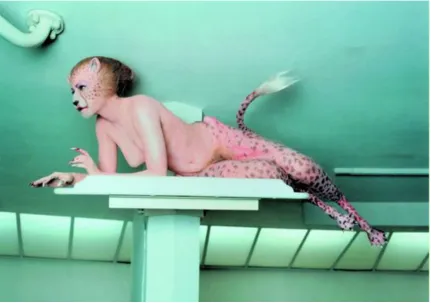
Stills from Elias Merhigeʼs “Begotten” 1991 ... 14
Still from David Sullivanʼs “Sunset Refinery” 2008 ... 15
Still from Matthew barney “Cremaster Cycle” 1995 ... 15
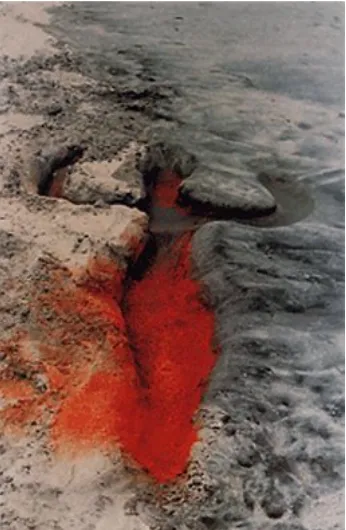
Ana Mendieta “Earth-Body Sculptures” ... 16
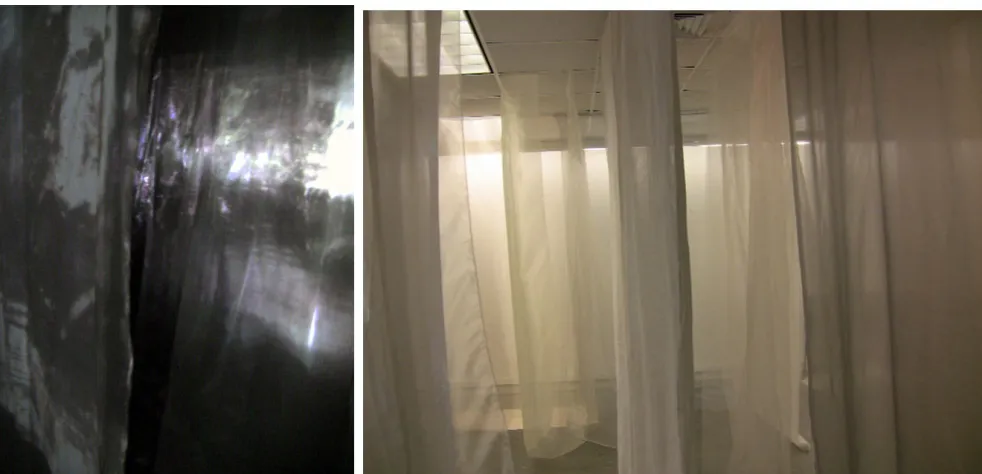
“Shedding Memories” 2010 ... 16
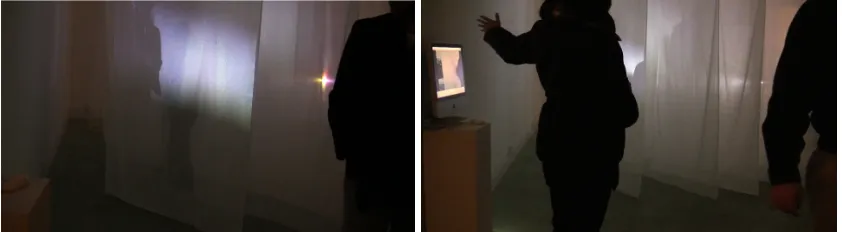
“Shadow of a Memory” 2011 UNO St. Claude Gallery ... 17
Abstract
I have gained control over a whole space through the use of video projections,
soundscaping and various other materials including some interactive media, enabling me
to give the audience a fuller sensual experience. Multi‐media has made it possible for
artists such as myself to create artworks that require more than a visual conversation with
the viewer. The manipulation of memory by time became a physical manifestation in the
environments that I create with the use of multi‐media installations.
Introduction
The intent of my work is to create a visceral response in the viewer that is based on the
visualization of an encompassing sensual experience but is not limited to the visual. The
main concept branches off into other interests, but the environments I build were meant
to create an immediate, emotional response from the viewer/participant. Work that is
intended to never be recreated and is meant only for a temporary experience is also an
essential component of my work.
Engaging multiple senses and creating an environment that engulfs the
participant is the vehicle through which my ideas are communicated. Multi-media
installations allow me to manipulate the whole environment with ease and place the
conceptual nature of the piece into a contemporary dialogue. The foundation of my work
focuses on circular and meandering thoughts based on spontaneously occurring
ruminations. I capture the passage of time and how time can alter the recollection of
events, hopefully triggering the contemplation of an enigmatic and complex thought
process. The metaphor for the underlying ideas mentioned above is expressed through
complicated layering of visual effects. When viewed as a whole, each facet of the
installation becomes as important as any other part.
Using new media has become essential when trying to communicate these
multi-layered ideas. I engaged multiple senses by simultaneously using video, installation,
and sound. The installations were tailored for the space and made up of several panels
of fabric suspended from the ceiling that draped down, creating hallways the audience
projections inside the space. A video loop wass projected through the back of the fabric
layers and a projection through the front, creating layers of light, images, and shadows
of the participants. The fabric panels were close together making tight corridors, forcing
the people to touch the material. The sound was tailored to engulf the space and
created a soundscape that brought the installations to life.
Video elements in Installation
The absence of color is essential to the images I have chosen for the videos.
Restricting the image to black and white allows for a more personal imaginative
interpretation. The black and white imagery in Elias Merhigeʼs 1991 art film Begotten
had a significant influence on my current body of work, particularly the video elements. I
am interested in the forms of nature mirroring the human body and movements, which is
a direct reference to the video in my installation Shedding Memories, 2010 (fig 5). Even
though the theme of Merhige's film Begotten (fig1) has no relation to my work, the visual
aspect has been influential for me. The stark black and white forms that are often
unclear give the film an abstract quality. Merhige has been quoted describing his film; "A
Rorschach test for the eyes." The viewer can't clearly make out what is going on visually
but can still get a basic sense of what is happening. Many of the images that flash
before your eyes are depictions of torture and suffering with periods of rest and peace
that creates a heightened sense of contrast.
Shadow of a Memory, 2011, following Shedding Memories andthe next step or
included a live feed of the audience as they were entering and was projected through
the front layers of fabric daggling from the ceiling. A computer captured these images
and the participants were invited to capture small video segments of themselves. These
segments will be used in later video loops (see fig 6) in the back projection that also
acts as the light that casts the participantsʼ shadows on to the fabric. The interactivity
involved strangers in the front video projection and was a shared experience between
the public and myself. The metaphor in the layering of video and other materials is
about time altering our recollection. Each layer of fabric changes the video and is
abstracted when the projection hits the last layer of fabric that is hanging from the
ceiling. The video has little color and the fabric is also white, emphasizing the high
contrast. The participant can continue through the environment without having to fully
engage the entire film; they can literally become a part of the experience as their
shadows are cast upon the panels of fabric.
In Shadow of a Memory, the participantsʼ shadows were not the only element
involved because their figures were also projected onto the fabric of the front section of
the installation (see fig 6). Monitors capturing their movements as they entered the
installation were fed through digital projectors. The spectator became part of the video
projections, bringing the interactivity to a new level and diluting the personal nature of
the piece. The video projections doubled as both the light that created the cast shadows
and the primary movement inside of the installation. Without the active participation of
people the production would not have related to the human connections I am
lingering feeling of something important taking place, but not fully realized. Since my
work boarders on a personal memoir, it is important to not show an over personalized
story to the audience. I was eager for the piece to function as a space that is conducive
to the movement of time and memories without reference to any concrete story or
narrative.
In Shadow of a Memory, 2011and Shedding Memory, 2010, the participant
wanders up and down corridors or hallways of fabric. Their shadow is cast upon the
many layers of fabric, ultimately combining with the video projection. This is obviously a
moment experienced by the individual walking through the space that cannot be
repeated. The constant obstruction and revealing of the images supported the intent of
an ever-changing environment. Layering remains the analogy for the complexities of our
memories and thoughts, which is why the actual images being projected are intended to
be insignificant. There are some snippets that are recognizable, and may even spark a
specific memory in an individual, but the main point of the projections is to provide the
light that illuminates the fabric, and gives only a hint of a beginning and end through the
motion of the video.
Rethinking digital theory and practices
Video, animation, interactive technology and AV equipment are essential for
communicating my ideas. Artists are more frequently using new media as technologies
become more available. Contemporary issues of using digital media are addressed in
exist at the moment of activation and ends with deactivation, which requires a person to
trigger. It is not to be documented and reshown as a single piece of artwork. Any video
documentation of the interactive installations is unacceptable because this cannot
become the artwork. It is imperative that my work is experienced and viewed only as it
happens. The artwork only exists in the space that I have chosen for the public to
interact, otherwise the piece no longer stands as an ephemeral, momentary experience
that speaks about the ubiquitous, non descript moments in life that define our memories.
The recording of a live performance or installation is often viewed as the artwork
instead of the performance. Inherently, the digital recording becomes the art that is
criticized and the performance is overlooked. The documentation of art becoming the art
is a downfall of the digital revolution that the art world is just now beginning to question.1
Video is a documentation of any live performance or installation and not a piece of
artwork. Matthew Barneyʼs Cremaster Cycle (fig. 3) is an example of the artist “cashing
in” on the fact that the documentation is viewed as the art. His elaborate installations
and live performances were a massive and expensive production held in the
Guggenheim in New York City (see fig. 3). However, there was no live audience and the
video was sold as the work of art. “No matter what, the moments recorded are not the
same as the moments playing on stage with the live performance.”2 Digital recordings of
the installations can easily become the art, and is why I choose not to make
documentation of this work readily available. Video documentation has no relation to my
1 Dixon, Steve Digital Performance: A History of New Media in Theater, Dance, Performance Art,
Installation, Cambridge, MA).
installations as artwork and only function as record keeping. I support the theory that the
documentation should not be viewed as the art but does become attached to the art.
Documentation of my work will only be given out selectively.
Dixon poses a question in his book Digital Performance: History of New Media in
Theater, Dance, Performance Art, and Installation; is video hidden? You can only view
video when shown, but a painting is always visible. Generic Art Solutions and digital
artist David Sullivan also brought up this point when discussing video work (fig. 2
interviewed October 2010), David Sullivan is perhaps best known for his digitally
rendered moving 3D paintings. Video requires a person to turn it on, so the question
posed, when does the piece disappear and does this disappearance become a part of
the artwork? The non-existent portion becomes important when the piece cannot just
exist in a space without assistance, such as a painting, which can always be viewed
and does not require human assistance to “turn on.” All of my installations require being
turned on and are not complete until the final element of people interacting with the art
is introduced or happens. I fully embrace and support the theory that the inactive
portions of the work are just as important as the activated installation.
“An Artist has to be engineer, programmer, graphic designer, and hardware
constructor all at one.”3 Bentowska believed that technology becomes part of the
process just as in painting, sculpture and more traditional art practices. Once in the
computer, the space is unlimited and the artists is no longer concerned with where and
how the work will happen or restricted by the lack of space. Therefore, the work can be
more experimental and the artist freer to explore other options, giving the work a
different aesthetic not experienced before. I have found this to not be true as supported
in the writings. The artists is still thinking about the final product and how the work will
be presented and this compels the artist to be equally restricted as with any other art
form. From the very beginning of my process, I have a specific site in mind and this
becomes my canvas.
New media has made my vision accessible, allowing me to layer many elements
at once to create a clear metaphor of time and memory. Digital elements in the
projections, the cast shadows of the participants, and the interactivity, would not be able
to become part of the artwork without new media. I would not have as much control to
add layers of other figures as I do with the video cast upon the people that walked
through the installation. I film people interacting with elements of the established
installation and then use that as part of the digital projections in subsequent video
projections. Shadow of a Memory has excerpts from the previous events that were
filmed, as did the former and so on and so forth. Layering images from previously
executed performances acts as a symbol of the complication of memories overlapping
each other.
Ephemeral Art: visualizing time
Ephemeral art has traditionally been linked to earth works and performances
staged outside. Over time the work will cease to exist and is not meant to be archival.
Ana Mendieta had the most influence on me as an artist in this chosen form of transient
Mendita writes: "I have been carrying on a dialogue between the landscape and the
female body (based on my own silhouette)... I am overwhelmed by the feeling of having
been cast from the womb (nature). Through my earth/body sculptures I become one
with the earth... I become an extension of nature and nature becomes an extension of
my body..." These pieces were purposely meant to exist only for the live moments of the
actual performance. For instance the ocean seen in the figure below eventually washed
the sculptures/performances away (fig 4).
Upon entering the rooms of my installations the participant/viewer was
immediately greeted with scent and sound, and then the visual components entered
their cognitive process. Essentially the mood of the environment is established before
the person actually sees anything. The visceral component of the installation was
created out of a space where the viewer had an immediate physical reaction upon
walking into the room. The emotional bond with the piece is shortened because of the
transitory nature of the installation, causing a heightened initial reaction. “Each of us
exists within a visceral world. We are wrapped among a simultaneity of physical
experiences: our perceptions of sound, light, temperature, touch: our responses to the
threat of danger, or the expression of a desire become memory: entering into a shifting
fabric of what we have known. The specificity of a particular site/location is a woven
container of association… a fluid mix of the physical, emotional, personal, social, and
political. The fabric is nonlinear; extending inward, and out. The present is written upon
by its inhabitants; all of us containers ourselves.”4
In the future, my work will change from one installation to the next. Shadow of a
Memory and the other installations required the participation of the public and are
impermanent. They were not disintegrated into the earth or washed away by the ocean,
but the installations have been dismantled and will change to adapt to a new interior
space. The pieces existed in the moment; even the subtle movements of the fabric were
fleeting and not repeatable. The medium of installation created a sense of momentary
existence because of the materials I chose, the layering of light, sound, and the limited
duration for the entire piece. This layering of video allows for me to freely express the
metaphor of time moving as it continuously changing our perception of the past.
Shadow of a Memory ended and was dismantled, remaining in the memories of
the observers and the subsequent stories of those individuals as they remember
interacting with the installation. It is not necessary that the viewer fully realizes all of my
intent, but rather grasps the “feeling” of being in limbo and in the physical presence of
memory and the energy of the subconscious. From the beginning I was faced with the
concepts of time as I manipulated moving pictures in the process of video editing. Using
time-based media inherently makes ephemeral artwork accessible to me during my
process.
Using Nature as Another Figure
The movement in my video represented our unavoidable tie to our surroundings
or nature. Using projected figures that fall onto the live audience created an illusion of
the video projections in the installation. “In the light of the current destructive capacity of
civilization and the disequilibrium it has engendered within the biosphere, the obvious
human need to reaffirm connection with the non-human world presents an ironic
challenge.”5 A common thread of thought among my peers is being aware of our
surroundings and once again becoming sensitive to nature. The principal view of my
peers revolves around leaving the selfish tenets of the past and entering a more holistic
approach to technological advances in contemporary society. This layered ideology is
incorporated through the interactive element combined with natural smells and artificial
pheromones in Shedding Memories, 2010. Shadow of a Memory, 2011,was more
focused on the active participation of an occurring event, using nature as the backdrop,
making the installation more human focused. The piece becomes less grounded and
creates an ethereal experience, which relates more to cerebral recollections.
“There is a long tradition of viewing art as a mirror of nature… Nature as subject
in contemporary art acts as a barometer of ecological attunement, while correspondingly
artists contribute to a progressive shift in how we relate to and envision nature (excerpt
of contemporary art historians and curators based in Budapest and London from Maja
and Reuben Fowkes).” In this millennium sound, video and other technological
advances, have been an influential instrument for artists who are trying to express the
idea of oneness and communion with nature. David Dunnʼs Wilderness as Reentrant
Form supports this research and also states that artists as “system thinkers. Even
though the general public is unaware of what radical artists are doing, within this
planetary electronic culture, the artist becomes the fabricator of feedback that
challenges the ideologies of the status quo.” 6
Sound as Form
There is a difference between music/scoring and adding sound to a space for the
purposes of informing the audience. In recent years sound has become accepted as a
form of art that can be manipulated in a space just like any other art medium. It is
assumed that "music" must function in the traditional and orderly sense that we are
used to, which early sound artist John Cage challenged.7 Sound is becoming more
accepted as a viable art form because of early pioneers such as John Cage.
Technology is making it possible to manipulate more than just the visual for artists and
myself.
The use of sound is essential in my installations. I am constantly revising my
choices to find a balance between sound tracking and sound that belongs with the
whole piece, functioning as art. Using source material from everyday life and keeping
with the confines of minimalism encourages the audience to interpret the sound as an
integral part of the artwork. I rely on low frequencies and familiar noises so that the
sound not only functions as a backdrop but also adds to the whole experience. The
sound used in Shadow of a Memory had elements from everyday life as well as
manipulated synthetic engineered tones. Sound art pioneer Le Monte Young perfected
this technique known as fluxus and minimalist compositions in the late 1950s. Le Monte
would take everyday sounds and manipulate them into a musical composition,
sometimes distorting the sound into an unrecognizable form. The mid nineties knew this
form of sound engineering as acoustic ecology or soundscaping, although was already
established by early pioneers such as John Cage, Phillip Glass, and Brian Eno.
The philosophy of soundscaping is the exploration of living things and the sounds
of their environment, taking ambient sounds and using them as compositional elements
in a piece of sound art. “What acoustic ecology reveals, and must contend with is the full
body of sound in all its beautiful and terrible dimensions, from the deafening to the
hauntingly attractive” (Background Noise: perspectives, pg 215). In Youngʼs piece the
Vision, he took the sound of a chair sliding across the floor and emphasized that sound
by drawing it out, similar to how minimalist painters would focus on one shape or color.
“…Sometimes regarded as an affront to the ear can actually be quite beautiful if one
concentrates on listening to the, pushing and dragging ordinary, readily available
furniture across an engaging floor surface.”8 The whole 25-minute sound loop in
Shadow of a Memory had one element linking it together which was a low tone that was
also felt through the vibrations caused by the subwoofers but had previously been the
sound from an ordinary object that I manipulated digitally. The software was able to
generate a random pattern for the rest of the sounds that I captured, such as a crowd in
a café, dogs barking, snow plows, etc., which was then layered on top of the constant
low tone. The seemingly random nature of the sound speaks volumes to the whole
8 (La Monte regarding Poem performed January 1960, from Four Musical Minimalists, La Monte Young,
Terry Riley, Steve Reich, Philip Glass, Keith Potter, Keith Potter, Cambridge University Press 2000)
concept of the installations being temporary and a metaphor for arbitrary memory recall.
Conclusion
The use of digital projections and large interactive installation is essential to the
success of relaying my intentions. My installations within the last year have proven to
me just how important it is not to have video documentation become the artwork.
Creating an environment where there is a visceral response is my ultimate goal. Using
multiple mediums at once has given me the best way to communicate my ideas to a
diverse audience. The more esoteric element of my work regarding the fragility of life is
a supportive element and is represented in the chosen fabric. Low frequencies in the
sound serve the purpose of creating an enclosed comforting space, not unlike being in a
womb, with the intent of assisting the viewer in feeling welcome to stay inside the space.
The fact that the participant can see himself or herself in the space is an obvious
attempt at making the experience more personal for that individual. Many other artists
have successfully created temporary and interactive installations, exploring new media,
and I intend to continue this discipline and further push the boundaries of new media
figure 2. still from Sunset Refinery David Sullivan 2008
figure 4 Ana Mendita “Earth‐Body Sculptures”
figure 5 continued northeast corner
Bibliography
Digital Visual Culture: Theory and Practice, Bentowska-Kafel, Anna Gardiner, Hazel,
Intellect Ltd. 2009.
Ana Mendieta and Carl Andre: Duet of Leaf and Stone Author(s): Laura Roulet Source:
Art Journal, Vol. 63, No. 3 (Autumn, 2004), pp. 80-101 Published by: College Art
Association
Digital Media Revisited: Theoretical and Conceptual Innovations in Digital...
By Gunnar Liestøl, Andrew Morrison, Terje Rasmussen
2003, Massachusetts Institute of Technology
Wilderness as Reentrant Form: Thoughts on the Future of Electronic Art and Nature
Author(s): David Dunn Source: Leonardo, Vol. 21, No. 4 (1988), pp. 377-382 Published
by: The MIT Press
“Digital Performance: A History of New Media in Theater, Dance, Performance and
Installation,” Dixon, Steve, MIT Press 2007.
“Background Noise: Perspectives on Sound Art Background Noise: Perspectives on
“Noise, Water, Meat: A History of Sound in the Arts,” Douglas Kahn
Kahn, a professor of media arts at the University of Technology in Australia
“Installation Art in the New Millennium: The Empire of the Senses” Nicolas De Oliveira,
Nicola Oxley, Michael Petry, Thames & Hudson, 2003
“Unframed Landscapes: Nature in Contemporary Art,” Maja and Reuben Fowkes, article
written by artists found on greenmuseum.org
“Space, site, intervention: situating installation art,” Suderburg, Erika editor, 2000
University of Minnesota
Four Musical Minimalists, La Monte Young, Terry Riley, Steve Reich, Philip Glass, Keith
Vita
Jules Hindman is from Canal Fulton Ohio and currently resides in New Orleans,
Louisiana. She departed from the arts and worked for several years in emergency
medicine in Ohio before returning back to fine arts and visual communications,
beginning her academic studies at the University of Akron in Ohio. Her background in
medicine has given her a unique perspective in the arts and is still a source of
inspiration in her work. She completely her B.F.A. at Louisiana State University and is
currently pursuing her Masters in Fine Arts with a concentration in Digital Media at the