2017 2nd International Conference on Computer Science and Technology (CST 2017) ISBN: 978-1-60595-461-5
Integration Application Technologies and Performance
Analysis of Very High Throughput Wi-Fi
in Dense Deployment Networks
Yue ZHAO, Zhou-guo CHEN, Jian-wei DING, Yu-bin GUO,
En-bo SUN and Hong SU
Science and Technology on Communication Security Laboratory, Chengdu 610041, China
a[email protected], b[email protected], c[email protected], d[email protected], e[email protected], f[email protected]
Keywords: Very high throughput Wi-Fi, Dense deployment, Software-defined
networking, Network function virtualization, Secure handoff.
Abstract. The paper proposes network architecture based on software-defined networking (SDN), wireless network virtualization, the enhanced authentication and the fast handoff to achieve scalability, interference immunity and security, aiming to reduce adverse effects of the dense deployment on the performance of very high throughput (VHT) Wi-Fi. The experimental results show that the combination of SDN, network function virtualization, Galois/counter mode protocol and VHT Wi-Fi can improve throughput by 10%, which is able to maintain security while reducing the handoff delay to 40ms. The techniques mentioned above can guarantee the role of the VHT Wi-Fi in future dense deployment wireless networks.
Introduction
Recent, 802.11ac and 802.11ad are formulated as a new generation of very high throughput (VHT) Wi-Fi to meet the demand of high-speed wireless data service development [1], [2]. However, VHT Wi-Fi needs to share the bands of the 2.4/5GHz with other 802.11 networks. Therefore, how to guarantee the performance of VHT Wi-Fi is a key concern in the case of dense deployment networks. With the deployment density of wireless access points (APs) increasing, the mobile service continuity requires Wi-Fi to support rapid and frequent handoff. In addition, how to realize fast handoff and security association is another concern, when user equipments (UEs) moving between the APs.
present, the research on interference coordination in the dense deployment networks is mainly based on the dynamic allocation channels through negotiations among APs. The frequent interactions among APs will undoubtedly occupy the channels, which lead to the reduction of the spectrum utilization efficiency. In addition, the research on security handoff in the dense deployment networks also needs to ensure the security and reduce the handoff delay.
Software-defined networking (SDN) and network function virtualization (NFV) technology are hot spots nowadays. SDN technology effectively achieves interference coordination and load balancing through collaborative technology. NFV technology can solve the mobility problem in the dense deployment networks. These technologies will guide the design and application of Wi-Fi in the future. How to combine SDN and NFV with VHT Wi-Fi application is an issue that needs to be paid attention to. In addition, VHT Wi-Fi needs to design lightweight, efficient access authentication and key management protocol, fast pairwise key establishment algorithm, as well as resource reservation before re-association or association to reduce the handoff delay.
The remainder of this paper is organized as follows. Section II describes the system model of VHT Wi-Fi in dense deployment networks. Section III presents some integration application techniques of VHT Wi-Fi to improve effectively the coexistence, anti-interference and security of VHT Wi-Fi. Section IV provides the simulation environment, the numerical results and some discussions. Section V concludes this paper.
System Model
Gigabit Cable Replacement
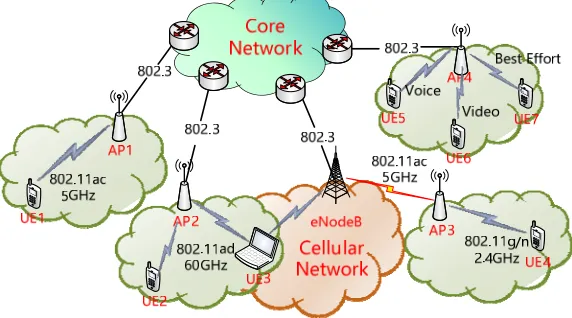
[image:2.612.163.449.514.673.2]VHT Wi-Fi can replace the traditional Gigabit Ethernet. In Fig. 1, AP1 adopts 802.11ac, which works in the 5GHz frequency band, supporting multi-channel spatial stream transmission. AP2 adopts 802.11ad which works in the high frequency band of 60GHz, in which the transmission distance and the signal coverage are greatly affected by the poor penetration of the carrier wave. 802.11ad is mainly used as a high-speed wireless transmission between the devices in a single room, to provide high speed and short distance wireless application services.
Data Traffic Offloading
Through the data traffic offloading technology, switching part of the users’ traffic from the mobile cellular networks to Wi-Fi networks can significantly reduce the data traffic load of the mobile cellular networks. In [7], a more efficient IP streaming technology is proposed by 3GPP. According to the situations of traffic type and network load, the data stream is distributed simultaneously to different wireless access networks. In Fig. 1, UE3 is accessible to the core networks through both AP2 and eNodeB. Another application scenario of data traffic offloading is the Wi-Fi environment, only in which the data traffic is transferred from the crowded 2.4/5GHz band to 60GHz band. In a single room, the limited transmission range of 60GHz band can avoid the inter-network interference. Therefore, Wi-Fi can use 2.4/5GHz band to build up a backhaul transport network connecting rooms with each other, and use 60GHz band to provide the ultra-short-distance bandwidth and high-speed data transmission for the UEs in a single room.
Wireless Backhaul Transport Networks
Traditionally, the backhaul is constructed on the cable network. However, with the dense deployment of APs, not every AP is accessible to wired backhaul. It is because the location and number of wired backhaul have a great influence on the performance of dense deployment networks. Construction costs will go up with the number of wired backhauls increasing. Either a small quantity of backhauls or an unreasonable location planning will limit the ability of backhauls. Within the sight distance, VHT Wi-Fi can serve as wireless backhaul. In Fig. 1, 802.11ac is used to replace Gigabit Ethernet between AP3 and eNodeB and provides backhaul support for 802.11g/n. VHT Wi-Fi is not only able to support a high standard of the network throughput which is a key performance index for backhaul, but also has such advantages as low investment cost, flexible networking and so on.
Multi-user Multiple-input Multiple-output (MU-MIMO) Transmission
The MU-MIMO transmission technology is adopted in downlink according to the 802.11ac protocol. Each AP is equipped with multi-antenna, using beam forming and multiuser diversity techniques, which are used to support the simultaneous data transmission of multiple UEs. 802.11ac defines a new type of transmitting opportunity sharing mechanism, in which a downlink data frame based on the traffic types is divided into different access categories (ACs) of the transmission queue [8]. Different transmission queues allow simultaneous data transmission. For low access levels, the mechanism can reduce delay and load of the transmission queue. In Fig. 1, AP4 provides 3 differentiated and distributed ACs, corresponding to different traffic types, i.e. voice, video, and best effort respectively, to support the simultaneous access to different traffic streams.
Integration Applications of VHT Wi-Fi
The Network Architecture based on SDN
distributed SDN controllers. The SDN controllers are responsible for centralized management of network awareness, access control, routing selection and other network services. The flow table based on OpenFlow protocol is used as a communication interface between the SDN controller and SDN switch. The application layer is composed of many different network services, which can be scheduled and allocated by SDN controllers. The open application programming interfaces (APIs) provide connection between SDN controllers and network services.
Figure 2. SDN based network architecture model.
SDN technology can solve the problems of interference and unbalanced traffic-load distribution in wireless networks. Taking CROWD project as an example [9], 802.11ac network resources, including the air-interface resources and backhaul resources, form a resource pool which can be centrally managed and dynamically allocated by SDN controllers. The SDN controllers are able to obtain real-time network information. Coordination and interaction among multiple SDN controllers can achieve information sharing of network management in a larger range and provide flexible management of network resources. SDN switches can support the local forwarding of data flows to relieve network load pressure. SDN technology can enhance the utilization ratio of 802.11ac network resources and reduce energy consumption. Meanwhile, the SDN collaborative technology can also achieve effective interference coordination as well as load balancing to improve network performance.
Wireless Network Virtualization
service quality and other factors into consideration, provide high-speed and stable services through coordinated multi-point transmission technology.
Data nodes need change to provide services for UEs in UEs mobile process, in order to provide sustained and stable services. NFV technology can solve the problem of mobility in densely deployed wireless scenarios. First, data from the core networks converge on the Wi-Fi management nodes which then forward the data to each data node in infrastructure layer, reducing the core network path conversion probability and transmission delay. Second, with joining the virtual networks, UEs has completed access control, resource reservation and uplink synchronization, which can avoid delay generated by the operations in original handoff process. Third, the context information of users and traffics is shared and synchronized between each node, which can be quickly switched with UEs moving, avoiding complex handoff process.
The Enhanced Authentication and the Fast Handoff
VHT Wi-Fi can use Galois/counter mode protocol (GCMP) instead of CCMP. According to CCMP, UEs accessing network requires implementation certificate authentication and unicast key-agreement. When a handoff occurs, the UE need to implement pre-authentication or re-authentication with the destination AP at first, and then carry out the unicast key agreement between the two sides. Moreover, when UE accesses networks, if an attacker gets the authentication information of clear text and the shared key between UE and AP, he can get the unicast session key through mathematical derivation and decrypt all the cipher text transmitted before. According to GCMP, a UE accessing network requires access authentication, while there is no need for explicit key authentication between UE and AP. Just running a security association on fast handoff enables occurrence of a handoff without re-implementing the authentication or pre-authentication process. In addition, GCMP uses Diffie-Hellman (DH) exchange to generate a new session key. So, the attacker is still not able to calculate the session key because of the elliptic curve DH problem, even if he captures the PSK, the random number and other parameters.
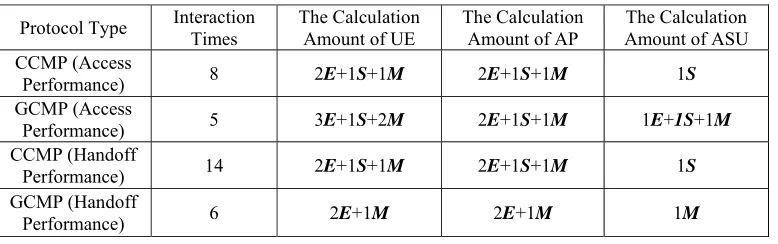
The performance comparison of the two protocols when UE implements accessing and switching processes is shown in Table 1. It is assumed that there is a direct link between AP and authentication service unit (ASU), and the process of sending and
receiving a message is called an interaction. E, S, and M represent a modular
[image:5.612.115.504.599.721.2]exponentiation, a signature computation, and a message integrity code, respectively. According to GCMP, when a UE accesses network, there is single one additional modular exponentiation at sides of UE and ASU each, while totally three interaction processes are saved, which reduces the access delay, compared with CCMP. Therefore, when it comes to a handoff, GCMP is superior to of CCMP in both communication performance and computing performance.
Table 1. Performance comparison of GCMP and CCMP.
Protocol Type Interaction Times
The Calculation Amount of UE
The Calculation Amount of AP
The Calculation Amount of ASU CCMP (Access
Performance) 8 2E+1S+1M 2E+1S+1M 1S GCMP (Access
Performance) 5 3E+1S+2M 2E+1S+1M 1E+1S+1M CCMP (Handoff
Performance) 14 2E+1S+1M 2E+1S+1M 1S
Performance Evaluation
Experimental Platform
The experimental platform uses COTS 802.11a/n/ac standards devices (including APs and UEs). The 802.11ac devices are equipped with the Broadcom BCM4360 dual-band AC chipset which supports as much as three spatial streams and 20/40/80 MHz channels. The 802.11a/n devices are equipped Atheros AR9580 chipset with 20/40MHz channels. The experiments are performed in two environments, Room A
(2×5m2, APs are densely deployed) and Room B (8×15m2, Ps are loose deployed). No
other devices operating in the 5GHz band are observed near the experimental environment. Through network performance test using Iperf, the average values of the maximum throughput of the downlink between AP and UE reach to 700Mb/s (with 802.11ac, on 80 MHz channel), 300Mb/s (with 802.11n, on 40 MHz channel), and 25Mb/s (with 802.11a, on 20 MHz channel).
Coexistence Analysis
1 AP (802.11ac) 2 APs (802.11 n/ac) 1 AP (802.11ac) 3 APs (802.11a/n/ac) 0
100 200 300 400 500 600 700
Experiment Configurations
Thr
oug
hput
(M
b
it
/s
)
[image:6.612.165.410.290.433.2]Total 802.11ac UE 802.11n UE 802.11a UE
Figure 3. Coexistence Analysis among Wi-Fi devices.
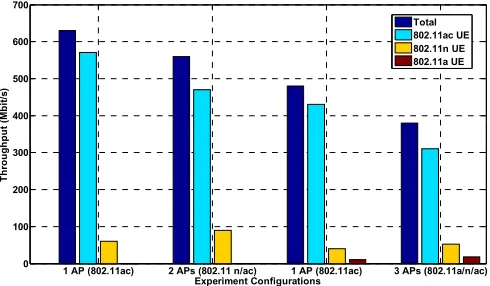
As shown in Fig. 3, in Room A, the performance comparison between one 802.11ac AP accessing UEs including 802.11a/n/ac and 802.11a/n/ac APs each accessing the same model UE is made, in which each UE has the same type of data service. Compared with 802.11ac AP accessing 802.11ac UE, 802.11ac AP accessing 802.11a/n UE would cause serious decrease in total network throughput. Moreover, the decline of accessing 802.11a UE is even more serious than that of accessing 802.11n UE. Even if APs uses non-overlapping channels, the total network throughput of using various modes APs is still low compared to using single one 802.11ac AP in a small and narrow environment. Wi-Fi devices, like 802.11a, poor backward compatibility, having negative impact on network performance, however, can coexist with the new Wi-Fi devices. And just deploying an 802.11ac AP can meet the needs to support high data rate for 802.11n/ac UEs.
Network Interference Analysis
1
2
3 Configuration
5170MHz 5250MHz
AP1 AP2 AP3 AP4
Frequency Domain
A P 2
A P 1
A P 1
A P 3
A P 1
[image:7.612.191.423.68.221.2]A P 4 A P 3
Figure 4. The network configuration of interference analysis.
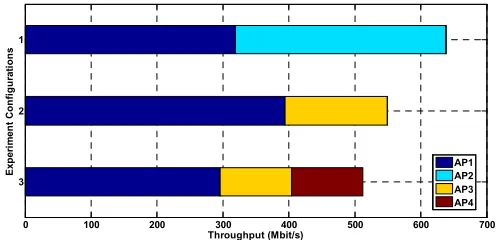
As shown in Fig. 5, AP1 and AP2 reuse 80MHz bandwidth channel in Configuration 1. The interference signal frequency of each AP is the same as the useful signal frequency, which certainly affects the quality of the communication link, resulting in a relatively low signal to interference plus noise ratio and a decrease of 10~15% in the total throughput; in Configuration 2, the transmission channel of AP1 partially overlaps with that of AP3. The presence of co-channel interference also causes the decrease in throughputs of AP1 and AP3. As 802.11ac has the ability to resist interference because of MU-MIMO, the interference in 802.11n is more serious. AP3s throughput decreases about 35~40%. In Configuration 3, the co-channel interference is further aggravated. The throughput of 802.11ac AP is similar to that of 802.11n AP in the case of no interference existing. The throughput of 802.11n AP decreases about 50~55%.
0 100 200 300 400 500 600 700
3 2 1
Throughput (Mbit/s)
E
xp
er
im
ent
C
o
nf
igur
at
io
ns
AP1 AP2 AP3 AP4
Figure 5. Analysis and performance testing of network interference.
[image:7.612.173.422.404.524.2]0 100 200 300 400 500 600 700 800 900 1000 3
2 1
Throughput (Mbit/s)
E
xpe
ri
m
ent
C
onf
igur
at
ions
N/A
[image:8.612.164.431.75.204.2]The Traditional Interference Coordination Interference Coordination based on SDN
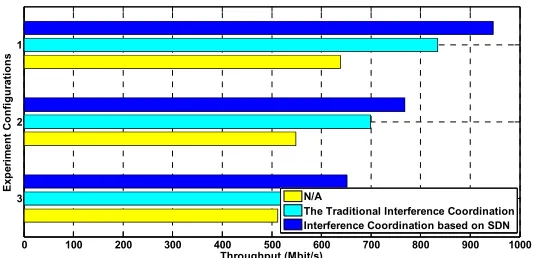
Figure 6. Performance comparison between interference coordination based on SDN and traditional interference coordination.
Handoff Delay Analysis
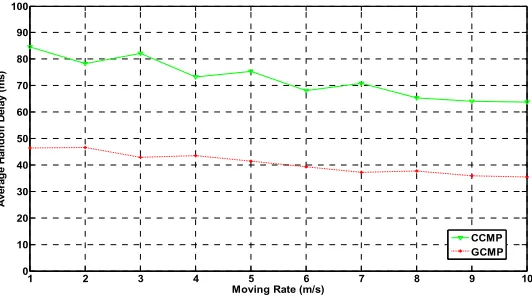
In Fig. 7, the statistical results of UE handoff delay in the scenarios of the traditional and wireless network virtualization are presented. A UE moves at rate of 1~10m/s between Room A and Room B. One 802.11ac AP is deployed in the Room A and Room B each. Combined with NFV technology, VHT Wi-Fi can achieve seamless handoff and a significant reduction of the handoff delay to solve the problem of UEs mobility in dense deployment scenarios. Compared with the low speed of UEs, when UEs mobile rate is higher within a certain range, the performance advantages of the virtual wireless network architecture in the UE become more obvious. This is because with the UEs mobile rate increasing, the time interval of Wi-Fi management nodes to obtain information will be reduced. It can quickly complete the collaboration and interaction, and deal with the UEs fast access and channel allocation in a timely manner. The statistical results of security handover delay according to CCMP and GCMP shown in Fig. 8 demonstrate that GCMP, the handoff delay of which is much less than that of CCMP, can ensure the security and at the same time meet the requirement of fast handoff to support UE to move at a regular speed in VHT Wi-Fi.
1 2 3 4 5 6 7 8 9 10
0 20 40 60 80 100
Moving Rate (m/s)
A
ver
ag
e
H
an
d
o
ff
D
el
ay
(
m
s)
[image:8.612.171.414.476.589.2]Traditional Scene Wireless Network Virtualization
Figure 7: Performance comparison of traditional approach and wireless network side virtualization.
Conclusion
network interference and handoff are tested and analyzed by setting up an experimental environment. Through the analysis and discussion of VHT Wi-Fi network architecture, virtual resource management and mobility management, it is expected to provide support and reference for the network planning of the future wireless networks.
1 2 3 4 5 6 7 8 9 10
0 10 20 30 40 50 60 70 80 90 100
Moving Rate (m/s)
A
ver
ag
e
Han
d
o
ff
D
el
ay
(m
s)
[image:9.612.159.425.135.284.2]CCMP GCMP
Figure 8: Performance comparison of CCMP and GCMP.
Acknowledgement
This work was supported by NSFC under the Grant 61202043.
References
[1] E. Charfi, L. Chaari, L. Kamoun. “PHY/MAC Enhancements and QoS Mechanisms for Very High Throughput WLANs: A Survey,” IEEE Communications Surveys and Tutorials, 2013, 15(4), pp.1714-1735.
[2] R. Cheng. “Performance evaluation of stream control transport protocol over IEEE 802.11ac networks,” Proceedings of IEEE Wireless Communications and Networking Conference Workshops (WCNCW). Istambul, Turkey, 2015: pp.97-102.
[3] D. Ozgun, K. Karabulut, K. Mehmet. “An Energy Consumption Model for 802.11ac Access Points,” Proceedings of International Conference on Software, Telecommunications and Computer Networks (SoftCOM). Split, Croatia, 2014: pp.67-71.
[4] B. Ji, L. Yang. “The Research on Solutions for OBSS Interference Problems in MU-MIMO Transmission Based on VHT WLANs,” Journal of Signal Processing, 2013, 29(1), pp.44-53.
[5] Y. Liao, L. Cao. “Practical Schemes for Smooth MAC Layer Handoff in 802.11 Wireless Networks,” Proceedings of International Symposium on a World of Wireless, Mobile and Multimedia Networks (WoWMoM). Buffalo-Niagara Falls, U.S, 2006: pp.181-190.
[6] H. Rha, H. Choi. “Efficient Pipelined Multistream AES CCMP Architecture for Wireless LAN,” Proceedings of International Conference on Information Science and Applications (ICISA). Suwon, Korea, 2012: pp.1-5.
[9] H. Aliahmad, C. Cicconetti, A. De La Oliva, et al. “CROWD: An SDN Approach for DenseNets,” Proceedings of European Workshop on Software Defined Networks (EWSDN), Berlin, Germany, 2013: pp.25-31.