Issue 5: March 2013
Integrating Learning Development into the Student Experience
Pat Hill
University of Huddersfield, UK
Amanda Tinker
University of Huddersfield, UK
Abstract
‘Embedding skills’ has become an educational buzz word which evokes many different responses. Whilst acknowledging this diversity, this article focuses on the promotion of the integration of skills development into the subject curriculum as theory is put into practice. A range of attitudes towards integrated learning development are discussed and there is an attempt to define the generic principles associated with integration. Different models of embedding are provided through case studies available on a new website developed as part of a university funded Teaching and Learning Project. The journey towards a more strategic level of integration though the course validation process is outlined along with ideas for continued progress.
Keywords: embedding skills; integrated learning development; curriculum design;
student experience; institutional change.
Introduction
Changes to the funding of higher education present new challenges; meeting these challenges requires innovative approaches to enhancing the quality of the student
experience. There is strong evidence that students benefit from the integration of learning development strategies into the core curriculum, and one of the key motivators for
Haggis (2006, p525) contributes another important perspective to the debate when she suggests that the question we ask should be altered from ‘‘What is wrong with this
student?’ to ‘What are the features of the curriculum, or of processes of interaction around the curriculum, which are preventing some students from being able to access this
subject?’’. This is important to learning developers as a whole as it moves the impetus away from the individual student to the realm of curriculum design, thus removing some of the notion of student deficit. It is also important to note that although embedding strategies do not replace the proven value of one-to-one contact, they can reach the majority of students who, for various reasons, do not have the advantage of, or take the opportunity provided, by such provision (Hill et al., 2010).
Putting the theory of embedding or integrating skills development into practice is one of the key themes of this paper. Ursula Wingate, a lecturer in the Department of Education and Professional Studies at King’s College, London, although she deals exclusively with writing skills, provides a useful model for moving integration from theory to practice. Her widely cited article ‘Doing away with ‘study skills’’written in 2006, clearly resonated with the higher education community (Wingate, 2006). She subsequently obtained funding to pilot the embedding of writing skills into modules at her institution and 100% of the academics involved agreed on the effectiveness of the embedded approach for the teaching of writing (Wingate et al., 2011). The current paper details how a student-centred perspective has developed into a more strategic, institutional one; it is also important to note that from an institutional perspective, proponents such as Manalo et al. (Executive summary, 2010) illustrate the advantages of such integration to institutions such as ‘better retention and completion rates’. This is particularly relevant in light of current changes in higher education and the new challenges it brings.
These challenges include increased institutional competition and higher fees, which make the NSS survey on student satisfaction more prominent and raise student expectations in terms of value for money. Employability has also become a more important focus both for students and institutions. In the current economic climate, institutions also need to
increase efficiency in reaching a larger number of students with fewer resources. Craig Mahoney, Chief Executive of the Higher Education Academy, suggests:
support for learning and teaching as prospective students, parents and sponsors expect outstanding learning across the sector (Mahoney, 2011).
As the quality of the student learning experience becomes a focal point, institutions need to promote a philosophy of learning which is not simply based on a transfer of knowledge but which encourages students to develop the ‘skills to allow them to fully participate in the university learning experience, to develop a sense of ‘graduateness’ and to enhance employability’ (Gerrard et al., 2005). Embedding the teaching of such skills into the curriculum, however, requires an institution-wide understanding of the complexities involved in developing skills where context, dialogue, reflection and motivation are key elements; relevance and timeliness being other major factors (Drew, 2004). This
institution-wide approach was strongly advocated by Lisa Ganobcsik-Williams in a report on the teaching of academic writing commissioned by the Royal Literary Fund (Ganobcsik-Williams, 2004). In response to a university wide call for Teaching and Learning projects in 2009, learning developers (LDs)and a senior academic at the University of Huddersfield were successful in gaining funding to examine existing institutional strategies for
integrating learning development into the curriculum in order to enhance the student experience (at the time, the majority of the LDs were named ‘Academic Skills Tutors’ (ASTs) but some have now opted for the term ‘Learning Developer’ and this has been used throughout this article as a more generic term). This paper details the process and key findings of the project along with future directions.
Method
As the investigation across the university began, one pertinent aim was to achieve some understanding of academic staff perceptions and attitudes towards embedding skills development within the curriculum. To this end, a one question, anonymous,
distributed to all LDs and library staff with a request to provide examples of good practice within the Schools to which they were attached. Sent along with this rationale was a skills list of undergraduate and graduate attributes compiled from various sources such as Yorke (2006). A ‘Mapping template’ was also produced which asked subject departments to illustrate where specific skills were practised and, if they were taught, who taught them (See Appendix 2). Not all Schools completed the template, but it was made obvious from the returned templates that some of the skills listed were being required and assessed but not being explicitly taught. Based on the feedback from the templates and LDs, individuals were contacted for details of case study modules where skills have been successfully integrated into the curriculum and it is these case studies that form the basis of the project’s newly developed website: http://embeddingskills.hud.ac.uk/.
The website was created using an open source tool, Drupal (http://drupal.org/). This choice was made after research showed that this tool is freely available, reliable and is
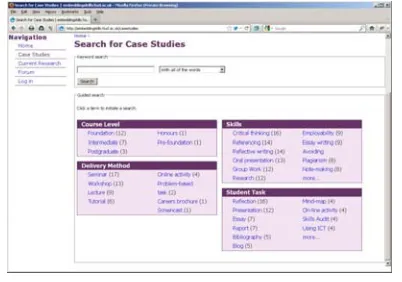
successfully used within the university (http://ipark.hud.ac.uk/). Drupal supports a multi-dimensional, faceted search that is invaluable in dealing with complex case studies, and allows the user to access information from a variety of perspectives. Through an analysis of these case studies a classification scheme was developed based on four facets: course level; delivery method; skill; student task. Through this faceted search, the reader can explore a variety of practices within the university and have access to relevant resources on a whole range of skills. These include all levels from pre-foundation to post-graduate.
Project outcomes
Table 1. Academic perceptions of what ‘embedding skills’ means.
Integrated ‘It can mean different things according to context…but the word 'embedding' implies that something is to be integrated, not added on
at the end or done separately’.
‘Teaching skills as part of academic modules in a particular subject
area rather than teaching them in a generic skills module or through
additional support mechanisms such as Academic Skills Tutors’.
‘This would mean to me that skills are integrated into a curriculum
from start to finish so they have core value and presence in all
individual modules that make up the curriculum’.
Progressive ‘…the integration of critical thinking, to inform study and critical writing, to inform the demonstration of understanding and application
of knowledge, into each stage of a student’s journey through their
degree. Each year stage is different requiring incrementally different
skills’.
‘…the teaching, learning (hopefully!), practice and assessment of
core practical skills. The assessment must be through practical
assignments designed to show proficiency in such core skills,
building them incrementally’.
‘It would seem that generic skills/transferable skills relating to
communication, analysis, interpretation and synthesis for example
are important factors in any discipline at an early stage of the course.
In relation to the area of art and design these need to be developed
in tandem with skills of practice, judgement and critique with the
notion of 'progression'. Quite often 'skills' remain remote if given as
an 'introductory' stage – they should be part of the diagnostic
process in developing the learner and the dialogue that happens in
teaching and learning. The 'curriculum' becomes more flexible and
holistic if 'skills' are related to the innate processes of the discipline
and re-introduced at key stages and as part of the continuing
Implicit or Explicit?
‘…the skills component is not, in general, learnt separately to the
content but is an implicit part of the content. The skills component
might be more explicitly drawn out at various stages, but certainly
wouldn't be learnt on its own to start with, and wouldn't be given
extra space in the curriculum (e.g. a study skills module)’.
‘To me it means providing transferable skills invisibly within the
curriculum. It means ensuring they are there. But it may be implicit
rather than explicit’.
‘If skills are truly embedded students shouldn’t be aware that they
are learning them, as opposed to the subject material, and the
delivery should be by the core academic staff’.
‘…the coursework and exercises in the curriculum would act as
incubation and development of specific skills, not necessarily
explicitly’.
‘It means that the curriculum is written in such a way that the skills
needed to achieve the overall learning outcomes/specific standards
are identified and made transparent’.
Remedial ‘It means cutting back on genuine academic content. It also means patronising our 18-21 year old students with Mickey Mouse bullshit
they’ve already learned in school and patronising our mature
students by treating them like school kids’.
‘Either they should be taught and assessed explicitly (and hence be
part of the curriculum) – and that might be true of chemistry lab skills
– or they should be assumed as part of what any undergrad should
already know – and this applies to most study skills. Of course some
students may lack the latter skills, in which case they need remedial
work – but that is what it is, remedial, not a core content of the
curriculum at university’.
‘For undergrads that come straight from formal education, it means
that their formal education has been insufficient. Students with a
solid set of A levels or equivalent (UCAS entry for my Course is 280)
should, in my opinion, be able to write in grammatically correct
English, have a good understanding of syntax and be able to
have these skills means they miss out on subject content and higher
academic skills whilst academics teach them the difference between
‘weather’ and ‘whether’’.
Putting theory into Practice
‘Simulation is a core process that to me allows me as a professional
to identify that my students are able to link theory to their practice
and are fit for purpose when out in the practical environment...’
‘Ensuring that where related skills are required by the student who
may also be a practitioner, that they are built in with supporting
Theory and Practice at the appropriate point in the programme’.
‘In professional or practice discipline curricula, it means the
integration of ‘practice with theory’ (‘practice (skills) to theory’) and
the linkage of ‘theory to practice’ -Bridging the theory-practice and
practice-theory gap’.
Transferable ‘It means, to me, that whatever items of coursework, projects, presentations etc. that we ask students to do (in relation to specific
learning outcomes or assessment criteria) they will also help develop
key/transferable skills, ideally as a consciously designed element of
pedagogy in relation to previous, adjacent and subsequent tasks’.
‘It refers to a path towards cultural change where the ‘skills’ are
eventually ‘taken for granted’ by the students after applying them as
part of academic study. As an example, use of computers to search
for information is taught to students as part of their course but is not
the prime focus. This is a transferable skill that may be invoked
during any subsequent part of their study’.
‘It means identifying skills such as using the library and internet,
seeking material on a topic, using it in academic work, quoting from it
appropriately and using the Harvard referencing system within a
module which is compulsory but not specifically called 'study skills'.
So they learn the skill in context such as studying social policy. The
challenge is to repeat the skill in another context’.
‘The word ‘skills’ to me, always makes me think of something that
can be used at a later date in employment, after the student has
graduated…we should, (but in many cases don’t) highlight the need
(for PDP purposes). Things like critical thinking, problem solving,
initiative, planning, collaboration etc.’.
‘Knowledge – learning – application – confidence – your skills allow
you to build on forming an identity to enable you to form broader
career prospects with confidence’.
Assessed ‘Clear alignment within the assessment criteria, learning outcomes and assessment task of activity which evidences the skills you’re
trying to embed, together with clear direction on supporting
information within teaching’.
‘Using the core/generic skills, use of appropriate
language/nomenclature, referencing, research skills, appropriate
data analysis, use of IT etc., in a range of activities across a range of
different subjects. I assess them in many of the assignments which I
set (they are part of the marking scheme) however I feel a number of
colleagues pay lip-service to them. I set some challenging
assignments which draw on these core skills, I know exactly what
they have been taught and want to see it used hence doing
assignments like writing up in a journal format etc.’.
These responses show how complex the concept of embedding is, let alone the use of the term ‘skills’. For some, the term evoked a very positive response aligned with professional development, but even these differ in that some colleagues saw it as integrating the development of graduate qualities seamlessly, and even ‘invisibly’ into the programme, whilst others felt it important to identify and record these skills explicitly. The more negative responses perceived a patronising and remedial approach in the move to embed skills. The challenge for LDs is to offer a range of strategies from which different colleagues can choose those which are appropriate and acceptable. Another interesting and important theme coming from the survey was the need for progression as the students move through their degree programme and this became more apparent on scrutinising the returned ‘mapping templates’.
to workloads. The completed template can highlight any omission or repetition and signpost opportunities to embed learning development into the curriculum, providing a more seamless student experience, with skills input from the most appropriate source at the most appropriate time. In analysing the templates, it was apparent that input on skills development was heavily frontloaded with most of the teaching being done in the first year. There was some input in the third year as students approached a major piece of work, such as a dissertation, but in the second year it was clear that although skills were assessed, they were rarely taught. This finding links to research done by Grump (2007) and Schreiner (2010) who found that second year students often experienced particular problems of stress and lack of engagement. Using the templates appeared to highlight gaps and areas of repetition and inefficiency, and the project leaders are now working to promote a more holistic approach to curriculum design.
Case Studies
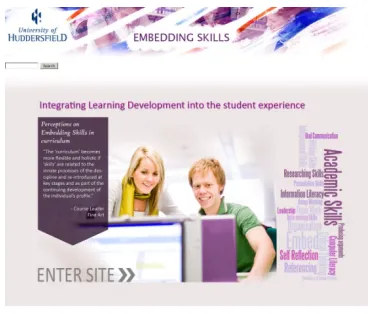
The project discovered many examples of innovative practice which integrate the teaching and learning of skills within the curriculum and it is these case studies that form the basis of the project’s newly developed website http://embeddingskills.hud.ac.uk (see Figure 1).
[image:9.595.204.388.448.605.2]
Figure 1. Home page.
Although the funding for the original project has finished, the team has taken on the
For each chosen case study a template was completed. This template includes a
[image:10.595.198.399.224.365.2]rationale, details of the module, ideas for adaptation, details of the innovators and usable resources. This template is also available on the website for users to contribute new case studies to add to the database. Case study resources include lecture notes, PowerPoint presentations, student activities, assignment briefs, tutor notes and links to valuable websites. The information includes all levels from pre-foundation to post-graduate (See Figure 2 below).
Figure 2. Case study faceted search.
The website also includes a repository of current research on embedding skills which will be updated annually.
A Set of Generic Principles for integrating learning development into the curriculum was extrapolated from research and case studies and these have been included on the
website:
Collaborative
Integrated learning development requires collaboration of all those who are involved in the teaching and learning. This might include course leaders, module tutors, lecturers, learning developers, librarians, technicians, careers advisors and the students
themselves, anyone who can contribute in providing the most effective learning experience for the student.
Holistic
Inclusive
Learning development should be incorporated at all levels of study progressively; it should also cater for different learning styles and needs.
Reflective
Reflection is a crucial element in integrated learning development as it makes the development of skills explicit. It allows students to discover and articulate different aspects of their own learning process. It encourages them to acknowledge strengths but also to recognise areas for development and set short and long terms goals.
Interactive
Learning takes place when students are actively engaged. Integrating learning development requires an innovative, activity-led approach to delivery that allows students not only to practise and develop skills but also the opportunity to develop as independent learners and critical thinkers.
Relevant
Integrated learning development means providing students with the opportunity to develop abilities within the curriculum that are not only relevant to their academic work but also to their future careers.
Timely
Students should be given resources to develop their learning at the appropriate time. This means making space within the curriculum and acknowledging that it might be more beneficial to teach the student how to find facts rather than simply giving the facts.
Table 2. A Set of Generic principles for Integrating Learning Development into the
Curriculum.
Based on these principles, the project leaders are working to achieve the implementation of a progressive, multi-strategy approach for the timely and efficient integration of learning development within the curriculum at all course levels. In order to do this we
…felt that the outcomes of the project emphasised the need to view the
development of a course as a whole rather than being applied on a module basis. This approach would allow teams to capture the overall progression of a student across all taught years whilst identifying any gaps in delivery or duplication assessment. (8 November, 2011,Minute ref.5.3)
They required that in future ‘[Course] Teams should reflect their incorporation of skills development in the Teaching and Learning section of the Programme Specification Document’. This is a significant step forward in encouraging all staff to consider how important it is to give students the opportunity within the curriculum to develop and reflect on the graduate skills that they need. It has also given LDs strategic recognition and support from senior management in their continued efforts to enhance the student experience.
Conclusion and future directions
This article supports the need to integrate skills development within the curriculum. A recent QAA draft for consultation document on the ‘UK Quality Code for Higher Education’ (May, 2012, p.6) promotes ‘The planning and design of learning and teaching activities [which]…provide effective teaching of subject-specific, transferable, practical and professional skills’. Although this has not yet been finalised, it shows a clear direction toward integration. The present article illustrates some of the complexity involved in this by outlining diverse attitudes and also attempts to move forward by bringing together a set of generic principles. Although the article outlines a successful project, it is important to acknowledge the many challenges faced in providing students with the opportunity to develop necessary and relevant skills within the curriculum.
gather evaluative data through staff and student interviews and focus groups. The results will be made available through the embedding skills website which is also to be further developed as part of a national resource through collaboration with ALDinHE.
Acknowledgements
We particularly need to acknowledge the invaluable technical contribution of Vidya Kanara and the management and guidance of Paul Squires (Principal Lecturer and Subject Leader in Textiles).
References
Bloxham, S. (2004) Embedding skills and employability in higher education: an institutional curriculum framework approach. Higher Education Academy [Online]. Available at: http://www.qualityresearchinternational.com/esecttools/esectpubs/bloxhamembeddi
ng.pdf (Accessed: 15 November 2011).
Drew, S. (2004) ‘How do you encourage usage of a computer based writing resource?’, Writing Development in Higher Education Conference. Sheffield Hallam University, Sheffield, . 11-12 May.
Ganobcsik,-Williams, L. (2004) A report on the teaching of academic writing in UK higher education [Online]. Available at:
http://www.rlf.org.uk/fellowshipscheme/documents/TeachingWritingUKHE.pdf (Accessed: 18 January 2012).
Gerrard, C., Tweedie, S. and McVey, D. (2005) Embedding effective learning skills in the curriculum: case studies and interventions. Scotland: University of Paisley.
Haggis, T. (2006) ‘Pedagogies for diversity: retaining critical challenge amidst fears of 'dumbing down'’, Studies in Higher Education, 31(5) pp. 521-535.
Hill, P., Tinker, A. and Catterall, S. (2010) ‘From deficiency to development: the evolution of academic skills provision at one UK university’, Journal of Learning Development in Higher Education, Issue 2, February, pp. 1-19 [Online]. Available at:
http://www.aldinhe.ac.uk/ojs/index.php?journal=jldhe&page=article&op=view&path %5B%5D=54&path%5B%5D=38 (Accessed: 21 May 2012).
Mahoney, C. (2011) HEA response to 2011 National Student Survey [Online]. Available at: http://www.heacademy.ac.uk/news/detail/2011/NSS_results_2011_comment_Craig
_Mahoney(Accessed: 18 January 2012).
Manalo, E., Marshall, J. and Fraser, C. (eds.) (2010) Student learning support programmes that demonstrate tangible impact on Retention, Pass Rates and
Completion. Aotearoa (N.Z.): Ako Aotearoa Northern Regional Hub.
QAA (2012) UK Quality code for higher education. Chapter B3: Learning and Teaching. Draft for consultation, May 2012. Available at:
http://www.qaa.ac.uk/Publications/InformationAndGuidance/Pages/learning-teaching-consultation.aspx (Accessed: 25 June 2012).
Schreiner, L. (2010) ‘Factors that contribute to sophomore success and satisfaction’, in Hunter, M., Tobolansky, B., Gardner, J., Evenbeck, S., Pattensgale, J., Schaller, M. and Schriver, L. (eds.), Helping sophomores succeed: understanding and improving second-year experiences. San Francisco: John Wiley and Sons, pp. 43-65.
Tariq, V., Scott, E.M., Cochrane, A.C., Lee, M. and Ryles, L. (2004) 'Auditing and mapping key skills within university curricula', Quality Assurance in Education, 12(2), pp. 70-81.
Wingate, U. (2006) ‘Doing away with ‘study skills’’, Teaching in Higher Education, 11(4), pp. 457-469.
Wingate, U., Andon, N. and Cogo, A. (2011) 'Embedding academic writing instruction into subject teaching: a case study', Active Learning in Higher Education, 12(1), pp. 69-81.
Yorke, M. (2006) ‘Employability in higher education: what it is –what it is not’. Learning and Employability Series One. York: Higher Education Academy [Online] Available at: http://www.heacademy.ac.uk/assets/documents/tla/employability/id116_employabilit y_in_higher_education_336.pdf (Accessed: 10 February 2012).
Author details
Dr Pat Hill is a Senior lecturer and Academic Skills Tutor in the School of Music, Humanities and Media at the University of Huddersfield. She chairs a Task and Finish Group on embedding skills that is part of the ALDinHE Continuing
Professional Development working group.
Appendix 1 Initial Survey via LDs
Promoting the Integration of Learning Development into the Student Experience.
What we hope to achieve:
To inform, encourage and support academic staff in embedding learning development within the curricula.
To produce a repository of good practice.
The first step is gathering information
ASTs – What is happening in your School? Library staff – What are you involved in? Survey of academic staff
Rationale:
This project is underpinned by the idea of a student experience which develops attributes which will enable students at all levels to make the most of their study and prepare them for future employment.
Whilst valuing interventions and opportunities offered to students in such forms as
Academic Skills provision; PDP; Personal Tutoring; and PAL, this project is exploring ways that learning development can be embedded within the curriculum. This embedding is designed to eliminate problems associated with engaging students in learning
development by incorporating activities into their mainstream activities.
Embedding does not mean simply including these abilities in learning outcomes but
specifically designing opportunities for development within a module and providing
the necessary input or guidance to enable such development.
The survey is designed to elicit examples of good practice which can be used to develop a framework and toolkit to encourage and enable colleagues to include learning
development within modules. The following is a list of undergraduate and graduate skills and attributes; it has been compiled from various sources but is not exhaustive so feel free to add to the list if necessary. Identify where these skills are taught and how; this may be already fully or partly embedded or bolt-on:
critical thinking self-reflection note-making skills information literacy
oral communication formal writing skills interpersonal skills,
identifying and solving problems leadership computer literacy
Appendix 2
Mapping Template
TT = Taught by module tutor
TAS = Taught by Academic Skills Staff P = Practised
LS = Input from library staff
(The current version also includes A =Assessed)
LEVEL:
Module Titles Module Module Module Module Module Module
Critical Thinking
Self-reflection
Note-making skills
Oral communication
Formal writing skills
Interpersonal skills
Identifying and solving problems
Leadership
Teamwork
Organisation Producing an
argument
Referencing
Information literacy