2016 International Conference on Manufacturing Science and Information Engineering (ICMSIE 2016) ISBN: 978-1-60595-325-0
Accelerating Convergence Method for
Relaxation Cooperative Optimization
JING CHEN, YU CHAO LV and LI MIN WANG
ABSTRACT
To solve problems of higher computational cost and lower convergence speed in collaborative optimization, a new relaxation cooperative optimization method of accelerating convergence is presented. The optimizations in this method are divided into two stages. In the accelerating convergence stage, the calculation method of relaxation factors is improved, relaxation factors are constructed according to the inconsistent information between each disciplinary optimal solution and their average value; in the optimization solving stage, the optimal solution in the former stage is taken as the initial point, relaxation factors with consistent precision are collaboratively optimized to obtain the final optimal solution. Finally, this optimization method is tested by a typical numerical example. Experimental results show that this method can reduce the computational cost and accelerate the convergence speed greatly.1
INTRODUCTION
Collaborative Optimization Method [1] is an efficient and widely used multidisciplinary design optimization method. But it also has some shortcomings, such as, the consistency equality constraints in system level optimization are ideal [2]. System optimization is difficult under the condition of consistency equality constraints, thus the feasible region of system level optimization may not exit[3]. In addition, many research results show that the optimization results of the CO are sensitive to the initial point’s selection and easily converged to the local optimal solution [4]. To solve these problems, the literature [5] proposed a relaxation factor method which change the equality constraints into inequality constraints. Two cases
Jing Chen College of Mechanical and Control Engineering, Guilin University of Technology, Guilin Guangxi China 541006
were analyzed separately in literature [6] when the initial points are inside or outside the feasible region. When the initial points are in the system feasible region, the dynamic relaxation factor method is invalided.
At present, the studies of CO method basically solved the problems of the inexistence of the feasible region in system level optimization and the sensitivity to initial point selection, but CO method still have problems of higher computational cost and lower convergence speed. Aiming at these problems, the relaxation factor calculation method is improved, a kind of accelerating convergence relaxation collaborative optimization (ACRCO) method put forward, and verified by an example in this paper.
1 ACCELERATING CONVERGENCE RELAXATION COLLABORATIVE OPTIMIZATION
To solve the problems of large calculate cost and low efficiency in the CO method. ACRCO method is proposed in this paper, which definite the inconsistent information between each disciplinary optimization solution and their average value to measure the degree of inconsistency among different disciplines. To avoid ACRCO method’s sensitivity to the initial point’s selection, the progressive relaxation in literature [4] is borrowed to divide the ACRCO method into the accelerating convergence stage and the optimization solving stage. Furthermore, taking the optimal solution of accelerating convergence stage as the initial point of the solving optimization stage.
1.1Accelerating Convergence Stage
As the collaborative optimization, the distance between each disciplinary optimization solution and their average value is gradually shortened, which means the degree of inconsistency among different disciplinary optimization solutions is lower. Therefore, the inconsistent information between each disciplinary optimization solution and their average value can also be used to measure the degree of inconsistency among disciplines. In this paper, the relaxation factor calculation method is improved, relaxation factors are constructed according to the inconsistent information between each disciplinary optimal solutions and their average value. The specific calculation method is as follows:
To define the inconsistent information between each disciplinary optimization solution and their average value as follows:
z x
h *i (1)
Use the relaxation factor calculation method in literature [2] and the calculation formula is:
( ) ;0.52 1
s h (2) Where µ is constant coefficient, and this value can guarantee the system level optimization go to the direction of reducing the inconsistent information among disciplines.
To ensure every subject is within the scope of the relaxation, h in form (2) should take the maximum value of the inconsistent information that between each disciplinary optimization solution and their average value.
Due to there are n inconsistent information between each disciplinary optimization solution and their average value. The numbers of inconsistent information among disciplines is n (n-1)/2. The computational complexity of maximizing n numbers is O (n), and the computational complexity of maximizing
n (n-1)/2 numbers is O (n2), By contrast the numbers of inconsistent information with the computing complexity of maximum value, the improved calculation method of the relaxation factors can effectively reduce the computational cost and the computing time, improve the efficiency of optimization.
1.2 Optimization Solving Stage
In the optimization solving stage, the optimal solution in accelerating convergence stage is taken as the initial point, static relaxation factor method is adopted to improve the collaborative optimization, and finally get the global optimal solution. The initial points have been in the nearby area of the global optimal solution, which prevent optimization to fall into a local optimal solution, and greatly reduce the iteration times[4].
The key of static relaxation factor method is selecting reasonable relaxation factors. Research in literature [7] shows that when the relaxation factor is 10-4, it not only guarantee the accurate optimization results and reasonable convergence time, but also reduce the system level optimization difficulty, satisfy the consistency among different disciplines. Therefore, the relaxation factor is selected as 10-4 in the optimization solving stage. Similarly, we can choose relaxation factors of different orders of magnitude depending on the actual problem.
2 EXAMPLE
2 1 . 0 4 1 . 0 . . ) ( 2 1 2 2 1 1 2 2 2 1 x x g x x g t s x x minf x (3)
After joining the relaxation factor, it converted to CO model which including a system level optimization model and two subject level optimization models.
The system level optimization model:
s z x z x J s z x z x J t s x minf * 22 2 * 21 1 * 12 2 * 11 1 2 2 2 1 2 2 2 2 2 1 ) ( ) ( ) ( ) ( ) ( ) ( . . x ) ( x x x (4)
Subject 1 optimization model:
4 1 . 0 . . ) ( ) ( )
( 2 2
1 12 11 * 2 12 * 1 11 z z t s x z x z z minJ 1 (5)
Subject 2 optimization model:
2 . . ) ( ) ( ) (
min 2 2
2 22 21 * 2 22 * 1 21 2 z 0.1z t s x z x z z J (6)
Literature [8] gave the optimization results: x1=0.198, x2=1.980, f(x) =3.9596. In order to verify that ACRCO method is efficient and feasible in all cases, this article selects four representative initial points.
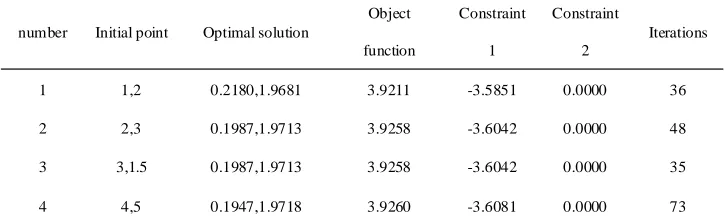
The initial point 1 and point 2 are within the feasible region while initial point 3 and point 4 are outside the feasible region. In ACRCO, take µ=0.8, respectively using standard CO method, dynamic relaxation method of CO and ACRCO method to optimize the numerical example.
TABLE I. OPTIMIZATION RESULT OF CO METHOD.
TABLE Ⅱ. OPTIMIZATION RESULT OF DYNAMIC RELAXATION CO METHOD.
TABLE Ⅲ. OPTIMIZATION RESULT OF ACRCO METHOD.
By the optimization results of table 1, the standard CO method cannot optimize the initial points which are within the feasible region, but can optimize the initial points which are outside the feasible region to the extreme value points near the initial points, which means CO method is sensitive to the initial point selection. It can only function on the initial points which are outside the feasible region and the optimization results are imprecise. By the optimization results of table 2, dynamic relaxation CO method also cannot optimize the initial points which are within the feasible region, but can optimize the initial points which are outside the feasible region to the local extremum points who are close to the globally optimal solution,
number Initial point Optimal solution
Object
function
Constraint
1
Constraint
2
Iterations
1 1,2 1.0000,2.0000 5.0000 -2.8000 0.1000 1
2 2,3 2.0000,3.0000 13.0000 -1.7000 1.2000 1
3 3,1.5 3.0197,1.6980 12.0018 -0.8105 0.0000 10
4 4,5 3.7911,2.0815 18.7051 0.0000 0.4606 54
number Initial point Optimal solution
Object
function
Constraint
1
Constraint
2
Iterations
1 1,2 1.0000,2.0000 5.0000 -2.8000 0.1000 1
2 2,3 2.0020,3.0000 13.0000 -1.7000 1.2000 1
3 3,1.5 0.2767,2.0241 4.1735 -3.5209 0.0517 30
4 4,5 0.5569,1.9435 4.0877 -3.2487 0.0000 44
number Initial point Optimal solution
Object
function
Constraint
1
Constraint
2
Iterations
1 1,2 0.2180,1.9681 3.9211 -3.5851 0.0000 36
2 2,3 0.1987,1.9713 3.9258 -3.6042 0.0000 48
3 3,1.5 0.1987,1.9713 3.9258 -3.6042 0.0000 35
[image:5.612.115.473.102.215.2] [image:5.612.115.474.259.370.2] [image:5.612.115.479.411.523.2].this optimization has low accuracy and large computational cost. The optimization results of table 3 show that four initial points are optimized to the nearby area of global optimal solution by ACRCO method. This optimization has good stability, high precision, fewer iteration times and higher efficiency. All the three methods meet the constraint conditions, which indicates that they have good feasibility.
3 CONCLUSIONS
In view of the current high computational cost and low efficiency in the CO optimization process, ACRCO optimization method is proposed. In accelerating convergence stage, using the averaging ideas to structure relaxation factors, accelerating the initial points which are far from the optimal solution to converge to the nearby area of the global optimal solution, reducing the computational cost. In optimization solving stage the static relaxation factor method is adopted, using the optimal solution in the former stage as the initial point to further speed up the convergence speed of the system, enhance the consistency among disciplines and guarantee the feasibility of this method. Finally, the stability and effectiveness of ACRCO method is verified by a typical numerical example.
REFERENCES
Haiyan Li, Ma Mingxu, Jing Yuanwei, et al. Improved multidisciplinary collaboration with global stability [J].Computer Integrated Manufacturing Systems,2009,15 (12):2363-2369 (in Chinese) .
Xiang Li, WeiJi Li. Collaborative optimization based on inter-disciplinary inconsistency information and its application to mechanical system design [J].Journal of Northwestern Polytechnical University,2003,21 (4):461-464.
Dongqin Li, Yongxiang Yang, Zhitong Chen. Improved collaborative optimization algorithm and its application [J].Computer Engineering and Science.2013,35 (01):137-141.
Yapeng Fang, Xinlong Chang, Kuan Hu, et al. Collaborative Optimization Based on Asymptotic Relaxation[J].Journal of Shanghai Jiao tong University.2013,47(12):1896-1899.
Alexandro N M, Lewis R M. Analytical and computational aspects of collaborative optimization for multidisciplinary design [J].AIAA Journal.2002,40 (02):301-309.
Haiyan Li, Yongjin Li, Ying Tian. Analysis and Improvement on Algorithm of Collaborative Optimization [J].Journal of Shenyang University.2013,25 (06):462-465.
Qingguo Wen, Baowei Song, Peng Wang. Some problems of collaborative optimization based on iSight [J].Journal of Northwestern Polytechnical University,2013,31 (1):145-149.