Client experiences of receiving adapted
Dialectical Behaviour Therapy (DBT) and
its perceived role in the process of change
Jasmine Childs-Fegredo
u1218817
A thesis submitted in partial fulfilment of the requirements of the
School of Psychology, University of East London, for the Degree of
Professional Doctorate in Counselling Psychology
ii Abstract
Research into Dialectical Behaviour Therapy (DBT) has been dominated by the neo positivist paradigm providing clinical practice with a sufficiently robust evidence base for DBT as an intervention, reporting positive outcomes with regards to reducing symptoms of Borderline Personality Disorder (BPD). However, in recent years, DBT has been adapted and replicated to different client groups, offering potential for new research into transdiagnostic applications and adapted versions of DBT to different settings.
Recent literature concludes that there is less practice-based evidence on the process of change in DBT, and which components are useful. The client voice is lacking in the literature, which would provide services with evidence and unique insights into how the therapy works and for whom.
This study aims to address these questions, by asking the clients how they experience DBT and its perceived role in the process of change. Furthermore, the study focusses on client experience in a private hospital setting with a transdiagnostic group of an adapted 12 week DBT programme.
Interpretative Phenomenological Analysis (IPA) was applied as the methodology,
incorporating descriptive, linguistic and conceptual elements in analysis of semi-structured interviews. The sample consists of five participants whom had completed a 12 week DBT programme at a private hospital.
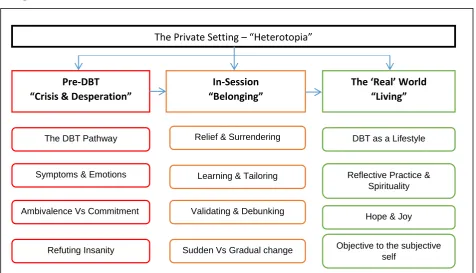
Three master themes were identified, namely ‘Pre DBT: Crisis & Desperation’; ‘In-session: Belonging’; and ‘The Real World: Living’. Each master theme was characterised by 4 sub-themes, illustrating the journey of the participants and the perceived process of change. All themes were conceptualised by the overarching theme ‘The private setting: Heterotopia’, giving voice to the role of the context of the private psychiatric setting.
The research findings illustrate that this version of DBT was a helpful and positive
iii
Acknowledgements
I placed a keen emphasis on wishing to contribute to the field of DBT through this piece of research, and therefore attended the annual conference of the ‘Dialectical Behaviour Therapy Society in Britain and Ireland’, in Dublin last year. There I was lucky to meet Dr Christine Dunkley, to whom I should like to thank for putting me in good stead to draw good
conclusions from my qualitative study.
I also want to thank Dr Lane Pederson, who I was very fortunate to meet online, following reading some of his and Dr Thomas Marra’s research. Thanks also to my supervisors Dr Edith Steffen and Dr Lisa Fellin for their ongoing support.
None of this would have been possible without the good will of my participants. Thank you so much for not only managing your own recovery processes, but also finding the time to contribute to the field of DBT.
I would like to extend thanks to the inpatients on the ward with whom I worked prior to embarking on the Doctorate for Counselling Psychology, and whose vibrancy and character inspired me to uncover more about their lifeworlds and the therapy they were receiving.
iv CONTENTS
Abstract ii
Acknowledgements iii
Glossary viii
List of figures and abbreviations used xi
INTRODUCTION 1
i. Reflexivity 1
ii. Introducing DBT as a treatment for BPD 3
iii. DBT and its underpinnings 3
iv. The current study 5
1.0 CHAPTER ONE 6
Literature Review
1.1 Search strategy 6
1.2 Evidence-based practice and the efficacy of DBT 6 1.3 Practice-based evidence and the client voice 11
1.4 Adaptations and settings 13
1.5 The process of change 16
1.6 Summary and rationale for current study 19
1.7 Research Questions 19
2.0 CHAPTER TWO 20
Methodology
2.1 Introduction 20
2.2 Nature of the study 20
2.2.1 Rationale for qualitative study 20
2.2.2 Interpretative Phenomenological Analysis 21
2.3 Epistemological Considerations 23
2.3.1 Phenomenology and IPA 24
v
2.3.3 Epistemological standpoint 26
2.4 Reflexivity 27
2.4.1 Epistemological reflexivity 27
2.4.2 Personal reflexivity 29
2.5 Procedures 30
2.5.1 Context 30
2.5.2 Sampling and participants 31
2.5.3 The adapted DBT programme 33
2.5.4 Recruitment 34
2.5.5 Pilot work 34
2.5.6 Interview procedure 35
2.5.7 Ethical considerations 35
2.5.8 Ethical Amendments 37
2.5.9 Transcription & Analytic strategy 37
2.5.1.1 Trustworthiness, Reliability, Validity and Rigour 37
2.6 Summary 38
3.0 CHAPTER THREE 39
Analysis
3.1 Introduction 39
3.2 Master Theme 1 – Pre-DBT: ‘Crisis & Desperation’ 40
3.2.1 Sub-theme one: ‘The DBT Pathway’ 41
3.2.1.1 Summary of sub-theme one 45
3.2.2 Sub-theme two: Symptoms & Emotions 45
3.2.2.1 Summary of sub-theme two 47
3.2.3 Sub-theme three: Ambivalence Versus Commitment to therapy 47
3.2.3.1 Summary of sub-theme three 51
3.2.4. Sub-theme four: Refuting Insanity 51
3.2.4.1 Summary of sub-theme four 54
3.3 Master Theme 2 – In-Session – ‘Belonging’ 54 3.3.1 Sub-theme five: Relief & Surrendering 55
vi
3.3.2 Sub-theme six: ‘Learning & Tailoring’ 59
3.3.2.1 Summary of sub-theme six 63
3.3.3 Sub-theme seven: Validating & Debunking 63
3.3.3.1 Summary of sub-theme seven 67
3.3.4 Sub-theme eight: Experiencing (Gradual versus Sudden) change 68
3.3.4.1 Summary of sub-theme eight 71
3.4 Master Theme 3: The ‘Real’ World: ‘Living’ 71
3.4.1. Sub-theme of nine: DBT as a Lifestyle 71
3.4.1.1 Summary sub-theme nine 74
3.4.2 Sub-theme ten: Reflective Practice & Spirituality 74
3.4.2.1 Summary of sub-theme ten 76
3.4.3 Sub-theme eleven: Hope & Joy 77
3.4.3.1 Summary of sub-theme eleven 78
3.4.4. Sub-theme twelve: The objective to the subjective self 78
3.4.4.1 Summary of sub-theme twelve 80
3.5 Overarching Theme - The Context 80
3.5.1 The Private Setting: ‘The Heterotopia’ 80
3.6 Summary of findings 83
4.0 CHAPTER FOUR 85
Discussion
4.1 Introduction 85
4.2 Synthesising the DBT Experience 85
4.2.1 The Clients’ experience 85
4.2.2 Potential harm through other treatment models 86
4.2.3 The role of the therapists 87
4.2.3.1 Therapist Self-Disclosure 88
4.2.3.2 Therapist training, support and self-care 88
4.3 The Process of Change 90
vii
4.3.2 Spirituality 91
4.3.3 The self & identity 92
4.4 Application of DBT to a Transdiagnostic Group 92
4.5 Adapted DBT 94
4.5 The Private Healthcare Setting 95
4.5.1 Private Health Insurance 95
4.5.2 The Heterotopia 96
4.6 Limitations 97
4.7 Summary of discussed findings 98
4.8 Final comments on reflexivity & conclusive remarks 99
5.0 References 101
6.0 Appendices 119
6.1 Appendix A Interview Schedule 119
6.2 Appendix B Participant Information Sheet 120
6.3 Appendix C Participant consent form 122
6.4 Appendix D Participant demographics 123
6.5 Appendix E Ethical practice checklist – academic 124 6.6 Appendix F Ethical clearance letter – clinical 127
6.7 Appendix G Ethical amendment I 128
6.8 Appendix H Ethical amendment II 131
6.9 Appendix I Example of sub-theme development from
[image:7.595.84.488.70.674.2]viii GLOSSARY
Acting Opposite a DBT skill which teaches clients to act in the opposite way to an emotion’s action urge with the aim of reducing the intensity of the emotion. E.g. a person feeling depressed would have the urge to withdraw. Acting opposite would be to reach out in some way to others, such as making a telephone call or being around people.
Behavioural Chain Analysis
a technique designed to help a person understand the function of a particular behaviour. During a chain analysis of a
particular problem behaviour (for example, self-harm), a person tries to uncover all the factors that led up to that behaviour in a step by step diagram of events and emotions.
Dialectical i. The process or art of reasoning through discussion of conflicting ideas.
ii. the notion that two opposing ideas can be true at the same time. In DBT, there is always more than one way to think about a situation, and all people have something unique and different to offer. A life worth living has both positive and negative aspects (happiness, sadness, anger) and all of these aspects are necessary and valuable. Dialectics allows for a balance between acceptance and change, both of which are necessary for
establishing a fulfilling life.
Distress Tolerance i. skills which are used when it is difficult or impossible to change a situation. Their aim is to help individuals cope and survive during a crisis, and tolerate short term or long term pain (physical or emotional).
ix
Emotion regulation i. learning to understand how emotions work, and the skills needed to manage emotions as opposed to being managed by them. Includes how to reduce vulnerability to negative emotions, and to build positive emotional experiences.
ii. the name of one of the 4 core modules of DBT.
Heterotopia literally meaning 'other places'. A diverse concept that describes a world misaligned with respect to normal or everyday space, elaborated by philosopher Michel Foucault (1966) to describe places and spaces that function in non-hegemonic conditions.
Interpersonal Effectiveness
i. refers to the skills which help us to: Attend to relationships. Balance priorities versus demands. Balancing the 'wants' and 'shoulds' to build a sense of mastery and self-respect.
ii. the name of one of the 4 core modules of DBT.
Mindfulness i. based in Eastern Zen philosophy, and includes Western contemplative practices. An awareness of thoughts, feelings, behaviours, and behavioural urges through their constant observation.
ii. The name of one of the core 4 modules of DBT.
Non-suicidal self-injury
(NSSI)
deliberately injuring oneself without suicidal intent. The most
x
Radical acceptance complete acceptance of the things (traumas) that cannot be changed. It is acceptance from the depths of the soul, with heart and mind. It is the decision to stop fighting reality, thereby causing less suffering.
Validation To confirm, to verify, to authenticate – emotions and experience.
xi
List of figures and abbreviations used
Figures
Figure 1.0 Analysis of themes Page 33
Abbreviations used
ACT Acceptance and Commitment Therapy APA American Psychiatric Association BCA Behavioural Chain Analysis BPD Borderline Personality Disorder BPS British Psychological Society CPA Care Programme Approach
CPD Continuous Professional Development DBT Dialectical Behaviour Therapy
DCOP Division of Counselling Psychology
DSM Diagnostic and Statistical Manual of Mental Disorders HCPC Health & Care Professions Council
IPA Interpretative Phenomenological Analysis NHS National Health Service
NICE National Institute of Clinical Excellence OCD Obsessive Compulsive Disorder
1
INTRODUCTION
When thinking about undertaking a piece of research into the complex matrix of
psychological therapy, I felt that the main aim was to contribute to the field of Counselling Psychology, whilst also doing justice to the voices of the clients we work with. As a fourth year doctoral student, I have spent 5 years working in mental health in a variety of settings and with a variety of client groups. Nothing feels more poignant in this work than the wellbeing of the clients, and the messages they give us constantly about the treatment and care they experience within mental health services. I feel that it is the clients to whom we owe so much – for their insight, their knowledge, their inner experiences – which reveal what really occurs in mental health services, and how we as professionals can learn to improve. This study is a qualitative piece of work, and as such, reflexivity of the researcher runs fluidly throughout.
i. Reflexivity
My interest stems from the time I was employed as a Psychology Assistant prior to my training on the Doctorate for Counselling Psychology. I was working on a low secure inpatient ward in a private hospital, for females diagnosed with Borderline Personality
Disorder (BPD). Clients would be admitted having spent years of their lives in hospital, most often on section under the Mental Health Act, with a history of being ferried around
psychiatric services from one treatment modality or pharmacological intervention to the next. Typical behaviours would include self-harm or self-mutilation, insertion of objects into the skin, absconding, suicide attempts, substance misuse and comorbid eating disorders. Admissions were of one year or 18 months in duration, with Dialectical Behaviour Therapy (DBT) as the therapeutic intervention. I would work 12 hour shifts on the ward, managing risk by keeping patients1 safe and dealing with issues around self-harm and other problem behaviours, carrying out daily activities, and delivering some of the DBT groups such as Mindfulness – whilst developing good therapeutic relationships. This work provided me with an invaluable immersive experience to understanding the lifeworlds of those diagnosed with BPD. Working in close proximity to highly distressed individuals did not come without its
1 The term ‘client’ is accepted in the field of Counselling Psychology as a term to describe people engaged with
2
challenges (Perseius, Kaver, Ekdahl, Asberg & Samuelsson, 2007), sparking intrigue and enthusiasm to delve deeper into understanding the lifeworlds of those taking part in DBT. My phenomenological intrigue was in contrast to what appeared in the literature to be a misrepresented group of clients, whose voice was less present and was largely characterised by Randomised Control Trials (RCTs) within the quantitative paradigm as evidence-based practice. As an untrained professional at the time, I was hungry for knowledge as to ‘what to do’ in my role as a healthcare worker, and would have welcomed reading research outcomes on how to adopt and facilitate a therapeutic stance with this client group (Liebenluft,
Gardener & Cowdry, 1987). Furthermore, the depth of the clients’ knowledge about their own conditions and engagement with the therapy was impressive to me, but not reflected adequately in the literature. The clients would talk insightfully and at length about their experiences in psychiatric services, with a deep understanding of what worked and did not work for them. Central to my interest was to understand more about DBT as the treatment of choice for BPD clients, who prior to the 1980s, were cast aside as either difficult or
impossible to treat. This led to my interest in DBT in general, not only for BPD, but for others diagnosed with different disorders by our medical healthcare system. It seemed that both therapists and clients could benefit from knowledge on what it is like for people to experience DBT in various contexts.
I undertook reflexivity to consider my positioning as a healthcare worker within a
3
interested in DBT and the way in which it was pivotal in the process of change. I realised that a qualitative piece of research should aim to encompass all these positions and tensions which I was attempting to hold and embody. In the methodology chapter of this thesis, I address researcher bracketing and how these tensions and prior experience come to influence the construction of data within a qualitative study.
ii. Introducing DBT as a treatment for BPD
DBT is a model of psychological therapy developed in the 1990s by Marsha Linehan (1993a, 1993b & 2015), an American psychologist with a former diagnosis of BPD. Up to this time, mental health services were having difficulty finding effective treatments for highly suicidal individuals, who would present to services with a pervasive pattern of impulsivity, unstable affect, interpersonal dysfunctioning and identity instability (American Psychiatric
Association (APA), 2013) usually with a diagnosis of BPD.
RCTs were launched in the 1990s to investigate the efficacy of DBT for this client group (Linehan, Armstrong, Suarez, Allmon & Heard, 1991; Linehan, Heard & Armstrong, 1993). They indicated positive outcomes, reporting significant reduction in suicidal and non-suicidal self-injury (NSSI; Koerner & Linehan, 2000). Given the long history of finding a treatment model that is effective for treating people at this severe end of the mental health spectrum, this revealed a revolutionary advancement in finding an effective therapeutic intervention for suicidal individuals and helping them build a life worth living.
iii. DBT and its underpinnings
DBT is a complex psychological intervention developed using some of the principles of Cognitive Behavioural Therapy (CBT) in combination with mindfulness-based and systemic strategies. These principles of the therapy are based on the notion of the biosocial theory (Linehan, 1993a & 1993b), whereby it is accepted that people who suffer with severe symptoms have a genetic predisposition to emotion dysregulation, coupled with an invalidating childhood environment to hold or heal any trauma which may occur. This double bind means that those predisposed to emotional dysregulation and suffer early trauma, such as severe neglect or abuse, will most likely develop symptoms of BPD or other mental health issues (Linehan, 1993a & 1993b; Linehan, 2015). From a phenomenological
4
to the wish of an end to suffering, perceived to be achievable only through suicide, or other behaviours aimed at alleviating pain even if for a short period of time.
Initially DBT was a treatment of one year to 18 months in duration, usually in inpatient settings for people who have had a long history of suffering with symptoms that have led to them feeling suicidal for most of their lives. Whilst adaptations of this model now exist, the fundamental principles and teaching of skills will pervade most new replicas. The model is comprised of four modules namely Mindfulness, Emotion Regulation, Interpersonal
Effectiveness and Distress Tolerance (Linehan, 1993b & 2015). These core modules aim to equip clients with the skills they need to deal with the pain associated with living with disorganised and painful emotions and those impulsive behaviours aimed at alleviating difficult lifeworlds. DBT takes the seriousness of these presentations in a validating and thorough manner, by offering individuals four modes of intervention – group therapy,
individual psychotherapy, phone calls and consultation team meetings (Linehan, 1993b). The principle of ‘acceptance versus change’ is fundamental to DBT, tying in the Eastern Zen approach through mindfulness to the challenging aspects of altering problem behaviours such as NSSI.
DBT has now been widely accepted as the treatment of choice for BPD (Linehan, 1993b & 2015) and has been incorporated into the National Health Service’s (NHS) National Institute for Health and Care Excellence (NICE) guidelines:
‘an intensive psychological treatment that focuses on enhancing a person’s skills in
regulating their emotions and behaviour. It aims to address and alter patterns of behaviour by finding a balance or resolving differences (this is what is meant by ‘dialectical’).’ (NICE Guidelines, 2009b).
5
regards to ideas for policy making and suggestions for improvement with the view that DBT would be better placed at the fore of mental health care provision.
The DBT Society in Britain and Ireland held their annual conference in December 2015, the title of which was ‘Journeys - Adapting and Adopting DBT’. This concept is very much at the forefront of questioning the delivery of DBT in current healthcare settings (Swales, Taylor & Hibbs, 2012). In this regard, the importance of continuous research into all such replicas is well documented, to add to the increasing evidence base of what elements of DBT work for whom, how, and in which settings.
iv. The current study
6
CHAPTER ONE
Literature Review
Introduction
The literature review will aim to present and critically evaluate the research that has been undertaken in the field of DBT to date, with a particular focus on the areas which pertain to the research questions. I will attempt also to give the literature a critical realist but
phenomenological voice, which is in line with my current stance as a researcher and the positioning of the work and methodology. The research into DBT was largely represented by the quantitative neo-positivist paradigm until more recently. There is therefore some tension regarding research which presents DBT as a form of evidence-based practice as opposed to practice-based evidence, and I aim to illustrate both giving the sense of a rich and varied research base from which to later draw conclusions.
1.1 Search strategy
In order to ensure a search of breath and depth, the literature search function on the advanced version of EndNote was used, which has the capabilities to search the MedLine, PsyInfo, Ebsco and Cochrane databases, and cross-referenced with the list provided on Marsha Linehan’s website (http://www.linehaninstitute.org) of RCTs undertaken in DBT, before using specific search terms. The literature search was broken down into the headings of this chapter, to not only give a general overview the research base for DBT, but specifically to explore the research topics which pertain to client experience, the process of change, and the experience an adapted DBT programme for a transdiagnostic group in a private setting.
1.2 Evidence-based practice & the efficacy of DBT
Within the medicalised psychiatric system, DBT currently stands as a treatment of choice for BPD (APA, 2013; NICE, 2009), backed up with considerable empirical evidence for its efficacy. RCTs have therefore focussed predominantly on clients with a diagnosis of BPD, although there is a body of research focussed on other diagnostic groups. Quantitative research has been carried out to test the effectiveness of the standard DBT model
(Feigenbaum, Fonagy, Pilling, Jones, Wildgoose & Bebbington, 2012; Koons et al., 2001; Linehan et al., 1991; Linehan et al., 1993; Linehan et al., 2006; Stepp, Epler, Jahng & Trull, 2008). These findings indicate that DBT seems to reduce the severe dysfunctional
7
research highlights that if clients are positively engaged, DBT can enhance treatment retention and reduce psychiatric hospitalisation (Koerner & Linehan, 2000). Whilst this evidence and positive view of DBT is interesting and provides services with the evidence they need to apply for funding, it leaves out the client voice and phenomenology which Counselling Psychology and the qualitative researcher seeks to approach. It may suffice to say that the evidence base for DBT is a necessary platform providing empirical evidence, but omits what therapists need to know and do to truly connect with their clients in a humanistic way, thereby increasing retention and recovery, as well as therapist job satisfaction as opposed to burnout.
DBT is not alone in having an evidence base as an intervention for BPD, highlighting the commitment of the mental health profession to help and find appropriate therapy for this client group. Other existing empirically supported treatments include transference-focused therapy (TFP; Kernberg, Yeomans, Clarkin & Levy, 2008), cognitive analytic therapy (Ryle, 2004), cognitive behavioural therapy (Davidson, 2007; Matusiewicz, Hopwood, Banducci, Lejuez, 2010), mentalisation-based treatment (MBT; Bateman, Ryle, Fonagy & Kerr, 2007), schema-focused therapy (SFT; Giesen-Bloo et al., 2006; Young, Klosko, & Weishar, 2003), psychodynamic psychotherapies (Gabbard, 2001), the Unified Protocol (UP) for
Transdiagnostic Treatment of Emotional Disorders (Barlow, Allen & Choate, 2004) and general psychiatric management (GPM; McMain, Guimond, Streiner, Cardish & Links, 2012). The more psychotherapeutic approaches claim slightly different mechanisms of action, according to their underlying specific aetiology models. Psychoanalytically-based therapies usually emphasise and use the therapeutic relationship as a model for other
relationships, whereas cognitive behaviour therapy-based therapies primarily aim at acquiring new learning experiences and general self-management skills (Chapman, 2006).
8
For DBT, the most influential of all studies is in the form of a two-year RCT and follow up of DBT versus therapy by experts for suicidal behaviours and BPD in the USA (Linehan et al., 2006). This RCT replicated previous empirical findings of the effectiveness of the model (Koerner & Linehan, 2000; Koons et al., 2001; Linehan, et al., 1991; Linehan et al., 1993) and concluded that DBT appears to be uniquely effective in reducing suicide attempts. Suggestions for further research included finding ways to keep more suicidal clients enrolled, perhaps by breaking down the components of DBT and client experience to discover what elements of DBT work and why, lending to the need for a practice-based evidence approach in new research.
A real-world study of the effectiveness of DBT in the UK National Health Service (NHS) was carried out to build on existing empirical evidence and to critically evaluate the perceived effectiveness of the model (Feigenbaum et al., 2012). Despite the popularity of and governmental support for DBT, concerns have been raised as to whether the growth of DBT in clinical settings has preceded the establishment of a sufficiently robust evidence base dominated by RCTs (Scheel, 2000). On this basis, the aim of Feigenbaum et al.’s (2012) study was to consider the effectiveness of DBT provided by mental health professionals with the level of training and supervision anticipated in a standard outpatient specialist service. The study found that there were no differences between DBT and the control group, which is in accordance with Burckell & McMain (2011) who found no differences between DBT and general psychiatric management for BPD in an outpatient clinic in Canada. The conclusive remarks went on to say that whilst the efficacy of DBT has been established, the evidence base for the effectiveness of DBT in standard clinical settings remains under researched. This brings in the need for a more qualitative inquiry into the phenomena of DBT and how these are described by clients as either helpful or unhelpful, taking into account contexts and lived experience.
9
environment that facilitated client recovery. This throws up an interesting area of tension between this and other RCT studies which advocate ‘effectiveness of DBT’. It may be that in fact it is the therapeutic alliance, and not the model of therapy which is the overarching factor in client recovery (Martin, Garske & Davis, 2000), and thereby highlights the need for
adherence to the DBT model in order to test its effectiveness. Since the common factors model of therapy is now the more dominant paradigm, (Hofmann & Barlow, 2014) it would seem appropriate to focus more on the therapeutic relationship, client lived experience of change, and the contexts of the services in which DBT is delivered.
Scheel’s (2000) critical review of DBT studies concluded that although results to date are promising, there remain methodological difficulties in the limited research base that supports this ‘eagerly received clinical approach to borderline personality disorder’ i.e. DBT has demonstrable effectiveness, but why or how is not known. Chapman’s (2006) review highlighted five functions of delivering DBT which need to be met to ensure effectiveness, and gave considerable emphasis to therapist training and knowledge of emotions and emotion regulation. The individual components and modules of DBT, client experience of the
intervention, and how change occurs remains largely under researched, as concluded in several studies (Brazier et al., 2006; Feigenbaum, 2007; Hodgetts, Wright & Gough, 2007; Linehan & Wilks, 2015; McSherry, O’Connor, Hevey & Gibbons, 2012; Perseius, Ojehagen, Ekdahl, Asberg & Samuelsson, 2003; Robins & Chapman 2004). It would seem that the people the system seeks to treat in medicalised clinical terms, are left out of the evidence in terms of what they may have to offer in terms of what is helpful and unhelpful about the therapy as well as ideas for enhancing the delivery of the model.
The evidence base for DBT was pulled together comprehensively in 2012 (Stoffers, Vollm, Rucker, Timmer, Huband & Lieb, 2012) whereby 28 studies of 1804 participants regarding the effectiveness of the intervention was evaluated. The study concluded and thereby officially recognised DBT by The Cochrane Review (2012) as the treatment of choice for characteristics associated with BPD in the USA, including impulsivity, interpersonal problems, emotional dysregulation, self-harm, and suicidal behaviours. These same
10
is pivotal in shaping policy, in terms of how clients are assessed for such an intervention, taking into consideration how DBT works and for whom.
Drop-out rates have been reported as an issue in DBT, which according to the literature has been largely due to the impulsivity of the client group and difficulty in retaining in any form of treatment (Feigenbaum et al., 2012; Koerner & Linehan, 2000; Linehan et al., 2006; Kroger, Roepke & Kliem, 2014; Rusch et al., 2008). Whilst there is empirical evidence to suggest that those that stay in DBT treatment recover and have an enhanced quality of life, Stoffers et al. (2012) found no statistical superiority of DBT in terms of keeping participants in treatment. The process of change and motivation of the clients to stay in treatment have been reported as poignant factors for future research (Robins & Chapman, 2004; Hodgetts et al., 2007) as little is known about what change is fundamentally comprised of and what therapists need to know and do to enhance outcomes (Koerner, 2013). However, these remarks indicate a deficit in the client as opposed to shifting the gaze towards services and how they could improve to help engage clients. It would seem that there is a need for qualitative research into client experience so that delivery of the therapy can be enhanced, paving the way for future RCTs which together, could aid in informing policy around the dissemination of and recommendations for DBT.
From the phenomenological stance, it is interesting to think about the lived experience of clients engaging in DBT, potentially feeling stigmatised or pathologised through assessments for a programme advocated in clinical terms. Gaglia (2013) found that clients who came to DBT from the Care Programme Approach (CPA) often dropped out, due to the emphasis on change in DBT. The CPA is known for keeping patients safe and managing risk, but with less challenge presented in terms of asking individuals to change. The lived experience of DBT could perhaps be frightening for clients who are fearful of what it means to change and give up behaviours that keep their painful lifeworlds at bay. It also presents the client as one with perceived deficits in character, whereas in practice, it takes a skilful and well trained team of therapists to present the ‘acceptance versus change’ philosophy of DBT in a validating an non-threatening way.
Following RCTs and reviews focussing on efficacy and effectiveness, more recent
quantitative literature has sought to discover which elements of DBT work, and for which diagnostic groups. For example, individuals with BPD and symptoms PTSD were
11
eating disorder such as Bulimia Nervosa or Binge Eating Disorder (Chen, Matthews, Allen, Kuo & Linehan, 2008; Kroger et al., 2010; Safer, Telch & Agras, 2001) and skills-only training (Wolf, Ebner-Priemer, Schramm, Domsalla, Hautzinger & Bohus, 2011) which published positive results in terms of reducing negative symptoms. In terms of researching which specific skills are effective, studies have looked at homing in on either one module, such as Mindfulness (Soler et al., 2012), or creating mobile apps providing access to an online DBT coach (Rizvi, Dimeff, Skutch, Carroll & Linehan, 2011). Research has also focussed on specific diagnostic categories which will be discussed later when looking at DBT’s application to transdiagnostic groups.
Overall, the effectiveness and efficacy of DBT has been proven by a firm and robust evidence base, for those who engage in DBT and are retained in the programme. However the dropout rate, currently standing at 27% (Gaglia et al., 2013), is indicative of DBT not working for some clients. This perhaps advocates the need for a more phenomenological and practice-based approach to research in the field of DBT. This would place clients as the experts in enhancing clinician knowledge of the delivery of the therapy, as opposed to reliance on statistical outcomes deeming it ‘effective’. There is also a very lively and current debate as to how the model can be effectively adapted and adopted to different client groups, and to which settings, as well as understanding which elements of DBT work and why. This throwsup dilemmas around the usage of other treatment models as opposed to DBT as standard, which will be discussed further on in this chapter.
1.3 Practice based-evidence and the client voice
Quantitative research and the adaptations of DBT have paved the way for more intricate qualitative research in recent years, aiming to elicit client voice to gain a better understanding regarding the delivery of the model and how it works. Furthermore, practice-based evidence has been advocated as a promising paradigm for Counselling Psychology (Henton, 2012).
Published qualitative studies have explored the contribution clients can offer about their experiences of DBT. Perseius et al. (2003) interviewed 4 therapists and 10 clients, analysed with qualitative content analysis. The study reported DBT as life changing in reducing suicidal behaviour and giving clients a bearable life situation. It was suggested that a
12
Cunningham, Wolbert & Lillie (2004) undertook a study into a 15 month programme of DBT and interviewed 14 clients about their opinions of the programme and treatment impact. Interpretative analysis of the interviews revealed both positive and negative aspects of the therapy, indicating that clients found positive benefits of being in a group where there was reduced stigma around their illness, and they could learn from others. They also highlighted that the delivery of DBT can be overly intricate, and that appropriate levels of therapist awareness and training is essential. Cunningham et al. (2004) concluded that the level of hope was paramount to recovery and led to clients being able to develop a ‘life worth living’.
Closely linked to the current study is research carried out by Hodgetts et al. (2007) who undertook a qualitative piece using Interpretative Phenomenological Analysis (IPA) to interview 5 participants diagnosed with BPD on their experience of DBT in the NHS. The study reported results under three main themes – joining a DBT programme, the experience of DBT and evaluation of DBT. Research implications from the study included the potential for theory development in relation to treatment completion by incorporating user experiences. This feeds in nicely to the current study which aims to build on this evidence base of user experiences to pave the way for theory regarding dropout rates, thus enhancing service delivery. The current study of the private healthcare system can sit alongside the findings of Hodgetts et al. (2007) with the aim of providing a basis for future research to develop theory and enhance retention rates in a variety of mental health settings (Marra, 2005).
McSherry et al. (2012), conducted semi-structured interviews and focus groups to examine clients’ perspective on the effectiveness of an adapted DBT programme in a community mental health setting, and its impact on their daily lives. The study found that BPD’s
13
skills training groups were most likely to dropout of the treatment, thereby highlighting the importance of the role of the therapists in managing client emotion.
The qualitative research has aimed to elicit the client voice, missing from quantitative studies and therefore limiting knowledge on how clients perceive the therapy, and which elements work for them and why. If clinicians are to improve service delivery, and academics are keen to know which elements of DBT are helpful, then qualitative research is essential to
understand more about these facets at the level of the clients, as well as the client-therapist interactions (Koerner, 2013). My piece of work will hopefully build on research to date, by attempting to understand from a phenomenological viewpoint, how clients experience the therapy including what elements of DBT were helpful and unhelpful. Although clients in this study will all have been positively engaged in DBT and not dropped out, it will pave the way for future research on client dropout specifically, so that we can begin to obtain a fuller picture of what people are saying is helpful and unhelpful, whether they have remained engaged in a DBT programme or not.
1.4 Adaptations and Settings
14
therapy is delivered, to understand more from the client’s perspective, how DBT is
experienced within a particular context – in this case the private psychiatric hospital setting.
There is a split between the research groups and the context in which DBT is currently delivered. In the USA, Linehan’s group in Seattle works on RCTs and delivery of DBT into state hospital settings. Meanwhile other groups, such as Pederson (2015) and Marra (2005) have published on the dissemination of DBT into private practice. In the UK, Feigenbaum et al. (2012) amongst others have largely conducted research in the NHS, whilst qualitative papers have addressed samples in the community. The qualitative research into the private setting remains under represented, especially from a qualitative standpoint. Undertaking this research from a phenomenological viewpoint would aid in addressing important questions such as how clients experience DBT in a private context and offering a platform for future research to compare this with other settings. It would help the DBT community ascertain what it specifically is about contexts that clients would deem important in retention and recovery.
In terms of adapting and replicating DBT to variety of diagnostic groups, empirical evidence now exists.Adaptations of DBT include DBT for PTSD (Bohus et al., 2013), DBT for the eating disorders (Wisniewski & Porath, 2015), Radically Open DBT (Lynch, Hempel & Dunkley, 2015) DBT for forensic inpatients (Nee & Farman, 2007), DBT for individuals who meet BPD criteria but are also drug-addicted (Dimeff, Rizvi, Brown, & Linehan, 2000) as well as adaptations for adolescents (Fasulo, Ball, Jurkovic & Miller, 2015; Miller, Rathaus & Linehan, 2007; Rathaus & Miller, 2015) and short-term programmes (van den Bosch,
Sinnaeve & Nijs, 2013). The concern here is how the model is replicated, and to what degree there is variation from the standardised model to achieve good outcomes and for it to be called ‘DBT’. However, all studies show positive effects on suicidal and NSSI behaviours, as well as studies reporting bespoke benefits with regards to the various diagnoses.
Current NICE guidelines (2009a) advocate DBT as a treatment of choice for women with a diagnosis of BPD, or for the management of self-harm, and for certain cases of eating
disorders. This is a comparatively small group for such a widely recognised treatment model, and advocates the need for research into delivery of DBT to wider groups. My study would aim to do this, by placing client experience at the fore within a certain context and
15
Schmidt, Dimeff, Craft Kanter & Comtois, 1999), bi-polar (Goldstein, Axelson, Birmaher & Brent, 2007), as well as adolescents (Wasser, Tyler, McLlhaney, Taplin & Henderson, 2008). Many papers exist on specific groups such as DBT for binge eating (Klein, Skinner &
Hawley, 2013), gambling (Christensen et al., 2013) and stalkers (Rosenfeld et al., 2007). The current study, with a range of diagnoses in the same DBT programme, can add to this body of literature by highlighting the helpful and unhelpful elements of the therapy for people
diagnosed with a variety of symptoms.
Swales et al. (2000) keenly assert that DBT does not ‘believe in’ a diagnosis per se but utilises it because it has been demonstrated to be effective. This more humanistic stance reflects the philosophy of Counselling Psychology whereby the diagnosis functions to predict the prognosis of various types of treatments with a given population and allows the therapist to develop a treatment plan accordingly, but with flexibility. Swales et al. (2012) raised the concern of sustainability of DBT programmes and that continuous staff training and
development is key. This is in accordance with Koerner, Swenson & Torrey (2002) who identify a number of barriers to the implementation of an effective DBT programme including high staff turnover, limited funding for services, and lack of adherence to the treatment programme. They highlight that modifications to the treatment programme and extensions to populations not previously included in efficacy studies can result in failures of DBT programmes to achieve expected results.
The debate around standard DBT, and the application of adapted and replicated programmes to transdiagnostic groups is likely to continue. It is testament to the DBT model itself that it is one that offers the possibility of being adapted to different client groups in various settings (Linehan & Wilks, 2015; Pederson, 2015). However, there are calls for services to be careful when naming their programmes as ‘DBT’, and that the term ‘DBT-informed’ therapy could be a more authentic form of terminology (Dimeff et al., 2007). The present study will take place in a service where DBT has been adopted and adapted to suit the needs of the clients and the service. This therefore will aid in ascertaining positive outcomes of ‘DBT-informed’ therapy at the level of the client. Whilst it is clear within the DBT field that clinicians are concerned with adaptability of DBT and the settings in which it is delivered, it is interesting to understand more about the way these adaptations are experienced by the clients
16
outcomes (Carey et al., 2007), which paves the way for qualitative research to begin addressing these important questions.
1.5 The process of change
Rizvi & Linehan (2001) clarified that DBT likely involves a number of principles of change, but there is no empirical basis for determining exactly which ones are critical or if there is a particular combination of factors that produces change. Rosen & Davison (2003) advocated that psychology should list empirically supported principles of change and not trademarked therapies or other treatment packages. This is a positive move away from the pathologising (and possibly stigmatising) system of mental health services served by the DSM signposting clients to allocated models of treatment. This more humanistic approach is underscored by Counselling Psychology’s non-reductionist philosophy (Division of Counselling Psychology (DCoP), British Psychological Society (BPS)). This principle has been taken forwards by the APA (2006) whereby the policy states that “the treating psychologist determines the
applicability of research conclusions to a particular patient” as “individual patients may
require decisions and interventions not directly addressed by the available research” (p. 280). Given this approach, it would seem important that principles and processes of change in DBT are researched, to add to the body of evidence available to psychologists treating their clients. A system focussed on principles of change would list the multiple change principles thought to be operative in DBT whilst noting that dismantling studies aimed at elucidating process mechanisms are yet to be conducted (Rosen & Davison, 2003). Koerner (2013) concludes that this is a current aim of the DBT community, to enhance practice-based evidence by creating online communities of practitioners who can systematically collect consented data from the clients they treat, thus adding to the body of evidence of what components of DBT work under what conditions.
In a preliminary study (Soler et al., 2008), the transtheoretical model (TTM; Prochaska & Diclemente, 1983; Prochaska & Norcross, 2001) was used to define stages of change in DBT. The transtheoretical model proposes that there are 6 stages of change, including
17
to BPD, such as self-injurious tendencies. This would lend towards qualitative inquiry, whereby a phenomenological approach could help give voice to the perceived process of change, at the level of client experience.
In a study conducted by Clarkin, Levy, Lenzenweger & Kernberg (2007), three treatment models were examined over a course of three years. It was found that whilst clients with BPD respond to structured treatment in an outpatient setting, it was highlighted that TFP was associated with change in multiple constructs across six domains, whilst DBT was associated with fewer changes. The study concluded by suggesting that further research is needed to examine the process of change in these treatments beyond common structures. Despite the support for the effectiveness and efficacy of existing treatments, researchers are still confronted with a high degree of uncertainty about the underlying processes of change (Clarkin & Levy, 2006).
Koerner and Linehan’s review of research on DBT (2000) stated that the therapist’s
knowledge of change and stages of motivation in clients is paramount to ensuring a style of delivery of DBT which will enhance treatment and raise enrolment numbers. Lynch, Chapman, Rosenthal, Kuo and Linehan (2006) went on to propose that change is associated with mindfulness, validation, targeting and chain analysis, and dialectics. This article aimed to provide guidance for theoretically grounded research to be undertaken on the mechanisms of change in DBT. Koerner (2013) went on to research what therapists specifically need to know and do to get good outcomes in DBT. The paper lists 6 principles which need to be adopted to achieve good results in DBT and concludes they provide a practice-based research approach that could help a move towards evidence-based answers about what therapists must know and do to positively impact the client change processes related to pervasive emotion dysregulation.
Although more dated, historical studies into psychotherapeutic approaches provide a good insight into the underlying process of change from a person-centred perspective, which may also be applicable to DBT. Duncan and Miller (2000) view the client’s theory of change as holding the keys to success regardless of the model used by the therapist, and especially with cases of multiple treatment failures. Similarly, Frank (1995) concludes, “I’m inclined to
18
skills as central to client experience, which would form an interesting focus in the current study in terms of how the clients perceive the role of the therapists delivering DBT.
Higginson & Mansell (2008) determined that in order to identify the process of change in clients, semi-structured interviews should include details of the journey of the problem. This study identified theory of change in terms of hopelessness and locus of control, experiential avoidance, acceptance and mindfulness, insight, and adversarial growth. The findings were also discussed in relation to a theory of self-regulation known as perceptual control theory (PCT - Powers, 2005). It is proposed that this theory may provide a valid account of the process of psychological change which highlights reorganisation of neural networks. Studies have proven that DBT alters neural networks in a similar way to other psychotherapies (Schnell & Herpertz, 2007) and therefore the PCT may provide an explanation as to how change occurs in DBT. PCT states that in the reorganisation, aspects of the neural network are altered by a random, trial-and-error process until error in the network is reduced and the ability to function as desired is restored (Powers, 2005).
The assimilation model (Stiles, 2001) is in some ways similar to the process of reorganisation described in PCT. The principle components of the assimilation model include schema, problematic experience, and the complementary processes of assimilation and
accommodation. However, it differs from PCT by giving a ‘stages-of-change’ model as opposed to a reorganisational one. Carey et al. (2007) undertook a qualitative study of client experience of change and concluded that both these models – a stage model versus an
19 1.6 Summary and rationale for current study
The literature is clear in proving the efficacy of DBT through quantitative RCTs and research. However, several studies conclude that the process of change, how the clients experience the therapy, and what therapists must know and do to deliver good outcomes, is under researched. Qualitative inquiry to date has looked at client experience in the NHS and community settings, which has begun to provide the DBT community with a richer picture of how clients perceive the therapy delivered to them (Perseius et al., 2003; Cunningham et al., 2004; Hodgetts et al., 2007; McSherry et al., 2012). The present study builds on this
literature by exploring client experience of receiving adapted or ‘DBT-informed’ therapy in the context of the private healthcare system thereby implying findings to a wider group. The study will contribute to the field of Counselling Psychology by offering a unique illustration of client experience to inform practitioners involved in delivering DBT groups, managing wards and services, or using DBT as part of individual therapy. Moreover, this study draws on DBT as an intervention for treating transdiagnostic client groups, so that the components can be more widely and effectively used in psychiatric services (Burckell & McMain, 2011; Feigenbaum 2007; Feigenbaum et al., 2012; Marra, 2005; Perseius et al., 2003; Ritschel et al., 2015). Ultimately the study aims to address gaps in the literature though qualitative inquiry, thereby raising the profile of the client voice to gain a rich account of the experience of the treatment.
1.7. Research Questions
1. How do clients experience and perceive receiving adapted DBT in a private setting?
2. How do clients and experience and view their progression through the 12-week programme?
20
CHAPTER TWO
Methodology
2.1 Introduction
The present study is concerned with answering research questions within a qualitative paradigm. This chapter aims to bring to the fore the chosen methodology to address the research questions alongside philosophical underpinnings. It is accepted that the researcher is central to a qualitative study, whereby methodology informs epistemology and vice versa. The process of considering a ‘best fit’ in terms of my standpoint as a researcher and the philosophies of various methods and paradigms will be made explicit. Thoughts around the epistemologies of the study, the methodology and researcher reflexivity are examined to give an in-depth account of how this was achieved. The section will then move on to how the study was itself conducted, with thought given to the ethical procedures and approvals, culminating in a detailed account of the analytic strategy employed whilst maintaining expected standards of trustworthiness and validity.
2.2 Nature of the study
2.2.1 Rationale for qualitative study
Reicher (2000) suggests that it is not advised to merely distinguish whether studies are qualitative or quantitative, without investigating their theoretical and philosophical
differences. According to Smith et al. (2009) qualitative research seeks to uncover and give rise to complex situations, whereas the quantitative approach seeks to quantify or precisely measure the extent and existence of a given phenomenon in society. Where the quantitative researcher typically assumes a positivist stance, more recently credited as being permeable with the quantitative-qualitative boundary (Madill & Gough, 2008), the qualitative researcher challenges this approach to knowledge development generally to include phenomenological, pragmatic, hermeneutic and critical traditions (Elliott, Fischer & Rennie, 1999).
21
adhering to guidelines with regards to validity, rigour and reliability (Morrow, 2005; Morse, 2015). Numerous strategies now exist to ensure these criteria are met, and a researcher should evaluate these strategies with a critical eye ensuring that they are fitting with the study in question as opposed to blindly following pre-existing structures which may either not be effective, or worse, unreliable (Morse, 2015).
The present study is concerned with the inner-life worlds of participants of a hard-to-reach group, whose experiences may give rise to new and complex phenomena. The focus of the research questions on ‘experience’ and the clients’ own perceptions of their processes, leans towards a qualitative inquiry where phenomena can be considered as ‘latent’ and waiting to be uncovered. Phenomena in the context of this study could perhaps be the elements of the therapy which were helpful or unhelpful, previous unknown emotions about the therapy, and ‘change’ as a phenomena in itself. Where the quantitative method would seek to measure the existence of phenomena, my study is seeking to uncover and ‘make sense’ of what may previously not have been seen or discovered (Larkin, Watts & Clifton, 2006). The aim is not to quantify this phenomena, but rather to explore it and give voice to previously unheard experiences and processes. This deep understanding of client experience would offer insight into what is important to clients in the delivery of DBT, offering audiences a unique insight into how to adapt and adopt the therapy to best effect. In order to achieve this, research would need to engage in a highly reflexive process of interpretation, ensuring that data is not overly influenced by the researcher but aims to keep the client experience at the fore. A qualitative approach which can engage in phenomenology, hermeneutics and constant reflexivity and reflection was thereby deemed appropriate for this study.
2.2.2 Interpretative Phenomenological Analysis
The methodology chosen for the thesis is Interpretative Phenomenological Analysis (IPA, Smith et al., 2009), with the aim of giving voice to the inner experiences of people, and helping them make sense of their world (Larkin et al., 2006). The method was chosen for its multi-layered approach which includes phenomenology as well as its emphasis on
hermeneutics and ideography. Engagement with phenomenology means that the claims and concerns of participants are elicited with the aim of getting as close as possible to the
22
The subjectivity of the descriptive account is acknowledged as being as close as possible to the participant’s lifeworld, whilst providing a unique and in-depth account of a person in a particular context (Larkin et al., 2006; Pietkiewicz & Smith, 2014; Pringle, Drummond, McLafferty & Hendry, 2011; Smith & Osborn, 2008). This leads to the engagement in hermeneutics, or theory of interpretation. The researcher attempts to understand what it is like to stand in the shoes of the participant, and to make meaning by translating it, thereby helping the participant make sense of their world. This ‘double hermeneutic’ or dual interpretation process enables the researcher to understand what an experience is like from the participant’s perspective, whilst also formulating critical questions with regards to process (Pietkiewicz & Smith, 2014). IPA is also committed to the ideographic particular, whereby each case is analysed in a detailed line by line exploration of the text before moving to the next case. This is in contrast to other qualitative methodologies which may use many participant accounts to generate themes or theory. Collecting data therefore is less focused on sample size and more on the concern of eliciting rich, detailed, first-person accounts of experiences and phenomena under investigation using semi-structured in depth interviews (Pietkiewicz & Smith, 2014; Smith et al., 2009).
In analysis, levels of interpretation can start from the descriptive and move to the linguistic and conceptual (Smith et al., 2009; Smith & Osborn, 2008). The researcher is committed to moving between the emic (unique) and etic (universal) perspectives, by looking at data through a psychological lens as well as the participant’s account. It is this multi-layered approach in analysis which is unique to IPA, and allows for a non-reductionist development of higher level theories and insight (Pietkiewicz & Smith, 2014). It has been noted that novice researchers in IPA, such as myself, can be too cautious in allowing conceptual and deeper levels of interpretation to arise (Smith, 2011). Adopting a less cautious stance meant the need for a strong triangulation process to ensure validity, rigour, reliability and
trustworthiness further illustrated in section 2.5.1.1 (Morrow, 2005; Morse, 2015; Rodham, Fox & Doran, 2015).
23
phenomena and experience could get lost and would not offer the unique insight into the world of this misrepresented client group.
Narrative and discourse analysis (DA) were also considered. Both approaches could take a phenomenological viewpoint to answer the research questions, but would not offer the richness of the hermeneutic circle with emphasis on phenomena as the focus would invariably shift to either life histories or to discourse (Hammersley, 2008). Life stories of participants from a client group who typically present with history of severe (sexual) trauma (APA, 2013), could give rise to serious distress during semi-structured interviews, presenting an ethical dilemma. DA has been presented as a ‘superior paradigm’ and more than a
methodology in its own right (Willig, 2012), but one which leaves out much of the person and the ‘person-in-context’ that we may think is important, through prioritising the action-orientated aspects of talk (Langdridge, 2008). IPA explores how people ascribe meaning to their experiences in their interactions with the environment (Biggerstaff & Thompson, 2008). This is especially fitting for the present study concerned with the ‘private setting’ i.e. the context in which the participants experienced the therapy.
2.3 Epistemological Considerations
The reflective researcher actively adopts a theory of knowledge thereby influencing
implementation of method, relationship between researcher and participant, and the way in which quality of methods is demonstrated (Carter & Little, 2007; Finlay, 2008; Morrow, 2005; Rodham et al., 2015).
24
2016; Willig, 2012). In the context of the current study, this meant undertaking a reflexive approach from inception to dissemination, whereby I actively engaged and questioned the positioning of my theoretical stance, my work as a clinician, and the questions I was seeking to address in the research process - explored further in sections on reflexivity.
2.3.1 Phenomenology and IPA
A phenomenological approach primarily takes the stance that we can access the worlds of others, and is heavily influenced by philosophers such as Husserl and Heidegger. Husserl’s radical phenomenological philosophy of the 1900s stemmed from his belief that “there is but
one world constituted as the true world” (Husserl, 1970, p. 73), which is accessible through a process of phenomenological reduction (Husserl, 1970). He was interested in the activities of consciousness as a medium between the person and the world. Descriptive phenomenology, as it has become known, has found its place in psychological research concerned with
studying the whole person, as opposed to fragmented psychological processes (Giorgi, 2012). The descriptive method stays close to Husserlerian philosophy, whereby the researcher
adopts the attitude of phenomenological reduction, that is, to resist from becoming part of whatever object is being presented, through ‘bracketing’ past knowledge (Giorgi, 2012; Husserl, 1970).
Heidegger (1962) argued that it is impossible to ignore subjective influences of ‘persons-in-context’. This is meaningful for the IPA researcher who is also part of the construction of the data set with his/her own subjective influences. Heidegger went on to argue that the
‘bracketing’ that Husserl posited as essential to the discovery of new phenomena, is, in practise, impossible to achieve. The IPA researcher accepts their limitations here, and thereby engages in reflexivity of their own process, bringing awareness to the potential for influence of the data by adjusting our ideas in response to subject matter (Larkin et al., 2006). More will be discussed here later, in terms of the researcher’s engagement in the interpretative elements of the methodology.
25
experiences things ‘in the body’, as sensations, and/or emotions. In terms of the current study, this is meaningful to enable a richer layer of understanding in analysis, to fully encapsulate what it is like for clients to experience DBT.
2.3.2 Interpretative phenomenology and IPA
IPA allows for multiple possibilities of interpretation, ranging from providing an insight into the participant’s lifeworld (phenomenological), offering an interpretation provided by the participant (ideographic), giving an example of the cultural resources used by the participant (hermeneutics), and even eliciting an expression of the participants’ unconscious conflicts and desires (Shinebourne, 2011).
Ricoeur & Kearny (1996) distinguish two interpretative positions, a hermeneutic of empathy and a hermeneutic of suspicion – the first being an approach to reconstruct original
experience, whilst the second can use theoretical perspectives. For IPA, good interpretation is achieved from reading within the terms of the text, and therefore differs slightly to
Ricoeur’s hermeneutics of suspicion by adopting a hermeneutic of questioning through puzzling, and to question what people are saying (Smith et al., 2009).
IPA methodology can go further with its theoretical underpinnings of phenomenology, hermeneutics and ideography. Smith et al. (2009) explain that:
“phenomenological research systematically and attentively reflects on everyday lived experience… (which) can be either first-order activity or second-order mental and affective responses to that activity - remembering, regretting, desiring, and so forth…IPA requires a combination of phenomenological and hermeneutic insights…Without the phenomenology, there would be nothing to interpret; without the hermeneutics, the phenomenon would not be seen” (p. 37).
This means that ‘experience’ can be described and interpreted at various levels, namely descriptive, linguistic and conceptual (Smith et al., 2009). The descriptive layer
26
depth to the findings. IPA has been posited as especially suited to studies that aim to relate findings to bio-psycho-social theories that dominate current thinking in healthcare
professions (Biggerstaff & Thompson, 2008). With DBT qualified as being based on the biosocial theory of emotion dysregulation (Linehan, 1993a), IPA was deemed a good fit for the present study.
2.3.3 Epistemological standpoint
There is a varied argument with regards to the ontological assumptions of IPA. Braun & Clarke (2013) argue that IPA is underpinned by a critical-realist ontology, where it is accepted that language reflects a perception of experience requiring a critical approach to interpretation. Others would argue for an existential-phenomenological position
(Shinebourne, 2011) focussing on accessing the inner lifeworld of a participant. Larkin et al. (2006) posit that IPA can be socio-constructionist if one is to argue about the nature of reality and the impossibility of refuting active intellectual construction. This eclectic approach to the ontology should credit the stance of IPA – that it is able to offer a researcher a unique process of engagement with the philosophical assumptions of the methodology (Smith, 2011).
I would like to demonstrate how taking a critical-realist approach in an IPA study can add an extra layer of interpretation in analysis. Shinebourne (2011) has argued that unconscious desires can be touched upon in IPA as long as they are rooted in experience. Merleau-Ponty (1962) said “the significance of psychoanalysis is less to make psychology biological than to
discover a dialectical process in functions thought of as ‘purely bodily’” (p. 158), indicating an overlap in the concerns of phenomenology and psychoanalysis. Taking this
epistemological position would add to this study the layer of depth missing from other qualitative studies such as McSherry et al. (2012). It also credits the critical-realist ontology, whereby I am recognising that participants can tell me something about their experiences, but that in order to discover the meaning of that experience, I needed to take a critical approach in interpretation without compromising on validity. This included drawing on
27 2.4 Reflexivity
2.4.1 Epistemological reflexivity
IPA’s engagement with hermeneutics, and its concern with the ideographic particular meant that researcher reflexivity was key to ensure parity across data sets. Husserl articulated that ‘bracketing’ though a process of phenomenological reduction is necessary to see the pure phenomena as an absolute given (Husserl, 1970). He distinguishes the science of
phenomenology from the psychology of perception, and only by removing the ego from the process is one “‘seeing’ pure phenomenon in the phenomenological sense” (Husserl, 1970,
p. 35). Heidegger’s claims challenged those of his mentor by asserting that “whenever something is interpreted as something, the interpretation will be founded essentially upon having fore-sight, and fore-conception…understanding always pertains to the whole of Being-in-the-world” (1962, p. 191-192). The notion of ‘fore-sight’ became part of the
language of other philosophers, with Merleau-Ponty (1962) describing the concept as
‘implicit understanding’, which resonates with the language used in an IPA study when referring to the influence of the researcher on the research process. He went on to
acknowledge that one must try to break familiar acceptance of the world, by taking a step back to be able to notice what our understandings are and bring them into consciousness:
“reduction does not withdraw from the world….it steps back to watch the forms of transcendence fly up like sparks from a fire…it reveals the world as strange and paradoxical” (Merleau-Ponty, 1962, p. xii).
It is, therefore, accepted that the researcher is by nature the embodiment of their experience, and that the task of removing this implicit understanding is impossible. The researcher’s engagement in reflexivity has been posited as one way of recognising, at some depth, the researchers influence on the project from inception through to analysis (Shaw, 2010). Finlay (2008) highlights novice researcher’s tendency of mistaking the bracketing process as a straightforward method of setting aside assumptions and acknowledging subjective bias towards establishing rigour and validity. Instead, the recognition is that bracketing is an immediate self-aware evaluation of the intersubjective dynamics between the researcher and the researched (Finlay & Gough, 2008).
28
always lean as a clinician to the works of Freud and other psychoanalytic authors, but only if this is rooted in the experience of the client. Imposing beliefs and theory on clients is in my view unhelpful and I therefore have experience of bracketing knowledge in clinical work.
Bracketing in this sense is carried out as a scientific phenomenological reduction (Giorgi & Giorgi, 2003) in the awareness that my past experience, knowledge, and how I am
experienced/perceived by the participant, will influence the data. Creating space in the interview between myself and the participant was key in bringing my implicit understandings into consciousness, and reflecting on the complex co-constructed mesh. Listening in
awareness and holding the empathetic interviewer stance facilitated this, creating an active space for insight and reflexivity - an intricate process of moving forwards and backwards to grasp, as much as is feasibly possible, the lifeworlds of the participants.
My epistemological considerations have also been influenced in my work with long-term inpatients diagnosed with BPD. This environment was prone to dealing with self-mutilation, suicidal intent and absconding on a daily basis, as well as high levels of projective
identification (Klein, 1946). In this role I also had experience of delivering DBT groups such as Mindfulness and Distress Tolerance. Patients on the ward would frequently say that DBT was not worthwhile, and many hated the therapy and had little time for it. However, the patients would slowly recover, all the time attacking the DBT programme. I learnt here therefore, that whilst I was interested from a phenomenological standpoint in the inner lifeworld of the clients and their experience, that it was also helpful to adopt a critical-realist stance to understand more about their recovery.
Psychoanalytic theories such as object relations and the notions of