ORIGINAL RESEARCH ARTICLE
EXTRACTION, OPTIMISATION AND DYEING OF SILK YARN
USING NATURAL DYE FROM COSMOS SP
*
Sohini Mukherjee and Shyamala Kanakarajan
Department of Plant Biology and Plant Biotechnology, Ethiraj College for Women, Chennai-600008,
Tamil Nadu, India
ARTICLE INFO ABSTRACT
The use of natural dye decreased in last few decades due to the discovery of synthetic dye in nineteenth century. Recently, non toxic, environment friendly natural dye started receiving much attention in order to avoid hazardous petrochemical raw materials which involve in synthetic dye production and also its non biodegradable effluent. In this study, extraction of a natural dye from
Cosmos sp flower was optimised. Pretreated silk yarn was dyed with aqueous extract of the dye. Dyeing was carried out through pre, meta and post mordanting method with the help of permissible chemical mordants –Alum and Ferrous sulphate. Further, these mordants were able to develop different shades of hue with good fastness property. Standardised dyeing protocol was fixed on the basis of different parameters like time, temperature, pH and material to liquor ratio. Extracted dye was also evaluated to determine the principal compound responsible for dyeing the yarn. Preliminary analysis showed the presence of flavonoid in the dye extract. These results revealed extract of Cosmos sp can be a potent source of natural dye in textile industry.
*Corresponding author:Sohini Mukherjee
Copyright ©2017,Sohini Mukherjee and Shyamala Kanakarajan. This is an open access article distributed under the Creative Commons Attribution License,
which permits unrestricted use, distribution, and reproduction in any medium, provided the original work is properly cited.
INTRODUCTION
Natural dyes are colourants which can be derived from plants, minerals and animals; capable to dye other substances such as textile material, leather, food, medicine etc. This technique of dyeing was practiced by ancient people before thousands of
years (Geelani et al., 2015; Prabhu and Bhute, 2012). Ajanta
,Ellora , Mithila wall painting, Egyptian pyramids , Spanish caves of Altamira, French Pyrene caves of Niaux are beautiful evidence of this ancient art (Prabhu and Bhute, 2012;Valladas
et al.,1992) . The different sources of natural colourant has
been found mentioned in Vedas and Bible (Ado et al., 2014).
Since accidental discovery of synthetic dye in 19th century, use
of natural dyes in textile industries started decreasing due to its drawbacks like less availability, low dye uptake and low fastness properties. On other hand, synthetic dye replaced the natural dye market drastically due to its cheaper cost, wide
range of colours and good fastness properties (Savarino et al.,
1999; Paisan et al., 2002). The synthetic textile dyes
considered as the most harmful pollutant of all the industrial sectors. Synthetic dye production involves many hazardous chemicals which is now serious threat to eco system and human health. Textile consumption is around 30 million
globally where synthetic dye production is 7 x10⁵ annually
(Rajendran and Tharamani, 2014; Ogugbue and Sawidis, 2011). Due to this huge amount of synthetic dye production, its non biodegradable effluent is now a major pollutant to
environment (Geelani et al., 2016; Aminoddin and Haji, 2010;
Arun and Yogamoorthi, 2014). Recently a ban on synthetic dye use has been imposed by European Economic Community, Germany, USA and India to protect the eco system from harmful, carcinogenic chemicals (Prabhu and Bhute, 2012). As a result natural dye started regaining interest in textile industries for its non toxic, environment friendly nature (Yusuf
et al., 2016).
ISSN: 2230-9926
International Journal of Development Research
Vol. 07, Issue, 07, pp.13865-13871, July,2017
Article History:
Received 09th April, 2017
Received in revised form 24th May, 2017
Accepted 16th June, 2017
Published online 22nd July, 2017
Key Words:
Natural dye,
Cosmos sp,
Optimisation, Fastness property, Flavonoid.
Citation: Sohini Mukherjee and Shyamala Kanakarajan, 2017. “Extraction, optimisation and dyeing of silk yarn using natural dye from cosmos sp”,
International Journal of Development Research, 7, (07), 13865-13871.
India is a potent land to produce natural dyes industrially, as India is considered as one of the seventeen mega diversity countries globally (Singh and Srivastava, 2015). In recent past considerable research work started to explore new sources to fulfill demands of natural dyes in industrial level with low cost , more dye exhaustion quality and better fastness properties
(Geelani et al., 2015). Natural dyes are mostly substantive dye
which requires mordants to prevent fading off the colour from the yarn due to wash and exposure to light (Siva, 2007). Mordant is a chemical which can successfully bind to the yarn and also make a ligand with natural dye to the yarn. The word “Mordant” has been derived from latin word “modere” meaning “to bite” (Prabhu and Bhute, 2012). Mostly natural salts are used as mordants due to its easy availability. Common metal mordants are alum, ferrous sulphate, copper sulphate etc
(Geelani et al., 2016). Metal mordants are used as electron
acceptor which makes coordinate bond with electron donor dye molecule to make water insoluble compound (Lee and Kim, 2004).
However, different mordants can produce different shades
with same dye (Ado et al.,2014). Natural fibres can
successfully bond with natural dye. Mainly silk, wool, alpaca from animal origin and cotton, jute, linen from plant origin are considered as natural fibres. Animal fibres are protein based fibres which have strong affinity towards natural dye than
plant based fibres (Ado et al., 2014). Depending on different
sources and different fabrics, method of applying dye varies
which can be optimised through screening (Ado et al., 2014).
Cosmos sp is also known as sulphur cosmos/ orange cosmos/
yellow cosmos which belong to Asteraceae family. This plant is native of Mexico and widely spread in tropical and sub tropical region like Africa, Asia. They are annual herb with simple or pinnately divided leaves, large and long stock daisy like flower, grows in summer. The petals of the plant are bright yellow and orange in colour. If natural dye can be classified on the basis of its chemical structure, most of the yellow dye can be categorised under hydroxy and methoxy derivatives of flavones and isoflavones (Siva, 2007). The aim
of this study is to extract textile dye from Cosmos sp flower
and developing colour shades with different mordants. Further, evaluation of light, wash and perspiration properties of extracted dyes has been studied. The chemical nature of the dye was analysed to identify principal pigment present in it.
MATERIALS AND METHODS
Collection of plant material
The flowerof Cosmos sp was used to extract the dye. Flowers
were collected from Horticulture, Chennai.
Collection of yarn
Silk yarn was purchased from TANSILK, Salem, Tamil Nadu.
Optimisation of extraction of dye
In this study, extraction from the flower was done using water to avoid toxicity of harmful solvents. The extraction procedure was optimised on the basis of different parameters such as pH
(5, 7, 9), Temperature (40○C, 50○C, 60○C, 70○C) and time (15
min, 30 min, 45min, 60min). Fresh flower of Cosmos sp were
collected. Further, it was ground with distilled water and maintained different time, temperature and pH to extract dye. Sample to Liquor ratio of the extract 1:20 was maintained.
On comparison with standard calibration curve optimum pH, temperature and time were fixed for further analysis.
Pre-treatment of Silk Yarn
Dirt and impurities like gum (serenin) of the silk yarn should be removed to increase the dye uptake. The yarn was soaked in
distilled water with soft detergent and aqueous Sapindus
mukorossi fruit extract at room temperature for 60 minute and
then washed thoroughly. Then the yarn was ready to use for dyeing.
Optimisation of Dyeing
The pretreated silk was dyed using Cosmos sp flower extract.
The dyeing method has been standardised using different parameters such as dyeing time (15min,30min,45min, 60min),
temperature (40○C, 50○C,60○C,70○C), pH (5,6,7,8), and
material (yarn) to dye ratio(1:20, 1:40, 1:60). On the basis of the percentage of dye exhaustion, optimum dyeing time, temperature, pH, and material to dye ratio were selected.
Measurement of dye exhaustion:
Percentage of dye exhaustion,
% E = C1-C2 x100 C1
where, C1 and C2 are concentration of dye bath before and after dyeing process respectively. Dye concentration was checked at specific wavelength (ƛ max) in UV Vis Spectroscopy. Dye exhaustion is the amount of dye which
diffused to yarn (Jigar et al., 2013).
Mordanting
Permissible chemical mordants have been used to improve fastness property of the dyed yarn. In this study, chemical mordant alum and ferrous sulphate were used. Three different mordanting process have been carried out with both chemical mordants ,i.e, pre mordanting, meta mordanting and post mordanting.
Standardisation of Chemical mordant
Different concentration of alum and ferrous sulphate ranging from 1-5% owy (on weight of yarn) has been screened. Wet yarn sample was brought into mordant solution and the various
temperature was maintained at 40○C -100○C for different time
between 30min - 1hour for both alum and ferrous sulphate (FeSO4). Further, the yarn was squeezed and soaked in dye bath. As few mordants are sensitive to light, therefore yarn has to be immediately dyed after mordanting. Similar process has been followed for pre, meta and post mordanting.
Colour fastness
Dyed silk yarn was analysed for colour fastness to light (ISO
105 B02-2013), wash (ISO:105 C-06:2010) and
perspiration(ISO 105 E04-2013) using standard ISO method.
Identification of Pigment Phytochemical analysis
Initial analysis of chemical constituents of dye solution was carried out by phytochemical analysis (Raaman, 2006; Divya
and Ravi,2013; Wanyama et al.,2011) following standard
procedure.
Thin layer chromatography
Silica gel coated plate was used to separate pigments. Different solvent systems such as Chloroform: Methanol (96:4); Methanol: Chloroform (9:1); Petroleum benzene: Methanol (5:5); Petroleum ether: Acetone: Chloroform (3:1:1); nButanol : Acetic acid : Water (4:1:5) were screened. Rf value has been calculated.
UV Visible Spectroscopy
The extract was analysed in UV Visible Spectrophotometer SHIMADZU 1650PC at wavelength of 400-800nm and the corresponding peaks were recorded.
FTIR Spectroscopy
FT-IR spectral system (Shimadzu, IR Affinity 1, Japan), equipped with a DLATGS detector with a mirror speed of 2.8mm/sec. scan range: from 400-4000cm-1 with a resolution
of 4cm-1 was used for this analysis. The dried samples were
finely grounded using potassium bromide (KBr) in 1:10 ratio. The IR pellet was recorded in the region 4000-400 cmˉ¹. This range was used to study the fundamental vibration and associated rational vibration structure.
RESULTS AND DISCUSSION
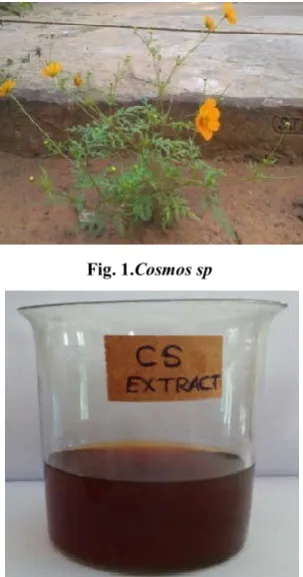
The initial screening showed the flower of Cosmos sp (figure
[image:3.595.87.239.435.724.2]1) yield orange colour dye (Figure 2).Therefore, detailed study was carried out to standardise the extraction and dyeing of silk yarn with the help of mordants.
Fig. 1.Cosmos sp
Fig. 2. Cosmos sp flower extract
Optimisation of extraction
Natural dye can be extracted using different techniques such as aqueous method, super critical fluid method, complicated
solvent system and ultrasonic extract. Among which the extraction with water is the most common, cheap and the oldest method (Prabhu and Bhute, 2012). Aqueous extraction depends on time, temperature, pH and sample to liquor ratio. Therefore, optimum extraction process can be determined by maximum absorbance value at lamda max (Prabhu and Bhute, 2012). Different pH such as 5, 7, 9 has been analysed. Result revealed that pH 5 gave light yellow colour where pH 7 showed dark orange and pH 9 showed orangish brown colour. Extraction of more colouring component in alkaline solvent might be due to ionisation of hydroxyl groups of colour components in alkalinity which increases the solubility of dye component (Tayade and Adivarekar, 2013). Neutral pH has been selected as optimum pH for extraction. Like pH, time and temperature also have significant effect in dye extraction. When temperature and time increases the extract of dye gets darker in colour which ultimately remains unchanged on further increase of time and temperature. In comparison with standard curve 60˚C and 45 min has been standardised as best extraction method. Increase flavonoids content extraction with
increase in time due to de novo formation in the aqueous
solvent (Sukrasno et al., 2011). Hence, water soluble orange
dye from flower might be a type of flavonoid. The sample to liquor ratio was maintained at 1:20. Optimisation of aqueous
extraction of dye has been successfully done by M A Khan et
al., (2006), S R Maulik and S C Pradhan (2005).
Mordanting and Dyeing of Silk Yarn:
Natural dyes mostly need mordants to fix to yarn and to improve fastness. One molecule of yarn bind with one dye molecule, whereas, one mordant molecule can bind with more than one dye molecule which makes mordanted yarn uptake more dye than unmordanted yarn (Bhattacharya and Shah, 2000; Uddin, 2014). Most commonly used less toxic chemical mordants are alum and ferrous sulphate. Saravana and Chandramohan (2011) supported the fact that ferrous sulphate and alum can help natural dye to attach with silk yarn successfully. Different shades of hue can be formed by using different metal salts as mordants due to formation of metal ion
complex (Saranya et al., 2011; Ghurde et al., 2016). Ferrous
sulphate can increase strong bonds between dye and yarn due to strong coordination tendency of Fe. Therefore, dye exhaustion can be increased by yarn and also chromophore of dye can be protected from photolytic degradation (Jothi, 2008). When Silk yarn interacts with ferrous sulphate, few coordination sites remain free which can be occupied by yarn, so ferrous sulphate can form ternary complex with yarn and dye (Uddin, 2015).
In case of alum, it can form strong bond with dye molecule whereas it forms lesser strong bond with yarn(Cotton and Wilkinson,1972). In this study, 1% (owy) ferrous sulphate was selected as optimised concentration to fix the dye. The mordanting process was optimised at 60˚C for 1 hour. Further,
3% (owy) alum at 80○C for 1 hour was standardised
mordants show attraction to NH+ bonds and COOH- bonds of silk yarns which forms strong ionic bonds between silk, mordants and dye (Uddin, 2015). Therefore, metal mordants can successfully overcome drawbacks of natural dyes.
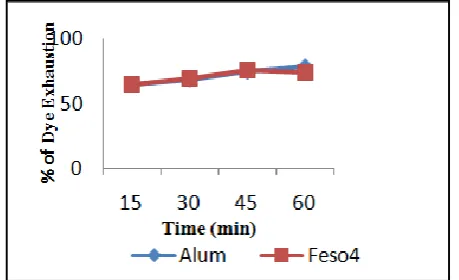
[image:4.595.312.557.238.387.2]Effect of time on dyeing:
Figure 3 showing effect of time on dye exhaustion percentage. Both the mordants show different results as they form different chemical complex with silk yarn. In case of ferrous sulphate 15min -45min dye uptake increases, following which the uptake was reduced. Hence, 45min was selected as optimum dyeing time, this can be due to disruption of dye at high temperature or silk yarn became saturated with dye molecule
(Saranya et al.,2011; Haji,2010). Further, for alum, dye
exhaustion increased gradually from 15min -1hour ,therefore 1 hour was selected as optimum dyeing time with alum. Similar
result was found by M Chairat et al.,(2007) and M Srivastava
et al., (2015).
Fig. 3. Effect of Time on dye exhaustion
Effect of temperature on dyeing:
Effect of various temperature on percentage of dye exhaustion showed in figure 4 .Dye uptake was found to increases with temperature rise from 40˚C-60˚C. After which there was a sharp decline of dye uptake percentage for both mordants, alum and ferrous sulphate. Therefore, for both the mordants 60˚C was selected as standardised temperature to maximise the percentage of dye exhaustion by silk yarn. This result can be
supported by M Chairat et al. (2007). With increase in
temperature, silk yarn gets swelled, which enhances its dye uptake in higher temperature (Jung and Dae, 2014). After 60˚C decrease of dye uptake attributes maybe due to unstability of
functional groups of dye in high temperature (Saranya et al.,
[image:4.595.48.278.281.421.2]2011).
Fig. 4. Effect of Temperature on dye exhaustion
Effect of pH on dyeing
Effect of various pH on silk dyeing depicted in figure 5. Dyeing of silk yarn with alum showed optimum dye uptake at pH 7 and with ferrous sulphate pH 6. In this study, dye exhaustion percentage was more in acidic pH where alkaline pH showed drastic decline in dye uptake. Similar results were reported by H T Deo and B K Desai (1999) and Sayed
Maqbool Geelani et al.,(2016). Further they stated that silk as
protein yarn having equal amount of positive and negative group , i.e, amino and carboxyl group respectively. At low pH carboxylic group absorbs hydrogen ion , whereas at high pH protein loses hydrogen ion, so protein yarn shows maximum colour depth in acidic dye bath (Deo and Desai,1999; Geelani
et al., 2016).
Fig. 5. Effect of pH on dye exhaustion
Effect of concentration on dyeing
Figure 6 shows the percentage of dye exhaustion of silk yarn using alum and ferrous sulphate in different material to liquor ratio such as 1:20, 1:40 and 1:60.All three ratios showed good results. There was an increase in dye uptake percentage from 1:20 to 1:40, however, 1:60 shows similar result as 1:40.Therefore 1:40 was selected as optimised material to liquor ratio for both mordants. Similar results were found by
Ado A et al., (2014).Dye uptake increases with increase of dye
concentration as concentration gradient increase with increase
of dye concentration in dye bath (Shabbir et al.,2016) . After a
certain concentration dyed yarn reaches to equilibrium after that dye uptake does not increase with increase of dye
concentration (Saranya et al.,2011) .
Fig. 6. Effect of concentration on dye exhaustion
Fastness Properties
Fastness properties of dyed yarn with both alum (Fig 7) and ferrous sulphate (Fig 8) have been tested through standard
[image:4.595.318.551.601.727.2] [image:4.595.39.288.641.779.2]methods in laboratory. Further, depending on best dye uptake and fastness properties, dyed silk yarn treated with alum was tested using standard ISO method. Light, wash and perspiration fastness was analysed with respect to grey scale.Light and perspiration fastness showed better result than wash fastness. Both perspiration (acidic and alkaline) and light showed fair to good(3-4) result. Result shows mordants not only help the yarn to uptake more dye, but also forms a water insoluble metal-dye complex with yarn which improves fastness properties (Tayade and Adivarekar,2013
[image:5.595.332.536.301.426.2]Fig. 7. Dyeing with Cosmos sp flower with alum
Fig. 8. Dyeing with Cosmos sp flower
with Ferrous sulphate
Characterization of Dye
Phytochemical screening of plant extract were carried out to simplify the characterization of dye (Wanyama
Phytochemical analysis revealed the presence of
carbohydrates, phenols and flavonoids in the extract. Presence of flavonoids, tannins, terpenoids, reducing sugar in the extract considered as significant characters for textile dyes (Wanyama
et al., 2011).
Fig. 9. TLC
methods in laboratory. Further, depending on best dye uptake dyed silk yarn treated with alum was tested using standard ISO method. Light, wash and perspiration fastness was analysed with respect to grey scale.Light and perspiration fastness showed better result than (acidic and alkaline) and light Result shows mordants not only help the yarn to uptake more dye, but also forms a water dye complex with yarn which improves
,2013).
flower with alum
flower
Phytochemical screening of plant extract were carried out to
simplify the characterization of dye (Wanyama et al., 2011).
Phytochemical analysis revealed the presence of
carbohydrates, phenols and flavonoids in the extract. Presence of flavonoids, tannins, terpenoids, reducing sugar in the extract considered as significant characters for textile dyes (Wanyama
Thin layer chromatography (TLC) is widely used
chromatographic technique due to its simplicity, rapid nature and low cost (Dias,2011).Figure 9 shows the TLC plate of
Cosmos sp flower extract, where mobile phase is
nButanol:Acetic acid:water (4:1:5). According to Harborne (1998) the presence of yellow spot on the TLC plate in day light shows the presence of flavonoid.
et al. (1998) ,mostly yellow to orange coloured flowers of
Asteraceae family contains carotenoid
except Dahlia sp , Coreopsis lanceolata
sulphureus Cav. Their principal pigments are butein and
coreopsin , sub group of flavonoid. Flavonoids contain unique UV active chromophore that is phenyl ring which make it easily detectable. Flavonoids mainly has two UV absorbance peak, one is range between 240
between 300-400nm (Dias, 2011). In this study, figure 10 shows maximum absorbance peak at 387
(1998) reported that UV spectrum of yello between 365-430nm and 240
concluded that extract of Cosmos sp
[image:5.595.130.198.340.466.2]major dyeing pigment
Fig.10. UV Vis Spectroscopic analysis of Dye extract
FTIR helps to identify functional groups of chemical constituents by their characteristic frequencies. Therefore, FTIR considered as a simple but reliable instrument to categorise compound in specific class (
between 1625-1650 cm-1 supports the presence of alpha beta
unsaturated carboxyl group which
flavonoid pigment (Nissankararao, 2011). Figure 11 shows presence of specific peaks in between above mentioned range. Stretches around 1610-1570cm
aromatic ring and stretches at 2850
presence of C-H bond which usually considered as prominent band for flavonoid pigment (Aksoz and Ertan, 2012). Presence of distinct characteristic peaks between 2850
1610-1570cm-1 range in Figure 11 determines the presence of
flavonoid in the dye pigment.
Fig. 11. FTIR analysis of dye extract
Thin layer chromatography (TLC) is widely used
chromatographic technique due to its simplicity, rapid nature and low cost (Dias,2011).Figure 9 shows the TLC plate of flower extract, where mobile phase is id:water (4:1:5). According to Harborne (1998) the presence of yellow spot on the TLC plate in day
light shows the presence of flavonoid.According to Harborne
(1998) ,mostly yellow to orange coloured flowers of Asteraceae family contains carotenoids as principal pigment
Coreopsis lanceolata L. and Cosmos
Cav. Their principal pigments are butein and coreopsin , sub group of flavonoid. Flavonoids contain unique UV active chromophore that is phenyl ring which make it y detectable. Flavonoids mainly has two UV absorbance peak, one is range between 240-285 nm and another range 2011). In this study, figure 10 shows maximum absorbance peak at 387.50nm. Harborne (1998) reported that UV spectrum of yellow flavonoid ranges
430nm and 240-260nm. Therefore it can be
Cosmos sp contains flavonoid as
UV Vis Spectroscopic analysis of Dye extract
FTIR helps to identify functional groups of chemical by their characteristic frequencies. Therefore, FTIR considered as a simple but reliable instrument to categorise compound in specific class (Harborne,1998). Peaks supports the presence of alpha beta unsaturated carboxyl group which is a characteristic of yellow flavonoid pigment (Nissankararao, 2011). Figure 11 shows presence of specific peaks in between above mentioned range.
1570cm-1 implies the presence of
aromatic ring and stretches at 2850-3000cm-1 represents
H bond which usually considered as prominent band for flavonoid pigment (Aksoz and Ertan, 2012). Presence
of distinct characteristic peaks between 2850-3000cm-1 and
range in Figure 11 determines the presence of
[image:5.595.130.197.607.784.2] [image:5.595.323.543.629.782.2]Conclusion
Present study revealed that orange natural dye can be
efficiently extracted from Cosmos sp flower. The extracted dye
could be successfully attached to silk yarn with the combination of chemical mordants having good fastness property. The extracted dye was analysed for its chemical constituent and found the presence of flavonoid as orange pigment.
Acknowledgement
The author thanks Mrs.Prema Sampathkumar, Associate Professor and Head, the Faculty members and non teaching staff of Department of Plant Biology and Plant Biotechnology, Dr. Mrs A. Nirmala, Principal, Ethiraj College for Women, Chennai, Tamil Nadu for their valuable support and encouragement throughout the entire period of research. We would also like to express our thanks for the facilities extended by the Central Instrumentation centre of Ethiraj College for Women. Sincere thanks to Textile Committee, Ministry of Textile, Mylapore, Chennai, Tamil Nadu and TANSILK, Salem, Tamil Nadu.
REFERENCES
Ado, A., Yahaya, H., Kwalli, A. A. and Abdulkadir, R. S. 2014. Dyeing of textiles with eco-friendly natural dyes:A
review. International Journal of Environmental Monitoring
and Protection. 1(5), pp.76-81.
Aksoz, B. E. and Ertan, R. 2012. Spectral properties of
chalcone II, FABAD Juornal of Pharmceutical Science.
37(4),pp.205-216.
Aminoddin and Haji, A. 2010. Functional dyeing of Wool with
natural dye extracted from Berberis vulgaris wood and
Rumex hymenosepolus root as biomordant. Iranian Journal
of Chemistry and Chemical Engineering. 3(29), pp.55-60.
Arun, K.P. and Yogamoorthi, A. 2014. Isolation, application and biochemical characterization of colour component from Tecoma stans: A new cost effective and eco-friendly
source of natural dye. International Journal of Natural
Products Research. 4(1),pp.9-11.
Bhattacharya, S. D. and Shah, A. K. 2000. Metal ion effect on dyeing of wool fabric with catechu.; Coloration Technology. 116(1), pp.10–12.
Chairat, M., Bremner, J. B. and Chantrapromma, K. 2007. Dyeing of cotton and silk yarn with extracted dye from the
fruit hulls of mangosteen, Gracinia mangostana Linn.
Fibres and Polymers. 8(6), pp.613-619.
Cotton, F. A. and Wilkinson, G. 1972. Advanced inorganic chemistry: a comprehensive text (3rd ed.). New York: John Wiley & Sons.
Deo, H.T. and Desai, B. K. 1999. Dyeing of cotton and jute
with tea as natural dye. Coloration Technology.115, 7(8),
pp. 224-227.
Dias, M. T. M. F. 2011. Phytochemical study of Coreopsis
tinctoria. flowering tops, 2011.
Divya, L.R.B. and Ravi, D. 2013. Extraction of natural dyes from selected plant sources and its application in fabrics.
International Journal of Textile and Fashion Technology.
1(2),pp.53-60.
Geelani, S. M., Ara, S., Mir, N. A., Bhat, S. J. and Mishra, P.
K. 2016. Dyeing and fastness properties of Quercus
robur with natural mordants on natural fibre.Textiles and
Clothing Sustainability. 2(8),pp.2-10.
Geelani, S. M., Ara, S. ,Mishra, P. K. , Bhat, S.J.A. , Hanifa, S., Haq, S., Jeelani, I. , Qazi, G., Sofi, A. H., Mir, S. A., Khan, P.A., Wani, S. A. and Raja, A.S.M. 2015.
Eco-friendly dyeing of wool and pashmina fabric using Quercus
robur L. (fruit cups) dye and Salix alba L. (wood extract)
mordant. Journal of Applied and Natural Science,
7(1),pp.138 – 143.
Ghurde, M. U., Padwad, M. M., Deshmukh, V. R. and
Malode, S. N. 2016. Extraction of natural dye from Ixora
coccinea (Linn.) flowers for cotton fabric colouration.
International Journal of science and Research. 5(1),
pp.1272-1276
Haji, A. 2010. Functional dyeing of wool with natural dye
extracted from Berberis vulgaris wood and Rumex
hymenosepolus root as biomordant. Iranian journal of
Chemistry and Chemical Engineering. 29(3),pp.55-60.
Harborne, J.A. 1998. Phytochemical methods-A guide to modern techniques of plant analyses. 3rd edition, Chapmann and Hall.
Jigar, P. R., Mitesh, P. H., Shirvastav, P. S. and Sanyal, M. 2013. Synthesis of a modified reactive dye with improved dyeing performance on cotton fabric and its degradation
study. Indian Journal of Science. 3(6),pp.45-51.
Jothi, D. 2008. Extraction of natural dyes from African
marigold flowers (Tagetuserecta) for textile colouration,
Autex Research Journal. 89(2),pp. 49-53.
Jung, W. S. and Dae, D. G. 2014. Natural dyeing with black cowpea seed coat. I .Dyeing properties of cotton and silk
fabrics. Fibres and Polymers.15(1),pp.138-144.
Konar, A. 2011. Studies on Textile Related Properties and Dyeability of Jute and Chemically Modified Jute Textiles using Selective Synthetic and Natural Dyes. PhD Thesis, Jadavpur University, India.
Khan, M.A., Khan, M., Srivastava, P. K. and Mohammad, F. 2006. Extraction of natural dyes from cutch, ratanjot and madder, and their application on wool. Colourage.53(1),pp. 61-68
Lee, Y. H. and Kim, H. D. 2004. Dyeing properties and colour
fastness of cotton and silk fabrics dyed with Cassia tora L.
extract. Fibres and Polymers.5(4),pp.303-308.
Maulik, S. R. and Pradhan, S. C. 2005. Dyeing of wool and silk with hinjal bark, jujube bark and Himalayan rhubarb. Man-made Textiles in India. 48(10),pp.396-400
Nissankararao, S. 2011. Synthesis and biological evaluation of some new chalcones, pyrimidines and pyrazolines.PhD Thesis. Faculty of pharmaceutical sciences. Research and
development cell. Jawaharlal nehru technological
university, Hyderabad, india.
Ogugbue, C. J. and Sawidis, T. 2011. Bioremediation and detoxification of synthetic wastewater containing triaryl
methane dyes by Aeromonas hydrophila isolated from
industrial effluent. Biotechnology Research International. doi: 10. 4061/2011/967925. pp.1-11.
Paisan, K., Aroonsiri, S. and Nontalee, C. 2002. Thermodynamics of adsorption of laccaic acid on silk.
Dyes and Pigments. 53(2),pp.179–185.
Prabhu and Bhute, A. S. 2012. Plant based natural dyes and
mordants:a review, Journal of Natural product and Plant
Resource . 2(6),pp.649-664.
Raaman, N. 2006. Phytochmeical Techniques.5,New India Publishing Agency,New Delhi, pp.19-25.
Rajendran, R. and Thamarai, S. B. 2014. Natural dyeing of
cotton fabrics with pigment extracted from Roseomonas
Fauriae. Universal Journal of Environmental Research
and Technology. 4(1), pp.54–59.
Saranya, R., Jayapriya, J. and Tamilselvi, A. 2011. Dyeing of
silk fabric with phenazine from Pseudomonas species.
Society of Dyers and Colourists. Coloration
Technology.128, pp.440-445.
Saravanan, P. and Chandramohan, G. 2011. Dyeing of silk with Eco-Friendly Natural Dye Obtained from Barks of
Ficus religiosa. Universal Journal of Environmental
Research and Technology. 1(3),pp.268-273.
Savarino, P., Viscardi, G., Quagliotto, P. Montoneri, E. and Bami, E.1999. Reactivity and effects of cyclodextrins in textile dyeing. Dyes and Pigments. 42(2),pp.143–147. Shabbir, M., Islam, S. U., Bukhari, M. N., Rather, L. J., Khan,
M. A. and Mohammad, F. 2016. Application of Terminalia
chebula natural dye on wool fibre-evaluation of color and
fastness properties. Textiles and Clothing Sustainability;
2(1),pp.1-9.
Singh, R. and Srivastava, S. 2015. Exploration of flower based natural dyes—a review. Research Journal of Recent
Sciences.4,pp.6–8.
Siva, R. 2007. Status of natural dyes and dye yielding plant in India. Current Science. 92(7),pp.916-925.
Srivastava, M., Moghra, D. and Gupta, P. 2015. Dye extraction
from Rheum emodi for colouring silk using natural
mordants. Journal of Applied and natura science.
7(1),pp.182-186.
Sukrasno, S., Fidriany, I., Anggadiredja, K. and Anam, K. 2011. Influence of Drying Method on Flavonoid Content of
Cosmos caudatus (Kunth) Leaves. Research Journal of
Medicinal Plant 5(2),pp.189-195.
Tayade, P. B. and Adivarekar, B. V. 2013. Dyeing of cotton
fabric with Cuminum cyminum L. as a natural dye and its
comparison with synthetic dye. The Journal of Textile
Institute. 104(10),pp.1080-1088.
Uddin, M. G. 2014. Effects of different mordants on silk fabric dyed with onion outer skin extracts.Journal of Textiles. Article ID 405626,pp.1–8.
Uddin, M. G. 2015. Extraction of eco-friendly natural dyes from mango leaves and their application on silk fabric. Textiles and Clothing Sustainability. 1(7),pp.1-8.
Valladas, H.,Cachier, H., Maurice, P., Queros, F. D. B., Clolles, J., Valdes, C. V., Uzquiano, P. and Arnold, M. 1992. Nature. 357,pp.68–70.
Wanyama, P.A.G., Kiremire, B.T., Murumu, J.E.S. and Kamoga, O. 2011. Textile dyeing and phytochemical characterization of crude plant extracts derived from
selected dye yielding plants in Uganda. International
journal of natural products research.1(2),pp.26-31.
Yusuf, M., Mohammad, F., Shabbir, M. and Khan, M. A. 2016. Eco-dyeing of wool with Rubia cordifolia root extract: Assessment of the effect of Acacia catechu as
biomordant on color and fastness properties. Textiles and
Clothing Sustainability. 2(10),pp.1-9.