IJPSR (2017), Volume 8, Issue 12 (Review Article)
Received on 19 April, 2017; received in revised form, 03 July, 2017; accepted, 25 July, 2017; published 01 December, 2017 BENZOTHIAZOLE - A MAGIC MOLECULE
Amin Shaista* and Parle Amrita
Department of Pharmaceutical Chemistry, Delhi Pharmaceutical Science and Research University, New Delhi - 110017, New Delhi, India.
ABSTRACT: Antimicrobial resistance has been called one of the world's most pressing public health problems. Addressing the issue of antimicrobial resistance is one of the most urgent priorities in the fields of public health today. Alarmingly, the development of resistance such as multi-drug resistance towards a number of antibiotics poses a challenge to the scientific community in the discovery of new therapies. Thus, there is a need to develop newer and effective molecules with high safety profile. Benzothiazoles are fused membered rings, which contain heterocycles bearing thiazole. Sulphur and nitrogen atoms constitute the core structure of thiazole and many pharmacologically and biologically active compounds. Benzothiazole is an interesting pharmacophore exhibiting diverse pharmacological activities like antimicrobial, anticancer, anthelminthic, antidiabetic, antitubercular, anticonvulsant, antioxidant, anti-inflammatory, antifungal, antipsychotic etc. The present article extensively covers various procedures of synthesis of 2-substituted benzothiazole core and its analogs - by utilizing distinctive catalysts, solvent conditions, reactants immobilized on solid support and microwave irradiation. Variations in synthetic procedures are studied to explore chemo-selectivity of the reactions, in-expensive, eco-friendly, less time consuming procedure with easy and quick isolation of the products. Ongoing clinical trials of different benzothiazole derivatives, exploring additional pharmacological activities, are also included.
INTRODUCTION: Benzothiazoles are fused membered rings, which contain heterocycles bearing thiazole. Sulphur and nitrogen atoms constitute the core structure of thiazole and many pharmacologically and biologically active compounds 1. Benzothiazoles consist of a 5-membered 1, 3-thiazole ring fused to a benzene ring. The nine atoms of the bicycle and the attached substituents are coplanar.
QUICK RESPONSE CODE
DOI:
10.13040/IJPSR.0975-8232.8(12).4909-29
Article can be accessed online on:
www.ijpsr.com
DOI link: http://dx.doi.org/10.13040/IJPSR.0975-8232.8 (12).4909-29
Benzothiazole derivatives have been intensively studied, as the pharmacophore is one of the privileged structures in medicinal chemistry. Benzothiazoles have emerged as a core structure for diversified therapeutic applications which include, antimicrobial, anticancer, anthelminthic, antidiabetic, antitubercular, anticonvulsant, anti-oxidant, anti-inflammatory, antifungal, anti-psychotic activities. They are also used in industry as vulcanisation accelerators. Various benzo-thiazoles such as 2-aryl benzobenzo-thiazoles received much attention due to unique structure and its uses as radioactive amyloid imagining agents. Benzothiazole ring is present in various marine or terrestrial natural compounds, which have useful biological properties 2.
Keywords:
Benzothiazoles, Antimicrobial, Anticancer, Clinical trials
Correspondence to Author: Shaista Amin
Research Scholar,
Department of Pharmaceutical Chemistry, Delhi Pharmaceutical Science and Research University, Pushp Vihar Sector 3, New Delhi - 110017, New Delhi, India.
It is reported that the isosteres and derivatives of benzothiazoles have antimicrobial activities against gram negative, gram positive bacterias (e.g., E. coli, Pseudomonas aeruginosa, Entero bacter, Staphylococcus epidermis, etc) and the yeast (e.g. Candidaalbicans).
Structure: The basic structure of benzothiazole consist of benzene ring fused with d face (4, 5 position) of thiazole. The numbering in thiazole starts from the sulphur atom.
THIAZOLE BENZOTHIAZOLE
[image:2.612.319.560.54.162.2]Some of the marketed drugs 3 having benzothiazole nucleus are shown in Table 1.
TABLE 1: MARKETED PREPARATIONS HAVING BENZOTHIAZOLE NUCLEUS
S. no Marketed drug Company Use Structure
1 Pramiprexole Zydus cadila Parkinsons disease, restless
legs syndrome
N S H
N
NH2
2 Riluzole Sun
pharmaceuticals
Amyotrophic lateral sclerosis
N
S O F
F F H2N
3 Ethoxzolamide Pharmacia, Upjohn, allergan
Glaucoma, diuretic, duodenal ulcers
N S O
S O
O NH2
4 Frentizole Not Available Antiviral, immunosuppress
ive agent N
S O
NH NH O
5 Zopolrestat Not Available Anti-diabetic
N N
S N O
O
OH
F
F F
6 Thioflavin T Not Available Amyloid imaging agent
S N
N
CH3 CH3
H3C
CH3
Cl
Methods of Synthesis: By Condensation Reaction:
Condensation of 2-aminothiophenol with aldehydes:
Homogenous Catalysis: Homogeneous catalysis is a catalytic reaction in which the catalyst is in the same phase as the reactants. Homogeneous
catalysis applies to reactions in the gas phase and even in a solid phase
Acid Catalyzed Condensation: Guo and
co-authors demonstrated the acid catalysed
homogeneous condensation of 2-aminothiophenol and substituted aldehyde using H2O2 / HCl in
SCHEME: 1
Mortimer and colleagues synthesized a series of novel phenylbenzothiazoles by the reaction of 2-aminothiophenol and substituted benzaldehydes in ethanol (EtOH) (Scheme 2) 5.
SCHEME: 2
Sattler and co-authors synthesized [5-(2,3-dihydro-1,3 benzothiazol-2-yl)oxolan-2-yl]methanol from the condensation of hydroxymethylfurfural (HMF) and 2 -aminobenzenethiol in the presence of acetic acid (AcOH). (Scheme 3) 6.
SCHEME: 3
Perkin et al., demonstrated the synthesis of benzobisthiazoles from benzaldehydes. Benz aldehydes when heated with para-phenylene diamine-2, 5- di- (thiosulfuric acid) formed a benzal derivative as an intermediate, which at higher temperature yielded the benzobisthiazole
(Scheme 4) 7.
SCHEME: 4
Base Catalyzed Condensation: Maleki et al., have developed a method for the synthesis of 2-arylbenzothiazole derivatives from condensation of 2-aminothiophenol with aromatic aldehydes using ammonium chloride as a catalyst in methanol/water (15:1 v:v) as a dual solvent system at room temperature (Scheme 5a, b) 8.
The chief advantage of this reaction is the use of ammonium chloride which is a cheap, metal-free and readily available reagent. For comparative study authors have used various organic solvents such as chloroform, ethanol, acetonitrile, dichloromethane and water. However, methanol / water have been observed as the best solvent system in terms of the yield.
SCHEME: 5A
SCHEME: 5B
Solvent Catalyzed Condensation: Batista et al., prepared Bithienyl-1, 3-benzothiazoles by
employing the condensation of 2-amino
benzenethiol and various 5-formyl-5’-alkoxy- bithiophenes or 5-formayl-5,-N,N-dialkylamino- 2, 2’-bithiophenes under the refluxing Dimethyl sulfoxide (DMSO) for 30-60 min (Scheme 6) 9.
Microwave-induced Condensation: Praveen and co-workers demonstrated microwave-assisted synthesis of benzothiazole and benzoxazole
derivatives using phenyliodonium bis
(trifluoroacetate) (PIFA) as an oxidant for the cyclocondensation of 2-aminothiophenols / 2-aminophenols with different aldehydes in ethanol at 80 °C, which afforded high yield of the products
(Scheme 7) 10. Due to the cleavage of the
heterocycles in the microwave irradiation, heterocyclic nucleus containing substituted aldehyde compounds such as pyridine, thiophene and furan allowed average yield. The major advantages of this method are the use of PIFA (which works both as a Lewis acid and as an oxidant), wide substrate scope, short reaction time, microwave condition and satisfactory yields.
SCHEME: 7
Dandia et al., reported the synthesis of benzothiazoles by the condensation of 2-phenyl-1H-indole-3-carboxaldehyde and 5-substituted 2-aminothiophenols in the presence of piperidine or para toluenesulphonic acid (p-TSA) in ethanol (EtOH) or N,N-dimethylformamide (DMF) solvent under microwave irradiation (MWI) for 3-6 min at 240 W (Scheme 8) 11.
SCHEME: 8
Paul et al., demonstrated an efficient method for the synthesis of 2-arylbenzothiazoles by condensation reaction of 2-aminothiophenol with β-chlorocinnam aldehydes under microwave irradiation (MWI) using para-toluenesulfonicacid (p-TSA) (Scheme 9) 12. Operational simplicity, fast
environmental friendly reaction, general
applicability and accommodating a variety of substitution patterns are the notable advantages of this procedure.
SCHEME: 9
Heterogeneous Catalysis: In heterogeneous catalysis the catalysis occurs at the interface of two phases, typically gas-solid. It involves the use of a catalyst in a different phase from the reactants. Typical examples involve a solid catalyst with the reactants as either liquids or gases.
following schemes: Nalage et al., demonstrated an efficient method for the synthesis of 2-arylbenzothiazole by condensation of different aldehydes and 2-aminothiophenol, in the presence of phosphorus pentoxide (P2O5) in methanol
(MeOH) for 3–7 hr at room temperature. Phosphorous pentoxide acts as an acid catalyst
(Scheme 10, Method 1) 13.
Chandrachood and colleagues demonstrated the synthesis of 2-arylsubstituted benzothiazoles, usuing cobalt nitrate (Co (NO3)2·6H2O)/ hydrogen
peroxide (H2O2) as a catalyst (Scheme 10, Method 2) 14. They have noticed the impact of temperature, change in reagent amount and change in solvent on the reaction and found the best outcomes utilizing cobalt nitrate and hydrogen peroxide in N,N-dimethylformamide (DMF).
Rapid and effective condensation reactions of 2-aminothiophenol with various aldehydes were carried out using iodine as a catalyst in solvent-free conditions, by Moghaddam et al., to afford the corresponding 2-substituted benzothiazole derivatives in a relatively short time in excellent yields
(Scheme 10, Method 3) 15.
Weekes et al., have reported a simple, one-pot and high-yielding protocol for the substituted 2-phenylbenzothiazoles under both thermal and
microwave (MW) conditions from the
condensation of various benzaldehydes and
2-aminothiophenol using sodium metabisulfite (Na2S2O5) as a mild oxidant in dimethylsulfoxide
(DMSO) at 120 °C (Scheme 10, Method 4) 16. Here, less reaction time and simple isolation of product without column chromatography are the additional advantages. Authors also achieved excellent yield of product using dimethyl-formamide (DMF) at 90 °C as a solvent, though this reaction takes longer time (>2 h) because of the lower solubility of reaction components in DMF. However, DMSO is an efficient solvent for promoting this reaction, due to its optimal reagent dissolution and oxidizing agent properties.
Synthesis of 2-(para-tolyl) benzothiazole by transition metal-Ir-catalyzed hydrogen-transfer reactions of 4-methylbenzaldehyde with 2-aminothiophenol have suggested by Blacker and colleagues (Scheme 10, Method 5) 17.
The H2O2/Cerium ammonium nitrate (CAN)
system as a novel and very efficient reagent for the convenient synthesis of benzothiazoles in good to excellent yields through the condensation of 2-aminothiophenol and various substituted aryl aldehydes was described by Bahrami and co-authors (Scheme 10, Method 6) 18. Short reaction time, easy and quick isolation method, excellent chemo selectivity and good yields are the main advantages of this procedure.
2-substituted benzothiazole and benzoxazole were synthesized by the condensation of aldehydes with 2-aminothiophenol or 2-aminophenol respectively through a one-pot reaction by applying diethyl bromo phoshonate and tert-butyl hypochlorite (t -BuOCl) in acetonitrile (MeCN) by Patil et al.,
(Scheme 11) 19.
SCHEME: 11
Solid Supported Condensation: Maleki et al., have suggested an efficient and improved catalyst, sulphuric acid immobilized on silica-gel (H2SO4.SiO2) for the synthesis of 2-aryl
benzothiazoles through condensation of various aldehydes and 2-aminothiophenol (Scheme 12, Method 1) 20. Here, H2SO4.SiO2 is an inexpensive,
heterogeneous and stable catalyst possessing very high reactivity compared to unsupported H2SO4.
The authors have examined the effect on the yield by employing different amounts of catalyst in various solvents but considerable growth of the reaction rate and improvement of the yield were observed when 5 mg of H2SO4.SiO2 in ethanol
(EtOH) was used.
Shokrolahi et al., have reported the condensation of 2-aminothiophenol with aldehyde using Sulfonated
Porous Carbon (SPC) as a heterogeneous catalyst in water under reflux conditions and microwave irradiation to produce benzothiazole derivatives
(Scheme 12, Method 2) 21. Here, porous carbon materials can accomplish most of the required properties for a suitable catalyst support due to high surface areas and well-developed porosities. Authors have studied the optimization experiment using different amount of SPC for the condensation reaction in water by refluxing for 90 min or by microwave irradiation for 6 min. Use of 0.1g of SPC shows the best results under these reaction conditions. The reusability and recyclability of the catalyst (SPC) was checked under similar reaction conditions and was concluded that, for the three catalytic cycles, the yields and reaction times remained the same. This protocol had simple work set up, was environmentally benign, produced good yields, and had no requirement of extra oxidants and use of cheap catalyst compared to previously reported methods.
The synthesis of 2-substituted benzothiazoles efficiently in good yields by the reaction of 2-aminothiophenol and various aldehydes in the presence of a catalytic amount of perchloric acid-doped Polyaniline (HClO4/PANI) under refluxing
ethanol (EtOH) was reported by Alibeik et al.,
(Scheme 12, Method 3) 22. The superior characteristics of this catalyst are the low cost, simple recovery and efficient reusability. The authors have studied the reusability of the catalyst and the results showed that there were no considerable changes in the catalyst reactivity.
Alloum et al., have presented the condensation of various aldehydes with 2-aminothiophenol on silica gel / nitrobenzene or montmorillonite K-10 / nitrobenzene under microwave irradiation (MWI) which afforded 2-arylbenzothiazoles in good yields with high purity (Scheme 12, Method 4) 23.
Kawashita and co-workers have disclosed a simple and direct synthesis of 2-arylbenzothiazole by the aid of activated carbon (Shirasagi KL) (Scheme 12, Method 5) 24.
Condensation of 2-Aminothiophenols with Nitrile: Mokhir et al., have mentioned the synthesis of 2-cyanomethyl benzothiazole from the
condensation of 2--aminothiophenol and
malonodinitrile in the presence of glacial acetic acid (Scheme 13, Method 1) 25. The suspension of 2-cyanomethyl benzothiazole in iso-propanol and water containing potassium nitrite (KNO2) was
further treated with conc. HCl to yield
benzothiazolyl cyanoxime, which is good
multidentate ligand for co-ordination chemistry.
Zandt and colleagues have reported the synthesis of 4-fluoro-2-hydroxy-N (4, 5,7-trifluorobenzothiazol-2-ylmethyl)-benzamide using N -cyanomethyl-4-fluoro-2-hydroxy-benzamide and 2-amino-4,5,7-trifluorothiophenol hydrochloride in refluxing ethanol (EtOH) for 24 h (Scheme 13, Method 2) 26
.
Copper acetate catalysed formation of 2-substituted benzothiazoles in excellent yields via condensation of 2-aminobenzenethiols with wide range of nitriles containing different functional groups was developed by Sun et al., (Scheme 13, Method 3) 27
. Optimization of the reaction conditions explored that the optimal catalytic conditions consist of Cu(OAc)2 (10mol %) and Et3N (1.0 equiv.) in
ethanol (EtOH) at 70 °C for 6 hr gives best results in terms of yield.
SCHEME: 13
Condensation 2-aminothiophenole with Ester:
Khalil et al., have surveyed that an amino ester and the selected 2-substitued aromatic amines such as 2-aminothiophenol was condensed in the presence of poly phosphoric acid (PPA) at 160 °C for 3 h followed by neutralization with aq. ammonia to yield corresponding 2-substituted benzothiazole
(Scheme 14, Method 1) 28.
Manfroni et al., have synthesized the 5-substituted ethyl-2-(benzothiazol-2-yl) acetate by the
condensation of various substituted
Reddy et al., have investigated the distinctive formation of trifluoroacetonyl benzothiazole by condensation of 2-aminophenol with trifluoroacetyl ketene diethyl acetal under microwave irradiation (MWI) in toluene for 8 min (Scheme 14, Method 3) 30.
Shantakumar et al., have presented some new banzothiazole derivatives by the reaction of benzothiazolyl carboxyhydrazide with variant aryl acids using phosphoryl chloride (POCl3) (Scheme 14, Method 4) 31.
The convenient, flexible, connective and efficient preparation of various benzothiazole derivatives by the condensation of substituted anilines with functionalized 2-esters in good to excellent yields under mild conditions was established by Bastug and colleagues (Scheme14, Method 5) 32.
The development of new libraries of
multifunctional sites containing heterocycles is the versatility of this protocol. Broad range of substituted 2-esters was prepared using the modified Pinner sequences which widen the scope of this condensation.
METHOD: 1
METHOD: 2
METHOD: 3
METHOD: 4
METHOD: 5 SCHEME: 14
Condensation of 2-aminothiophenol with Acid:
Sharghi et al., have indicated an efficient, one-pot and high yielding procedure for the synthesis of
2-substituted benzothiazoles from the
2-aminothiophenol and different aliphatic or aromatic carboxylic acids in novel methane sulfonic acid / silica gel (MeSO3H/SiO2) at 140 °C for 2-12 h (Scheme 15, Method 1) 33. Silica gel was recovered and reused many times without loss of its efficiency.
Yildiz et al., have reported the viable methodology for the synthesis of various 2-substituted benzothiazoles from 2-aminothiophenols and corresponding carboxylic acids refluxing in trimethylsilylpolyphosphate ester (PPSE) at various temperatures and time to afford various derivatives in excellent yield (Scheme 15, Method 2) 34.
SCHEME: 15
An efficient and one-pot synthesis of 2-trifluoro- and 2-difluoromethyl substituted benzothiazole derivatives in excellent yields by the condensation reaction of trifluoroacetic acid and difluoroacetic
acid with commercially available
2-aminobenzenethiols, respectively, was examined by Ge and co-workers (Scheme 16) 36.
SCHEME: 16
Condensation with Acyl Chloride: Racane et al., have reported that the bis-nitrile and nitro-nitrile derivatives of 2-phenylbenzothiazole were prepared by the condensation reaction of cyano or nitro-substituted 2-aminobenzothiole with commercially available 4-cyano or 4-nitrobenzoylchloride, respectively, under reflux condition in acetic acid (AcOH) for 4 hr (Scheme 17, Method 1) 37.
An efficient and environment friendly catalyst NaHSO4-SiO2 promoted solvent-free synthesis of
library of benzothiazole derivatives by the condensation reaction of various acyl chlorides with 2-aminothiophenol was developed by Kumar and co-workers (Scheme 17, Method 2)38. This reaction is heterogeneous in nature, so the catalyst can be easily recovered by simple filtration. The
use of nontoxic, inexpensive, easily available, reusable and green catalyst makes the reaction protocol inexpensive and eco-friendly. NaHSO4
-SiO2 catalyst can be used four times with consistent
yield, which shows importance of its use in the large scale operations and industry. Authors have also investigated the effect of time, temperature and solvent on the reaction. From this study they have concluded that best results were obtained, when NaHSO4-SiO2 refluxing at 100 °C for 12 hours,
without use of any solvent.
Nadaf and co-workers developed a novel one-pot regioselective synthesis of 2-aryl benzothiazoles by condensation of 2-aminothiophenol and substituted benzoyl chloride using 1-butylimidazolium tetraflouroborate ([Hbim]BF4) and
1,3-di-nbutylimidazoliumtetrafluoroborate ([bbim]BF4)
ionic liquids (ILs) as reaction media at room temperature in excellent yields (Scheme 17, Method 3) 39. Ambient reaction conditions, absence of a catalyst and recyclability of the non-volatile ILs makes this protocol green and environment-friendly.
SCHEME: 17
Condensation with Isothiocyanate: El-Sharief and colleagues have introduced an exclusive condensation reaction of 1, 4-phenylenedi-isothiocyanate with 2--aminothiophenol to produce N,N’-Bis(benzothiazole-2-yl)-benzene-1,4-diamine using triethanolamine / N,N-dimethylformamide (TEA/ DMF) as a reaction media (Scheme 18) 41.
SCHEME: 18
Cano et al., described the reaction of equimolecular amounts of 2-iodoaniline and various isothiocyanato derivatives in presence of combination of dimethyl sulfoxide (DMSO) and an excess of potassium hydroxide (KOH) at 120 °C for 96 hr, which afforded N- substituted benzothiazol-2-amine derivatives (Scheme 19, Method 1) 42.
Ding et al., demonstrated Copper (I)-catalysed reaction of 2-iodobenzenamine with isothio-cyanates under mild conditions for the synthesis of 2-substituted benzothiazoles. (Scheme19, Method 2) 43.
High efficiency, mild reaction conditions and experimental ease are the key features of this method. Authors have applied various ligands and base in different solvents for optimization of the reaction condition by means of good yield and time. From that study, they have concluded that the best results were obtained, when the reaction of 2-iodoaniline and phenyl isothiocyanates catalysed by CuI(I) (10 mol%) in the presence of ligand
(1,10-phenanthroline) and base
(1,4-diazabicyclo[2.2.2]octane) (DABCO) in toluene at 50 °C. Guo et al., have reported a ligand and
base-free, copper-catalyzed reaction of
2-halobenzenamine derivatives with various
isothiocyanates using copper(I)bromide (CuBr) and tetra-n-butyl ammonium bromide (TBAB ) as the
promoter at 40 °C, afforded various
2-aminobenzothiazoles in moderate to excellent yields (Scheme 19, Method 3) 44.
Condensation of 2-aminothiophenol with Aryl Amines: A novel, efficient, solvent-free, catalyst-free and metallic contaminants catalyst-free chemoselective oxidative coupling of various alkylamines and substituted 2-mercaptoaniline for the synthesis of substituted benzothiazoles using elemental sulphur was developed by Nguyen and co-authors (Scheme 20) 45.
SCHEME: 20
The present method has valuable advantages such as easy availability of all reaction components including sulphur and the remarkably simple and catalyst-free reaction conditions at moderate temperature.
Condensation of 2-aminothiophenol with Ketones: Liao et al., have developed an inexpensive and an efficient formation of various 2-aryl benzothiazoles from substituted 2-aminobenzenethiols and various aryl ketones using molecular oxygen as oxidant under metal-free and I2-free conditions in a mixture of dimethyl
sulfoxide (DMSO) / chlorobenzene (ClC6H5), to
afford high yields of the products (Scheme 21, Method 1) 46. Solvent played an important role in this transformation. Functional groups such as methyl (CH3), methoxy (OCH3), fluoro (F), chloro
(Cl), bromo (Br) and nitro (NO2) groups were all
well endured during the study of the optimized reaction conditions.
The reaction of various derivatives of 2- aminobenzenethiol with various ketones to yield
2,2-disubstituted benzothiazolines, which
converted into 2-substituted benzothiazoles by the pyrolysis with the elimination of concomitant hydrocarbon under reflux condition, have examined by Elderfield and colleagues (Scheme 21, Method 2) 47.
Kreysa and co-workers have investigated a new protocol for the synthesis of 2-methylbenzothiazole
using benzyl methyl ketone and 2-amino
benzenethiol (Scheme 21, Method 3) 48.
Xue and co-authors have reported the condensation reaction of simple and readily available aromatic ketones with substituted anilines by employing NaSH.nH2O and CuO/CuI in the presence of base
(Cs2CO3) and ligand (1,10-phenanthrolin) in
dimethyl sulfoxide (DMSO) at 120 °C for the preparation of 2- acylbenzothiazoles (Scheme 22) 49
.
SCHEME: 22
SCHEME: 23
Condensation of 2-haloaniline with Sulfide: Klar and co-authors have developed method of synthesis of 2-methylbenzothiazole-5-carboxylic acid from
4-chloro-3-nitro benzoic acid in a one-pot reaction using sodium sulfide (Na2S) in the presence of
acetic anhydride (Ac2O) and acetic acid (HOAc) (Scheme 23) 50.
Miscellaneous Reactions: A variety of 2-acylbenzothiazoles were synthesized by Zhu et al.
from multiform substrates arylethenes,
arylacetylenes, 2-hydroxyaromatic ketones and 1-arylethanol via four distinct pathways. They converted these substrates into aryl substituted glyoxal in situ, which condensed with various 2-aminothiophenol in one-pot metal-free reaction
(Scheme 24) 51. This synthetic approach embodied four specific reaction pathways. For optimisation of reaction conditions, the authors have carried out this reaction in the presence of various oxidants and additives in dimethyl sulfoxide (DMSO). However, the excellent reaction conditions for this reaction turned out to be styrene (1.1 mmol) and aminobenzenethiol (1.2 mmol) using iodine/ 2-iodobenzoic acid (I2/ IBX, 2.0 mmol/ 1.5 mmol) in
DMSO at 80 °C. Arylethenes, 2-hydroxy-aromatic ketones and 1-arylethanol follow the same optimal procedure, but arylacetylenes occur in good yield using N-iodosuccinimide (NIS) as catalyst.
SCHEME: 24
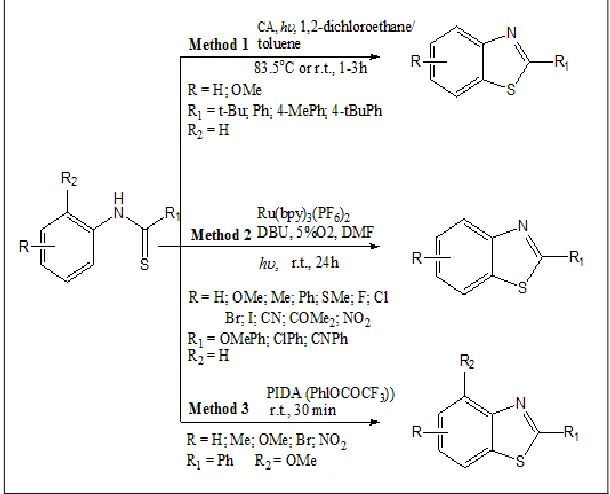
By Cyclization Reaction: Wide range of derivatives of benzothiazole was synthesized by the cyclization of various substituted thioformanilides using different reagents and novel methods. Rey and co-authors have investigated a simple and
1) 52. The key step of the reaction mechanism was hydrogen atom abstraction from thiobenzamide by triplet chloranil.
Another aerobic visible-light promoted photo redox catalytic formation of 2 substituted benzothiazoles have accomplished by Cheng et al., via radical cyclization of thioanilides without metal involvement except the sensitizer (Scheme 25, Method 2) 53. Various catalyst and solvents were applied for optimization of the reaction conditions and the results showed that tris(bipyridine) ruthenium(II) hexafluorophosphate (Ru(bpy)3
(PF6)2) works as an optimal catalyst and N,N
-dimethyl formamide (DMF) works as an optimal
solvent for this new protocol. Visible-light as the reaction driving force, molecular oxygen as the terminal oxidant and water as the only by-product are the salient features of this protocol.
Downer et al., have introduced a new and applicable protocol for the intramolecular cyclization of thiobenzamides to benzothiazoles through the aryl radical cations as reactive intermediates (Scheme 25, Method 3) 54. The protocol uses phenyliodine (III)bis(trifluoroacetate) (PIFA) in trifluoroethanol or cerium ammonium nitrate (CAN) in aqueous acetonitrile to enhance the cyclization within 30 min at room temperature, which afforded moderate yield of the products.
SCHEME: 25
Pharmacological Activities: Benzothiazole nucleus is present in the drugs which possess numerous biological activities and is studied by
[image:13.612.153.458.269.516.2]researchers with interest. Table 2 covers benzothiazole derivatives which have shown different pharmacological activities.
TABLE 2: PHARMACOLOGICAL ACTIVITIES OF BENZOTHIAZOLE DERIVATIVES Pharmacological activity and
derivative
Structure Activity
2-(substitutedphenylsulfonamido)‐6‐
substituted Benzothiazoles
S N
NHSO2
R
R1
COOH
R = Cl, Br, CH3, OCH3 R1 = I, CH3, NH2
Bacillus subtilis,
[image:13.612.50.564.593.746.2]Benzothiazolo triazole derivatives
S N
N N
F H N
R
R= ONO2, H, OCl
S. aureus, E. coli and C. ablican56
6-fluoro‐7‐(substituted)‐2-(
N-p‐anilinosulfonamido) benzothiazoles
S N
NHSO2
R
NH2
R = onitroanilino, mnitroanilino, p•nitroanilino, ochloroanilino, m•chloroanilino,p•chloroanilin o, anilino, morpholino, piperazino, dimethylamino
S. aureus, S. albus and
C.ablicans 57
Benzothiazolyl carboxamido pyrazoline derivatives
S N
NH C O
N N
H3C
R1
R
R = Cl, CH3,
R1 = C6H5, o-CH3C6H4, p-OCH3C6H4
S. aureus, E. coli, Pseudomonas aeruginosa, Klebsiella pneumoniae and Proteus
mirabilis58
Substituted 2- (4‐aminophenyl) benzothiazoles
N S
CH3
NH2
Ovarian, breast, lung, renal and colon carnicoma human cell
line 59
(3-bromo-propyl)-(6-methoxy-benzothiazol-2-yl)amine
S N
O
NH Br
Pancreatic cancer cell lines 60
amidino derivatives of phenylene-bisbenzothiazoles
N
S S
N
N
NH HN
N
Cl Cl
Human cancer cell lines 61
4-benzothiazole-amino-quinazolines
N N
R O
HN S
N
HN
O
R1
R = 2-Cl, 6-CH3, 2,4,6-OCH3
R1 =
N O
N O
Human cancer cell lines 62
8-fluoro‐9‐substituted benzothiazolo (5,1‐b) ‐1, 3, 4‐triazole
N S
N NH R
R1
R = aniline, onitroanilino, mnitroanilino, pnitroanilino, omethylanilino guanidine, hydrazine, pmethylanilino, diphenylamino, 2carboxyanilino, 4•carboxyanilino ,morpholino, piperzino.
R1 = F ,Br
substituted 2-amino-benzothiazoles
S N
NH2
O2N
Eudrilus eugeinae, Megascoplex konkanensis 64
3-(2-hydrazinobenzothiazole)- substituted indole-2-one
S N
H
N N
NH O
R
R = NO2, Cl
Comparable to standard drug; Albendazole 65
1-[2-(substituted phenyl)-4-
oxothiazolidin-3-yl]-3-(6-fluoro-7-chloro-1,3-benzothiazol-2-yl) ureas S N
NH NH
N S O
Cl F
O
R
R = 3-CH3, 2-OCH3
Perituma Posthuma 66
Substituted-2‐benzothiazolamines
S N
NH2 R
R=CH3 ,C2H5, n-prop, i-prop, n-but,
n-pent, t-pent, OCHF2, CF3, OC2H5,
CF3, 4-OCF3, 5-OCF3, 7-OCF3
Phenyltetrazolone induced convulsions 67
2‐(‐4-arylthiosemicarbazido carbonylthio)- benzothiazoles
S N OCH3
OCH3
S HN
O
H
N HN
S
Ar
Phenyltetrazolone induced convulsions 68
benzothiazoles containing sulphonamide derivative
N S
SCONHNH
ArHN
Ar = C6H5, o-CH3C6H4, m-CH3C6H4, p-CH3C6H4, o-OCH3C6H4, p-CH3C6H4, p-ClC6H4, p-BrC6H4
S
Electroshock and phenyl tetrazolone induced
seizures 69
2- (3 H) ‐benzothiazolone derivatives
N S
R
N N
CH3
R1
H3C
R= H, CH3, OCH3, Cl, F, NO2
R1= H, CH3, C2H5, i-C3H7, Br, CH2COOH
Phenyl tetrazolone induced convulsions 69
2-amino-6-substituted benzothiazole
S N
R
NH2
R = H, CH3, OCH3, F, Cl
Selective COX-2 Inhibition 70
2-chloro-acetyl-amino-6-substituted benzothiazole
S N
H N
O
Cl R
R = H, CH3, OCH3, F, Cl
2- (4'‐butyl‐3',
5’‐dimethylpyrazol‐1'‐yl)‐ 6‐substituted
benzothiazoles N
S
R
N N
CH3
CH2CH2CH2CH3 O
R= H, CH3, OCH3, Cl, F
Inhibit human cycloxygenase-2 enzyme
(COX‐2) 71
4-butyl‐1‐(6'‐susbtituted‐2'‐benzothiazolyl)
‐3‐methylpyrazol‐5‐ones
N S
R
CH3
O
R= H, CH3, C6H5, p-ClC6H4
Inhibit human cycloxygenase-2 enzyme
(COX‐2) 71
(a) N’-(benzo[d]-thiazol-2-yl aminomethyl)sulfanilamide (b) N’-(5-chlorobenzo- [d]thiazol-2-yl aminomethyl)
sulfanilamide (c) N’-(5-chloro-6- Fluorobenzo[d]thiazol-2-yl aminomethyl) sulfanilamide (d) N’-(5-chlorobenzo[d]thiazol-2-
ylaminomethyl)-N0-(pyramidin-4-yl)-sulfanilamide
H2N
S O
O
N N
H
R3 S
N R1
R2
(a ): R1 = H, R2 = H, R3 = H
(b ): R1 = Cl, R2 = H, R3 = H (c ): R1 = Cl, R2 = F, R3 = H
(d ): R1 = Cl, R2 = H, R3 = C4H3N2
M. tuberculosis H37 RV strains 72
Amodiaquine analogues
N
HN S
N NH
N
Cl
N
HN S
N NH
N
Cl
N
HN S
N NH
N
Cl
Antiplasmodial activity against W2 and K1 chloroquine resistant strains of Plasmodium
falciparum 73
2,6-substituted and 2,4- substituted-benzo[d]thiazoles
X
NH N S
OH R1
R2
(a) : X =CH, R1 = 4-OH, R2 = 6-Cl
(b) : X =CH, R1 = H, R2 = 6-Cl
(c) : X = CH, R1 = 4-NO2, R2 = 6-Cl
(d) : X = N, R1 = 4-OCH3, R2 = 6-Br
(e) : X = CH, R1 = 4-OCH3, R2 = 4-CH3
Anopheles arabiensis 74
N-(6-chlorobenzo[d]thiazol-2-yl)-2-morpholinoacetamide
S N
Cl
N H
O N
O Maximum glucose lowering effects comparable to the
TABLE 3: BENZOTHIAZOLES IN CLINICAL TRIALS
Drug Indication Clinical trial
Pramipexole
N S H
N
NH2
Binge Eating Disorder Phase 3 79 Cocaine Addiction
Cocaine Abuse Cocaine Dependence
Phase 1 80
Amyotrophic Lateral Sclerosis Phase 2 81 Early Parkinson's Disease Phase 4 82 Bipolar Disorder Phase 4 83 Tourette Syndrome Phase 2 84
Fibromyalgia Phase 2 85
Alzheimer's Disease Phase 2 86 Major Depressive Disorder Phase 4 87 Restless Legs Syndrome Phase 4 88 Dexpramipexole
H N
NH2
Hypereosinophilic Syndrome Phase 2 89 Chronic Sinusitis With Nasal Polyps and Eosinophilia Phase 2 90 Amyotrophic Lateral Sclerosis Phase 1 91
Riluzole N
S O F
F F H2N
Fragile X Syndrome Phase 4 92 Post-traumatic Stress Disorder (PTSD) Phase 1, Phase 2 93
Depression Phase 2 94
Autism Spectrum Disorders Phase 2, Phase 3 95 Adult Solid Neoplasm,
Recurrent Melanoma, Stage IIIA Skin Melanoma, Stage IIIB Skin Melanoma, Stage IIIC Skin Melanoma
Phase 1 96
Obsessive-compulsive Disorder (Ocd) Phase 2 97 Obsessive-Compulsive Disorder,
Autism Spectrum Disorder, Autism, Asperger Disorder, Developmental Disorder
Phase 2 98
Cervical Spondylotic Myelopathy Phase 3 99 (E)-3-(benzo[d]thiazol-2-ylamino)
phenylprop-2-en-1-ones
R3
O
S
HN S
N
R2
R1
R1 = H, CH3, OC2H5 R2 = H, CH3
R3 = Br, Cl, F, CH3, OCH3
show appreciable antidiabetic activity 76
6-ethoxy substituted benzothiazoles
S
N S
S N
O
enhance the rate of glucose uptake in L6 myotubes in AMPK-dependent manner 77 2-piperazinyl benzothiazoles
X N H2C
O R R1
R2
X = S, O R1= H, Cl
R2= H, CH3 , C6H5-CO, (oCl-C6H4-CO) R = 1-morpholinyl, 1-pyrrolidinyl diethylamino, OCH3, OC2H5
psychotropic diseases
Cerebellar Ataxia Phase 2, Phase 3 100 Melanoma (Skin) Phase 2 101 Major Depressive Disorder Phase 2 102
Social Anxiety Disorder, Performance Anxiety
Phase 2, Phase 3 103 Spinal Muscular Atrophy (SMA) Phase 2,
Phase 3 104 Huntington Disease Phase 3 105 Mood, Memory Deficit Phase 4 106 Tourette Syndrome Phase 4 107 Multiple Sclerosis Phase 2 108 Multiple System Atrophy,
Progressive Supranuclear Palsy
Phase 3 109
CONCLUSION: Benzothiazole is a versatile class of heterocyclic compounds which exhibits a variety of biological activities. Many procedures for their synthesis have been developed among which the condensation of 2-aminothiophenols with various acids/ aldehydes/ ketones/ nitriles/ esters is widely used. A large number of benzothiazoles have been developed in recent years possessing appreciable anti-tubercular, antimicrobial, antimalarial, anticonvulsant, anthelmintic, analgesic, anti-inflammatory, antidiabetic and anticancer activities. This comprehensive review will be highly useful to the researchers working in this area. They can discover better and easy ways of synthesis with enhanced yield, purity in shorter span of time. They can further explore this class to increase the ambit of existing biological activity profile.
ACKNOWLEDGEMENT: The authors are
thankful to Dr. Younis Ahmad, Dr. Muqtasid Rashid and Dr. Iqtibas Ahmad for their motivational support and guidance.
CONFLICT OF INTERESTS: Declared None.
REFERENCES:
1. Patel NB and Shaikh FM: New 4-thiazolidinones of nicotinic acid with 2-amino-6-methylbenzothiazole and their biological activity. Scientia Pharmaceutica, The Australian Journal of Pharmaceutical Sciences 2010; 78: 753-765.
2. Carroll AR and Scheuer PJ: Kuanoniamines A, B, C and D: Pentacyclic alkaloids from a tunicate and its prosobranch mollusk predator Chelynotus semperi. Journal of Organic Chemistry 1990; 55: 4426-4431.
3. Ahmad K, Malik MS and Syed MAH: Therapeutic potential of benzothiazoles A patent review 2010-2014. 4. Guo HY, Li JC and Shang YL: A simple and efficient
synthesis of 2-substituted benzothiazoles catalyzed by H2O2/HCl. Chinese Chemical Letters 2009; 20:
1408-1410.
5. Mortimer CG, Wells G, Crochard JP, Stone EL, Bradshaw TD, Stevens MF and Westwell AD: Antitumor benzothiazoles. 26(1) 2-(3, 4-dimethoxyphenyl)-5-fluoro-benzothiazole (GW 610, NSC 721648), a simple fluorinated 2-arylbenzothiazole, shows potent and selective inhibitory activity against lung, colon, and breast cancer cell lines. Journal of Medicinal Chemistry 2006; 49: 179-185.
6. Sattler L, Zerban F, Clark G and Chu CC: Journal of American Chemical Society 1951; 73: 5908-5910
7. Green and Perkin: Polythiosulphonic acids of p-diamines. Jounal of Chcmical Society 1903; 70: 1201-1212.
8. Maleki B and Salehabadi H: Ammonium chloride as a mild and efficient catalyst for the synthesis of some 2-arylbenzothiazoles and bisbenzothiazole derivatives. European Journal of Chemistry 2010; 1: 377-380.
9. Batista RM, Costa SP and Raposo MMM: Synthesis of new fluorescent 2-(2’, 2”-Bithienyl)-1,3-benzothiazoles. Tetrahedron Letters 2004; 45: 2825-2828.
10. Praveen C, Nandakumar A, Dheenkumar P, Muralidharan D and Perumal P: Microwave-assisted one-pot synthesis of benzothiazole and benzoxazole libraries as analgesic agents. Journal of Chemical Sciences 2012; 124: 609-624. 11. Dandia BR, Saha M and Gupta I: Microwave induced
synthesis of 2-substituted phenyl-3-(3-alkyl/aryl-5,6-dihydro-s-triazolo)[2,4-b][1,3,4]thiadiazo 6-yl indoles and 2-phenyl-3[2,substituted benzothiazole] derivatives and their fungicidal activity. Phosphorus, Sulfur Silicon Related Elements 1997; 130: 217-227.
12. Paul S, Gupta M and Gupta R: Synthetic Communications 2002; 32: 3541-354.
13. Nalage SV, Bhosale SV, Bhosale DS and Jadhav WN: P2O5 mediated rapid condensation of 2-aminothiophenol
with aromatic aldehydes at ambient temperature, Chinese Chemical Letters 2010; 21: 790-793.
14. Chandrachood PS, Garud DR, Gadakari TV, Torane RC, Deshpande NR and Kashalkar RV: A cobalt nitrate/hydrogen peroxide system as an efficient reagent for the synthesis of 2-aryl benzimidazoles and benzo thiazoles.Acta Chimica Slovenica 2011; 58: 367-371. 15. Moghaddam FM, Bardajee GR, Ismaili H and Taimoory
SMD: Synthetic Communications 2006; 36: 2543-2548. 16. Weekes A, Dix MC, BagleyMC and Westwell AD:
Synthetic Communications 2010; 40: 3027-3032.
17. Blacker J, Farah MM, Hall MI, Marsden SP, Saidi O and Williams JM: Synthesis of Benzazoles by Hydrogen-Transfer Catalysis. Organic letters 2009; 11: 2039-2042. 18. Bahrami K, Khodaei MM and Naali F: Mild and Highly
benzimidazoles and 2-Arylbenzothiazoles. The Journal of Organic Chemistry 2008; 73: 6835-6837.
19. Patil SS and Bobade VD: Simple and Efficient One-Pot Synthesis of 2-Substituted Benzoxazole and Benzo thiazole. Synthetic Communications 2010; 40: 206-212. 20. Maleki HS and Moghaddam MK: Room-temperature
synthesis of 2-arylbenzothiazoles using sulfuric acid immobilized on silica as a reusable catalyst under heterogeneous conditions. Acta Chimica Slovenica 2010; 57: 741-745.
21. Shokrolahi AZ and Mahdavi M: Phosphorus, Sulfur Silicon Related Elements 2012; 187: 535-543.
22. Abdollahi-Alibeik M and Poorirani S: Perchloric acid– doped polyaniline as an efficient and reusable catalyst for the synthesis of 2-substituted benzothiazoles. Phosphorus, Sulfur Silicon Related Elements 2009; 184: 3182-3190. 23. Alloum B, Bakkas S and Soufiaoui M: Tetrahedron Letters
1997; 38: 6395-6396.
24. Kawashita Y, Ueba C and Hayashi M: A simple synthesis of 2-arylbenzothiazoles and its application to palladium-catalyzed Mizoroki–Heck reaction. Tetrahedron Letters 2006; 47: 4231-4233.
25. Domasevich MK, Dalley NK, Kou X, Gerasimchuk N and Gerasimchuk O: Synthesis, crystal structures and coordination compounds of some 2-hetarylcyanoximes. Inorganica Chimica Acta 1999; 284: 85-98.
26. Van Zandt MC, Sibley EO, McCann EE, Combs KJ, Flam B, Sawicki DR, Sabetta A, Carrington A, Sredy J and Howard E: Design and synthesis of highly potent and selective (2-arylcarbamoyl-phenoxy)-acetic acid inhibitors of aldose reductase for treatment of chronic diabetic complications. Bioorganic and Medicinal Chemistry 2004; 12: 5661-5675.
27. Yadong S, Huanfeng J, Wanqing W, Wei Z and Xia W: Copper-Catalyzed Synthesis of Substituted Benzothiazoles
via Condensation of 2-Aminobenzenethiols with Nitriles. Organic Letters 2013; 15: 1598-1601.
28. Khalil ZH, Yanni AS, Gaber AM and Abdel-Mohsen SA: Phosphorus, Sulfur Silicon Related Elements 2000; 166: 57-69.
29. Manfroni G, Meschini F, Barreca ML, Leyssen P, Samuele A, Iraci N, Sabatini S, Massari S, Maga G, Neyts J and Cecchetti V: Pyridobenzothiazole derivatives as new chemotype targeting the HCV NS5B polymerase. Bioorganic and Medicinal Chemistry 2012; 20: 866-876. 30. Reddy CS, Rao PS and Venkataratnam R: Fluoro organics-
Facile syntheses of novel 2- or 4-trifluoromethyl-1H-arylo-1,5-diazepines, oxazepines, thiazepines, 2 -(1,1,1-trifluoroacetonyl)imidazoles, oxazoles and thiazoles. Tetrahedron 1997; 53: 5847-5854.
31. Rajeeva NSand Shantakumar S: Synthesis and Antimicrobial Activity of Some New 2-Substituted Benzothiazole Derivatives. E- Journal of Chemistry 2009; 6: 775-779.
32. Bastug G, Eviolitte C and Marko IE: Functionalized Orthoesters as Powerful Building Blocks for the Efficient Preparation of Heteroaromatic Bicycles. Organic Letters 2012; 14: 3502-3505.
33. Sharghi H and Asemani O: Methanesulfonic Acid/SiO2 as
an Efficient Combination for the Synthesis of 2-Substituted Aromatic and Aliphatic Benzothiazoles from Carboxylic Acids. Synthetic Communications 2009; 39: 860-867.
34. Yildiz-Oren IY, Aki-Sener E and Ucarturk N: Synthesis and structure–activity relationships of new antimicrobial active multisubstituted benzazole derivatives. European Journal of Medicinal Chemistry 2004; 39: 291-298.
35. Gupta SD, Singh HP and Moorthy N: Synthetic Communications 2007; 37: 4327-4329.
36. Ge F, Wang Z, Wan W, Lu W and Hao J: One-pot synthesis of 2-trifluoromethyl and 2-difluoromethyl substitution benzo-1, 3-diazoles. Tetrahedron Letters 2007; 48: 3251-3254.
37. Racane L, Kralj M, Suman L, Stojkovic R, Tralic-Kulenovic V and Karminski-Zamola G: Novel amidino substituted 2-phenylbenzothiazoles: Synthesis, antitumor evaluation in vitro and acute toxicity testing in vivo. Bioorganic and Medicinal Chemistry 2010; 18: 1038-1044.
38. Kumar R, Satyanarayana P and Reddy BS: NaHSO4-SiO2
-Promoted Solvent-Free Synthesis of Benzoxazoles, Benzimidazoles, and Benzothiazole Derivatives. Journal of Chemistry 2012; 2013: 1-10.
39. Nadaf RN, Siddiqui SA, Daniel T, Lahoti RJ and Srinivasan KV: Journal of Molecular Catalysis A: Chemical 2004; 214: 155-160.
40. Karlsson HJ, Bergqvist MH, Lincoln P and Westman G: Syntheses and DNA-binding studies of a series of unsymmetrical cyanine dyes- structural influence on the degree of minor groove binding to natural DNA. Bioorganic and Medicinal Chemistry 2004; 12: 2369-2384.
41. El-Sharief S, Ammar Y, Zahran M and Sabet HK: Phosphorus, Sulfur Silicon Related Elements 2004; 179: 267-275.
42. Cano R, Ramon DJ and Yus M: Journal of Organic Chemistry 2010; 76: 654-660.
43. Ding Q, He X and Wu J: Journal of Combinatorial Chemistry 2009; 11: 587-591.
44. Guo YJ, Tang RY, Zhong P and Li JH: Tetrahedron Letters 2010; 51: 649-652.
45. Nguyen TB, Ermolenko L, Dean WA and Al-Mourabit A: Benzazoles from Aliphatic Amines and o-Amino/ Mercaptan/ Hydroxyanilines - Elemental Sulfur as a Highly Efficient and Traceless Oxidizing Agent. Organic Letters 2012; 14: 5948-5951.
46. Liao Y, Qi H, Chen S, Jiang P, Zhou W and Deng GJ: Organic Letters 2012; 14: 6004-6007.
47. Elderfield RC and McClenachan EC: Journal of American Chemical Society 1960; 82: 1982-1988.
48. Kreysa FJ, Maturi VF, Finn JJ, McClarnon JJ and Lombardo F: Journal of American Chemical Society 1951; 73: 1155-1156.
49. Xue WJ, Guo YQ, Gao FF, Li HZ and Wu AX: A novel self-sequence reaction Network involving a set of six reactions in one pot: the synthesis of substituted benzothiazoles from aromatic ketones and anilines. Organic Letters 2013; 15: 890-893.
50. Klar U, Buchmann B, Schwede W, Skuballa W, Hoffmann J and Lichtner RB: Total synthesis and antitumor activity of ZK-EPO: the first fully synthetic epothilone in clinical development. Angewandte Chemie International Edition 2006; 45: 7942-7948.
51. Zhu Y, Jia FC, Liu MC and Wu AX: A Multipathway Coupled Domino Strategy: Metal-free Oxidative Cyclization for One-Pot Synthesis of 2-Acylbenzo-thiazoles from Multiform Substrates. Organic Letters 2012; 14: 4414-4417.
52. Rey Y, Soria-Castro SM, Arguello JE and Penenory AB: Photochemical cyclization of thioformanilides by chloranil: An approach to 2-substituted benzothiazoles. Tetrahedron Letters 2009; 50: 4720-4723.
synthesis of 2-substituted benzothiazoles. Organic Letters 2011; 14: 98-101.
54. Downer-Riley NK and Jackson YA: Conversion of Thiobenzamides to Benzothiazoles via Intramolecular Cyclization of the Aryl Radical Cation. Tetrahedron 2008; 64: 7741-7744
55. Hutchinson I, Chua MS, Browne HL, Trapani V, Bradshaw TD, Westwell AD et al: Antitumor benzothiazoles. 14. Synthesis and in vitro biological properties of fluorinated 2-(4-aminophenyl) benzo thiazoles: Journal of Medicinal Chemistry 2001; 44: 1446-55
56. Bhusari SR, Pawar RP, and Vibute YB: Indian Journal of Heterocyclic Chemistry 2001; 11: 79.
57. Sreenivasa MV, Nagappa AN and Nargund LVGL: Indian Journal of Heterocyclic Chemistry 1998; 8: 23.
58. Gopkumar P, Shivakumar B, Jayachandran E, Nagappa AN, Nargund LVG and Gurupadaiah BM: Indian Journal of Heterocyclic Chemistry 2001; 11: 39.
59. Brien SEO, Browne HL, Bradshaw TD, Westwell AD, Stevens MFG and Laughton CA: Antitumor benzothiazoles. Frontier molecular orbital analysis predicts bioactivation of 2-(4-aminophenyl) benzothiazoles to reactive intermediates by cytochrome P4501A1. Organic and Biomolecular Chemistry 2003; 1: 493-497.
60. Gill RK, Singh G, Sharma A, Bedi PMS and Saxena AK: Synthesis, cytotoxic evaluation, and in silico studies of substituted N-alkylbromo-benzothiazoles, Medicinal Chemistry Research 2013; 22: 4211–4222.
61. Racané SK, Pavelic RN, Depauwc S, Paul-Constant C, Ratkaj I, David-Cordonnier MH, Pavelic K, Tralic-Kulenovic V, Karminski-Zamola G: New anticancer active and selective phenylene-bisbenzothiazoles: synthesis, antiproliferative evaluation and DNA binding. European Journal of Medicinal Chemistry 2013; 63: 882–891. 62. Cai J, Sun M, Wu X, Chen J, Wang P, Zong X and Ji M:
Design and synthesis of novel 4-benzothiazole amino quinazolines Dasatinib derivatives as potential anti-tumor agents. European Journal of Medicinal Chemistry 2013; 63: 702–712.
63. Ghoneim KM, Essawi MYH, Mohamed MS and Kamal AM: Indian Journal of Chemistry 1998; 37(B): 904. 64. Munirajasekhar, Himaja M and Mali SV: Synthesis and
Anthelmintic activity of 2-Amino-6-substituted Benzothiazoles. International Research Journal of Pharmacy 2011; 2: 114–117.
65. Suresh H, Rao JV, Jayaveera KN and Subudhi SK: Synthesis and Anthelmintic activity of 3-(2-hydrazino benzothiazoles)-substituted indole-2-one. International Research Journal of Pharmacy 2011; 2: 257–261.
66. Sarkar S, Dwivedi J and Chauhan R: Journal of Pharmacy Research 2013; 7: 439–442.
67. Amit BN, Kamath RV and Khadse GB: Indian Journal of Heterocyclic Chemistry 2000; 9: 309.
68. Jimonet P, Francois A, Barreau M, Blanchard JC and Boirean A: Indian Journal of Medicinal Chemistry 1991; 42: 2828.
69. Singh SP, Misra RS, Parmar SS and Bramlave SJ: Journal of Pharmaceutical Sciences 1978; 64: 1245.
70. Yadav SK, Malipatil SM and Yadav SK: International Journal of Drug Discovery and Herbal Research 2011; 1: 42–43.
71. Singh SP and Vaid RK: Indian Journal of Chemistry 1986; 25B: 288.
72. Nayeem N and Denny G: Der Pharma Chemica 2012; 4: 1277–1282.
73. Ongarora SB, Gut J, Rosenthal PJ, Masimirembwa CM and Chibale K: Bioorganic and Medicinal Chemistry Letters 2012; 5046–5050.
74. Venugopala N, Krishnappa M, Nayak SK, et al.: European Journal of Medicinal Chemistry 2013; 65: 295–303. 75. Mariappan PP, Sutharson L, Banerjee J, Patangia U and
Nath S: Journal of Korean Chemical Society 2012; 56: 251–256.
76. Patil VS, Nandre KP, Ghosh S, et al.: Synthesis, crystal structure and antidiabetic activity of substituted (E)-3-(Benzo [d] thiazol-2-ylamino) phenylprop-2-en-1-one, European Journal of Medicinal Chemistry 2013; 59: 304– 309.
77. Meltzer-Mats E, Babai-Shani G, Pasternak L, et al.: Journal of Medicinal Chemistry 2013; 56: 5335–5350. 78. Diouf O, Depreux P, Lesieur D, Poupaert JH and Caignard
DH: European Journal of Medicinal Chemistry 1995; 30: 715.
79. Pramipexole for Binge Eating Disorder. Available from: https://ClinicalTrials.gov/show/NCT01106053
80. Pramipexole as a Treatment for Cocaine Dependence. Available from:
https://ClinicalTrials.gov/show/NCT01651377
81. Safety and Tolerability Study of KNS-760704 in Amyotrophic Lateral Sclerosis (ALS) (CL201). Available from: https://ClinicalTrials.gov/show/NCT00647296 82. Pramipexole and Bromocriptine on Nonmotor Symptoms
of Early Parkinson's Disease. Available from: https://ClinicalTrials.gov/show/NCT01673724.
83. Targeting Cognition in Bipolar Disorder with Pramipexole (PRAM-BD). Available from:
https://ClinicalTrials.gov/show/NCT02397837
84. Pramipexole Pilot Phase II Study in Children and Adolescents with Tourette Disorder According to DSM-IV Criteria. Available from:
https://ClinicalTrials.gov/show/NCT00558467.
85. Pramipexole ER vs. Placebo in Fibromyalgia. Available from: https://ClinicalTrials.gov/show/NCT00689052. 86. Safety Study of R(+)Pramipexole to Treat Early
Alzheimer's Disease. Available from: https://ClinicalTrials.gov/show/NCT01388478
87. Imaging Dopamine Release in Depression. Available from: https://ClinicalTrials.gov/show/NCT02033369 88. Long-term Efficacy, Safety and Tolerability of
Pramipexole in Patients with Idiopathic Moderate to Severe Restless Legs Syndrome (RLS). Available from: https://ClinicalTrials.gov/show/NCT00472199
89. Study to Evaluate Safety and Efficacy of Dexpramipexole (KNS-760704) in Subjects with Hypereosinophilic Syndrome. Available from:
https://ClinicalTrials.gov/show/NCT02101138
90. Study of Dexpramipexole Chronic Sinusitis with Nasal Polyps and Eosinophilia (CS201). Available from: https://ClinicalTrials.gov/show/NCT02217332
91. Study to Evaluate the QTC Interval in Healthy Volunteers Dosed With Dexpramipexole (QTC = Electrocardiogram (ECG) Interval Measured From the Onset of the QRS Complex to the End of the T Wave Corrected for Heart Rate). Available from:
https://ClinicalTrials.gov/show/NCT01511029
92. Riluzole in Fragile X Syndrome. Available from: https://ClinicalTrials.gov/show/NCT00895752
93. Safety Study of Riluzole to Treat Post-traumatic Stress Disorder (PTSD). Available from:
https://ClinicalTrials.gov/show/NCT02155829
https://ClinicalTrials.gov/show/NCT01204918
95. Pilot Study of Riluzole for Drug-Refractory Irritability in Autism Spectrum Disorders. Available from:
https://ClinicalTrials.gov/show/NCT02081027
96. Riluzole and Sorafenib Tosylate in Treating Patients with Advanced Solid Tumors or Melanoma. Available from: https://ClinicalTrials.gov/show/NCT01303341
97. Riluzole Augmentation in Treatment-refractory Obsessive-compulsive Disorder. Available from: https://ClinicalTrials.gov/show/NCT00523718
98. Riluzole to Treat Child and Adolescent Obsessive-Compulsive Disorder With or Without Autism Spectrum Disorders. Available from:
https://ClinicalTrials.gov/show/NCT00251303
99. Efficacy of Riluzole in Surgical Treatment for Cervical Spondylotic Myelopathy (CSM-Protect) (CSM-Protect). Available from:
https://ClinicalTrials.gov/show/NCT01257828
100.Efficacy of Riluzole in Hereditary Cerebellar Ataxia. Available from:
https://ClinicalTrials.gov/show/NCT01104649
101.Riluzole in Treating Patients with Stage III or Stage IV Melanoma That Cannot Be Removed by Surgery. Availble from: https://ClinicalTrials.gov/show/NCT00866840 102.Riluzole Augmentation Pilot in Depression (RAPID) Trial
(RAPID). Available from:
https://ClinicalTrials.gov/show/NCT01703039
103.Acute Anxiolytic Effects of Riluzole on Subjects with Social Anxiety Disorder. Available from:
https://ClinicalTrials.gov/show/NCT03017508
104.Study to Evaluate the Efficacy of Riluzole in Children and Young Adults with Spinal Muscular Atrophy (SMA) (ASIRI). Available from:
https://ClinicalTrials.gov/show/NCT00774423
105.Riluzole in Huntington's Disease. Available from: https://ClinicalTrials.gov/show/NCT00277602
106.Memantine or Riluzole Prophylaxis for Corticosteroid-induced Mood and Declarative Memory Changes. Available from:
https://ClinicalTrials.gov/show/NCT00283309
107.Developing New Treatments for Tourette Syndrome: Therapeutic Trials With Modulators of Glutamatergic Neurotransmission. Available from:
https://ClinicalTrials.gov/show/NCT01018056
108.Neuroprotection with Riluzole Patients with Early Multiple Sclerosis. Available from:
https://ClinicalTrials.gov/show/NCT00501943
109.Neuroprotection and Natural History in Parkinson's plus Syndromes (NNIPPS). Available from:
https://ClinicalTrials.gov/show/NCT00211224
All © 2013 are reserved by International Journal of Pharmaceutical Sciences and Research. This Journal licensed under a Creative Commons Attribution-NonCommercial-ShareAlike 3.0 Unported License. This article can be downloaded to ANDROID OS based mobile. Scan QR Code using Code/Bar Scanner from your mobile. (Scanners are available on Google Playstore)
How to cite this article: