109
A NEW PROPOSAL OF COMPRESSION METHOD FOR
ENHANCING SHAMIR’S SECRET SHARING USING
GAUSSIAN ELIMINATION BASED ON HYBRID
TRANSFORM CODING (IWT-DCT)
1SALAH S. AL-RAWI, 2AHMED S. FASIH, 3AHMED T. SADIQ
1 & 2Computer Sciences & Information Technology College- Al-Anbar University, Al-Anbar- Iraq
3Computer Science Dep.- University of Technology – Iraq
E‐mail:1 [email protected], 2[email protected],
ABSTRACT
Based on the dictionary coding technique, a new lossless compression method (CBDM) is presented to compress the color image in sufficient manner without missing any information and give a good CR. Then we use this proposed method in the sharing scheme (which presented and explained in reference [3]) to enhancing the performance of the system by combining it with other methods in compression phase into the sharing system, which suggested to share a secret image into multiple shadow pictures utilizing a method for solving a system of linear equation by Gaussian Elimination and scheme of Shamir’s threshold. This sharing system gives a shadow image size for everyone user to be as smaller as possible [1/4.6*(v/k)] of the secret image (where v=2,3,.., according to k value; the minimum number of qualified shares to reconstruct the secret), and any number of shares less than kuncovers any data about the secret image.This technique is secure for an image sharing with excellent execution time and gives fantastic (PSNR) value rate [larger than 34 dB] as shown in result table using DPCM that keep an image quality good however much as could be expected.
Keywords: Secret Image Sharing (SIS),Visual Secret (VS),RLC, DPCM,Gaussian Elimination (GE).
1. INTRODUCTION
Information security turns into an essential issue these days. in a certain application, it is a hazard if an arrangement of mystery information is held by just a single individual without additional duplicates in light of the fact that the secret information might be lost or adjusted. In many different cases, it may be important for a gathering of people to share a specific arrangement of mystery information. Transmission or store secret data, for example, business writings, military mystery, and private medical picture,., etc. is an exceptionally noteworthy and handy issue [1].
Secret sharing (SS) indicate to a strategy for circulating a mystery among a gathering of members, each of whom is distributed a share of the secret information. This secret can be recovered just when an adequate number of shares are collected together (denoted by k);
singular shares are of no utilization all alone [2].
110 picture data (called shares) to an arrangement of members so that, alone approved people together can reconstruct the image X' with the end goal that, X and X' are optically indistinguishable.
This paper enhancing the performance of proposed secret sharing scheme in [3] by suggest a new compression method based dictionary coding (CBDM) which combines with modified (RLC) in compression step to minimize the shares as much as possible with the same recovering image quality PSNR (because it’s a lossless compression method) beside the other things achieved in the original paper.
The motivation of this paper is exploitation and using three subject (PCM, Gaussian elimination and hybrid transform DCT & Wavelet) to enhance Shamir's secret sharing performance.
The current paper arranged and divided into six sections, the related works is explained in Section-2. The section-3 describe the previous work of Enhancing Shamir’s SS Using GE, followed by three sub sections (A,B,C) to explain a new compression method. Section-4 presents the our proposed system after combine with CBDM. The Experimental Results & Discussion, as well as the advantages of proposed technique, are examined and shown in Section-5. Finally, expressed the conclusions in section-6.
2. RELATED WORKS
In 2011, Bilal [4] suggest a hybrid
technique to compressed a color image that combines the Run-Length (RLC) and Shift coding after applied the zigzag and quantization step followed by the DCT on the whole blocks have (8*8) pixels to de-correlate the neighbouring pixels into an image. The obtained result of Compression Ratio (CR) was in the range (2.76, 13.34) and the values of (PSNR) was within the range (31.61, 46.21) for the Lena test image (for two size; 128, 256).
In 2013, Dalvir et al. [5], a lossless
compression scheme is utilized Huffman coding Based LZW Lossless Image Compression and
Retinex Algorithm; in which, the Huffman coding is used to compress the image. Then all these Huffman code words are concatenated together and compressed with LZW coding. In the last stage, the Retinex algorithm are used on compressed image for enhance the contrast of image and improve the quality of image. The Lena image result was (6.23) of CR and (48.06) of PSNR.
In 2013, Ashwaq and Loay [6], has been
proposed a visual cryptography technique which applied on a colored image to perform SS threshold (k, n) based on wavelet. In this framework, a compression of the image is adjusted to decrease the image size for efficient transmission and storage of secret images which contains applied a quantization step for all wavelet sub-bands and modulator (for LL) or Q-Tree (for other bands) followed by shift encoder, while a random generation function and a linear system have been utilized in the construction of secret image sharing scheme.
This system [6] reused (in 2014, Ashwaq
and Loay [7]) with other compression technique
based DCT transform that utilize quantization and Zig-Zag step after applied DCT. Then it splits the DC coefficients (to make a Modular process on it) from AC (to applying RLC) for every image block(8*8 pixels) followed by Shift Encoder step; as well as some modification to construct a system for sharing a secret gray image. The last two works of Ashwaq et al., given a good VS scheme
utilizing compression step based on transform coding techniques that produces shares size to be as small as possible (i.e., good CR) comparing to other works in secret sharing field.
Ali M. et al. [8] introduce a paper in
111 reduce shares size with good quality of the reconstructed secret image.
3. ENHANCING SHAMIR’S SS USING GE
BASED ON HYBRID TRANSFORM
CODING[3]
Based on the hybrid transform, a new dynamic technique of sharing scheme is suggested to share a secret image into multiple shadow pictures utilizing a method for solving a system of linear equation by Gaussian Elimination (GE) and scheme of Shamir’s threshold. This technique consist of three stages, the first one is the hybrid transform coding (with and without DPCM) and the second is for image compressor using hybrid ways while the third represent shares generation used modified Shamir’s approach. The first proposed system was construct an efficient secret image sharing by applied (k, n) threshold scheme based on a hybrid transformation of (I-WT and DCT) utilizing DPCM. This scheme firstly utilized the integer-WT to split the most important sub-bands (of a secret color image) from others followed by DCT which applied on all WT output except the LL sub-band where entered into another lossless coding called DPCM to keep the best quality as possible; and this hybrid transform used to reduce the image size as small as possible by the second stage.
Next, the compression stage utilize a Zig-Zag technique that produces a stream of bytes as the input of modified Run Length Coding (RLC) (by make it a lossless compression method for more to produce a compressed image; which encrypted by the RC4 for more security. Finally, a compressed-encrypted image used to produce shares by passing it through a proposed scheme of modified Shamir’s sharing approach that is the (k, n)-threshold scheme; A modification used polynomials to create shares but in different way of a traditional Shamir’s scheme while it depends on a set of linear equations solved by matrices with Gaussian Elimination methods to remade a secret image instead of utilizing a Lagrange Interpolation.
In this work, the previous secret sharing system explained above is extending and
improving by add a new proposed compression method to this system for decrement shares size which described in the following sections:
3.1 Proposal of Compression Based Dictionary Method (CDBM)
This new compression way utilizes the dictionary coding technique to compressor the data as a stream of bytes. Although this method requires more time (comparing with other coding ways) but it’s not losing any information during compressed the data stream (lossless type) and gives a good compression ratio with acceptable execution time. It utilizes in this paper as a basic part in compression stage of the proposed image sharing system, to minimize the image dimension as much as it can. The CDBM
compressed the image utilizing the following steps:
1- This technique depending on a dictionary coding, so firstly there is a need to insert this dictionary which looks like Huffman tree but, it differs in that it fixed and not change for any encoding process (contrast to Huffman encoding way) and arranged in particular way to achieve the best results. Thus, require to storing the dictionary symbols in 1D-array or database into a system, named Coding symbols dictionary (have string data type and size of 256) which includes a sequence string of (0’s and 1’s) listed in the appendix section.
2- The second step of this way includes calculates the frequency for all symbols values in the whole of input stream data (which represents an image pixels). Because of limiting the pixels value in the range (0 to 255), there is a need to use another 1D-array (lets called Frequency array) with size (256- corresponding to the first array) to store the redundancy of pixels values; then sorting this array according to higher to the lower frequency.
112 same size of a stream data needs to encoding, consisting of a stream of values (zero’s and one’s) as a binary file.
4- After constructing a Coding Dictionary that is fixed database to encodes the data as well as the two arrays listed above (Frequency
and Index arrays which are creation
depending on the input of a data stream), the process of encoding the input data (an image) can be achieved perfectly by performs the following steps:
i. Determine the largest repeater value (in the pixels image) utilizing Frequency
array and representing it into the new
array called compressed data array (which is a part of the compression file) by a first value in the coding dictionary, the second value in frequency array acts by second value in coding array and so on.
ii.
Before encoding process, the index array (which has the same input data size) filled with zeros that’s equal the same bits number in the input data. Then insert the value (1) at the end of each byte (in theindex array) that corresponding the end of
each encoded byte (in the compressed
array) and so on for all data until
processing the whole incoming data.
Finally, it converting these bits in the index and compressed data array to bytes and resizing them to a new length. In the result, the encoding file combine these three arrays (includes the compressed data and index arrays after converting them to arrays have an elements of bytes rather than a series of bits [zero’s and one’s], in addition to the frequency array) to encoding the secret image and reconstructing it without any losing values (Lossless compression method).
3.2 The Proposed Of De-Compression Method (I-CDBM)
The decoding of proposed method is necessary to reconstruct the data after applying (CDBM) explained above, by separating the components of the stream of data and rebuild the
original bytes based on a coding dictionary. This lossless technique decodes the data by applying the steps of forwarding compression way in reverse which illustrates in the following steps:
1- This process starts by extract the basic parts of information from a stream of compressed bytes that requires to rebuilding the original data. These parts include three arrays, compressed data,
frequency and index which are split by
extraction the length of each one stored in the specific position at the stream of encoding data.
2- The next step of this method is achieved by converting the contents of frequency and index parts in adding to the compressed section into bits instead of bytes (binary format).
3- Dividing a series of binary data (for a compressed part have 0’s and 1’s) into subsections of bits according to index part by determine the positions of index array (which identical the length of compressed part) have a one’s value, and by dropping these positions to the corresponding them into compressed part. So it is easy to determine the end of a segment and the beginning of another.
4-
After that, each segment takes the corresponding value in frequency part using a Dictionary Coding by determining the sequence of every substring in it to obtain the original value according to this sequence in frequency part. This process performed for all the segment in compressed part until completing them and produce decoding file.3.3 An Example Of The Proposed Compression Work
113 So, arranging these frequencies from higher to lower gives:
(0:1 ,.., 1:4, …..,155:20,…., 99:37, …,24:146).[i.e. the sequence of value (0) in frequency DB is first, (1) fourth, and so on].These values are encoded depending on the dictionary coding as the following:
The value (1) representing by (01), the (99) acting as (00111), (155) by (0110), and (24) by (0010100). This process illustrates in the below figure (1) that shows how to convert these bytes to sequence of bits:
Figure (1): Proposal Compression Method (CBDM)
Also, the above example show how to add the value (1) to corresponding the end of each encoded pixel value. These series of zero’s and one’s for encoding the original data and index
DB converts again to byte by collecting each eight values alone as a byte, final compression file is combine: the Compressed data {78 ,197, 14} followed by an Index data {66, 32, 67} followed by the Frequencies DB (after ordered) {0,.., 1, ..155, ..99, …., 24 ,….}. These steps is applying in reverse to remade the original image pixels.
4. The Proposed System
The principle challenges confronting secure secret image sharing assignments are an increment of sharing volume and sharing control adaptability. Albeit a few works have been devoted to concentrating the issue of imparting shading secret image to concentrate on diminishing the shared measure. Still, there is have to finish more decrease on the share. In this paper, a new compression method has been suggested and added to the new scheme presented in [3] which based on hybrid transform coding to make packed SIS when the secret image is a color with smallest shares size. Figure (2) illustrates the structure of the proposed system.
The main principle of the proposed works as the color image involves more space and Spend more data transfer capacity contrasted with binary images or grayscale. since reduce the color images size is essential for effective storage and transmission.
[image:5.612.87.309.282.473.2]
114
Figure (2): Proposed Sharing System Structure
5. Experimental Results and Discussion This section explains the performance of a proposed compression technique (DBCM) when it used alone as well as utilizing it as a part of a secret sharing scheme by combining this technique with other methods in compression stage (proposed in [3]). Different testing color
images have been carried out to survey the execution of a newly proposed technique. These testing samples include four bitmap images (Bear, Children, Flower, Lean), the first three images have the same size (256*256) except a Lean size is (512*512) which are shown in the figure (3). Lean size is (512*512) which are shown in the figure (3).
[image:6.612.90.564.51.442.2] [image:6.612.110.521.595.723.2]115
Table (1) shows several results of a proposed lossless compression method(CB-DM) after applying a transform coding to de-correlate the neighbouring.
Table (1): The Results Of Applying A Proposed CB-DM On Testing Images.
Pic_Name Orign. image size (bytes) Comp. Size after CBDM (bytes) Comp. Ratio (CR) Image Dimen. after Comp. Time of Comp. (in Sec.) Time of De‐ Comp. (in Sec.)
Bear 196,608 86,481 2.27 168*176 30.33 06.48
Children 196,608 93,611 2.10 176*184 34.71 07.97
Flower 196,608 82,983 2.36 168*168 30.94 05.93
Lena 786,432 100,741 1.95 184*184 38.19 08.95
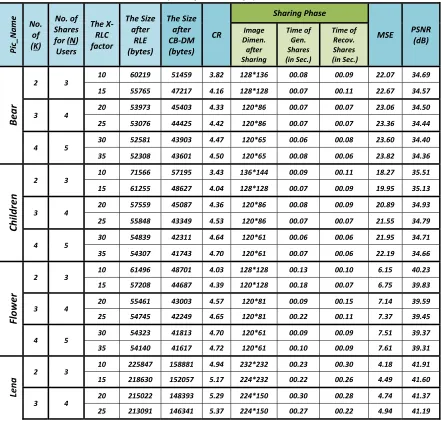
Table (2): The Results Of A Proposed Sharing System Based On (IWT-DCT).
Pic_Name No. of (K) No. of Shares for (N) Users The X‐ RLC factor The Size after RLE (bytes) The Size after CB‐DM (bytes) CR Sharing Phase MSE PSNR (dB) Image Dimen. after Sharing Time of Gen. Shares (in Sec.) Time of Recov. Shares (in Sec.) Bear 2 3
10 60219 51459 3.82 128*136 00.08 00.09 22.07 34.69
15 55765 47217 4.16 128*128 00.07 00.11 22.67 34.57
3 4 20 53973 45403 4.33 120*86 00.07 00.07 23.06 34.50
25 53076 44425 4.42 120*86 00.07 00.07 23.36 34.44
4 5 30 52581 43903 4.47 120*65 00.06 00.08 23.60 34.40
35 52308 43601 4.50 120*65 00.08 00.06 23.82 34.36
Children
2 3 10 71566 57195 3.43 136*144 00.09 00.11 18.27 35.51
15 61255 48627 4.04 128*128 00.07 00.09 19.95 35.13
3 4
20 57559 45087 4.36 120*86 00.08 00.09 20.89 34.93
25 55848 43349 4.53 120*86 00.07 00.07 21.55 34.79
4 5 30 54839 42311 4.64 120*61 00.06 00.06 21.95 34.71
35 54307 41743 4.70 120*61 00.07 00.06 22.19 34.66
Flower
2 3 10 61496 48701 4.03 128*128 00.13 00.10 6.15 40.23
15 57208 44687 4.39 120*128 00.18 00.07 6.75 39.83
3 4 20 55461 43003 4.57 120*81 00.09 00.15 7.14 39.59
25 54745 42249 4.65 120*81 00.22 00.11 7.37 39.45
4 5 30 54323 41813 4.70 120*61 00.09 00.09 7.51 39.37
35 54140 41617 4.72 120*61 00.10 00.09 7.61 39.31
Lena
2 3
10 225847 158881 4.94 232*232 00.23 00.30 4.18 41.91
15 218630 152057 5.17 224*232 00.22 00.26 4.49 41.60
3 4 20 215022 148393 5.29 224*150 00.30 00.28 4.74 41.37
[image:7.612.140.474.149.279.2] [image:7.612.87.528.313.738.2]116
4 5
30 211668 144845 5.42 216*113 00.22 00.33 5.15 41.0
35 210927 144043 5.45 216*113 00.22 00.19 5.29 40.89
40 210440 143521 5.47 216*113 00.22 00.31 5.39 40.80
Notes that a new compression method explained in above table gives a good CR (comparing to other lossless techniques for compressed a color image) but with high execution time. So, it’s suitable to combine this method with other to enhancing the performance of CR in addition to decrease the spends time, by utilize the compression techniques in proposed sharing system (presented in [3]) that have a modified RLC with X factor as well as Zig-Zag technique after applying a hybrid transform coding which explained in the Table (2).
Also, a figure (4) explain an example of applying a proposed hybrid transform based
scheme with DPCM to create shares and retrieve Lena image from these shares; this example used (4, 3) threshold sharing in addition to set x=40 (of RLC factor). The Lena image is compressed to be (143521 bytes ≈ 216*224 image dimension) before sharing phase and the size of every share become 216*150.
117
Figure (4): Example Of Sharing Step Using (3, 4) Threshold To Generate Shares And Retrieve Lena Image (By Applying A Proposed Hybrid Based Scheme With PCM).
Table (3): The Comparison Of The Performance Of Proposed Secret Sharing Schemes With Some Of Other Schemes.
Ref
No. Year
Type of
Image Domain
Original Image Size
Size of Shares
Shares Size (k=2)
PSNR
dB
[9] 2002 (Lena) Gray Spatial (512x512) 262,144 1/k 131,072 -
[1] 2007 (Lena) Gray Frequency (ITIW) (512x512) 262,144 1/2.6 k 50,000 Lossless
[10] 2011 (Lena) Gray Frequency (DWT) (512x512) 262,144 1/4k 32,768 -
[11] 2013 (Lena) Color Spatial (512x512*3) 786,432 Same S. The 786,432 -
[image:9.612.94.554.54.450.2] [image:9.612.100.517.527.727.2]118
[6] 2014 (Lena) Color Frequency (DWT) (512x512*3) 786,432 1/7.7k -1/13.7k - 56,320 102,576 34.42 – 31.35
[7] 2014 (Lena) Color Frequency (DCT) (512x512*3) 786,432 1/8.2k - 1/23.7k 95,968 - 33,120 32.54 –31.35
Proposed system with
PCM 2017
Color (Lena) Frequency (Hybrid-IWT&DCT) 786,432 (512x512*3) v/4.9k- v/5.4k : v=2,3. 158881- 143521 41.91 – 40.80 Proposed system without PCM
2017 (Lena) Color Frequency (Hybrid-IWT&DCT) 786,432 (512x512*3) v/ 7.6k-v/ 19.4k : v=2,3. 102643 - 40495 40.72-36.36
6. CONCLUSION
A new lossless compression method (DBCM) has been proposed to enhancing the performance of an introduced (k, n) secret image sharing scheme (in [3]) which is based on hybrid transform using a linear system by Gaussian Elimination to reconstruct the secret, it’s given us a high reliable to recover an image than other linear systems like Grammar’s Rule.
The Experimental results, given an affirm that we have a good lessening in shadow size during two steps by compression phase utilizing a hybrid compression method of (RLC and CBDM) firstly (on average; smaller than 1/4.6 of its original size), and by diminished to [v/k] of compressed image in sharing phase (where v=2 when k≤ 4, v=3: k≤ 8).
Estimated Shares Size = CR of Comp. Phase * Reduce of Sharing Phase * O.I size
On example, If k=3, The Reduce Ratio → (1/4.6)
* 2/3 ≈ (1/7) an so on.
Also, appeared that the MSE value of recovered secret image between (4.18 & 23.82) while the
value of PSNR measure in range (34.36 - 41.91).
The execution time results were very little in both of generation shares and reveal phase, it’s in Parts of the second between (00:00.06 -
00:00.36). The security of proposed structure is
ensured by, decorrelation of image transformation utilizing a hybrid (IWT-DCT). The other issue, uncorrelated coefficients become more secure by the standard RC4. And the last thing, that is every share relies on upon its own particular image coefficients which made the restoration of the secret is excessively
confounded for the assailant. As a future works can be used with Lin-Then scheme (mentioned in [9]) instead of a proposed sharing with GE, where Lin scheme utilizes a prime number 257 (which increase the difficulty of discovering a secret by an attacker) and decrease the shares size to be 1/k instead of v/k in our proposed sharing system (cause of the implicit extension). Also, can be implemented on other types of multimedia like secret text or audio instead of just images. Also we can use chaotic maps randomization [13] to improve the secretsharing keys depend on some features in this technique.
REFERENCES
[1] C. P. Huang and C. C. Li, "A secret image sharing method using integer wavelet
transform", Eurasip Journal on Advances in
Signal Processing, (2,2007), 1-13.
[2] A. Shamir. "How to share a secret", Communications of the ACM. 11( 22, 1979), 612-613.
[3] Ahmed T. Sadiq, Ahmed S. and Salah S., "Enhancing Shamir’s Secret Sharing Using Gaussian Elimination Based on Hybrid
Transform (Integer WT-DCT)", Journal of
Advanced Computer Science and Technology Research, Vol. 7, March-2017.
[4] Bilal K. Ahmed, "DCT Image Compression
by Run-Length and Shift Coding Techniques",
Jounal of University of Anbar for Pure Science, 2011.
119
Retinex Algorithm", International Journal of
Advanced Research in Computer and Communication Engineering Vol. 2, Issue 8, August-2013.
[6] Ashwaq T. Hashim and Loay E. George. 2013. "Secret Image Sharing Based on
Wavelet Transform", International
Conference on Information Technology in Signal and Image Processing, Mumbai, India, 324-332.
[7] Ashwaq T. and Loay E. 2014."Secret Image Sharing Based on Discrete Cosine
Transform", International Journal Of
Computers & Technology, ISSN: 2277-3061. [8] Ali M. Sagheer and Laith H. Abed, "Visual
Secret Sharing Without Pixel Expansion",
International Journal of Digital Crime and Forensics, 7(2), 20-30, June-2015.
[9] C. Thien, J. Lin. "Secret Image Sharing", Computers & Graphics.,765-770, 2002. [10] C. Yang, Y. Huang and J. Syue, "Reversible
Secret Image Sharing Based on Shamir’s Scheme with Discrete Haar Wavelet
Transform", Electrical and Control
Engineering (ICECE), International Conference, Yichange, PP.1250 – 1253, 2011.
[11] K. Wu, "A Secret Image Sharing Scheme for
Light Images", EURASIP Journal on
Advance in signal Processing, Vol. 49, PP. 1-5, 2013.
[12] P. Kumar, N.Hemrajani, S. Shiwani, and R. Davey, "Halftone Based Secret Sharing Visual Cryptography Scheme for Color
Image Using Bit Analysis", Int. J. Comp.
Tech. Appl., Vol. 3, No.1, PP.17-22, 2013. [13] Ahmed B. Majeed Ahmed T. Sadiq, E.M.E.
Mostafa and Yasser F. Mahmoud, "Using Chaotic Maps to Enhance RSA Public Key Cryptography", International Science Journal (Lahore), Vol. 30, No. 5, pp. 711-715, 2018.
120
Appendix
Coding Dictionary
The coding dictionary of a Proposal Compression Based Dictionary Method (CBDM) is listed in the following section:
Database Dictionary[] = {
//*1‐4*/bits to represent: (1+1+4+8+16)=30 Symbols(character)
"0","1","00","01","10","11","000","001","010","011","100","101","110","111","0000","000 1","0010","0011","0100","0101","0110","0111","1000","1001","1010","1011","1100","1101", "1110","1111",
//*5*/bits to represent: (2^5)=32 Symbols(character)
"00000","00001","00010","00011","00100","00101","00110","00111","01000","01001","01010" ,"01011","01100","01101","01110","01111","10000","10001","10010","10011","10100","10101 ","10110","10111","11000","11001","11010","11011","11100","11101","11110","11111" ,
//*6*/ bits to represent: (2^6)=64 Symbols(character)
"000000","000001","000010","000011","000100","000101","000110","000111","001000","00100 1","001010","001011","001100","001101","001110","001111","010000","010001","010010","01 0011","010100","010101","010110","010111","011000","011001","011010","011011","011100", "011101","011110","011111","100000","100001","100010","100011","100100","100101","10011 0","100111","101000","101001","101010","101011","101100","101101","101110","101111","11 0000","110001","110010","110011","110100","110101","110110","110111","111000","111001", "111010","111011","111100","111101","111110","111111",
//*7*/ bits to represent: (2^7)=128 Symbols(characters)
"0000000","0000001","0000010","0000011","0000100","0000101","0000110","0000111","000100 0","0001001","0001010","0001011","0001100","0001101","0001110","0001111","0010000","001 0001","0010010","0010011","0010100","0010101","0010110","0010111","0011000","0011001"," 0011010","0011011","0011100","0011101","0011110","0011111","0100000","0100001","0100010 ","0100011","0100100","0100101","0100110","0100111","0101000","0101001","0101010","0101 011","0101100","0101101","0101110","0101111","0110000","0110001","0110010","0110011","0 110100","0110101","0110110","0110111","0111000","0111001","0111010","0111011","0111100" ,"0111101","0111110","0111111","1000000","1000001","1000010","1000011","1000100","10001 01","1000110","1000111","1001000","1001001","1001010","1001011","1001100","1001101","10 01110","1001111","1010000","1010001","1010010","1010011","1010100","1010101","1010110", "1010111","1011000","1011001","1011010","1011011","1011100","1011101","1011110","101111 1","1100000","1100001","1100010","1100011","1100100","1100101","1100110","1100111","110 1000","1101001","1101010","1101011","1101100","1101101","1101110","1101111","1110000"," 1110001","1110010","1110011","1110100","1110101","1110110","1110111","1111000","1111001 ","1111010","1111011","1111100","1111101","1111110","1111111",
//*8*/ bits(2 char:253‐254) coding values
"00000000","00000001"
}.