810
GRADUATION-PROJECT MANAGEMENT SYSTEM:
A SOCIAL NETWORK ANALYSIS PERSPECTIVE
1 HAYA EL-GHALAYINI, 2 MOHAMMED ABU-ARQOUB, 3 GHASSAN ISSA, 4
AHMAD F. SHUBITA
1
McMaster University, Canada,
2University of Petra, Jordan
E-mail: 1 [email protected], 2 [email protected],3 [email protected], 4 [email protected]
ABSTRACT
This paper presents a web-based graduation-project management system that utilizes project-based and networked learning methods. The system is developed using Moodle open source platform that employs social constructivism learning theory. The main objective of this system is to manage and control activities such as submission of project deliverables, grading, evaluation, announcements, and supplementary course material along with facilitate an efficient communication between the many participants in the graduation project course including: students, supervisors, mentors, examiners and graduation project committee members. While students can organize their deadline submissions with less effort, supervisors and graduation project committee can track and monitor students’ transactions instantaneously. To highlight the advantages of using a web-based graduation-project system a Social Network Analysis is applied to study the interactions messages amongst all participants using cohesion measures including density and centrality. The results of analyzing the learning network of the graduation project system show that students interact and communicate as active learners while the system can assist supervisors and other participants in coordinating and managing the processes of the graduation project course.
Keywords: Constructivism Learning Theory, Project-Based Learning, Networked Learning, Social Network Analysis.
1. INTRODUCTION
Learning as defined by Driscoll [1] is “a persisting change in human performance or performance potential… [Which] must come about as a result of the learner’s experience and interaction with the world”. This definition includes the attributes associated with the well-known learning theories - behaviorism, cognitivism, and constructivism. These theories were established before the era of digital technology, therefore, the social media, networking technology, and information and communications technology (ICT) technologies leverage to sustain learning. Thus, the development of learning theories during the past decades emerged different learning methods and approaches such as project-based learning and networked learning. This means that the development of e-learning courses focuses on applying information and ICT to make possible new teaching and learning scenarios.
Project-Based Learning (PBL) has been highly recognized as a learning method that overcomes the limitations of traditional pedagogies [2, 3]. Learning is moving towards social-constructivist paradigm, which is a student-centered approach considering the student as an "Active Learner" [4]. Researchers have clearly specified the requirements of project-based learning and have put forward criteria for applying PBL in education. PBL must be involved with real-world problems requiring problem solving and creative decision making with minimal directions from the teacher. Additionally, Thomas [2] specified five important features for project-based learning as follows: centrality, driving question, constructive investigations, autonomy, and realism. Issa [5] used these features in a recent paper to integrate PBL with competitions resulting in a framework called "Competition-Based Learning".
811 networked learning as “Learning in which ICT is used to promote connections: between one learner and other learners, between learners and tutors; between a learning community and its learning resources”. Thus, many institutes initiate Learning Management Systems platform (LMS) and/or Content (Course) Management Systems (CMS) platforms in teaching courses. Networked-Learning is facilitated using a "network environment" which provides connections amongst a group of learners, learners and teachers, and a group of teachers [6]. It is basically a physical connection (environment) that allows connected people to distribute and share learning over space and time [7].
One of the advantages of using networked learning is the ability of researchers to investigate the levels of participation between users using Social Network Analysis (SNA) [8]. Relationships amongst a group of people can be visualized using diagrams (sociograms) and analyzed using mathematical measures such as density and centrality.
This research employs social constructivism learning theory using Moodle platform [9] that supports a social constructivist framework of education, project-based and networked learning methods in developing the graduation project management system. This is because the graduation project plays a significant role for students in their professional career; therefore the intended system aims to support educational planning and management issues in the graduation project course. Moreover, a case study has been presented in this paper to evaluate the effectiveness of the system. This has been performed using SNA techniques to understand the communication of the leaning networks (sociograms) for the case study.
2. GRADUATION-PROJECT COURSE
Most of the undergraduate Computer Science programs require an obligatory "Graduation-Project" course to be taken by students at the third or fourth year of study. This paper
studies and
analyzes the activities of managing the
graduation-project course in the Faculty of
Information Technology (IT).
Each student isrequired to develop a project, implement a prototype system, and write a research report in one semester. At the end of the semester, the designated assessment committee grades student’s work according to how the students present their work and defend it. At the beginning of every semester, students enrolled in the “Graduation-Project“ subject are grouped in teams formed by three to five students and assigned a supervisor on acceptance of their project proposal. Supervisors should assist their students in identifying and acquiring the knowledge and skills needed to complete the project, and to guide them through the main phases of the graduation projects life cycle i.e. specification, design, implementation, and conclude with testing and evaluation.
As experience shows, planning and management play a great role in the quality of education especially in courses such as the graduation project, where managing these projects is a real challenge for all participants including students, supervisors and the graduation project committee members. Students struggle with their projects to meet deadlines, and to have their deliverables on time. Consequently, supervisors and other participants will be involved to track students’ work and progress. Hence, a graduation project management system may be useful in managing the work included in the graduation projects.
The objective of this study is to study the communication between the participants of the graduation project using a web-based system that aims to manage the processes of the graduation project course and in order to meet this objective, the research question of the study is:
Do managing and coordinating the processes of graduation project course using a web-based system assist in achieving better communication between participants?
2.1 Graduation Project Course Participants
812 Committee (GPC) is in charge of organizing, scheduling, and monitoring the graduation project course during the semester. At the start of each semester, the committee provides the general themes and ideas to the student to use them in choosing their graduation project topic. Furthermore, subsequent to the submission of projects' proposal the committee review and evaluate the projects' proposals for acceptance and then assign a supervisor for each accepted project. In addition, the GPC is responsible of confirming the students' final marks at the end of each semester.
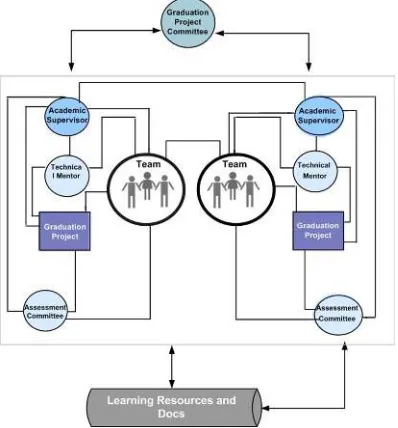
[image:3.612.92.291.433.647.2]The second participant in the learning network is the Student/Team. The student has to register in the graduation project course and a team of three to five students can collaborate in accomplishing the graduation project. The teams can be formed either as a self-organized team where the students create the team or an assigned-team where the graduation project committee creates the team and assigned number of students to work together. All members of the group have to know the phases of the graduation project lifecycle.
Figure 1. Participants’ Network of Graduation Project Course
This study didn’t consider the communication within the members of one team or between different teams; however, it considered the communication between a team and other
participants that are involved in supervising, managing or assessing the graduation project course. The next participant, an academic supervisor: is a faculty member that supervises a team and his responsibility is to monitor student progress and to make sure that deadlines are being met. For examples, the supervisor can assist in: helping students in understanding the problem, how it should be accomplished, facilitating each step of the graduation project process, and monitoring the students' progress during the development of graduation project. The technical mentor participant is a faculty member who assists students in solving technical problems during the development of their projects. Finally, an assessment committee (examiners) participant is formed by the graduation project committee and approved by the Dean. The assessment committee is responsible for grading and evaluating students' work and the final grades are sent to the GPC. The committee comprised of: supervisor, three faculty members, and a member from the innovation center.
2.2 Graduation-Project Course Structure
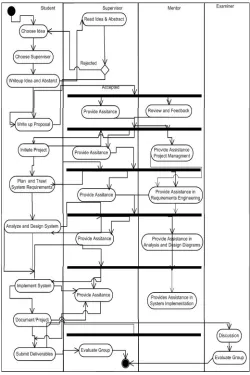
The development of the graduation project has a basic structure that includes a number of activities during the graduation project life cycle. Figure 2 depicts a UML activity diagram that describes how Faculty of Information Technology carries the activities of the Graduation Project course and describes the workflow behavior of the course. It shows the flow of control from one activity to another in the current system. An activity is a task which needs to be carried out and completed in a given period of time. For example, some of the typical activities in graduation project course are:
813
2. Initiate a project: this activity involves defining project's objectives, scope, purpose and deliverables to be produced.
3. Review literature: a literature review that describes the state of the art research related to the problem domain. A literature review should be organized according to the project objectives.
4. Plan and trawl system requirements: this activity relates to defining each major task, estimating the time and resources required. Also in this activity, requirements elicitation, functional and non-functional requirements are specified.
5. Analyze and design the system: this activity relates to utilizing an object-oriented approach in analyzing and designing the underlying system. This phase includes also the design of all the necessary hardware.
6. Implement and test the system: in this activity, students utilize their programming skills to produce the code (i.e. product) which is the main focus of the developer. Then, the generated code has to be tested against the requirements to make sure that the product is actually solving the needs gathered during the requirements phase. A complete system test that includes both software and hardware is accomplished.
7. Submit documentation: students have to submit a full documentation of their project phases. At the end of each phase each supervisor evaluates and grades the students' work.
8. Evaluate project: students have to present their work, and answer questions posted from the assessment committee. Project assessment is a multi-criteria process which focuses not only on the overall project outcomes, but also on each individual team member.
2.3 Graduation-Project Management System Faculty of Information Technology
Graduation-Project System (FIT-GPS) is implemented using Moodle 2.2. Moodle as a learning management system created by Martin Dougiamas, and is guided by the principles of social constructivist pedagogy in which students are involved in building their own knowledge [10]. Moodle is an open-source software with an engine that can be easily modified using PHP (Hypertext Preprocessor scripting language), and which provides users and developers with hundreds of tools and modules relevant to e-learning and to
social interaction. Thus, it enables the production of Internet-based courses and web sites that support a social constructionist framework of education [9].
The FIT-GPS is mainly focused on implementing the following functionalities: (1) manage the submission and evaluation phases of the graduation project deliverables, (2) provide students with means of communication with participants (i.e., GPC, supervisors, and examiners) by different techniques such as chatting, instant messaging, emails, and forums, (3) and allow students to access essential graduation
project learning resources and
[image:4.612.314.564.333.708.2]documentations. FIT-GPS is based on the basic structure of the graduation project development process described in Figure 2. In the next section, we will illustrate how we evaluated the communication among participants of the system using social network analysis.
814
3. EVALUATION OF FIT-GPS
This section studies and analyzes the communication between the participants for FIT-GPS using social network analysis (SNA). The rationale behind choosing this technique is due to the nature of social network analysis which studies the relationships that occur among social actors and focuses on the pattern from these interactions [11]. SNA could be a suitable method for mapping and visually representing the interactions of the network. In addition, it provides quantitative measures of social structures [12].
3.1 Social Network Analysis
Social Network Analysis (SNA) is the mapping and measuring of relationships and flows between people or/and groups, organizations, computers or other information/knowledge processing entities. A social network is constructed from a set of nodes representing the people or groups involved in the network. Nodes are connected through a set of links designating relationships or flows between the nodes. SNA allows researchers to analyze human relationships both visually and mathematically [13]. The main goals of using SNA are: visualization of the relationships between people and/or groups using diagrams, studying the factors that affect the relationships and the correlations between them, drawing out the relational data implications, and making recommendations to improve communication and workflow [8]. SNA data is represented using matrices, graphs and sociograms.
SNA measures were applied to the social networks in FIT-GPS in order to investigate the network relationships and level of participation between the users of the system. Individual actors are represented by nodes while the links between actors are represented by edges. Calculations that analyze the overall network analysis of all participants such as density and centrality were conducted in evaluating the system for greater insight to describe and illustrate the collective communicative structure of the learning network.
3.2 Network Measures
The work presented in this paper relies on the commonly used Cohesion measures (Density and Centrality) for the analysis of social networks and for the representation of the overall network structure. The Density of a network is used to measure the overall level of network's cohesion. According to Scott [14], Density describes the general level of linking between the members of a network. It measures how far from the state of complete graph, in which every member is connected to every other member, a certain network is. Thus, the density can be defined as the ratio of observed interactions between participants compared to the total number of possible interactions in a complete graph. This means that the value of the density measure is between zero and one. Lipponen and colleagues [15] noted that the smaller the network is, the higher its density would be. Typically, small networks have less than 1,000 nodes; thus the case study in this paper represents small networks.
The concept of centrality in SNA addresses the strategic position of a participant within the network. Usually, centrality is measured as a property of a single node within the network to evaluate the importance of this participant. The most simple centrality measure is the degree centrality of a node, which is the number of edges directly connected to a node. This implies that a node with a high degree of centrality and a high number of interactions is an important participant within the network and the actor of this node who needs more resources can get it more easily by establishing more contacts.
3.4 Case Study
815
3.4.1 Representation of Learning Network
The learning network matrix of FIT-GPS has been extracted from the Moodle log files for the three graduation project groups. The matrix represents the number of interaction messages between the participants of the network learning as shown in Figure 3. The participants in Figure 3 are as follows:
• Graduation-Project Committee (GPC),
• students of Graduation Project 1 (P1), students of Graduation Project 2 (P2), students of Graduation Project 3 (P3),
• Supervisor of P1 (S1), Supervisor of P2 (S2), Supervisor of P3 (S3), and
• Assessment Committee that consists of 5 examiners (E1, E2, E3, E4, E5).
Figure 3: Learning Network matrix
The value of interactions in Figure 3 has been calculated from the log file as the number of activities between the participants per group. The interactions of a graduation project group have been computed as the total number of interactions messages for the three students in that group.
[image:6.612.315.516.81.195.2]Figure 4 presents the FIT-GPS sociogram generated from NetDraw. The sociogram is a visualization of the network matrix shown in Figure 3 that represents the participants as the nodes of the network and the communications between the participants as the lines or edges of the network.
Figure 4. FIT-GPS Sociogram
3.4.2 Interpreting the Density Result
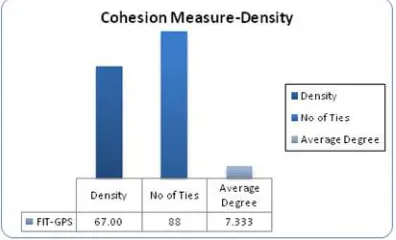
The density is a cohesion measure indicating the overall linkage between network actors and allows us to measure the speed of information distribution in a network. The density values in FIT-GPS had a value of 67% as shown in Figure 5. The density values do not indicate the number of participants in a network but the connectivity between those who actually participate. Lower degree of density indicates a low connectivity between participants while a higher degree of density may indicates that actors have participated and engaged in the interactions. Regarding the overall linkage between network participants, the results show that FIT-GPS has a high value of density due to the increased connectivity of students, supervisors, and Graduate Project Committee. This has been confirmed with the average degree in FIT-GPS which is equals to 7.3 out of 10.
Figure 5. FIT-GPS Cohesion Measure-Density
3.4.3 Interpreting the Centrality Result
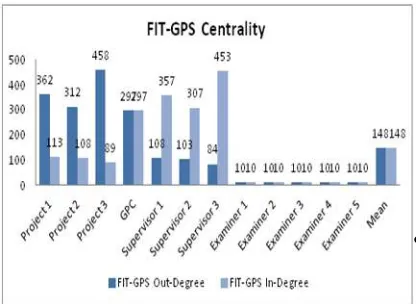
[image:6.612.317.515.522.642.2]816 degree in a network. Thus, the amount of information sent depends on the importance of the participant (out-degree) and the strength of the relation to the receiving participant (in-degree). In-degree and out-In-degree are measures of interaction to and from a participant. The lines that connect nodes in a sociogram are called arcs or edges. Based on that, the in-degree of a given node is described by the number of arcs pointing to that node, while the out-degree of a given node is described by the number of outgoing arcs from that node.
[image:7.612.90.298.549.701.2]With regard to Freeman’s Degree of Centrality Measures (Figure 6), the outDegree measure indicates that students in the three projects (i.e. 362, 312, and 458) were the focal point in the three projects and this is followed by GPC, supervisors, and finally the examiners. The role of GPC was to monitor the general activities by sending instructions and documentation needed during the graduation project development. The supervisors had less out-degree of centrality in the network compared to the GPC. Concerning the inDegree measure, supervisors were the focal points in three projects (i.e. 357, 3.7, and 453). We can safely state that the values of Centrality in all students ‘projects reinforce the discussion above about Density. The high values of Centrality were observed in FIT-GPS which also had high values of Density. This means that a higher network Density provides its participants with more opportunities to exchange information and is also an indicator of experience and power [16].
Figure 6. FIT-GPS Centrality Result
4. DISCUSSION
The idea of developing a graduation project management system is relatively new. For example, Khelifi [19] described the system requirements of a Graduation Project Manager application, which is implemented using traditional approach such as: JSP, Java Servlets and Oracle Database. Moreover, an academic project management web-based system is developed by Letouze [20] using JAVA, Javaserver, Primefaces, PostgreSQL, Glassfish and Netbeans. Whereby, in this research, we believe that using open-source software tools such as Moodle provides developers with source code that can be easily modified for constructing Internet-based courses. Moodle by its nature as mentioned by Moodle [9] is designed based on socio-constructivist pedagogy which means that it consists of a set of educational rather than computational tools. This is also conforms to the results in [25] that Moodle can help in establishing an effective learning and knowledge construction.
Implementing the graduation project management system based on Moodle software allows us to study the communications between the participants of the system; we utilized social network analysis to evaluate the process of networked learning. SNA shows great promise in assessing students’ interactions. This also concurs with studies reported in literature. For example, Rabbany [21] demonstrated that social network analysis is useful for educational data in order to evaluate students’ learning behavior. While the analysis that has been done by Vincent [22] over a part of an online language course, shows that online activities encourage students to socialize with their fellow students, where some students would like to take on the role of a teacher.
The results of analyzing FIT-GPS using SNA that answered the research question can be summarized as follows:
817 the development of the graduation project. This is because the students had the highest values of outDegree which means that they were sending messages to the supervisors.
• Information and resources seemed to be managed by the graduation committee and supervisors due to the high inDegree of GPC and supervisors which mean that they were the ones who received more messages from the students.
• The communication and interactivity of the graduation project learning network occurred mainly due to two reasons: the speed of dissemination of information among the actors and the major role that students have to play during the project life-cycle to submit their deliverables due certain dates.
5. CONCLUSION
The Higher Education sector worldwide has largely integrated information and communication technologies into general teaching and learning practices. This has been facilitated through the readily available open source learning management systems such as Moodle. The levels of utilizing these systems vary across institutions. This paper presented a web-based graduation-project management system (FIT-GPS) that utilizes two learning methods: project-based learning and networked-based learning. The system has been developed on Moodle platform that employs social constructivism learning theory.
The motivation behind the implementation of such a system has been the realization of the important role of the graduation project for preparing students to the real world, and the realization of the amount of administrative tasks involved on the part of faculty members as well as students. Accordingly, the graduation management system (FIT-GPS) was put to work in place of the manual procedure.
With these benefits in mind, the consensus was to perform further analysis for FIT-GPS using a scientific approach; namely "Social Network Analysis". Accordingly, the interactivity between participants was evaluated using social network calculations such as density and centrality (i.e. cohesion measures). The cohesion measures were conducted in this study to provide a greater insight into relationships between participants. High
values of centrality and density were observed in the developed FIT-GPS system. The result of density measure shows that the FIT-GPS has a high speed in distributing the information in a network. On the other hand, the results of centrality measure show that students play an important role in exchanging information and in the learning process during the graduation project development. High network cohesion is an indicator that students have the opportunities to exchange information. Finally, the system can help supervisors and graduation project committee in coordinating and managing the processes of the graduation project course where the student is an active actor in the learning network.
This study has some limitations: (1) the sample size was small; (2) the roles of the students in the group are not considered; (3) the communication between and among student groups are not taken into consideration. Despite these limitations, most participants (students, supervisors, committees) intuitively agreed on the many benefits of the system which includes:
• easy access to information,
• continuous communication between participants,
• posting announcements and auto reminders,
• adhering to strict deadlines,
• easy submission of requirements with immediate feedback from supervisors,
• reduction of number of face-to-face meetings, and
• enhancing the assessment and evaluation process through the use of online forms and automatic calculation of points.
As a result, further investigation is needed to study how the analyzed data of scoiogram can be used in evaluating individual members of a group and their roles in addition to the traditional assessment of students’ behavior during project development.
818 the fact that many institutions are going toward changing their teaching approach in some courses from curriculum oriented learning to outcome based learning and/or project based learning models [23], [24]. In competition-based learning, students can acquire practical knowledge and skills needed by industries [5]. However, the utilization of social network analysis in competition-based learning remains open for future investigation.
REFERENCES:
[1] Driscoll, M., Psychology of Learning for
Instruction. Needham Heights, MA: Allyn &
Bacon, 2000.
[2] Thomas, J. W., Mergendoller, J. R., & Michaelson, A, Project-based learning, 1999. [3] Mifflin, H., Project-based learning
background knowledge & theory. Retrieved
from: http://college.hmco.com/education/pbl/ background.html, 2003.
[4] Yiping, L., & MacGregor S. K, “Enhancing Project-Based Learning Through Online Between-Group Collaboration”. Educational
Research and Evaluation, Vol. 10, 2004, pp.
4-6.
[5] Issa, G., Hussain, S., & Al-Bahadili, H., “Competition-Based Learning: A Model for the Integration of Competitions with Project-Based Learning using Open Source LMS”,
International Journal of Information and
Communication Technology Education
(IJICTE), Vol. 10, No. 1, 2014, pp. 1-13.
[6] Banks, S., Goodyear, P., Hodgson, V., & McConnell, D., “Introduction to the special issue on Advances in Research on Networked Learning”, Instructional Science, Vol. 3, 2003, pp.1-6.
[7] Jones, C., “Networked Learning: Stepping Beyond the Net Generation and Digital Natives”, In Exploring the Theory, Pedagogy
and Practice of Networked Learning, Springer,
New York, 2012, pp. 27-41.
[8] Dekker, A.H., “A Category-Theoretic Approach to Social Network Analysis”,
Proceedings of Computing: The Australasian
Theory Symposium (CATS), Melbourne,
Australia, Vol.6, No.3, 2002.
[9] Moodle, Moodle Documents: Philosophy.
Retrieved from
http://www.docs.moodle.org/23/en/ Philosophy, 2012.
[10]Dougiamas, M., & Taylor, C., Moodle: Using learning communities to create an open sour
course management. Retrieved from
http://dougiamas. com/writing/edmedia2003/, (2003).
[11]Wasserman, S., & Faust, K., Social network
analysis: Methods and applications. New
York: Cambridge University Press. Cp. 3, Notation for Social Network Data and Cp. 4: Graphs and Matrices, 1994.
[12]Van Duijn, M., & Vermunt, J., “What Is Special About Social Network Analysis?”,
European Journal of Research Methods for the
Behavioral and Social Sciences, Vol. 2, No.1,
2006, pp. 2-6.
[13]Otte, E., & Rousseau, R. “Social network analysis: A powerful strategy, also for the information sciences”, Journal of Information
Science, Vol. 28, No. 6, 2002, pp. 441-453.
[14]Scott, J., “Social Network Analysis Sociology”, Vol. 22, No. 2, 2000, London:
SAGE Publications.
doi:10.1177/0038038588022001007.
[15]Lipponen, L., Rahikainen, M., Lallima, J., &
Hakkarainen, K,
“Patterns of participation and discourse in elementary students' computer supported
collaborative learning”, Learning and I
nstruction, Vol. 13, No. 5, 2003, pp.
487-509.
[16]Borgatti, P., Everett, G. & Freeman, C., Ucinet for Windows: Software for Social Network
Analysis. Harvard, MA: Analytic
Technologies, 2002.
[17]Borgatti, P., Netdraw Network Visualization. Analytic Technologies: Harvard, MA, 2002. [18]Shaqifah, N., Sani, M., Taib, S. M., Jusoff, K.,
& Shazi, A. R., “Finding Knowledge in Students Social Network”, World Applied
Sciences Journal, Vol. 12, 2011, pp. 47–54.
[19]Khelifi, A., Al-Rajab, M., Karem, S. & Subhi, L., “Graduation project online management system ALHOSN university case study”, In Proceedings of the 10th WSEAS international
conference on Software engineering
(SEPADS'11), 2011, pp. 130-137
[20]Letouze, P., Ronzani, R., Oliveira, A., "An Academic Project Management Web System Developed through a Software House Simulation in a Classroom”, International Conference on Sociality and Economics
Development IPEDR, IACSIT Press,
819 [21]Rabbany, R., Takaffol, M., & Zaïane, O.,
“Analyzing participation of students in online courses using social network analysis techniques”, Proceedings of Educational Data
Mining, 2011, pp. 21-30.
[22]Vincent L., & David L., “Beyond outcome-based: Competition-based learning for engineering students”, 9TH International
Conference on Modern Industrial Training,
2009.
[23]Makgato M., & Mbanguta Z., “Towards an outcomes-based teaching and learning module for teacher preparation programmes of FET institutions’ engineering and technology educators in South Africa”, World Transactions on Engineering and Technology
Education, Vol.1, No. 2, 2002, pp. 27-232.
[24]Hashim R., & Din M., “Implementing outcome based education using project based learning at University of Malaya”, European
Journal of Scientific Research, Vol. 26 No. 1,
2008, pp. 80-86.