2357
AN ANTICIPATORY ACTION: PORNOGRAPHIC EXPOSURE
VIA INTERNET AND THE ATTITUDES OF THE STUDENT
WITH VISUAL IMPAIRMENT TOWARD SEXUALITY
1
HANNY HAFIAR,
2SYAUQY LUKMAN, 3FAJAR SYUDERAJAT,4 FX. ARI AGUNG PRASTOWO
1,2,3,4 Lecturer in the Faculty of Communication Sciences, Universitas Padjadjaran Indonesia
E-mail: 1[email protected], 2[email protected], 3[email protected], 4[email protected]
ABSTRACT
The presence of assistive technology to facilitate people with visual impairment in reading texts digitally, has other impacts that were previously not anticipated. Some negative digital content, includes pornography, can be easily accessed and have impact on attitudes regarding sexuality. The purpose of this study was to determine the effect of exposure to pornography on students with visual impairment regarding sexuality, in the cultural context adopted by most Indonesian people, sexuality has certain limitations that must be maintained in accordance with social values. The findings are the initial stage for mapping efforts that can be taken by school institutions to expect the negative effects of pornography among students. The method used is a quantitative, using simple linear regression test, while the samples taken are 41 students. Along with data got from interviews and observations to map out the anticipation effort. The results showed that there was an influence from pornographic exposure on students with visual impairment regarding sexuality so there was a shift in the values adopted by some of them regarding sexuality, compared to the previous generation who were not familiar with pornographic content obtained from the internet. The anticipated actions include filtering, socializing the negative effects of pornography, teacher supervision, coordination between schools with parents, reminding each other among peers, strengthening religious value, consultation and addition activities that students can follow.
Keywords: Pornography, Sexuality, Students, Adolescents, Visual Impairment.
1. INTRODUCTION
The existence and technology development has opened up a new world for people with visual impairment. In the past the text could only be enjoyed by people with visual impairment with the help of someone to read it, now people with visual impairment can read text directly with the help of a screen reader. Screen Reader is a software that can help people with visual impairment to be able to read text on a computer screen or mobile phone. As Millennials, adolescents with visual impairment tend to be more adaptable and skilled in mastering technology compared to people with visual impairments that are more mature. Skills in this technology also open opportunities for adolescents with visual impairment to explore various features found on computers and mobile phone. So now, adolescents with visual impairment can access
various information through the internet independently without depending on someone to find and read it. Moreover, information obtained through the internet is not only in the form of text or visuals, but there are various types of audio and audiovisual information that are easier to consume for adolescents with visual impairment.
2358 But now, with the existence of the media convergence and technological advances, particularly the emergence of the Internet and digitizing information [2], through the internet and various tools, pornographic content does not have to be read and seen to be consumed by adolescents with visual impairments, but simply opening content and activating screen reader mode, or similiar application, then texts originating from a digital porn novel can be heard and enjoyed immediately said word by word.
Therefore, not infrequently some teenagers state that the pornographic content they can access, most of them are gained through the short-seasoned stories of pornography uploaded by anonymous authors but can be accessed through certain sites. Such sites are sometimes blocked so that it is difficult to access, but the teens always find other ways to access the site or even find other sites that also provide other pornographic content. In fact, based on the research results mentioned that media messages about sex in online media are often inaccurate and incomplete result in adolescents ‘ interpretation of sex in the media has the wrong possibility [3], the error of this interpretation will form a perception that is also erroneous.
For those who have low vision, usually can still see static images or load-laden pornography that can be accessed through several sites on the Internet. When it comes to access to sites like this, the teenagers usually utilize the presence of earphones, which is actually relatively infrequent. Although the earphones are also used when listening to music and songs. In some cases, there are times when the sound from the earphones is leaked and heard by people nearby, without being noticed by the user of the earphone.
The ability to find and access pornographic sites is known to stem from the accident followed by a try-to-search attempt. Another way is to be notified by others, or to recall the steps of accessing the site it has ever done while they are still in the state of viewing. Because some teenagers with visual impairment are people who experience blindness after adolescence.
This condition is a condition which needs to be observed, considering that adolescents with visual impairment are adolescents in general who are in the growth phase towards maturity who still need supervision so that they do not cross the line. It is stated that technology directs and changes the lives of people who are not all in a condition ready for specific progress. This lack of preparedness has
made people unable to fully control the effects of technology, good and bad [4], including the impact of technology that opens the door to the introduction of adolescents with visual impairment with pornographic content on the internet. Especially if the teenager is continuing to study in a different city with their family so that the supervision of the family towards the use of internet media by children is reduced. Even though parents should guide their children’s for a media user [5] Actually, the existence of internet technology has expanded the opportunities for teenagers with visual impairment to obtain better quality education through learning technology, but a number of challenges have reduced the realization of the potential of Internet-based education. One of the most significant and controversial challenges involves the possibility of exposure to minors from inappropriate online content [6] including pornography.
Pornography has the capacity to reach an audience that is significantly broader than any notion of ‘audience’ that we might envision [7], including children and underage adolescents. This is supported by one of the findings from the Pre-CIPA study which found that 53% of teenagers had seen websites that contained pornographic or violent elements [8]. In relation to exposure to pornography, is the harm a child gaining sexual knowledge too early[9]. Moreover, the search for pornographic content is now easier to obtain. Websites with adult content can be found with the help of pornography search engines and website directories [10].
Communication technology is one element of globalization. Globalization makes people aware of important events that occur in any region of the world. However, in culture, the community is flooded with values that are not in accordance with national culture, including clothing, violence, and pornography [11]. Pornography has the capacity to reach an audience that is significantly broader than any notion of ‘audience’ that we might envision. In relation to exposure to pornography, is the harm a child gaining sexual knowledge too early.
2359 [12] increase the complexity of the problems faced by adolescents with visual impairment.
This is related to stress conditions that tend to be easily felt by teenagers with visual impairment compared to teenagers in general. The researches that examine pornography problems associated with the condition of adolescents with foreign impairment are still relatively limited. This is what led researchers to conduct studies relating to the influence of exposure to pornographic content on student attitudes with visual impairment that are still in the adolescent category, regarding sexuality. Researchers believe that the attitude of an individual to an object is influenced by the intake of information consumed. Moreover, based on the results of previous observations, the researchers caught the symptom of a change in the pattern shown by teenagers with visual impairment during dating who was considered to be more open and no longer reluctant to show romantic acts to their partners, even though they realized that there were strangers they did not really know were around them.
Referring to eastern customs and religions adopted by most Indonesian people, romantic acts such as sitting close together when there are other empty seats, holding hands intensively, leaning head to shoulder of the couple, talking in whispers to the pair, are taboo actions carried out by unmarried teenage couples, especially if done in front of other people. But if this action is carried out by a pair of teenagers openly, then it is not impossible that the order of values no longer underlies their behavior when dating. This means that there is a shift in their values and attitudes towards sexuality which is characterized by insecurity in showing romance openly.
2. METHOD
There are studies that have examined the influence of pornography on adolescents, including research that examines the frequency of consumption of pornography with permissive sexual attitudes [8], research describing the risk of exposure to pornography through the internet also mentions that the internet users of any age find it difficult to avoid unwanted encounters with sexually explicit materials [9] discrimination test between girls and boys who consume pornography with fantasies about sexual acts, and perceptions about pornography [10].
Whereas in terms of research carried out on disability, pornography and the internet, there are studies of students with disabilities using social media such as YouTube and Facebook for personal and educational purposes [11], the link between pornography use as a tool for sexuality-related acts by persons with disabilities [12], although also the results mention that the internet and personal electronic devices are made to compare with their intimate sexual partners in a respectful manner [13].
However, researchers have not found research that specifically studies the effects of pornographic content obtained through the internet, which is associated with attitudes, adolescents with visual impairments about sexuality. Various studies have indeed stated that pornographic content has a certain impact, including negative impacts on adolescents. Like teenagers in general, adolescents with visual impairment in some studies mentioned that they also experienced the difficult phase when facing their teens moment in general. Whereas attitudes towards sexuality are also stated to be influenced by the consumption of information through various sources, including internet media.
Therefore, this time, the research conducted by researchers was research that examined the effect of pornography exposure on student attitudes with visual impairment regarding sexuality. The sample obtained was 41 people consisting of students with visual impairments which were at the level education of junior and senior high school in Wyataguna Bandung, Indonesia.
Wyataguna is a place that has become a national rehabilitation center for people with visual impairments. There are various levels of education provided at this place, ranging from Early Childhood Education and Development (ECED)/ PAUD, kindergarten, elementary school, junior high school to high school that is under the auspices of the government. In this place there are also various other facilities such as consultation for parents who have children with visual impairment, empowerment and youth direction with visual impairment who are in preparation to be able to jump in and mingle with the general public, or training and developing competencies for debriefing towards independence in working and earning a living.
2360 high and high school levels, although their age is not infrequently past the initial teenage age in general, due to their maturity and maturity as individuals, the school allows them to study according to the level needed.
At the time of data collection, the researcher tried to accompany and read the questions contained in the questionnaire while conducting short interviews and observations on attitudes and behaviors when filling out the questionnaire and after. This is done to enrich the data and add insight to researchers on the topic being studied.
After the quantitative data has been collected, data analysis is performed. Statistical analysis using a simple linear regression test was calculated using the SPSS application. The qualitative data was collected through interviews with a number of teachers and school management as well as dormitory managers within the study area, using purposive sampling techniques.
Qualitative data collected in the form of answers to questions about efforts made by the institution, as a proactive step in anticipating the negative impact of pornography on the internet among students and adolescents guided by them. In addition to interviews, qualitative data are also obtained from observations of a number of students and their behavior both inside and outside the school environment. This is done to add insight in sharpening the results of the analysis that will be used as conclusions in research.
3. FINDINGS
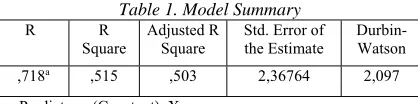
A number of data collected through the questionnaire are then inputted and processed to produce data which can then be used to draw conclusions. Figures Based on the calculation results of the data collected through questionnaires, it is known that the results are as on table 1:
Table 1. Model Summary
R R
Square
Adjusted R Square
Std. Error of the Estimate
Durbin-Watson
,718a ,515 ,503 2,36764 2,097
a. Predictors: (Constant), X b. Dependent Variable: Y
Table 1 shows that the value of R Square is 0.718. R Square is the determinant coefficient defined as the significant ability of independent variable in
[image:4.612.314.523.154.227.2]explaining the dependent variable. This means that the porn media exposure (X) affected to the attitude of students with visual impairment regarding sexuality (Y) at 71,8%.
Table 2. The Result of ANOVA
Model Sum of Squares
df Mean Square
F Sig. Regression 232,596 1 232,596 41,492 ,000b
Residual 218,624 39 5,606
Total 451,220 40
a. Dependent Variable: Y b. Predictors: (Constant), X
[image:4.612.314.523.396.467.2]Table 2 shows the level of significance. Based on ANOVA or F-test, F-count is 41,492 > F-table is 4,09 with b significance level of 0.000. Since the probability (significance level) is smaller than 0.05. If F-count > F-table and Sig < 0,5, it means H0 is rejected and Hi is accepted, then this regression model can be used to predict the porn media exposure (X) to the attitude of students with visual impairment regarding sexuality (Y)
Table 3. The Result of Coefficients
Model Unstandardized
Coefficients Standardized Coefficients t Sig.
B
Std.
Error Beta (Constant)
X
2,930 1,062 2,760 ,009
1,082 ,168 ,718 6,441 ,000 a. Dependent Variable: Y
Statistical analysis in this research used Statistical Product and Service Solution (SPSS) software. Data were analyzed using a simple linear regression test. The study tested the following hypotheses: H0: There is no a significant relationship between porn media exposure and to the attitude of students with visual impairment regarding sexuality
Hi: There is significant relationship between porn media exposure and to the attitude of students with visual impairment regarding sexuality
[image:4.612.91.300.607.659.2]2361 The results of the data analysis produced the coefficient of regression X of 1,082. It means that if the porn media exposure increases by one unit, the attitude of students with visual impairment regarding sexuality will increase by 1,082%. The constant value found in the test is at 2,930. It means that if the variable (X), porn media exposure does influence the variable (Y), the average amount of the attitude of students with visual impairment will be positive with the value of 2,930. Based on Table 1 it is known that exposure to porn media has a significant effect on the attitude of students with visual impairment by 71,8%. This means that exposure to porn media has been made accessible by adolescent with visual impairment, and considers activities that contain sexual elements to be something that is considered quite reasonable in this era.
Based on these results, the school and dormitory institutions try to take action as an effort to prevent the adverse effects of pornography accessed through the internet can be overcome. One of them is the existence of regulatory support carried out by the Indonesian government through the Ministry of Communication and Information which carried out filtering of pornographic content that came into force since August 2018. This is in line with the suggestion that it is recommended by the Government and Information Communication Department (Kominfo) to monitor pornography in electronic media [13], including supervision of content on internet media.
Since the enactment of safe google search, some respondents have admitted that the accessing pornographic content is not as easy as it used to be only writing certain keywords. Although in the end access to similar content can still be done, it requires a more complicated method.
This government policy can be followed by policies made by school institutions and also dormitories. Because some of the students studying at SLBN A Wyataguna are also listed as residents of the dormitories at the Bina Netra Social Institution (PSBN) Wyataguna which are in a regional complex. This means that additional filtering can be done by institutions to filter out keywords that have not been covered by Kominfo. In addition to filtering, restrictions on wifi access provided by institutions can also be done to avoid accessing the internet at hours that should be used by students to rest, for example at night which tends to be difficult to monitor by the board supervisor.
The second step that has been attempted is to socialize the effects of pornography on adolescents, which are followed by all teachers and dormitory management. This is done to provide information on preventive and curative procedures to prevent further negative impacts. This activity presents tutors from the fields of communication and psychology to open insights and refresh the memories of the teachers and dormitory management regarding the new responsibilities and challenges they face as today’s technology develops.
The next step taken is to intensify the religious recitation activities that present Ustadz (religious teachers) by emphasizing the bad topic of pornography in terms of religion, morality and social. This is done by referring to the conclusion that religiosity is very effective as a way to delay or even prevent ourselves from leading to a tendency towards deviant sexual behavior [14]
The other thing that can be done is to open an opportunity for consultation for students who feel they have problems related to the impact of Internet technology. The opportunity to consult is not limited to, pornography problems. Students experiencing various problems related to virtual cyberbullying, dealing with hoax information, and the like. According to the research results, they are also given the understanding that in interacting through the media, exploring moral engagement should be regarded to provide the framework of interaction basis with human communities such as trust, care, friendship, and commitment [15]. The effort to provide a consultation facility is given to those who feel already experiencing technology addiction. Technology addiction refers to emotional addiction to mobile devices [16]. The consultation activity is facilitated by the consular who has a counseling and religious education background. So it is hoped counselors and therapists can be instrumental in educating, diagnosing, and treating Internet use problems [17] including pornography.
2362 sexuality from peers [18] which is not necessarily accountable for its accuracy.
Another effort is to coordinate with parents, especially mothers. This is necessary because the mediation of parents on the use of devices and internet in children is an effort to protect children from the negative effects of technology. Mothers are important actors in the application of types of mediation in families [19]. Through optimizing the role of proactive mothers, it is expected that the use of information technology by adolescents can be more closely monitored.
Teachers who play the role of parents of students in the school and supervisors in the dormitory should have mastered media literacy [20], so that the authority of the dormitory and supervisor can be better maintained and can no longer be deceived by various groups of teenagers who argue when caught in activities that do not reasonable and not in accordance with school or boarding regulations. This is in line with the opinion that digital literacy must be given at the level of family, school, and state [21], because as a millennial generation, adolescents with visual impairment also have a fairly high adaptive ability to technology.
Next is to do the addition of extracurricular activities, as it is also known that the more leisure time they have, making teenagers more easily interested to spend time interacting through the smartphone. This is feared to increase the length of risk of adverse effects of digital technology, while too much exposure to information is useless. Extracurricular activities are expected to form adolescent characters because the establishment of values in schools is also very dependent on school culture and school activities [22] and in dormitories.
Some steps that have been attempted by the school in addressing the phenomenon of pornography exposure to students can be formulated in table 4.
Table 4. Preventive and Curative steps conducted by the institution/school
Activities Target
Filtering Students/Teenagers
Socialization of
pornography’s impact Teacher/school/dormitory Management Religious activities Students/Teenagers
Consultation Students/Teenagers Supervision Students/Teenagers Coordination Parents/Family Students The appeal of the
Peergroup
Students/Teenagers
Additional Extracurricular Activities
Students/Teenagers
Preventive and curative efforts carried out by school institutions and dormitories will not be carried out without assistance and coordination with other interested parties. Therefore, the school cooperates with parties who are considered to be able to contribute. One of them is a higher education institution that conducts research and mapping situations and priors programs to tackle problems. Other parties invited to work together are counseling institutions, teachers and religious leaders, students parent groups, peer group friends, and alumni. This is done as a serious effort in overcoming the impact of pornography among students with disabilities who tend to be considered not to be exposed to pornography.
4. DISCUSSION
Based on the results of statistical calculations showing the influence of exposure to pornography on students' attitudes with visual impairment related to sexuality. The exposure of pornography is related to the frequency and intensity of exposure to adolescents who gradually influence their assessment of what values are allowed and who is not allowed to carry out an action, which contains elements of sexuality.
As a country that is located in the eastern region, Indonesia has a customary tradition that differs from other countries. Indonesia not only has a culture of the society that still holds the values of taboo in terms of sexuality, but Indonesia is also one of the countries with the most Muslim population. These religious values are also a lot of color people’s interactions to be having.
2363 A direct rebuke is usually done by conveying the direct appeal to the couple not to make an advance in public due to many young children who are not yet worthy to witness the warmth. Strikes are usually conveyed by authorities such as security or other similar officers; or by other parties who morally feel called for enforcement for shared convenience. While indirect rebuke is usually performed by means of nonverbal dislikes, either an implied view of prohibition and or other nonverbal code. This is usually done while there are couples that are not yet tied to marriage showing excessive warmth in public places such as malls, cinemas, or other entertainment venues that are also visited by minors. Whereas if the warmth is shown by the couple “Bule” or is in the place that there are foreign tourists, for example, in Sanur Beach, Bali, the warmth made is often more overlooked. This means that Indonesian people also tend to consider the context surrounding the behavior of the warmth that is displayed.
But if the perpetrator’s content is a pair of unmarried teenagers, then the parties who feel they have moral and social responsibility will not hesitate to perform the enforcement. But based on the developments that researchers observed, there was quite a change felt. Among them: the fewer people who feel called to perform the enforcement as a step indicating the social responsibility, there is a resistance from teenagers who feel inappropriate for a strike, until the other party that felt that the rebuke delivered by one to the youth who was making an exaggeration was excessive.
This demonstrates the dynamics of the culture of Indonesian society in regard to the context of warmth. It may arise apathy toward things that were previously considered taboo, or neglect of the rebellious attitude of teenagers. One of the triggers of the attitudes is due to the amount of information that the community acquired about the rights so that the public making it tends to do in the pretext of expressing feelings towards the couple, even in public. In public areas. This at the same time, it is the shift of the values that the youth embraced against sexual behavior [18], including a public preface.
As teenagers are still in the transition phase, some of the attitudes and behaviors are shown by adolescents tend to be a result of the example of the attitude and behavior of the person being an idol. But due to the limitations of the loss, the imitation process of behavior is likely to be not
comprehensive but only limited to the adolescent interpretation itself. This phenomenon is also found among adolescents with visual impairment. For visually impaired children, it becomes difficult to imitate other people's behavior [23] including for the teenagers.
Not infrequently a reprimand was delivered when a couple of teenagers with visual impairment found that they were making out, like sitting with their faces close together, showing a disturbing attitude and not receiving the rebuke. The reason for being suggested is that their actions are still within reasonable limits. The understanding of this fairness boundary was triggered by readings of the romanticism that they read through novels or short stories from anonymous authors on the internet. That is, pornography becomes one of the contents that can change the social condition of a society [24], including changing the values that have been embraced in generations.
This finding is in line with the results of research that states that teens who consume pornography can develop unrealistic values and sexual beliefs, including higher levels of permissive sexual attitudes, and sexual experiments related to the frequency of pornography consumption [25], among adolescents.
Other research results that also show similar results are research on people with intellectual disability in Australia. The results mention that five participants indicated they had viewed pornography to explore sexuality [26], In the area of online pornography, also mentioned that the exposure to internet pornography increases supports for premarital intimate behavior, extramarital sex, and sexual permissiveness [27]. This means that exposure to pornography has a negative influence, while the level of influence can also be caused by the level of education that helps them to select exposure to information from the media.
2364 with stronger gender-stereotypical sexual beliefs [30]. Therefore, exposure to pornography is also feared to shape the perspective of a male teenager in treating women. This certainly will be a particular problem when they are adults, forming relationships, and undergoing marriage later.
Although there were few differences between pornography-consuming girls and boys regarding sexual acts that inspired by pornography and perceptions of pornography [31], but the majority of minors who use the Internet to search for sexual images are likely to be 14 years and over [32], which means women and men who belong to the phase of adolescents who consume pornography will have their own perceptions about pornography and sexual acts. Whereas on the other hand, there is pornography that is unhealthy and contains elements of violence. Pornography that is unhealthy and contains elements of violence is feared to endanger the physical and mental health of individuals, both when they are adults, especially if they are still teenagers.
In general, technology is created to provide benefits to humans, but it does not rule out the possibility that there will always be a negative impact that accompanies it. That is, even though the internet has potential to promote their ability to perform daily tasks, cope with vision impairment and feel socially included [33], but the internet also risks the abuse of use to access pornography which is relatively dangerous for them as teenagers with visual impairment. This should be watched out, considering that internet usage among youth with disabilities is also quite high. Students with disabilities are using social media such as YouTube and Facebook both for personal (on average 12 hours per week) and educational (on average 6 hours per week) purposes [34]. That is, the adolescent use of the Internet through various programs and applications offered is more used for personal interests that are not intended for educational purposes.
The adverse effects of pornography itself are quite dangerous to the functioning of the brain because the frequent brain activation caused by pornography exposure might lead to down-regulation of the underlying brain structure, function, and a higher need for external stimulation to search for more sexual material [35], which can cause addiction gradually. In essence, pornography may give a false view of sexuality [31]. In addition,
pornography also has other mental and social health effects.
The mental health effects due to pornography, among others, can cause anxiety and anxiety, especially when not getting a way out to resolve the sex drive generated by pornography. Even though without the urge of pornography, compared to males, visually impaired females had higher scores in various psychopathological symptoms (obsession-compulsion, depression, anxiety, hostility, etc.) [36]. That’s why the women with visual impairments show greater neuroticism than the men with visual impairments [37]. The tendency of psychological problems coupled with the impact of pornography is feared to give a greater disruption to their social relations with the environment because students who have vision problems are less interested in friendship and have a tendency toward social isolation because they do not receive any feedback or positive response [23]. Therefore, pornography implicates the mental health of its consumers..
Therefore, it is necessary to have the existence of monitoring of Internet content and chatting or blocking sexually explicit web sites [38] by parents, because the problematic internet use was associated with less parental monitoring and parental mediation and poorer parental relationships [39]. Challenging the 21st century requires teenagers as students to comprehensively have a ‘science and technology’ skill [40], but this requirement also applies to teachers who teach them at school. In other hand, there are some teachers who do not agree with the use of technology in learning because it requires professional teachers and a drastic change on understanding, perception, and attitude to technology [41]. Then the teacher must be encouraged to want to adapt to the demands of change.
2365 heritage from parents to children [43]. If the transmission of moral and religious values of parents to their children is broken, then from whom else they will obtain sublime values that can be used as a living guideline.
Vision is one of the most vital sensory perceptions, without the sense of sight, many people find it difficult to adapt to their environment, this can cause problems in emotional, behavioral, and communicative development [44]. Therefore, perceptual elements for people with visual impairment are more limited due to reduced experience gained by viewing. Forming elements that can be processed into a perception in a person with visual impairment can be ensured by means of imagination, memories and past experience [45]. The experience of the past is obtained through various senses, such as vision, hearing, touch, smell and taste sensation. Whereas experiences that have been seen by teenagers with visual impairment can be interpreted as the experience of vision when they have not experienced visual impairments.
5. CONCLUSIONS
Based Based on the results of statistical calculations and discussions it can be concluded that pornography exposure affects the students who are in the adolescent phase in behaving towards sexuality values. This is supported by observations that also show symptoms of attitudes among adolescents with visual impairment who are more open samples in carrying out actions that contain elements of romance in couples when dating in front of other people. This also shows the symptom of a shift in the value of eastern culture and religion which has so far been quite thick and has limited the procedures for associating unmarried teenagers in Indonesia.
Therefore it is necessary to monitor the exposure of pornography and make an appeal to remain inside the eastern oriental corridors which is held by the majority of the community, so as not to cause a negative assessment of adolescents as unmarried individuals. Because, at a certain level, the act of accessing pornography that is caught in the act, and performing romantic acts in public for unmarried couples is not a commendable act for most people, and will lead to a negative assessment of the personality of a teenager.
In addition, it also needs to be conducted of the awareness about sexual intercourse with the
opposite sex so that some examples of actions such as sexual intercourse and pregnancy outside marriage, as one of the effects of pornography can be anticipated, so that adolescence is a difficult phase for individuals, especially for teenagers with visual impairment, can be passed without problems that can hinder them from facing their future.
There are several efforts that school institutions and dormitories have done to anticipate the negative impact problems of pornography, among them by filtering certain sites through keyword filtering, socialization of negative impacts for teacher and dorm supervisors, improved supervision of teachers and dormitories, coordination between the school and parents, reminding each other among peers, strengthening religious value, consultation and addition of activities that can be followed by students.
REFERENCES
[1] M. Tokovarov, K. Sereja, A. Nafalski, and Z. Nedic, “Towards the use of selected social media in the process of education at a technical university - study of students ’ awareness and preferences,” World Trans. Eng. Technol. Educ., vol. 16, no. 2, pp. 146–150, 2018.
[2] I. Gemiharto, “Teknologi 4G-Lte Dan Tantangan Konvergensi Media di Indonesia,” J. Kaji. Komun., vol. 3, no. 2, pp. 212–220, 2015.
[3] R. Sulandjari and S. U. Habsari, “Peran pornoteks media (online) pada perilaku seksual remaja,” Maj. Ilm. Univ. Pandanaran, vol. 12, no. 28, pp. 19–43, 2014.
[4] S. E. Merlis, “Preserving internet expression while protecting our children : solutions following Ashcroft v. ACLU,” Northwest. J. Technol. Intellect. Prop., vol. 4, no. 1, 2005.
[5] P. Nikken and J. De Haan, “Guiding young children ’ s internet use at home : Problems that parents experience in their parental mediation and the need for parenting support,” Cyberpsychology J. Psychosoc. Res. Cybersp., vol. 9, no. 1, 2015.
[6] M. E. Vicks, “An Examination of Internet Filtering and Safety Policy Trends and Issues in South Carolina’s K-12 Public Schools,” Nova Southeastern University, 2013.
2366 Country: Porn Movies and the Image of Archaeology,” AP Online J. Public Archaeol., vol. 4, p. 117, 2014.
[8] J. M. Overaa, “Website Blocked : Filtering Technology in Schools and School Libraries,” SLIS Student Res. J., vol. 4, no. 2, 2014.
[9] S. Livingstone and M. Bulger, “A Global Research Agenda for Children’s Rights in the Digital Age,” J. Child. Media, vol. 8, no. 4, pp. 317–335, 2014.
[10] N. M. Döring, “The Internet’s impact on sexuality: A critical review of 15 years of research,” Comput. Human Behav., vol. 25, no. 5, pp. 1089–1101, 2009.
[11] Parwito and K. T. Drajat, “Kontruksi Identitas Kultural Masyarakat Pluralis dalam Terpaan Masyarakat Globalisasi,” J. Mimb., vol. 29, no. 1, pp. 111–120, 2013. [12] E. Hikmawati and C. Rusmiyati,
“Kebutuhan Pelayanan Sosial Penyandang Cacat,” J. Inf., vol. 16, no. 1, pp. 17–32, 2011.
[13] H. Yutifa, A. P. Dewi, and Misrawati, “Hubungan Paparan Pornografi Melalui Elektronik Terhadap Perilaku Seksual Remaja,” JOM, vol. 2, no. 2, 2015.
[14] V. T. Nuandri and I. W. Hidayat, “Hubungan Antara Sikap terhadap Religiusitas dengan Sikap terhadap Kecenderungan Perilaku Seks Pranikah pada Remaja Akhir yang Sedang Berpacaran di Universitas Airlangga Surabaya,” J. Psikol. Kepribadian dan Sos., vol. 3, no. 2, pp. 60–69, 2014.
[15] M. Huda et al., “From Live Interaction To Virtual Interaction : Addressing Moral Engagement In The Digital Era,” J. Theor. Appl. Inf. Technol., vol. 95, no. 19, pp. 4964–4972, 2017.
[16] N. F. Ismail, M. H. Hasan, and E. E. Mustapha, “Technology Use , Emotional Connection And Their Relationship : A Literature Review,” J. Theor. Appl. Inf. Technol., vol. 96, no. 1, pp. 127–139, 2018. [17] A. Baltazar, H. W. Helm Jr, D. Mcbride, G.
S. Hopkins, and J. V Stevens jr, “Internet Pornograpy Use in the Context of External and Internal Religiosity,” J. Psychol. Theol., vol. 38, no. 1, pp. 32–40, 2010. [18] T. Prihartini, S. Nuryoto, and T. Aviatin,
“Hubungan Antara Komunikasi Efektif Tentang Seksualitas Dalam Keluarga Dengan Sikap Remaja Awal Terhadap Pergaulan Bebas Antar Lawan Jenis,” J.
Psikol., no. 2, pp. 124–137, 2002.
[19] I. Widiyastuti, “Tipe mediasi ibu rumah tangga terhadap keselamatan berinternet anak dan remaja,” Inf. Kaji. Ilmu Komun., vol. 47, no. 2, 2017.
[20] P. Siyamitri, “Literasi Media Internet pada Kalangan Guru Sekolah Menengah Kejuruan di Kota Medan,” J. Simbolika/Volume 1/Nomor 2/September 2015, vol. 1, no. September, pp. 161–176, 2015.
[21] N. Kurnia and S. I. Astuti, “Peta gerakan literasi digital di indonesia,” Inf. Kaji. Ilmu Komun., vol. 47, no. 2, pp. 149–166, 2017. [22] Sunhaji, “Character Education Strategy
Through Integrated Islamic Religious Education In SMPN 01 Kedungbanteng Purwokerto,” Karsa J. Soc. Islam. Cult., vol. 22, no. 1, pp. 40–52, 2014.
[23] N. M. Salleh and K. Zainal, “How and why the visually impaired students socially behave the way they do,” Procedia Soc. Behav. Sci., vol. 9, pp. 859–863, 2010. [24] M. Ihsan, “Pengaruh Terapan Media
Internet dan Pola Pergaulan,” Tsamrah al-Fikri, vol. 10, pp. 103–120, 2016.
[25] E. W. Owens, R. J. Behun, J. C. Manning, and R. C. Reid, “The Impact of Internet Pornography on Adolescents: A Review of the Research,” Sex. Addict. Compulsivity, vol. 19, no. 1–2, pp. 99–122, 2012.
[26] J. Darragh, L. Reynolds, C. Ellison, and M. Bellon, “Let ’ s talk about sex : How people with intellectual disability in Australia engage with online social media and intimate relationships,” Cyberpsychology J. Psychosoc. Res. Cybersp., vol. 11, no. 1, 2017.
[27] H. Chen, Y. Wu, and D. J. Atkin, “Third person effect and Internet pornography in China,” Telemat. Informatics, vol. 32, no. 4, pp. 823–833, 2015.
[28] J. E. K. Hartley, D. Wight, and K. Hunt, “Presuming the influence of the media: Teenagers’ constructions of gender identity through sexual/romantic relationships and alcohol consumption,” Sociol. Heal. Illn., vol. 36, no. 5, pp. 772–786, 2014.
[29] M. Maas and L. Bohon, “The Influence of Internet Pornography on College Students: An Empirical Analysis of Attitudes, Affect and Sexual Behavior,” McNair Sch. J., vol. 11, pp. 137–150, 2010.
2367 of 20 Years of Research,” J. Sex Res., pp. 509–531, 2016.
[31] M. Mattebo, “Use of Pornography and its Associations with Sexual Experiences , Lifestyles and Health among Adolescents,” Digit. Compr. Summ. Uppsala Diss. from
Fac. Med. 974. Uppsala Acta Univ. Ups.,
pp. 60–62, 2014.
[32] M. L. Ybarra and K. J. Mitchell, “Exposure to Internet Pornography among Children and Adolescents: A National Survey,” CyberPsychology Behav., vol. 8, no. 5, pp. 473–486, 2005.
[33] P. Okonji, M. Lhussier, C. Bailey, and M. Cattan, “Internet use: Perceptions and experiences of visually impaired older adults,” J. Soc. Incl., vol. 6, no. 1, pp. 120– 145, 2015.
[34] J. Asuncion, J. Budd, C. S. Fichten, M. Nguyen, M. Barile, and R. Amsel, “Social Media Use By Students With Disabilities,” Acad. Exch. Q., vol. 16, no. 1, p. 30–35, Editor’s Choice, 2012.
[35] S. Kühn and J. Gallinat, “Brain structure and functional connectivity associated with pornography consumption the brain on porn,” JAMA Psychiatry, vol. 71, no. 7, pp. 827–834, 2014.
[36] M. Garaigordobil, E. Bernarás, and P. Vasco, “Self-concept , Self-esteem , Personality Traits and Psychopathological Symptoms in Adolescents with and without Visual Impairment,” Span. J. Psychol., vol. 12, no. 1, pp. 149–160, 2009.
[37] K. S. Papadopoulos, E. Koustriava, M. Charalampidou, and I. Gerapostolou, “The impact of vision loss on personality traits,” Int. J. Spec. Educ., vol. 28, no. 3, pp. 132– 138, 2013.
[38] R. B. Krueger, S. L. Weiss, M. S. Kaplan, L. J. Braunstein, and E. Wiener, “The Impact of Internet Pornography Use and Cybersexual Behavior on Child Custody and Visitation,” J. Child Custody, vol. 10, no. 1, pp. 68–98, 2013.
[39] A. Bleakley, M. Ellithorpe, and D. Romer, “The Role of Parents in Problematic Internet Use among US Adolescents,” Media Commun., vol. 4, no. 3, p. 24, 2016. [40] H. S. Zahara and S. Atun, “Effect of
Science-Technology-Society Approach on Senior High School Students ’ Scientific Literacy and Social Skills,” J. Turkish Sci. Educ., vol. 15, no. 2, pp. 30–38, 2018.
[41] Sariyatun, H. Joebagio, and M. Akhyar, “Teachers ’ Perception on Digital Teaching Material Development in Social Science Education,” J. Turkish Sci. Educ., vol. 15, no. Special issue, pp. 13–21, 2018.
[42] K. Hinkley, “Shielding Children from Pornography by Incentivizing Private Choice,” Washingt. Univ. Law Rev., vol. 95, no. 4, 2018.
[43] S. L. Perry, “Pornography Consumption as a Threat to Religious Socialization,” Sociol. Relig. A Q. Rev., vol. 76, no. 4, pp. 436– 458, 2015.
[44] R. A. Makkiyan, M. Malekitabar, and K. Farahbakhsh, “Attachment Styles and Self-Efficacy in Blind and Non-blind Female High School Students,” J. Pract. Clin. Psychol., vol. 4, no. 4, pp. 237–248, 2016. [45] H. Majerova, “The Person in a Situation of