Lower response to simeprevir and
sofosbuvir in HCV genotype 1 in
routine practice compared with clinical
trials
Brittany E Yee,1Nghia H Nguyen,1Minjuan Jin,2 3Glen Lutchman,2Joseph K Lim,4 Mindie H Nguyen2
To cite:Yee BE, Nguyen NH, Jin M,et al. Lower response to simeprevir and sofosbuvir in HCV genotype 1 in routine practice compared with clinical trials.BMJ Open
Gastro2016;3:e000056.
doi:10.1136/bmjgast-2015-000056
Received 27 June 2015 Revised 24 November 2015 Accepted 17 December 2015
1Department of Internal Medicine, University of California San Diego Medical Center, San Diego, California, USA
2Department of Gastroenterology and Hepatology, Stanford University Medical Center, Palo Alto, California, USA 3Department of Epidemiology and Biostatistics, Zhejiang University School of Public Health, Hang Zhou, China 4Yale Liver Center, Yale University School of Medicine, New Haven, Connecticut, USA
Correspondence to Dr Mindie H Nguyen; [email protected].
ABSTRACT
Background:High sustained virological response at
12 weeks after end of treatment (SVR12) with 12 weeks of simeprevir and sofosbuvir±ribavirin (SMV +SOF±RBV) has been demonstrated in hepatitis C virus genotype 1 (HCV-1) but is based on limited data. Therefore, we performed a meta-analysis of available data evaluating the effectiveness of SMV+SOF±RBV in HCV-1.
Methods:We performed a comprehensive literature
search in June 2015 to identify randomised controlled trials (RCTs) and observational studies of HCV-1 patients treated with 12 weeks of SMV+SOF±RBV. Original studies with SVR12 data in≥5 HCV-1 patients were included. We excluded studies on liver transplant recipients and/or patients co-infected with HIV or hepatitis B/D. We estimated pooled effect sizes using a random-effects model and evaluated heterogeneity with Cochrane Q-test, p≤0.10 and I2statistic≥50%.
Results:Pooled SVR12 was 85.6% (CI 81.3% to
89.0%) in 1389 HCV-1 patients from 15 studies. On subgroup analysis, SVR12 was 83.9% (CI 79.4% to 87.5%) in observational studies, which was lower than 93.5% (CI 85.7% to 97.2%) in RCTs. A trend showed SVR12 was higher in mild fibrosis, 93.0% (CI 86.2% to 96.6%) compared with advanced fibrosis, 81.5% (CI 75.7% to 86.1%), OR 2.22 (CI 0.79 to 6.25, p=0.131). There was no significant difference in SVR12 rates between HCV-1a, 89.9% (CI 81.9% to 94.6%) and HCV-1b, 89.0% (CI 78.9% to 94.6%) with OR 1.35 (CI 0.75 to 2.42, p=0.322). The most common pooled side effects were: headache 15.2% (n=55/361), fatigue 12.1% (n=78/646), nausea 9.5% (n=50/527) and rash 9.3% (n=68/728).
Conclusions:SMV+SOF±RBV is an effective regimen
in HCV-1 patients. The SVR12 rate in observational studies was lower than that in RCTs, which may reflect the more diverse patient population in real-world settings.
INTRODUCTION
Hepatitis C virus (HCV) is a major global public health issue that affects approximately
185 million people worldwide.1 Chronic infection can lead to significant morbidity (cirrhosis, end-stage liver disease and hepato-cellular carcinoma) and mortality.2 Historically, the HCV genotype 1 (HCV-1) has been one of the most difficult genotypes to treat, with sustained virological response (SVR) rates ranging from 24% to 45% on previous standard of care therapy with pegylated-interferon and ribavirin (PEG-IFN +RBV).3 4 The recent development of direct-acting agents (DAAs) has led to dra-matically improved treatment outcomes and better tolerated options.2
Protease-inhibitor-based therapies were part of this new age of highly potent oral agents and carried much promise for
Summary box
What is already known about this topic?
▸ Newer direct-acting agents including simeprevir (SMV) and sofosbuvir (SOF) have demonstrated greater efficacy and better tolerability in patients with hepatitis C.
▸ In randomised controlled trials (RCTs) of hepa-titis C virus genotype 1 (HCV-1) patients, sus-tained virological response at 12 weeks after end of treatment (SVR12) rates greater than 90% have been achieved with 12 weeks of SMV and SOF.
▸ However, less is known about the effectiveness of this regimen in a real-life setting.
What are the new findings?
▸ In the current meta-analysis based on a total of 15 studies with 1389 HCV-1 patients treated with 12 weeks of SMV+SOF±ribavirin, we dem-onstrate a pooled SVR12 rate of 86%.
▸ Observational studies had a lower SVR12 rate at 84% compared with RCTs at 94%.
▸ In subgroup analysis, we demonstrated a trend favouring SVR12 in patients with mild fibrosis.
copyright.
on May 30, 2020 by guest. Protected by
patients with HCV.5 While SVR12 rates of up to 80% brought a great deal of enthusiasm to thefield,5 univer-sal adoption of this treatment regimen was tempered by significant rates of treatment-limiting adverse events,6 7 and the expectation of newer and safer drugs being developed in the near future.8
In late 2013, the Food and Drug Administration (FDA) approved second generation DAAs—simeprevir (SMV) and sofosbuvir (SOF)—for use with PEG-IFN and/or RBV.9 Then, in the phase II Combination Of SiMeprevir and sOfosbuvir in HCV genotype 1 infected patientS (COSMOS) trial, the all-oral, IFN-free combin-ation of SMV and SOF with or without RBV (SMV+SOF ±RBV) demonstrated SVR12 rates greater than 90% with few adverse events.10 These findings prompted major changes in clinical guidelines by the American Association for the Study of Liver Diseases (AASLD)/ Infectious Disease Society of America (IDSA) and European Association for the Study of the Liver (EASL), recommending the use of SMV+SOF±RBV in HCV-1 patients with IFN ineligibility/intolerance or prior treat-ment failure.11 12 Shortly after these recommendations were made, the FDA approved SMV+SOF±RBV for HCV-1 as a 12-week regimen in patients without cirrhosis and a 24-week regimen in patients with cirrhosis.9
Evidence supporting the recommendations made by professional societies and FDA approval were mostly based on limited data from randomised controlled trials (RCTs) with small sample sizes and heterogeneous study designs. Currently, less is known regarding treatment outcomes in real-world cohorts. Therefore, we sought to perform a meta-analysis of available data to evaluate the effectiveness of SMV+SOF±RBV for 12 weeks in HCV-1 patients from real-world settings compared with RCTs.
METHODS Literature search
In June 2015, we performed a literature search to evaluate studies of SMV and SOF combination therapy. We
identi-fied articles through a search of MEDLINE and EMBASE databases using the term:‘simeprevir’. We used the same search term to manually identify relevant abstracts from major scientific conferences held in 2014 by the AASLD, Digestive Disease Week (DDW), Asian Pacific Association for the Study of the Liver (APASL), EASL and World Transplant Congress, and, in 2015, by EASL. No restric-tions on language, date or geography were applied.
Study selection
After duplicate studies were removed, the remaining records were evaluated based on titles and abstracts. Criteria for inclusion were original studies with SVR12 data on ≥5 patients treated with 12 weeks of SMV+SOF ±RBV. Studies were excluded if patients were co-infected with HIV, hepatitis B and/or hepatitis D, or if they were liver transplant recipients. Two authors (BEY and NHN) independently screened articles for inclusion.
Discrepancies were evaluated by a third author (MHN) and resolved by consensus.
Data abstraction
A data abstraction form was designed for this study to collect the following data: study design, study type, prac-tice setting, collaboration (single vs mulprac-ticentre) and patient demographics including age, gender, ethnicity, viral load, degree of fibrosis/cirrhosis and (sub) geno-type. We also obtained data on treatment outcomes including end of treatment response, SVR at 4 weeks after end of treatment and SVR12, as well as safety and tolerability data on side effects, dose reductions, inter-ruptions and/or withdrawals from treatment.
Statistical analysis
The primary outcome of this study was the pooled rate of SVR12. Secondary outcomes included subgroup analysis of characteristics between studies (ie, study design and study type) and characteristics within studies (ie, severity offibrosis and subgenotype). We calculated pooled event rates for each outcome, using a random-effects model with corresponding 95% CIs.13 We assessed for hetero-geneity using the Cochrane Q-statistic with p≤0.10 and I2 statistic ≥50%.13 We produced ORs with corresponding 95% CIs for subgroup analyses. Additionally, we utilised funnel plots of ln (OR) against SE with Egger’s test to assess for publication bias and one-study removed method to evaluate for the disproportionate influence of any included studies. All statistical analyses were con-ducted using Comprehensive Meta-analysis Software, V.2 (Biostat, Englewood, New Jersey, USA).
RESULTS
Results of literature search
From our literature search, we identified 1139 studies (1014 articles from MEDLINE/EMBASE and 125 abstracts from major liver meetings held in 2014 and 2015). After removing duplicates, 882 records were screened for eligibility. A total of 47 studies were assessed in their entirety. Of those, 32 were excluded for reasons described infigure 1. Ultimately, 15 studies (4 full-length articles and 11 abstracts) met all eligibility criteria.
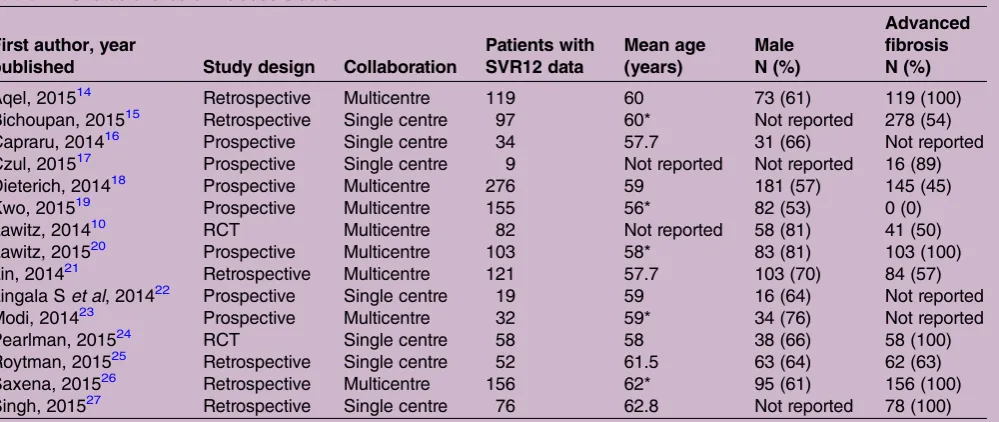
Characteristics of included studies
Fifteen studies with a total of 1389 HCV-1 patients treated with 12 weeks of SMV+SOF±RBV were included in this meta-analysis.10 14–27 Study characteristics are summarised in table 1. All were conducted in the USA. Two were RCTs.10 24Thirteen were observational studies: seven were prospective16–20 22 23and six were retrospect-ive.14 15 21 25–27 Mean age ranged from 58 to 63 years. Most patients were male (53–81%).
SVR12
The overall rate of SVR12 was 85.6% (CI 81.3% to 89.0%) based on 1389 HCV-1 patients pooled from 15
copyright.
on May 30, 2020 by guest. Protected by
studies. Significant heterogeneity (Q-statistic=48.035, p=0.000, I2=70.85%; figure 2) and publication bias (Egger’s two-tailed p=0.033) were observed among the eligible studies. On one-study removed influence ana-lysis, the pooled rate of SVR12 varied by no more than approximately 2%. On subgroup analysis by study design, we found an SVR12 rate of 93.5% (CI 85.7% to 97.2%)
based on 2 RCTs, compared with 83.9% (CI 79.4% to 87.5%) based on 13 observational studies (figure 3).
Mild compared with advanced fibrosis
[image:3.595.201.554.61.389.2]Five studies10 18 19 21 25 provided SVR12 data on a total of 343 patients with mild fibrosis. The pooled rate of SVR12 was 93.0% (CI 86.2% to 96.6%). Significant
Figure 1 PRISMA flow diagram of study selection. SVR12, sustained virological response at 12 weeks after end of treatment.
Table 1 Characteristics of included studies
First author, year
published Study design Collaboration
Patients with SVR12 data
Mean age (years)
Male N (%)
Advanced fibrosis N (%)
Aqel, 201514 Retrospective Multicentre 119 60 73 (61) 119 (100)
Bichoupan, 201515 Retrospective Single centre 97 60* Not reported 278 (54) Capraru, 201416 Prospective Single centre 34 57.7 31 (66) Not reported Czul, 201517 Prospective Single centre 9 Not reported Not reported 16 (89) Dieterich, 201418 Prospective Multicentre 276 59 181 (57) 145 (45)
Kwo, 201519 Prospective Multicentre 155 56* 82 (53) 0 (0)
Lawitz, 201410 RCT Multicentre 82 Not reported 58 (81) 41 (50)
Lawitz, 201520 Prospective Multicentre 103 58* 83 (81) 103 (100) Lin, 201421 Retrospective Multicentre 121 57.7 103 (70) 84 (57) Lingala Set al, 201422 Prospective Single centre 19 59 16 (64) Not reported
Modi, 201423 Prospective Multicentre 32 59* 34 (76) Not reported
Pearlman, 201524 RCT Single centre 58 58 38 (66) 58 (100)
Roytman, 201525 Retrospective Single centre 52 61.5 63 (64) 62 (63) Saxena, 201526 Retrospective Multicentre 156 62* 95 (61) 156 (100) Singh, 201527 Retrospective Single centre 76 62.8 Not reported 78 (100) *Median age presented.
RCT, randomised controlled trial; SVR12, sustained virological response at 12 weeks after end of treatment.
copyright.
on May 30, 2020 by guest. Protected by
[image:3.595.53.553.514.725.2]heterogeneity was observed among these studies (Q-statistic=9.867, p=0.043, I2=59.46%).
Nine studies10 14 18 20 21 24–27provided SVR12 data on a total of 711 patients with advanced fibrosis. These studies used different definitions to classify patients with advanced fibrosis; seven defined advanced fibrosis as presence of cirrhosis14 18 20 21 25–27 while two used the METAVIR scoring system.10 24 The pooled rate of SVR12 was 81.5% (CI 75.7% to 86.1%) for patients with advanced fibrosis. Significant heterogeneity was observed among these studies (Q-statistic=22.68, p=0.004, I2=64.72%).
In direct comparison of four studies with a total of 387 patients (188 with mild fibrosis; 199 with advanced
fibrosis), a trend favouring SVR12 in patients with mild
fibrosis over advanced fibrosis was found, OR 2.22 (CI 0.78 to 6.25, p=0.131; figure 4). There was significant heterogeneity among these studies (Q-statistic=6.29, p=0.098, I2=52.31%).
Subtypes of hepatitis C genotype 1
On subgroup analysis of hepatitis C genotype 1a compared with genotype 1b, the pooled rates of SVR12 were 89.9% (CI 81.9% to 94.6%) in HCV-1a and 89.0% (CI 78.9% to 94.6%) in HCV-1b. No significant associ-ation between hepatitis C genotype 1 subtype and SVR12 was observed, OR 1.35 (CI 0.75 to 2.42, p=0.322;
[image:4.595.206.549.54.302.2]figure 5).
Figure 2 Pooled rate of sustained virological response at 12 weeks after end of treatment in all hepatitis C virus genotype 1 patients treated with simeprevir and sofosbuvir±ribavirin.
Figure 3 Sustained virological response at 12 weeks after end of treatment subgroup analysis by study design: observational versus randomised controlled trial (RCT).
copyright.
on May 30, 2020 by guest. Protected by
[image:4.595.85.506.507.719.2]Tolerability
Based on available tolerability data, the most common pooled side effects were: headache 15.2% (n=55/361), fatigue 12.1% (n=78/646), nausea 9.49% (n=50/527) and rash 9.3% (n=68/728). Insufficient data were avail-able to evaluate for withdrawal from treatment and serious adverse events.
DISCUSSION
Currently, there are few published studies with treatment data on SMV+SOF±RBV.10 14 24 26 While findings from the COSMOS study were highly promising, study patients were recruited, and stratified into different treatment durations and severity offibrosis, and only 82 patients received SMV+SOF±RBV for 12 weeks.10 In a separate RCT by Pearlmanet al,24 the authors recruited 58 patients to the treatment arm with 12 weeks of SMV +SOF±RBV and only included patients with chronic HCV genotype 1a infection and child’s grade A cirrho-sis. Two additional studies on patients with cirrhosis were recently published, but have been limited to retrospect-ive cohorts.14 26Therefore, given the small sample sizes and heterogeneous study designs of the aforementioned studies, we performed a meta-analysis of available data to provide a more robust estimate of SVR12 in a 12-week regimen of SMV+SOF±RBV.
In our analysis, the overall pooled SVR12 rate was 86%, which was lower than rates reported by the COSMOS trial10 and RCT by Pearlmanet al.24 This esti-mate was robust, varying by no more than 2.1% on
one-study removed influence analysis. In subgroup ana-lysis comparing observational studies and RCTs, the pooled SVR12 rate was 89%, which reflects a difference in weights due to the dispersion of studies within each subgroup. When evaluating treatment outcomes based on study design, observational studies had a lower SVR12 rate at 84% compared with RCTs at 94%. While this finding is limited since this was not a head-to-head comparison, it may reflect the lower treatment rates of real-world settings.
Our meta-analysis was inclusive of patients with geno-types 1a and 1b as well as varying degrees of fibrosis. Given the more diverse nature of the study population and the uncontrolled environment in which all of the observational studies were conducted, it is not surprising to see that the pooled SVR12 rate is slightly lower than those from RCTs.10 24However, our treatment rate is still better compared with historical cohorts treated with protease-inhibitor-based therapies,5 which suggests that SMV+SOF±RBV is a more effective treatment option.
In our subgroup analysis of patients with SVR12 and
[image:5.595.91.509.53.168.2]fibrosis data, we observed a higher SVR12 rate in patients with mild fibrosis (93%) compared with those with advanced fibrosis (82%), with a trend favouring SVR12 in patients with mild fibrosis, OR 2.22 (95% CI 0.79 to 6.25, p=0.131). Of the nine studies with SVR12 data on patients with advanced fibrosis, both RCTs10 24 had SVR12 rates greater than 90% while the seven obser-vational studies14 18 20 21 25–27 had lower SVR12 rates ranging from 68.4% to 88.9%. Thisfinding is likely due to the diversity of real-world patients with more
Figure 4 Odds of sustained virological response at 12 weeks after end of treatment (SVR12) by severity of fibrosis: mild versus advanced fibrosis.
Figure 5 Odds of sustained virological response at 12 weeks after end of treatment (SVR12) by subtype: hepatitis C virus genotype 1a (HCV-1a) versus genotype 1b (HCV-1b).
copyright.
on May 30, 2020 by guest. Protected by
[image:5.595.93.507.605.720.2]variability in terms of medication adherence, follow-up and comorbidities, compared with the highly selective patients included in clinical trials.
This meta-analysis exclusively evaluated outcomes in HCV-1, the most prevalent genotype in the USA.28 While HCV-1a has been considered the more difficult-to-treat subtype due to NS3 polymorphisms asso-ciated with decreased SMV activity1 and a higher likeli-hood of developing resistance against protease inhibitors,24 29 clinical trials including COSMOS,10 ION-130and ION-231have shown minimal differences in SVR rates between HCV-1a and HCV-1b. Similarly, our subgroup analysis showed no significant association between HCV-1 subtype and the likelihood of achieving SVR, OR 1.35 (95% CI 0.75 to 2.42, p=0.322), suggesting that a nucleotide polymerase inhibitor such as SOF may serve as an added barrier against the development of resistant variants,1 24 abrogating subclinical differences between subtypes.
Limitations to our study include insufficient data to evaluate serious adverse events, perform subgroup ana-lysis of treatment with or without RBV, and compare out-comes in treatment naïve and experienced patients. An additional limitation was publication bias in our pooled estimate of SVR12, where smaller studies with larger than average effect sizes were more likely to be published, and thisfinding was statistically significant. In conducting our literature search, we attempted to be as comprehensive as possible, including preliminary data from abstracts pre-sented at major scientific conferences in addition to four full-length articles. We also attempted to give a more con-servative estimate of the pooled effect by using a random-effects model. More information on SMV+SOF ±RBV will become available in the future, with clinical trials underway to address the efficacy and tolerability of SMV+SOF±RBV in special populations including those with cirrhosis,32 HIV co-infection,33 liver transplant-ation34and HCV genotype 4.35–37In the meantime, and despite the limitations described above, our study is cur-rently the largest to evaluate the effectiveness of SMV +SOF±RBV for 12 weeks in HCV-1 patients in real-world settings, which included several university centres and the TRIO network data gathered from patients managed by practitioners from the community (n=152) as well as from academic centres (n=82).
In summary, our results support SMV+SOF±RBV as a treatment option for HCV-1 patients. While this rate is slightly lower than that seen in the COSMOS trial alone, ourfindings are likely more representative of the diverse patient population encountered in routine clinical set-tings. Given the rapid evolution in HCV therapy and need to optimise treatment, our meta-analysis provides a robust estimate of SVR12 in HCV-1 patients treated with SMV+SOF±RBV.
Contributors MHN is the guarantor of the article. BEY was involved in study design, data collection, data analysis and interpretation, and drafting of the manuscript. NHN was involved in data collection, data analysis and
interpretation, and participation in drafting of the manuscript. MJ was involved in data analysis and interpretation, and critical revision of the manuscript. GL was involved in data analysis and interpretation, and critical revision of the manuscript. JKL was involved in data analysis and interpretation, and critical revision of the manuscript. MHN was involved in concept development, study design, data collection, data analysis and interpretation, and critical revision of the manuscript. All the authors identified above have critically reviewed and approve the final version of this paper, including the authorship statement.
Competing interests Authors’declaration of personal interests: (1) GL has served as a consultant and as an advisory board member for Gilead Sciences, Janssen and Abbvie. (2) JKL has received research support from Abbott, Boehringer-Ingelheim, Bristol-Myers Squibb, Gilead, Glaxo-Smith Kline and Janssen, and has served as a consultant and/or advisory board member for Bristol-Myers Squibb, Gilead, Janssen and Merck. (3) MHN has received research support from and served as a consultant and/or an advisory board member for Gilead Sciences, Janssen Pharmaceuticals and Bristol-Myers Squibb.
Provenance and peer review Not commissioned; externally peer reviewed.
Data sharing statement No additional data are available.
Open Access This is an Open Access article distributed in accordance with the Creative Commons Attribution Non Commercial (CC BY-NC 4.0) license, which permits others to distribute, remix, adapt, build upon this work non-commercially, and license their derivative works on different terms, provided the original work is properly cited and the use is non-commercial. See: http:// creativecommons.org/licenses/by-nc/4.0/
REFERENCES
1. Childs-Kean LM, Hand EO. Simeprevir and sofosbuvir for treatment of chronic hepatitis C infection.Clin Ther2015;37:243–67. 2. Sadler MD, Lee SS. Revolution in hepatitis C antiviral therapy.Br
Med Bull2015;113:31–44.
3. Berenguer M, Schuppan D. Progression of liver fibrosis in
post-transplant hepatitis C: mechanisms, assessment and treatment. J Hepatol2013;58:1028–41.
4. Wang CS, Ko HH, Yoshida EM,et al. Interferon-based combination anti-viral therapy for hepatitis C virus after liver transplantation: a review and quantitative analysis.Am J Transplant2006;6: 1586–99.
5. Shiffman ML, Esteban R. Triple therapy for HCV genotype 1 infection: telaprevir or boceprevir?Liver Int2012;32(Suppl 1):54–60. 6. Maasoumy B, Port K, Deterding K,et al. Limited effectiveness and
safety profile of protease inhibitor-based triple therapy against chronic hepatitis C in a real-world cohort with a high proportion of advanced liver disease.Eur J Gastroenterol Hepatol2014;26: 836–45.
7. Maasoumy B, Port K, Markova AA,et al. Eligibility and safety of triple therapy for hepatitis C: lessons learned from the first experience in a real world setting.PLoS ONE2013;8:e55285. 8. Pawlotsky JM. New hepatitis C therapies: the toolbox, strategies,
and challenges.Gastroenterology2014;146:1176–92.
9. Pungpapong S, Aqel B, Leise M,et al. Multicenter experience using simeprevir and sofosbuvir with or without ribavirin to treat hepatitis C genotype 1 after liver transplant.Hepatology2015;60(S4):201A. 10. Lawitz E, Sulkowski MS, Ghalib R,et al. Simeprevir plus sofosbuvir,
with or without ribavirin, to treat chronic infection with hepatitis C virus genotype 1 in non-responders to pegylated interferon and ribavirin and treatment-naive patients: the COSMOS randomised study.Lancet2014;384:1756–65.
11. AASLD/IDSA. Recommendations for testing, managing, and treating hepatitis C. 2015. http://www.hcvguidelines.org/full-report/
retreatment-persons-whom-prior-therapy-has-failed
12. EASL. Recommendations on Treatment of Hepatitis C. European Association for the Study of the Liver. 2014. http://files.easl.eu/easl-recommendations-on-treatment-of-hepatitis-C.pdf
13. Higgins JPT, Green S (eds). Cochrane Handbook for Systematic reviews of Interventions. Version 5.1.0 [updated March 2011]. The Cochrane Collaboration. 2011. www.cochrane-handbook.org 14. Aqel BA, Pungpapong S, Leise M,et al. Multicenter experience
using simeprevir and sofosbuvir with or without ribavirin to treat hepatitis C genotype 1 in patients with cirrhosis.Hepatology 2015;62:1004–12.
copyright.
on May 30, 2020 by guest. Protected by
15. Bichoupan K, Tandon N, Del Bello D,et al. Real world effectiveness and cost of simeprevir- and/or sofosbuvir-based HCV treatments: $175,000 per SVR12.J Hepatol2015;62:S672.
16. Capraru CI, Kuczynski M, La D,et al. Efficacy and safety of sofosbuvir plus simeprevir in patients with advanced HCV cirrhosis.
Hepatology2014;60(Suppl 1):665A.
17. Czul F, Schiff E, Peyton A,et al. First ribavirin-free sofosbuvir and simeprevir treatment of hepatitis C genotype 1 patients with severe renal impairment (GFR <30 mL/min or dialysis).J Hepatol2015;62: S670–1.
18. Dieterich D, Bacon BR, Flamm SL,et al. Evaluation of sofosbuvir and simeprevir-based regimens in the trio network: academic and community treatment of a real-world, heterogeneous population.
Hepatology2014;60(Suppl 1):220A.
19. Kwo P, Gitlin N, Nahass R,et al. A phase 3, randomised, open-label study to evaluate the efficacy and safety of 8 and 12 weeks of simeprevir (SMV) plus sofosbuvir (SOF) in treatment -naive and -experienced patients with chronic HCV genotype 1 infection without cirrhosis: OPTIMIST-1.J Hepatol2015;62:1.
20. Lawitz E, Matusow G, DeJesus E,et al. A phase 3, open-label, single-arm study to evaluate the efficacy and safety of 12 weeks of simeprevir (SMV) plus sofosbuvir (SOF) in treatment -naive or -experienced patients with chronic HCV genotype 1 infection and cirrhosis: OPTIMIST-2.J Hepatol2015;62:1.
21. Lin MV, Gogela NA, Wisocky JL,et al. Real world experience with sofosbuvir and simeprevir combination treatment in patients with HCV genotype 1.Hepatology2014;60(Suppl 1):683A.
22. Lingala S, Satapathy SK, Dbouk N,et al. Safety and efficacy of simeprevir and sofosbuvir in patients with decompensated cirrhosis.
Hepatology2014;60(Suppl 1):688A.
23. Modi AA, Nazario H, Gonzalez SA,et al. Safety and efficacy of simeprevir + sofosbuvir with or without ribavirin in patients with decompensated genotype 1 hepatitis C induced cirrhosis.
Hepatology2014;60(Suppl 1):661A.
24. Pearlman BL, Ehleben C, Perrys M. The combination of simeprevir and sofosbuvir is more effective than that of peginterferon, ribavirin, and sofosbuvir for patients with hepatitis C-related child’s class A cirrhosis.Gastroenterology2015;148:762–70.e2; quiz e11-2.
25. Roytman M, Ramikissoon R, Hong L,et al. Examining the clinical course of genotype 1 chronic hepatitis C patients treated with the COSMOS regimen: including patients with advanced liver disease, and east Asian ancestry.J Hepatol2015;62:S671.
26. Saxena V, Nyberg L, Pauly M,et al. Safety and efficacy of simeprevir/sofosbuvir in hepatitis C infected patients with compensated and decompensated cirrhosis.Hepatology 2015;62:715–25.
27. Singh V, Frederick T, Holt EW,et al. Efficacy of simeprevir and sofosbuvir for treatment of cirrhotic patients with genotype 1 chronic hepatitis C- a single center experience.J Hepatol2015;62:1. 28. Nainan OV, Alter MJ, Kruszon-Moran D,et al. Hepatitis C virus
genotypes and viral concentrations in participants of a general population survey in the United States.Gastroenterology 2006;131:478–84.
29. Sarrazin C, Zeuzem S. Resistance to direct antiviral agents in patients with hepatitis C virus infection.Gastroenterology 2010;138:447–62.
30. Afdhal N, Zeuzem S, Kwo P,et al. Ledipasvir and sofosbuvir for untreated HCV genotype 1 infection.N Engl J Med2014;370: 1889–98.
31. Afdhal N, Reddy KR, Nelson DR,et al. Ledipasvir and sofosbuvir for previously treated HCV genotype 1 infection.N Engl J Med 2014;370:1483–93.
32. Efficacy and Safety Study of Simeprevir in Combination With Sofosbuvir in Participants With Genotype 1 Chronic Hepatitis C Virus Infection and Cirrhosis [Internet]. ClinicalTrials.gov [Internet]. 2014 (cited 27 February 2015). https://clinicaltrials.gov/ct2/show/ NCT02114151?term=simeprevir+AND+sofosbuvir&rank=6 33. Hospital VU.Real-life security and efficacy of DAA-based therapy in
HCV/HIV-coinfected patients. Bethesda, MD: National Library of
Medicine (US), 2014 [5 March 2015]. https://clinicaltrials.gov/ct2/ show/NCT02057003?term=simeprevir&rank=19
34. An Efficacy and Safety Study of Simeprevir and Sofosbuvir With and Without Ribavirin in Participants With Recurrent Genotype 1 Hepatitis C Post-Orthotopic Liver Transplant (GALAXY) [Internet]. ClinicalTrials.gov [Internet]. 2014 (cited 27 February 2015). https:// clinicaltrials.gov/ct2/show/NCT02165189?term=simeprevir+AND +sofosbuvir&rank=1
35. Ireland JRD.Efficacy and safety study of simeprevir in combination with sofosbuvir in subjects with chronic genotype 4 hepatitis C virus
infection. Bethesda, MD: National Library of Medicine (US), 2015 [5
March 2015]. https://clinicaltrials.gov/ct2/show/NCT02250807? term=simeprevir&rank=9
36. NV JCI.An efficacy and safety study of a 8 or 12-week treatment regimen of simeprevir in combination with sofosbuvir in
treatment-naive and experienced participants with chronic genotype
4 hepatitis C virus infection. Bethesda, MD: National Library of
Medicine (US); 2014 [5 March 2015]. https://clinicaltrials.gov/ct2/ show/NCT02278419?term=simeprevir&rank=12
37. Peter J, Ruane MD.Simeprevir in combination with sofosbuvir in treatment-naïve or -experienced adults with chronic genotype 4
hepatitis C virus infection. Bethesda, MD: National Library of
Medicine (US), 2014 [5 March 2015]. https://clinicaltrials.gov/ct2/ show/NCT02253550?term=simeprevir&rank=14
copyright.
on May 30, 2020 by guest. Protected by