Carbon Dioxide Reduction in Gasoline Engine
- A Comparative Study
Mylaudy Dr. S. Rajadurai1 and J. Maya2
Head R&D, Sharda Motor Industries Ltd., Chennai, Tamil Nadu, India1
Senior Executive -Professional Management R&D, Sharda Motor Industries Ltd., Chennai, Tamil Nadu, India2
ABSTRACT: We have undertaken a study to artificially reduce carbon dioxide using different catalysts in a gasoline passenger caras our continued effort to control carbon dioxide in the atmosphere. Carbon dioxide absorption/adsorption efficiencyfrom the exhaust gas stream using different catalysts such as activated charcoal, activated alumina, ZSM-5 zeolite and activated ZSM-5 zeolite shows a clear trend and dependency on the mass flow
rate and surface properties of catalysts. The CO2 absorption efficiency of these catalysts aremeasured at two different
engine operating conditions and arecompared. The CO2 reduction on activated charcoal at 700 rpm and 2500 rpm are
0.48% and 0.38% respectively, the CO2 reduction on activated alumina at 700 rpm and 2500 rpm are 7.35% and 6.61%
respectively, the CO2 reduction on ZSM-5 zeolite at 700 rpm and 2500 rpm are 6.46% and 45.48% respectively and the
CO2 reduction on activated ZSM-5 zeolite at 700 rpm and 2500 rpm are 52.3% and 46.12% respectively. The
CO2absorption / adsorption performance at 700 rpm and 2500 rpm shows a consistent variation proportional to mass
flow rate in all the four catalysts. High efficiency is observed at lower rpm and low efficiency is observed at higher rpm showing the mass flow rate and thus theresidence time control the performance. The relatively lowperformance of activated charcoal derived from coconut shell is also due to low surface area and porosity. The highest activity of
activated ZSM-5 zeolite is due to increased Bronsted acidic site which facilitates CO2 adsorption.
KEYWORDS: Catalytic reduction of CO2, Gasoline passenger car, Activated alumina, ZSM-5 zeolite, Activated
ZSM-5 zeolite, Activated charcoal, Coconut shell.
I. INTRODUCTION
The world is moving towards a crucial new climate agreement which could provide the long-needed global
plan to slow down climate change and enable humanity to adapt to the unavoidable part of a changing climate [1,2]
.
While recognizing that some climate change is unavoidable, researchers and innovators are working on procedures
tolimit global warming to 2ºC in this century,relative to the pre-industrial period. Further, they have decided to review
this limit to see if it should be further lowered to 1.5ºC. Given the aim to limit global temperature, the critical question
has now become what level of emission would make this possible. The enhanced green houseeffect changes the
climate and pollute the environment[3,4]
.
The greenhouse gases result in the global warming and uncontrollable climatechange, floods, draughts and famine. Carbon dioxide is one of the major components of greenhouse gases results in
enhanced greenhouse effect.CO2 is the main contributor for greenhouse gases and enhanced greenhouse gases causing
the significant impact on climate change, storm patterns and increased tide height and sea levels. Abnormal climate change and uncontrolled natural calamities and catastrophes are increasing in the recent years. Due to that the level of
carbon dioxide in the atmosphere is rising significantly [5-7].CO2 originates from human impact on the environmental
Figure 1.The Impacts of Carbon dioxide
Carbon dioxide is produced when any substance containing carbon is burnt. It is also a product of breathing and of
fermentation. Plant absorbs carbon dioxide through photosynthesis, and plants and soil return.CO2 emission from
various sources through respiration performed by plants and animals, decay of plants and animal matter, Burning fossil fuels such as coal, petroleum products and natural gas releases carbon. Carbon dioxide is released when limestone (calcium carbonate) is heated to produce lime. A variety of human activities lead to the emission (sources) and
removal (sinks) of carbon dioxide (CO2). The breakdown of CO2 from various sources is shown in the figure 2.
Figure 2.Production of carbon dioxide from various sources
As seen in figure 2, the largest source of CO2 emission is the combustion of fossil fuels such as coal, oil and gas in
power plants, automobiles, industrial facilities and other sources.The exponential growth of mobility sector in the
current century causes the higher production of CO2[8,9]. There are many naturally reducing sources of carbon dioxide
from the atmosphere is available, Carbon sequestration is the process by which growing trees and plants absorb or
to significant increaseofCO2 emissions in the atmosphere. Consequently, the residual growth of carbon dioxide in the
atmosphere is increasing. A representative example of the CO2 production from few passenger cars and reduction by
few trees and the gap between the production and reduction is shown in Figure 3 [5].
Figure 3.The gap between CO2 production and consumption
This demands the need for fixing CO2 concentration in the atmosphere. Though, several activities such as planting tree
and green development to reduce CO2 and also development of fuel efficiency in combustion to minimize the
production of CO2, the gap seems to be continuously growing. Hence, artificial methods to reduce CO2 are required.
The different ways of reducing CO2 both by natural processes and also by artificial methods are illustrated in figure 4
[10].
Figure 4.Methods of CO2fixation
Our current study is to artificially reduce CO2 using different catalysts such as activated charcoal granule, activated
alumina sphere, ZSM-5 zeolite pellet and activated ZSM-5 zeolite capsule. A comparative study of CO2
II. SCHEMATICREPRESENTATIONOF CO2REDUCTIONINGASOLINEVEHICLE
The gasoline-burnt internal combustion engines emit regulated gases such as CO, NOx, and HC. They are converted
into CO2, H2O, and N2 by three-way catalytic converter (TWC) as described in the equations.
2 + →2 (1)
2 + + 2 →2 + (2)
2 + 2 → + 2 (3)
The products coming out of the three-way catalyst system contain CO2, H2O, N2, O2, etc. The slip stream of the
exhaust gas coming out of the TWC, rich in CO2, is then passed through a fixed-bed CO2 absorption/adsorption catalyst
chamber as shown in Figure 5.
Figure 5.The Schematic of the CO2 reduction in gasoline engine
Heterogeneous catalytic absorption/adsorption is carried out in a tubular reactor of one type or another. Fixed-bed
tubular reactor and tubular honeycomb structures are used in the current study. The materials used for CO2 reduction is
chosen to have the absorption and adsorption characteristics. Catalysts are usually loaded on high surface area porous support materials. Charcoal, alumina and ZSM-5 zeolite are few materials supports used in our current study.
III.CATALYST FROM DIFFERENT SOURCE
Charcoal from coconut shell is prepared by controlled firing of the raw materials. Charcoal is porous and can absorb liquids and gases on its porous surface. A representative sample of the activated charcoal granule from coconutshell is shown in Figure 6a. Activated alumina used in our studies is in the spherical form, with a size of approximately
5-8mm diameter and surface area between 360-480 m2/g (Figure 6b).ZSM-5 zeolite is used as pellets (Figure 6c) and
Figure 6.Various catalyst used for CO2 absorption/adsorption
IV.THEREACTORMODEL
The CO2 absorption studies are carried out using the absorption chamber filled with the catalyst material. The
absorption chamber is chosen to minimize catalyst abrasion. The diameter of the cylindrical chamber is 100 mmand
the length is300mm. The child parts and assembly of the reactor chamber is shown in figure 7 a,b and c. The CO2
absorption studies are carried out using the absorption chamber filled with the catalyst material. Absorption chamber is chosen to minimize catalyst abrasion. The catalyst filled reactor chamber is attached at the tail end of the exhaust system through a slip stream for performance evaluation.
Figure 7.CO2Reduction reactor chamber model
Figure 8.Computation Flow Uniformity of the reactor assembly
V. VEHICLETESTASSEMBLYFOR CO2REDUCTIONSTUDY
The CO2reduction is studied from the exhaust gas at the tail pipe of the gasoline passenger car as shown in figure 9.
The exhaust gas is passed through a three-way catalyst to convert NOx, HC, and CO. The gas coming of TWC, rich in
CO2, is passed through a CO2 reduction catalyst chamber as shown in Figure 9. A constant volume sampling method is
used to analyze the exhaust gas stream. The gas analyzer capable of analyzing CO, CO2, HC, and NOx is used in this
application. Results are reproduced by repeated experiments under identical test conditions. Samples are taken before
and after the CO2 absorption catalytic chamber for quantitative measurement of CO2 reduction. The physical capture of
CO2 on activated charcoal, activated alumina, ZSM-5 Zeolite and activated ZSM-5 Zeolite are studied at two different
engine operating conditions (700 RPM and 2500 RPM). The quantitative reduction of CO2 of the absorption and
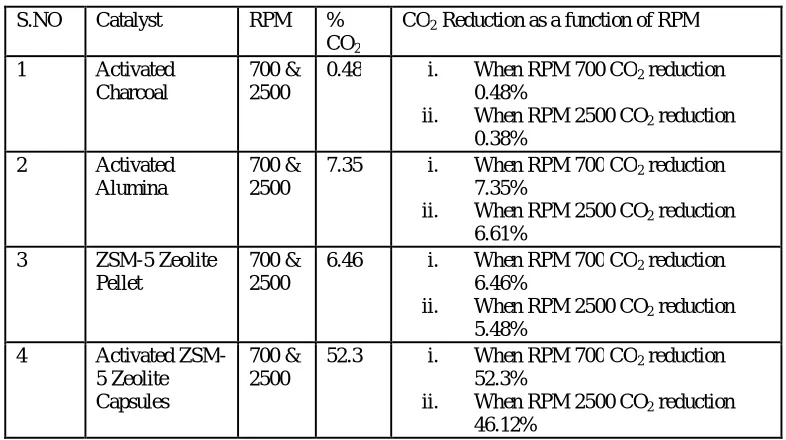
adsorption efficiencies is calculated and compared in Table 1.
Table 1.CO2 Reduction Performance Comparison
S.NO Catalyst RPM %
CO2
CO2 Reduction as a function of RPM
1 Activated
Charcoal
700 & 2500
0.48 i. When RPM 700 CO2 reduction
0.48%
ii. When RPM 2500 CO2 reduction
0.38%
2 Activated
Alumina
700 & 2500
7.35 i. When RPM 700 CO2 reduction
7.35%
ii. When RPM 2500 CO2 reduction
6.61%
3 ZSM-5 Zeolite
Pellet
700 & 2500
6.46 i. When RPM 700 CO2 reduction
6.46%
ii. When RPM 2500 CO2 reduction
5.48%
4 Activated
ZSM-5 Zeolite Capsules
700 & 2500
52.3 i. When RPM 700 CO2 reduction
52.3%
ii. When RPM 2500 CO2 reduction
46.12%
As shown in Table 1, the CO2 reduction on activated charcoal at 700 rpm and 2500 rpm are 0.48% and 0.38%
respectively,the CO2 reduction on activated alumina at 700 rpm and 2500 rpm are 7.35% and 6.61% respectively. , the
CO2 reduction on ZSM-5 Zeolite at 700 rpm and 2500 rpm are 6.46% and 45.48% respectively and the CO2 reduction
on activated ZSM-5 Zeolite at 700 rpm and 2500 rpm are 52.3% and 46.12% respectively. Activated charcoal derived from coconut shell shows relatively low efficiency compared to that of the activated alumina and ZSM- 5 Zeolite may be due to low surface area and porosity. Activated alumina and ZSM-5 zeolites are showing relatively similar efficiency where as activated ZSM-5 zeolite show very high absorption/adsorption characteristics. This may be due to
increased Bronstedacidic site in the activated ZSM-5 zeolite which facilitates CO2 adsorption. This shows that chemical
adsorption and catalytic reduction is more efficient than physical absorption as absorption is limited to physical nature
of the catalyst. The variation of CO2absorption/adsorption at two different engine operating conditions is due to effect
of mass flow rate. At low rpm, the gas flow is low and the residence time of the exhaust gas is higher, consequently
CO2 absorption/adsorption is higher. Similarly at high rpm, the gas flow is high and the residence time of the exhaust
gas is lower, consequently CO2 absorption/adsorption is lower.
VI.SUMMARYANDCONCLUSION
Carbon dioxide absorption / adsorption efficiencyfrom the exhaust gas stream using different catalysts such as activated charcoal derived from coconut shell, activated alumina, ZSM-5 zeolite and activated ZSM-5 zeolite shows a clear trend
and dependency on the mass flow rate and surface properties of catalysts. The CO2 reduction on activated charcoal at
700 rpm and 2500 rpm are 0.48% and 0.38% respectively, the CO2 reduction on activated alumina at 700 rpm and 2500
rpm are 7.35% and 6.61% respectively, the CO2 reduction on ZSM-5 zeolite at 700 rpm and 2500 rpm are 6.46% and
46.12% respectively. The absorption / adsorption performance of CO2 at 700 rpm and 2500 rpm shows a consistent
variation proportional to mass flow rate in all the four catalysts. Higher efficiency is observed at lower rpm and lower efficiency is observed at lower rpm showing the mass flow rate direct dependency.The relative lower efficiency of activated charcoal from coconut shell is also due to low surface area and porosity and the highest activity of activated
ZSM-5 zeolite is due to increased Bronsted acidic site which facilitates CO2 adsorption along with conventional
absorption.
REFERENCES
[1] Arren Bar-Even,Elad, Noor,NathanE.Lewis and Ron Milo,“Design and analysis of synthetic carbon fixation pathways”Proc.Natl. Acad. Sci USA., 107(19), 8889-8894 (2010)
[2] Albritton ,D.L. et al. Technical Summary. In Climate Change 2001, The Scientific Basis. New York: Cambridge University Press.
[3] S. Rajadurai, and R. Prashanthi, “Environmental Accountability for Sustainable Earth”Indian Journal of Science and Technology, 4, 350-355 (2011)
[4] Vergragt, P. J., Markusson, N. Karlsson, H. "Carbon capture and storage, bio-energy with carbon capture and storage, and the escape from the fossil-fuel lock-in”Global Environmental Change,21 (2): 282S (2011).
[5] Fisher, D. et al. Natural Variability of Arctic Sea Ice over the Holocene. EOS (Transactions of the American Geophysical Union) 87 (28): 273 (2006).
[6] Stuart D.Jordan“Global climate change triggered by global warming”, Center for Inquiry Inc., 2006.
[7] Rajadurai,andJ.Maya, “Carbon dioxide reduction in diesel power generator using modified charcoal” Indian Journal of Recent Developed in Engineering and Technology Science and Technology, Vol 4,No 2347 - 6435 (2015)
[8] S. Rajadurai and R. K. Anulatha, “Carbon Dioxide Fixation – The Must and The Path” International Journal of Science and Advanced Technology, Vol. 2, No 5 164 - 171 (2012)
[9] Guo, Liping Chang and KechangXie, “Adsorption of Carbon Dioxide on Activated Carbon”J.Natural Gas Chemistry, 15, 223-229 (2006). [10] S. Rajadurai and R. K. Anulatha, “Catalytic reduction of CO2 in diesel engines-A lot with a Little” International Journal of Science and
Advanced Technology, Vol. 2, No 5 164 - 171 (2014)
BIOGRAPHY
Dr. S. Rajadurai, born in Mylaudy, Kanyakumari District, Tamil Nadu, India, received his Ph.D. in Chemistry from IIT Chennai in 1979. He has devoted nearly 37 years to scientific innovation, pioneering theory and application through the 20th century, and expanding strides of advancement into the 21st century. By authoring hundreds of published papers
and reports and creating several patents, his research on solid oxide solutions, free radicals, catalyst structure sensitivity, carbon dioxide reduction and emission control has revolutionized the field of chemistry and automobile industry. As a corporate executive in the United States and India for over three decades, Dr. Rajadurai managed strategy on power train development and emission control for low, ultra low, super ultra low and partial zero-emission systems. From 1990-1996, he was the Director of Research at Cummins Engine Company. He was the Director of Advanced Development at Tenneco Automotive between 1996 and 2002 and subsequently Emission Strategist and Director of Emissions at ArvinMeritor until 2004. From 2004-2009, he was Vice-President of ACS Industries and since 2009 as President &CEO and Head of R&D Sharda Motor Industries Ltd.
Dr. Rajadurai has held leadership positions on the Board of Directors for the U.S. Fuel Cell Council, Manufacturers of Emission Control Association (MECA), Chairman of MECA Committee on Advanced Technologies and Alternate Fuels and Walker Exhaust India. He is an active participant in Clean and Green Earth Day demonstrations since 1997 and US Clean Diesel School Bus Summit (2003). He was a panelist of the Scientists and Technologists of Indian Origin, New Delhi 2004. He is a Fellow of the Society of Automotive Engineers. He was the UNESCO representative of India on low-cost analytical studies (1983-85). He is a Life Member of the North American Catalysis Society, North American Photo Chemical Society, Catalysis Society of India, Instrumental Society of India, Bangladesh Chemical Society and Indian Chemical Society.