CHALLENGES OF THE CARE NETWORK ON REFERENCE AND COUNTER-REFERENCE: AN
INTEGRATIVE REVIEW
1
Silvana Cavalcanti dos Santos, *
2Juliane da Silva Pereira
2Gessica Carlla Matos Sousa
Batista,
2Pedro Isaac Gomes da Silva,
1Valdirene Pereira da Silva Carvalho,
1Marcelo Flávio
Batista da Silva,
1Ana KarineLaranjeira de Sa,
1Raimundo Valmir de Oliveira,
1Valquíria Farias
Bezerra Barbosa,
1Claudia Daniele Barros Leite Salgueiro, Maria do Socorro Torres Galindo dos
Santos, Nelson Miguel Galindo Neto,
2Ana Carla Silva Alexandre,
2Jefferson Nunes
dos Santos, and
2Silvia Camelo de Albuquerque
1Department of Nursing, the Federal Institute f Education, Science and Tecnology of Pernambuco Br 232, Km 214,
EP-Fishing, Brazil, Z IP code: 55250-000.
2Department of Economics, Health Economics and Management Graduation, Av. Dos Economistas, s / n, Recife-PE, Brazil,
Zip Code: 50740 - 590
ARTICLE INFO ABSTRACT
Objectives: To identify in scientific productions, which are the main challenges that network
professionals face regarding the referral and counter-referral process. Methodology: This study is
an integrative literature review, conducted in the first half of 2018, at the Virtual Health Library (VHL), based on the Latin American and Caribbean Health Sciences Literature, Data Base on the Nursing (BDENF), and MEDLINE (Online Medical Literature Analysis and Retrieval System). After considering inclusion and exclusion, they were used and analyzed
through a synoptic table. Results: They were found 11 articles that met the inclusion criteria. The
articles were about the attributes of Primary Health Care, negotiation and decision-making between users and professionals, the importance of PHC as coordinator ofhealth care, the assessments of references and counter references, the challenges to its implementation
and the knowledge of nurses about them. Conclusion: Even the Reference and Counter- referral
service being an important tool for effective communication between professionals, and ensuring continued care, it faces fragmentation of care, lack of coordination between the points of health attention and no counter-referral.
Copyright © 2019, Silvana Cavalcanti dos Santos et al. This is an open access article distributed under the Creative Commons Attribution License, which permits unrestricted use, distribution, and reproduction in any medium, provided the original work is properly cited.
INTRODUCTION
The concept of Health Care Networks (HCN), was implemented by Ordinance number 4.2791 / 2010, which establishes guidelines for the organization of the networks within the scope of Brazilian Unified Health System (SUS) and presidential Decree number 7.5082, by June 28 of 2011, which regulates Law number 8080/90. Being defined “the organizational arrangements of health actions and services, of different technological densities, which integrated through technical, logistic and management support systems, seek to ensure the integrality of care (BRAZIL, 2011)”.
To another author, the HCN are polyarchic organizations of health services sets, linked to each other by a single mission, common objectives, cooperative and interdependent actions, which allow to offer continuous and full attention to a given population, coordinated by the health care provided, at the right time, at the right place, at the right cost, at the right quality and in a humane way - and with health and economic responsibilities for this population (Mendes, 2009). From this concept, we can infer the main points of health care networks: common mission and objectives; operate cooperatively and interdependently; constantly exchange their resources; there is no hierarchy between its components, organized in a polyarchic way, equally important points and with horizontal
ISSN: 2230-9926
International Journal of Development Research
Vol. 09, Issue, 11, pp. 31602-31606, November, 2019
Article History:
Received xxxxxx, 2019 Received in revised form xxxxxxxx, 2019
Accepted xxxxxxxxx, 2019 Published online xxxxx, 2019
Article History:
Received 13th August, 2019
Received in revised form 26th September, 2019
Accepted 10th October, 2019
Published online 30th November, 2019
Key Words:
Public Health, Primary Health Care, Referral and Consultation, Unified Health System.
*Corresponding author: Juliane da Silva Pereira
RESEARCH ARTICLE
OPEN ACCESS
Citation: Silvana Cavalcanti dos Santos, Juliane da Silva Pereira, Gessica Carlla Matos Sousa Batista, Pedro Isaac Gomes da Silva et al., 2019. “Challenges of
interrelationship; generate value for their population among others (MENDES, 2010). Primary Health Care (PHC) establishes communication with the entire HCN and is based on the principles of equity, universality, accessibility, continuity of care, bonding, accountability, humanization, integrality of care and social participation. It should be emphasized that PHC is in a strategic position in the center of the HCN and must be connected to the other health care points, in a horizontal and interdependent manner, in which it will enable the flow and counterflow of care to be provided. to the coordinated population (BRAZIL, 2011 and MOLL, 2017). The levels of secondary and tertiary care that make up the RAS have the competence to plan and perform actions of medium and high complexity, which are developed in hospital and outpatient specialty services. These are services that act as a point of reference and counter-reference (PEREIRA, 2016). It is ideal that the PHC professional who wishes to refer the pat then knows the system, only that the referral occurs correctly, and that it is really out of the technical and human resources possibility of being treated in the municipality where the patients live. Cases that are misdirected and found by the coordinator of the Reference system and audits will be sought for clarification and further action (SCHIMITH, 2014). Research as proposed here, demonstrates the need for greater integration between health services and establishments, to enable professionals to direct their action s, and one of the pillars for the networks is to ensure the integrality and integration between For these reasons, the purpose of this study was to identify in the scientific productions, which are the main challenges that the HCN professionals face regarding the referral and counter-referral process.
MATERIALS AND METHODS
This study is an integrative review of the literature, whose intention is to make, in a structured way, the joining and analysis of the results of published scientific research on a certain theme. This type of review comprises six steps: 1) identify the theme and the issue that will lead the research; 2) establish the inclusion and exclusion criteria; 3) delimit the information from the selected literature; 4th) analyze the chosen literature; 5th) analyze the results 6th) synthesize the knowledge (Souza, 2010 and Crossetti, 2012). Given this perspective, to guide this review, the following question was asked: Do Health Care Network professionals face challenges within the referral and counter-referral system?
From this question, the articles published by scientific journals found in the Virtual Health Library (VHL) databases were surveyed. The identification of the bibliographic sources was extracted from the VHL Portal: LILACS (Latin American and Caribbean Health Sciences Literature), BDENF (Nursing Specialized Bibliographic Database) and MEDLINE (Medical Literature Analysis and Re trident System). online). The choice of databases was due to the quantity of indexing articles of health, moreover, being bases that include primary studies, as well as for indexing articles on topics related to enfer Magen (Alves, 2018). For the survey of the articles, we used a listing by subject, title and words, from the terms of the DeCS: “Unified Health System ” ; “ Primary Health
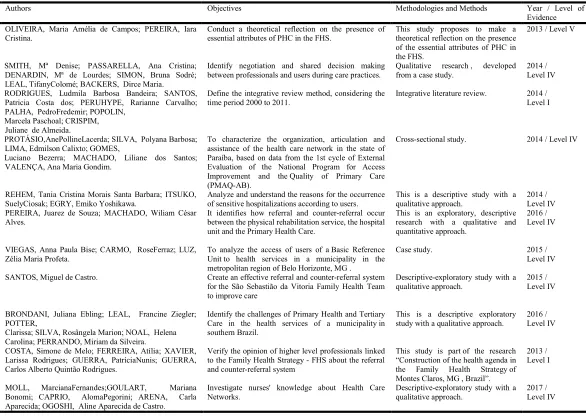
The following inclusion criteria establishedwere: studies from 2012 to 2017, articles in Portuguese language, with full text available and addressing the theme. And , as exclusion criteria: articles repeated in more than one database, incomplete, in a language other than Portuguese, theses, dissertations, book chapters, news and studies that did not address the chosen theme. After the selection, it was performed a reading of the abstracts and titles of the articles, being selected those that were related to the theme. The final sample consisted of 30 articles, among which 1 1 met the requirements of and specificity of the proposed theme . Subsequently, we proceeded with cataloging in a synoptic framework, adapted from URSI (2005)and Souza, Silva and Carvalho (2010) (BRAZIL, 2011). The search strategy allowed the identification of studies that were included in the review, are presented in table 1 and include the following aspects: article title, year of publication, name of authors, year of publication, study objectives, methodology and level of scientific evidence. Another variable considered was the level of scientific evidence, which ratifies the strengthening of the Evidence-Based Practice (EBP) process, with hierarchically characterized evidence classification systems based on the methodological approach adopted, namely: Level 1: evidence from meta-analysis of multiple randomized controlled clinical trials; Level 2: evidence obtained from individual studies with experimental design; Level 3: Evidence from quasi-experimental studies; Level 4: Evidence from descriptive (non-experimental) or qualitative approach studies ; Level 5: evidence from case or experience reports; Level 6: Evidence based on expert opinion (Mendes, 2009). In this article, we also considered the important recommendations of the PRISMA (2009) checklist, a strongly indicated methodology that adds protocol character to scientific evidence (Galvão, 2015 and Souza, 2018).
RESULTS
For presentation of the results, were selected eleven publications under synoptic table below. They were found 11 articles that met the inclusion criteria. Of these, 01 (9.5%) was published in 2013, 04 (36%) in 2014, 03 (27%) in 2015, 02 (18%) in 2016 and 01 (9.5%) in 2017. All were published in scientific journals of the health area, being: 06 in journals of Collective Health, 01 of Public Health Care and 04 in journals of Nursing. As for the level of evidence, 01 (18%) was level I, none (0%) at levels II and III, 09 (73%) were level IV and 01 (18%) was level V. The methodology found was 01 theoretical reflection, 02 case studies, 01 literaturereview, 0 5 qualitative studies, 01 quantitative and qualitative, and 01 quantitative study. The articles were about the attributes of PHC, negotiation and decision-making between users and professionals, the importance of PHC as coordinator ofhealth care, the assessments of references and counter references, the challenges to its implementation and the knowledge of nurses about them. As PHC attributes, coordination is one that promotes integration between network health care points, recognizing that health needs are quite complex and generally not adequately addressed by health systems characterized by specialization and isolated professional guidance. Thus, inadequacy may result not only in unmet needs, but also in
Table 1. Information of the analyzed articles
Title Authors Objectives Methodologies and Methods Year / Level of
Evidence Essential Attributes of Primary Care and the Family
Health Strategy 15 .
OLIVEIRA, Maria Amélia de Campos; PEREIRA, Iara Cristina.
Conduct a theoretical reflection on the presence of essential attributes of PHC in the FHS.
This study proposes to make a theoretical reflection on the presence of the essential attributes of PHC in the FHS.
2013 / Level V
Continuity of care in the Health Care Network: negotiation between users and professionals 7
SMITH, Mª Denise; PASSARELLA, Ana Cristina; DENARDIN, Mª de Lourdes; SIMON, Bruna Sodré; LEAL, TifanyColomé; BACKERS, Dirce Maria.
Identify negotiation and shared decision making between professionals and users during care practices.
Qualitative research , developed from a case study.
2014 / Level IV
Primary health care in coordinating care networks: an
integrative review 16 RODRIGUES, Ludmila Barbosa Bandeira; SANTOS, Patricia Costa dos; PERUHYPE, Rarianne Carvalho;
PALHA, PedroFredemir; POPOLIN, Marcela Paschoal; CRISPIM, Juliane de Almeida.
Define the integrative review method, considering the time period 2000 to 2011.
Integrative literature review. 2014 / Level I
Evaluation of the referral system and reference of the state of Paraíba according to Primary Care professionals in the context of the 1st cycle of External Evaluation of PMAQ-AB 17
PROTÁSIO,AnePollineLacerda; SILVA, Polyana Barbosa; LIMA, Edmilson Calixto; GOMES,
Luciano Bezerra; MACHADO, Liliane dos Santos; VALENÇA, Ana Maria Gondim.
To characterize the organization, articulation and assistance of the health care network in the state of Paraíba, based on data from the 1st cycle of External Evaluation of the National Program for Access Improvement and the Quality of Primary Care (PMAQ-AB).
Cross-sectional study. 2014 / Level IV
Primary Care Sensitive Hospitalizations: Users Detect Failed Access to Services 18 .
REHEM, Tania Cristina Morais Santa Barbara; ITSUKO, SuelyCiosak; EGRY, Emiko Yoshikawa.
Analyze and understand the reasons for the occurrence of sensitive hospitalizations according to users.
This is a descriptive study with a qualitative approach.
2014 / Level IV Reference and counter-reference between the physical
rehabilitation services of people with disabilities: the (dis) articulation in Centr -Sul Fluminense microregion , RJ , Brazil 6 .
PEREIRA, Juarez de Souza; MACHADO, Wiliam César Alves.
It identifies how referral and counter-referral occur between the physical rehabilitation service, the hospital unit and the Primary Health Care.
This is an exploratory, descriptive research with a qualitative and quantitative approach.
2016 / Level IV
Factors that influence access to health services in the eyes of professionals and users of a basic unit d and reference 19
VIEGAS, Anna Paula Bise; CARMO, RoseFerraz; LUZ, Zélia Maria Profeta.
To analyze the access of users of a Basic Reference Unit to health services in a municipality in the metropolitan region of Belo Horizonte, MG .
Case study. 2015 /
Level IV
Health referral and counter-referral system in São Sebastião da Vitória, São João Del Rei District - MG: The Network's role in
Primary Care 20 .
SANTOS, Miguel de Castro. Create an effective referral and counter-referral system for the São Sebastião da Vitoria Family Health Team to improve care
Descriptive-exploratory study with a qualitative approach.
2015 / Level IV
Challenges of Reference and counter - in Health Care in the Workers Perspective res 21
BRONDANI, Juliana Ebling; LEAL, Francine Ziegler; POTTER,
Clarissa; SILVA, Rosângela Marion; NOAL, Helena Carolina; PERRANDO, Miriam da Silveira.
Identify the challenges of Primary Health and Tertiary Care in the health services of a municipality in southern Brazil.
This is a descriptive exploratory study with a qualitative approach.
2016 / Level IV
Reference and Counter-reference in Family Health: Perception of Health Professionals 22 .
COSTA, Simone de Melo; FERREIRA, Atília; XAVIER, Larissa Rodrigues; GUERRA, PatríciaNunis; GUERRA, Carlos Alberto Quintão Rodrigues.
Verify the opinion of higher level professionals linked to the Family Health Strategy - FHS about the referral and counter-referral system
This study is part of the research “Construction of the health agenda in the Family Health Strategy of Montes Claros, MG , Brazil”.
2013 / Level I
Nurses' Knowledge about Health Care Networks 5 .
MOLL, MarcianaFernandes;GOULART, Mariana Bonomi; CAPRIO, AlomaPegorini; ARENA, Carla Aparecida; OGOSHI, Aline Aparecida de Castro.
Investigate nurses' knowledge about Health Care Networks.
Descriptive-exploratory study with a qualitative approach.
For effectiveness and continuity of care, professionals and users must negotiate the best options and strategies, however decisions have been taken unilaterally and users and professionals seek alternative paths for continuity of care. In this study it was not possible to identify the negotiation between workers and users and it was noticed that the user was lonely in the search for access. As this finding of great gravity, since these one-sided actions and decisions undermine adherence to treatment, bond formation, as well as promoting hypermedication and inaccessibility, meeting with the proposition coordination and comprehensiveness of care and demonstrating that there are gaps in reference and counter r reference (SCHIMITH, 2014). In the evaluation of the referral and counter-referral system, it was found that there are weaknesses in the integration of the health care network in Paraíba in relation to the ordering and definition of the flow, especially in counter-referral, a fact that may compromise the completeness and the role of Attention. Basic of coordinating care and ordering networks (PROTASIO, 2014). Finally, when analyzing nursing knowledge about this theme, considering that there is a diversity of understandings about the levels of health care among the participants, it is believed that these difficulties, in their understanding, can cause problems. in daily work and, because it can hinder the consolidation of the network. It was also evidenced the need to establish a continuous flow of care that strengthens the articulation between the services of all levels of health care.
DISCUSSION
The PHN is the integration of the whole health system, being important for the articulation between the health services, to establish communications and exchanges in order to create a bond with the user,so that he can be followed, and thus be able to meet his needs and demands. However, there is obstacles to joint the PHN goals, for lack of a work in participatory team, as the little appreciation among the different professional categories, the flaws in the training process professional and inadequate organization. It is important to highlight that there is a lack of knowledge or confusion on the part of professionals about health care levels, which can cause problems in daily work and hinder the consolidation of the health care network (BRAZIL, 2018). Consequently, attention levels have been criticized as being unable to articulate, resulting in fractional care. Therefore, it is recommended by the PHN that there is collaboration between the different points of attention, characterizing them as being of equivalent importance, so that care is continuously provided (PEREIRA, 2016). As a result, it is seen that the basic attention has suffered difficulties in exercising their important function, which is to be the center of communication, responsible for continuity of care. It is essential to have this continuity for care flows to exist, be effective and resolutive. Through this it is possible to ascertain the paths that should be guaranteed to the user and define the actions that should be performed at the points of attention (BRONDANI, 2016). In this sense, the PHN needs an effective referral and counter- referral system enabling the flows between the various levels of attention that compose them, through a “logistic system”. This way, it is possible to guarantee an organization of flows and counter flows of people, products and information,
the management tools that is part of the consolidation of SUS. These processes are part of the competence of each RAS component and present how the organization of services configured in networks, flows and operating agreement mechanisms to ensure full attention to users (OLIVEIRA, 2013). For the authors it is necessary for the system to be effective in order to improve service to users. Thus, it is possible to consider r strategy s, which could be encouraged by managers, as encourage lifelong learning to improve communication between the services, which will help to reduce queues at levels of assistance, the lack of skilled resources for welcoming users and the absence of counter-reference (PROTASIO, 2014). Therefore, it is emphasized that health service users play a fundamental role in the institutionalization of the Unified Health System. Community participation is a guiding principle of the SUS and needs to be built in the daily routine of services, both for access to care, as for the improvement of this access, which is monitored by the municipal health councils (RODRIGUES, 2014). Failures in the coordination of care that involve the perspective of users and their families, generally occur in the transition of the user from one health unit to another, manifested by problems of accountability and disruption of information flow. Communication. The failures that they cover from the perspective of professionals arise when people are referred to an unqualified professional or when results are below expectations due to poor clinical care or incomplete information flows (MOLL, 2017). In this context, the appreciation of this participatory condition is directly related to the performance of health professionals, who need to consider the characteristics and diversity of the population of each location so that they can identify the needs of the community, based on the following directives. Territory there organization of work, based on the profile epidemiologic the registered population ; user reception, ensuring spontaneous demand and risk analysis (PEREIRA, 2016).
CONCLUSIONS
The Reference and Counter- reference service is an important tool for effective communication between professionals, ensuring continued care. Even faced with resistance and difficulties in its execution and formalization , which are mainly being the lack of PHN by users and professionals that hind the consolidation of the network , weakness in the highlighted network by fragmentation of care, lack of coordination between the points of attention health and no counter-reference. These difficulties are expected to be overcomed through continuing education, improvement in regulatory systems, promoting greater efficiency and effectiveness of network communication, in fact implementing references and counter-references, with PHC as the care coordinator and coordinator and real care coordinatorof the SUS; and promote the improvement of user access and reception in the system.
REFERENCES
Alves, PHM, Willow Milk, CDB, Alexandre, ACS, Oliveira, GF. Reflections on comprehensive care in the ethno-racial context: an integrative review . CienSaude Colet [internet
BRAZIL. Ministry of Health, Decree No. 7,508, of July 28, 2011.
BRAZIL. Ministry of Health. Ordinance No. 2,488 of October 21, 2,011, National Policy for Primary Care.
BRONDANI, Juliana et al. Challenges of reference and counter-reference in health care from the perspective of workers. CogitareEnferm. 2016 Jan / Mar. 21 ( 1): 01-08. COSTA, Simone et al. FAMILY HEALTH REFERENCE
AND COUNTERFEITING: PERCEPTION OF HEALTH PROFESSIONALS 287 Rev. APS. 2013 Jul / Sep; 16 (3): 287-293.
Crossetti MGO Integrative review of nursing research: the scientific rigor required. Gaucho Journal of Nursing. Rio Grande do Sul 2012; v. 33, no. 2, pp. 8-13. I have the level at: https://lume.ufrgs.br/handle/10183/94920 .
Galvão TF, Pansani TSA, Harrad D. Key items to report Systematic reviews and meta-analyzes: the PRISMA recommendation. Epidemiol Serv Health. 2015 Apr-J un; 24 (2): 335-42.
MENDES EV. Health Care Networks. Science & Collective Health, 15 (5): 2297-2305, 2010.
Mendes EV. The health care networks. Belo Horizonte: School of Public Health of Minas Gerais; 2009
MOLL, Marciana et al. NURSES 'KNOWLEDGE
ON HEALTH CARE NETWORKS . Rev and nferm
UFPE online, Recife, 11 (1): 86-93, Jan 2017.
OLIVEIRA, Maria; PEREIRA, Iara. Essential attributes of Primary Care and the Family Health Strategy. Rev Bras Enferm. 2013. 66 (esp): 158-64.
PEREIRA, Juarez; AX, William. Reference and counter-reference between the physical rehabilitation services of people with disabilities: the (dis) articulation in the Centro-Sul Fluminense microregion, Rio de Janeiro, Brazil. Journal of Collective Health, Rio de Janeiro, 26 [3]: 1033-1051, 2016.
PROTASIO, Ane et al. Evaluation of the Paraíba state reference and counter-reference system according to Primary Care professionals in the context of the 1st cycle of External Evaluation of PMAQ-A. Rio de Janeiro, V. 38, Special N., Oct 2014
REHEM, Tania Cristina Morais Santa Barbara; CIOSAK, SuelyItsuko; EGRY, Emiko Yoshikawa. Primary Care Sensitive Hospitalizations: Users experience failure to access services. Rev. esc. sick USP, Sao Paulo, v. 48, no. spe2, p. 66-72, Dec. 2014. Available from <http://www.scielo.br/scielo.php?script=sci_arttext&pid= S0080-62342014000800066&lng=en&nrm=iso>. access on 12 Oct. 2019. http://dx.doi.org/10.1590/S0080-623420140000800011 .
RODRIGUES, Ludmila Barbosa Bandeira et al. Primary health care in coordinating care networks: an integrative review. Public Health Science [online]. 2014, vol.19, n.2, pp.343-352. ISSN 1413-8123. http://dx.doi.org/10.1590/ 1413-81232014192.18032012.
SANTOS, Miguel de Castro. Reference system - health counter-reference in São Sebastião da Vitória, São João Del Rei district - MG: the role of the network in primary care. Un Federal iversidade of Minas Gerais. Faculty of Medicine. Collective Health Education Center. São João Del Rei, 2015. 32f. Monography (Specialization in Family Health Strategy). Available at https://www.nescon. medicina.ufmg.br/library/search/simple/System%20de%2 03%AAncia%20-%20contrrefer%C3%AAncia%20em% 20sa%C3%B de% 20in% 20S% C3% A3o% 20Sebasti% C3% A3o% 20da% 20Vit% C3% B3ria,% 20district% 20of% 20S% C3% A3o% 20J o% C3% A3o% 20Del% 20King% 20-% 20MG:% 20% 20paper% 20of% 20net% 20in% 20aten% C3% A7% C3A3o% 20b% C3% A1 silica / 1030
SCHIMITH, Maria et al. Continuity of care in the Health Care
Network: negotiation between users and
professionals. Rev Rene 2014 Sep-Oct. 15 (5): 812-22. Souza GC, Cabral KDS, Willow Milk CDB. Reflections on
nursing care for incarcerated women: an integrative review study. Arch Science Health UNIPAR. 2018; 22 (1): 55-62.
Souza MT, Silva M. D, Carvalho R. Integrative review: what it is and how to do it. Einstein São Paulo 2010; pp: 102-6 Available at: http://www.scielo.br/pdf/eins/v8n1/en_1679-4508-eins-8-1-0102.pdf
Souza MT, Silva M. D, Carvalho R. Integrative review: what it is and how to do it. Einstein. Sao Paulo 2,010; pp: 102-6 Available at: http://www.scielo.br/pdf/eins/v8n1/en_1679-4508-eins-8-1-0102.pdf.
Ursi, ES. Prevention of perioperative skin lesions : an integrative literature review. [dissertation]. Ribeirão Preto: University of São Paulo, Ribeirão Preto College of Nursing; 2005
VIEGAS, Anna Paula Bise ; C ARMO, Rose Ferraz and LIGHT, Zélia Maria Prophet of . Factors that influence access to health services in the view of professionals and users of a basic unit of reference. Health soc. [online]. 2015, vol.24, n.1, pp.100-112. ISSN 0104-1290. http://dx.doi.org/10.1590/S0104-129020150001 00008.