Dewaele,
Jean-Marc (2015) Gender errors in French interlanguage:
the effect of initial consonant versus initial vowel of the head noun.
Arborescences : revue d’études françaises 5 , pp. 7-27. ISSN 1925-5357.
Downloaded from:
Usage Guidelines:
Please refer to usage guidelines at or alternatively
Érudit est un consortium interuniversitaire sans but lucratif composé de l'Université de Montréal, l'Université Laval et l'Université du Québec à Montréal. Il a pour mission la promotion et la valorisation de la recherche. Érudit offre des services d'édition numérique de documents scientifiques depuis 1998.
Pour communiquer avec les responsables d'Érudit : [email protected]
"Gender Errors in French Interlanguage: The Effect of Initial Consonant Versus Initial Vowel of the Head Noun"
Jean-Marc Dewaele
Arborescences : revue d’études françaises, n° 5, 2015, p. 7-27.
Pour citer cet article, utiliser l'information suivante :
URI: http://id.erudit.org/iderudit/1032661ar
DOI: 10.7202/1032661ar
Note : les règles d'écriture des références bibliographiques peuvent varier selon les différents domaines du savoir.
Numéro dirigé par Jeffrey Steele et Mihaela Pirvulescu
Département d’études françaises — Université de Toronto Web arbo.erudit.org
ISSN: 1925-5357 Twitter @revue_arbo
SOMMAIRE
Julie LeBlanc. Université de Toronto
Présentation
Liliane Louvel. Université de Poitiers
Déclinaisons et figures ekphrastiques : quelques modestes propositions
Laurence Petit. Université Paul Valéry – Montpellier 3
Sublime et abjection dans « The Chinese Lobster » de A. S. Byatt
Cécile Meynard. Université Stendhal – Grenoble 3
L’Africain de Le Clézio : une quête des origines entre images et mots
Kirsty Bell. Université Mount Allison
Des ateliers et arbres : traces d’artistes dans Le livre des branches de Louise Warren
Julie St-Laurent. Université de Toronto
« J’écris avec mes yeux » : écriture du soi et photographie chez Nicole Brossard
Nancy Pedri. Memorial University of Newfoundland
Re-Visualizing the Map in Guy Delisle’s Pyongyang Cartoon Maps
Anthony J. Wall. Université de Calgary
Hubert Robert et la notion de crise (essai de « lecture » avec Mikhaïl Bakhtine)
Marion Colas-Blaise. Université du Luxembourg
Le verbal et l’iconique : le sens et ses déplacements
SOMMAIRE
Jeffrey Steele et Mihaela Pirvulescu. Université de Toronto
Introduction
Jean-Marc Dewaele. University of London
Gender Errors in French Interlanguage: The Effect of Initial Consonant versus Initial Vowel of the Head Noun
Emily Felker, Annie Tremblay et Peter Golato.
Université d’Utrecht, Université du Kansas et Université d’État du Texas
Traitement de l’accord dans la parole continue chez les apprenants anglophones tardifs du français
Caitlin Gaffney. Université de Toronto
L’acquisition L2 des compléments infinitifs français par des apprenants anglophones
Martin Howard. University College Cork
At the Interface between Sociolinguistic and Grammatical Development: The Expression of Futurity in L2 French — A Preliminary Study
Alain Thomas. Université de Guelph
Nous/on : de la réalité linguistique à la salle de classe
01
07
28
63
97
126
Arborescences
Gender Errors in French Interlanguage
The Effect of Initial Consonant Versus Initial Vowel of the
Head Noun
Jean-Marc Dewaele. Birkbeck College, University of London
Abstract
Many studies on gender assignment in French have focused on the effect of the final morpheme of the noun on the identification of the gender of the noun and the subsequent agreement with any determiners. The present study considers the effect of a noun’s initial vowel on gender accuracy in conversations with 36 Dutch-speaking French foreign language learners. The analysis of 1540 indefinite article + noun sequences revealed that gender accuracy was significantly lower when the noun started with a vowel. This effect was significant for French L3 learners but weaker among more advanced French L2 learners. It thus seems that an initial vowel, and the resulting gender syncretism, delays the correct identification of a noun’s gender among French L2 learners.
French distinguishes two grammatical genders: masculine and feminine (Grevisse 1980, Surridge 1996). Gender is an inherent diacritic feature of French nouns, which has to be acquired individually for every noun. Gender in French is also “a derivative property of specifiers such as determiners and adjectives” (Carroll 1989: 545). The gender of the noun thus triggers gender agreement among determiners and adjectives. The indefinite and definite articles in French have different morphological forms for the masculine and feminine in the singular (un/une ‘aMASC.SG/aFEM.SG’, le/la ‘theMASC.SG/theFEM.SG’), but not in the plural (des/les ‘somePL/thePL’). The difference between un professeur ‘a male teacher’ and une professeure ‘a female teacher’ is clearly audible. The difference is even more salient with the definite article: le professeur ‘the male teacher’ and la professeure ‘the female teacher’.
However, there is no phonological distinction in the gender of the definite article when the noun starts with a vowel: le + avion becomes l’avion
Arborescences
words also occurs when they are preceded by possessives or demonstratives:
ton amie ‘your friendFEM’, cet ami ‘this friendMASC’.
Gender assignment and gender agreement have fascinated teachers and researchers working on the acquisition of complex gender systems such as those of the Romance languages. The most obvious difference between native and non-native speech production, as far as grammatical gender processing is concerned, is the fact that native speakers make very few gender errors in their first language (L1). Schriefers and Jescheniak (1999: 583) describe such errors as rare events in native speech production. Psycholinguists have shown that native speakers react within milliseconds to gender errors (Sabourin 2001). A positive deflection in the brain wave reaches a maximum at approximately 600ms after the related event, the so-called P600 (Frenck-Mestre, Foucart, Carrasco and Herschensohn 2009: 82). However, gender errors are more abundant in second language (L2) production. These seem to “ring loudly” in the ears of native speakers/listeners and are a typical give-away of the non-nativeness of highly advanced L2 users (Ayoun 2007).
Native speakers of French may have little difficulty with gender assignment and agreement, but one intriguing study by Barbaud, Ducharme and Valois (1982) on 120 native speakers of Canadian French found that among the 1044 occurrences where grammatical gender could be unambiguously identified, there were 113 instances (11%) of non-standard uses of feminine gender with masculine nouns beginning with a vowel and 11 non-standard uses of masculine gender (p. 115). The most frequent tokens of words reassigned to feminine gender were accent, accident, âge, and air (p. 129). No such non-standard use was found for nouns starting with a consonant. The phenomenon of feminization of some masculine nouns starting with a vowel has not been reported outside of Canada, and the study of its causes lies outside the scope of the present study. One could wonder whether the systematic absence of a clear gender clue in oral speech for certain types of nouns might increase the probability of gender errors occurring with these nouns.
Arborescences
1. Gender in French
The idiosyncratic nature of gender in French has been hotly debated: “one of the controversies of the linguistic and developmental literature is precisely whether gender in French is arbitrarily assigned or assigned on a principled basis” (Carroll 1999: 46). Corbett (1991: 34) points out that the combination of semantic and formal principles makes the French gender attribution system opaque.
Lyster (2006) quotes the observation by Tucker, Lambert, Rigault and Segalowitz (1968: 136) that “French grammarians have been hasty in their conclusion that there are no regularities or only minimal ones to gender determination”. This author shows that the idea that word endings are of little use in determining whether a word is masculine or feminine is still widespread among linguists. As a consequence:
Learners of French as a second or foreign language (L2) are thus faced with the challenge of sorting out what is claimed to be an arbitrary subsystem in French grammar, left to their own devices to learn gender attribution of inanimate nouns on an item-by-item basis (Lyster 2006: 70).
Lyster (2006) analyzed a 20,000-word dictionary corpus (Le Robert Junior illustré for 8-12 year-old children), focusing on the endings of 9,961 singular inanimate nouns selected from a total of 10,112 nouns in order to “describe rule-governed patterns” (p. 72). He classified the nouns as feminine, masculine or both feminine and masculine (p. 73). Six final phonemes, accounting for less than a fifth of the corpus, were found to be reliable predictors of gender for at least 90 percent of all nouns in the corpus (p. 74). Another 11 final phonemes predicted gender in the 78-88 percent range (p. 74). His analysis revealed that, of all nouns with one gender, 80 percent “have endings that reliably predict their gender” (p. 84). Lyster argues that his findings have an important pedagogical implication: for French L2 learners, “knowledge of gender attribution needs to precede knowledge of gender agreement rules” (p. 86).
Arborescences
(p. 137). This fact, combined with complex and numerous gender-assignment rules to be combined with “semantic and syntactic rules, exceptions, idiosyncracies and asymmetries” (p. 137) makes the acquisition of French grammatical gender “notoriously difficult to acquire for L2 learners” (p. 137).
While native speakers of French seem to have a very good intuition about the gender of words, research has shown that there is actually some sociolectal variation in native Canadian French. Barbaud, Ducharme and Valois (1982) used the Sankoff and Cedergren corpus (1972) of natural conversations with 120 native Canadian French speakers in order to analyze the phenomenon of feminisation of masculine nouns starting with a vowel. The authors focused on the linguistic causes of the feminisation rule and carried out a sociolinguistic enquiry into the social stratification of this phenomenon. Their research dealt with formal characteristics (morphophonology) of the head noun and its effect on variation in gender use. They identified 10,000 occurrences of nouns beginning with a vowel where some gender agreement targets are phonologically neutralised (e.g.,
l’avion, l’horloge, l’hélice, l’organisation, l’année). Grammatical gender could be unambiguously identified for 1,044 occurrences (p. 108), of which 113 showed non-standard use of feminine gender and 11 non-standard use of masculine gender (p. 115). As stated earlier, the most frequent tokens of words reassigned to feminine gender were accent, accident, âge, and air (p. 129). Accuracy rates for nouns starting with a consonant, however, came close to 100 percent. The authors argue that the feminisation rule of nouns starting with vowels is phonologically motivated and that this rule exists in the linguistic competence of French-Canadian speakers. A VARBRUL analysis1 revealed that this phenomenon is not linked to age, sex nor syntactic context. It was, however, significantly related to socioeconomic status and education level: the higher the social class and education level, the lower the use of the feminisation rule (Barbaud, Ducharme and Valois 1982).
Karmiloff-Smith (1979) has shown that very young native speakers of French (aged 3) are able to distinguish the feminine and masculine forms of the singular. Children do not simply focus on determiners but also pay attention to the endings of nouns (1979: 219). When children were presented with nonce nouns lacking a clue to gender in the determiner but with the typical masculine or feminine ending (e.g., Voici deux plichettes2), they classified approximately 80% of the words correctly (p. 150). This suggests that they were categorizing the nouns according to morphophonological rules. However, recent research has shown that French native speakers’
1 This is a statistical tool used to perform factor analysis in research on sociolinguistic
variation.
Arborescences
judgments of gender may not be as reliable as it has been generally assumed, especially with nouns exhibiting fluctuating gender (Ayoun 2014).
There does seem to be some variation in the speed and accuracy with which native speakers of French determine gender. Desrochers and Paivio (1990) found that both the morphological ending of the noun and the presence of an initial vowel had a significant negative impact on gender accuracy. The effect of morphological endings that did not provide a clear clue to the gender of the noun was stronger on gender accuracy for lower-frequency nouns. Participants were also significantly slower in determining the gender of nouns with an initial vowel compared to nouns with an initial consonant (930 versus 867 milliseconds respectively). Nouns with a morphological ending that provided a clear gender clue elicited significantly faster responses (870 versus 926 milliseconds). The researchers highlighted that the most interesting finding was that the effect of the initial vowel remained even with a morphological ending that did provide a clear gender clue (Desrochers and Paivio 1990).
2. Gender in L2 French
Researchers have focused on the question of why L2 learners and users seem to have greater difficulty in extracting gender information from the input. Do L2 learners rely on morphological, phonological or syntactic cues to establish the gender of nouns? If the input is insufficient, do French L2 learners engage in the learning of the gender of specific items as opposed to learning the overall system (Ayoun 2010)? Are gender errors of instructed French L2 learners mere performance errors (Ayoun 2007)? Can gender attribution in L2 French be explained through pre-existing patterns of connectivity (Sokolik and Smith 1992; Matthews 1999)? Granfeldt’s (2005) study of bilingual first and second language learners of French has shown superior levels of accuracy in the acquisition of gender agreement in bilingual children. He argues that adult learners are initially unable to draw on the properties of the abstract category GENDER, which, in turn, “leads to a different pattern of acquisition occurring primarily on the level of individual types” (p. 185).
Arborescences
to the task of acquiring new words” (1989: 581). Anglophones are thus reduced to learning determiners as independent phonological units and can only use relative general rules-of-thumb to guess the gender of new nouns in the input. These rules do not guarantee a high level of accuracy and learners “will have difficulty making a categorization” (1989: 580). Rivers (1983) had developed a similar theory, attributing the difficulties of L1 English learners of L2 French to a conceptual interlingual divide between the gender systems of both languages.
Carroll (1999) points out that, “If the learner is to learn, he must perceive the objective properties of the stimulus so that patterns can be detected and encoded, but his cognitive system serves as a filtering function” (1999: 44). Some researchers have focused on the importance of phonological and morphological cues in the acquisition of gender agreement in L2 French (Karmiloff-Smith 1979; Sisson 2006; Tucker, Lambert and Rigault 1977), while others have looked at the role of syntactic cues (Beeching and Lewis 2008; Carroll 1989; Hawkins and Franceschina 2004; Sisson 2006). Renaud (2010, 2011) has looked at the gender feature in groups of intermediate to advanced English-speaking learners of French and a control group of French native speakers. She used a judgment task presented on a computer involving sentences in which the referent introduced in the context had a synonym of a different gender. She found that the intermediate learners (who were second- and fourth-semester students) accepted all forms of the pronouns at fairly high rates (between 50 and 67%) regardless of the context in which they occurred (2011: 130). However, the advanced learners behaved like the native speaker control group, rejecting the mismatched pronouns and accepting the matched pronouns. All learners exhibited asymmetries in reading times. The author concluded that a dissociation seems to exist between processing and grammatical knowledge, with the latter lagging behind.
Arborescences
started using the strategy of overgeneralisation of the masculine gender” (2000b: 231).
Dewaele and Véronique (2001) also found that gender errors most often involved the misuse of masculine for feminine gender: 73.5 percent of determiners and 63 percent of adjectives with incorrect gender were masculine forms (p. 285). This increased use of masculine gender for feminine nouns in French interlanguage has been noticed before (Carroll 1989; Bartning 1999). Unsurprisingly, a closer look at the 30 head nouns most frequently involved in gender errors revealed 21 feminine nouns (Dewaele and Véronique 2001). The masculine form is generally the unmarked form in French and can be used as a generic, both at the lexical and grammatical levels (Wise 1997). Inter-individual variation in the data was found to be linked to specific generalization and avoidance strategies such as the insertion of a ‘ça/c’est + Adjective’ structure involving a default masculine singular agreement, instead of a more complex verb phrase where both the verb and the adjective need to agree with the head noun. An example of this avoidance strategy is La profession, c’est très intéressant ‘The professionFEM, it is very interesting’ (Dewaele and Véronique 2001: 285). These structures were used significantly more frequently by less advanced learners. Participants with higher levels of morpholexical accuracy and those with a longer and more intense instruction in French were found to have higher gender accuracy rates. Frequent use of French outside the classroom was also linked to higher gender accuracy rates with both determiners and adjectives. A closer look at intra-individual variation revealed a large number of possible psycholinguistic scenarios underlying the errors: overall, 19 percent of gender errors were identified as agreement errors, while 70 percent were deemed to be gender assignment errors (p. 284). The authors argued that gender errors can originate at various levels: lemma, lexeme or gender node (p. 293). Crosslinguistic influence was not excluded even though the language-specific nature of gender nodes makes direct transfer of gender information impossible (p. 288; see, however, Sabourin 2001 who found that participants who had grammatical gender in their L1 (German or Romance languages) outperformed participants whose L1 lacked this feature (namely native English speakers) in L2 Dutch gender experiments, p. 168).
Arborescences
associated mentally with one sex influences the activation of the corresponding gender node” (p. 150). Prodeau argues that in French interlanguage “lemmas are not systematically stored with their gender, and accessing the form of the lemma differs depending on the strength of the link between the lemma and the corresponding gender node” (p. 159). She concludes that her participants sometimes neglected gender when they felt it was not fundamental for comprehension.
An unpublished study by Beeching and Lewis (2008) has shown that gender accuracy in L2 French varies significantly across tasks. The researchers found that gender accuracy scores of British final-year language students were significantly higher on written than on oral exams, and that the lowest gender scores were obtained in a picture description task. The researchers also found significantly higher gender accuracy scores for definite articles compared to indefinite articles, confirming previous findings in the field (Bartning 2000b; Sabourin, Stowe and de Haan 2006).
Lyster (2004) has investigated the acquisition of grammatical gender by immersion students and undergraduate students of L2 French, focusing specifically on the effects of form-focused instruction delivered in tandem with different types of corrective feedback (see also Lyster and Izquierdo 2009). Form-focused instruction was provided by the teachers, who drew attention “to selected noun endings that reliably predict grammatical gender and also provided two different feedback treatments (recasts or prompts)” (Lyster 2010: 73). This instruction led to a significant increase among students in “correctly assign[ing] gender in French L2” (p. 73).
Finally, the effect of the initial vowel of a noun on gender accuracy has, to our knowledge, only been considered in L1 Canadian French (Barbaud Ducharme and Valois 1982; Desrochers, Paivio and Desrochers 1989; Desrochers and Paivio 1990; Tucker, Lambert and Rigault 1977). In the study to be presented next, we will investigate whether that ambiguity poses a problem for learners of French with Dutch as an L1 and English as an L2/L3 in their quest to discover the gender of nouns.
3. Gender in Dutch and English
The study to be presented in section 6 involves patterns of gender agreement in the L2/L3 French of native Dutch speakers, who had also acquired English. Accordingly, we will briefly review the gender patterns in these two languages.
Arborescences
singular definite article, most anteposed adjectives, several determiners, and relative pronouns (Theissen and Hiligsmann 1999). While the adjective is not inflected with indefinite neuter nouns, a morpheme “-e” is added to the adjective agreeing with indefinite common gender nouns. Dutch nouns have one of two possible genders: a neuter gender, requiring the definite article ‘het’ (e.g., het dier ‘the animal’); or a common gender (either masculine or feminine) which only goes with the definite article ‘de’ (e.g., de man
‘theMASC.SG man’, de vrouw ‘theFEM.SG woman’; Sabourin, Stowe and de Haan
2006: 5).
Theissen and Hiligsmann (1999) estimate that approximately 70% of Dutch nouns belong to the common gender. Furthermore, “the agreement patterns in the Romance languages are different from those in Dutch” (p. 6). All of this makes the surface transfer of the gender of a given Dutch word to French unlikely. Sabourin, Stowe and de Haan (2006) did find evidence of transfer of “the more abstract features of language” (p. 3), so-called “deep transfer of the gender category” (p. 23) in the acquisition of L2 Dutch by native speakers of other Germanic and Romance languages.
English lost its system of grammatical gender, whereby nouns could be masculine, feminine or neuter, in the 13th century (Curzan 2003). Modern English does retain some features reflecting natural gender in certain nouns and pronouns (such as he and she) but no longer has any morphological gender agreement.
4. French as an L2 versus French L3
Arborescences
5. Research Hypotheses
Taking into account the research discussed to this point, we hypothesize that:
1. Gender accuracy rates for indefinite articles preceding noun lemmas starting with a vowel (V-nouns) will be significantly lower than those preceding noun lemmas starting with a consonant (C-nouns).
2. There will be fewer gender errors involving masculine nouns. 3. Participants with French L2 will perform better than those with
French L3 on general gender accuracy rates and, more specifically, on indefinite articles preceding V-nouns.
6. Methodology
6.1. Participants
Thirty-six Flemish university students participated in the data collection (13 female, 23 male; age range: 18-21)3 that took place in 1989 and 1990. Participants and the researcher were minimally trilingual (Dutch-French-English) and maximally quadrilingual with various levels of proficiency; some may have had knowledge of either German or Spanish as an L44. The researcher is a native speaker of French and Dutch, and fluent in English and Spanish; none of the participants were native speakers of French. Twenty-nine participants had French as an L2 (meaning that they had started learning the language at age 10 rather than 14 and had had more French classes). Following the Common European Framework of Reference for Languages (CEFR) developed to describe the foreign language learning achievement of learners across Europe, these participants could be described as ranging from B2 to C2 for French. For 7 participants, French was their L3 (they had chosen English as their L2 in high school), which meant later and more limited classroom exposure to French compared to those for whom French was their L2. The proficiency of the L3 group could be described as ranging from A2 to B1. All participants were enrolled in intensive French courses
3 The present sample includes the 27 participants whose data were used in Dewaele and
Véronique (2001).
4 Information concerning L3 learning was not collected. Although we cannot exclude a
Arborescences
(150 hours) at the Language Institute of the Free University of Brussels with the researcher as their teacher. The researcher and the participants communicated usually in French. As part of the study, the participants filled out a sociobiographical questionnaire including questions about their French learning history and their current use of the language.
6.2. Linguistic Material
The researcher recorded conversations between himself and the participants in both an informal and a formal situation. As no differences were found in the number of gender errors produced in the informal and formal situations in Dewaele (1994), the material collected from both has been pooled. The informal situation consisted of conversations with the researcher ranging from five to fifteen minutes concerning studies, hobbies, politics, and economics. The formal situation involved an oral exam of approximately ten minutes with the same participants, a few weeks after the informal conversations. Participants had been asked to prepare a number of topics on politics, economics, and current affairs, and this formed the basis for the conversations. The researcher took note of errors made as the exam progressed. All recordings were transcribed by the researcher into orthographical French as part of a doctoral research project on synchronic variation in interlanguage. The corpora were coded grammatically and lexically and included codes for various morphological and lexical errors (Dewaele 1994, 1996, 1998).
6.3. Identification of Gender Errors
One of the points discussed in Dewaele and Véronique (2001) was the difficulty in deciding whether or not a learner had made a gender error. In order to avoid ambiguity as to the identification of the gender of a noun, the current analysis has been restricted to sequences of the indefinite article
un/une + noun. The phonetic distinction between the masculine and feminine forms of the indefinite article allows for the identification of gender, although in some cases it was difficult to discriminate between nasalized un
(with and without the ‘n’ of liaison) and une.
Arborescences
attributed to erroneous gender assignment rather than a failure to carry out gender agreement, although there is no empirical way to verify this (Dewaele and Véronique 2001).
Contrary to Barbaud, Ducharme and Valois (1982), nouns whose gender is semantically determined or whose morphological ending might give a clue as to the noun’s gender as in the previous example were not excluded. Indeed, native speakers would not use a masculine determiner in front of an unambiguous feminine noun. Yet, there are frequent occurrences in the corpus analyzed here of unambiguously feminine words like mère ‘mother’ and femme ‘woman’ that were accompanied by determiners of masculine gender. In the following example, Danny seems to notice his gender error and repeats the article with the correct gender:
Danny: on on avait un euh professeur, aussi *un une femme.
‘we we had an err teacher, also a*MASC aFEM woman.’
A similar example exists in our corpus where the learner Frank uses a feminine indefinite article in front of an unambiguously masculine word:
Frank: Allez c’était une homme fantastique (Dewaele and Véronique 2001: 286).
‘‘Well it was a*FEM fantastic man.’’
It appears that grammatical gender in French L2 functions differently than in French L1, hence the decision not to exclude any category of nouns from the analysis.
6.4. Gender Accuracy Scores
Overall gender accuracy scores were calculated for each participant. This was done by considering the proportion of indefinite articles with correct gender. The mean gender accuracy score was 87.9 percent (SD = 9.1).
7. Analysis
7.1. Gender Accuracy of V-nouns and C-nouns
The relative proportion of gender errors with the definite determiners un and
Arborescences
calculated. For the null hypothesis to be rejected, a paired t-test should reveal a significant difference between both sets of data. T-tests were run over percentages of correct gender for each participant.
[image:16.612.130.479.290.565.2]A paired t-test did indeed confirm the first hypothesis, namely that gender accuracy rates for indefinite articles preceding noun lemmas starting with a vowel (V-nouns) would be significantly lower than those preceding noun lemmas starting with a consonant (C-nouns; t(35) = -2.22, p < .033). The mean accuracy rate for V-nouns was 84.6 percent (SD = 16.0) compared to 89.1 percent (SD = 8.4) for C-nouns. Moreover, the standard deviation around the mean for V-nouns was almost double that for C-nouns, suggesting a very wide range of variation (see figure 1). This could be interpreted as a clear indication that French interlanguage speakers are more likely to be unsure of the gender of V-nouns and use masculine and feminine determiners in free variation.
Figure 1: Gender accuracy for V-nouns and C-nouns
Arborescences
Bartning 2000a, b; Dewaele and Véronique 2000, 2001) and could be more easily influenced by general phonological phenomena that limit the amount of audible gender marking on determiners preceding V-nouns.
The finding that gender accuracy with V-nouns does differ significantly from C-nouns, suggests that the initial phonological segment of the noun does affect the acquisition of grammatical gender. This is a nice complement to Slobin’s principle ‘pay attention to the end of words’, namely ‘pay attention to the determiner preceding the noun’. Earlier, we discussed research that focused on morphophonological cues present in noun endings in Romance languages (Ayoun 2010; Lyster 2006) and how such information helps speakers to determine the gender of the noun. The beginning of a noun contains no clue as to that noun’s gender. The article preceding the noun is therefore of crucial importance. If that article is definite and singular or plural, there will be no audible clue (e.g., l’avion, les avions); this is also true when the noun is preceded by a possessive or a demonstrative determiner. With vowel-initial nouns, only when the article is indefinite singular will there be a clue (e.g., un avion, une hirondelle). Definite articles seem to be much more frequent in spoken continental French than indefinite articles. In their corpus of spoken hexagonal French, Gougenheim, Rivenc, Michéa and Sauvageot (1967) counted 5374 tokens of la, 4957 tokens of le, 4188 tokens of un, and 2780 tokens of une (pp. 69-70). This means that, in an average speech sample, a learner will hear nearly twice as many instances of la
compared to occurrences of une. This finding could explain why gender agreement of the definite determiner is acquired before that with the indefinite determiner in French interlanguages (Bartning 2000b 235). A corollary of this is that our pre-advanced learners might still have been struggling with the acquisition of gender with nouns. Not only are V-nouns less frequent than C-V-nouns, they are also more often accompanied by a determiner that yields no clue as to their gender.
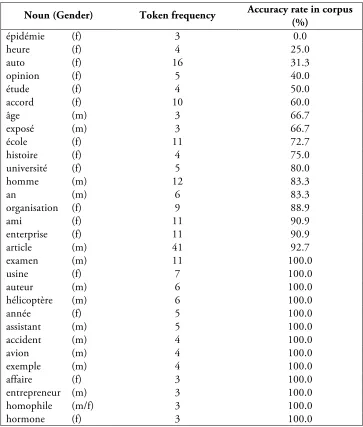
A closer look at the list of the thirty V-nouns with an occurrence of at least 3 tokens in the corpus shows that 13 of them were always used with the correct gender. There is no clear distinguishing feature among the remaining 17 nouns that had less than 100% gender accuracy. Indeed, two of the V-nouns that elicited gender errors were relatively high-frequency and morphologically simple words: article ‘article’ occurred 41 times, and auto
Arborescences
Noun (Gender) Token frequency Accuracy rate in corpus
(%)
épidémie (f) 3 0.0
heure (f) 4 25.0
auto (f) 16 31.3
opinion (f) 5 40.0
étude (f) 4 50.0
accord (f) 10 60.0
âge (m) 3 66.7
exposé (m) 3 66.7
école (f) 11 72.7
histoire (f) 4 75.0
université (f) 5 80.0
homme (m) 12 83.3
an (m) 6 83.3
organisation (f) 9 88.9
ami (f) 11 90.9
enterprise (f) 11 90.9
article (m) 41 92.7
examen (m) 11 100.0
usine (f) 7 100.0
auteur (m) 6 100.0
hélicoptère (m) 6 100.0
année (f) 5 100.0
assistant (m) 5 100.0
accident (m) 4 100.0
avion (m) 4 100.0
exemple (m) 4 100.0
affaire (f) 3 100.0
entrepreneur (m) 3 100.0
homophile (m/f) 3 100.0
[image:18.612.121.484.70.497.2]hormone (f) 3 100.0
Table 1: List of 30 V-noun lemmas with a token frequency greater than 3 in the current learner corpus, ordered by increasing gender accuracy rate
7.2. Gender Errors Involving Masculine and Feminine Nouns
Arborescences
‘default’ case for the majority of French nouns (Prodeau 2005; Sisson 2006; Wise 1997), their gender does not seem to be inherently easier to assign for learners.
7.3. Gender Accuracy in the French L2 and French L3 Groups
The third and final hypothesis concerned potential differences between French L2 and L3 learners. More specifically, would the French L2 participants perform better than their French L3 peers on general gender accuracy rates and on indefinite articles preceding V-nouns? An independent t-test revealed that the difference in general gender accuracy between the French L2 (M = 91.5 percent; SD = 10.1) and the French L3 groups (M = 79.2 percent; SD = 16) was significant (t(35) = -3.4, p < .002).
The effect of the initial vowel in nouns was analyzed for each of the two groups of participants (see figure 2). A paired t-test for potential differences in gender accuracy rates for C-nouns and V-nouns revealed a significant effect for the L3 French group: (t(6) = -3.7, p < .01). No effect was observed, however, for the L2 French group (t(28)= 1.3, p = ns).
Arborescences
Figure 2: Gender accuracy for V-nouns and C-nouns in the French L2 and L3 groups
8. Conclusion
The present study has confirmed that the L2 acquisition of gender in French can be hindered by the vowel elision that occurs with definite articles preceding V-nouns just as it delays accuracy and latency of gender identification among native speakers (Desrochers, Paivio and Desrochers 1989; Desrochers and Paivo 1990). This elision, which results in gender syncretism, seems to have had longer-term effects in particular sociolects of native speakers of Canadian French from lower social classes and lower education levels (Barbaud, Ducharme and Valois 1982). The present study is the first to establish that elision resulting in gender syncretism of V-nouns does present an extra obstacle to learners of French.
The learner of French who hears l’avion, son avion or cet avion cannot infer from such sequences whether the noun avion ‘plane’ is a masculine or feminine word. The learner may in fact erroneously misanalyze the initial /la/ sequence of l’avion as the feminine definite article la and conclude that avion
C-Arborescences
nouns in the learner’s input. In the present study, less advanced L3 French learners were found to have significantly lower gender accuracy rates compared to more advanced L2 French learners. Gender accuracy for V-nouns was also significantly lower than that of C-V-nouns among the L3 French learners; no such difference existed among the L2 French learners.
Considering the small sample size, it is important not to over-interpret the findings. However, it is possible that the L2 French learners had been able to infer the correct gender of V-nouns after having received more input (including gender marking) in French and after having developed their understanding of morphophonological gender cues in the endings of the nouns. In other words, at some point in their interlanguage development, learners are able to overcome this particular gender syncretism. It thus seems that learners of French do not simply need to pay attention to the end of words, but also need to focus on the article preceding the noun in order to determine the gender of a noun. An initial vowel delays the correct identification of the gender of a noun among learners. Future research could focus on why initial V-nouns are more difficult for learners. Indeed, our study shows that gender itself is not so much the issue as the initial-V condition on the noun (no significant difference emerged between accuracy rates of masculine versus feminine nouns - only on the initial V condition were they significantly different).
Acknowledgment
We would like to thank the reviewers and the editors for their excellent comments on a previous version of this paper.
References
Ayoun, D. 2007. “The Second Language Acquisition of Grammatical Gender and Agreement.”
In French Applied Linguistics, Ed. D. Ayoun. Amsterdam and Philadelphia: John
Benjamins: 130-170.
Ayoun, D. 2010. “Corpus Data: Shedding the Light on French Grammatical Gender... or Not.”
EUROSLA Yearbook 10: 119-141.
Ayoun, D. 2010. “Grammatical Gender Assignment in French: Dispelling the Native Speaker Myth.” Unpublished manuscript.
Barbaud, Ph., Ch. Ducharme and D. Valois. 1982. « D’un usage particulier du genre en canadien-français : la féminisation des noms à initiale vocalique. » Canadian Journal of
Linguistics 27: 103-133.
Bartning, I. 1997. « L’apprenant dit avancé et son acquisition d’une langue étrangère. Tour d’horizon et esquisse d’une caractérisation de la variété avancée. » AILE 9: 9-50.
Arborescences
groupe d’amis, de collègues et de disciples, Ed. M. Plénat, M. Aunargue, A. Condamines,
J.-P. Maurel, Ch. Molinier and C. Muller. Amsterdam: Rodopi: 45-60.
Bartning, I. 2000b. “Gender Agreement in L2 French. Pre-Advanced vs Advanced Learners.”
Studia Linguistica 54: 225-237.
Beeching, K. and A. Lewis. 2008. “The L2 Acquisition of Gender-Concord in French: Phonological versus Syntactic Explanations.” Unpublished manuscript.
Carroll, S. 1989. “Second Language Acquisition and the Computational Paradigm.” Language
Learning 39: 535-594.
Carroll, S. 1999. “Input and SLA: Adult’s Sensitivity to Different Sorts of Cues to French Gender.” Language Learning 49: 37-92.
Common European Framework of Reference for Languages: Learning, Teaching, Assessment (CEFR) http://www.coe.int/t/dg4/linguistic/cadre_en.asp (accessed 26.07.2009)
Corbett, G. 1991. Gender. Cambridge: Cambridge University Press.
Curzan, A. 2003. Gender Shifts in the History of English. Cambridge: Cambridge University Press.
Desrochers, A. and A. Paivio. 1990. « Le phonème initial des noms inanimés et son effet sur l’identification du genre grammatical. » Canadian Journal of Psychology 44: 44-57.
Desrochers, A. Paivio, A. and S. Desrochers 1989. « L’effet de la fréquence d’usage des noms inanimés et de la valeur prédictive de leur terminaison sur l’identification du genre grammatical. » Canadian Journal of Psychology 43: 62-73.
De Angelis, G. and J.-M. Dewaele. 2011. New Trends in Crosslinguistic Influence and
Multilingualism Research. Bristol: Multilingual Matters.
Dewaele, J.-M. 1994. « Variation synchronique des taux d’exactitude. Analyse de fréquence des erreurs morpholexicales dans trois styles d’interlangue française. » International Review of
Applied Linguistics 32: 275-300.
Dewaele, J.-M. 1996. « Effet de l’intensité de l’instruction formelle sur l’interlangue orale française de locuteurs néerlandophones. » In Teaching Grammar: Perspectives in Higher
Education, Ed. F. Myles and D. Engel. London: Middlesex University Press: 122-134.
Dewaele, J.-M. 1998. “Lexical Inventions: French Interlanguage as L2 versus L3.” Applied
Linguistics 19: 471-490.
Dewaele, J.-M. and D. Véronique. 2000. “Relating Gender Errors to Morphosyntactic and Lexical Systems in Advanced French Interlanguage.” Studia Linguistica 54: 212-224. Dewaele, J.-M. and D. Véronique. 2001. “Gender Assignment and Gender Agreement in
Advanced French Interlanguage: A Cross-Sectional Study.” Bilingualism: Language and
Cognition 4: 275-297.
Frenck-Mestre, Ch., A. Foucart, H. Carrasco and J. Herschensohn. 2009. “Processing of Grammatical Gender in French as a First and Second Language: Evidence from ERPs.”
EUROSLA Yearbook 9: 76-106.
Gougenheim, G., P., Rivenc, R. Michéa and A. Sauvageot. 1967. L’élaboration du français
fondamental 1e degré. Étude sur l’établissement d’un vocabulaire et une grammaire de base.
Paris: Didier.
Granfeldt, J. 2005. “The Development of Gender Attribution and Gender Agreement in French: A Comparison of Bilingual First and Second Language Learners.” In Focus on
French as a Foreign Language, Ed. J.-M. Dewaele. Clevedon, UK: Multilingual Matters:
164-190.
Grevisse, M. 1980. Le bon usage. Grammaire française. Gembloux: Duculot.
Arborescences
in Different Contexts: Focus on Functional Categories, Ed. P. Prévost and J. Paradis.
Amsterdam and Philadelphia: John Benjamins: 175-205.
Karmiloff-Smith, A. 1979. “Micro- and Macro-Developmental Changes in Language Acquisition and Other Representational Systems.” Cognitive Science 3: 91-118.
Lyster, R. 2004. “Differential Effects of Prompts and Recasts in Form-Focused Instruction.”
Studies in Second Language Acquisition 26: 399-432.
Lyster, R. 2006. “Predictability in French Gender Attribution: A Corpus Analysis.” Journal of
French Language Studies 16: 69-92.
Lyster, R. 2010. « Enseignement centré sur la forme et acquisition du genre grammatical en français L2. » Canadian Journal of Applied Linguistics – Revue Canadienne de Lingusitique
Appliquée 13: 73-94.
Lyster, R. and J. Izquierdo. 2009. “Prompts versus Recasts in Dyadic Interaction.” Language
Learning 59: 453-498.
Matthews, C. A. 1999. “Connectionism and French Gender Attribution: Sokolik and Smith Re-visited.” Second Language Research 15: 412-427.
Prodeau, M. 2005. “Gender and Number in French L2: Can We Find Out More About the Constraints on Production in L2?” In Focus on French as a Foreign Language, Ed. J.-M. Dewaele. Clevedon, UK: Multilingual Matters: 114-134.
Renaud, C. 2010. On the Nature of Agreement in English-French Acquisition: A Processing
Investigation in the Verbal and Nominal Domains. Unpublished PhD dissertation, Indiana
University.
Renaud, C. 2011. “Processing Gender: The Case of Pronouns and Adjectives in L2 French.” In
Proceedings of the 11th Generative Approaches to Second Language Acquisition Conference
(GASLA 2011), Ed. J. Herschensohn and D. Tanner. Somerville, MA: Cascadilla
Proceedings Project: 121-134.
Rivers, W. M. 1983. “Foreign Language Acquisition: Where the Real Problems Lie.” In
Communicating Naturally in a Foreign Language, Ed. W. Rivers. New York: Cambridge
University Press: 155-168.
Sabourin, L. 2001. “L1 Effects on the Processing of Grammatical Gender in L2.” EUROSLA
Yearbook 1: 159-69.
Sabourin, L., L.A. Stowe and G.J. de Haan. 2006. “Transfer Effects in Learning a Second Language Grammatical Gender System.” Second Language Research 22: 1-29.
Schriefers, H. and J. D. Jescheniak. 1999. “Representation and Processing of Grammatical Gender in Language Production: A Review.” Journal of Psycholinguistic Research 28: 575-600.
Sisson, C. 2006. Adult L2 Acquisition of French Grammatical Gender: Investigating Sensitivity to
Phonological and Morphological Gender Cues. Honours Thesis, McGill University.
Sokolik, M.E. and M.E. Smith. 1992. “Assignment of Gender to French Nouns in Primary and Secondary Language: A Connectionist Model.” Second Language Research 8: 39-58. Surridge, M. 1996. Le ou La? The Gender of French Nouns. Clevedon: Multilingual Matters. Theissen, S. and Ph. Hiligsmann. 1999. “Met de natte vinger, met de pet . . . of met de muis?
Een onderzoek naar enkele het- / de-substantieven.” In Morfologiedagen 1997.
Handelingen van het colloqium aan de Université de Liège op 23 en 24 september 1997. Ed.
S. Theissen and Ph. Hiligsmann. Liège: Vakgroep Nederlands, Université de Liège, 51-70.
Tucker, G. A., Lambert, W. E. and A. Rigault. 1977. The French Speaker’s Skills with
Arborescences
Tucker, G. A., Lambert, W. E., Rigault, A. and N. Segalowitz. 1968. “A Psychological Investigation of French Speakers’ Skill with Grammatical Gender.” Journal of Verbal
Learning and Verbal Behavior 7: 312-316.