International Journal of Emerging Technology and Advanced Engineering
Website: www.ijetae.com (ISSN 2250-2459, ISO 9001:2008 Certified Journal, Volume 9, Issue 3, March 2019)
8
Smart Billing System Using Raspberry PI
R. Leena rose
1, M. Dhinakaran
2, K. RamKumar
3, S. Gracy Selva Amala
41Associate Professor, Department of Electrical and Electronics Engineering, 2,3,4
UG Student, Department of Electrical and Electronics Engineering, Sree Sakthi Engineering College, Coimbatore, Tamil Nadu, India
Abstract- In metro cities we can see a huge rush at shopping malls on holidays and weekend. This becomes even more when there are huge offers and discounts. Now a day’s people purchase a variety of items and put them in the trolley. After the purchasing was over one should approach the counter for billing purpose. By using barcode reader the cashier prepares the bill which is a time consuming process. This results in long queues at the billing counters. This paper presents an idea to design and develop a system in shopping malls to overcome the above problem. To achieve this all products in the mall should be equipped with barcode tags and all trolleys should be equipped with a barcode scanner. When one puts any product in the trolley its code will be detected automatically, the item name and cost will be displayed; thereby the cost gets added to the total bill. If we wish to remove the product from the trolley, we can take away the product and the amount of that specific product gets deducted from total amount and this information passes to the central billing unit where payment is to done with the help of Raspberry pi module 3 where payment has to be done. Hence the billing can be done in the trolley itself thereby saving a lot of time to the customers.
Keywords-- Raspberry Pi 3 model B, Barcode scanner, Thermal printer and Trolley.
I. INTRODUCTION
Shopping malls provide customers all the necessary products like clothes, shoes, food and health products etc under one roof. Nowadays, shopping is not only a necessity but also a mode of rejuvenation. However, the supermarkets face a problem of handling the crowd at the billing system. It is not uncommon to see a huge line outside supermarkets waiting for paying bill. Considering the hassle at the billing counter, the proposed electronic system with barcode scanner will be placed in all the trolley at the shopping center. Barcode tags are attached to all the products. When a person scans any product in the trolley, barcode tag will detects the price and Product id will be stored in memory. As we scan the products, the cost will be added to total bill. Thus the bill will be calculated in the trolley itself. Product name, id, cost and total bill amount will be shown on the display. When the customer presses the done button after completing shopping, the bill will be sent to the computer at billing counter.
II. LITERETURE REVIEW
The implementation of IOT (Internet of Things) based automated trolley system was reported in this system is used to ease queues in mall by using RFID module and IOT. The RFID reader will read the RFID Tag placed on the product when the products fall in the trolley. In case, the user wants to remove any product then he will have to remove that product from the trolley. The LCD will display the details of the removed product like name, cost and the total bill. Information is transferred to the main server in range using ESP. The owner can access the information from anywhere and anytime with the help of user ID and password as the main server has its own cloud [1]. Udita gangwal describes the implementation of a Smart Shopping Cart using Wireless Sensor Networks. The reliable and cost efficient system design also ensures detection of deception. Thus, the smart system attracts both the buyers and sellers [2].
Jay Dave explains RFID smart shelf that uses standard passive UHF RFID to locate tagged objects accurately. The system uses a localization algorithm that detects changes in a tag’s readability to infer the presence of neighbouring tags. Thus, the location of objects is sensed accurately [3]. Julian Villegas describes a smart shopping cart application that is implemented using pattern based software framework. The automatic embedded software generation framework can create and evolve Zigbee applications. The framework consists of two major modules, pattern extraction and code generation. The current location of a shopping cart is monitored constantly by the WSN network [4].
International Journal of Emerging Technology and Advanced Engineering
Website: www.ijetae.com (ISSN 2250-2459, ISO 9001:2008 Certified Journal, Volume 9, Issue 3, March 2019)
9 G S Rajagopal present one of the major problems faced by consumers while shopping at a supermarket is the inability to locate items and also to carry goods to the billing counter. We describe a novel cost-effective method to overcome these issues by creating a smart trolley using a web camera along with video processing to complete the tasks [7].
Zubin Thomas using RFID tags instead of barcodes. Each and every product has RFID tag. Whenever the customer puts a product into the trolley, it will get scanned by RFID Reader. The name and cost of the product will be displayed on android application of mobile phone. We are using Visible Light Communication (VLC) technology to transfer the data to the main computer. At the billing counter, LI-FI receiver will be placed, which will receive the data from the LI--FI transmitter connected to the RF reader. RF reader connected to the trolley [8]. Sudhir Rao Rupanagudi work, the customers have to scan barcode of every product which they wish to purchase and drop into the shopping cart and then proceed to checkout at the billing counter. This is implemented using an Android application [9]. Galande Jayashree work proposes a cloud service billing system. The resource collector periodically collects resource usage information and transmitted to the billing. The billing will calculate the corresponding resource consumption based on these data, and store these records in the database to provide user management. The resource rates vary dynamically based on the current infrastructure load and service quality [10].
S Jai Ganesh prototype, the android phone is being used as a barcode scanner for its simplicity, good performance and portability. This scanner is connected wirelessly to MCU (via Bluetooth module. MCU is also connected to PC/Laptop for creating the database of all customers, their products, and bills. This database also tracks the total sale and number of goods sold per day. In addition, RFID technology is implemented in this system for payment through credit/debit-based system [11].
III. PROPOSED METHOD
The barcode of the purchased item is scanned with the help of barcode scanner which is connected with Raspberry pi 3 models. The printer is connected with a USB cable and the computer is connected with Wi-Fi. The barcode of the product is scanned with a add barcode so the products are scanned and purchased. If the remove barcode has been scanned the added barcode gets removed. When the completed barcode has been typed the bill will be generated in the thermal printer. At the same time the product details and the amount will be displayed in the mobile phone of the customers.
A. Power supply
In this system two power supplies are needed, they are 12 volt supply and 5 volt supply.
[image:2.595.322.540.166.377.2]The 12 volt supply is used only for printer. The 5 volt supply is used Raspberry pi 3 and barcode scanner.
FIG 1: Block diagram of raspberry pi 3 based smart billing system.
B. Raspberry pi 3 diagram
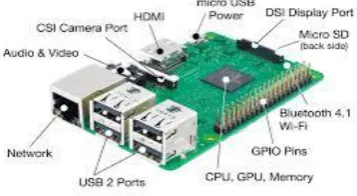
Raspberry Pi3 which is used as a microcontroller in our proposed system. It is a third generation module The Raspberry pi 3 shown I figure 2 is a strongly built credit card sized single board computer which can be used for various applications and dominates Raspberry Pi Model B and Raspberry Pi2 Model B.
FIG 2: Raspberry pi 3 modal B.
[image:2.595.342.521.498.596.2]International Journal of Emerging Technology and Advanced Engineering
Website: www.ijetae.com (ISSN 2250-2459, ISO 9001:2008 Certified Journal, Volume 9, Issue 3, March 2019)
10 i. Operating system
The operating system is installed on the micro- SD card by a PC computer through software such as Win32Disk manager or Linux Live USB creator. Which need an ’image file’ to install the ’Raspbian’ operating system. Raspbian is the R Pi foundation’s official operating system, and is based on Debi an. The educational target of this task is the following: letting the students perform the installation starting from scratch is relevant so that they understand that the operating system is placed on the micro-SD card which is plugged into the R Pi, and neither on the Samsungs memory chip, nor on the "ARM" processor placed underneath. They are asked to run the following command lines, for the purpose of software update or installation.
C. Thermal printer
Thermal printers are those printers which uses heat against a special paper in order to burn the images. Thermal printer has a number of advantages over traditional printing techniques. The main advantages of thermal printers are very fast and quiet operation. Also it has very limited number of mechanical parts compared to traditional printer.
D. Barcode scanner
[image:3.595.323.537.293.571.2]Barcode scanners scan across a bar code and measure the intensity of the reflected light. The light variation is converted into a digital signal. A barcode scanner contains two basic sections. It converts the image into a digital representation and the binary digital signals into a series of characters. The decoded information is sent to the computer via keyboard or serial interface.
FIG 3: Scanned light converted to digital signal
i. Input device
An input device accepts the reflected light and converts the optical reflection into digital/ analogy signals as shown in figure 3. There are two major methods used for input; laser beam and CCD (charge-coupled device).CCD scanners can be very small, but they have less depth of field than laser scanners.
ii. Decoders
A decoder interprets the symbolic information and passes it to a host computer or stores the information in memory. A decoder accepts the digital signal from the input device and converts it to bars and spaces. Then it quantifies the element width and decodes the signal.
Finally, it performs character checks. After the decoding process is complete, it transmits the data to a host computer. Decoders can be divided into two categories: on-line decoders and portable decoders. The on-line decoder uses the power from an AC adapter or a computer and the latter uses a battery.
IV. FLOW CHART
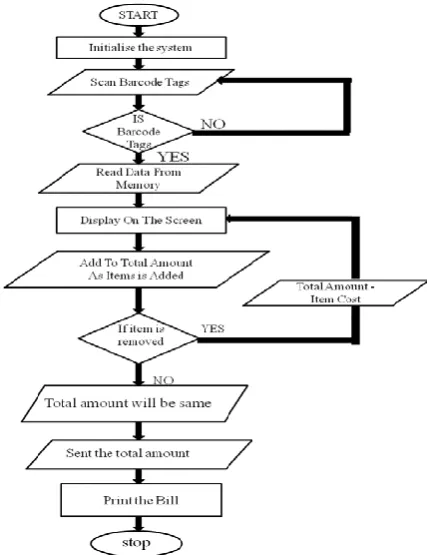
A barcode scanner is used for scanning barcode in an item to be purchased, the controller used here is raspberry pi 3 and the output device is a thermal printer which is used for printing the bill details. The flow chart for the proposed system is shown in figure 4.
FIG 4: Flow chart of Raspberry pi 3based smart billing system
V. ALGORITHM Switch ON the power supply circuit.
First step is to initialise the system then the scanning of barcode tags is done.
If the barcode tags are scanned, then the data will be read from memory otherwise the scanning will repeat.
This data will be displayed on the screen.
If the item is removed from the basket, then it will subtract the removed item amount from the total amount.
If the item is put on the basket, then it will add the added item amount to the total amount.
[image:3.595.98.225.517.591.2]International Journal of Emerging Technology and Advanced Engineering
Website: www.ijetae.com (ISSN 2250-2459, ISO 9001:2008 Certified Journal, Volume 9, Issue 3, March 2019)
11 At bill counter payment has to be done.
Finally stop the program.VI. RESULTS AND DISCUSSION
After typing add code the message displayed on screen to prompt the customer to add the product of shopping is as shown in figure 5
FIG 5: Barcode to add the product
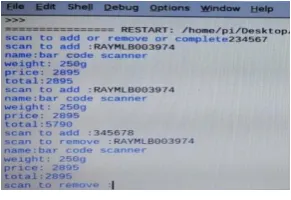
After the welcome massage, the system asks the customer to add the product. The customers scan the product barcode with the help of barcode scanner. After typing remove code the message shown in figure 6 will be displayed on screen to prompt the customer to remove the product by scanning barcode of the product which they want to remove.
[image:4.595.351.499.217.333.2]The data of a scanned removing product is
displayed as follows:
FIG 6: Barcode to remove the product
The removed product details consist of product name, price, product id product weight and amount will be displayed on screen as shown in figure 6.
Analysis of fig.6: Product name: Shoe Product cost: Rs 2895 Product id: RAYMLB003974 Product weight: 250g
Previous Total bill Amount: Rs 5790 Remove product cost: Rs 2895 Current total bill amount: Rs 2895
Thus, the customer has scanned product named “shoe” at Rs 2895. The barcode scanner scans the product name, id, weight and cost using barcode tag attached to the item. The total bill amount calculated is Rs.5790/-.Now if the customer want to remove the purchased shoe its cost will be deducted from the total amount and current bill amount is Rs.2895/- and saved in the memory of the microcontroller.
[image:4.595.84.243.230.313.2]The bill printed on thermal printer is shown in figure 7. The total bill denotes the addition of price of all
products which the customer has purchased. According to his purchase the bill was generated and printed in the thermal printer and the bill information will be transferred to the bill desk and entry gate, the customer has to pay the amount in bill counter.
FIG 7: Bill generated in thermal printer
Also final bill details will be displayed in mobile phone of the customers
The hardware setup of smart billing system by raspberry pi 3 module is shown in figure 9 where 3 barcodes were shown.
The first bar code is to add an item. The second barcode is to remove an item.
The third barcode is the barcode of the purchased product.
[image:4.595.91.237.444.544.2]Thus, the customer has to complete the process to generate the bill using thermal printer. At the same time the bill details with date and time will be sent to the user’s mobile phone as shown in figure 8.
FIG 8: Total bill display on mobile phone.
VII.HARDWARE SETUP
[image:4.595.348.509.501.750.2]International Journal of Emerging Technology and Advanced Engineering
Website: www.ijetae.com (ISSN 2250-2459, ISO 9001:2008 Certified Journal, Volume 9, Issue 3, March 2019)
12 VIII.ADVANTAGES
• The time required for shopping is reduced and hence increases customer satisfaction.
• It helps to keep the users informed of the total bill amount at the time of purchase.
• Reduces the number of employees required at the billing desk. And reduces the expenses incurred by the management
• Alert users when exceeding the estimated budget. • Automatic data transfer to cash section.
• It is a user friendly system.
IX. APPLICATIONS
The smart billing system can be used in: • Super markets
• Clothing showrooms • Grocery stores • Shopping malls
X. CONCLUSION
This work intended to design and develop a smart basket system for the purchase in shopping malls. Now-a-days, with the existing shopping system, more time is required for the billing procedure. Keeping this in mind, this system was proposed to reduce the time consumption which has been fulfilled. Customers have been given authority to shop on their own without worrying about standing in long queues for scanning of each and every product at the billing section. Instead, the bill will be directly sent to the counter and the customer has only to pay at the billing section.
XI. FUTURE SCOPE
If weight sensor is used in the basket it will identify the product which is not scanned and gives us an alarm.
The trolley can be made to act as a robot which follows us when we do shopping in supermarkets, so we will be free from pulling the basket.
REFERENCES
[1] Kulkarni Radhika Ravindranath, Agarwal Isha Sanjay, Chawandke Manasi Prashant “RFID Based Supermarket Shopping System” published on - 2017 International Conference on Big Data, IoT and Data Science (BID) Vishwakarma Institute of Technology, Pune, Dec 20-22, 2017.
[2] Jay Dave, Sagar Gondaliya, Bhumi Patel “M-Commerce Shopping Using NFC” published on -2017 IEEE 3rd International Conference on Sensing, Signal Processing and Security (ICSSS). [3] Julian Villegas and Shoma Saito “Assisting System for Grocery
Shopping Navigation and Product Recommendation” published on - 2017 IEEE 6th Global Conference on Consumer Electronics. [4] Dr. Shivani Arora, Dr.Adheesh Budree “Basket Loyalty Tussle
amongst Indian Online Retailers” published on – 2016 international conference on information technology(incite). [5] Dhavale Shraddha, DhokaneTrupti, Shinde Priyanka S "IOT
Based Intelligent Trolley for Shopping Mall" published on - 2016 IJEDR, Volume 4, Issue 2.
[6] G S Rajagopal, Mr. S Gout “Small Intelligent System for Shopping and Billing” published on - International journal of Advance Research Trends in Engineering and Technology, Volume 3, Special issue 19, April 2016.
[7] Zubin Thomas, Nikil Kumar and D. Jyothi Preshiya “Automatic Billing System using Li-Fi Module” published on - International Conference on Communication and Signal Processing, April 6-8, 2016, India.
[8] Sudhir Rao Rupanagudi, Fathima Jabeen, Vaishnav Ram Savarni K R, Varsha G.Bhat “A Novel Video Processing based Cost Effective Smart Trolley System for Supermarkets using FPGA” published on - 2015 International Conference on Communication, Information & Computing Technology (ICCICT), Jan. 16-17, Mumbai, India.
[9] Galande Jayashree, Rutuja Gholap, Priti Yadav “RFID based Automatic billing trolley”published on - 2015, publication- IJETAE.
[10] S Jai Ganesh, S Sahithi, S Akhita “RFID Based Shopping Cart” published on - International Journal of Innovative Research in Engineering & Management, Volume 2, issue 3, May 2015. [11] P.Chandrasekar, Ms.t.sangeetha “smart shpping cart with