IJPSR (2018), Volume 9, Issue 5 (Research Article)
Received on 31 July, 2017; received in revised form, 23 October, 2017; accepted, 17 November, 2017; published 01 May, 2018 STABILITY INDICATING RP-HPLC METHOD FOR SIMULTANEOUS DETERMINATION OF EPALRESTAT AND PREGABALIN IN BULK AND TABLET DOSAGE FORM
S. Angala Parameswari * and Gaddam Arunamma
Department of Pharmaceutical Analysis, Krishna Teja Pharmacy College, Tirupathi - 517506, Andhra Pradesh, India.
ABSTRACT: A New simple, sensitive, precise, accurate and stability indicating RP-HPLC method has been developed for the simultaneous determination of epalrestat and pregabalin in combined tablet dosage form. The
chromatogram was achieved with STD Discovery column 250 × 4.6 mm, 5 and
mobile phase containing 0.1% ortho phosphoric acid buffer and acetonitrile taken in the ratio of 45: 55 was pumped through column at a flow rate of 1 ml/min. temperature was maintained at 25 °C. The effluents were monitored at 244 nm by using PDA detector. The retention time of epalrestat and pregabalin were found to be 2.407 min and 3.272 min. The validation of the method was done according to the ICH guidelines for different analytical parameters. The method was found to be linear in the range of 37.5 - 225 µg and 18.75 - 112.5 µg/ml for epalrestat and pregabalin respectively. The assay of marketed formulation was determined and find with 99.22% and 99.07% w/v for epalrestat and pregabalin respectively. The stressed sample was analysed and this proposed method was found to be specific and stability indicating as no interfering peaks of degradation compound and excipients were noticed. So the method was simple and economical that can be applied successfully for simultaneous estimation of both epalrestat and pregabalin in bulk and combined tablet formulation.
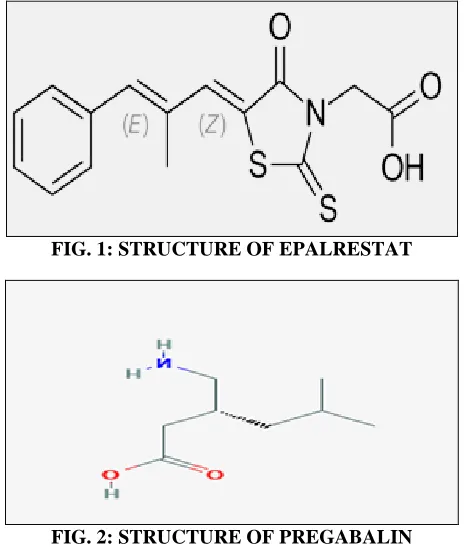
INTRODUCTION: Epalrestat was chemically 2-[(5Z)-5- [(E)-2-methyl-3-phenylprop-2-enylidene]-4-oxo-2-sulfanylidene-1, 3-thiazolidin-3-yl] acetic acid, epalrestat is a carboxylic acid derivative and a noncompetitive and reversible used for the treatment of which is one of the most common long-term complications in patients. It reduces the accumulation of intracellular sorbitol, which is believed to be the cause of diabetic neuropathy. Pregabalin was chemically (3S)-3-(aminomethyl)-5-methylhexanoic acid.
QUICK RESPONSE CODE
DOI:
10.13040/IJPSR.0975-8232.9(5).1844-50
Article can be accessed online on: www.ijpsr.com DOI link: http://dx.doi.org/10.13040/IJPSR.0975-8232.9(5).1844-50
Pregabalin was used for the management of neuropathic pain associated with diabetic peripheral neuropathy or spinal cord injury and postherpetic neuralgia. Both the drugs are official in IP and USP.
The extensive literature survey revealed that RP-HPLC 1 - 10 and UV spectrophotometric methods 11, 12, 13
and UPLC method 14 were available for the determination of epalrestat and pregabalin individually or in combination with other drugs, but no method was reported for simultaneous estimation epalrestat and pregabalin in combined tablet dosage form using RP-HPLC method. The study was thus performed with an aim to develop a simple, economic, sensitive, rapid, accurate, precise and stability indicating RP-HPLC method for the determination of epalrestat and pregabalin in combined tablet dosage form.
Keywords:
RP-HPLC, Epalrestat, Pregabalin, Method validation, Stability, Simultaneous estimation Correspondence to Author: Dr. S. Angala parameswari
Associate professor,
Department of Pharmaceutical Analysis, Krishna Teja Pharmacy College, Tirupathi - 517506, Andhra Pradesh, India.
FIG. 1: STRUCTURE OF EPALRESTAT
FIG. 2: STRUCTURE OF PREGABALIN
MATERIALS AND METHODS:
Instruments: Waters (2695) PDA detector HPLC using the software Empower 2.
Chemicals and Reagent: Epalrestat and
pregabalin pure drugs (API), epalrestat and pregabalin tablets obtained from Spectrum labs, Hyderabad, India. Potassium dihydrogen phosphate buffer, ortho-phosphoric acid are from Rankem chemicals, Hyderabad, India. HPLC grade methanol, acetonitrile and water were procured from Merck specialties private limited, Hyderabad. Preparation of Mobile Phase: Accurately weighed 1.36 gm of potassium dihyrogen ortho phosphate in a 1000 ml of volumetric flask, add about 900 ml of milli-Q water added and degass to sonicate and finally make up the volume with water then pH adjusted to 5.4 with dil. orthophosphoric acid solution.
Preparation of Standard Solutions: Accurately weighed 15 mg of epalrestat, 7.5 mg of pregabalin was transferred to 10 ml volumetric flasks. 3/4th of diluents was added and sonicated for 10 minutes. Flasks were made up with diluents and labeled as a standard solution.
Preparation of Sample Solution: 20 tablets were weighed and the average weight of each tablet was calculated, then the weight equivalent to 15 mg
epalrestat transferred into a 100 ml volumetric flask, 50 ml of diluents was added and sonicated for 25 min, further the volume was made up with diluents.
Chromatographic Conditions: The chromato-graphic column used was STD Discovery column 250 × 4.6 mm, with 5 µm particle size. The flow rate was maintained at 1 ml/min. The detection wavelength of the method was 244 nm. The temperature was maintained at 25 °C. The injection volume was 10 µl. The run time of standard and sample was 10 minutes.
Optimization of RP-HPLC Method: The HPLC method was optimized with an aim to develop a simultaneous estimation procedure for the assay of epalrestat and pregabalin. For the method optimization, different mobile phases were tried, but acceptable retention times, theoretical plates and good resolution were observed with Methanol, Phosphate buffer pH 5.4 (45:55 v/v) using column Discovery 250 × 4.6 mm, 5m. The results were shown in Fig. 3.
Validation of the RP-HPLC Method: Validation of the optimized method was performed according to the ICH guidelines.
System Suitability: The system suitability parameters were determined by preparing standard solutions of epalrestat (15 µg/ml) and pregabalin (75 µg/ml). The solutions were injected six times and the parameters like peak tailing, resolution and USP plate count were determined. The % RSD for the area of six standard injections results should not be more than 2%. The results were shown in Table 1.
Specificity: Specificity of a method was determined by testing standard substances against potential interferences. There should not find interfering peaks in the blank and placebo at retention times of these drugs in this method. So this method was said to be specific.
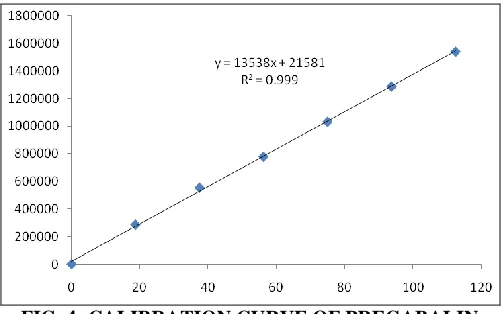
triplicate. Calibration curves were plotted with observed peak areas against concentration followed by the determination of regression equations and calculation of the correlation coefficient on curves for epalrestat and pregabalin. The results were shown in Table 2.
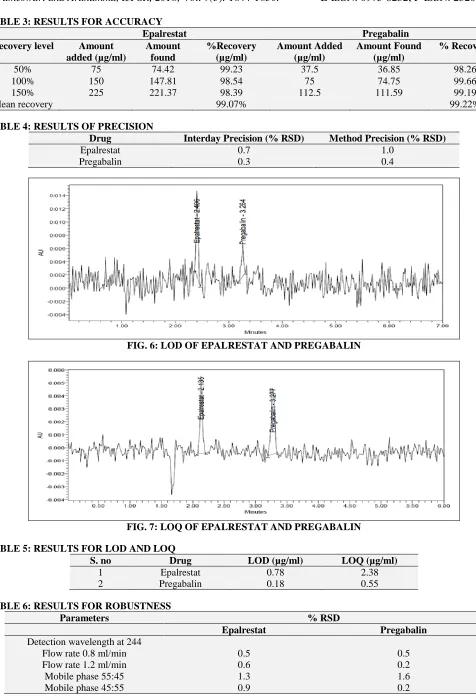
Accuracy: Accuracy was carried out by % recovery studies of epalretat and pregabalin at three different concentration levels (50%, 100%, and 150%). Percentage recovery was calculated from the amount added and the amount recovered. The percentage recovery was within the acceptance criteria, this indicates the accuracy of the method. (Acceptance criteria: % recovery between 98 to 102). The results were shown in Table 3.
Precision: The repeatability of the method was verified by calculating the % RSD of six replicate injections of 100% concentration (150 µg/ml of epalrestat and 75 µg/ml of pregabalin) on the same day and for intermediate precision % RSD was calculated from repeated studies on different days. The results were shown in Table 4.
Limit of Detection (LOD) and Limit of Quantitation (LOQ): The LOD and LOQ were calculated from the slope(s) of the calibration plot and the standard deviation (SD) of the peak areas using the formulae LOD = 0.78 σ/s and LOQ = 0.18 σ/s. The results were shown in Table 5.
Robustness: Robustness of the method were verified by altering the chromatographic conditions like flow rate, mobile phase ratio and temperature are made, but there were no recognized change in the result and all are within range as per ICH guidelines. Robustness conditions like flow minus (0.9 ml/min), flow plus (1.1 ml/min), mobile phase minus 55:45 mobile phase plus, temperature minus (25 °C) and temperature plus (35 °C) were maintained and samples were injected in duplicate manner. System suitability parameter was passed. % RSD was within the limit. The result was shown in Table 6.
Degradation Studies:
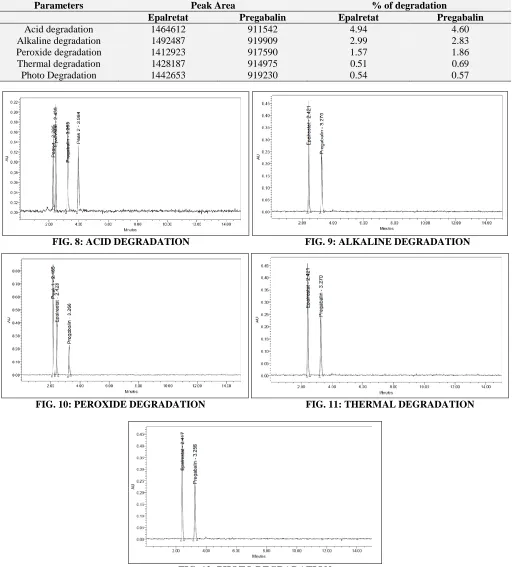
Acid degradation: To 1 ml of stock solution epalrestat and pregabalin, 1ml of 2N Hydrochloric acid was added and refluxed for 30 mins at 60 °C. The resultant solution was diluted to obtain 150 µg/ml and 75 µg/ml solutions and 10 µl solutions
were injected into the system and the chromatograms were recorded to assess the stability of the sample. The results were shown in Fig. 8.
Oxidative Degradation: To 1 ml of stock solution of epalrestat and pregabalin, 1 ml of 20% hydrogen peroxide (H2O2) was added separately. The solutions were kept for 30 min at 60 °C. For HPLC study, the resultant solution was diluted to obtain 150 µg/ml and 75 µg/ml solution and 10 µl were injected into the system and the chromatograms were recorded to assess the stability of the sample. The results were shown in Fig. 9.
Alkali Degradation: To 1 ml of stock solution epalrestat and pregabalin, 1 ml of 2N sodium hydroxide was added and refluxed for 30 mins at 60 °C. The resultant solution was diluted to obtain 150 µg/ml and 75 µg/ml solution and 10 µl were injected into the system and the chromatograms were recorded to assess the stability of the sample. The results were shown in Fig. 10.
Thermal Degradation: The standard drug solution was placed in oven at 105 °C for 6 hrs to study dry heat degradation. For HPLC study, the resultant solution was diluted to 150 µg/ml and 75 µg/ml solution and 10µl were injected into the system and the chromatograms were recorded to assess the stability of the sample. The results are shown in Fig. 11.
Photo Degradation: The photochemical stability of the drug was also studied by exposing the 1500 µg/ml and 750 µg/ml solution to UV light by keeping the beaker in UV chamber for 7 days or 200 Watt hrs/m2 in photo stability chamber. For HPLC study, the resultant solution was diluted to obtain 150 µg/ml and 75 µg/ml solutions and 10 µl were injected into the system and the chromatograms were recorded to assess the stability of the sample. The results are shown in Fig. 12.
RESULTS AND DISCUSSION: After a number
pregabalin were found to show appreciable absorbance at 244 nm when determined spectro-photometrically and hence it was selected as the detection wavelength. An optimized chromatogram showing the separation of epalrestat and pregbalin.
FIG. 3: OPTIMIZED CHROMATOGRAM OF
EPALRESTAT AND PREGABALIN
System Suitability: According to ICH guidelines plate count should be more than 2000, tailing factor should be less than2 and resolution must be more than 2. All the system suitable parameters were passed and were within the limits.
TABLE 1: SYSTEM SUITABILITY PARAMETERS Parameter Epalrestat Pregabalin Retention time (min) 2.403 3.265 Theoretical plates (N) 11803 16866
[image:4.612.312.566.120.285.2]Tailing factor (T) 1.14 1.21 Linearity: Concentration range of 37.5 - 225 µg/ml for epalrestat and 18.75 - 112.5 µg/ml of pregabalin were found to be linear with correlation coefficients 0.999 were within limits. The result was shown in Fig. 4 and 5.
FIG. 4: CALIBRATION CURVE OF PREGABALIN
Accuracy: The Percentage accuracy was a relative standard deviation for accuracy at each level is well
within the limit. Over all the percentage recovery of the relative standard deviation was found to be 99.23% - 100.35 % for all the levels was within the limit.
FIG. 5: CALIBRATION CURVE OF EPALRESTAT
TABLE 2: RESULTS FOR LINEARITY
Parameter Epalrestat Pregabalin
Y intercept 10024 21581
Correlation coefficient r2
0.999 0.999
Regression Equation
10024x + 24800 13538x + 21581 Linearity range 37.5 - 225 µg/ml 18.75 - 112.5 µg/ml
LOD 0.78 2.38
LOQ 0.18 0.55
Precision: Percentage relative standard deviation of six results was within the limit. Results shown good degree of precision was found to be 0.7% and 0.3%.
Limit of Detection: Limit of detection of target assay concentration of epalrestat and pregabalin by using formula method 0.78 µg/ml and 0.18 µg/ml within the limits. The results were shown in Fig. 6. Limit of Quantification: Limit of quantification of the target assay concentration of epalrestat and pregabalin by using formula method .38 µg/ml and 0.55 µg/ml were within the limits. The results were shown in Fig. 7.
[image:4.612.48.300.130.311.2] [image:4.612.48.299.548.705.2]TABLE 3: RESULTS FOR ACCURACY
Epalrestat Pregabalin
Recovery level Amount added (µg/ml)
Amount found
%Recovery (µg/ml)
Amount Added (µg/ml)
Amount Found (µg/ml)
% Recovery
50% 75 74.42 99.23 37.5 36.85 98.26
100% 150 147.81 98.54 75 74.75 99.66
150% 225 221.37 98.39 112.5 111.59 99.19
Mean recovery 99.07% 99.22%
TABLE 4: RESULTS OF PRECISION
Drug Interday Precision (% RSD) Method Precision (% RSD)
Epalrestat 0.7 1.0
Pregabalin 0.3 0.4
FIG. 6: LOD OF EPALRESTAT AND PREGABALIN
FIG. 7: LOQ OF EPALRESTAT AND PREGABALIN
TABLE 5: RESULTS FOR LOD AND LOQ
S. no Drug LOD (µg/ml) LOQ (µg/ml)
1 Epalrestat 0.78 2.38
2 Pregabalin 0.18 0.55
TABLE 6: RESULTS FOR ROBUSTNESS
Parameters % RSD
Epalrestat Pregabalin
Detection wavelength at 244
Flow rate 0.8 ml/min 0.5 0.5
Flow rate 1.2 ml/min 0.6 0.2
Mobile phase 55:45 1.3 1.6
Forced Degradation Study: Degradation studies indicated the specificity of the developed method in the presence of degradation products. Degradation was carried out in combination of two drugs and purity of drug peaks was confirmed by purity angles. Their combination drug products were
[image:6.612.51.563.160.727.2]exposed to acid, alkali, oxidative and thermal stress conditions. Then found to be no degradable substances presence and proved that the proposed method was stable towards acid, alkali, peroxide and thermal conditions within the limits.
TABLE 7: RESULTS FOR STABILITY STUDIES OF EPALRESTAT AND PREGABALIN
Parameters Peak Area % of degradation
Epalretat Pregabalin Epalretat Pregabalin
Acid degradation 1464612 911542 4.94 4.60
Alkaline degradation 1492487 919909 2.99 2.83
Peroxide degradation 1412923 917590 1.57 1.86
Thermal degradation 1428187 914975 0.51 0.69
Photo Degradation 1442653 919230 0.54 0.57
FIG. 8: ACID DEGRADATION FIG. 9: ALKALINE DEGRADATION
FIG. 10: PEROXIDE DEGRADATION FIG. 11: THERMAL DEGRADATION
CONCLUSION: The RP-HPLC method developed and validated allows a simple and rapid quantitative determination of epalrestat and pregabalin in bulk and tablet dosage forms. All the validation parameters were found to be within the limits according to ICH guidelines.
The proposed method was found to be specific for the drugs of interest irrespective of the excipients present and the short retention times allows the analyst to analyze no. of samples in a short period and method was found to be simple, accurate, precise, rugged, robust and stable under forced degradation stress conditions. So the established method can be successfully applied for the routine analysis of the marketed formulations.
ACKNOWLEDGEMENT: The authors are
thankful to the MSN laboratories, Hyderabad for providing the gift samples of epalrestat and pregabalin and also to the management of Krishna Teja Charitries for providing facility to carry out this work.
CONFLICT OF INTEREST: Nil
REFERENCES:
1. Kasawar GB: Development and validation of HPLC method for the determination of pregabalin in capsules. Indian journal of pharmaceutical sciences 2010; 72(4): 517-519.
2. Patel M: Development and validation of RP-HPLC method for simultaneous estimation of epalrestat and methylcobalamin in tablet dosage form. World journal of pharmacy and pharmaceutical sciences 2015; 6(4): 3673-3678.
3. Pathi PJ and Raju NP: The estimation of epalrestat in tablet dosage form by RP-HPLC. Asian J Pharm Ana. 2012; 2(2): 49-51.
4. Vaishali, Singh V, Singh RK, Gupta RK and Swain SR: Development and validation of RP-HPLC method for the
assay of pregabalin capsule. World journal of pharmacy and pharmaceutical sciences 2015; 2(6): 1038-1047. 5. Kaushal C and Srivatsava B: A Process of Method
development a chromatographic Approach. J Chem Pharm Res. 2010; 2(2): 519-54.
6. Sneha P and Srinivas P: Stability indicating assay method development and validation of Pregabalin in Pharmaceutical dosage forms by RP-HPLC formulation. International Journal of Pharm Tech Research 2015; 2(6): 1038-1047.
7. Kannapan N, Nayak SP, Venkatachalam T and Prabhakaran V: Analytical RP-HPLC method for development and validation of pregabalin and methylcobalamine in combined capsule formulation. Journal of applied chemical Research 2010; 13: 85-89. 8. Balaji J, Ramachandra B and Naidu NVS: Analytical
RP-HPLC method for development and validation of pregabalin in bulk and the determination of pregabalin in capsule dosage form. International Journal of innovative research in Science 2014; 3(4): 11095-11098.
9. Kasawar GB and Farooqui MN: Development and validation of HPLC method for the determination of pregabalin in capules. Indian J. Pharm. Sci. 2010; 72(4): 517-519.
10. Patel AJ and Kadika H: Stability indicating HPLC method for simultaneous estimation of pregabalin and methylcobalamin from combined dosage form. J Pharm Sci. Bio-scientific Res. 2017; 7(1): 158-166.
11. Maheshwar DG and Chaudhari K: Development and validation of UV Spectrophotometric method for simultaneous estimation of epalrestat and methylcobalamin in the Pharmaceutical dosage form. International Journal of Pharm Tech Research 2014; 6(4): 1180-1188.
12. Santosh G, Shep and Lahoti SR: Development and validation of UV spectrophotometric method of pregabalin in bulk and pharmaceutical formulation. International Journal of PharmTech Research 2013; 5(3): 1264-127. 13. Chandani P, Rajan DP, Shruti JS, Mardia SRB, Chauhan
SP and Suhagia BN: Simultaneous estimation of epalrestat and methylcobalamin in bulk and tablet formulation by UV Spectrophotometry and liquid chromatography. Indo American Journal of Pharmaceutical Research 2014; 4(5): 2650-2656.
14. Seelam SC, Lakshmi DK, Nagarjuna Reddy G and Sreenivasa S: Analytical method validation of epalrestat an antidiabetic drug in bulk and tablet formulations by UPLC A novel technique. Indo American Journal of Pharmaceutical Research 2013; 3(7): 5179-5187.
All © 2013 are reserved by International Journal of Pharmaceutical Sciences and Research. This Journal licensed under a Creative Commons Attribution-NonCommercial-ShareAlike 3.0 Unported License. This article can be downloaded to ANDROID OS based mobile. Scan QR Code using Code/Bar Scanner from your mobile. (Scanners are available on Google Playstore)
How to cite this article: