BIROn - Birkbeck Institutional Research Online
Rosli, Ainurul and Rossi, Federica (2015) Assessing the impact of knowledge
transfer policies: an international comparison of models and indicators of
universities’ knowledge transfer performance. In: Hilpert, U. (ed.) Routledge
Handbook of Politics and Technology. London, UK: Routledge, pp. 438-454.
ISBN 9780415692014.
Downloaded from:
Usage Guidelines:
Please refer to usage guidelines at or alternatively
Assessing the impact of knowledge transfer policies
An international comparison of models and indicators of
universities’ knowledge transfer performance
Ainurul Rosli and Federica Rossi
Published in: U. Hilpert (ed.), Handbook of Politics and Technology, London:
Routledge, 2015.
Abstract
This chapter discusses how to appropriately measure the effectiveness of
knowledge transfer from university to industry. It shows that the assessment
systems implemented in several countries (UK, US, Canada, Australia and
Europe) adopt rather narrow views of what constitute relevant knowledge transfer
activities and their impacts, leading to the selection of partial indicators that might
not allow all institutions to represent their knowledge transfer performance
accurately. We derive some implications for the measurement of universities’
performance and for the assessment of policies in support of knowledge
Introduction
At least since the 1980s, a consensus has consolidated among economists and
policymakers on the central role of knowledge production and accumulation as a
key stimulus to economic growth (Romer 1990). In the new knowledge based
economy, intangible investment in the production of knowledge – through the
funding of R&D and human capital formation – plays a crucial economic role in
order to increase the economy’s productive resources, just as physical capital did
in the old industrial economy.
Public intervention is often required in order to ensure that a sufficient amount of
knowledge is produced and transferred1. For example, governments often fund
research carried out in universities and in public research organizations, support
firms’ investment in innovation and research, promote various kinds of
dissemination and knowledge transfer activities in order to ensure that new
scientific discoveries are diffused and implemented. Assessing the extent to which
government interventions in support of processes of knowledge production and
transfer are successful is therefore a very important issue in the knowledge based
economy. It is not coincidental that a lot of debates are taking place
internationally concerning how to set up appropriate systems to monitor the extent
to which the beneficiaries of public funds are able to produce and transfer
knowledge successfully and to assess the impact of their activities.
This is, however, a complex task. Not only is knowledge intangible and inherently
difficult to measure, but different views and theories about ‘what is’ knowledge
suggest different approaches to measuring success in knowledge production and
transfer. Choosing the ‘right’ metrics for performance measurement is particularly
crucial because indicators are recognized to play a performative role (Davis et al.
2010; Merry 2011): they signal which behaviours are considered important by
policymakers, and which ones may be associated to implicit rewards, such as
better reputation and prestige. As such, they can potentially influence the
behaviour of the organizations that are monitored.
This chapter discusses how to appropriately measure the effectiveness of public
interventions in support of knowledge production and transfer, by focusing on a
specific issue: how to monitor and assess the performance of universities with
respect to their knowledge transfer activities. This analysis allows us to derive
some specific implications for the measurement of universities’ performance as
well as some more general implications for the assessment of policies in support
of knowledge production and transfer.
Models of knowledge transfer and their implications for the
choice of performance indicators
The increasing importance and visibility of universities’ knowledge transfer
activities
As universities are among the most important producers of new knowledge, their
contribution to processes of economic growth and development in the knowledge
based economy has become more prominent and more debated. Universities are
an intellectual endeavour detached from practical and commercial applications,
but as active agents of economic development (Etzkowitz/ Leydesdorff 2000): for
most universities, knowledge transfer has become a ‘third mission’ which
complements the traditional research and teaching activities and has gained
increasing prominence.
Consequently, ensuring the efficient transfer of academic knowledge to the
economic system - so that it can be productively incorporated into the knowledge
bases of firms and other organizations and used to generate further innovations,
driving productivity increases and opening up new markets - has become an
important policy objective. For example, in the United Kingdom, the government
has launched a specific stream of funding (the Higher Education Innovation Fund,
or HEIF, appropriately referred to as ‘third stream’ funding) in order to promote
knowledge transfer from universities (Molas Gallart/ Martinez 2007; Kitagawa/
Lightowler 2012). In other countries, support for knowledge transfer activities
takes place through national project-based funding (for example in Spain; Molas
et al. 2007) and support for the development of a knowledge transfer
infrastructure, whether at national level (as in Sweden; Sellenthin 2006), at
regional level (as in Germany; Sellenthin 2006) or at State level (as in the US;
PACEC 2010).
In order to evaluate the impact of public programmes and to identify whether
further interventions are required, policymakers in many countries have launched
monitoring and assessment initiatives, which often consist of systematic data
about their engagement in several activities. In the US and Canada, the
Association of University Technology Managers (AUTM) runs a yearly survey of
the technology transfer offices of about 200 research universities, mainly focused
on technology commercialization activities. In Europe, several associations of
technology transfer professionals such as the European Knowledge Transfer
Association (ProTon) and the Association of European Science and Technology
Transfer Professionals (ASTP) organize their own surveys, usually addressed to
the associations’ members. Individual countries in Europe organize data
collection exercises too. For example, in Spain the Conference of University
Rectors distributes an annual survey to the technology transfer offices of
universities and public research organizations (Molas Gallart/ Martinez 2007). In
the UK a comprehensive survey (Higher Education Business and Community
Interaction survey, henceforth HE-BCI) currently managed by the Higher
Education Statistics Agency is distributed yearly to all universities in the country;
the results of this survey are used to allocate third stream funds to universities.
The Australian government runs a biannual survey of universities and public
research institutes, and it is currently debating the implementation of indicators
similar to those used in the UK (Jensen et al. 2009) 2.
Despite the importance of this issue, the choice of appropriate indicators is largely
shaped by practical and empirical considerations. In this section, we propose a
theoretical discussion both of the different views of knowledge that often
implicitly drive the choice of current indicators, as well as of what are the
indicators currently used by several data collection exercises implemented
internationally in light of this theoretical analysis.
Different knowledge transfer models
Universities transfer knowledge to external stakeholders in many ways. Even in
abstract terms, several possible models of knowledge production and transfer have
been identified, according to the nature and properties of knowledge considered
(Wang/ Peng 2009).
When knowledge is perfectly codified (that is, it has the nature of ‘information’),
and therefore easily transferrable from one person to another, it shares some
features with public goods: differently from tangible goods, it is non rival,
because its use on the part of one person does not prevent another person from
using it at the same time; and it can be difficult to prevent anyone, including those
who have not paid for it, from using it, since it can be transferred rapidly and its
marginal cost of reproduction is almost zero (Arrow 1962). This generates a
market failure: as knowledge generates positive externalities in the economy,
competitive markets do not create sufficient incentives for private agents to
produce the amount of knowledge that would be optimal for society.
The market failure in knowledge production can be overcome through
government intervention: the government provides public funding for research (by
funding universities and public research institutes), and demands that the outputs
that result from it are openly disseminated, in the form of publications, reports,
David 1994; Antonelli 2008). This model – which we can call the public
knowledge model – is consistent with the objective to maximize knowledge
externalities, and with the assumption that no support mechanisms are needed in
order to incentivize knowledge transfer: as knowledge is considered akin to
perfectly codified information, economic agents are assumed to be perfectly able
to understand it and implement it once it is placed in the public domain.
Another approach to overcoming the market failure in knowledge production is
the set up of a system of intellectual property rights. The intellectual property
rights system generates at least two types of incentives (Mazzoleni/ Nelson 1998;
Andersen 2004): the incentive to invest resources in knowledge production (by
allowing those who produce knowledge to obtain an adequate economic reward
for their efforts) and the incentive to transfer knowledge from one agent to
another (by allowing knowledge to be commercialized, for example in the form of
patents, copyright, trademarks, design rights that can be sold or licensed). The
second incentive is the most relevant in the case of university-generated
knowledge (Mowery/ Sampat 2005; Schacht 2005). Once intellectual property
rights are applied, knowledge is transformed into a quasi-private good for which
markets arise spontaneously (Dasgupta/ David 1994)3 – we can call this the
proprietary knowledge model of knowledge transfer.
The view of knowledge as information conceptualizes knowledge transfer as a
uni-directional and linear process where the knowledge creator (the university)
provides certain ‘output’ to another party. Therefore, measuring knowledge
transferred, to how many users, what is its value. Since this approach presumes
that information does not change in the course of the transfer process, the amount
of information that is made available and the number of users who have accessed
it are considered good measures of the amount of information that is actually
received: this suggests that appropriate metrics for universities’ intensity and
impact of knowledge transfer would be, for example, the number of publications
made, accessed and cited, the number of patents and other IPR filed, sold and
licensed. It also presumes that the price at which knowledge is sold (or, in case of
publicly funded knowledge, the price that the government pays in order to fund it)
clearly reflects its value to the user, hence the income that universities derive from
knowledge transfer is considered a good measure of its value to society.
Knowledge, however, is not always codified and transmissible like pure
information: often, the transmission of knowledge requires practice, active
participation and complementary knowledge on the part of the person who is
supposed to receive it. In this case, knowledge transfer unfolds over a longer time
and usually involves direct interactions between the knowledge holder and the
knowledge receiver, in which knowledge is actively constructed rather than
simply transmitted – a model of knowledge transfer that we can call interactive.
When knowledge transfer requires direct interactions, it can be difficult for free
riders to acquire it, even in the absence of intellectual property rights, and this
weakens the ‘market failure’ rationale for public funding: the more knowledge is
private firms, as shown by much empirical evidence (Cohen et al. 2000; Levin et
al. 1987; Mansfield 1986).
However, even when markets create sufficient incentives to invest in knowledge
production, the economic system may fail to provide sufficient opportunities or
resources for agents to interact with other agents (that is, there is a ‘system
failure’; Klein Woolthuis et al. 2005). Appropriate interventions to support
interactions may be needed to ensure that knowledge is diffused sufficiently in the
economy; since those interactions in turn promote the recombination of existing
knowledge, they are potentially able to stimulate the further production of new
knowledge.
When knowledge is characterized by tacitness (Ryle 1949; Polanyi 1966),
specialization (Cowan/ Van der Paal 2000; Cowan et al. 2000; Dosi et al. 2006),
cumulativeness4, universities need to directly interact with external stakeholders
in order to transfer knowledge effectively. Therefore, the measurement of
knowledge transfer performance should not simply focus on the amount and value
of outputs that are transferred, but also on the interaction processes themselves:
that is, the frequency, characteristics and quality of the interactions and the (short
and long term) learning processes that all participants in the interactions
experience (with a focus on knowledge exchange rather than just knowledge
transfer).
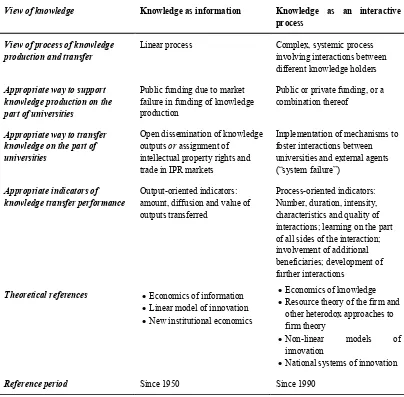
The following table summarizes the main characteristics of the different views of
Table 14.1: Different views of knowledge and their implication for knowledge transfer
View of knowledge Knowledge as information Knowledge as an interactive process
View of process of knowledge production and transfer
Linear process Complex, systemic process involving interactions between different knowledge holders
Appropriate way to support knowledge production on the part of universities
Public funding due to market failure in funding of knowledge production
Public or private funding, or a combination thereof
Appropriate way to transfer knowledge on the part of universities
Open dissemination of knowledge outputs or assignment of
intellectual property rights and trade in IPR markets
Implementation of mechanisms to foster interactions between universities and external agents (“system failure”)
Appropriate indicators of knowledge transfer performance
Output-oriented indicators: amount, diffusion and value of outputs transferred
Process-oriented indicators: Number, duration, intensity, characteristics and quality of interactions; learning on the part of all sides of the interaction; involvement of additional beneficiaries; development of further interactions
Theoretical references Economics of information
Linear model of innovation
New institutional economics
Economics of knowledge
Resource theory of the firm and other heterodox approaches to firm theory
Non-linear models of innovation
National systems of innovation
Reference period Since 1950 Since 1990
Implications: choosing indicators for different knowledge transfer activities
Some knowledge transfer activities fall quite neatly within one of the models
identified in the previous section. It has been acknowledged that the view of
knowledge as information is particularly appropriate to describe basic research,
which is far from any potential implementation. In this case, the market failure in
knowledge production is particularly serious (Nelson 1959) and in fact basic
research is mostly publicly funded (Haskel/ Wallis 2013) and its outcomes are
disseminated openly through books, publications, presentations, talks,
production and transfer (for example, much research produced in the humanities
may fall within this description). Instead, forms of knowledge that are very tacit
and specific to particular users generate very little externalities (Holi et al. 2008).
Here we find that private organizations are willing to pay universities for contract
research, consultancies, the provision of certification and testing services, the
provision of training and continuing professional development courses (CPDs),
and similar, as in the interactive knowledge model described earlier. In other cases,
the transfer of knowledge from university to industry occurs simply via the sale of
a patent or the licensing of a piece of software or other technology, as in the
proprietary knowledge model.
But many knowledge transfer activities involve a combination of these
approaches. Publicly-funded projects like regeneration programmes and
community and cultural events can give rise both to openly disseminated outputs
and to interactions with the local communities. Sometimes the effective transfer
of knowledge that is codified into a book, or even a patent, requires direct
interactions with the researchers who produced it (Cohen et al. 2002); hence very
often informal or even formal interactions develop around the use of published
results or around the implementation of a patent licensed from the university5. The
creation of spinoff companies to exploit the IPR created by universities is another
example of a situation where knowledge that is codified into a patent requires the
setup of a system of stable interactions to implement it and commercialize it. In
the opposite case, the interactions developed around contract research and
consultancy may give rise to patents that can be traded and licensed. It is also
standardized and do not involve the production or transfer of new knowledge (for
example the rental of rooms and equipment).
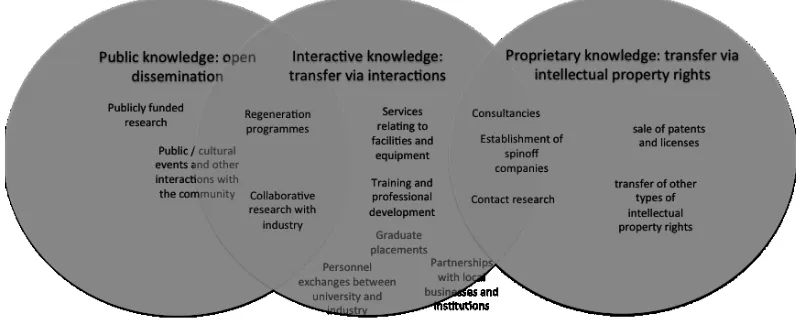
The following figure illustrates how different types of knowledge transfer
activities relate to the three models of knowledge transfer identified in the
[image:13.595.97.497.283.446.2]previous section.
Figure 1: Models of knowledge transfer and types of knowledge transfer activities
Because there is no one-to-one correspondence between knowledge transfer
activities and theoretical models (and corresponding indicators) of knowledge
transfer, the appropriate indicators for each activity must be considered carefully,
based on an in-depth understanding of its nature and the channels through which it
Implications: choosing indicators for different types of knowledge transfer
profiles
The arguments presented suggest that not all knowledge transfer activities can be
appropriately measured with the same indicators. For example, the more such
activities involve the transmission of tacit knowledge through interactions, the
more the characteristics of such interactions matter for the ability of the
knowledge transfer process to generate impacts. The more knowledge transfer
generates large externalities, the more difficult it is to quantify its impact, and the
less likely are private organizations to pay for it: hence, income is less likely to be
a good proxy for the value of the knowledge transferred.
The choice of indicators may have important consequences for universities, since
the use of a narrow range of indicators may advantage certain types of institutions
(those that focus on the activities that are best measured by the chosen indicators)
and disadvantage others, according to their knowledge transfer profiles.
A fair and accurate system of assessment of universities’ knowledge transfer
performance should allow the transfer of different forms of knowledge to be
represented and assessed comprehensively. First, the range of knowledge transfer
activities considered must be broad enough to reflect the variety of activities
undertaken by universities: if the choice of activities to be measured is not
comprehensive enough, the results may misrepresent the performance of
universities that engage in activities that are not measured. Second, for many
activities, both output-oriented and process-oriented indicators should be
transfer knowledge whose social and economic impact is not accurately reflected
by the measurable outputs it generates6. Third, the system should be structured in
such a way as to avoid the creation of perverse behavioural incentives. If the
chosen indicators specifically measure only some knowledge transfer activities
and not others, this creates implicit incentives for universities to engage only in
the activities that are measured, but these activities may not necessarily be the
most effective ways to transfer knowledge for all universities.
These problems are particularly relevant in highly differentiated university
systems. Different types of universities, in fact, tend to engage in different types
of knowledge transfer activities, for example according to their research
orientation (basic vs. applied), their research intensity (research-intensive or
teaching-intensive; Wright et al. 2008), their disciplinary focus (science,
technology or the arts and humanities), their geographic localization (urban or
peripheral) and their knowledge transfer policies (Di Gregorio/ Shane 2003).
In the next section, we show that the systems implemented in several countries
(UK, US, Canada, Australia and Europe) in order to assess universities’
knowledge transfer performance, generally adopt rather narrow views of what
constitute relevant knowledge transfer activities and their impacts. This leads to
the selection of indicators that might not allow all institutions to accurately
represent their knowledge transfer performance, and in turn it may incentivize
universities to focus on the types of knowledge transfer activities whose impacts
Case studies: indicators of universities’ knowledge transfer
performance used in the UK, US and Canada, Australia and
Europe
Models of knowledge transfer and choice of indicators in international surveys
In order to showcase the relationship between theoretical knowledge transfer
models and the choice of indicators to assess universities’ knowledge transfer
performance, we consider several surveys implemented in the United Kingdom,
US and Canada, Australia and Europe.
United Kingdom. In the late 1990s, England’s main funding agency (the Higher
Education Funding Council for England, HEFCE) introduced a systematic
UK-wide survey aimed at capturing the exchange of knowledge between higher
education institutions, the business community and society at large (the Higher
Education – Business and Community Interaction Survey, HE-BCI). Since its
existence, the historical HE-BCI data has been used for reference towards grants
allocations supporting knowledge exchange. The survey consists of two parts:
Part A for strategic and infrastructural data and Part B for financial numeric data,
concerning a specific year. The survey has evolved over time, since its inception
in 1999. We focus on the indicators contained in the 2010/11 edition of the survey.
United States and Canada. Since the early 1990s, The US based Association of
University Technology Managers (AUTM), a non-profit organisation, has
surveyed North American universities, hospitals and research institutes on their
Activity Survey) focuses on technology transfer activities in the US and Canada,
and captures the activities that offices engage in rather than the impact or results
of licenses (AUTM 2011). The survey consists of 19 sub-headings and covers six
core measures of knowledge transfer activities. We analyse the structure of the
survey implemented in the 2011 fiscal year.
Australia. Since 2002, the Australian Government, through the Department of
Industry, Innovation, Climate Change, Science, Research and Tertiary Education
has conducted a biennial survey (National Survey of Research Commercialisation,
NSRC) of 70 Australian publicly funded research organisations (PFROs:
universities, publicly funded research agencies and a range of medical research
institutes) concerning research commercialisation inputs, activity and outputs
(NSRC 2012). It consists of two parts: Part 1, which covers the preliminaries of
the surveyed institution, and Part 2 for financial and numeric data, concerning a
specific year. We focus on the indicators contained in the 2010/2011 edition of
the survey.
Europe. Created in 2003 by the European Commission, ProTon Europe, a
European Knowledge Transfer Association, coordinates an annual survey of its
members across multiple European countries (managed through collaboration
with national networks). The survey has evolved over time. Since 2005, it has
focused on the performance of technology transfer offices. The survey consists of
two parts: Part 1 for core and mandatory questions with three subsections, and
Part 2 for optional questions that focus on profiling knowledge transfer activities.
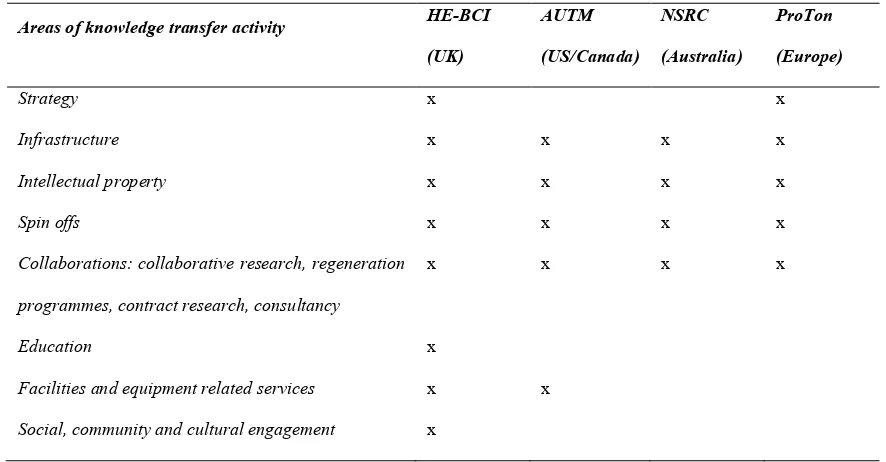
Table 2 summarises the general areas of knowledge transfer engagement included
in each of these four surveys. The HE-BCI survey is the most comprehensive in
terms of areas considered, although not all of them are investigated with a similar
level of detail, as it will be clear from our subsequent analysis. The AUTM and
NSRC surveys focus very strongly on spinoffs and intellectual property (and to
some extent research collaborations, contracts and consultancies) and neglect
most of the other areas (the AUTM includes a question on clinical trial services
which we consider part of ‘facilities and equipment related services’ activity; it is
however very marginal in this survey). The ProTon survey also focuses mainly on
spinoffs, intellectual property, research collaborations, contracts and consultancies,
and includes some background information about institutional strategies and
[image:18.595.95.538.472.703.2]infrastructures.
Table 14.2: General areas of knowledge transfer activity investigated in the four surveys
Areas of knowledge transfer activity HE-BCI (UK)
AUTM
(US/Canada)
NSRC
(Australia)
ProTon
(Europe)
Strategy x x
Infrastructure x x x x
Intellectual property x x x x
Spin offs x x x x
Collaborations: collaborative research, regeneration
programmes, contract research, consultancy
x x x x
Education x
Facilities and equipment related services x x
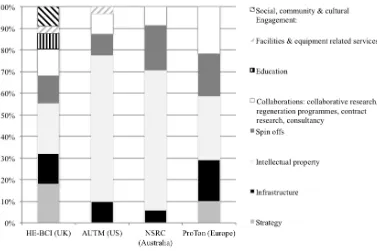
The next figure shows the shares of questions concerning each area of knowledge
transfer activity included in each survey. Questions related to intellectual property
(and to a lesser extent, spinoff companies) are prevalent in both the AUTM and
NSRC surveys, while the HE-BCI and ProTon survey present a more balanced
focus on the different areas, with the HE-BCI being more comprehensive in terms
of coverage. Even in the HE-BCI and ProTon surveys, however, intellectual
property and spinoffs are relatively more intensely investigated than the other
[image:19.595.108.485.339.590.2]activities.
Figure 14.2: Shares of questions relating to each knowledge transfer area
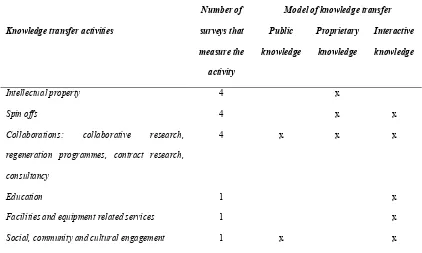
The next two tables compare the four surveys in terms of the models of
knowledge transfer represented, and of the types of indicators used. We do not
consider questions relating to the institutions’ strategies and their infrastructures
for knowledge transfer, since these do not relate to specific activities but rather
Instead, we focus on the questions concerning the specific knowledge transfer
activities that universities perform. In Table 4, we have mapped each activity
included in the surveys onto the three possible models of knowledge transfer,
described in section 2: the public model, where knowledge is transferred via open
dissemination, the proprietary model where knowledge is transferred via trade of
intellectual property rights and the interactive model, where knowledge is
transferred via direct interactions. As illustrated in Figure 1, intellectual
property-related activities reflect the proprietary model; social, community and cultural
engagement activities and regeneration programmes mainly follow the public
model (public financing with open dissemination); the transfer of knowledge via
education channels (mostly student placements and CPD), and the provision of
facilities and equipment-related services follow the interactive model. The other
activities combine different models, for example spinoffs combine the
exploitation of intellectual property with the setup of stable interactions around its
commercialization; collaborations involve the setup of qualified interactions, but
sometimes also open dissemination combined with public funding (in the case of
collaborative research) or the creation and transfer of intellectual property
(contract research, consultancies).
All four surveys focus on the knowledge-transfer activities that follow the
proprietary model. The activities that mainly reflect the interactive model,
whether on its own (education-related activities, facilities and equipment-related
services) or in combination with the public knowledge model (regeneration
survey. Collaborations with external stakeholders are present in all four surveys,
but if we break them into specific types (collaborative research, regeneration
programmes, and contract research and consultancy) we find that only one survey,
the HE-BCI, includes all three; the ProTon has some questions on contract
research and consultancy while the other two only ask for some general
[image:21.595.98.520.286.539.2]information about research expenditure.
Table 14.3: Knowledge transfer activities included in the four surveys, by model of knowledge transfer
Number of
surveys that
measure the
activity
Model of knowledge transfer
Knowledge transfer activities Public
knowledge
Proprietary
knowledge
Interactive
knowledge
Intellectual property 4 x
Spin offs 4 x x
Collaborations: collaborative research,
regeneration programmes, contract research,
consultancy
4 x x x
Education 1 x
Facilities and equipment related services 1 x
Social, community and cultural engagement 1 x x
Since most activities combine elements of two or more knowledge transfer
models, and most of them are at least partly inspired by the interactive view of
knowledge, we would expect the surveys to include a mixture of output-oriented
and process-oriented indicators, in order to capture both the outputs transferred as
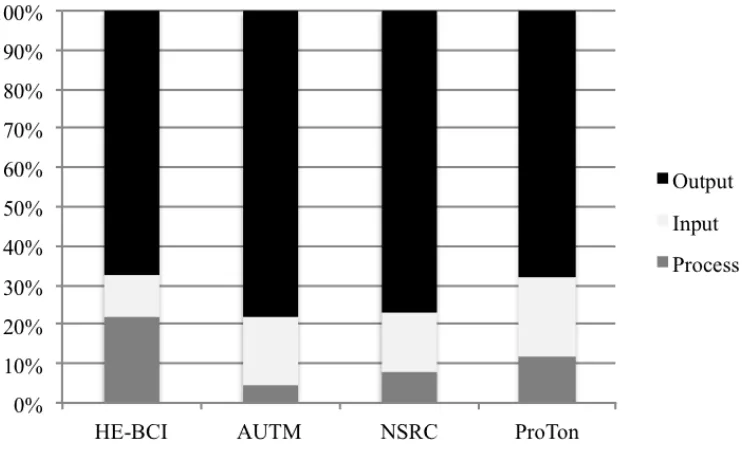
Instead, as shown in the following figures 3 and 4, the majority of indicators
capture only the outputs of the knowledge transfer process, whether in the form of
knowledge produced (number of disclosures, patents applied and granted, events
organized), of income received from the exchange of knowledge, of impact made
upon the business environment (number of licenses executed, number of
technologies commercialised, number of companies created, employment in
companies, etc.). Some indicators capture the cost of the knowledge transfer
activity to the university (patent fees, academic staff days invested, etc.) or the
inputs in the knowledge transfer process (research personnel, research
expenditure). Very few indicators aim to capture some features of the process of
knowledge transfer itself; the only information in this sense concerns the number
of interactions (in very general terms: number of contracts activated, number of
training days delivered) and the identity (SMEs versus other commercial and non
commercial organizations, for example) and location (regional versus
non-regional) of some of the knowledge transfer partners, as well as some more
specific information about the features of the activity performed.
Figure 14.4: Shares of process-oriented indicators vs shares of questions about knowledge transfer activities involving interactions
General patterns
Several patterns emerge from our mapping of the knowledge transfer activities
and the indicators considered in each survey. No survey is fully comprehensive in
[image:23.595.111.482.81.312.2]intellectual property rights is attributed high importance in all surveys, as clearly
shown in Figure 2, particularly in the AUTM and NSRC surveys. This is despite
evidence that shows that only few universities use this model with appreciable
intensity and success (Litan et al. 2008), as it suitable to a limited number of
scientific fields (Harabi 1995; Brouwer/ Kleinknecht 1999). Moreover, the
indicators are strongly biased towards patents and software licenses, further
skewing the outcomes in favour of a few fields that produce patentable outputs, or
software. Little attention is paid to other types of intellectual property rights
(design rights, trademarks), to intellectual assets protected by open source or
creative common licenses (such as open source software, blogs, wikis, open
source film, open source media, open source pharmaceuticals, etc.) and to
inventions (for example materials and artefacts) not protected by intellectual
property rights (Andersen et al. 2012; Baghurst/ Pollard 2009). Hence, institutions
that are relatively more focused on disciplines, such as the arts and humanities,
that are unlikely to generate patents but may generate other forms of intellectual
assets, may be unable to correctly represent the amount of intellectual property
they produce and transfer.
The public knowledge model is mostly overlooked, especially in the AUTM,
NSRC and ProTon surveys, where the only examples of activities that fall within
this model are publicly-funded collaborative research projects (usually grouped
with other types of research activities under the heading ‘research expenditure’).
In the HE-BCI survey, a few more activities are considered: regeneration
programmes as well as knowledge-dissemination activities in the humanities and
cent of the overall questions and their impact is mostly measured on the basis of
the funding they attract, neglecting other potential outputs7. This approach may
reflect a concern with keeping a clear distinction between outputs that result from
research activities (such as publications) and outputs from knowledge transfer
activities, where in practice such distinction is not so easy to make (for example,
collaborative and contract research activities and regeneration programmes often
have both research and knowledge transfer components). Finding ways to
measure the universities’ engagement in the open dissemination of scientific
outputs resulting from publicly-funded research, and to identify their impact more
accurately, would be important in order to more precisely assess the outcomes of
universities’ knowledge transfer engagement. Indeed, empirical evidence shows
that ‘open science’ channels are firms’ preferred way to access academic
knowledge (Arundel/ Geuna 2004; Mowery/ Sampat 2005; D’Este/ Patel 2007;
Abreu et al. 2008; Bruneel et al. 2009).
In most surveys, very little attention is paid to interactions with different type of
external partners (businesses, private non commercial organizations, public
organizations, specific communities and even individuals). In the AUTM, NSRC
and ProTon surveys, the only interactions considered involve university spinoffs
and start-ups and different types of research contracts; in most cases the indicators
only quantify the number of companies established and the number of agreements
and contracts signed. The HE-BCI is the only survey that attempts to measure
numerous types of interactions. Nonetheless, several important direct interactions
between university and industry personnel are not included, such as recruitment of
industry conferences and workshops, placements of entrepreneurs and industry
personnel in universities, visiting scholarships, and more. Company surveys have
shown that firms consider these interactions as important channels in order to
benefit from academic knowledge (Dutrénit et al. 2010; Hughes et al. 2011;
Boardman/ Ponomariov 2009; Jensen et al. 2010; Bekkers/ Bodas Freitas 2008),
particularly for applied disciplines such as architecture, design, engineering,
medicine. Furthermore, interactions around production and service activities, such
as prototyping, clinical trials, testing and design services, would fall within the
very generic area of ‘Facilities and equipment related services’ where they would
be grouped with standardized, non-knowledge producing services like room and
equipment rental activities. The minor importance attributed to these activities (if
they are considered at all) suggests that the view of knowledge as codified
information, easily transferred through economic transactions, is still prevalent,
leading policymakers to overlook many activities where the transfer of knowledge
occurs in the context of complex, often long term interactions which may not even
involve a monetary exchange.
Similarly, the view of knowledge as information shapes the choice of indicators,
since all surveys are strongly biased towards output-oriented measures.
Knowledge transfer is seen as a linear transmission of information from the
university to its external partners, rather than an interactive process that can
generate short and long term benefits for both parties and whose outcomes depend
on the quality of the interactions themselves. The characteristics and quality of the
interactions through which knowledge transfer takes place are not considered.
transfer from the universities, and no attempts are made to explore the (often
non-monetary) benefits that universities derive from these activities.
Conclusions
Performance measurement exercises adopt a narrow view of what constitutes
knowledge transfer, and consequently focus on a limited range of activities and
impacts. We have illustrated this with reference to four surveys implemented in
different international contexts (the UK, the US and Canada, Australia and
Europe). In all these surveys, the choice of areas of knowledge transfer to be
measured: (i) is strongly inspired by the proprietary model of knowledge transfer
based on intellectual property rights, in particular emphasizing patents and
software licenses; (ii) it only marginally includes activities based on the public
model of knowledge transfer (only in relation to the funding attracted to the
university and not to the knowledge outputs generated and openly disseminarted);
(iii) it is partly inspired by the interactive model but not inclusive of all possible
interactions. Even in the most comprehensive survey (the UK’s HE-BCI) not all
possible types of knowledge transfer activity are included, and not all of activities
are considered with a similar level of detail.
This rather narrow focus implies that some universities may be at an advantage
and others at a disadvantage in representing their knowledge transfer activities,
depending on their knowledge transfer strategies. Moreover, universities may be
incentivized to focus more on the activities that are measured more accurately,
even if this may not be particularly effective for some institutions. Performance
possibly use different sets of indicators for different groups of institutions, rather
than apply the same model of knowledge transfer indifferently to all of them. An
alternative approach could be to develop a very broad range of indicators taking
into account all possible activities, and let universities themselves choose the
profile of knowledge transfer engagement that suits them best (adopting a flexible
approach to measurement as suggested, in the more general case of innovation
policy indicators, by Rafols et al. 2012).
The chapter has also argued that output oriented indicators alone are inadequate to
capture the impact of universities’ knowledge transfer activities. In particular, the
impact of knowledge transfer is not fully captured through monetary measures.
Further research should strive to identify indicators that are better able to capture
procedural aspects of knowledge transfer rather than just narrowly defined outputs,
and that better reflect the multi-directional nature of ‘knowledge exchange’
processes involving multiple stakeholders rather than unidirectional transfer of
knowledge from university to industry8. A range of outcome indicators capturing
a variety of bidirectional impacts are already deployed in practice, for example by
universities attempting to measure their economic and social impacts; these could
provide a basis to develop indicators to be adopted more systematically.
We can also derive some implications for the more general issue of identifying
appropriate indicators in order to evaluate the impact and success of policies in
support of knowledge production and transfer activities. First, different theories of
what is knowledge, how it is produced and how it is transferred carry different
success. Hence, the choice of indicators needs to be in harmony with the nature of
the knowledge whose production and transfer is being monitored. When a wide
range of knowledge production and transfer activities are considered the range of
indicators should be broad enough to accurately capture performance in the
production and transfer of different types of knowledge. Second, not only
indicators should be sufficiently comprehensive, but care should be taken in order
to avoid problems of lack of comparability across organizations and of creation of
perverse behavioural incentives. Third, countries considering the implementation
of performance measurement systems need to be cautious when emulating
existing data collection exercises. As this chapter has shown, current exercises
suffer from numerous limitations in the scope and types of indicators used.
Moreover, each national system is characterized by specific socio-cultural
arrangements, organizational structures, funding structures, relationships between
universities and industry that should be taken into account when designing
appropriate systems of performance measurement and assessment.
Note
1 ‘…Knowledge transfer is about transferring good ideas, research results and skills between
universities, other research organisations, business and the wider community to enable innovative
2 See European Commission (2009) for a comprehensive international list of current university
knowledge transfer data collections.
3 Whether these markets are efficient and work well, however, is a debated issue: evidence
suggests that markets for intellectual property rights suffer from numerous inefficiencies
(Andersen/ Rossi 2012; Andersen et al. 2012).
4 Since the search for new solutions is strongly driven by the knowledge that individuals and
organizations already possess, the existing knowledge base is both a driver and a constraint to the
development of new knowledge; Lundvall, 1988; Nelson andand Winter, 1982).
5 Thursby et al. (2001), in a survey of 62 US universities, found that 71 per Cent of the inventions
licensed from the university to firms required interactions with the inventor in order to be
subsequently commercialized.
6 In particular, the assumption that the value of knowledge to those that receive it can be accurately
captured by the income that the university accrues from it is debatable: more prestigious
institutions may be able to charge more for their services because of reputation, and not because of
the value of the knowledge is greater; certain forms of knowledge may be transferred for free or at
a very low price with the objective to achieve greater diffusion or because they are aimed at people
who cannot pay for them, but their value can be high from a social viewpoint; some forms of
knowledge may not attract a lot of funding because of their high uncertainty and potential large
externalities (Nelson 1959), but they may turn out to have important impacts in the long run.
7 For example, collaborative research can produce joint university-industry publications, support
joint workshops and other openly disseminated outputs, and regeneration programmes can have
many valuable impacts on the community.
8 For example, some questions could focus on the interactions’ duration, the number of partner
they learned from the interactions and the short and long term benefits they received, the long term
effects in terms of further interactions generated and of involvement of additional beneficiaries.
References
Abreu, M., Grinevich, V., Hughes, A., Kitson, M. and Ternouth, P., 2008:
Universities, Business and Knowledge Exchange. Council for Industry and
Higher Education and Centre for Business Research, London and
Cambridge.
Andersen, B., 2004: If “Intellectual Property Rights” is the Answer, What is the
Question? Revisiting the Patent Controversies. Economics of Innovation
and New Technology 13(5), pp. 417-442.
Andersen, B., Rosli, A., Rossi, F. and Yangsap, W., 2012: Intellectual Property
(IP) Governance in ICT Firms: Strategic Value Seeking through Proprietary
and Non-Proprietary IP Transactions. Int. J. Intellectual Property
Management 5(1).
Andersen, B. and Rossi, F., 2012: Inefficiencies in Markets for Intellectual
Property Rights: Experiences of Academic and Public Research Institutions.
Prometheus 30(1), pp. 5-27.
Antonelli, C., 2008: The new economics of the university: A knowledge
Arrow, K., 1962: Economic Welfare and the Allocation of resources for invention.
In: Richard Nelson (Ed.): The Rate and Direction of Inventive Activity.
Princeton, NJ: Princeton University Press, pp. 609-25.
Arundel, A. and Geuna, A., 2004: Proximity and the use of Public Science by
Innovative European Firms. Economics of Innovation and New Technology.
13(6), pp. 559-580. AUTM (2011), AUTM US Licensing Activity Survey
Highlights. Available at:
http://www.autm.net/AM-/Template.cfm?Section=FY_2011_Licensing_Activity_SurveyandTemplate
=/CM/ContentDisplay.cfmandContentID=8731 [Accessed: 13 June 2013].
Baghurst, D. and Pollard, T., 2009: A Literature Review on the Efficiency and
Effectiveness of University Intellectual Property (IP) Models for the
Generation, Identification and Exploitation of “Soft” (Patent and
Non-Trademark) IP. SABIP Report.
Bekkers, R. and Bodas Freitas, I., 2008: Analysing Preferences for Knowledge
Transfer Channels between Universities and Industry: To what Degree do
Sectors also Matter? Research Policy 37, pp. 1837-53.
Boardman, P.G. and Ponomariov, B.L., 2009: University Researchers Working
with Private Companies. Technovation 29, pp. 142-153.
Brouwer, E. and Kleinknecht, A., 1999: Innovative Output, and a Firm’s
Propensity to Patent. An Exploration of CIS Micro Data. Research Policy
28, pp. 615-24.
Bruneel, J., D’Este, P., Neely, A. and Salter, A., 2009: The Search for Talent and
Cohen, W., Nelson, R.R. and Walsh, J., 2000: Protecting Their Intellectual
Assets: Appropriability Conditions and Why U.S. Manufacturing Firms
Patent (or Not).
Cohen, W.M., Nelson, R.R. and Walsh, J.P., 2002: Links and Impacts: The
Influence of Public Research on Industrial R&D. Management Science
48(1), pp. 1-23.
Cowan, R., David, P.A. and Foray, D., 2000: The Explicit Economics of
Knowledge Codification and Tacitness. Industrial and Corporate Change
9(2), pp. 211-253.
Cowan, R. and Van der Paal, G., 2000: Innovation Policy in a Knowledge-based
Economy, Publication EUR 17023 of the Commission of the European
Communities. Luxembourg.
Dasgupta, P. and David, P.A., 1994: Toward a new economics of science,
Research Policy 23(5), pp. 487-521.
Davis, K.E., Kingsbury, B. and Merry, S.E., 2010: Indicators as a Technology of
Global Governance. [Online]. 2010. Available from: SSRN.
http://ssrn.com/paper=1583431.
Dosi, G., Llerena, P. and Labini, M., 2006: The relationships between science,
technologies and their industrial exploitation: An illustration through the
myths and realities of the so-called ‘European Paradox. Research Policy
Dutrénit, G., De Fuentes, C. and Torres, A., 2010: Channels of interaction
between public research organisations and industry and their benefits:
evidence from Mexico. Science and Public Policy 37(7), pp. 513-526.
D’Este, P. and Patel, P., 2007: University-industry linkages in the UK: what are
the factors underlying the variety of interactions with industry? Research
Policy 36(9), pp. 1295-1313.
Etzkowitz, H. and Leydesdorff, L., 2000: The dynamics of Innovation:From
National Systems and "Mode 2" to a Triple Helix of
University-Industry-Government relations, Research Policy 29, pp. 1098-123.
European Commission-DG Research, 2009: Metrics for Knowledge Transfer from
Public Research Organisations in Europe, DG Research, Brussels.
Department for Trade and Industry, 2006: Knowledge transfer from the research
base, DTI, UK.
Di Gregorio, D. and Shane, S., 2003: Why do some universities generate more
start-ups than others? Research Policy 32(2), pp. 209-227.
Harabi, N., 1995: Appropriability of Technical Innovations: An Empirical
Analysis. Research Policy 24, pp. 981-992.
Haskel, J and Wallis, G, 2013: Public Support for Innovation, Intangible
investment and Productivity Growth in the UK Market Sector, Economics
Holi, M. T., Wickramasinghe, R. and Leeuwen, M. van, 2008: Metrics for the
Evaluation of Knowledge TransferActivities at Universities. Cambridge:
Library House.
Hughes, T., Bence, D., Grisoni, L., O’Regan, N. and Wornham, D., 2011:
Scholarship that matters: academic/practitioner engagement in business and
management. Management Learning 10(1), pp. 40-57.
Jensen, P.H., Palangkaraya, A. and Webster, E., 2009: A Guide to Metrics on
Knowledge Transfer from Universities to Businesses and Industry in
Australia.
Jensen, R., Thursby, J. and Thursby, M.C., 2010: University-Industry Spillovers,
Government Funding, and Industrial Consulting. NBER Working Papers
15732, Cambridge. MA: National Bureau of Economic Research Inc.
Kitagawa, F and Lightowler, C, 2012: Knowledge Exchange: A comparison of
Policies, strategies, and funding incentives in English and Scottish Higher
Education,Research Evaluation, pp. 1-14.
Klein Woolthuis, R., Lankhuizen, M. and Gilsing, V., 2005: A system failure
framework for innovation policy design. Technovation 25(6), pp. 609-619.
Levin, R.C., Klevorick, A.K., Nelson, R.R. and Winter, S.G., 1987: Appropriating
the Returns from Industrial Research and Development. Brookings Papers
on Economic Activity 1987(3), pp. 783-831.
Litan, R.., Mitchell, L. and Reedy, E.J., 2008 Commercializing University
Inventions: Alternative Approaches. In: A. Jaffe, J. Lerner, and S. Stern
Lundvall, B.-Å., 1988: Innovation as an interactive process: from user-producer
interaction to the national system of innovation. In: Dosi, G. et al (Ed.).
Technical change and economic theory. London: Pinter Publishers, pp. 349–
369.
Mazzoleni, R. and Nelson, R.R., 1998: The Benefits and Costs of Strong Patent
Protection: A Contribution to the Current Debate. Research Policy 27(3), pp.
273-284.
Merry, S.E., 2011: Measuring the World: Indicators, Human Rights, and Global
Governance: With CA Comment by John M. Conley. Current Anthropology
52(3), pp. 83-95.
Molas Gallart, J and Castro-Martinez, E., 2007: Ambiguity and Conflict in the
development of 'Third Mission indicators, Research Evaluation 16(4), pp.
321-330.
Mowery, D. and Sampat, B., 2005: The Bayh-Dole Act of 1980 and
University-Industry Technology Transfer: A Model for other OECD Governments? The
Journal of Technology Transfer 30, pp. 115-127.
Nelson, R.R., 1959: The Simple Economics of Basic Scientific Research E.
Mansfield and E. Mansfield (Eds.). Journal of Political Economy 67(3), pp.
297-306.
Nelson, R.R. and Winter, S.G., 1982: An evolutionary theory of economic change.
NSRC, 2012: The National Survey of Research Commercialisation 2010-2011.
Available at:
http://www.innovation.gov.au/Innovation/ReportsandStudies-/Documents/2010-11NSRCReport.pdf [Accessed: 13 June 2013].
PACEC, 2010: Synergies and Trade-offs between Research, Teaching and
Knowledge Exchange, A Report to HEFCE by PACEC and the Centre for
Business Research, University of Cambridge.
Polanyi, M., 1966: The tacit dimension. New York: Doubleday.
Rafols, I., Ciarli, T., van Zwanenberg, P. and Stirling, A., 2012: Towards
Indicators for “Opening up” Science and Technology Policy.
Romer, P, 1990: Human capital and growth: Theory and evidence,
Carnegie-Rochester Conference Series on Public Policy 32(1), pp. 251-286.
Ryle, G., 1949: The Concept of Mind. London: Hutchinson.
Sellenthin, M. O., 2006: Beyond the ivory tower: Do patent rights regimes impact
on patenting behaviour in Sweden and Germany, VEST Journal of Science
and Technology Studies 19(3-4), pp. 27-58.
Thursby, J., Jensen, R. and Thursby, M., 2001: Objectives, Characteristics and
Outcomes of University Licensing: A Survey of Major U.S. Universities,
Journal of Technology Transfer 26, pp. 59-72.
Wang, C.F. and Peng, Z., 2009: An empirical study on the relationship between
properties of knowledge, network topology and corporation innovation
Wright, M., Clarysse, B., Lockett, A. and Knockaert, M., 2008: Mid-range
universities’ linkages with industry: Knowledge types and the role of
intermediaries. Research Policy 37(8), pp. 1205-1223.
Dr Ainurul Rosli is a lecturer in Entrepreneurship, Creativity and Innovation at University of Wolverhampton, UK. She worked for several years with the R&D arm of a telecommunication company in Malaysia as well as a consultant for two London based firms. Her research interests focus on university-industry relationship, knowledge transfer strategies, innovation activities of firms and entrepreneurship.
Address: University of Wolverhampton Business School, University of Wolverhampton, MN Building, Nursery Street, Wolverhampton, WV1 1AD, UK E-mail: [email protected]
Dr Federica Rossi is lecturer at Birkbeck, University of London, UK. She has worked as a consultant for the OECD, the UK's Strategic Advisory Board for Intellectual Property, the EC/Eurostat and regional and local development agencies. Her research interests focus on the economics and management of intellectual property rights, innovation activities of firms and networks of firms, the economics and governance of the higher education sector, science and technology policy.