
N A N O E X P R E S S
Open Access
Pumped double quantum dot with
spin-orbit coupling
Denis Khomitsky
1, Eugene Sherman
2,3*Abstract
We study driven by an external electric field quantum orbital and spin dynamics of electron in a one-dimensional double quantum dot with spin-orbit coupling. Two types of external perturbation are considered: a periodic field at the Zeeman frequency and a single half-period pulse. Spin-orbit coupling leads to a nontrivial evolution in the spin and orbital channels and to a strongly spin- dependent probability density distribution. Both the interdot tunneling and the driven motion contribute into the spin evolution. These results can be important for the design of the spin manipulation schemes in semiconductor nanostructures.
PACS numbers: 73.63.Kv,72.25.Dc,72.25.Pn
Introduction
Quantum dots, being one of the most intensively stu-died examples of natural and artificial nanostructures, attract attention due to the richness in the properties they demonstrate in the static and dynamic regimes [1]. A possible realization of qubits for quantum information processing can be done by using spins of electrons in semiconductor quantum dots [2]. Spin- orbit coupling makes the dynamics even in the basic systems such as the single-electron quantum dots extremely rich both in the orbital and spin channels. If the frequency of the electric field driving the orbital motion matches the Zeeman resonance for electron spin in a magnetic field, the spin-orbit coupling causes a spin flip. This effect was proposed in refs. [3,4] to manipulate the spin states by electric means. The efficiency of this process is much greater than that of the conventional application of a periodic resonant magnetic field. The ability to cause coherently the spin flip in GaAs quantum dots was demonstrated in ref. [5] where the gate-produced elec-tric field induced the spin Rabi oscillations. In ref. [6] periodic electric field caused the spin dynamics by indu-cing electron oscillations in a coordinate-dependent magnetic field. In addition, these results confirmed that the spin dephasing in GaAs quantum dots, arising due
to the spin-orbit coupling [7,8] is not sufficiently severe to prohibit a coherent spin manipulation.
The spin dynamics experiments [5,6] necessarily use at least a double quantum dot to detect the driven spin state relative to the spin of the reference electron. Multi-ple quantum dots realizations become nowadays the sub-ject of extensive investigation [9]. In double quantum dots an interesting charge dynamics occurs and requires theoretical understanding. In this article we address full driven by an external electric field spin and charge quan-tum dynamics in a one-dimensional double quanquan-tum dot [10-13]. Despite the simplicity, these systems show a rich physics. In the wide quantum dots, where the tunneling is suppressed, and the motion is classical, the interdot transfer occurs only due to the over-the-barrier motion, and a chaos-like behavior is usually expected. The irregu-lar driven behavior in the spin and charge dynamics in these systems was studied in ref. [14]. In the quantum double quantum dots, the tunneling between single quantum dots is crucial and the spin-orbit coupling makes the interdot tunneling spin-dependent [15-17]. In quantum systems a finite set of energy eigenstates allows only for a strongly irregular rather than a real chaotic behavior. These orbital and spin dynamical irregularities are important for the understanding of the quantum pro-cesses in multiple quantum dots.
In this article we consider various regimes for a one-dimensional double quantum dot with spin-orbit cou-pling driven by an external electric field and analyze the probability and spin density dynamics in these systems. * Correspondence: [email protected]
2
Department of Physical Chemistry, Universidad del País Vasco, 48080 Bilbao, Spain.
Full list of author information is available at the end of the article
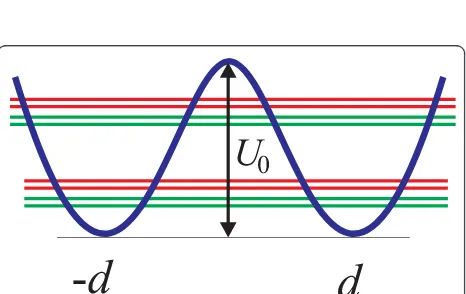
Hamiltonian, time evolution, and observables We use a quartic potential model to describe a one-dimensional double quantum dot [18],
U(x) =U0(−2(xd)2+ (xd)4), (1) where the minima located at dand -dare separated by a barrier of height U0, as shown in Figure 1. We
assume that the interminima tunneling is sufficiently weak such that the ground state can be described with a high accuracy as even linear combination of the oscilla-tor states with a certain “harmonic” frequency ω0
located near the minima. The double quantum dot is located in a static magnetic fieldBzalong thez-axis and
is driven by an external electric fieldℰ(t) parallel to the x-axis. The full Hamiltonian H=H0+Hso+V˜, where
the time-independent parts are given by
H0= p
2 x
2m +U(x)−
z
2 σz, (2)
Hso= (βσx+ασy)px, (3)
and the time-dependent perturbation is
˜
V=−eE(t)x. (4)
Herepx is the momentum operator,mis the electron
effective mass,eis the electron charge,Δz= |g|μBBz(we
assume belowg< 0) is the Zeeman splitting, andsiare
the Pauli matrices. The electron Landé factor g deter-mines the effect ofBz, which in this geometry is reduced
to the Zeeman spin splitting only. The bulk-originated Dresselhaus (b) and structure-related Rashba (a) para-meters determine the strength of spin-orbit coupling and make the electron velocity defined as
v≡ ˙x= i
¯
h[H0+Hso,x] =px
m+βσx+ασy, (5)
spin-dependent.
We use the highly numerically accurate approach to describe the dynamics with the sum of Hamiltonians in Equations (2)-(4). As the first step we diagonalize exactly the time-independentH0 +Hso in the truncated
spinor basis ψn(x) |s〉 of the eigenstates of the quartic
potential in magnetic field without spin-orbit coupling with corresponding eigenvalues Ens. As a result, we
obtain the basis set |ψn〉 where boldnincorporates the spin index. For the presentation, it is convenient to introduce the four-states subset: |ψ1〉=ψ1(x)|↑〉, |ψ2〉=
ψ1(x)|↓〉, |ψ3〉 =ψ2(x)|↑〉, |ψ4〉= ψ2(x)|↓〉, and to note
that the spin-dependent bold index may not correspond to the state energy due to the Zeeman term in the Hamiltonian. The wavefunction ψ1(x) (ψ2(x)) is even
(odd) with respect to the inversion ofx. In the case of weak tunneling, assumed here, these functions can be presented in the form: ψ1,2(x) = (ψL(x)±ψR(x))/
√
2, where ψL(x) andψR(x) are localized in the left and in
the right dot, respectively.
As the second step we build in the full basis the
matrix of time-dependent V˜ and study the full
dynamics with the wavefunctions:
|= n
ξn(t)e−iEnt/h¯|ψn.
(6)
The expansion coefficientsξn(t) are then calculated as:
d
dtξn(t) =i e ¯ hE(t)
ξm(t)xnme−i(Em−En)t/h¯, (7)
Where xnm≡ ψn|ˆx|ψm. The spin-dependence of the matrix element of coordinate responsible for the spin dynamics is determined with
i(En−Em)xnm=h¯ψn|ˆv|ψm (8)
and the spin-dependent velocity in Equation (5). With the knowledge of the time-dependent wavefunc-tions (6) one can calculate the evolution of probability r(x,t) and spinSi(x,t)-density
ρ(x,t) =†(x,t)(x,t), (9)
Si(x,t) =†(x,t)σi(x,t). (10)
Since we are interested in the interdot transitions, with these distributions we find the gross quantities, e. g., for the right quantum dot:
ωR(t) =
∞
0
ρ(x,t)dx, (11)
σi R(t) =
∞
0
[image:2.595.58.291.543.690.2]Si(x,t)dx, (12)
where ωR(t) is the probability to find electron and
σi
R(t) is the analog of expectation value of the spin
component.
Calculations and results
As the electron wavefunction at t = 0 we take linear combinations of two out of four low-energy states. The
initial state in the form (ψ1(x)±ψ2(x))| ↑
√
2 is
localized in the left quantum dot, corresponding to the
parameters ξ1(0) =ξ3(0)1
√
2.
Two types of electric field were considered as the external perturbation. The first one is the exactly peri-odic perturbation for allt> 0:
E(t) =E0sin (2πt/Tz(Bz)), (13)
Where Tz(Bz) = 2πħ/Δz is the Zeeman period. The
second type is a half-period pulse, same as in Equation (13), but acting at the time interval 0 <t<Tz(Bz)/2 only.
The spectral width of the pulse covers both the spin and the tunneling splitting of the ground state, thus, driving the spin and orbital dynamics simultaneously. Since Tz(Bz)ω ≫1, that is the corresponding frequen-cies are much less than those for the transitions between the orbital levels corresponding to a single dot, the higher-energy states follow the perturbation adiaba-tically. The field strength ℰ0 is characterized by
para-meter f such that |e|ℰ0 ≡ f × U0/2d. Here we
concentrate on the regime of a relatively weak coupling (f=≫1).
Where the shape of the quartic potential remains almost intact in time, and the interdot tunneling is still crucially important. For the magnetic field we consider two different regimesΔz=ΔEg/2 andΔz= 2ΔEgto
illus-trate the role of the Zeeman field for the entire dynamics.
We consider a nanostructure with d= 25√2 nm and U0 = 10 meV. The four lowest spin-degenerate energy
levels are E1 = 3.938 meV, E2 = 4.030 meV, E3 =
9.782 meV,E4= 11.590 meV counted from the bottom
of a single quantum dot with the tunneling splittingΔEg
=E2 -E1= 0.092meV, and the corresponding timescale
2πħ/ΔEg= 45ps. The spin-orbit coupling is described by
parameters a = 1.0 · 10-9 eVcm and b = 0.3 · 10-9
eVcm. The field parameter f= 0.125, corresponding to ℰ0 = 177 V/cm. We use the truncated basis of 20 states
with the energies up to 42 meV.
We begin with the exactly periodic driving force, as illustrated in Figure 2 where |ξn|2 for three states are presented. Since the motion is periodic, here we use the Floquet method [13,19,20] based on the exact calcula-tion at the first period and then transformed into the
integer number of periods. Figure 2 demonstrates the interplay between the tunneling and the spin-flip pro-cess. The results indicate that the exact matching of the driving frequency with the Zeeman splitting generates the spin flip which is clearly visible as the initial spin-up (ξ1and ξ3) components are decreasing to zero and, at the same time, the opposite spin-down components (ξ2 and ξ4) reach their maxima (not shown in the upper panel). The spin-flip time is approximately 350Tz(Bz)
(or 31 ns) for the weak magnetic field (upper panel) and 24Tz(Bz) (or 528 ps) for the strong field (lower panel).
Such an increase in the Rabi frequency with increasing magnetic field is consistent with previous theoretical [3,4] and experimental results [5].
0
20
40
60
80
100
time [ps]
-0.2
0
0.2
0.4
0.6
0.8
1
expectat
ion va
lues
0
20
40
60
80
100
time [ps]
-0.2
0
0.2
0.4
0.6
0.8
1
expectat
ion va
lues
B
z= 1.73 T
B
z= 6.93 T
σ
xσ
xσ
y [image:3.595.306.540.88.461.2]σ
yFigure 2 Motion driven by the exactly periodic field. Upper panel:Bz= 1.73T,Δz=ΔEg/2 andTz(Bz) = 90 ps; lower panel:Bz=
6.92T,Δz= 2ΔEg, andTz(Bz) = 22 ps. The states forξn(t) are marked
near the plots. The upper panel demonstrates a relatively slow dynamics on the top of the fast oscillations. The increase in theξ2(t)
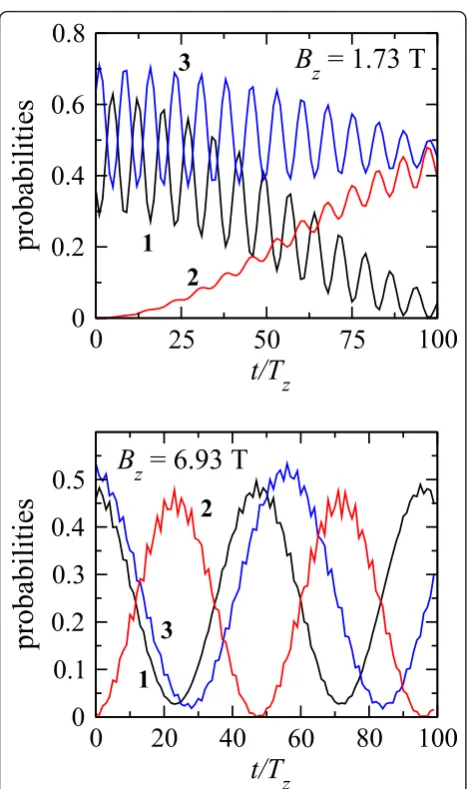
As the second example we consider the probabilities
ωR(t) and σ
i
R(t) for the pulse-driven motion, presented
in Figure 3. As one can see in the figure, the initial stage is the preparation for the tunneling, which devel-ops only after the pulse is finished. Electric field of the pulse induces the higher-frequency motion by involving higher-energy states, as can be seen in the oscillations at t≤ Tz(Bz)/2, however, prohibits the tunneling. Such a
behavior of the probability and spin density can be explained by taking into account the detailed structure of matrix elements xnm. Namely, due to the symmetry of the eigenfunctions in a symmetric double QW the largest amplitude can be found for the matrix element
of xˆ-operator for the pairs of states with opposite space parity having the same dominating spin projection. Hence, the dynamics involving all four lowest levels first of all triggers the transitions inside these pairs which do not involve the spin flip and only after this the spin-flip processes can become significant. As a result, Figure 3 shows that the spin flip has only partial character while the free tunneling dominates as soon as the pulse is switched off. A detailed description of other processes of nonresonant driven dynamics in the case of a half-period perturbation can be found in ref. [21].
Conclusions
We have studied the full driven quantum spin and charge dynamics of single electron confined in one-dimensional double quantum dot with spin-orbit cou-pling. Equations of motion have been solved in a finite basis set numerically exactly for a pulsed field and by the Floquet technique for the periodic fields. We explored here the regime of relatively weak coupling to the external field, where a nontrivial dynamics already occurs. Our results are important for the understanding of the effects of spin-orbit coupling for nanostructures as we have demonstrated a possibility to achieve a con-trollable spin flip at various time scales and in various regimes by the electrical means only.
Acknowledgements
D.V.K. is supported by the RNP Program of Ministry of Education and Science RF (Grants No. 2.1.1.2686, 2.1.1.3778, 2.2.2.2/4297, 2.1.1/2833), by the RFBR (Grant No. 09-02-1241-a), by the USCRDF (Grant No. BP4M01), by
“Researchers and Teachers of Russia”FZP Program NK-589P, and by the President of RF Grant No. MK-1652.2009.2. E.Y.S. is supported by the University of Basque Country UPV/EHU grant GIU07/40, Basque Country Government grant IT-472-10, and MCI of Spain grant FIS2009-12773-C02-01. The authors are grateful to L.V. Gulyaev for assistance.
Author details
1Department of Physics, University of Nizhny Novgorod, 23 Gagarin Avenue,
603950 Nizhny Novgorod, Russian Federation.2Department of Physical Chemistry, Universidad del País Vasco, 48080 Bilbao, Spain.3IKERBASQUE
Basque Foundation for Science, 48011, Bilbao, Spain.
Authors’contributions
DV and ES contributed equally in the development of the model, calculations, interpretation of the results, and preparation of the manuscript. All authors read and approved the final manuscript.
Competing interests
The authors declare that they have no competing interests.
Received: 13 August 2010 Accepted: 11 March 2011 Published: 11 March 2011
References
1. Kohler S, Lehmann J, Hänggi P:Driven quantum transport on the nanoscale.Phys Rep2005,406:379.
2. Burkard G, Loss D, DiVincenzo DP:Coupled quantum dots as quantum gates.Phys Rev B1999,59:2070.
3. Rashba EI, Efros AlL:Orbital mechanisms of electron-spin manipulation by an electric field.Phys Rev Lett2003,91:126405.
0
25
50
75
100
t/T
z0
0.2
0.4
0.6
0.8
probabilities
0
20
40
60
80
100
t/T
z0
0.1
0.2
0.3
0.4
0.5
probabilities
B
z= 1.73 T
B
z= 6.93 T
1
3
2
1
2
[image:4.595.57.291.84.479.2]3
Figure 3Motion driven by the single-pulse field. Upper panel: Bz= 1.73T,Δz=ΔEg/2, andTz(Bz) = 90 ps; lower panel:Bz= 6.92T, Δz= 2ΔEg, andTz(Bz) = 22 ps Black line is the probability to find the
4. Rashba EI, Efros AlL:Efficient electron spin manipulation in a quantum well by an in-plane electric field.Appl Phys Lett2003,83:5295. 5. Nowack KC, Koppens FHL, Nazarov YuV, Vandersypen LMK:Coherent
control of a single electron spin with electric fields.Science2007, 318:1430.
6. Pioro-Ladriere M, Obata T, Tokura Y, Shin Y-S, Kubo T, Yoshida K, Taniyama T, Tarucha S:Electrically driven single-electron spin resonance in a slanting Zeeman field.Nat Phys2008,4:776.
7. Semenov YG, Kim KW:Phonon-mediated electron-spin phase diffusion in a quantum dot.Phys Rev Lett2004,92:026601.
8. Stano P, Fabian J:Theory of phonon-induced spin relaxation in laterally coupled quantum dots.Phys Rev Lett2006,96:186602.
9. Busl M, Sanchez R, Platero G:Control of spin blockade by ac magnetic fields in triple quantum dots.Phys Rev B2010,81:121306.
10. Sánchez D, Serra L:Fano-Rashba effect in a quantum wire.Phys Rev B 2006,74:153313.
11. Lü C, Zülicke U, Wu MW:Hole spin relaxation in p-type GaAs quantum wires investigated by numerically solving fully microscopic kinetic spin Bloch equations.Phys Rev B2008,78:165321.
12. Romano CL, Tamborenea PI, Ulloa SE:Spin relaxation rates in quasi-one-dimensional coupled quantum dots.Phys Rev B2006,74:155433. 13. Jiang JH, Wu MW:Spin relaxation in an InAs quantum dot in the
presence of terahertz driving fields.Phys Rev B2007,75:035307. 14. Khomitsky DV, Sherman EYa:Nonlinear spin-charge dynamics in a driven
double quantum dot.Phys Rev B2009,79:245321.
15. Lin WA, Ballentine LE:Quantum tunneling and chaos in a driven anharmonic oscillator.Phys Rev Lett1990,65:2927.
16. Tameshtit A, Sipe JE:Orbital instability and the loss of quantum coherence.Phys Rev E1995,51:1582.
17. Murgida GE, Wisniacki DA, Tamborenea PI:Landau Zener transitions in a semiconductor quantum dot.J Mod Opt2009,56:799.
18. Romano CL, Ulloa SE, Tamborenea PI:Level structure and spin-orbit effects in quasi-one-dimensional semiconductor nanostructures.Phys Rev B2005,71:035336.
19. Shirley JH:Solution of the Schrdinger equation with a Hamiltonian periodic in time.Phys Rev1965,138:B979.
20. Demikhovskii VYa, Izrailev FM, Malyshev FM:Manifestation of Arnold diffusion in quantum systems.Phys Rev Lett2002,88:154101. 21. Khomitsky DV, Sherman EYa:Pulse-pumped double quantum dot with
spin-orbit coupling.EPL2010,90:27010.
doi:10.1186/1556-276X-6-212
Cite this article as:Khomitsky and Sherman:Pumped double quantum dot with spin-orbit coupling.Nanoscale Research Letters20116:212.
Submit your manuscript to a
journal and benefi t from:
7Convenient online submission
7Rigorous peer review
7Immediate publication on acceptance
7Open access: articles freely available online 7High visibility within the fi eld
7Retaining the copyright to your article

![A second monoclinic polymorph of 2 (3,5 dimethyl 1H pyrazol 1 yl) 2 hydroxyimino N′ [1 (pyridin 2 yl)ethylidene]acetohydrazide](data:image/gif;base64,R0lGODlhAQABAIAAAP///wAAACH5BAEAAAAALAAAAAABAAEAAAICRAEAOw==)