http://dx.doi.org/10.4236/ajcm.2014.43022
Interaction of Two Pulsatory Waves of
the Korteweg-de Vries Equation in
a Zigzag Hyperbolic Structure
Victor A. MiroshnikovDepartment of Mathematics, College of Mount Saint Vincent, New York, USA
Email: [email protected]
Received 5 May 2014; revised 2 June 2014; accepted 8 June 2014
Copyright © 2014 by author and Scientific Research Publishing Inc.
This work is licensed under the Creative Commons Attribution International License (CC BY).
http://creativecommons.org/licenses/by/4.0/
Abstract
A new exact solution for nonlinear interaction of two pulsatory waves of the Korteweg-de Vries (KdV) equation is computed by decomposition in an invariant zigzag hyperbolic tangent (ZHT) structure. A computational algorithm is developed by experimental programming with lists of eq-uations and expressions. The structural solution is proved by theoretical programming with sym-bolic general terms. Convergence, tolerance, and summation of the ZHT structural approximation are discussed. When a reference level vanishes, the two-wave solution is reduced to the two-soli- ton solution of the KdV equation.
Keywords
KdV Equation, Two Pulsatory Waves, ZHT Structure, Experimental, Theoretical Computation
1. Introduction
Since the discovery of the N-soliton solution of the Korteweg-de Vries (KdV) equation by experimental compu-tation [1], various analytical methods, like the inverse scattering transform, the Bäcklund transform, generalized functions, etc. [2]-[5], were developed and implemented by theoretical computation [6]. Further developments of the theory of solitons comprise effects of vorticity [7]-[9] and viscosity [10], while computational methods evolved from asymptotic methods [11]-[13], to series approximations [14]-[16], and structural decompositions in invariant structures [17] [18]. In the current paper, an invariant zigzag hyperbolic-tangent (ZHT) structure is developed to treat nonlinear interaction of two pulsatory waves of the KdV equation. A zigzagging pattern is a ubiquitous phenomenon in fluid-dynamic, biological, and chemical systems [19]-[21].
expression is used to develop a computational algorithm in Maple™ and explore the convergence of the ZHT structural approximation. Theoretical computation with symbolic general terms is utilized in Section 3 to devel-op differentiation and multiplication formulas for the ZHT structure, show its invariance, and consider summa-tion, convergence and tolerance of the structural approximation. The two-wave solution is visualized and com-pared with the two-soliton solution in Section 4, which is followed by a summary of main results in Section 5.
2. Experiment on Interaction of Two Pulsatory Waves in the ZHT Structure
2.1. Formulation of an Experimental Problem in the ZHT Structure
Explore experimentally a structural solution of the canonical form of the KdV equation
3
3
6 0
t x x
φ φ φ φ
∂ + ∂ +∂ =
∂ ∂ ∂ (1) for nonlinear interaction of two pulsatory waves. Construct the structural solution in the ZHT structure of alge-braic order M =3, which is used to illustrate a computational algorithm,
( )
2 2 2(
3)
(
2 4)
2(
3 5)
30,0 2,0 1,1 3,1 2,2 4,2 3,3 5,3
2 ,
,
x t h p Z Z ta Z ta Z ta Tb Z ta Z ta Tb Z ta Z ta Tb
φ = + µ + + + + + + + (2)
where h is a reference level, Zm+2,m and Zm m, are structural coefficients, ta=tanh
( )
µ
X and( )
tanhTb=qtb=
ν
Y are structural functions, 1 62 U h
µ= − and 1 6
2 V h
ν = − are wave numbers such that 0≤ <ν µ, X = −x Ut−a and Y = − −x Vt b are propagation variables, U and V are celerities, a
and b are initial locations of first and second pulsatory waves, q ν
µ
= and p= 1−q2 are interaction and
complementary parameters such that 0≤ <q 1 and 0< ≤p 1, respectively. When p=1
(
q=0 ,)
Z0,0=1, and Z0,2 = −p2, the two-wave solution is reduced to a one-wave solution( )
(
)
(
)
(
)
2 2
2
, 2 1
1 1
6 sec 6 ,
2 2
x t h ta
h U h h U h x Ut a
φ = + µ −
= + − − − −
(3)
which becomes the one-soliton solution
( )
, sec 2 1(
)
2 2
x t U h U x Ut a
φ = − −
[3] for h=0. Consider an in-stance of (2) with h=1 8,U=3,V =1,q=1 3,p=2 2 3,
µ
=3 4, and ν =1 4. The ZHT structure then is( )
(
)
(
)
(
)
2 3
0,0 2,0 1,1 3,1
2 4 2 3 5 3
2,2 4,2 3,3 5,3
1 ,
8
.
x t Z Z ta Z ta Z ta Tb Z ta Z ta Tb Z ta Z ta Tb
φ = + + +
+ + +
+ +
(4)
2.2. Experimental Differentiation of the ZHT Structure
Primarily, symbolic computation of a spatial derivative of differential order N =1 of two-wave solution (4) yields the ZHT structure of algebraic order M+N=4
(
)
(
)
(
)
(
)
3 2 4
1,0 3,0 0,1 2,1 4,1
3 5 2
1,2 3,2 5,2
2 4 6 3 3 5 4
2,3 4,3 6,3 3,4 5,4 ,
A ta A ta A A ta A ta Tb x
A ta A ta A ta Tb
A ta A ta A ta Tb A ta A ta Tb
φ
∂ = + + + +
∂
+ + +
+ + + + +
(5)
with a general term ,
n n m
m
ta Tb
1,0 2,0 1,1 3,0 2,0 3,1
0,1 1,1 2,1 1,1 3,1 2,2
4,1 3,1 4,2 1,2 1,1 2,2
3,2 3,1 2,2 4,2 3,3 5,2 4,2 5,3
2,3 2,2 3,3
3 1 3 1
, ,
2 12 2 12
3 3 9 1
, ,
4 4 4 6
9 1 3 3
, ,
4 6 4 2
3 3 1 1
3 , 3 ,
4 2 4 4
3 9
,
2 4
A Z Z A Z Z
A Z A Z Z Z
A Z Z A Z Z
A Z Z Z Z A Z Z
A Z Z A
= + = − +
= = − + +
= − + = − +
= − − + + = − +
= − + 4,3 4,2 3,3 5,3
6,3 5,3 3,4 3,3 5,4 5,3
3 9 15
,
2 4 4
15 9 9
, , .
4 4 4
Z Z Z
A Z A Z A Z
= − − +
= − = − = −
(6)
Secondly, computation of a temporal derivative of differential order N =1 also returns the ZHT structure of algebraic order M+N=5
(
)
(
)
(
)
(
)
3 2 4
1,0 3,0 0,1 2,1 4,1
3 5 2
1,2 3,2 5,2
2 4 6 3
2,3 4,3 6,3
3 5 4
3,4 5,4
T ta T ta T T ta T ta Tb
t
T ta T ta T ta Tb
T ta T ta T ta Tb
T ta T ta Tb
φ
∂ = + + + +
∂
+ + +
+ + +
+ +
(7)
with a general term ,
m n m
n
T ta Tb and the following structural coefficients Tn m, :
1,0 2,0 1,1 3,0 2,0 3,1
0,1 1,1 2,1 1,1 3,1 2,2
4,1 3,1 4,2 1,2 1,1 2,2
3,2 3,1 2,2 4,2 3,3 5,2 4,2 5,3
2,3 2,2 3,3 4,
9 1 9 1
, ,
2 12 2 12
9 9 27 1
, ,
4 4 4 6
27 1 3 9
, ,
4 6 4 2
3 9 1 1
9 , 9 ,
4 2 4 4
3 27
,
2 4
T Z Z T Z Z
T Z T Z Z Z
T Z Z T Z Z
T Z Z Z Z T Z Z
T Z Z T
= − − = −
= − = − −
= − = −
= + − − = −
= − 3 4,2 3,3 5,3
6,3 5,3 3,4 3,3 5,4 5,3
3 27 45
,
2 4 4
45
,
4 .
9 9
,
4 4
Z Z Z
T Z T Z T Z
+ −
= =
=
=
(8)
Finally, a spatial derivative of order N=3 again produces the ZHT structure of order M +N =6
(
)
(
)
(
)
(
)
(
)
3
3 5 2 4 6
1,0 3,0 5,0 0,1 2,1 4,1 6,1
3
3 5 7
1,2 3,2 5,2 7,2
2 4 6 8 3
0,3 2,3 4,3 6,3 8,3
3 5 7 4
1,4 3,4 5,4 7,4
2 4 6 5
2,5 4,5 6,5
6
2
3,
B ta B ta B ta B B ta B ta B ta Tb
x
B ta B ta B ta B ta Tb
B B ta B ta B ta B ta Tb
B ta B ta B ta B ta Tb
B ta B ta B ta Tb
B
φ ∂
= + + + + + +
∂
+ + + +
+ + + + +
+ + + +
+ + +
+
(
3 5)
6 5,6 ta +B ta Tb(9)
with a general term ,
m n m
n
1,0 2,0 1,1 3,1 2,2
3,0 2,0 1,1 3,1 2,2 4,2 3,3
5,0 2,0 3,1 4,2 5,3
0,1 1,1 3,1 2,2
2,1 1,1 3,1 2,2 4
27 7 27 1
4 24 32 16
135 9 61 1 1 1
,
8 32 24 16 8 288
81 27 1 1
,
8 16 8 288
9 81 9
,
8 32 16
117 837 7 27
3 2
,
2 3 3 8
B Z Z Z Z
B Z Z Z Z Z Z
B Z Z Z Z
B Z Z Z
B Z Z Z Z
= − − + +
= + − − +
= − + − +
= −
− +
+
= −
+
+
,2 3,3
4,1 1,1 3,1 2,2 4,2 3,3 5,3
6,1 3,1 4,2 5,3 1,2 1,1 3,1 2,2 4,2 3,3
3,2 1,1 3,1 2,2 4,2
9 , 32
81 783 27 109 9 15
,
32 16 16 12 32 32
405 45 15 93 243 81 81
, 9 ,
16 8 32 32 32 8 32
81 741 153 549 253
32 32 8 8 32
Z
B Z Z Z Z Z Z
B Z Z Z B Z Z Z Z Z
B Z Z Z Z
+
= − + + − − +
= − + − = − − + +
= − + + − − 3,3 5,3
5,2 3,1 2,2 4,2 3,3 5,3
7,2 4,2 5,3 0,3 1,1 2,2 3,3
2,3 1,1 3,1 2,2 4,2 3,3 5,3
4,3
135 , 16
243 81 873 81 685
16 8 8 16 32
405 405 81 81 81
, ,
8 32 32 16 32
81 243 177 243 1053 405
,
32 32 8 8 32 16
243 32
,
Z Z
B Z Z Z Z Z
B Z Z B Z Z Z
B Z Z Z Z Z Z
B Z
+
= − − + + −
= − + = − +
= − + + − − +
= − 3,1 2,2 4,2 3,3 5,3
6,3 4,2 3,3 5,3 8,3 5,3
1,4 1,1 2,2 3,3 3,4 3,1 2,2 4,2 3,3 5,3
5,4 4
243 663 891 2295
16 8 16 16
405 405 6615 2835
, ,
8 16 32 32
81 243 729 81 243 243 1179 1215
,
32 16 32 32 16 8 16 16
243 8
,
,
Z Z Z Z
B Z Z Z B Z
B Z Z Z B Z Z Z Z Z
B Z
− + + −
= − − + = −
= − + − = − − + + −
= − ,2 3,3 5,3 7,4 5,3
2,5 2,2 3,3
4,5 4,2 3,3 5,3 6,5 5,3
3,6 3,3 5,6 5,3
729 3123 3645
,
16 16 32
81 729
,
8 16
81 729 1215 1215
,
8 16 16 16
405 405
, .
1
,
16 6
,
Z Z B Z
B Z Z
B Z Z Z B Z
B Z B Z
− + = −
= − +
= − − + = −
= − = −
(10)
2.3. Experimental Multiplication of the ZHT Structures
Symbolic computation of a product of two-wave solution (4) and first spatial derivative (5) once more produces the ZHT structure of algebraic order 2M+N=7
(
)
(
)
(
)
(
)
(
)
3 5 2 4 6
1,0 3,0 5,0 0,1 2,1 4,1 6,1
3 5 7 2 2 4 6 8 3
1,2 3,2 5,2 7,2 2,3 4,3 6,3 8,3
3 5 7 9 4 4 6 8 10 5
3,4 5,4 7,4 9,4 4,5 6,5 8,5 10,5
P ta P ta P ta P P ta P ta P ta Tb
x
P ta P ta P ta P ta Tb P ta P ta P ta P ta Tb
P ta P ta P ta P ta Tb P ta P ta P ta P ta Tb
φ
φ∂ = + + + + + +
∂
+ + + + + + + +
+ + + + + + + +
(
5 7 9 11)
6(
6 8 10)
75,6 7,6 9,6 11,6 6,7 8,7 10,7
P ta P ta P ta P ta Tb P ta P ta P ta Tb
+ + + + + + +
with a general term ,
m n m
n
P ta Tb and the following structural coefficients Pn m, :
1,0 0,0 1,0 3,0 0,0 3,0 2,0 1,0
5,0 2,0 3,0 0,1 0,0 0,1
2,1 0,0 2,1 2,0 0,1 1,1 1,0
4,1 0,0 4,1 2,0 2,1 3,1 1,0 1,1 3,0
6,1 3,1 3,
1 1
, ,
8 8
1 , ,
8
1
, 8
1
, 8
P Z A P Z A Z A
P Z A P Z A
P Z A Z A Z A
P Z A Z A Z A Z A
P Z A
= + = + +
= = +
= + + +
= + + + +
= 0 2,0 4,1 1,2 0,0 1,2 1,1 0,1
3,2 0,0 3,2 2,0 1,2 3,1 0,1 1,1 2,1 2,2 1,0
5,2 0,0 5,2 2,0 3,2 3,1 2,1 1,1 4,1 4,2 1,0 2,2 3,0
7,2 4,2 3,0 3,1 4,1 2,0
1
, , 8
1
, 8
1
, 8
Z A P Z A Z A
P Z A Z A Z A Z A Z A
P Z A Z A Z A Z A Z A Z A
P Z A Z A Z A
+ = +
= + + + +
= + + + + + +
= + +
+
+
5,2
2,3 0,0 2,3 1,1 1,2 2,2 0,1
4,3 0,0 4,3 2,0 2,3 3,1 1,2 1,1 3,2 4,2 0,1 2,2 2,1 3,3 1,0
6,3 0,0 6,3 2,0 4,3 3,1 3,2 1,1 5,2 4,2 2,1 2,2 4,1 5,3 1,0
, ,
1
, 8
1
1 8 8
P Z A Z A Z A
P Z A Z A Z A Z A Z A Z A Z A
P Z A Z A Z A Z A Z A Z A Z A
= + + +
= + + + + + +
= + + + + + +
+
+ 3,3 3,0
8,3 5,3 3,0 4,2 4,1 3,1 5,2 2,0 6,3
3,4 0,0 3,4 1,1 2,3 2,2 1,2 3,3 0,1
5,4 0,0 5,4 2,0 3,4 3,1 2,3 1,1 4,3 4,2 1,2 2,2 3,2 5,3 0,1 3,3 2,1
7,4 5,3 2,
,
1
, 8
1
, 8
Z A
P Z A Z A Z A Z A
P Z A Z A Z A Z A
P Z A Z A Z A Z A Z A Z A Z A Z A
P Z A
+
= + + +
= + + +
= + +
+
+ + + + +
+
= 1 4,2 3,2 3,3 4,1 3,1 4,3 2,2 5,2 2,0 5,4 1,1 6,3
9,4 5,3 4,1 4,2 5,2 3,1 6,3
4,5 3,3 1,2 2,2 2,3 1,1 3,4
6,5 5,3 1,2 4,2 2,3 3,3 3,2 3,1 3,4 2,2 4,3 1,1 5,4
8,5 5,3 3,2 4,2
,
,
,
,
Z A Z A Z A Z A Z A Z A
P Z A Z A Z A
P Z A Z A Z A
P Z A Z A Z A Z A Z A Z A
P Z A Z
+
+ + +
= + +
= +
= + + +
= +
+ +
+
+ +
4,3 3,3 5,2 3,1 5,4 2,2 6,3
10,5 5,3 5,2 4,2 6,3 5,6 3,3 2,3 2,2 3,4
7,6 5,3 2,3 4,2 3,4 3,3 4,3 2,2 5,4
9,6 5,3 4,3 4,2 5,4 3,3 6,3 11,6 5,3 6,3 6,7 3,3 3,4
8,7 5,3 3,4 3,
,
, ,
,
,
, ,
A Z A Z A Z A
P Z A Z A P Z A Z A
P Z A Z A Z A Z A
P Z A Z A Z A P Z A P Z A
P Z A Z
+ +
= + = +
= + + +
= + + = =
= +
+
3A5,4,P10,7=Z5,3A5,4.
(12)
2.4. Experimental Solution of an Algebraic KdV Problem
(
) (
)
(
)
(
(
)
(
)
(
)
)
(
(
) (
)
(
)
(
)
)
3 5 2
1,0 1,0 1,0 3,0 3,0 3,0 5,0 5,0 0,1 0,1 0,1 2,1 2,1 2,1
4 6 3
4,1 4,1 4,1 6,1 6,1 1,2 1,2 1,2 3,2 3,2 3,2
5 7 2
5,2 5,2 5,2 7,2 7,2 0,3
6 6 6 6 6
6 6 6 6
6 6
B P T ta B P T ta B P ta B P T B P T ta
B P T ta B P ta Tb B P T ta B P T ta
B P T ta B P ta Tb B B
+
+ + + + + + + + + + +
+ + + + + +
+
+
+ + + + +
+ + + + +
(
+(
)
(
)
(
)
(
)
)
(
(
)
(
)
(
)
(
)
)
(
(
)
(
)
2 4
2,3 2,3 2,3 4,3 4,3 4,3
6 8 3 3 5
6,3 6,3 6,3 8,3 8,3 1,4 3,4 3,4 3,4 5,4 5,4 5,4
7 9 4 2 4 6
7,4 7,4 7,4 9,4 9,4 2,5 4,5 4,5 4,5 6,5 6,5 6,5
6 6
6 6 6 6
6 6 6 6
P T ta B P T ta
B P T ta B P ta Tb B ta B P T ta B P T ta
B P T ta B P ta Tb B ta B P T ta B P T ta
+ + + + +
+ + + + + + + + + + +
+ + + + + + + + + + + +
+
+
(
)
)
(
(
)
(
)
)
(
)
(
)
(
)
8 10 5 3 5 7 9 11 6
8,5 8,5 10,5 3,6 5,6 5,6 7,6 7,6 9,6 11,6
4 6 8 10 12 7 7 9 11
4,7 6,7 6,7 8,7 10,7 12,7 7,8 9,8 11,8
13 8 8
13,8 8,9 10,
6 6 6 6 6 6
6 6 6 6 6 6 6
6 6 6
B P ta ta P Tb B ta B P ta B P ta P ta P ta Tb
B ta B P ta P ta P ta P ta Tb P ta P ta P ta
P ta Tb P ta P
+ + + + + + + +
+ + + + + +
+ +
+ + +
+
+
(
10 12)
99ta +6P12,9ta Tb =0.
(13)
To vanish structural coefficients of n m
ta Tb , construct binomial systems by vanishing structural coefficients of k m m
ta − Tb of odd binomial orders k=1, 3,, 2M−1 with m=0,1,, .k The binomial systems have two equations, four equations, and five equations for k=1,k=3, and k≥5, respectively.
The degenerated binomial systems for k=1 and k =3 are, respectively, 1,0 6 1,0 1,0 0, 0,1 6 0,1 0,1 0,
T + P +B = T + P +B = (14) 3,0 6 3,0 3,0 0, 2,1 6 2,1 2,1 0, 1,2 6 1,2 1,2 0, 0,3 0.
T + P +B = T + P +B = T + P +B = B = (15) In agreement with one-wave solution (3), structural coefficients Zn m, of the two-wave solution are initia-lized by
2 0,0 1, 2,0 .
Z = Z = −p (16) For the experimental solution,
0,0 1, 2,0 8 9.
Z = Z = − (17) Solving Equations (14) and (15) with respect to Z1,1,Z3,1,Z2,2,Z4,2, and Z3,3 yields
1,1 2, 3,1 16 9 , 2,2 2, 4,2 8 3, 3,3 2.
Z = Z = − Z = Z = − Z = (18) For k=5, 7,, 2M −3, the binomial system has five equations
5,0 5,0 4,1 4,1 4,1 3,2 3,2 3,2 2,3 2,3 2,3 1,4
6P +B =0, T +6P +B =0, T +6P +B =0, T +6P +B =0, B =0. (19) Solving first and fifth equations of (19) with respect to Z(k+5 2,) (k+1 2) and Z(k+3 2,) (k+3 2) , respectively, gives
5,3 32 9 , 4,4 2.
Z = − Z = (20) Substitution of (20) in second, third, and fourth equations of system (19) reduces them to identities.
For k=2M−1, the binomial system also has five equations
6,1 6,1 5,2 5,2 5,2 4,3 4,3 4,3 3,4 3,4 3,4 2,5
6P +B =0, T +6P +B =0, T +6P +B =0, T +6P +B =0, B =0. (21) Solving first equation of system (21) respect to Z(k+5 2,) (k+1 2) returns
6,4 40 9.
Z = − (22) Substitution of computed structural coefficients (17), (18), (20), and (22) in (4) yields an experimental two- wave solution in the ZHT structure of algebraic order M =4
( )
9 8 2 16 3 2 8 4 2 3 32 5 3 4 40 6 4, 2 2 2 2
8 9 9 3 9 9
x t ta ta ta Tb ta ta Tb ta ta Tb ta ta Tb
φ = − + − + − + − + −
(23)
( )
5 7 2 4 6 8 33 5 7 9 4
2 4 6 8 10 5
3 5 7
5 5 25 1055 910
,
72 27 8 72 81
225 1765 13405 14230
8 8 36 81
405 5805 4307 19081 17536
8 8 2 9 27
1215 1611
319
8 2
e
r x t ta ta Tb ta ta ta Tb
ta ta ta ta Tb
ta ta ta ta ta Tb
ta ta ta
= − + + − + −
+ − + − +
+ − + − + −
− +
+
9 11 6
4 6 8 10 12 7
7 9 11 13 8
12 10 8 9
3416 61760
3 81
405 60160
189 190 904
4 81
3920 1600
54 32
9 3
3200
320 72
9 .
ta ta Tb
ta ta ta ta ta Tb
ta ta ta ta Tb
ta ta ta Tb
+ −
+ − + − + −
+ − + + −
+ − + −
(24)
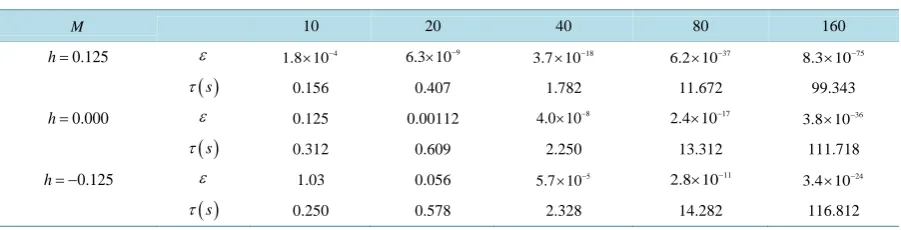
Rate of convergence of the ZHT structural approximation is examined in Table 1, where a tolerance
( )
( , ) ( , )
max e ,
t x
r x t
ε
∈ −∞ ∞ −∞ ∞
= (25)
and a CPU time τ are given versus algebraic order M for various reference levels h. Table 1 was com-puted on a workstation in Maple 17.02 by using a six-core AMD-6300 processor with frequency 3.50 GHz and RAM 12.0 GB. The CPU time depends mainly on order of approximation M . Tolerance significantly depends upon M and h through interaction parameter q. For propagation celerities U =3 and
1, 1 3, 3 3
V = q= , 105 15=0.333, 0.577, 0.683 for h=1 8, 0, 1 8− =0.125, 0, 0.125,− respectively. Surface plots of R x tc
( )
, show a uniform convergence of the two-wave solution in the ZHT structure.The experimental solutions of Section 2 were computed by experimental programming with lists of equations and expressions in the virtual environment of a global variable Eqe with 4 procedures of 185 code lines in to-tal.
3. Theory of Interaction of Two Pulsatory Waves in the ZHT Structure
3.1. Formulation of the Theoretical Problem in the ZHT Structure
Compute theoretically a structural solution of (1) for nonlinear interaction of two pulsatory waves. Construct the structural solution in the ZHT structure of algebraic order M and differential order N
( )
22 , 0
1
0
, ,
M N
m m N k
m N k m m
N
K
s x t h S Tb C ta
+
− + − +
+ = =
= +
∑
∑
(26) [image:7.595.88.539.602.717.2]where S is a scale, M→ ∞,Cm N− +2 ,k m is a structural coefficient, M andN are symbolic limits of sum-
Table 1.Convergence of the experimental solutions in the ZHT structure.
M 10 20 40 80 160
0.125
h= ε 4
1.8 10× − 9
6.3 10× − 18
3.7 10× − 37
6.2 10× − 75
8.3 10× −
( )s
τ 0.156 0.407 1.782 11.672 99.343
0.000
h= ε 0.125 0.00112 8
4.0 10× − 17
2.4 10× − 36
3.8 10× −
( )s
τ 0.312 0.609 2.250 13.312 111.718
0.125
h= − ε 1.03 0.056 5
5.7 10× − 11
2.8 10× − 24
3.4 10× −
( )s
mation. Other variables and parameters are the same as in (2), but instead of experimental instances of section 2 they receive symbolic values to compute theoretically a general term of the structural solution.
In agreement with (26) and (2), a two-wave solution is constructed with algebraic order M and differential
order N=0 using a generalized Einstein notation for summation, which is extended for exponents, as follows:
( )
2 2(
2)
, 2,
, 2 m m m,
m m m m
x t h p ta Z ta Z Tb
φ µ +
+
= + + (27)
where m=0,1,,M. When p=1
(
q=0)
,Tb=qtb=0, and initialization condition (16) is invoked, the two- wave solution is reduced to one-wave solution (3).3.2. Theoretical Differentiation of the Invariant ZHT Structure
Primarily, computation a first spatial derivative of a binomial term ta Tbn m yields
(
)
1 1 1 1
, 1 1, 1, , 1 ,
n m
n m n n m n m
n m n m n m n m
ta Tb
da ta Tb da ta a ta Tb da ta Tb
x µ d
− − + +
− − + + +
∂ = + +
∂ (28)
(
)
(
)
(
)
(
)
2
, 1 , 1 1, 1,
1, 1, , 1 , 1
, ,
,
, ,
, , ,
n m n m n m n m
n m n m n m n m
da a q da a n
d
d n m m d n m d n m
a a n da da n m m
− − − −
+ + + +
= =
= =
=
− = −
=
= (29)
where structural coefficients (29) of binomial derivative (28), called differential binomial coefficients, are ma-trix functions dan m, =dan m,
( )
i j, . Here, indices n and m, which are equal to powers of ta and Tb in thebinomial derivative, define names of the matrix functions. Indices i and j which are equal to powers of ta
and Tb in the binomial term ta Tbi j, determine definitions of the matrix functions. Similarly, computation of a first temporal derivative of the binomial term n m
ta Tb gives
(
)
1 1 1 1
, 1 1, 1, , 1 ,
n m
n m n n m n m
n m n m n m n m
ta Tb
dt ta Tb dt ta t ta Tb dt ta Tb
t µ d
− − + +
− − + + +
∂ = + +
∂ (30)
(
)
(
)
(
)
(
)
(
)
(
)
(
)
(
)
2 2 2 2
, 1 , 1 1, 1,
2 2 2
1, 1, , 1 , 1
2 2
, ,
, ,
3 , 2 2 3 ,
2 2 3 , 2 2 3 .
n m n m n m n m
n m n m n m n m
dt dt n m q q h m dt dt h n
dt t h n dt
n m
d n m dt n m q h m
µ µ
µ µ
− − − −
+ + + +
=
= =
= = − + = − +
= + = + (31)
Thus, spatial and temporal derivatives (28) and (30) have the same structure but vary in differential binomial coefficients (29) and (31), respectively.
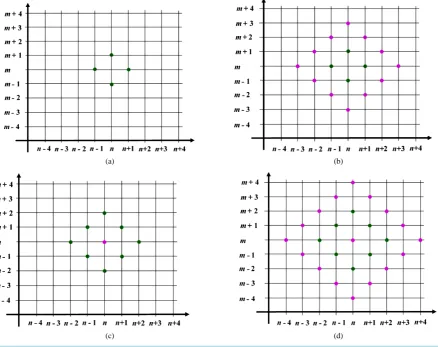
Increase in order of differentiation produces a two-dimensional (2d) differentiation cascade, which is shown in Figure 1. The one-dimensional (1d) differentiation cascade of invariant hyperbolic-secant structures is asym- metrical as the cascade spreads only towards higher powers [18]. To the contrary of the 1d differentiation cas-cade, the 2d differentiation cascade spreads in symmetrical square waves, which resemble circular waves on the water surface generated by a point source. Similar to the 1d differentiation of the invariant trigonometric, hyper- bolic, and elliptic structures [18], the 2d differentiation of an even order preserves structure of binomial deriva-tives and the 2d differentiation of an odd order converts structure of binomial derivaderiva-tives to complementary ones.
Finally, computation a third spatial derivative of the binomial term n m
ta Tb returns a binomial derivative of
the following structure:
(
)
(
)
(
)
3
3 3 1 1 2 2
, 3 1, 2 1, 2 2, 1 , 1
3
2 1 3 1 1 3
2, 1 3, 1, 1, 3,
2
2, 1 , 1 2,
n m
n m n n m n n
n m n m n m n m n m
n m n n n n m
n m n m n m n m n m
n n
n m n m n
ta Tb
db ta Tb db ta db ta Tb db ta db ta
x
db ta Tb db ta db ta db ta db ta Tb
db ta db ta db
µ − − + − −
− − − + − − − −
+ − − − + +
+ − − − + +
−
− + + +
∂
= + + + +
∂
+ + + + +
+
(
+ +)
(
)
2 1
1
1 1 2
1, 2 1, 2
3 , 3
n m
m
n n m
n m n m
n m n m
ta Tb
db ta db ta Tb
db ta Tb
+ +
+
− + +
− + + +
+ +
+ +
+
(32)
(a) (b)
[image:9.595.97.536.87.434.2]
(c) (d)
Figure 1. Differentiation cascade of the binomial structure: (a) N = 1; (b) N = 3;(c) N = 2; (d) N = 4.
(
)
(
)(
)
(
)
(
)
(
)
(
)
(
)
(
)
(
)
(
)
(
)
6 4
, 3 , 3 1, 2 1, 2
4 2
1, 2 1, 2 2, 1 2, 1
2 2 2 2 2
, 1 , 1 2, 1 2, 1
1 2 , 3 1 ,
3 1 , 3 1 ,
2 1 6
, ,
, ,
, 3 , 3,
n m n m n m n m
n m n m n m n m
n m n m n m n m
db db q m m m db db q m m n
db b q m m n db db q mn n
db
n m n m
d n m n m
db n m q m q q m m n db db n m q
− − − − − −
+ − + − − − − −
− − + − + −
= = − − = −
= − − =
=
= =
−
= − − + = =
= +
(
)
(
)
(
)(
)
(
)
(
)
(
)
(
)
(
)
(
)(
)
(
)
(
)
(
)
2 2
3, 3, 1, 1,
2 2
1, 1, 3, 3,
2
2, 1 2, 1 , 1 , 1
1 ,
1 2 , 2 6 3 1 ,
2 6 3 1 ,
,
1 2 ,
3 1 ,
,
2
, ,
, ,
n m n m n m n m
n m n m n m n m
n m n m n m n m
d n m d n m
d n m
mn n
db b n n n db b q m n n n
db b q m n n n db b n n n
db b mn n
d n m
db db
d n m n m m q
− − − −
+ + + +
− + − + + +
+
= − − = − + + −
= + + + =
= =
= = − + +
− − = =
= =
(
)
(
)
(
)
(
)
(
)
(
)
(
)
(
)
(
)(
)
2 2
2, 1 2, 1 1, 2 1, 2
1, 2 1, 2 , 3 , 3
, ,
3 1 6 ,
3 1 ,
,
3 1 ,
,
3 1 , 1 2 .
n m n m n m n m
n m n m n m n m
d n m n m
d
q m m n
db b mn n db db m m n
db b n m m m n db db n m m m m
+ + + + − + − +
+ + + + + +
+ +
= − + = +
= − + = − +
+ =
= +
= =
(33)
Construct now a sequence of terms of the zigzag structure
(
, 2, 2)
m k m k m k
m k m m k m
Z + ta + +Z + + ta + + Tb + with , 1, ,
k= − − +N N N, derivatives of which make a contribution to the general term of a zigzag derivative through binomial derivatives (28), (30), and (32). Substitute then the binomial derivatives of
2 ,
m k m k m k m k
ta + Tb + ta + +Tb + and collect like terms of a structural coefficient of the general term proportional to
m
Tb . In agreement with (5), a first spatial derivative of the two-wave solution is the invariant ZHT structure of algebraic order M+N and differential order N =1
(
)
3 2 1 1 3
1, 1, 3,
2 p Am mtam Am mtam Am mtam Tbm,
x
φ µ − + +
− + + +
∂ = +
where m=0,1,,M+N and structural coefficients An m, are following:
( )
1, , 1 1, 1 1, ,
1, , 1 1, 1 1, , 1, 2, , 1 1, 1
3, 1, 2, , 1 3, 1
, , , ,
,
,
, .
,
m m n m m m n m m m
m m n m m m n m m m n m m m n m m m
m m n m m m n m m m
n m i j n m i j
A Da Z Da Z
A Da Z Da Z Da Z Da Z A Da Z Da Z
d i j Da Z a Z
− + − − −
+ + + − + − + − + +
+ + + − + +
= +
= + + +
= +
=
(35)
Equations (34)-(35) are complemented by truncation conditions of the two-wave solution
, 0 for 0, ,
n m
Z = m< m>M (36) which are set by (27). Conditions (36) result in truncation conditions for the first spatial derivative:
, 0 for 0, 1, 3; 3, 0 for ; 1, 0, 1, 0 for 1.
n m m m m m m m
A = n< n< −m n> +m A + = m>M A + = A − = m>M+ (37)
Similarly, a first temporal derivative of the two wave solution again yields the invariant ZHT structure of al-gebraic order M +N and differential order N =1
(
)
3 2 1 1 3
1, 1, 3,
2 p Tm mtam Tm mtam Tm mtam Tbm,
t
φ µ − + +
− + +
∂ = + +
∂ (38)
where structural coefficients Tn m, are
( )
1, , 1 1, 1 1, , 1, , 1 1, 1 1, , 1, 2,
, 1 1, 1 3, 1, 2, , 1 3, 1 , , , ,
,
, , , ,
m m n m m m n m m m m m n m m m n m m m n m m m
n m m m m m n m m m n m m m n m i j n m i j
T Dt Z Dt Z T Dt Z Dt Z Dt Z
Dt Z T Dt Z Dt Z Dt Z dt i j Z
− + − − − + + + − + − +
− + + + + + − + +
= + = +
+ =
+
+ = (39)
and truncation conditions are given by (36).Truncation conditions for the first temporal derivative become
, 0 for 0, 1, 3; 3, 0 for ; 1, 0, 1, 0 for 1.
n m m m m m m m
T = n< n< −m n> +m T + = m>M T + = T − = m>M+ (40)
Finally, computation of a third spatial derivative of the two-wave solution produces the invariant ZHT struc-ture of algebraic order M +N and differential order N =3
(
)
3
5 2 3 1 1 3 5
3, 1, 1, 3, 5,
3 2 ,
m m m m m m
m m m m m m m m m m
p B ta B ta B ta B ta B ta Tb
x
φ µ − − + + +
− − + + +
∂ = + + + +
∂ (41)
where structural coefficients Bn m, are
3, , 3 3, 3 1, 2 2, 2 2, 1 1, 1 3, ,
1, , 3 1, 3 1, 2 2, 2 1, 2 , 2 , 1 1, 1
2, 1 1, 1 1, , 3, 2,
,
m m n m m m n m m m n m m m n m m m
m m n m m m n m m m n m m m n m m m
n m m m n m m m n m m
B Db Z Db Z Db Z Db Z
B Db Z Db Z Db Z Db Z
Db Z Db Z Db Z
− + − − − + − − − + − − −
− + − − + + − − − + − + − −
− + + − − − +
= + + +
= +
+
+ +
+ + 2, 1 1, 1
1, 1, 2 , 2 2, 1 1, 1 , 1 1, 1 1, ,
1, 2, , 1 1, 1 2, 1 3, 1 1, 2 2, 2
3, 2, 1 1, 1 3
,
,
m n m m m
m m n m m m n m m m n m m m n m m m
n m m m n m m m n m m m n m m m
m m n m m m n
Db Z
B Db Z Db Z Db Z Db Z
Db Z Db Z Db Z Db Z
B Db Z Db
− − + +
+ + + − + + − − + + − +
− + − + + − − + + − − + +
+ + + + − +
+ +
+
= +
+ +
=
+ +
+ , , 1, 2, 2, 1 1, 1
, 1 3, 1 1, 2 2, 2 1, 2 4, 2 , 3 3, 3
5, 3, 2, 2, 1 3, 1 1, 2 4, 2 , 3 5, 3
,
,
,
m m m n m m m n m m m
n m m m n m m m n m m m n m m m
m m n m m m n m m m n m m m n m m m
n m i
Z Db Z Db Z
Db Z Db Z Db Z Db Z
B Db Z Db Z Db Z Db Z
Db Z
+ + + − + +
− + + + − + + − − + + − + +
+ + + + − + + + − + + − + +
+
+ + +
= +
+
+ +
+
( )
,j=dbn m, i,j Zi j, ,
(42)
and truncation conditions are set by (36). Truncation conditions for the third spatial derivative are
, 5, 3,
1, 1, 3,
0 for 0, 3, 5; 0 for ; 0 for 1;
0 for 2; 0, 0 for 3.
n m m m m m
m m m m m m
B n n m n m B m M B m M
B m M B B m M
+ +
+ − −
= < < − > + = > = > +
= > + = = > + (43)
Equations (34), (38), and (41) show that the ZHT structure is invariant with respect to differentiation of orders 1
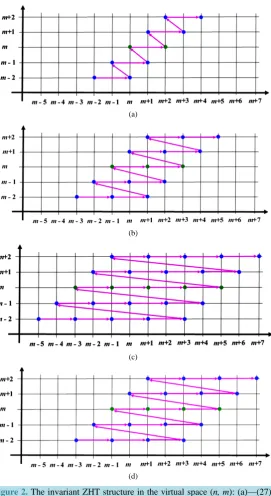
N = and N=3, which only modify algebraic orders and structural coefficients. The zigzag structure of two- wave solution (27) and its derivatives (34) and (38) together with product of (27) and (34) are shown in Figure 2 in a virtual space of computational indices n and m of structural coefficients An m, , Tn m, , Bn m,
(a)
(b)
(c)
[image:11.595.179.451.80.577.2](d)
Figure 2. The invariant ZHT structure in the virtual space (n, m): (a)—(27),
(b)—(34),(c)—(38), (d)—(53).
and Pn m, , which coincides with a virtual space of computational powers n and m of ta Tbn m. Differentia-tion increases the width of the invariant ZHT structure and the effect of multiplicaDifferentia-tion is similar to that of diffe-rentiation.
3.3. Theoretical Multiplication of the Invariant ZHT Structures
Continuation of spatial derivatives (34) and (38) in the invariant ZHT structure to any differential order N in
the generalized Einstein notation gives
2 2 2
2 , ,
2 N m N k m m N k m N
N p ta Tb
x R
φ µ + − +
− +
∂ =
where k=0,1,,N+1 and m=0,1,,M+N. The spatial derivative of order N−1 then becomes
1 2 2
1
1 2 1
1
,
2 N m N k m.
m N k m N
N p ta Tb
x µ Q
φ + − +
− −
+ − + +
∂ =
∂ (45)
Differentiation of (45) with respect to x and reduction of all terms to a general term by substitutions
1
m= +m and k= −k 1 in a term proportional to Tbm−1, k= −k 1 in a term proportional to 2 2 ,
m N k m
ta − + +Tb m= −m 1 in a term proportional to Tbm+1 yields
(
)
(
)
(
)
(
)
2 2
2 1, 2 , 1
2
2 1, 1
2
2 ,
2 1 1
2 2
1 1 ,
N
m N k m m N k m
m N k m
m N k m m N k m
N
N m N k Q m Q
m N k Q m
x
t T
q Q a
p b µ φ + − + − − + − − + − + + − + + − − + − − − + − + − + + ∂ =
∂ (46)
where structural coefficients of (44) are connected with structural coefficients of (46) by a recurrent relation
(
)
(
)
(
)
(
)
2 , 2 1, 2 , 1
2 2 , 1
2 1,
2 1 1
2 1 1 .
m N k m m N k m m N k m
m N k m m N k m
R m N k Q m Q m N k Q m q Q
− + − + − − + − − + + − + + − − + − − − + − + + + + = (47)
Thus, the invariance of the ZHT structure with respect to spatial differentiation of any order is proved by in-duction.
Set up two spatial derivatives of the two-wave solution in the invariant ZHT structures of algebraic order M
and differential orders N1 and N2 with structural coefficients Qm N− +1 2 ,k m and Rm N− 2+2 ,k m as
1 2
1
1 1 2 2
1 2 2
2 2 2 2 2 2
2 , 2 ,
2 N m N k m m N k m, 2 N m N m N k m,
N N
N p ta Tb N p k mta Tb
x
Q R
x
φ µ + − + φ µ + − +
− + − +
∂ = ∂ =
∂ ∂ (48-49)
wherek=0,1,,N1+1 andm=0,1,,M+N1 for the first structure, k=0,1,,N2+1 and 2
0,1, ,
m= M+N for the second structure. Product of (48) with a binomial substitution m=n k, =l and (49) with a binomial substitution m= −m n k, = −k l returns
1 2 1
1 2 1 2
1 2 2
4 2
2 , 2 2 ,
4
,
4 N N m N N k m
n N l n m n N k l
N N
m n
N N p Q ta Tb
x x R
φ φ µ + + − − +
− + − − + − −
∂ ∂ =
∂ ∂ (50)
where l=0,1,,k, k=0,1,N1+N2+2, n=0,1,,m and m=0,1,, 2M+N1+N2.
Thus, the ZHT structure is also invariant with respect to multiplication since a general term of the product is the ZHT structure of algebraic order 2M+N1+N2 and differentiation order N1+N2
1 2 1 2
1 2 2 1 1 2 4 4 2 2
4 N N m N N k m,
m
N N
N N p P N N kta Tb
x x
φ φ µ + + − − +
− − +
∂ ∂ =
∂ ∂ (51)
where the structural coefficients are
1 2 2 1 2 , 2 2 2 , .
m N N k n N l n m n N k l m n
P− − + =Q− + R − − + − − (52)
Summation of a general term of the product of two-wave solution (27) and first spatial derivative (34) by (51)-(52) with N1=0,N2 =1,k=0,1,, 3 yields
(
)
5 1 1 3 5
1, 1, 3
4
, 5, ,
4 m m m m m
m m m m m m m m
p P ta P ta P ta P ta Tb x
φ
φ µ − + + +
− + + +
∂ = + + +
∂ (53)
where structural coefficients Pm− +1 2 ,k m are obtained for Q=Z and R=A by constructing a list of sums of general terms for l=0,1,,k with truncation conditions Zn+4,n =0,Zn+6,n =0, which follows from (27),
1, 1, , 1, 1, , 1, 2,
3, 3, , 1, 2, 5, 5, , 3, 2,
, ,
, .
m m m n m n n n m m m n m n n n m n m n n n
m m m n m n n n m n m n n n m m m n m n n n m n m n n n
P A Z P A Z A Z
P A Z A Z P A Z A Z
− − − − + − + − − − − +
+ − + − − + − + + − + − − + − +
= = +
= + = + (54)
Structure of the two-wave solution is reduced to that of a spatial derivative by substitution
2 2
0,0 0,0 2 .
, 5,
3, 1, 1, 3,
0 for 0, 1, 5; 0 for 2 ;
0, 0, 0, 0 for 2 1.
n m m m
m m m m m m m m
P n n m n m P m M
P P P P m M
+
+ + − −
= < < − > + = >
= = = = > + (56)
3.4. Theoretical Solution of the Algebraic KdV Problem
Substitution of temporal derivative (38), product (53) of the two-wave solution and the first order spatial deriva-tive, third order spatial derivative (41), and collection of structural coefficients reduce differential KdV Equation (1) to a theoretical algebraic KdV equation
(
)
(
)
(
)
(
)
5 2 3 3 2 5 4 5 2 1
3, 1, 1, 1,
3 2 5 4 5 2 1 3 2 5 4 5 2 3
1, 1, 1, 3, 3, 3,
5 4 5 2 5
5, 5,
2 2 24 2
2 24 2 2 24 2
24 2 0,
m m
m m m m m m m m
m m
m m m m m m m m m m m m
m m
m m m m
p B ta p T p P p B ta
p T p P p B ta p T p P p B ta
p P p B ta Tb
µ µ µ µ
µ µ µ µ µ µ
µ µ
− −
− − − −
+ +
+ + + + + +
+
+ +
+ + +
+ + + + + +
+ + =
(57)
which is complemented by truncation conditions (40), (56), and (43).
For this equation to be satisfied exactly for all parameters and variables, all structural coefficients of n m
ta Tb
should vanish. Therefore, five structural coefficients of (57), which are supposed to be vanished, are
2 2 2 2 2 2 2
3, 1, 1, 1, 1, 1, 1,
2 2 2 2 2 2
3, 3, 3, 5, 5,
0, 12 0, 12 0,
12 0,12 0.
m m m m m m m m m m m m m m
m m m m m m m m m m
B T p P B T p P B
T p P B p P B
µ µ µ µ µ
µ µ µ µ
− − − − + + +
+ + + + +
= + + = + + =
+ + = + = (58)
These equations constitute a polynomial system of equations with respect to leading structural coefficients
,
n m
Z of increasing orders. To combine equations with respect to Zn m, of same binomial orders k, construct binomial systems as structural coefficients of tak m− Tbm, where k=1, 3,2M−1 for m=0,1,k.
The binomial systems of orders k=1 and k=3 have two and four equations, respectively,
2 2 2 2 2 2
1,0 12 1,0 1,0 0, 120,1 0,1 0,1 0,
T + µ p P +µ B = T + µ p P +µ B = (59)
2 2 2 2 2 2 2 2 2 2
3,0 12 3,0 3,0 0, 2,1 12 2,1 2,1 0, 1,2 12 1,2 1,2 0, 0,3 0.
T + µ p P +µ B = T + µ p P +µ B = T + µ p P +µ B = µ B = (60) Substituting structural coefficients Tn m, ,Pn m, ,Bn m, through Zn m, by (39)-(40), (54)-(56), (42)-(43), using initialization (16), and solving (59)-(60) with respect to Z1,1,Z3,1,Z2,2,Z4,2 and Z3,3 gives
2 2
1,1 2, 3,1 , 2,2 2, 4,2 2 , 3,3 2.
Z = Z = −p Z = Z = − p Z = (61) For binomial orders k=5, 7,2M−3, where k=2l+5 for l=0,1,M−4, the binomial system has five equations
5,
2 2 2 2 2 2
5, 4, 1 4, 1 4, 1
2 2 2
3, 2 3, 2 3, 2
2 2 2 2
2, 3 2, 3 2, 3 1, 4
12 0, 12 0,
12 0,
12 0, 0.
l l
l l l l l l l l
l l l l l l
l l l l l l l l
p P B T p P B
T p P B
T p P B B
µ µ µ µ
µ µ
µ µ µ
+
+ + + + + + +
+ + + + + +
+ + + + + + + +
+ = + + =
+ + =
+ + = =
(62)
Solving first and fifth equations of (62) with respect to Z(k+5 2,) (k+1 2) and Z(k+3 2,) (k+3 2) respectively, yields
2 2 2
5,3 4 , 4,4 2, 6,4 5 , 5,5 2, M 1,M 1 , M M, 2,
Z = − p Z = Z = − p Z = Z + − = −Mp Z = (63)
where last two terms are obtained by induction. In agreement with the experimental solution of section 2.4, second, third, and fourth equations of system (62) are satisfied identically.
For binomial orders k=7,9,2M−1, where k=2l+5 for l=M−3, the binomial system also has five equations
2 2 2 2 2 2
2, 3 2, 3 1, 2 1, 2 1, 2
2 2 2 2 2 2 2
, 1 , 1 , 1 1, 1, 1, 2, 1
12 0, 12 0,
12 0, 12 0, 0.
M M M M M M M M M M
M M M M M M M M M M M M M M
p P B T p P B
T p P B T p P B B
µ µ µ µ
µ µ µ µ µ
+ − + − + − + − + −
− − − − − − − +
+ = + + =
+ + = + + = = (64)
(
)
2 2 2
6,4 5 , 7,5 6 , M 2,M 1 ,
Z = − p Z = − p Z + = − M+ p (65)
where a last term is also generated by induction, the proof of which will be completed in Section 4. Finally, a general solution for the ZHT structural coefficients may be written as
(
)
2, 2, 2, 1 ,
m m m m
Z = Z + = − m+ p (66)
and general term (27) of the two-wave solution in the ZHT structure becomes
( )
2 2(
)
2 2, 2 2 m 1 m m
x t h p ta m p ta Tb
φ = + µ − + +
(67)
for m=1, 2,M .Theoretical formula for the ZHT structural sum of the two-wave solution is
( )
2 2 2 2(
)
2 21
, 2 1 2 1 .
M
m m m
m
x t h p p ta ta m p ta Tb
φ µ +
=
= + − + − +
∑
(68)Substitution of initialized (16) and computed (66) structural coefficients in the left-hand-side part of theoreti-cal algebraic KdV Equation (57) yields a theoretitheoreti-cal remainder of the invariant ZHT structure
( )
(
)
(
)
(
)
(
)
3 2 1 3 2 2
1, 2 3, 2 , 1 2, 1
4 1 1 1 3 5
4, 1 1, 1, 3, 5,
3 1 1 3 5
3, 1, 1, 3, 5,
, 2 M M M M M
t M M M M M M M M
M M M M M M M
M M M M M M M M M M
m m m m m
m m m m m m m m m m
r x t p C ta C ta Tb C ta C ta
C ta Tb C ta C ta C ta C ta Tb
C ta C ta C ta C ta C ta T
µ + + − +
+ − + − − + −
+ − − + + +
+ − − + + +
− − + + +
− − + + +
= + + +
+ + + + +
+2 1 + + + +
1
,
M
m
m M
b
+ = +
∑
(69)
where a structural coefficient
2 2 2
, , 12 , ,
n m n m n m n m
C =T + µ p P +µ B (70) and truncation conditions (40), (56), and (43) are invoked.
The theoretical solutions of Section 3 in the invariant ZHT structure were computed using theoretical pro-gramming methods with symbolic general terms by the generalized Einstein notation in the virtual environment of a global variable Eqt with 16 procedures of 923 code lines in total. The theoretical formulas for two-wave solution (68), first spatial derivative (34)-(36), first temporal derivative (38)-(40), third spatial derivative (41)-(43), product of the two-wave solution and the first spatial derivative (53)-(56), and structural remainder (69)-(70) were justified by the correspondent experimental solutions for algebraic order M =40.
4. Discussion and Visualization
Through an expansion variable z=taTb=qtatb, where z <1 as − ≤ ≤ − ≤ ≤1 ta 1, 1 tb 1, and 0≤ <q 1, summation of the ZHT structural approximation yields
( )
(
)
(
)
2 2 2 2 2 2
2
2 1
, ,
1
p p ta ta Tb
x t h
taTb
µ
φ = + − −
− (71)
since a partial sum of the Taylor series expansion of (71) in zof order Mreturns the same expression as the ZHT structural sum (68) with the same general term as general term (67) of the invariant ZHT structure.
A functional form of (71) expressed through two regular hyperbolic functions tanh
( )
µ
X and tanh( )
vY , five parameters h q p, , , ,µ ν, and two propagation variables X = −x Ut−a and Y = − −x Vt b becomes( )
(
)
(
)
( )
(
)
( )
2 2 2
2 2 2 2
2
tanh anh tanh
t
2 1 t
a
, .
1 nh tanh
X X
p Y
X Y
p q
x t h
q
µ
φ µ µ ν
µ ν
− −
= +
−
(72)
Differentiation and substitution of Equation (72) into differential KdV Equation (1) completes the proof by induction of (66)-(68) and returns another verification of (71) as Equation (1) is satisfied identically.