Missing Numbers in
-Graceful Graphs
P. Pradhan
Department of Mathematics and Statistics,Gurukula Kangari University, Haridwar (UK), India
Kamesh Kumar
Department of Mathematics andStatistics,Gurukula Kangari University, Haridwar (UK), India
A. Kumar
Department of Mathematics Uttaranchal University,
Dehradun (UK), India
ABSTRACT
The generalization of graceful labeling is termed as -graceful labeling. In this paper it has been shown that , is -graceful for any (set of natural numbers) and some results related to missing numbers for -graceful labeling of cycle , comb , hairy cycle and wheel graph have been discussed.
Keywords
-Graceful labeling, -graceful graphs, missing numbers.
1.
INTRODUCTION
A labeling of vertices and edges of a graph G which are required to obey certain condition, have often been motivated by the labeling given by Rosa [10] in 1966. Let be a simple undirected graph with order p and size q, if there exist an injective mapping that induces a bijective mapping and defined by
, Then Rosa [10] called the mapping the β-labeling (valuation) of a graph G, Golomb [4] subsequently called such labeling to be graceful labeling and the graph is called a graceful graph, while is called an induced edge’s graceful labeling.
-graceful labeling is the generalization of graceful labeling that introduced by Slater [11] in 1982 and by Maheo and Thuillier [8] in 1982.
Let be a simple undirected graph with order p and size q, be an arbitrary natural number, if there exist an injective mapping that induces bijective mapping and defined by
Then is called -graceful labeling, while is called an induced edge’s -graceful labeling and the graph G is called
-graceful graph. Graphs that are -graceful for all are sometimes called arbitrarily graceful.
Maheo and Thuillier [8] proved that the cycle is -graceful if and only if either:
(i) , where is even and , or
(ii) where is even and
or
(iii) where is odd and .
They also proved that the wheel is -graceful and conjectured that is -graceful when . This conjecture was proved by Liang, Sun and Hu [7].
Bu, Zhang and He [3] has shown that an even cycle with a fixed number of pendant edges adjoined to each vertex is -graceful.
Lee and Wang [6] have shown that all combs are -graceful.
Acharya [1] has shown that a -graceful Eulerian graph with q edges must satisfy one of the following conditions:
(a) where is even. (b) where is even. (c) where is odd.
Maheo and Thuillier [8] has shown that is -graceful if
and is even and . We observe that -gracefulness for the cycle , also holds for any (set of natural numbers).
1.1 Corollary
For all (set of natural numbers), the cycle ,
is -graceful.
Proof: Let be a cycle where and
be the vertices of cycle . Consider the map
defined as follows:
It is clear that is injective and the induced mapping
is bijective, given as
. Thus, is -graceful labeling of cycle .
1.2 Example
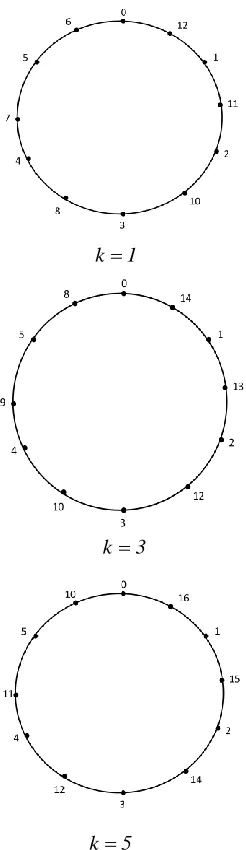
Consider the figure (1) of -graceful labeling of for
Figure (1): -graceful labeling of
1.3 Missing Numbers
In -graceful labeling of a graph G, all the vertices are assigned distinct labels from the set of numbers
and some numbers of the set do not appear in the vertex labeling. Such numbers are called missing numbers.
Bagga, Heinz and Majumder [2] have given the range of values for the missing label for graceful labeling of as given below:
.
P. Pradhan and A. Kumar [9] have shown that
(i) Missing number in the graceful labeling of ,
is not unique.
(ii) Missing number in the graceful labeling of is , where .
(iii) The range of missing number for graceful labeling of ,
is
.
2.
MAIN RASULTS
There are missing numbers in the -graceful labeling of ,
. Following theorem gives a way to find them.
2.1 Theorem
In -graceful labeling of ( ), one missing number is (set of natural numbers) and remaining
missing numbers will be from . Proof: In -graceful labeling of ( ), (from corollary 1.1), numbers used in labeling to odd vertices of are in increasing sequence beginning with , while numbers being used in labeling of even vertices are in decreasing
sequence beginning with .Obviously, is the last odd vertex and is the last even vertex of and numbers assigned to these two vertices are respectively,
and .
Sequence of missing numbers lie between
and , so they will be from ,
and one missing number will be i.e. ( .
2.2 Example
Consider the following figure (2) of 8-graceful labeling and 9-graceful labeling of which as below:
Figure (2): -graceful labeling of
1
k
3
k
[image:2.612.110.233.71.496.2] [image:2.612.369.510.409.703.2]Missing numbers in 8-graceful labeling of are 12, 13, 14, 15, 16, 17, 18 and 25. Missing numbers in 9-graceful labeling of are 12, 13, 14, 15, 16, 17, 18, 19 and 26.
In the following theorem, we have studied the missing numbers for -graceful labeling of , where .
2.3 Theorem
If there exists -graceful labeling of cycle (n is odd), one missing number in -graceful labeling is and remaining
missing numbers will be from , where
.
Proof: Let be a cycle of odd length n and
. Now, the following two cases are arising for -graceful labeling of cycle
of odd length.
Case I-In -graceful labeling of , if , is odd and , then for , we have
Case II- In -graceful labeling of , if , is even and , then for , we have
In -graceful labeling of ( ), numbers used in labeling to odd vertices of are in increasing sequence beginning with , while numbers being used in labeling of even vertices are in decreasing sequence beginning with
. Obviously, is the last odd vertex and is the last even vertex of and numbers assigned to these two vertices are respectively,
and .
Sequence of missing numbers lie between and ,
so they will be from , and one missing number
is ; and is odd i.e., one missing
number is .
2.4 Example
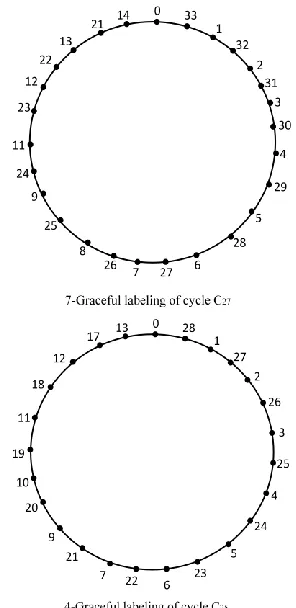
Consider the figure (3) of 7-graceful labeling of and 4-graceful labeling of which are given below:
Figure (3): -graceful labeling of and
Missing numbers in 7-graceful labeling of C27 are 10, 15, 16, 17,
18, 19, 20 and Missing numbers in 4-graceful labeling of C25 are
8, 14, 15, 16.
2.5 Theorem
In -graceful labeling of comb have missing numbers from
Proof: The comb has vertices and edges. Let be the set of path vertices and be the set of pendant vertices of comb
such that is adjacent to .
For -graceful labeling of the comb , consider a labeling map defined as
and Obviously is injective and the induced labeling map defined as
and , where are adjacent vertices of , is bijective.
[image:3.612.362.510.73.377.2]Case I- when n is odd,
A=
is the set of alternative sequence of path vertices and pendant vertices, beginning and ending with path vertices, where
are path vertices and are pendant vertices,and
B=
is the set of alternative sequence of pendant vertices and path vertices, beginning and ending with pendant vertices, where are pendant vertices and are path vertices.
Case II- when n is even,
A=
is the set of alternative sequence of path vertices and pendant vertices, beginning with path vertex and ending with pendant vertex, and
B=
is the set of alternative sequence of pendant vertices and path vertices, beginning with pendant vertex and ending with path vertex.
In -graceful labeling of , we observe that in both cases, the numbers assigned to the vertices of one set A are in increasing order beginning with , while the numbers assigned to the vertices of other set B are in decreasing order beginning with . So missing numbers will lie between and , i.e. missing numbers will be from .
2.6 Example
Case I- Consider the -graceful labeling of comb , where (odd) and .
Figure (4): -graceful labeling of comb .
Here we get;
and . It is clear from above that the numbers assigned to the vertices of set are in increasing order from to while the numbers assigned to the vertices of set are in decreasing order from to . So missing numbers are and .
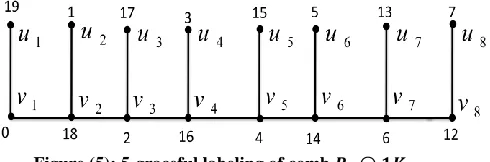
Case II- Consider the 5-graceful labeling of comb , where (even) and .
Figure (5): 5-graceful labeling of comb .
Here we get;
and .
Obviously, the numbers assigned to the vertices of set are in increasing order from to while the numbers assigned to the vertices of set are in decreasing order from to . So missing numbers are and .
2.7 Theorem
In labeling of ( ), one missing number is ( and remaining missing numbers will be from .
Proof: Let be the set of vertices of hairy cycle . The vertices on cycle are
while are pendant vertices such that
are adjacent to respectively.
For -graceful labeling of the hairy cycle , consider a labeling map defined as follows:
And
Obviously is injective and the induced labeling map defined as
and ,
where are adjacent vertices of , is bijective. Co-domain of contains non-negative integers and only
non-negative integers are used for -graceful labeling of . We are left with positive integers which are not used and we call them missing numbers. Thus, there are missing numbers the -graceful labeling of .
For finding the missing numbers in the -graceful labeling of , the vertex set is partitioned into two disjoint sets say A and B in the following way:
A =
is the set of an alternative sequence of cycle vertices and pendant vertices, beginning with cycle vertex and ending with pendant vertex , and
B =
is the set of an alternative sequence of pendant vertices and cycle vertices, beginning with pendant vertex and ending with cycle vertex .
Now the numbers to assign to vertices of set A by definition of given in the beginning of proof of this theorem will be as below:
,
[image:4.612.58.303.610.691.2]
.
Thus, there is an increasing sequence of numbers . i.e. an increasing sequence beginning with and ending with
.
Similarly, for set B, we have a decreasing sequence of non-negative integers beginning with and ending with .
Last vertex of set A is and last vertex of set B is and their respectively labeling are
and .
Sequence of missing numbers must lie between and . Since missing numbers are positive integers, therefore they must be from , and one missing number will be i.e. ( .
2.8 Example
Consider the figure of 4-graceful labeling of which are given below:
Figure (6): 4-graceful labeling of Hairy cycle .
Here we get;
and . It is clear from above that the numbers used in labeling to vertices of set are in increasing sequence beginning with , while numbers being used in labeling to vertices of set are in decreasing sequence beginning with . So missing numbers are and there is exactly one missing number i.e. .
A graph that obtained from the cycle , by adding a new vertex and edges joining it to all the vertices of the cycle is called a wheel graph .
Maheo and Thuillier [8] have proved that the wheel graph is -graceful. There are missing numbers in the -graceful labeling of the wheel graph . We have the following corollary for the range of missing numbers.
2.9 Corollary
Missing numbers in the -graceful labeling of the wheel graph are from and from .
Proof: Let be the labeling of centre vertex of and let its remaining vertices be labeled as .
For labeling of the wheel graph consider a labeling map defined by
Obviously is injective and the induced labeling map
defined as
and , where are adjacent vertices of , is bijective. After
-graceful labeling of the wheel graph , we observe that missing numbers out of lie from to and remaining missing numbers lie from to
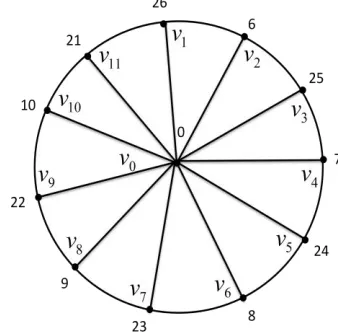
2.10 Example
Let 5-graceful labeling of and missing numbers are from 1 to 5 and from 11 to 20.
Figure (7): 5-graceful labeling of wheel graph .
3.
CONCLUSION
We have extended the result of Maheo and Thuillier [8] that is -graceful, for every (set of natural numbers) either even or odd. In -graceful labeling of ,
and hairy cycle
, there are missing numbers. A method to obtain missing numbers for and has been given. For comb , there are missing numbers and for wheel graph , there are missing numbers while performing
[image:5.612.61.269.287.470.2] [image:5.612.353.522.360.526.2]4.
ACKNOWLEDGEMENT
This research work is supported by Council of Scientific & Industrial Research and University Grant Commission (CSIR-UGC) New Delhi, India under the UGC Junior Research Fellowship (JRF) scheme to the second author. The authors are grateful to referee for his valuable suggestions to improve the manuscript of this paper.
5.
REFERENCES
[1] Acharya, B.D. 1984. Are all polyminoes arbitrarily graceful, Proc. First Southeast Asian Graph Theory Colloquium (Eds: K.M. Koh, H.P. Yap), Springer-Verlag, N.Y., 205-211.
[2] Bagga, J., Heinz, A. and Majumder, M.M. 2007. Properties of graceful labeling of cycle, Congress Nemrantum, 188, 109-115.
[3] Bu, C., Zhang, D., He, B. 1994. -gracefulness of , J. Harbin Shipbuilding Eng. Inst., 15, 95-99.
[4] Gallian, J.A. 2011. A dynamic survey of graph labeling, The Electronic Journal of Combinatorics 18 #DS6.
[5] Golomb, S.W. 1972. How to number a graph, in Graph Theory and Computing, R.C. Read, ed.,Academic Press, New York 23-37.
[6] Lee, S.M. 1988. All pyramids, lotuses and diamonds are -graceful,Bull. Math. Soc. Sci, Math. R.S. Roumanie (N.S.), 32, 145-150.
[7] Liang, Zh.H., Sun, D.Q., Xu, R.J. 1993. -graceful labeling of the wheel graph , J. Hebei Normal College, 1, 33-44.
[8] Maheo, M. and Thuillier, H. 1982.On d-graceful graphs, ArsCombinat, 13, 181-192.
[9] Pradhan, P. and Kumar, A. 2011. Graceful hairy cycles with pendent edges and some properties of cycles and cycle related graphs, Bulletin of The Calcutta Mathematical Society 103(3) 233 – 246.
[10] Rosa, A. 1966. On certain valuations of the vertices of a graph,Theory of Graphs (Internat. Symposium, Rome, July 1966), Gordon and Breach, N. Y. and Dunod Paris, 349-355.