A Survey of Reputable and Dissemination
Protocol in VANET
C.Kumuthini
Doctoral Research Scholar, Department of Computer Science, Bharathiar University, Coimbatore,
Tamilnadu, India.
P.Krishna Kumari
Doctoral Research Supervisor, Director of MCA,RVS college of
Arts and Science, Bharathiar University, Coimbatore,
Tamilnadu, India.
ABSTRACT
Vehicular Ad hoc Network (VANET) is a new communication technology that enables communication among vehicles to vehicles (V2V), vehicles to road-side unit (V2R), and vehicles to infrastructure (V2I). Several protocols are available in VANET to communicate from one vehicle to another vehicle such as AODV, DSR, FSR, DSDV, CBR, HCBR, GPCR, VADD, CAR, DIR, ROMSGP, DRG, PBR, GV-Grid, DVCAST, DECA, PBSM, ABSM etc. This research work concentrates on comparative study of the performance made by selecting protocols such as AODV, DSR, DSDV, GPSR, PBR, DV-CAST, DECA, PBSM, ABSM. As a further enhancement, a new protocol will be developed to extend the work through the real time protocol performance.
Keywords
Vehicular ad hoc networks, Routing protocols, Broadcasting, Data dissemination, Performance comparison.
1.
INTRODUCTION
Nowadays, communication between people is very effective and easy with through mobile, Internet etc. People around the world keep travelling for a long time in vehicles and injured and victims in accidents are also increasing. VANET can be introduced to prevent such accidents and traffic jam. Vehicular Ad Hoc Networks consist of collections of vehicles equipped with wireless communication capabilities. The protocols developed in MANET is not suitable for VANET, because MANET contain the random movement of nodes and nodes in VANET move in a predefined road and they do not have the problem of power, storage, resource.
Vehicles cooperate to deliver data messages through Multihop paths, without the need of centralized administration. The Broadcasting which is the task of sending messages from a source node to all other nodes in the network. It is also called as data dissemination. The delivery of broadcast messages to the vehicles inside in a certain area of interest. This operation is also known as Geocasting or multicasting. The VANET is to transmit data from a single source to a single destination via wireless multihop transmission known as unicasting.
VANET enable plenty of applications for vehicles such as : i) Give warning to the driver
ii) Intimate traffic issues iii) Intimate road conditions
Other new applications in VANET such as; i) ETC (Electronic Toll collections) ii) Car to Home communications
iii) Travel and tourism information distribution iv) Multimedia and game applications etc.
Types of routing protocols taken in this survey work as
Routing Protocols
Topology-Based Position-Based Cluster-Based Broadcast Protocol protocol protocol -Based Protocol.
AODV GPSR CBR DV-CAST DSR PBR DECA
DSDV PBSM
ABSM
CHALLENGES IN VANET PROTOCOLS
An identifying the various efficient routing protocols with the low communication delay, the low communication overhead, and low time complexity.1.1
Flooding
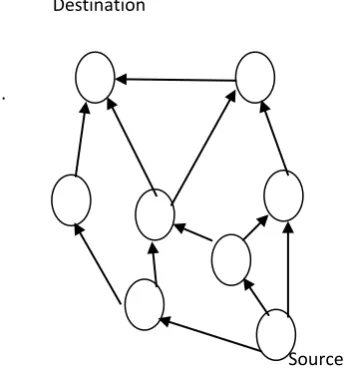
In the latter case, each vehicle decides whether it belongs to the particular network group. If it belongs to the particular group, each vehicle in this group can be packed into a one-hop communication range and lead to the well known broadcast storm problem[1] as shown in figure 1.
Destination
.
[image:2.595.40.214.138.323.2]Source
Figure 1: Simple flooding in networks
The flooding results in a large number of duplicate packets being sent on the network [2]. Several techniques have been introduced to reduce the number of unnecessary forwarded messages in the Broadcast Storm Problem. They are i) Counter-based scheme ii) Distance-based scheme iii) Location-based scheme iv) Counter-based scheme v) Probability-Counter-based scheme etc.
1.1.1
On the Broadcast Storm Problem in Ad Hoc
Wireless Networks
The broadcast storm problem is nothing but the number of duplicate packets sends to the destination and causes serious packet collision and packet loss since too many vehicles simultaneously broadcast messages in a VANET. To avoid the broadcast storm problem, there are three distributed broadcast suppression techniques can be introduced such as i) Weighted p-persistence, ii) slotted 1-persistence, and iii) slotted p-persistence. These three schemes are to reduce the problem of collision and loss of packet through broadcast.
i)
Weighted p-persistence scheme
In the weighted p-persistence scheme, for example if the vehicles Vi can send thebroadcast message to the vehicle Vj .After
receiving the packet from Vi ,vehicles Vj can check first whether
the packet is already receiving or not. If the packet has been received already the vehicle Vj drops this packet otherwise vehicle
Vj has set the probability Pij to re-broadcast the packet.
The probability Pij = Dij / R
Dij = Distance between the vehicles Vi and Vj
R= Transmission Range
ii)
Slotted 1-persistence scheme
In the slotted 1-persistence scheme, if the vehicles Vi can
send thebroadcast message to the vehicle Vj. The vehicle Vj firstly
receives this packet from vehicle Vi, then vehicle Vj waits for certaintime slots TSij, after timeout expiration vehicle Vj, has set the probability value 1 to re-broadcast the packet .
Where TSij = Sij × ô
ô = propagation time for one hop transmission Sij = [ns(1-Dij/R)] if Dij <= R; otherwise, Sij = 0
Ns= Default number of time-slot
iii)
Slotted p-persistence scheme
The combination of both weighted p-persistence and slotted 1-persistence schemes are called as slotted p-persistence scheme.
1.2
DSDV Routing Protocol
Destination Sequenced Distance Vector routing protocols are a proactive routing protocol. The proactive routing protocol is one type of topology-Based protocols. The topology-Based protocols discover the route and maintain it on a table before the sender starts transmitting data. The DSDV routing protocols maintain routing information about the available path in the networks even if these paths are not currently used. This protocol maintains the unnecessary paths may occupy the maximum bandwidth if the topology of the network changes frequently. In the high mobility network, these protocols are not suitable. Only 35% of data packets may be delivered successfully[3].
1.3
AODV Routing Protocol
AODV is a reactive routing protocol .To overcome the disadvantages of DSDV, the AODV protocol has been introduced. In DSDV, the number of unnecessary paths can be stored in the routing table. To avoid this, AODV creates paths on demand only. So AODV is classified as a pure on-demand route acquisition system [4], because it can store only the necessary route. AODV routing protocols can maintain routing tables in the nodes and establish the connection between two nodes when it necessary. In AODV, the route is created by using three types of message. They are Route Request (RREQ), Route Reply (RREP) and Route Error (RERR). The network will be activated only the source node needs to communicate with the destination node. If the source node can send the broadcast message RREQ to the destination node, first it will broadcasts RREQs to its neighbors , which will also forward this RREQ to their neighbors and so on, until the RREQ reaches the destination or an intermediate node which contains a valid route to the destination. Each node will assign a sequence number and broadcast ID.
The sequence number will be increased along the path with every RREQ generated. Therefore, RREQ can be identified based on broadcast ID and the IP address of the source node. When RREQ reaches the destination or intermediate node having an active route, it will reply back to the source. If the source node gets back multiple routes, chooses the one with the minimum hop count and discarded the remaining route. If any link failure occurs, RERR will be fed back to the source node and new route discovery process will be initiated upon receives of RERR [5].
The feature of AODV contains the sequence number in routing discovery process to avoid the “counting to infinity” problem [6] and 70% to 95% of the network traffic is dedicated to broadcasting of route requests(RREQ).
1.4
DSR Protocol
similar to the AODV protocol and cache routing information in each node on-demand basis and it is possible to update the existing route when any new route is discovered. The cached routing information indicates existed route in the network and it will be updated when any routes are discovered. Because of the cached routing information, the overhead is minimized for periodic information transmission.
The DSR protocol consists of two main processes to establish the route. They are Route discovery and Route maintenance. In route discovery, the route is created by using two types of message. They are Route Request(RREQ), Route Reply (RREP) similar to AODV protocol. Before sending RREQ, source node will consult its routing cache to check whether there is any unexpired routes can be used. If there is no available existing route in the cache then the source node starts to broadcast RREQ which contains a unique ID number and the addresses of both source and destination node. Upon receiving RREQ, the node checks for any valid route to the destination. The process continues to pass RREQ to the next nodes until it reaches the final destination or a node that consists of the route to the destination.
The nodes on the route may receive several RREQs labeled with the same ID number but different route record due to the broadcast mechanism from the source node. In this situation, nodes only forward the first arrival of RREQ in which their addresses have not been recorded[7].When the RREQ reach the destination or intermediate node which holds an unexpired route to the destination, RREP contains route message will be generated and forwarded back to the source. If it is an intermediate node then the route information will be added in the RREP.
1.5
GPSR Routing Protocol
Greedy Perimeter Stateless Routing protocol is a position-based routing protocol. This protocol is used to find out the position of the neighbor with the help of the beacon message and the position of a packet destination with the help of the location service. With this information a node forwards incoming packet to a neighbor located in the general direction of the destination [3].
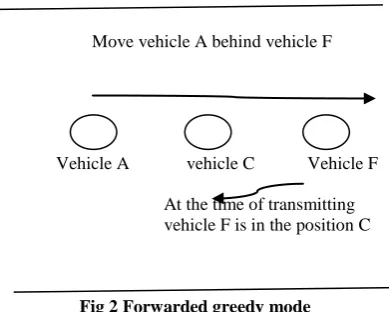
In GPSR, when the vehicle A want to broadcast the packets to the vehicle C. First the source node finds out the location of the destination vehicle with the help of GPS and forwarded in greedy mode, the selection of the next-hop node is based on the neighbor table of the forwarding node. The source node before sending the packet to the destination node, it can attach the header to each packet. The header contains the location of the destination node and this information in the packet is never updated while travelling. In a highly mobile environment such as a highway, the vehicle A sends the packets to the vehicle C unfortunately the vehicle c is moving forward to the nearest vehicle F ,now vehicle F is in the location of vehicle C instead of sending the packet to the vehicle C ,the packet send to the vehicle F.
It does not check if the destination node is in its neighborhood. So if the destination node moves away and another node move near the former location of the destination node, this node is selected as the next hop. When the position of the destination is updated only at the last hop. This protocol is used to store the unnecessary information in the routing table such as node’s speed and direction of travel to the beacon, due to this information does not find out the neighbor node. In the GPSR protocol, only 50% of the data packet can be delivered successfully as shown in figure 2.
Move vehicle A behind vehicle F
[image:3.595.350.545.77.233.2]Vehicle A vehicle C Vehicle F At the time of transmitting vehicle F is in the position C
Fig 2 Forwarded greedy mode
1.6
PBR Protocol
The Position-based bus relay protocol is used to transmit the packet only by the buses. In the PBR, the source node can send the packets to the nearer vehicles and after receiving the packets by the nearer vehicles can decide whether it should broadcast the packet or not. Each vehicle equips with GPS to find out the position of the vehicle. If the position is nearer to the target vehicle, it should broadcast the message. Otherwise, the position is not nearer to the target vehicle, it would discard the packet.
When using this protocol PBR, with the help of GPS to find out the position of the target vehicles. When the target vehicles are moving with high speed and leaves in their position, another routing calculation should be issued and more resources would be wasted. PBR produces protocol overheads and deliver packets with low reliability.
1.6.1
Bus Assisted routing protocol
To overcome the drawbacks in the PBR, two schemes can be introduced. They are
i) Foot-mark leaving scheme ii) Bus-assisted transmission protocol
In PBR, with the help of GPS to find out the position of target vehicles and that position of vehicles is to be changed very frequently with high speed moving of vehicles. Due to this, packet loss will occurs.
To overcome this, in Foot-mark leaving scheme maintain a table to store the information of all passed vehicles in road segment. Suppose when the vehicles leave a road segment, already it can store the ID number and Moving direction of the leave vehicle in a table, that information on the table can be sent to the nearer vehicles. If the vehicle is in the same segment of the target vehicle, it can accept the table packet and update the entries according to the timestamps of the entries. Entries whose timestamps are out-of-date would be deleted. Otherwise it adds these entries into the table of passes vehicles to form a complete table. If the vehicle is not in the same road segment, it will discard the table packets. The Foot-mark leaving scheme would be more efficient than PBR.
1.6.2
Bus-assisted transmission protocol
the particular target vehicle and send the packet to the nearest vehicle to forward the message[8].When comparing to PBR, the Bus-assisted transmission protocol should be more reliable and
reduce transmission delay.
1.7
Cluster Based Routing (CBR) Protocol
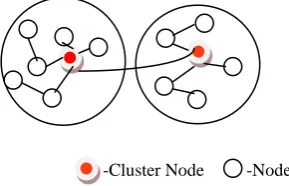
CBR is a cluster-based routing protocol and this protocol is mainly developed for traffic signals in urban area. CBR protocol adopted the idea of carry and forward for data delivery. Several near vehicles can be grouped to form one cluster and each cluster has one cluster-head which is responsible for intra and inter-cluster management functions. Inter –cluster nodes can be communicating with a direct links and intra cluster nodes are communicating through cluster header. In cluster- based routing protocols the formation of clusters and the selection of the cluster-head is more important [9]as shown in figure 3.
[image:4.595.61.206.264.357.2]-Cluster Node -Node
Fig 3 Cluster-based routing methods
In CBR protocol consists of two types of message to communicate. They are LEAD message and LEAVE message.
The geographic area can be divided into a number of grids .Each grid contains one cluster header. The cluster header broadcasts a LEAD message to its neighbors with the coordinate of its grid and the location of cluster header. Whenever the header is leaving the grid, it will broadcast a LEAVE message containing its grid position. An intermediate node stores it until a new cluster header is selected. The new cluster header uses this information for data routing. The cluster-based protocols do not need to find out the direction and speed of vehicles.
1.8
Reliable Broadcast Protocols
VANET is a subclass of MANET [10]. Routing of data depends on the routing protocols being used in the network. The VANET consists of many applications such as driver assistant or safety transport application need reliable broad casting protocols to provide accurate and reliable service. Each vehicle can send messages to all the other vehicles in a same network are called as broadcast routing protocols. The few reliable broadcasting protocols such as DECA, ABSM [11], DV-Cast [12] etc. The reliable broadcast protocols can be designed to broadcast the message with low bandwidth and reduce the number of retransmission.
1.8.1
DECA routing protocol
Density aware broadcasting protocol (DECA) is a reliable broadcasting routing protocol for dissemination in VANET with store and forward techniques. It can transmit the data which uniform speed that simple flooding does and reduce the duplicate data retransmission by using density information to the adjacent nodes. DECA uses beacon message for transferring information with each neighbor node. The preferable node for forwarding the message is selected from a maximum number of neighbor nodes. The preferred node will be chosen by pre-cursor and response to the rebroadcast the message.
1.8.2
RSSI Routing Algorithm
In DECA protocols select the preferable node based on the maximum neighbors’ node. Which node has the maximum neighbor node and broadcast the packet to the preferred node. In this scenario, the preferable node has low transmission range and it is possible occurring packet loss through transmission. This is due to an asymmetric link problem. Asymmetric link scenario, it is impossible to achieve 100% of delivery ratio. In unicasting routing protocols, when the asymmetric link problem exists, they use route repairing to choose another path for transmitting data. But, this cannot be applied to broadcasting protocols. To avoid the problem, the new algorithm was developed to overcome this issue [13].
The new algorithm named RSSI (Received signal strength indicator) can improve protocol performance and overhead on asymmetric scenarios. In this algorithm, the preferred node can be selected based on received signal strength indicator (RSSI). So RSSI can be determined based on the new algorithm called an RSSI voting algorithm. In the RSSI voting algorithm every node vote for the received signal strength indicator level node from their neighbor node.
If a sender node wants to broadcast the message, it will choose the neighbor node which has the majority vote has a preferable node. So we focus on the selection of a preferred node with a broadly transmission range and cover the maximum number of neighbors. In DECA selects a neighbor node with a maximum number of neighbors. So a node in DECA is trying to select a node that can maximize the number of neighbors.
So a node in DECA is trying to select a node that can maximize number of received nodes in one retransmission. But in a symmetric link scenario, the selected node may have a short transmission range. Therefore, its retransmission has low probability of success and reaches to fewer neighbors than expectation. So , the new algorithm can be selected to increase probability of success transmission.
Node2 (voting 3)
Node3 (voting 2)
Node4 (voting 1) Node1 (center node)
[image:5.595.75.249.86.245.2]Node5 (voting 5)
Figure 4 RSSI voting Algorithm
1.8.3
DV-CAST Routing protocol
DV-CAST is a multi-hop broadcast routing protocol in VANETs and is mainly suitable for sparse traffic scenarios, dense traffic scenarios and regular traffic scenarios. This protocol is mainly introduced to reduce the protocol overhead.
In DV-CAST, each vehicle monitors the status of neighboring vehicles all the time to make the broadcasting decisions. If a vehicle Vi receives a new broadcast message, Vi firstly checks whether vehicles exist behind. If it is true, the broadcast suppression is adopted to forward the broadcast message; otherwise, Vi forwards the broadcast message via the traffic flow in the opposite direction. After Vi broadcasting message, Vi overhears for a period of time to ensure that the message is successfully broadcasted if the direction of Vi is different from the source vehicle. Fig. 5 shows that the broadcast message is initiated by VS and it is forwarded from group 1 to group 2. Although groups 1, 2, and 3 are dense group, groups 1 and 2 encounter the temporary network fragmentation problem. Group 1 cannot directly forward packets to group 2. In this case, vehicle VA can forward packets to group 3 which is in the opposite direction, then vehicle VB forwards packets to group 2. Observe that, the temporary network fragmentation problem is also considered in the design of broadcasting.
Group 1 Group 2
VS VA
VB
[image:5.595.352.528.115.195.2]Group 3
Fig. 5 DV-CAST routing protocol.
1.8.4
Broadcast methods for Inter-vehicle
communications system protocol
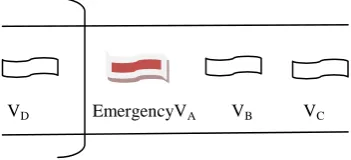
Inter-vehicle communications system protocols are suitable for communicating emergency information. For example, the Ambulance can broadcast the emergency information to the nearby vehicles. According to the purpose of emergency information, the broadcasting methods can be divided into two categories. They are i) Emergency-vehicle-approach and ii) traffic accident information. The Emergency-vehicle-approach is mainly used to announce the emergency information to the front of the current vehicles and no
need to announce the behind vehicles. But, in the Traffic accident information is used to announce the accident information only to the behind of the current vehicles [14] .
VD EmergencyVA VB VC
Fig. 6 Broadcast area for emergency information.
Fig.6 shows that Vehicles VA is used to broadcast the message to the
vehicle VB and not necessary to broadcast the behind vehicles VD.
Vehicle VB is located in the relay range, it re-broadcasts the
emergency information. Vehicle VC is located in the notification
range but not in the relay range, VC just receives the emergency
information and not to re-broadcast.
1.8.5
ABSM protocol
Acknowledgement Broadcast from static to highly mobile (ABSM) protocol is suitable for high mobility with urban and highway scenarios in VANET. ABSM use the techniques of CDS, NES and store carry forward paradigm. Each vehicle is equipped with GPS to find out the position of vehicles and easy to calculate a CDS. Similar to PBSM, each vehicle in ABSM maintain two lists such as R and N to reduce the redundant broadcast message [15].
R= maintain the list in each vehicles buffer who have received the message.
N= maintain the list who needs to receive the message.
For example the source node a generates a broadcast message and send to the neighbor nodes as b, c and d, which it belongs to the CDS. The receivers set up a short time -out waiting period and check it belongs to the other CDS, if it retransmits the message. The receiver vehicles do not find out any vehicles in the CDS, the receiver setup a longer time-out waiting period. When the time-out waiting period expired, then the message is removed from the vehicles buffer.
[image:5.595.49.256.558.649.2]2.
COMPARSION
OF
VARIOUS
ROUTING PROTOCOLS
2.1
Table-1
Protocols DSDV GPSR AODV DSV
Prior forwarding
Wireless multihop forwarding
heuristic
method
Wireless multihop forwarding
Wireless multihop forwarding
Scenario Urban Urban Urban Urban
Strategy Multihop forwarding
Carry& forward
Carry& forward
Carry& forward
Realistic Traffic flow
Yes Yes Yes Yes
Digital Map needed
No No No No
Virtual infrastructure
No No No No
Routing type Unicast Unicast Unicast Unicast
2.2
Table-2
Protocols CBR DECA
DV-CAST
ABSM
Prior forwarding
Wireless multihop forwardin g
heuristic
method
Wireless multihop forwarding
Wireless multihop forwarding
scenario Urban highway highway highway
Strategy Multihop forwardin g
Carry& forward
Carry& forward
Carry& forward
Realistic Traffic flow
No Yes Yes Yes
Digital Map needed
Yes No No No
Virtual infrastructure Requirement
Yes No No No
Routing type Unicast broadca st
broadcast broadcast
3.
PERFORMANCE COMPARISON
The performance of the system is of paramount importance to the design team. Performance analysis entails the balancing of response time (the delay) and throughput. Response time to individual users must be weighed against total throughput for all users. Fast response time requires that minimum delay be encountered in moving the message through the network. Small delay relies on relatively short message in order to reduce the time required to receive and check all bits of the message. Fast response time also benefits from shorter message queues, since the shorter
queues will decrease the aggregate waiting time for message processing.
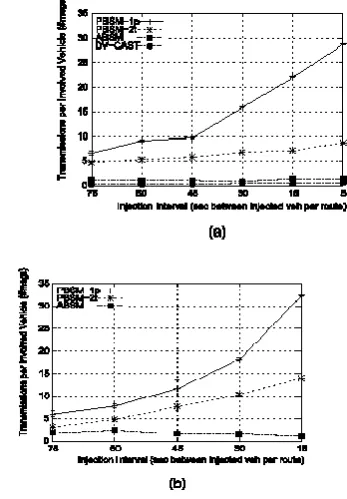
Let us focus on the comparative performance of various protocols such as AODV, GPSR, DV-CAST, PBSM, and ABSM. According to the simulation results ABSM provides better performance when compared to the other protocols such as AODV, GPSR, DV-CAST, and PBSM. Among them, ABSM provide the highest reliability for broadcasting the packet in both urban and highway scenario and achieves the best results. In ABSM, 94.1 percent of the vehicles could receive the message successfully. When compared to the PBSM, 7 percent of throughput will be increased in ABSM and compared to DV-CAST, ABSM provide very high reliability.
[image:6.595.33.292.72.649.2]In DV_CAST provide poor reliability and only minimum number of vehicles should receive the packets successfully as shown in fig 7.
Fig. 7. Throughput (a) Highway. (b) Suburban.
As compared to DSDV and AODV, GPSR shows higher throughput rate at the entire simulation time. DSDV drops a number of packets due to invalid routes taken into account and rapidly changing routes through the fast moving nodes are required for inter-group traffic and are fairly long. DSDV is totally not suitable for high mobility and only 35 percent of the packet can be sent successfully. As compared to DSDV, AODV provide little better performance.
[image:6.595.364.538.272.522.2]14
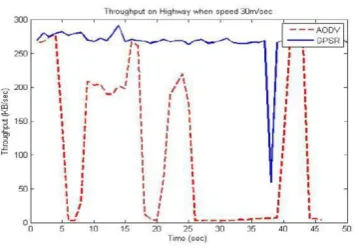
Figure 8: Throughput Scenario with 30 m/s node speed
Figure 8 depicts the performance of AODV and GPSR protocols with node speed of 30 m/s i.e., 108 km/h. The fig 10 shows AODV throughput is decrease suddenly when it reaches 270 KB/Sec and dramatically increase in a couple of seconds and again decrease when it reaches 270 KB/Sec. From 26 to 39 seconds throughput is almost zero and the performance of throughput is poor when compared to GPSR. In GPSR, throughput is constant for a certain period of time and suddenly increase when reaches 15 KB/Sec. From 36 seconds, throughput is dramatically decreasing and again increases within a second. When compared to AODV, GPSR provide high reliability and the throughput is affected if the node speed become higher.
[image:7.595.42.227.443.570.2]As compared with fig 7 and fig 8, ABSM routing protocol provides better performance when compared to all the protocols given above. So from this scenario it can be concluded that ABSM out performs PBSM, DV-CAST, GPSR in terms of throughput and creates lower delay in network as shown in fig 9.
Fig 9. Performance of Protocols
4.
PROPOSED SYSTEM
After completely studying the protocols in VANET , ABSM still have some limitations is there while producing the throughput. In ABSM , Acknowledgement list can increased in the data structure and time-delay problem can occur. As a further enhancement, research work has concentrated mainly on to introduce a new protocol in VANET environment with the new features as to limit the size of acknowledgement list in a beacon message and also to reduce the waiting time. In the proposed system , the sender vehicles keeps copies of all transmitted data until they have been acknowledged. Instead of sending single message, the protocol designed to send a group of message to all the neighbor vehicle in the CDS and the receiver send single acknowledgement to confirm the receipt of multiple message.Due to this proposed methods waiting time will also be reduced.This research work can come up with a better solution with the existing one.
5.
CONCLUSION
Several protocols are surveyed in which few may have some challenges. Protocols are developed especially for urban area and few protocols have been developed for usage in highways or rural area. Nowadays, many broadcasting protocols suit the need for both urban and highway environments. The protocols are not designed for wireless communication between cars to the car but also designed for predictability and regularity of buses. Packages can also be transmitted by switching between common vehicles and buses so that the routes would be more feasible and scalable.
According to the simulation results of above mentioned various protocols; it can vary performance and protocols overhead. As a further work to extend the research new techniques are used to develop new protocols which will be introduced to give better performance than the existing protocols. We predict the tendency of designing a routing protocol for VANETS must be low
communication overhead, low time cost, and high adaptability for the city, highway, and rural environments.
6.
REFERENCES
[1] Strategy for Efficient Routing in V ANET 978-1-4244-6716-711 0/$26.00 ©20 1 0 IEEE.
[2] ”Stochastic Broadcast for VANET” 978-1-4244-5176-0/10/$26.00 ©2010 IEEE.
[3] 201O International Conference on Networking and Information Technology “An Application of Routing Protocols for Vehicular Ad-hoc Networks”.
[4]D. B. Johnson and D. A. Maltz, "Dynamic Source Routing in Ad Hoc Wireless Networks," in Mobile Computing, vol. 353: Kluwer Academic Publishers, 2011, pp. 153-181.
[5] C. Perkins, E. Belding-Royer, S. Das, "Ad hoc On- Demand Distance Vector (AODV) Routing", RFC 3561, July 2012. [6] 20IO 3rd International Conference on Advanced Computer
Theory and Engineering (ICACTE) “Improved AODV Routing Protocol for Vehicular Ad hoc Networks”.
[7] Evaluation of ad-hoc routing protocols in vehicular ad-hoc network using OPNET “2011 11th International Conference on ITS Telecommunications”.
[8]. Bus Assisted Connectionless Routing Protocol for Metropolitan VANET 2011 Fifth International Conference on Genetic and Evolutionary Computing.
[9] A Cluster-Based Directional Routing Protocol in VANET “978-1-4244-6871-3/10/$26.00 ©2010 IEEE”.
[10] M. Nekovee, and B. Bjarni Bogason, "Reliable and efficient information dissemination in intermittently connected vehicular ad hoc networks,"IEEE the 65th VTC'07-Spring, Dublin, Ireland, April 22-25, 2007.
[11] F. 1. Ros, P. M. Ruiz, and I. Stojmenovic, "Reliable and efficient broadcasting in vehicular ad hoc networks," IEEE the 69th Vehicular Technology Conference (VTC'09), Barcelona, Spain, April 26-29, 2009.
[12] O. K. Tonguz, N. Wisitpongphan, F. Bai, P. Mudalige and V. Sadekar, "Broadcasting in VANET,"Proc. IEEE INFOCOM MOVE Workshop 2007, Anchorage, USA, 2007.
[13].2011 International Symposium on Intelligent Signal Processing and Communication Systems (ISPACS) December 7-9, 2011 Improving Reliable Broadcast over Asymmetric VANETs Based on a RSSI-Voting Algorithm.
[14] Routing Protocols in Vehicular Ad Hoc Networks: A Survey and Future Perspectives “JOURNAL OF INFORMATION SCIENCE AND ENGINEERING 26, 913-932 (2010). [15]Acknowledgment-Based Broadcast Protocol for Reliable and
Efficient Data Dissemination in Vehicular Ad Hoc Networks IEEE TRANSACTIONS ON MOBILE COMPUTING, VOL. 11, NO. 1, JANUARY 2012 33