• No results found

An Operation Network for Abstractive Sentence Compression

N/A
N/A
Protected

Academic year: 2020

Share "An Operation Network for Abstractive Sentence Compression"

Copied!
12
0
0

Loading.... (view fulltext now)

Full text

(1)

Proceedings of the 27th International Conference on Computational Linguistics, pages 1065–1076 1065

An Operation Network for Abstractive Sentence Compression

Naitong Yu Jie Zhang∗ Minlie Huang† Xiaoyan Zhu State Key Laboratory of Intelligent Technology and Systems Tsinghua National Laboratory for Information Science and Technology Dept. of Computer Science and Technology, Tsinghua University, Beijing, PR China

Microsoft Search Technology Center

[email protected] [email protected]

[email protected] [email protected]

Abstract

Sentence compression condenses a sentence while preserving its most important contents. Delete-based models have the strong ability to delete undesired words, while generate-based models are able to reorder or rephrase the words, which are more coherent to human sen-tence compression. In this paper, we propose Operation Network, a neural network approach for abstractive sentence compression, which combines the advantages of both delete-based and generate-based sentence compression models. The central idea of Operation Network is to model the sentence compression process as an editing procedure. First, unnecessary words aredeleted

from the source sentence, then new words are eithergeneratedfrom a large vocabulary orcopied

directly from the source sentence. A compressed sentence can be obtained by a series of such edit operations (delete,copyandgenerate). Experiments show that Operation Network outperforms state-of-the-art baselines.

1 Introduction

Sentence compression is the natural language generation (NLG) task of condensing a sentence while preserving its most important contents. It can also be viewed as a sentence-level summarization task. With the rapid growth of the web contents in recent years, summarization techniques such as sentence compression are becoming more and more important since these techniques can greatly reduce the infor-mation overload on the web. Sentence compression can benefit a wide range of applications, especially those on mobile devices which have restricted screen spaces. Sentence compression models can be broadly classified into two categories: delete-based models and abstractive models. Delete-based ap-proaches remove unimportant words from the source sentence and generate a shorter sentence by stitch-ing the remainstitch-ing fragments together. On the contrary, abstractive models consider operations beyond word deletion, such as reordering, substitution and insertion. Abstractive sentence compression models produce a reform of the source sentence from scratch, thus the results produced by abstractive sentence compression models are more expressive. Obviously, abstractive sentence compression is much harder than delete-based sentence compression, since it needs deeper understanding of the source sentence.

Delete-based sentence compression treats the task as a word deletion problem: given an inputsource

sentence x = x1, x2, ..., xn(wherexi stands for theith word in the sentence x), the goal is to produce

atargetsentence by removing any subset of words in the source sentence x (Knight and Marcu, 2002). Delete-based sentence compression has been widely explored across different modeling paradigms, such as noisy-channel model (Knight and Marcu, 2002; Turner and Charniak, 2005), large-margin learn-ing (McDonald, 2006; Cohn and Lapata, 2007), integer linear programmlearn-ing (Clarke and Lapata, 2008) and variational auto-encoder (Miao and Blunsom, 2016). In delete-based sentence compression models, onlydeleteoperations are allowed, thus the order of the remaining words can not be changed. These con-straints make delete-based sentence compression a relatively easier task. However, in spite of the strong ability of deleting undesired words, delete-based models are not able to rephrase the words, which is far

Corresponding author: Minlie Huang ([email protected])

(2)

from human sentence compression. For example, in human sentence compression, the word “remove” can replace the phrase “get rid of” under some particular circumstance, but this substitution can not be accomplished by delete-only models.

Abstractive sentence compression has the ability to reorder, substitute words or rephrase, thus it is more coherent to human sentence compression. Due to the difficulty of abstractive sentence compression, there was only a limited number of work on the task (Cohn and Lapata, 2008; Cohn and Lapata, 2013; Galanis and Androutsopoulos, 2011; Coster and Kauchak, 2011a). However, with the recent success of the sequence-to-sequence (Seq2Seq) model, the task of abstractive sentence compression has become viable. Seq2Seq has an encoder-decoder architecture where the encoder encodes the input sequence into hidden states, and the decoder then generates the output sequence from the hidden states. The atten-tion mechanism (Bahdanau et al., 2014), which can align the output sequence with the input sequence automatically, boosts the performance of Seq2Seq significantly. A number of abstractive sentence com-pression work has been built upon the Seq2Seq architecture with attention mechanism, such as (Chopra et al., 2016; Wubben et al., 2016; Nallapati et al., 2016; See et al., 2017). These abstractive models (which will be termedgenerate-based models hereafter) have the ability to reorder words or rephrase. However, none of these models consider explicit word deletion. As Coster and Kauchak (2011b) pointed out, deletion is a frequently occurring phenomena in sentence compression dataset. Coster and Kauchak (2011a) imposed delete operation on their sentence compression model and improved the performance significantly. Thus, deletion is also very important for abstractive sentence compression task.

Inspired by previous work, we propose an Operation Network for abstractive sentence compression, which combines the advantages of both delete-based and generated-based sentence compression. The central idea is to model the sentence compression process as an editing procedure. We not only enable the model with a strong ability of word deletion inspired from delete-based models, but also endow the model with the ability of word reordering and word rephrasing inspired from generate-based models.

With a series of editing operations, the source text can be transformed into a condensed version of itself. There are three kinds of editing operations in our model: delete, copyand generate. Given a source text as input, first thedeleteoperations remove unnecessary words from the source text yet retain the important content. Then, the summary is constructed by thecopy andgenerateoperations. Copy

operations duplicate words directly from the selected source text, while generateoperations produce words which are not in the source texts. Our model is built upon the Seq2Seq framework, and can be trained in an end-to-end fashion.

To summarize, the contributions of this paper are as follows:

• We propose Operation Network, a neural framework for abstractive sentence compression, which models the sentence compression task as a series of editing operations.

• Our Operation Network combines the advantages of both delete-based and generate-based sentence compression. The model is equipped with a strong ability of not only word deletion, but also word reordering and word rephrasing. Experiments show that our model outperforms the baselines.

2 Task Definition

We formulate the problem of abstractive sentence compression discussed in this paper as follows: Given a source sentence X = (x1, x2, ..., xn) as input, the goal is to generate a target sentence Y = (y1, y2, ..., ym), m < n, which is a condensed version of X with good readability and retains

the most important information inX. Essentially, the model estimates the conditional probability as follows:

P(Y|X) =

m

Y

t=1

P(yt|y<t,X). (1)

3 Background: Seq2Seq Model

(3)

a source sequenceX = (x1, x2, ..., xn), and outputs a sequence of hidden statesh= (h1, h2, ..., hn).

The decoder takeshas input and outputs the target sequenceY = (y1, y2, ..., ym).

In both encoder and decoder, we use gated recurrent unit (GRU) (Cho et al., 2014; Chung et al., 2014) as the basic unit. We use a directional RNN (Schuster and Paliwal, 1997) as encoder. A bi-directional RNN contains two distinct RNNs, a forward RNN and a backward RNN. Given the input X = (x1, x2, ..., xn) and the embedding lookup tablee, the forward RNN reads the input in the

left-to-right direction, resulting a sequence of forward hidden states−→h = (−→h1, − →

h2, ..., − →

hn), where

− →

ht =

GRU(−→ht−1, e(xt)). Similarly, the backward RNN reads the input in the reversed direction and outputs ←−

h = (←−h1, ←−

h2, ..., ←−

hn). At each time step, we concatenate the hidden states of the corresponding

forward and backward RNNs and obtain the encoder hidden states h = (h1, h2, ..., hn), where ht =

[−→ht;

←−

ht],t= 1, ..., nand[A;B]denotes vector concatenation.

In the decoder for general Seq2Seq model, another GRU is used for updating the decoder hidden states. Given a context vectorctand the previously decoded wordyt−1, the decoder hidden states are

updated as follows:

st=GRU(st−1,[ct;e(yt−1)]) (2)

The context vectorctis designed to dynamically attend on key information of the input sentence during

the decoding procedure (Bahdanau et al., 2014).ctis calculated as a weighted sum of the encoder hidden states:

ct= n

X

k=1

αtkhk (3)

αt = (αt1, αt2, ..., αtn) is called theattention distribution. It can be viewed as a probability

distri-bution over the source words, which tells the decoder where to attend to produce the next word. The attention distribution is calculated as follows:

αtk =softmax(etk) =

exp(etk)

Pn

j=1exp(etj)

(4)

etk =va>tanh(Wast−1+Uahk+ba) (5)

whereva,Wa,Uaandbaare trainable parameters.

The vocabulary distributionPtvocat time steptis calculated as follows:

Ptvoc=softmax(Wo0(Wo[st;ct] +bo) +b0o) (6)

whereWo0,Wo,boandb0oare trainable parameters.Ptvocis a probability distribution over all words in the

vocabularyV, and the output wordytat time steptis calculated as follows:

yt= arg max w P

voc

t (w), w∈V (7)

During training, the loss for time steptis the negative log likelihood of the target wordy∗t: losst =

−logPtvoc(yt∗). The overall loss function for the whole word sequence is: loss= T1

Y

PTY

t=1losst, where TY is the length of the target word sequenceY.

4 Operation Network

(4)

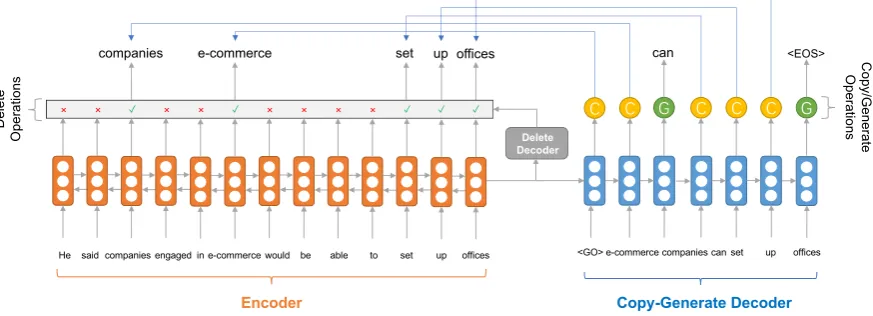
sentence is encoded by the encoder, the delete decoder will first delete unnecessary words from the input sentence, then the copy-generate decoder will produce the output sentence either by copying from the choices of the delete decoder, or generating from a fixed vocabulary. The overall architecture of our model is shown in Figure 1.

× × ✓ × × ✓ × × × × ✓ ✓ ✓

De

le

te

Op

er

at

io

ns

Co

py

/G

en

er

ate

Op

er

ati

on

s

<GO> He said companies engaged in e-commerce would be able to set up offices

companies e-commerce set up offices can <EOS>

e-commerce companies can set up offices

Copy-Generate Decoder

Encoder

[image:4.595.81.518.136.294.2]

Delete Decoder

Figure 1: Operation Network, which consists of an encoder, a delete decoder and a copy-generate de-coder.

4.1 Delete Decoder

The delete decoder “deletes” all unimportant words from the sentence. It takes as input the sequence of the encoder hidden states h = (h1, h2, ..., hn), the text sequenceX = (x1, x2, ..., xn), and outputs a

sequenced= (d1, d2, ..., dn), which has the same lengthn.di ∈[0,1], i∈1,2, ..., n. Ifdi is close to0,

then the corresponding wordxitends to be deleted. Otherwise ifdi is close to1, then the corresponding

wordxitends to be kept. The output sequencedwill be used together with the copy-generate decoder

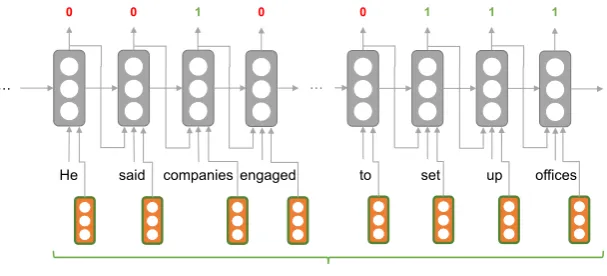
which we will discuss in Section 4.2. The architecture of the delete decoder is shown in Figure 2. For decoding step tin the delete decoder, we feed the decoder with the embedding of wordxt, the

previous decoder outputdt−1and the context vectorct. The delete decoder states are updated as follows:

st=GRU(st−1,[ct;e(xt);dt−1]) (8)

dt=σ(Wdsdt+bd) (9)

whereσ is the sigmoid function,ct is the context vector calculated in the same way as Equation 3, e

denotes the word embedding table, andWdandbdare trainable parameters.

The output of the delete decoder,d= (d1, d2, ..., dn), is fed into the copy-generate decoder for further

calculation.

4.2 Copy-Generate Decoder

The Copy-Generate decoder produces output the compressed sentence word by word, and the output words are either copied from the input words which are filtered by the delete decoder, or generated with a fixed vocabulary. In other words, our model integrates copy, generate, delete operations together to produce the output sequence.

(5)

He said companies

0 0 1

engaged 0

Context Vectors

to set up

0 1 1 1

[image:5.595.147.451.66.204.2]

offices

Figure 2: Delete Decoder.

training procedure, we also add supervision on these operations (see Section 4.3). We find that explicit operation supervision can lead to better results. Last, unlike Gu et al. (2016) and Gulcehre et al. (2016), where copy operations are only used for handling UNK tokens (special tokens which stand for out-of-vocabulary words) or named entities, in our model, copy operations are triggered much frequently as long as the output word can be copied from the input sentence. This is useful especially when the training dataset is relatively small.

The Copy-Generate decoder takes as input the encoder hidden states h = (h1, h2, ..., hn) and the

attention distributions α = (α1, α2, ..., αn), and outputs the target sentence as a sequence of words

Y = (y1, y2, ..., ym). At each step of decoding, a switch network is used to decide whether to use copy

mode or generate mode. If copy mode is chosen, the word is copied directly from the source words (filtered by the delete decoder). We use the attention distributions to sample the source words. The output of the delete decoder is used to modify the attention distributions to filter out unwanted words. Otherwise, if generate mode is chosen, the word is generated from the fixed vocabulary. Specifically, for words that are neither in the source sentence nor in the vocabulary, the switch network will choose generate mode and UNK tokens will be produced from the decoder.

The Copy-Generate decoder use another distinct GRU to update its decoder hidden states as follows:

s0t=GRU(s0t−1,[ct;e(yt−1)]) (10)

wheres0tis the decoder hidden state at time stept,ctis the context vector,edenotes the word embedding

table, andyt−1is the previous decoded output.

At each time stept, the switch network calculatesgenerate probabilityas follows:

ggent =σ(Wz[s0t;ct] +bz) (11)

gtgenacts as a soft switch to choose between generate mode and copy mode.

In generate mode, the target word is sampled from the vocabulary distributionPtvoc(see Equation 6). In copy mode, first we use the outputs of the delete decoder d (see Section 4.1) to mask and re-normalize the attention distributionαt:

α0t= Pn 1

i=1diαti

(d1αt1, d2αt2, ..., dnαtn) = (α0t1, α0t2, ..., α0tn). (12)

Then the target word is sampled from the modified attention distributionα0t.

For each sentence, let theextended vocabularyV0denotes the union of the vocabularyV and all words appearing in the source sentence, then the final probability distribution over the extended vocabularyV0

is:

Pt(w) =ggent Ptvoc(w) + (1−g gen t )

X

k:w=xk

(6)

wherexkdenotes thekth words in the source sequenceX. The output wordytat time steptis sampled

from the final distributionPt:

yt= arg max

w Pt(w), w∈V 0

(14)

4.3 Loss Function

The total loss consists of two parts: the loss from delete decoder and the loss from copy-generate decoder.

4.3.1 Delete Decoder Loss

The delete decoder loss measures the difference between the target deletion sequence and the actual deletion sequence predicted by the delete decoder. The delete decoder loss is calculated as follows:

delete loss= 1

TX TX

X

t=1

−dˆtlogdt−(1−dˆt) log(1−dt)

(15)

whereTX is the length of the source word sequenceX, anddˆis the target deletion sequence,dˆt = 0if

wordxtshould be deleted, otherwise, if wordxtshould be kept,dˆt= 1.

4.3.2 Copy-Generate Decoder Loss

At each time stept, the copy-generate decoder loss can be divided into three parts: the switch loss, the copy loss and the generate loss. The switch loss measures the difference between the target switch and the predicted switch by the model. The copy loss measures the difference between the target attention distribution and the actual attention distribution predicted by the model. And the generate loss measures the loss between the target vocabulary distribution and the generated vocabulary distribution at that time step. The losses at time steptis calculated as follows:

switch losst=−ˆggent logg gen t

−(1−gˆtgen) log(1−gtgen) (16)

copy losst=−(1−gˆtgen) log

X

k:y∗

t=xk

α0tk (17)

gen losst=−ˆggent logPtvoc(y∗t) (18)

whereˆgtgen= 1if target is ingenerate modeat time stept, otherwise, if target is incopy mode,gˆgent = 0.

yt∗denotes the target word at time stept.

The overall copy-generate loss function for the target compressed sentence is as follows:

copy gen loss= 1

TY TY

X

t=1

(switch losst+copy losst+gen losst) (19)

whereTY is the length of the target word sequenceY.

5 Experiments

In this section, we introduce the experiments for abstractive sentence compression with our proposed Operation Network. First, we present a brief description of the dataset, and the pre-processing procedure in our experiments. Then, we introduce baselines that are compared with our model. Next, we introduce parameters of our models in the experiments. At last we present and analyze the experiment results.

5.1 Dataset

(7)

news journals, and technical documents sampled from the Open American National Corpus (OANC1). Of all the source texts, 3,769 are single sentences and the rest are 2-sentence short paragraphs. Each pair of the source and compressed text is aligned by the state-of-the-art monolingual aligner Jacana (Yao et al., 2013). The dataset is split into a training set (21,145 pairs), a validation set (1,908 pairs) and a test set (3,370 pairs). The dataset is available online2.

The alignment information together with the pair of source text and compressed text are used for gen-erating operation sequences for our experiments. Specifically, for each pair of the source and compressed text, a delete operation sequence and a copy/generate sequence are generated. The delete operation se-quence is a sese-quence ofdelete/retaintokens which has the same length with the source text. For each word in the source text, if the word exists in the compressed text or is aligned by the aligner, the corre-sponding token in the delete operation sequence isretain. On the other hand, if the word neither exists in the compressed text nor aligned by the aligner, the corresponding token in the delete operation sequence should be delete. The copy/generate operation sequence is a sequence ofcopy/generatetokens which has the same length with the compressed text. For each word in the compressed text, if the word is aligned by the aligner and is the same as its counterpart, then the corresponding token in the sequence is

copy, which means this word is copied from the source text. If the word is not aligned or not the same as its counterpart, then the corresponding token in the sequence is set to generate, which means this word is generated from the vocabulary. The reason we didn’t putdelete,copyandgenerateoperations in a single sequence is thatdeleteoperations are source-text-based operations whilecopyandgenerate

operations are target-text-based operations. It is consistent with that the delete operation sequence has the same length as the source text and the copy/generate operation sequence has the same length as the compressed text.

5.2 Baselines

We compared the abstractive sentence compression results generated by our model (Operation Network) with those by two baselines. These baselines consist of a generate-only model (Seq2Seq) and a generate + copy model (Pointer-Generator). The details of the baselines are described as follows:

• Seq2Seq: Seq2Seq is an generate-only model similar to the model described by Nallapati et al. (2016). It uses the same bi-directional RNN encoder and attention mechanisms as our model. The decoder of Seq2Seq model can only generate words from the fixed vocabulary.

• Pointer-Generator: Pointer-Generator is a model proposed by See et al. (2017). It uses a hybrid pointer-generator network that can copy words from source text or generate words directly from a large vocabulary. This model also use coverage to keep track of what has been summarized, which discourage repetition. Refer to See et al. (2017) for more details.

5.3 Experiment Parameters

For all experiments, we use 300-dimensional word embeddings. We also use the pre-trainedGoogleNews

vectors to initialize the embeddings. For words do not exist inGoogleNewsvectors, we initialize them randomly. The vocabulary size is set to 20,000. We also use the large vocabulary tricks described by Jean et al. (2014). The sampled vocabulary size is set to 4,096. The hidden state of a single GRU is 256-dimensional. To overcome overfitting, we also imposed dropout on the input, output and state vector of the GRUs. The dropout probability is set to 0.5.

We trained the models on a single Nvidia Titan X GPU with a batch size of 32. During training, we used Stochastic Gradient Descent with an initial learning rate of 0.15, and applied the exponential decay to the learning rate as the training process proceeds. At test time, the output sentences are decoded using beam search with beam size 4.

1

http://www.anc.org/data/oanc

2The dataset can be downloaded from the project’s website

(8)

5.4 Experiment Metric

In the experiments, we compare our model and the baselines with the following metrics.

Compression Ratio: The common assumption in compression research is that the system can make the determination of the optimal compression length. Thus, compression ratios can vary drastically across systems. Different systems can be compared only when they are compressing at similar ra-tios (Napoles et al., 2011). Compression ratio is defined as:

CompRatio= # of tokens in compressed text

# of tokens in source text (20)

ROUGE: We evaluated our models with the standard ROUGE metric proposed by Lin (2004).

ROUGE stands for Recall-Oriented Understudy for Gisting Evaluation. It is commonly used for mea-suring the quality of the summary by comparing computer-generated summaries to reference summaries generated by humans. The basic idea of ROUGE is to count the number of overlapping units such as n-grams, word sequences, and word pairs between computer-generated summaries and the reference summaries. In our experiments, we considered ROUGE-1, ROUGE-2 and ROUGE-L (which respec-tively measures the word-overlap, bigram-overlap, and longest common sequence between the reference summary and the summary to be evaluated).

BLEU:We also report BLEU scores of the baseline models and Operation Network on the test dataset. BLEU is proposed by Papineni et al. (2002), and is usually used for automatic evaluation of statis-tical machine translation systems. However, it can also be used for evaluating sentence compression task (Napoles et al., 2011). We use the multi-bleu script3for BLEU score calculation.

5.5 Result Analysis

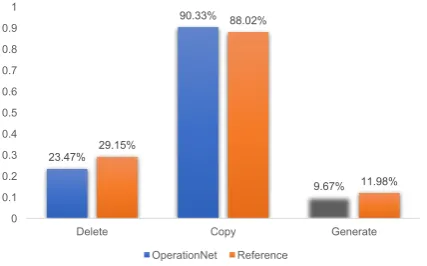
We present the average ratios of the operations in Operation Network’s outputs and the human-written references on the test dataset in Figure 3. Note that the delete ratio is calculated as the number of delete operations divide by the number of tokens insourcetext, and the copy and generate ratio is calculated as the number of copy and generate operations divided by the number of tokens in compressed text, respectively. From the figure we can see that Operation Network can utilize the operation information to help accomplish the sentence compression task. The average delete ratio in Operation Network is lower than in human reference, since there are multiple references for one source text in the dataset, and the Operation Network learns to delete a token only it is deleted in most of the references. The average copy ratio is higher in Operation Network than in human reference, this may suggest that Operation Network tends to copy words directly from the source text whenever it is possible.

23.47%

90.33%

9.67% 29.15%

88.02%

11.98%

0 0.1 0.2 0.3 0.4 0.5 0.6 0.7 0.8 0.9 1

Delete Copy Generate

[image:8.595.194.408.525.658.2]

OperationNet Reference

Figure 3: The average ratios ofdelete,copyandgenerateoperations of Operation Network and human-written references on the test dataset.

Table 1 shows the average compression ratios (%), ROUGE and BLEU scores of the baseline models and Operation Network on the test dataset. The second column shows the average compression ratios.

3https://github.com/moses-smt/mosesdecoder/blob/master/scripts/generic/multi-bleu.

(9)

The average compression ratio is calculated as the average of the compression ratios of all the compressed text outputs in the test dataset. We can see that the average compression ratios of both our model and the other two baselines are similar. Thus, the comparison between our model and the baseline models is fair. Since we have employed the delete decoder in Operation Network, the average compression ratio of our model is lower than the other baselines.

CompRatio (%) ROUGE-1 ROUGE-2 ROUGE-L BLEU

Seq2Seq 69.39 30.05 10.42 26.87 18.32

Pointer-Generator 66.59 35.34 16.57 32.56 25.09

OperationNet 65.53 36.21 17.43 33.72 26.30

Table 1: Average compression ratios (%), ROUGE and BLEU scores of the models on the test dataset. Statistically significant improvements (p <0.01) over the baselines are demonstrated by bold fonts.

From Table 1 we can see that the generate-only model (Seq2Seq) performs poorly compared to its counterparts. This is due to the fact that the Seq2Seq model can only generate words from a fixed vocab-ulary. When the training dataset is relatively small (about 21k pairs of source and compressed text), the model may not be trained adequately. We tried the same models with random-initialized word embed-dings and withGoogleNews-vector-initialized word embeddings and it turned out that random-initialized word embeddings lead to worse performance. The copy-and-generate model (Pointer-Generator) per-forms much better than the generate-only model. This is because the copy operations allow to copy words directly from the source texts and the attention distribution is much smaller than the vocabulary distribution and easier to train. With the addition of delete operation, our model (Operation Network) outperforms the other baselines in terms of all three ROUGE metrics and the BLEU metric. Results show that the delete operations can effectively filter out unnecessary words from the source texts and lead to better performance. This can also show that the Operation Network is suitable for the abstractive sentence compression task.

In order to evaluate the quality of the summaries produced by our model and the other baselines, we ask annotators to do a score evaluation on some aspects of the summaries. Specifically, we ask them to score the grammaticality and non-redundancy of the summaries. Annotators are instructed to read the summary carefully and rate each aspect with scores matching the quality of the corresponding aspect. Each aspect is rated with a score from 0 (bad) to 5 (excellent). We randomly sample 100 samples from the test set for evaluation. Each summary generated by our model or baselines is rated by at least 5 annotators. The summaries are randomly reordered and model information is anonymous to the annotators. The evaluation result is shown in Table 2.

Grammaticality Non-Redundancy

Seq2Seq 2.53 2.24

Pointer-Generator 3.46 3.58

OperationNet 3.23 3.64

Table 2: Results of aspect evaluation.

(10)

6 Related Work

Delete-based sentence compression.A large number of work is devoted to delete-based sentence com-pression. Jing (2000) presented a system that used multiple sources of knowledge to decide which phrases in a sentence can be removed. Knight and Marcu (2000) proposed statistical approaches to mimic the sentence compression process, they used both noisy-channel and decision-tree to solve the problem. McDonald (2006) presented a discriminative large-margin learning framework coupled with a feature set and syntactic representations for sentence compression. Clarke and Lapata (2006) com-pared different models for sentence compression across domains and assessed a number of automatic evaluation measures. Clarke and Lapata (2008) used integer linear programming to infer globally op-timal compression with linguistically motivated constraints. Berg-Kirkpatrick et al. (2011) proposed a joint model of sentence extraction and compression for multi-document summarization. Filippova and Altun (2013) presented a method for automatically building delete-based sentence compression corpus and proposed an compression method which used structured prediction.

Abstractive sentence compression. Abstractive sentence compression extends delete-based com-pression methods with additional operations, such as substitution, reordering and insertion. Cohn and Lapata (2008) proposed a discriminative tree-to-tree transduction model which incorporated a gram-mar extraction method and used a language model for coherent output. Galanis and Androutsopoulos (2011) presented a dataset for extractive and abstractive sentence compression and proposed a SVR based abstractive sentence compressor which utilized additional PMI-based and LDA-based features. Shafieibavani et al. (2016) proposed a word graph-based model which can improve both informativeness and grammaticality of the sentence at the same time.

Neural sentence compression. Filippova et al. (2015) proposed a delete-based sentence compression system which took as input a sentence and output a binary sequence corresponding to word deletion deci-sions in the sentence. The model was trained on a set of 2 millions sentence pairs which was constructed by the same approach used in Filippova and Altun (2013). There are also some neural approaches for ab-stractive sentence compression. Rush et al. (2015) proposed a fully data-driven approach which utilized neural language models for abstractive sentence compression. They tried different kinds of encoders to encode the input sentence into vector representation of fixed dimensions. Chopra et al. (2016) further im-proved the model with Recurrent Neural Networks. However, both works used vocabularies of fixed size for target sentence generation. Wubben et al. (2016) used a Seq2Seq model with bi-directional LSTMs for abstractive compression of captions. Toutanova et al. (2016) manually created a multi-reference dataset for sentence and short paragraph compression and studied the correlations between several auto-matic evaluation metrics and human judgment.

7 Conclusion

In this paper, we propose Operation Network, a neural approach for abstractive sentence compression, which combines the advantages of both delete-based and generate-based abstractive sentence compres-sion. The central idea of Operation Network is to model the sentence compression process as an editing procedure. With 3 kinds of operations (delete, copyandgenerate), Operation Network can transform the source sentence into the condensed target. Operation Network is implemented based on the neural Seq2Seq network and pointer network, which consists of a delete decoder and a copy-generate decoder. Given a source sentence as input, first the delete decoder deletes unnecessary words from the source sentence, then new words are eithergenerated from a large vocabulary orcopiedfrom the source sen-tence with the copy-generate decoder. The model is equipped with a strong ability of not only word deletion, but also word reordering and word rephrasing. Experiments show that the model outperforms the baselines.

Acknowledgements

(11)

References

Dzmitry Bahdanau, Kyunghyun Cho, and Yoshua Bengio. 2014. Neural machine translation by jointly learning to align and translate. arXiv preprint arXiv:1409.0473.

Taylor Berg-Kirkpatrick, Dan Gillick, and Dan Klein. 2011. Jointly learning to extract and compress. In Proceed-ings of the 49th Annual Meeting of the Association for Computational Linguistics: Human Language Technolo-gies, pages 481–490. Association for Computational Linguistics.

Kyunghyun Cho, Bart van Merrienboer, Caglar Gulcehre, Dzmitry Bahdanau, Fethi Bougares, Holger Schwenk, and Yoshua Bengio. 2014. Learning phrase representations using rnn encoder–decoder for statistical machine translation. InProceedings of the 2014 Conference on Empirical Methods in Natural Language Processing, pages 1724–1734. Association for Computational Linguistics.

Sumit Chopra, Michael Auli, and Alexander M Rush. 2016. Abstractive sentence summarization with attentive recurrent neural networks. Proceedings of NAACL-HLT16, pages 93–98.

Junyoung Chung, Caglar Gulcehre, Kyunghyun Cho, and Yoshua Bengio. 2014. Empirical evaluation of gated recurrent neural networks on sequence modeling. arXiv preprint arXiv:1412.3555. Presented at the Deep Learning workshop at NIPS2014.

James Clarke and Mirella Lapata. 2006. Models for sentence compression: A comparison across domains, training requirements and evaluation measures. InProceedings of the 21st International Conference on Computational Linguistics and the 44th Annual Meeting of the Association for Computational Linguistics, pages 377–384. Association for Computational Linguistics.

James Clarke and Mirella Lapata. 2008. Global inference for sentence compression: An integer linear program-ming approach. Journal of Artificial Intelligence Research, 31:399–429.

Trevor Cohn and Mirella Lapata. 2007. Large margin synchronous generation and its application to sentence compression. InEMNLP-CoNLL, pages 73–82.

Trevor Cohn and Mirella Lapata. 2008. Sentence compression beyond word deletion. InProceedings of the 22nd International Conference on Computational Linguistics, pages 137–144. Association for Computational Linguistics.

Trevor Cohn and Mirella Lapata. 2013. An abstractive approach to sentence compression. ACM Transactions on Intelligent Systems and Technology (TIST), 4(3):41.

William Coster and David Kauchak. 2011a. Learning to simplify sentences using wikipedia. InProceedings of the Workshop on Monolingual Text-To-Text Generation, MTTG ’11, pages 1–9, Stroudsburg, PA, USA. Association for Computational Linguistics.

William Coster and David Kauchak. 2011b. Simple english wikipedia: a new text simplification task. In Proceed-ings of the 49th Annual Meeting of the Association for Computational Linguistics: Human Language Technolo-gies: short papers-Volume 2, pages 665–669. Association for Computational Linguistics.

Katja Filippova and Yasemin Altun. 2013. Overcoming the lack of parallel data in sentence compression. In Proceedings of the 2013 Conference on Empirical Methods in Natural Language Processing, pages 1481–1491. Association for Computational Linguistics.

Katja Filippova, Enrique Alfonseca, Carlos Colmenares, Lukasz Kaiser, and Oriol Vinyals. 2015. Sentence compression by deletion with lstms. InProceedings of the 2015 Conference on Empirical Methods in Natural Language Processing. Association for Computational Linguistics.

Dimitrios Galanis and Ion Androutsopoulos. 2011. A new sentence compression dataset and its use in an abstrac-tive generate-and-rank sentence compressor. InProceedings of the UCNLG+Eval: Language Generation and Evaluation Workshop, pages 1–11. Association for Computational Linguistics.

Jiatao Gu, Zhengdong Lu, Hang Li, and Victor O.K. Li. 2016. Incorporating copying mechanism in sequence-to-sequence learning. InProceedings of the 54th Annual Meeting of the Association for Computational Linguistics, pages 1631–1640. Association for Computational Linguistics.

(12)

S´ebastien Jean, Kyunghyun Cho, Roland Memisevic, and Yoshua Bengio. 2014. On using very large target vocabulary for neural machine translation. arXiv preprint arXiv:1412.2007.

Hongyan Jing. 2000. Sentence reduction for automatic text summarization. InProceedings of the sixth conference on Applied natural language processing, pages 310–315. Association for Computational Linguistics.

Kevin Knight and Daniel Marcu. 2000. Statistics-based summarization - step one: Sentence compression. In Pro-ceedings of the Seventeenth National Conference on Artificial Intelligence and Twelfth Conference on Innovative Applications of Artificial Intelligence, pages 703–710. AAAI Press.

Kevin Knight and Daniel Marcu. 2002. Summarization beyond sentence extraction: A probabilistic approach to sentence compression. Artificial Intelligence, 139(1):91–107.

Chin-Yew Lin. 2004. Rouge: A package for automatic evaluation of summaries. InText summarization branches out: Proceedings of the ACL-04 workshop, volume 8. Barcelona, Spain.

Ryan McDonald. 2006. Discriminative sentence compression with soft syntactic evidence. In11th Conference of the European Chapter of the Association for Computational Linguistics, pages 297–304.

Yishu Miao and Phil Blunsom. 2016. Language as a latent variable: Discrete generative models for sentence compression. InConference on Empirical Methods in Natural Language Processing (EMNLP).

Ramesh Nallapati, Bowen Zhou, Cicero dos Santos, Caglar Gulcehre, and Bing Xiang. 2016. Abstractive text summarization using sequence-to-sequence rnns and beyond. InProceedings of the 20th SIGNLL Conference on Computational Natural Language Learning (CoNLL), pages 280–290. Association for Computational Lin-guistics.

Courtney Napoles, Benjamin Van Durme, and Chris Callison-Burch. 2011. Evaluating sentence compression: Pitfalls and suggested remedies. In Proceedings of the Workshop on Monolingual Text-To-Text Generation, pages 91–97. Association for Computational Linguistics.

Kishore Papineni, Salim Roukos, Todd Ward, and Wei-Jing Zhu. 2002. Bleu: a method for automatic evaluation of machine translation. InProceedings of the 40th annual meeting on association for computational linguistics, pages 311–318. Association for Computational Linguistics.

Alexander M. Rush, Sumit Chopra, and Jason Weston. 2015. A neural attention model for sentence summariza-tion. InProceedings of the 2015 Conference on Empirical Methods in Natural Language Processing, pages 379–389. Association for Computational Linguistics.

Mike Schuster and Kuldip K Paliwal. 1997. Bidirectional recurrent neural networks.IEEE Transactions on Signal Processing, 45(11):2673–2681.

Abigail See, Christopher Manning, and Peter Liu. 2017. Get to the point: Summarization with pointer-generator networks. InAssociation for Computational Linguistics.

Elaheh Shafieibavani, Mohammad Ebrahimi, Raymond K Wong, Fang Chen, Robert J Durrant, and Kee-Eung Kim. 2016. An efficient approach for multi-sentence compression. InProceedings of the 8th Asian Conference on Machine Learning.

Ilya Sutskever, Oriol Vinyals, and Quoc V Le. 2014. Sequence to sequence learning with neural networks. In Advances in Neural Information Processing Systems, pages 3104–3112.

Kristina Toutanova, Chris Brockett, Ke M. Tran, and Saleema Amershi. 2016. A dataset and evaluation metrics for abstractive compression of sentences and short paragraphs. InProceedings of the 2016 Conference on Empirical Methods in Natural Language Processing, pages 340–350. Association for Computational Linguistics.

Jenine Turner and Eugene Charniak. 2005. Supervised and unsupervised learning for sentence compression. In Proceedings of the 43rd Annual Meeting on Association for Computational Linguistics, ACL ’05, pages 290– 297, Stroudsburg, PA, USA. Association for Computational Linguistics.

Oriol Vinyals, Meire Fortunato, and Navdeep Jaitly. 2015. Pointer networks. InNeural Information Processing Systems.

Sander Wubben, Emiel Krahmer, Antal van den Bosch, and Suzan Verberne. 2016. Abstractive compression of captions with attentive recurrent neural networks. In Proceedings of the 9th International Natural Language Generation Conference. Association for Computational Linguistics.

Figure

Figure 1: Operation Network, which consists of an encoder, a delete decoder and a copy-generate de-coder.
Figure 2: Delete Decoder.
Figure 3: The average ratios of delete, copy and generate operations of Operation Network and human-written references on the test dataset.

References

Related documents

We propose a novel graph-based attention mechanism in a hierarchical encoder- decoder framework, and propose a hierarchical beam search algorithm to generate multi-sentence

We consider the problem of using sentence compression techniques to facilitate query- focused multi-document summarization.. We present a sentence-compression-based frame- work for

This paper presents a 2-step approach for sentence compression: we first generate an n-best list for each source sentence using a sequence labeling method, then rerank the

Con- ventional approaches to sentence compression ex- ploit various linguistic properties based on lexical information and syntactic dependencies (McDonald, 2006; Clarke and

% Dependency Tree Based Sentence Compression K atja Filippova and Michael Strube EML Research gGmbH Schlo? Wolfsbrunnenweg 33 69118 Heidelberg, Germany http //www eml research

Abstractive News Summarization based on Event Semantic Link Network Proceedings of COLING 2016, the 26th International Conference on Computational Linguistics Technical Papers,

We consider the task of summarizing a cluster of related sentences with a short sentence which we call multi-sentence compression and present a simple ap- proach based on shortest

ILPSumm also outperforms the MSC-based method, i.e., our approach can generate more informative summaries by glob- ally maximizing content selection from multiple clusters