Effect of Lanthanum Addition on Microstructure and Hardness as
Cooling Rate Function of ADC12 Eutectic Cast Alloy
R. Ahmad
1,aand M. B. A. Asmael
1,b1,Department of Manufacturing and Industrial Engineering, Faculty of Mechanical and
Manufacturing Engineering, Universiti Tun Hussein Onn Malaysia, 86400, Parit Raja, Johor, Malaysia
a[email protected], b[email protected]
Keywords: Aluminum, Lanthanum, solidification rate, Hardness
Abstract. This paper presents the experimental investigation conducted on ADC12 cast alloy. The main objective of the research is to investigate the effect of 1.5%La addition with different cooling rate on microstructure and hardness value of ADC12 cast alloy. The Ceramic Mold with different thickness dimensions was use to obtained different cooling rate. The Si structure became modified by increase the cooling rate of base alloy. With La addition the Si size observed smaller area than base alloy when the cooling rate increases. In addition, the higher cooling rate and La addition improves the hardness specially at lower thickness with La addition.
Introduction
Aluminum alloys are widely used in the transport industry due to their relative low density. They allow approximately 50% weight saving over competing ferrous materials. Recently, it has been estimated that 20% of the total worldwide aluminum production is converted into cast components and about 70% of all aluminum castings are used in the transport industry, in particular in the automotive sector [1]. The addition of alkali or alkaline earth elements changes the morphology of eutectic silicon from flake like to branched fibers. The mechanism of eutectic modification is still not yet fully understood. For a long time, alterations in the growth of eutectic silicon by a large increase in twin density were used to explain eutectic modification, but more recent studies have shown that modification changes the nucleation frequency and dynamics of eutectic grains with associated effects on the growth rate [2, 3]. Cooling rate is one of the most important variables which affects microstructure and mechanical properties of cast alloys [4]. High cooling rate decreases grain size, shrinkage porosity, and causes more uniform distribution of porosity. Also, it modifies primary and eutectic silicon and decreases the size of them. Segregation between dendrites and grain boundaries decreases with increasing cooling rate [4, 5]. In addition to heat treatment and alloying elements, higher cooling rates have strongly affected the mechanical properties and microstructure of near eutectic Al–Si [6]. Lanthanum meets most of these requirements, while cerium and neodymium have a low solubility in α-aluminum. Fluidity, in the foundry science, is defined as the ability of molten metal to flow before it was stopped by solidification [7, 8]. The present study aimed to investigate the effect of high of Lanthanum on microstructure and hardness in different cooling rate of ADC12 Al-11Si-Cu cast alloy.
Experimental Produce
Material Preparation
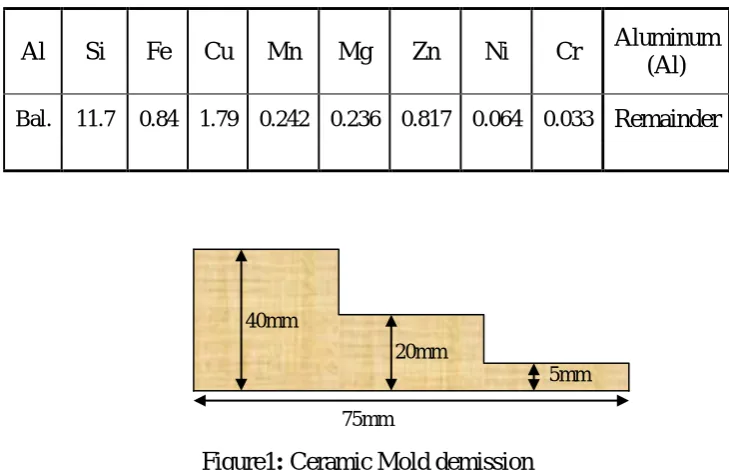
cross-sectional thickness of 5mm,20mm,40mm as shown in Fig 1. The microstructure analysis was carryout by by Nikon optical microscope and all simples were etched by 5Hf solution. A hardness measurement was conducted by using a Vickers hardness tester.
Table 1: Chemical Composition of ADC12 (Al-Si-Cu) Alloy.
Al Si Fe Cu Mn Mg Zn Ni Cr Aluminum
(Al)
Bal. 11.7 0.84 1.79 0.242 0.236 0.817 0.064 0.033 Remainder
Figure1: Ceramic Mold demission
Result and Discussion
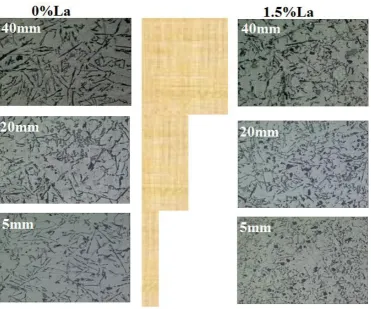
Fig. 2 showed the microstructure images of base alloy and treated alloy with 1.5%Ce of different cooling rate. The base alloy shows the flake–plate like and continuously reduces with increase the cooling rate which confirmed by image analysis result. The Si area decrease with increase cooling rate (lower thickness) at 5mm section 34.5µm2 while the higher thinness 40mm obtained 68.3 µm2 and 41.8 µm2 at 20mm as showed in Fig3. Similar result was obtained by LFC [4]. With La addition showed the significant effect on Si with higher thickness (lower solidification rate) the Si particles decrease and showed very irregular, smaller, longitudinal, sharp-edged structures and a refined Si morphology comparing to base alloy. La addition decrease size of Si to 34.16 µm2 at 40mm section and slightly decreases with other sections 31.84 and 28.6 µm2 of 20mm, 5mm respectively. The influence of high amount of La on size of Si that due to ability of La to reduce the eutectic growth and forming intermetallic phases with alloy element [3, 9]. As reported by by Hongkun, et al. [10, 11] while studied the compound and microstructure of La Cu-containing hypereutectic Al–Si alloy and (A390) while La compound can indicated during Al-Si phase and Al-Cu phase such as Al-Si-La and Al-Si-Cu-Al-Si-La. It is well known that the rare earth Al-Si-La is one type of surface active agent. In addition, Lu and Hellawell proposed that a growth twin will be created at the interface when the ratio (the atomic radius of the modification elements relative to that of silicon) is close to 1.646. For La, rLa/rSi is 1.56 closed to the values 1.646 [9].
75mm 20mm
Figure2: Microstructure images of ADC12 cast alloy and La containing alloy as a function of cooling rate
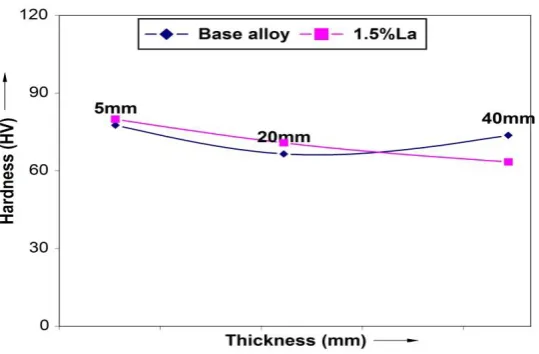
Figure 4: Hardness value of ADC12 alloy and La treaded alloy as a function of cooling rate
As showed in Fig 4, the cooling and La addition had significant effect on hardness of Al-Si-Cu. The hardness of base alloy increase slightly, by about 5% at high cooling rate. Similar result was obtained by O. El Sebaie, et al. [12]. The La containing alloy observed decrease in hardness at lower cooling rate 40mm. This decrease may due on α-Al matrix and degree to modification and effect of cooling rate on eutectic temperature on Al-Cu phase which increase with lower cooling rate and more Al-Cu-La compounds nucleate and decrease the hardness [12]. Higher hardness value can obtained by increase the cooling rate at La containing alloy which increase slightly, by about 3% at 5mm section. This increase may due effect of La on α-Al phase will form the harder intermetallic compounds such as LaAl4 [13, 14]. The hardness has increased with high amount of La and Ce which is in agreement with Ravi, et al. [15] and El Sebaie, et al.[12]. The increment in microhardness is due to the increase in the quantity of the relatively hard-phase Al–La present [15]. Furthermore, La and Ce addition formed the hard intermetallic compounds with other alloying elements in the matrix and consumption of certain amount of Mg toward formation of these compounds [12, 15] .
Conclusion
The effect of high of Lanthanum on microstructure and hardness in different cooling rate of ADC12 Al-11Si-Cu cast alloy was investigated. The result showed that addition La refiner Si particles and reduce the size to 50% at lower cooling rate. With increase the cooling rate the stricture of Si was refiner and reduces the size to 17% at higher cooling rate 5mm. The La intermetallic compounds caused to improve the hardness. The hardness value improved 3% by La addition with higher cooling rate. In addition, the hardness of base alloy increases with increase the cooling rate.
Acknowledgement:
This research is funded by Fundamental Research Grant Scheme (FRGS), vot number 1422, Ministry of Education.
References
[4] M. Karimian, A. Ourdjini, M.H. Idris, M.B.A. Asmael, Advanced Materials Research, 264 (2011) 295-300.
[5] V. Hosseini, S. Shabestari, R. Gholizadeh, Materials & Design, 50 (2013) 7-14.
[6] L. Zhang, Y. Jiang, Z. Ma, S. Shan, Y. Jia, C. Fan, W. Wang, Journal of Materials Processing Technology, 207 (2008) 107-111.
[7] M.B.A. Asmael, R. Ahmad, A. Ourdjini, Applied Mechanics and Materials, 465 (2014) 839-842. [8] M. Di Sabatino, L. Arnberg, Metall. Sc. and Tech., Teksid Aluminum, 22 (2004) 9-l5.
[9] Y.-C. Tsai, C.-Y. Chou, S.-L. Lee, C.-K. Lin, J.-C. Lin, S. Lim, Journal of Alloys and Compounds, 487 (2009) 157-162.
[10] H. Yi, D. Zhang, T. Sakata, H. Mori, Journal of Alloys and Compounds, 354 (2003) 159-164. [11] H. Yi, D. Zhang, Materials Letters, 57 (2003) 2523-2529.
[12] O. El Sebaie, A. Samuel, F. Samuel, H. Doty, Materials Science and Engineering: A, 486 (2008) 241-252.
[13] Y. Chen, Q. Li, Z. Jiang, Journal of the Less Common Metals, 110 (1985) 175-178. [14] M. Zhang, X. Meng, R. Wu, C. Cui, L. Wu, Kovove Mater, 48 (2010) 211-216.