Available online www.jocpr.com
Journal of Chemical and Pharmaceutical Research, 2016, 8(9):117-123
Research Article
ISSN : 0975-7384
CODEN(USA) : JCPRC5
117
μ-Peroxo Binuclear Cobalt(III) Complexes of Some Azamacrocyclic Ligands:
Synthesis, Characterization and Antimicrobial Studies
Saswata Rabi, Tapashi G Roy*, Saroj KS Hazari, Benu K Dey and Debashis Palit
Department of Chemistry, University of Chittagong, Chittagong-4331, Bangladesh
___________________________________________________________________________________
ABSTRACT
The tetraazamacrocyclicdiene ligand, Me6[14]diene (L) on reduction with sodium borohydrate yielded isomeric
saturated ligands ‘tet-a’ and tet-b’, whereas 3,10-C-meso-Me8[14]diene (L1) yielded isomers, LA, LB and LC. Reactions
of tet-a, tet-b, LB and LC with cobalt(II) perchlorate hexahydrate produced brown µ-peroxo binuclear cobalt(III)
complexes corresponding to the molecular formula, [(H2O)L*Co-O-O-CoL*(H2O)](ClO4)4 ( L* = ‘tet-a’, ‘tet-b’, LB or
LC). However similar reactions with L, L1 and LA did not produce such type of complexes. The complexes have been
characterized on the basis of elemental analysis, spectroscopic, magnetochemical and molar conductivity data. The antibacterial activities of the ligands and their complexes have been investigated.
Keywords: Azamacrocycles; Isomeric ligands; Binuclear µ-peroxocobalt(III) complexes; Spectroscopic analysis; Antimicrobial studies
___________________________________________________________________________________
INTRODUCTION
The fourteen membered tetraazamacrocycles and their complexes have taken a considerable position for their wide variety of applications. They are applicable in magnetic resonance imaging (MRI) [1], pharmacological [2], radioimmunotherapy [3], analytical [4] and industrial [5] field. They are also well recognized due to their resemblance to the naturally occurring macrocyclic complexes. These macrocyclic ligands and complexes are also important because of their antifungal [6], antibacterial [7], anticancer [8] and antitumor [9] activity.
From the recent research reports [10-15], it is evident that, complexation of dioxygen plays an important role in various biological systems. Involvement of dioxygen in the biological reactions is very fast with synthetic caged dioxygen carrier [16]. Extensive research has focused on the coordination chemistry of naturally occurring dioxygen complexes, i.e. haemoglobin, haemerythrin, haemocyanin and their model compounds [10]. Cobalt(II) complexes of polyamines, amino acids and dipeptide ligands containing dicobalt µ-peroxo or µ-superperoxo-bridged derivatives have been studied extensively, because of their applicability to biochemical system [16]. In these complexes, the binding of oxygen is accompanied in many cases, by the transfer of electrons from the metal center to the oxygen molecules, and thus the oxidation state of the metal atom changes. In view of this, peroxo-bridged dicobalt complexes are often regarded as models for biological oxygen carriers. So a number of reports [16-18] on such type of complexes of cobalt(III), ruthenium(III) and iron(II) are available in the literature.
_____________________________________________________________________________________________
118
Chart-1
EXPERIMENTAL SECTION
Materials and equipment
All chemicals were of analytical grade (Sigma Aldrich) or equivalent grades and were used without further purification. The solvents were of reagent grade and dried according to standard procedure. Equipments used were of standard ones.
Synthesis
Preparation of ligands: The parent ligands L [24] and L1 [25] were prepared by the method described in literature. The ligand L on reduction with sodium borohydrate produced two isomeric ligands, tet-a and tet-b, whereas L1 yielded three isomers LA, LB and LC. The separation and isolation of isomers ‘tet-a’&‘tet-b’ [24] and LA, LB & LC [25] have been carried out as procedure adopted in literature.
µ-Peroxo binuclear cobalt(III) complexes of ‘tet-a’& ‘tet-b’: The isomeric ligands ‘tet-a’ & ‘tet-b’(0.160 g, 0.5 mmol) and cobalt(II) perchlorate hexahydrate (0.183 g, 0.5 mmole) were dissolved separately in a minimum volume of cold methanol and water respectively and mixed. Sodium perchlorate hexahydrate (0.5 g) was added to this and the mixture was allowed to stand overnight. The brown precipitate formed was filtered off, washed with ethanol, followed by ether and dried in vacuum. [Calcd. for complex of ‘tet-a’ (%): C, 36.25; H, 3.80; N, 5.28. Found C, 36.20; H, 3.82; N, 5.26. Calcd. for complex of ‘tet-b’(%):C, 36.25; H, 3.80; N, 5.28. Found C, 36.23; H, 3.79; N, 5.24].
µ-Peroxo binuclear cobalt (III) complexes of LB and LC: The above mentioned procedure was adopted to prepare the
complexes with the isomeric ligands, LB and LC.[Calcd. for complex of LB (%): C, 38.87; H, 3.99; N, 5.04. Found C, 38.85; H, 3.95; N, 5.02.Calcd.for complex of LC (%): C, 38.87; H, 3.99; N, 5.04. Found C, 38.83 H, 3.98; N, 5.06].
Physical measurements: UV- visible spectra were recorded on a Shimadzu UV-visible spectrophotometer in pure DMSO. Conductance measurements were carried out on a conductivity bridge Hanna instrument HI-8820 in pure DMSO, then by dissolving in DMSO and diluting with acetonitrile and water to make the solution of 5% DMSO in acetonitrile and water respectively. Magnetic measurements were performed on Gouy Balance which was calibrated using Hg[Co(NCS)4]. IR spectra were recorded on a Shimadzu IR 20 spectrophotometer as KBr disks. Microanalyses of the complexes were carried out on a C, N, H analyzer at the Inorganic research laboratory in the Hamburg University, Germany. 1H-NMR spectra were recorded in DMSO with a 400 MHz Bruker DPX-400 spectrometer using TMS as internal standard at the BCSIR Laboratory, Dhaka, Bangladesh.
Antibacterial activities: Antibacterial activities of the ligands and their complexes against selected gram-positive and gram-negative bacteria were investigated by the disc diffusion method. Paper disc (6 mm in diameter) and Petri plates (70 mm in diameter) were used throughout the experiment. Pour plates were made with sterilized melted nutrient agar NA (45°C) and after solidification of pour plates, the test organisms (suspension in sterilized water) were spread uniformly over the pour plates with sterilized glass rod separately. The paper discs after soaking with test chemicals (1mg/mL in DMSO) were placed at the center of the inoculated pour plates. A control plate was also maintained in each case with DMSO. The plates firstly were kept for four hours at low temperature (4°C) and the test chemicals diffused from disc to the surrounding medium by this time. The plates were then incubated at (35±2)°C for growth of test organisms and were observed at 24-hour and 48 hours intervals. The activity was expressed in terms of zone of inhibition in mm. The results for all compounds have been reported after subtracting values for solvent DMSO itself. Tests were repeated twice.
RESULTS AND DISCUSSION
_____________________________________________________________________________________________
119
A few peroxo-bridged dicobalt(III) complexes of 14-membered tetraazamacrocycles have been isolated in solid state [26-31]. The reaction in some cases are very rapid [31] while in others, prolonged aeration is required [32]. The cobalt(II) complexes of 14- membered tetra azamacrocycles have been reported as low spin (t2g
6 eg
1
) [Co(N4)(OH2)2]
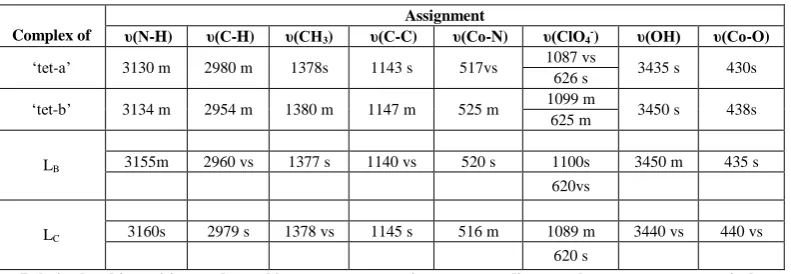
[image:3.595.108.490.74.126.2]2-species of yellow color prior to oxygenation [33]. But in present case µ-peroxocobalt(III) complxes were formed immediately after addition of ligand solution into aqueous cobalt(II) perchlorate hexahydrate solution. Such as interaction of the ligands ‘tet-a’, ‘tet-b’, LB and LC with cobalt (II) perchlorate hexahydrate produced brown product in each case. Elemental analysis, IR spectral data (Table-1), molar conductivity data (Table-3), electronic spectral data (Table-2) and 1H-NMR data (Table-2) are fully consistent with molecular formula [(H2O) L* Co-O-O-Co L* (H2O)](ClO4)4 [ where L*= ‘tet-a’, ‘tet-b’ LB or LC] (Chart-1). The concerned complexes are found to be diamagnetic as expected for low spin d6 system.
Table 1: IR spectral data
Complex of
Assignment
υ(N-H) υ(C-H) υ(CH3) υ(C-C) υ(Co-N) υ(ClO4-) υ(OH) υ(Co-O)
‘tet-a’ 3130 m 2980 m 1378s 1143 s 517vs 1087 vs 3435 s 430s 626 s
‘tet-b’ 3134 m 2954 m 1380 m 1147 m 525 m 1099 m 3450 s 438s 625 m
LB
3155m 2960 vs 1377 s 1140 vs 520 s 1100s 3450 m 435 s
620vs
LC
3160s 2979 s 1378 vs 1145 s 516 m 1089 m 3440 vs 440 vs
620 s
Relative band intensities are denoted by s, m, w, vs, meaning strong, medium, weak, very strong, respectively
Table 2: Electronic and 1H-NMR spectral data; sh, s, d, a, e mean shoulder, singlet, doublet, axial, equatorial respectively
Complex of λmax(€max)in nm CH3 signals (δ ppm)
‘tet-a’ 674(91), 500(147), 441(190), 340(3,666), 263(8,000) 1.30a (s, 12H), 1.40e (s, 12H), 1.51e(d, 12H) ‘tet-b’ 660(110), 510(142), 443(182), 341(3600), 264(7,930) 1.29a (s, 12H), 1.46e (s, 12H) 1.50e (d, 12H)
LB 493sh(161), 436sh(193), 336(3,720), 259sh(10,000) 1.28
a (s, 12H), 1.50e (s, 12H), 1.44e (d, 12H) 1.48e (d, 12H)
LC 495(150), 438(178), 338(3,712), 260(9,110) 1.27
[image:3.595.102.498.282.419.2]a (s, 12H), 1.51e (s, 12H) 1.33a (d, 12H) 1.48e (d, 12H)
Table 3: Molar Conductivity data
Complex of In DMSO In (DMSO: Acetonitrile) (5:95) (ohm-1cm2mole-1) In (DMSO: Water) (5:95) (ohm-1cm2mole-1) (ohm-1cm2mole-1)
‘tet-a’ 33 376 350
‘tet-b’ 29 380 355
LB 32 375 357
LC 39 368 365
IR spectra
The infrared spectra (Table-1) of these complexes display υ(NH) bands at 3130-3160 cm-1, υ(ClO4-) bands at 1087-1100 cm-1and 620-626 cm-1. The positions as well as non-splitting of bands [34] at around 1080 cm-1 strongly support the non-coordination of ClO4
ions. Appearance of υ(OH) bands at 3435-3450 cm-1 is due to coordination of water molecules. The spectra further exhibit υ(C-H), υ(CH3) and υ(C-C) bands at 2954-2980 cm-1, 1377-1380 cm-1 and 1143-1147 cm-1 respectively. The bands at 517-525 cm-1 can be attributed to υ(Co-N) band. The spectra of the complexes also reveal υ(Co-O) bands at 430-440 cm-1.
Electronic Spectra
The present complexes have a very low solubility in water and other common solvents except DMSO, hence their electronic spectra were run in DMSO. The electronic spectra of these complexes display shoulders at around 500 nm due to 1A1g →1T1g (oh) d-d transition, whereas the expected same bands sometimes are obscured by the tail of the strong charge transfer band [30,31]. The brown color of the complexes is due to an intense charge transfer band assigned to π* O22- → dz2 Co(III) [30,31] transition in the ultra violet region tailing into the visible region. This charge transfer band
CoIIIL O2 K1
K2
+ CoIIILO2
-CoIIILO2
-
+ CoIIL [LCoIIIO22-CoIIIL]4+(i)
[image:3.595.92.506.456.605.2]_____________________________________________________________________________________________
120
occurs in the 341-259 nm region with € in the range of 3600 to 10000 dm3M-1cm-1. This strong charge transfer bands is in accord with µ-peroxo formulation. Appearance of a band/shoulder around 650-675 nm in case of complexes with tet-a tet-and tet-b ctet-an be tet-assigned to d-d btet-and for the formtet-ation of [CoL(H2O)2](ClO4)3 species due to slight decomposition of µ-peroxo species in solution, which can be shown by the following expression,
[(H2O)L′Co-O-O-CoLʹ(H2O)](ClO4)4 → [CoL′(H2O)2](ClO4)3 (iii)
[image:4.595.141.452.180.321.2][ L′ =‘tet-a’ or ‘tet-b’ ]
Table 4: Antibacterial activities of the compounds against gram-positive bacteria
Ligands and their complexes Gram positive bacteria
B. cereus B.subtilies S. aureus
[(H2O)(‘tet-a’)Co-O-O-Co(‘tet-a’)(H2O)](ClO4)4 18 15 16 [(H2O)(‘tet-b’)Co-O-O-Co(‘tet-b’)(H2O)](ClO4)4 17 20 18 [(H2O)(LB)Co-O-O-Co(LB)(H2O)](ClO4)4 11 15 10 [(H2O)(LC)Co-O-O-Co(LC)(H2O)](ClO4)4 10 12 10
‘tet-a’ 0 0 0
‘tet-b’ 0 0 0
LB 0 0 0
LC 0 0 0
DMSO 2 3 2
Co(ClO4)2.6H2O 2 3 2
Ampicillin 30 25 32
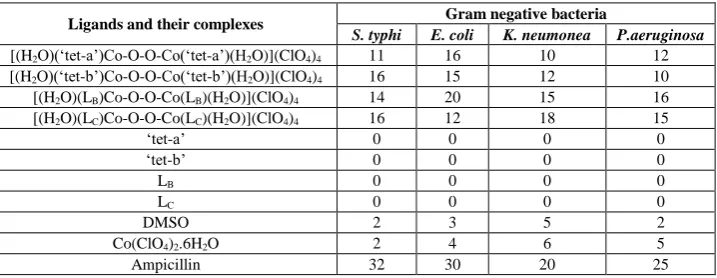
Table 5: Antibacterial activities of the compounds against gram-negative bacteria
Ligands and their complexes Gram negative bacteria
S. typhi E. coli K. neumonea P.aeruginosa
[(H2O)(‘tet-a’)Co-O-O-Co(‘tet-a’)(H2O)](ClO4)4 11 16 10 12 [(H2O)(‘tet-b’)Co-O-O-Co(‘tet-b’)(H2O)](ClO4)4 16 15 12 10 [(H2O)(LB)Co-O-O-Co(LB)(H2O)](ClO4)4 14 20 15 16 [(H2O)(LC)Co-O-O-Co(LC)(H2O)](ClO4)4 16 12 18 15
‘tet-a’ 0 0 0 0
‘tet-b’ 0 0 0 0
LB 0 0 0 0
LC 0 0 0 0
DMSO 2 3 5 2
Co(ClO4)2.6H2O 2 4 6 5
Ampicillin 32 30 20 25
Some µ-peroxodicobalt(III) complexes decompose in acidic solutions to the corresponding diaqua complexes [27] [CoL(H2O)2]
3+
. But in the case of [(H2O)Co(Me2[14]dieneN4)]2O2 4+
, the products of acid decomposition are [Co(H2O)6]3+and Me2[14]dieneN4.2HClO4 [31]. Similarly the present µ-peroxodicobalt(III) complexes with ligands LB and Lc undergo decomposition in 6M HClO4 giving insoluble white products corresponding to Lʹʹ.4HClO4 (Lʹʹ= LB or LC) and pink solutions, while the electronic spectra of pink solution correspond to that of [Co(H2O)6](ClO4)2 with a λmax at 519 nm. But these complexes with ‘tet-a’ and ‘tet-b’ are very stable as no noticeable decomposition occurs in these cases even after adding concentrated HClO4.
Conductance
The molar conductivity values (Table-3) of [(H2O)L*Co-O-O-Co L*(H2O)](ClO4)4 in pure DMSO deviate significantly from expected values for 1:4 electrolytes, rather corresponds to almost non electrolyte [10,35,36] which may be due to conversion of (1) to (2) in DMSO solution as shown by the following conversion. While not implying a co-ordination number greater than 6 for the cobalt(III) centre, some association between all perchlorate anions and complex is implied in reducing conductivity of the solutions as observed in related cases [37,38].
[(H2O)L*Co-O-O-CoL*(H2O)](ClO4)4 → [(H2O)L*Co-O-O-CoL*(H2O)(ClO4)4] (iv) (1) (2)
[image:4.595.120.479.349.488.2]_____________________________________________________________________________________________
121
1H-NMR Spectra
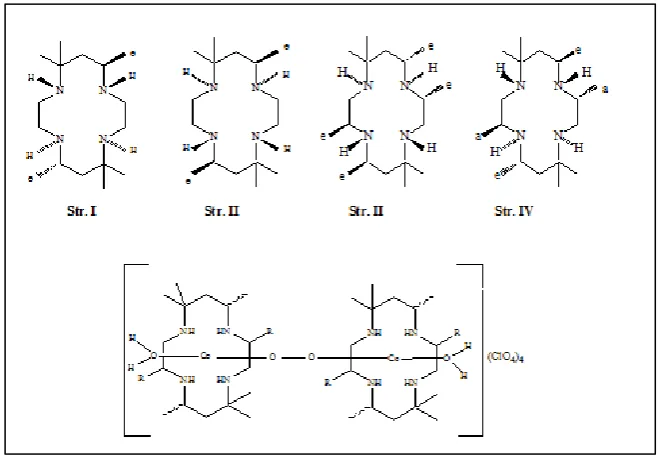
[image:5.595.132.463.290.520.2]The 1H-NMR spectra of these µ-peroxo binuclear cobalt(III) complexes of tet-a and tet-b display similar pattern. The spectra of both complexes exhibit two singlets and one doublet. The singlets at 1.30 ppm (‘tet-a’) and 1.29 ppm (‘tet-b’) can be assigned to axial components and those at 1.40 ppm (‘tet-a’) and 1.46 ppm (‘tet-b’) to equatorial components of the gem-dimethyl groups. The spectra further reveal doublets at 1.51 ppm (‘tet-a’) and 1.50 ppm (‘tet-b’) corresponding to 12H, which are assigned to equatorially oriented methyl protons on C5 and C12 chiral carbons of two ligands. On the other hand, the 1H-NMR spectra of the complexes of LB and LC, exhibit two singlets and two doublets. So appearance of two singlets at 1.28 ppm (LB) & 1.27 ppm (LC) for axial components and at 1.50 ppm (LB) & 1.51 ppm (LC) for equatorial components of their gem-dimethyl groups respectively can be assigned. The spectrum of each complex further reveals two doublets, 1.44 ppm (12H) & 1.48 ppm (12H) for LB assigned to all equatorial arrangement, whereas 1.33 ppm (12H) & 1.48 ppm (12H) for LC to diaxial-diequatorial arrangement respectively. Molecular models show that, though 10 diastereoisomers for the complexes of Me6[14]anes and 16 for the complexes of Me8[14]anes of their complexes are possible for each isomeric ligand, but one complex could have been isolated in each case. Thus a diequtorial arrangement for tet-a & tet-b and all equatorial & diaxial-diequtorial arrangement for LB & LC respectively with most stable trans (III) form [39] have been assigned as already been assigned for their corresponding octahedral dinitratozinc(II) complexes. From the symmetric spectral pattern, it can be assumed that two molecules of ligand in each complex are with same conformation. So the configuration and conformation of ligands, tet-a, tet-b, LB and LC in the respective complexes can be shown by Str. I, Str. II, Str. III, & Str. IV respectively and a representative full structure of these complexes can be shown in Figure 1.
Figure 1: R= H or CH3
Antimicrobial activities
_____________________________________________________________________________________________
122
a standard antibiotic (Ampiciline) almost showed different activity against different bacteria. The results presented for different compounds in Table-4 & 5 are the values after subtracting the values for DMSO alone. The observation of activity for 48-hours intervals and the repetition of the test for 24-hour interval did not show remarkable change in the diameter of inhibition zone. However no definite trend can be derived from the observations at this stage but the positive results suggest further studies are warranted. It is to be noted that though non-coordinated metal salt is more or less effective against all bacteria. The standard antibiotic, Ampiciline is always highly effective against all bacteria. The increased activity of the complexes in few cases compared to ligands can be explained by chelation theory [10] i.e the possible mechanism is that, the complexes disturb the respiration process of the cell and thus block the synthesis of protein, which restricts further growth of the organism [42]. In the disc diffusion method, inhibition zone of the complexes is related susceptibility of the isolate and to diffusion rate of drug through agar medium [43].
CONCLUSION
Our research is mainly centered on synthesis, characterization, X-ray crystallographic and antimicrobial studies of transition metal complexes of azamacrocyclic ligands. Though a varieties of metal complexes have been reported from this group, this is our new approach to synthesize biologically important binuclear µ-peroxocobalt(III) complexes. Though preparations of these complexes have been attempted with seven ligands, but only four of these worked to produce expected complexes. The study reveals that diene ligands do not form binuclear µ-peroxo complexes. One isomer also does not produce expected complex. This variation may be due to stereochemical difference. Based on all experimental results, the conformation and configuration of the ligands ‘tet-a’, ‘tet-b’, LB & LC in their respective complexes are shown by Str. I, II, III & IV respectively. The suggestive modes of coordination are shown in Figure 1. Antimicrobial activities reveal that the ligands arenontoxic against all bacteria, but all the complexes are more effective against all selected bacteria.
ACKNOWLEDGEMENTS
The authors gratefully acknowledge the University Grants Commission, Bangladesh to give a research grant to Professor Dr. Tapashi Ghosh Roy. The authors also thankful to Md. A. Monchur, Department of Microbiology, University of Chittagong, for his help in conducting antibacterial studies.
REFERENCES
[1] Touti; AK Singh; P Maurin; L Canaple; O Beuf; J Samarut; J. Hasserodt. J. Med.Chem., 2011, 54(12), 4274-4278. [2] M Wang; IF Wang; YZ Li; ZD Xu. Trans. Met. Chem., 2001, 26, 307-310.
[3] Chong; K Garmestani; D Ma; DE Milenic; T Overstreet; MW Brechbiel. J. Med. Chem., 2002, 45(16), 3458-3464. [4] D John; Lamb; S Joseph; Gardner. Macro. Chem., 2005, 349-363.
[5] D Singh; K Kumar. J. Serb. Chem. Soc., 2010, 75 (4), 475–482.
[6] RA Sheikh; S Shreaz; LA Khan; AA Hashmi. J. Chem. Pharm. Res., 2010, 2(3), 274-286. [7] PM Reddy; R Rohini; ER Krishna; A Hu; V Ravinnder. Int. J. Mol. Sci., 2012, 13, 4982-4992.
[8] H. Boraey; SM Emon; DA Tolan; A. Nahas. Spectro Acta Part-A:Mol. and Bio. Spec., 2011, 78, 360-370. [9] D Kong; L Meng; L Song; Y Xie. Trans. Met. Chem., 1999, 24, 553-557.
[10] M Salehi; M Hasanzadeh. Inorg. Chimi. Acta, 2015, 426, 6-14.
[11] Y Mulyana; KG Alley; KM Devies; BF Abrahams; B Moubaraki; KS Murray; C.Boskovic. Dalton Trans., 2014, 43, 2499-251.
[12] S Kumar; R Gupta. Euro. J. of Inorg. chem., 2014, 32, 5567-5567.
[13] C Cappelli; C Duce; M Formica; V Fusi; L Ghezzi; L Glori; M Mioheloni; Paoli; P Rossi; MR Tine. Inorg. Chim. Acta., 2014, 417, 230-238.
[14] MS Vad; FB Johansson; RK Seidler-Egdal; JE McGrady; SM Novikov; SI Bozhevolnyi; AD Bond; CJ Mckenzie.
Dalton Trans., 2013, 42(27), 9921-9929.
[15] MR Tinne. Coord. Chem. Rev., 2012, 256(1-2), 316-327. [16] M Tas; O Buyukgungor. J. Chem. Sci., 2009, 121,267-273. [17] MM Khan; KV Reddy. J. Coord. Chem., 1981, 11, 199.
[18] NM Levy; E Stadler; AS Mangrich; MA Melo; V Drago. Trans. Met. Chem., 1993, 18(3), 613-618. [19] BC Nath; S Suarez; F Doctorvich; TG Roy; R. Baggio. Acta Cryst., 2013, C69, 689-695.
[20] TG Roy; SKS Hazari; BK Dey; HA Miah; F Olbrich; D. Rehder. Inorg. Chem., 2007, 46, 5372-5380. [21] TG Roy, BC Nath, K Begum, Ng SW, ER Tiekink. Acta Cryst., 2011, E67, 1576-1577.
[22] S Yasmin; S Suarez; F. Doctorvich; TG Roy; R Baggio. Acta Crysta., 2013,C69, 862-867.
[23] 3. FB Biswas; TG Roy; MA Rahman; TB Emran. Asian. Pac. J. Trop. Biomed., 2014, 4(Suppl2), 618-623. [24] RW Ray; GA Lawrance; NF Curtis. J. Chem. Sot. Parkins Trans. I., 1975, 591-593.
_____________________________________________________________________________________________
123
[27] RW Hay; B Jeragh. J. Chem. Soc. Dalton., 1977, 20, 1951-1956.
[28] CG Barraclough; GA Lawrance. Inorg. Nucl. Chem. Lett., 1976, 12, 133-136. [29] GA Lawrance, PA Lay. J Inorg. Nucl. Chem. Lett., 1979, 41, 301.
[30] B Bosnich; CK Poon; ML Tobe. Inorg. Chem., 1966, 5(9), 1514-1517. [31] CL Wong; EJ Endicott. Inorg.Chem., 1981, 20(7), 2233-2239.
[32] R Bembi; VK Bhardwarj; R Singh; K Taneja, S Aftab. Inorg Chem., 1984, 23 (25), 4153–41. [33] G McLendon; M Mason. Inorg. Chem., 1978, 17, 362-365.
[34] RT Conley. Infrared Spectroscopy. Boston: Allyn and Bacon, Massachusetts, 1966.
[35] WJ Geary. Coord. Chem. Rev., 1971, 7(1), 81-122.
[36] NN Greenwood; BP Straughan, AE Wilson. J. Chem. Soc. A.1968, 2209-2212. [37] K Barua. Ph. D thesis, Dept of Chemistry, University of Chittagong, 2003.
[38] TG Roy; SKS Hazari; KK Barua; DI Kim;YC Park; ERT Tiekink. Appl. Organo. Chem., 2008, 22, 637-646. [39] TG Roy; SKS Hazari; BK Dey; BC Nath; S Dutta; F Olbrich; D Rehder. Inorg. Chim. Acta, 2011, 371, 63-70. [40] TG Roy; SKS Hazari; BK Dey; Dutta S; MA Monchur; ERT Tiekink. J. Coord. Chem., 2006, 59, 1757-1767. [41] TG Roy; SKS Hazari; BK Dey; HA Meah; C. Bader; D. Rehder. Eur. J. Inorg. Chem., 2004, 4115-4123. [42] N Dharmaraj; P Viswanathamurthi; K Nataranjan. Trans. Met. Chem., 2001, 26, 105-109.