Original Research Article
The effectiveness education of counseling of infant and young child
feeding as intensive to improve counseling performance of Posyandu
cadres in Bogor, Indonesia
Siti Mutia Rahmawati
1,2*, Siti Madanijah
3, Faisal Anwar
3, Risatianti Kolopaking
4INTRODUCTION
Cadres are the main actors for all activities in Posyandu. Health service obtained by the visitors of Posyandu was mostly (92.5%) body weight monitoring, while only 40.1% of them received health education.1 This lack of
educational activity in Posyandu resulted in the absence of information regarding infant or child health received by the mothers. In 2012, the Ministry of Health adopted the infant and young child feeding practices (IYCF)
Module from WHO/UNICEFto use in training of cadres
named IYCF counseling.2,3 UNICEF also introduced ABSTRACT
Background: Cadres have an essential role in providing counseling in integrated health service post (Posyandu). Poor capacity cadres may affect information delivery to the mothers/caregivers of under-five children. This study aimed is to assess the effect education of counseling of infant and young child feeding (IYCF) as intensive on the performance of the cadres in providing IYCF counseling.
Methods: The study was a quasi-experimental with a pre-post test controlled group. The subjects were 55 Posyandu cadres in Ciomas sub-district Bogor. The intervention was training for cadres using education of counseling of IYCF as intensive carried out in the classroom and the field. Data on knowledge, attitude, motivation and counseling performance of cadres before and after the training were collected using a validated structured questionnaire. The paired and independent T-test was applied to analyze the difference before and after the intervention, and analysis of covariance (ANCOVA) was applied to analyze the factors that influence cadre counseling performance.
Results: Mean score of knowledge (p=0.00), attitude (p=0.00), motivation (p=0.04), and counseling performance (p=0.00) of cadres in intervention group significantly increased. There is an increase in the score of performance counseling indicators for cadre in the quantity and quality after the education of counseling of IYCF as intensive. All of the indicators of the counseling performance of cadres influenced by educational models, knowledge, attitudes and attended training (p<0.05).
Conclusions: Training of cadres using the education of counseling of IYCF as intensive effectively improved the knowledge, attitude, motivation and counseling performance of IYCF practice with indicators of quantity, quality, concern, and character. The capacity building of the cadres should improve continuously through the development of various methods which are more specific and applicable.
Keywords: Cadres, Counseling, IYCF, Performance, Posyandu
1
Department of Nutrition, Politeknik Kesehatan, 2Ministry of Health, Jakarta, Indonesia
3
Department of Community Nutrition, Human Ecology Faculty, Bogor Agricultural University, Bogor, Indonesia
4
Universitas Islam Negeri Syarif Hidayatullah, Jakarta, Indonesia
Received: 22 April 2019
Accepted: 14 May 2019
*Correspondence:
Dr. Siti Mutia Rahmawati, E-mail: [email protected]
Copyright: © the author(s), publisher and licensee Medip Academy. This is an open-access article distributed under the terms of the Creative Commons Attribution Non-Commercial License, which permits unrestricted non-commercial use, distribution, and reproduction in any medium, provided the original work is properly cited.
Supportive supervision (SS) module to assist cadre during IYCF counseling practice.4
IYCF module research has been carried out in many countries. The study by Bassichetto et al that nutrition education in the form of IYCF counseling on health workers (nutritionists and pediatricians) in Brazil can increase infant and young child feeding knowledge and counseling, breastfeeding and complementary feeding and skills of dietary history, but there has been no change in counseling skills.5 The study in Klaten Indonesia showed that IYCF training was able to improve counseling knowledge and skills, but there was no effect on the motivation of midwife.6
Cadre counseling performance is a description of the work results of a cadre related to the implementation of the task of providing health education to the community, both at Posyandu and during home visits. The performance is the result of the interaction of elements of motivation, ability, and perception of oneself.7 Performance indicators are the number of jobs completed (quantity), quality of work (quality), timeliness and leadership.8 The previous study uses counseling skills, food history, nutritional assessment and guidance, and reactions from mothers who given counseling as an indicator of performance analysis.5 In Indonesia, the performance standard of cadres, particularly on counseling, was not available. The cadres are voluntary officers who do not get a salary, do not have a health education background, and are people who connect the community with health workers.9 By the reason, this study only uses quantity, quality, concern, and character as an indicator of counseling performance and the implications of the knowledge, attitudes, and motivation about their duties as IYCF cadres.
Performance influence by individuals, situations and both of factor. The study in Pakistan showed improvement in the performance, communication and counseling skills of health workers after being given complementary feeding counseling training.10 The knowledge, skills, and
self-confidence can improve task implementation
effectively.11 Incentives and training improved the performance of cadres.12,13 The performance of community health cadres depends on their job satisfaction which is influenced by specific intrinsic and extrinsic motivations.9 However, studies on training for cadres with approaches to improving counseling performance are still minimal.
The results of previous studies showed the cadres have about 46.3% excellent counseling skills and only 43.2% of them conducted at least once a month counseling in Posyandu or through a home visit after six months IYCF training. The suggestion of this study is necessary to add more time to the practice of counseling through a home visit.14 The preliminary study, we modification of IYCF module by add more time of counseling practice, supportive supervision (SS) / assistance by researchers
/health workers and focus on primary material. This study aimed to analyze the effectiveness education of counseling of IYCF as intensive to improve counseling performance of Posyandu cadres.
METHODS
Subjects
The study design is pre-post quasi-experimental as conducted in Pagelaran village and Ciomas Rahayu village of Bogor district in September-December 2017. The study sites were purposively selected based on criteria that the villages have active cadres, but the nutrition education in Integrated Health Service Post (Posyandu) did not implement yet. The other criteria were the willingness of the village and community health center (CHC) to be involved in the study. The number of samples bases on Bassichetto et al.5 The sample calculation using hypothesis testing for the difference between two proportions15 and each group of at least 26 people. The selected sample has fulfilled the inclusion and exclusion criteria and signed the informed consent. Ethical approval obtained from The Ethical Commission of Research Involving Human Subjects of Bogor Agricultural University Number 05/IT3.KEPMSM-IPB/SK/2017.
Cadres information
Data on characteristics of cadres covering name, age, education, occupation, household size, the working period of being cadre, and training history were collected using a validated structured questionnaire. Data on knowledge of cadres collected by questionnaires covering topics on breastfeeding, complementary feeding, growth monitoring, and counseling with some 20 questions in the form of multiple choices with four answer choices. Attitude data obtained by a questionnaire containing 20 statements about positive attitudes and negative attitudes towards IYCF and counseling. Motivation obtained by a questionnaire containing 20 statements of motivation from intrinsic and extrinsic factors about their duties as cadres. The attitude and motivation questionnaires were measured using a 5-point Likert scale namely 1=strongly disagree, 2=disagree, 3=doubt, 4=agree, 5=strongly agree.
Measurement of the counseling performance of cadre
questions, and recording the results of counseling. Concern indicators contain four statements, namely hearing the mother's complaints patiently, giving praise to the mother for what has been done correctly, helping the mother who has the IYCF problem and willing to help the mother outside the Posyandu time. Character indicators contain five statements about cadre efforts to maintain good relations with mothers, fellow cadres, health workers, village heads/community leaders and friendly to everyone. Total counseling performance assessment is 20 statements and measured using a 5-point Likert scale, namely 1=never, 2=less, 3=sometimes, 4=often, 5=very often.
The questionnaire test conducted in this study was a test of validity and reliability, carried out on 30 Posyandu cadres in the work area of Ciomas Bogor Health Center. Test results for knowledge questionnaires (Cronbach's Alpha 0.655 value) attitude (Cronbach's Alpha 0.632 value) cadre motivation (Cronbach's Alpha 0.874 value) and performance (Cronbach's Alpha 0.767 value), so that Cronbach's Alpha value is >0.6 so the question items are reliable.
Control group training
The control group received training using a standard nutrition module with main topics on breastfeeding,
complementary feeding, growth monitoring, and
Posyandu activities. The training conducted for one day at 8 am - 4 pm. The participants, which were 29 cadres, were trained by a facilitator (researcher) accompanied by three research assistants. The topics were delivered using various methods, namely lecture, question-answer session and practice on filling the maternal and child health book (MCHB). Training evaluation is carried out with a knowledge test about IYCF before and after training.
Intervention group training
Cadres belong to the intervention group were given training using the module counseling of IYCF as
intensive with main topics on breastfeeding,
complementary feeding, growth monitoring, and infant and young child feeding counseling. Breastfeeding topic are including breastfeeding process, production of breast milk, position and attachment to breastfeeding, recommended breastfeeding practices and difficulties in breastfeeding. The material about the factors that must considered in giving complementary feeding, the recommended practice of complementary feeding, giving complementary feeding. Growth monitoring material on the topic of how to accurately weigh, how to fill out to growth chart correctly, follow up on to growth chart results. IYCF counseling material provides topics such as listening and learning skills, the step of behavior change, skills in building confidence and providing support and three steps of counseling.
The training was conduct in the form of giving the material delivered with lecture methods, question and answer, role play, case discussions, and practices on breastfeeding, complementary feeding, filling in growth chart and IYCF counseling. Position and attachment of breastfeeding and counseling practices are carried out with fellow participants and using counseling card aids. The implementation of counseling practices in the field is carried out through home visits. Each participant practiced counseling for four mothers/caregivers who had babies and children aged 0-24 months, and counseling was done twice for each mother so that each cadre practiced counseling eight times for eight weeks. When carrying out counseling practices, cadres use three steps of counseling and assessment form for infant and children feeding ages 0-24 months. The supportive supervision process was carried out by teams researcher (companion ratio and participants 1: 8) using four steps of mentoring and a counseling skill observation form.
The training conducted in three classes, for three days at 8 am - 5 pm. The trainees were 26 cadres who met the criteria. Each class contained 8-10 cadres and trained by two IYCF national facilitators and one research assistant as a companion (trainer and participant ratio are 1: 5).
Training evaluation is carried out in class and the field. Class evaluations include test participants 'knowledge before and after training (pre and post-test), daily evaluation in the form of participants' mood meters, evaluation of training implementation at the end of the training. Evaluation in the field carried out when the cadres practiced counseling to mothers/caregivers of infants and children aged 0-24 months through home visits with the mentoring process by the research team. The counseling skills evaluation was carried out by the research team using a counseling skills assessment form for eight weeks. Evaluation of the results of counseling obtained from mothers/caregivers in the form of IYCF practices that have been carried out and an assessment of the benefits felt by mothers/caregivers. The evaluation results reported in separate writings.
In details, the interventions for cadres, were: 1). A sign informed concern, 2). Filled questionnaire on the characteristic of cadres, 3). Collected baseline data (questionnaire on knowledge, attitude, motivation and counseling performance), carried out one week before
training 4). Gave material about breastfeeding,
complementary feeding, growth monitoring, and
counseling for infant and child feeding (PMBA) in classrooms and counseling practices in field 5). Collected end-line data (questionnaire on knowledge, attitudes, motivation and counseling performance) to evaluate the impact of the education provided was carried out ten weeks after training in class.
Statistical analysis
the form of frequency distribution, mean and standard deviation. Inferential statistics applied were the Kolmogorov-Smirnov normality test, sample paired t-test to analyze mean differences in knowledge, attitude, motivation and counseling performance based on indicators scores before and after the intervention. Independent t-test was also applied to analyze differences in knowledge, attitude, motivation and counseling performance based on indicators between groups. In order to test the factors that influence the performance of IYCF counseling, was applied. All of the tests used a 95% confidence level.
RESULTS
Characteristics of subjects
The results showed that the mean age of 55 cadres was 40 years with the youngest was 23 years, while the oldest was 54 years. Most of the cadres were senior high school graduates. The cadres with a high education level of facilitates them to receive new information faster.
Table 1: Characteristics of cadres.
Characteristics of cadres (n=55)
Control N (%)
Intervention N (%)
P value
Age (in years)
>45 9 (31.0) 5 (19.2) 0.43
35-45 14 (48.3) 17 (65.4)
<35 6 (20.7 4 (15.4)
Education level
Diploma 5 (17.2) 3 (11.5) 0.83
Senior high school
graduates 18 (62.1) 17 (65.4)
Junior high school
graduates 6 (20.7 6 (23.1)
Occupation
Working 4 (13.8) 7 (26.9) 0.22
Housewives 25 (86.2) 19 (73.1)
Attended training
Twice or more 10 (34.5) 6 (23.1) 0.58
Once 9 (31.0) 11 (42.3)
Never 10 (34.6) 9 (34.5)
Family support
Yes 29 (100) 23 (88.5) 0.06
No 0 (0) 3 (11.5)
The working period of being a cadre (years)
>10 3 (10.3) 2 (7.7) 0.93
5-10 6 (20.7) 5 (19.2)
2-5 20 (69.0) 19 (73.1)
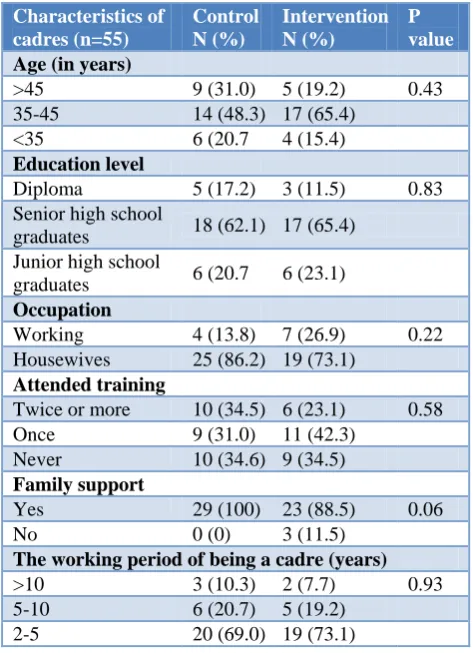
The Posyandu cadres were mostly housewives. Only a few of them was PAUD teacher, seller, and other entrepreneurs. All cadres were married, and almost all of them were supported by their families, particularly husband, to perform the task of cadres. The results showed that during the last year, the cadres were evenly
categorized as never attended any training, attended once and attended twice or more. Most of the cadres had a working period and experience of 2-5 years. Statistical analysis found no difference in characteristics of cadres between control and intervention groups (p>0.05). The details were present in Table 1.
Knowledge, attitude, the motivation of the cadres
The results showed that the knowledge score of cadres in both groups improved after the training. The increase was higher among cadres receiving the education of counseling intensive of IYCF compared to the control group (13.5 points vs. 5.9 points). There is a significant difference in the knowledge score of cadres belonging to the intervention group before and after the training (p=0.00) and a significant difference in knowledge score between groups after the training (p=0.00) (Table 2).
Table 2: Mean score of knowledge, attitude, motivation of cadres.
Variable Control
group (n=29)
Intervention
group (n=26) P value
Knowledge
Baseline 69.31±9.2 74.04±10.1 0.77
End line 75.17±10.7 87.50±9.4 0.00*
Gap (end-base) 5.9 13.4
P value 0.05 0.00**
Attitude
Baseline 72.52±6.4 75.23±4.4 0.08
End line 80.14±7.0 84.20±10.3 0.09
Gap (end-base) 7.6 9.0
P value 0.00** 0.00**
Motivation
Baseline 4.25±0.3 4.22±0.3 0.77
End line 4.62±0.4 4.44±0.4 0.08
Gap (end-base) 0.4 0.2
P value 0.00** 0.04**
*Independent t-test, significant p<0.05** paired t-test, significant p<0.05.
Since the beginning, all cadres had a positive attitude on IYCF practice (Table 2). Overall, the attitude of cadres in both groups improved after the training. The score increase in the intervention group was 9.0 points, while the increase in the control group was 7.6 points. There is a significant difference in the attitude score of cadres before and after the training (p<0.05), but no difference in attitude score between groups after the training.
Counseling performance of cadres
All of the cadres have similar performance on IYCF practice. Overall, the counseling performance scores of
both groups improved after the training. The
improvement was higher among cadres receiving the education of counseling intensive of IYCF than the control group (16.7 points vs. 7.2 points). There is a significant difference in the counseling performance of cadres before and after the training in the intervention group (p=0.00) and a significant difference in counseling performance score after the training in both of groups (p=0.00) (Table 3).
Table 3: Mean score of counseling performance of cadres.
Variable Control group (n=29)
Intervention
group (n=26) P value
Baseline 67.62±8.3 67.88±10.6 0.92
End-line 74.83±12.8 84.58±10.4 0.00*
Gap
(end-base) 7.2 16.7
P value 0.06 0.00**
*Independent t-test, significant p<0.05** paired t-test, significant p<0.05.
The study (Figure 1) shows the average score of each counseling performance indicator, namely the quantity, quality, concern, and character of the cadre. In the baseline data, the cadre counseling performance indicators in both groups were in quantity and quality was still low with an average score of 3. In terms of quantity, cadres did counseling not routinely every month. Counseling carried out in quality is still lacking. There is not done with the appropriate preparation, using tools, reading the previous book, taking the right counseling steps yet. The indicators of concern and character have an average score of >4. After training, the quantity and the quality indicator of counseling
performance on the intervention group cadre increased with a score of >4 but did not in the control group. The average score for concern and character indicators increases after training with a value of >4.
Figure 1: Counseling performance IYCF score of cadres.
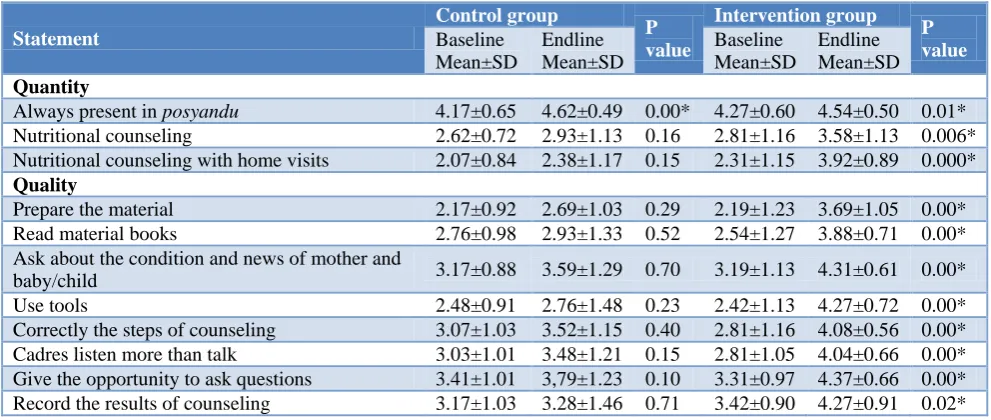
Results of T-tests of each statement based on Posyandu cadre counseling performance indicators shown in Table 4. On the quantity indicator, all statements of cadre groups given IYCF education differed significantly (p<0.005). The quality indicator with eight statements, counseling performance in terms of quality improved and differed significantly (p<0.005). Whereas from the four concern indicator statements, three statements differed significantly (p<0.005) and from the five statements of character indicators that were significantly different two statements namely about maintaining good relations with mother/caregivers and fellow cadres.
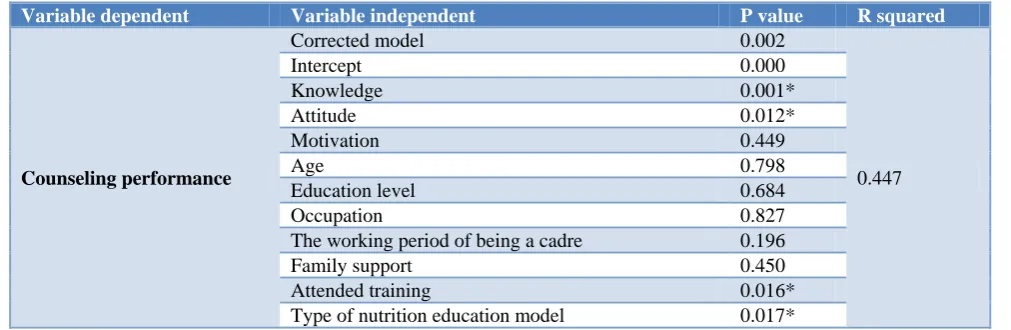
The results of ANCOVA in Table 5 showed the effect of knowledge, attitudes, attended training, and education models on cadre counseling performance with the value of squared R=0.447. Knowledge, attitude, attended training and the educational model affects the
performance of cadre counseling (p<0.05).
Table 4: Results of T-tests of each statement based on Posyandu cadre counseling performance indicators.
Statement
Control group
P value
Intervention group P value
Baseline Mean±SD
Endline Mean±SD
Baseline Mean±SD
Endline Mean±SD
Quantity
Always present in posyandu 4.17±0.65 4.62±0.49 0.00* 4.27±0.60 4.54±0.50 0.01*
Nutritional counseling 2.62±0.72 2.93±1.13 0.16 2.81±1.16 3.58±1.13 0.006*
Nutritional counseling with home visits 2.07±0.84 2.38±1.17 0.15 2.31±1.15 3.92±0.89 0.000*
Quality
Prepare the material 2.17±0.92 2.69±1.03 0.29 2.19±1.23 3.69±1.05 0.00*
Read material books 2.76±0.98 2.93±1.33 0.52 2.54±1.27 3.88±0.71 0.00*
Ask about the condition and news of mother and
baby/child 3.17±0.88 3.59±1.29 0.70 3.19±1.13 4.31±0.61 0.00*
Use tools 2.48±0.91 2.76±1.48 0.23 2.42±1.13 4.27±0.72 0.00*
Correctly the steps of counseling 3.07±1.03 3.52±1.15 0.40 2.81±1.16 4.08±0.56 0.00*
Cadres listen more than talk 3.03±1.01 3.48±1.21 0.15 2.81±1.05 4.04±0.66 0.00*
Give the opportunity to ask questions 3.41±1.01 3,79±1.23 0.10 3.31±0.97 4.37±0.66 0.00*
Record the results of counseling 3.17±1.03 3.28±1.46 0.71 3.42±0.90 4.27±0.91 0.02*
3
.1
2
.8
3
.7 4
.3
4
.0 4.1 4.3 4.5
3
.0
2
.9
3
.7 4
.2
3
.3
3
.2
4
.0 4.6
0.0 1.0 2.0 3.0 4.0 5.0
Quantity Quality Concern Caracter
Intervention baseline Intervention endline
Statement
Control group
P value
Intervention group P value
Baseline Mean±SD
Endline Mean±SD
Baseline Mean±SD
Endline Mean±SD
Concern
Praise 3.62±1.01 3.90±1.14 0.20 3.58±1.06 4.38±0.69 0.00*
Listen to problems 3.66±0.85 4.14±0.91 0.01* 3.81±0.80 4.38±0.57 0.02*
Problem-solving 3.86±0.51 4.17±0.65 0.48 3.73±0.96 4.23±0.71 0.16
Taking the time 3.48±1.21 3.79±0.86 0.27 3.46±0.90 4.15±0.96 0.02*
Character
Good relations with mother/ caregivers 3.97±0.82 4.45±0.57 0.02* 4.08±0.74 4.58±0.57 0.03*
Good relations with fellow cadres 4.24±0.95 4,72±0.45 0.02* 4.31±0.54 4.62±0.49 0.02*
Good relations with health workers 4.17±0.53 4.55±0.68 0.03* 4.23±0.51 4.42±0.64 0.26
Good relations with village heads and community
leaders 4.10±0.48 4.48±0.57 0.03* 4.23±0.51 4.35±0.79 0.52
Be friendly 4.38±0.49 4.66±0.48 0.43 4.38±0.49 4.62±0.49 0.14
*paired t-test, significant p<0.05.
Table 5: Factors affecting counseling performance of cadres.
Variable dependent Variable independent P value R squared
Counseling performance
Corrected model 0.002
0.447
Intercept 0.000
Knowledge 0.001*
Attitude 0.012*
Motivation 0.449
Age 0.798
Education level 0.684
Occupation 0.827
The working period of being a cadre 0.196
Family support 0.450
Attended training 0.016*
Type of nutrition education model 0.017*
*significant p<0.05.
DISCUSSION
The result showed that about half of the cadres were in productive age (35-45 years). Productive age is a supporting factor of being a cadre in integrated health service post (Posyandu). Most of the cadres had a high education level, which was senior high school graduates. It exceeds the 9-year compulsory education (equivalent to junior high school) set by the Government of Indonesia. High education level supported the capacity of cadres to receive information as well as to manage problems in Posyandu, particularly about IYCF practice. Most of the cadres were housewives so that they had time to volunteer as Posyandu cadres.
The study showed that the education of counseling intensive of IYCF given to the intervention group provided better knowledge for the cadres, shown by more significant increments (13.5 points vs. 5.9 points). IYCF module was in line with theory mentioning that a combination of various education strategy and systematic plan encourage the participants to understand the information and to have behavior change. Besides that, recognition and appreciation of any opinion and
experience of someone/participant of training and also positive environment supported the implementation of the education process.3 The study is in line with a similar study that finding nutrition education using module IYCF for health personnel in Brazil improved the knowledge by 89.7%, while the control groups improved by 33.3%.5 Other studies showed that IYCF education for midwives in Klaten significantly improved knowledge, and the
nutrition education for cadres could improved
knowledge.6,10,16,17 Improvement in knowledge score was expected to encourage cadre to relay the nutritional knowledge to mothers/caregivers during Posyandu activity or home visit.
positive attitude, and the behavior change after the training.17-19
The cadres which training IYCF have proper motivation and increases after training. This result is not in line by previous studies in Klaten Indonesia, while the others study shows that the motivation of cadres and health workers increases after training which further increases their self-confidence so that they are more optimal in performing tasks.9,20 Cadres need to be highly motivated because of its voluntary so that the award be a very dominant motivational tool and exceed the satisfaction of compensation.8 The unfair treatment, poor management, and lack of appreciation are the main factors that decrease motivation.21
Intensive IYCF counseling education model can improve the performance of counseling cadres better. These results occur because the cadres of the intervention group immediately practice counseling to caregivers who have children under two years. Assessment of counseling performance in the intervention group that experienced a rapid increase and significantly different occurred in two indicators, namely the quantity and quality of cadres in conducting counseling. These results differ from the results of the control group. The intensive IYCF counseling education model provides an opportunity for cadres to improve their counseling skills through practice eight times over eight weeks by mentoring. The mentoring process can improve counseling skills and have an impact on increasing the quantity and quality of counseling performance. Before the training, the indicators of concern and character in both groups of cadres had excellent values. After the training, cadres in the intervention group showed differences in performance with caring indicators, especially about the behavior of cadres in praising good things from the mother, hearing the complaints of the mother patiently and serve outside the posyandu time
The results of the cadre's counseling performance are by
previous research stating that employee work
performance is the extent to which duties and responsibilities have been carried out. The two main criteria for measuring job performance are the quantity of work and the quality of work.22 The comprehensive planning, message and how to convey bright, frequency and duration of each education process, experienced facilitators comprehensive planning, messages and how to convey precisely, frequency and duration of each education process, experienced facilitators, different methods by considering the sustainability of the education model so that it effectively produces behavioral changes.23 It verify in this study which use an intensive IYCF counseling education model, and several other studies show that nutrition/counseling training can improve the communication skills and performance of trainees.10,24,25 However in other studies stated that IYCF training had not been able to improve skills counseling participants.5
The education of counseling intensive of IYCF can improve the counseling performance of cadres better because the cadres directly practiced counseling to mothers having children under-two years old. The assessment of counseling performance cadres increases on the quantity and quality indicators in conducting counseling. The employee work performance is the extent to which duties and responsibilities have been carried out. The two main criteria for measuring job performance are the quantity and the quality of work.22 It was proven in this study using the education of counseling intensive of IYCF and the other study so that training on nutrition/counseling improved the communication skill and performance of the participants.10,24,25 While, there is the study found that IYCF training has not been able to improve counseling skills of participants.5
The results of this study indicate that the characteristics of cadres have not contributed to the performance of cadre counseling. This result is in line with the previous study that the characteristics of posyandu cadres such as formal education level, age, cadre duration did not significantly influence the performance of posyandu cadres.26 The study showed that knowledge did affect the performance of cadre counseling. Performance Posyandu cadres influenced by knowledge.27
This study had not found the effect of motivation on cadre counseling performance. The previous study shows that motivation is one of the factors that significantly contributed to the performance of instructors.28
This study found that the objectives of the training achieved, namely can improve knowledge, skill, the dedication of the cadres to be confident in implementing the task to serve the community in Posyandu or during the home visit. Training improving and updates employee knowledge which leads to improved performance.28 The meta-analysis of IYCF Bangladesh, Ethiopia, and Vietnam states that guidelines and standards for services, training, work tools, supportive supervision, incentives, and data monitoring can improve the performance of health workers /cadres and strengthen the system to provide IYCF counseling services in the community or health facilities.29 Counseling is a way of nutrition education that needs to do at Posyandu and home visits.30 Health workers can accompany regular home visits by cadres, local community leaders, NGOs before or after Posyandu activities will have an impact on improving children's health status. The previous study in Peru proved that nutrition education provided through routine health services could reduce the prevalence of stunted.31 CONCLUSION
Model education of counseling of IYCF as intensive
effectively improved the knowledge, attitudes,
and attended training. Therefore, model IYCF is the potential for implementing the training of cadres in Indonesia. Furthermore, the instrument for the counseling performance assessment used in this study can be implemented independently by cadres. Moreover, capacity building of the cadres is necessary to conduct simultaneously and regularly. The more specific model corresponding to the nutrition problem in the respective areas for the training of cadres is necessary to develop.
ACKNOWLEDGEMENTS
We thank 55 Posyandu cadres who were participating in this study, national IYCF facilitators who trained the cadres and research assistants who assist data collection. We also thank Sub District Head of Ciomas, Village Head of Pagelaran and Ciomas Rahayu and the staff, PHC Head of Ciomas and health personnel for facilitating this study.
Funding: No funding sources Conflict of interest: None declared
Ethical approval: The study was approved by the Institutional Ethics Committee
REFERENCES
1. Hidayat TS, Jahari AB. Perilaku pemanfaatan
posyandu hubungannya dengan status gizi dan morbiditas Balita. Buletin Penelitian Kesehatan. 2012;40(1):1–10.
2. WHO. World Health Organisation. Infant and
Young Child Feeding Counselling: An Integrated Course. Trainer’s Guide. Geneva: WHO, 2006. 3. MoH. Ministry of Health of Republic of Indonesia.
Module for Training on Infant and Young Child Feeding for Health Personnel and Cadre. Jakarta (ID): Directorate of Public Nutrition, Directorate General of Public Nutrition and Maternal and Child Health; 2014.
4. UNICEF. Supportive Supervision/Mentoring and
Monitoring for Community Infant and Young Child Feeding, UNICEF. 2013.
5. Bassichetto KC, Rea MF. Infant and young child feeding counseling an intervention study. Rio J. 2008;84(1):75-82.
6. Retno A, Soebijanto AA, Hadiwidjaja S. Pengaruh pelatihan pemberian makan pada bayi dan anak
(PMBA) terhadap pengetahuan, ketrampilan
konseling dan motivasi bidan desa. J DIKESA. 2013;1(1):1-20.
7. Uno H, Lamatenggo N. Teori Kinerja dan
Pengukurannya. Jakarta (ID): Bumi Aksara;2012. 8. Riniwati H. Mendongkrak motivasi dan kinerja.
Malang (ID): Universitas Brawijaya Press; 2011.
9. Gopalan SS, Mohanty, Das A. Assessing
community health workers’ performance
motivation: a mixed-methods approach on India’s Accredited Social Health Activists (ASHA) programme. BMJ Open. 2012;2(e001557):1-10.
10. Zaman S, Ashraf R, Martines J. Training in complementary feeding counseling of health care workers and its influence on maternal behaviors and child growth: a cluster randomized controlled trial in Lahore, Pakistan. J Health Popular Nutr. 2008;26(2):210-22.
11. Iswarawanti DN. Kader Posyandu: Peranan dan
tantangan pemberdayaannya dalam usaha
peningkatan gizi anak di Indonesia. Jurnal Manajemen Pelayanan Kesehatan. 2010;13(4):169-73.
12. Simanjuntak M. Karakteristik sosial demografi dan faktor pendorong peningkatan kinerja kader
Posyandu. J Wira Ekonomi Mikroskil.
2012;2(1):49-58.
13. Wisnuwardani RW. Insentif uang tunai dan
peningkatan kinerja kader posyandu. Jurnal
Kesehatan Masyarakat Nasional. 2012;7(1):44-8. 14. Pardosi R. Knowledge, Attitude and Counseling
skills of Trained Cadres on Infant and Young Child Feeding (IYCF) in West Lombok District [Tesis]. Jakarta (ID): Universitas Indonesia, 2013.
15. Murti B. Desain dan ukuran sampel untuk penelitian kuantitatif dan kualitatif bidang kesehatan. Yogjakarta (ID): Gadjah Mada University Press; 2013.
16. Sunguya BF, Poudel KC, Mlunde LB, Urassa DP, Yasuoka J, Jimba M. Nutrition training improve
health workers' nutrition knowledge and
competence to manage child undernutrition: a
systematic review. Front public health.
2013.1(37):1-21.
17. Khomsan A, Anwar F, Mudjajanto ES.
Pengetahuan, sikap dan praktek gizi ibu peserta Posyandu. J Gizi dan Pangan. 2009;4(1):33–41. 18. Sarwono SW, Meinarno E. Psikologi Sosial. Jakarta
(ID): Salemba Humanika; 2012.
19. Sukandar D, Khomsan A, Anwar F, Riyadi H,
Mudjajanto E. Nutrition knowledge, attitude, and practice of mothers and children nutritional status improved after five months of nutrition education intervention. IJSBAR. 2015;23(2):424-42.
20. Shattuck M, Bidwell P, Thomas S, Wyness L, Blaauw D, Ditlopo P. Motivation and retention of health workers in developing countries: a systematic review. BMC Health Services Res. 2008;8(1):247. 21. Daneshkohan A, Zarei E, Mansouri T, Maajani K,
Ghasemi M, Rezaeian M. Factors affecting job motivation among health workers: A study from Iran. Global J Health Sci. 2015;7(3):153-60.
22. Ramawickrama J, Opatha HHDNP, PushpaKumari
MD. A Synthesis towards the Construct of Job Performance. Int Business Res. 2017;10(10):66-81. 23. Fabrizio CS, Liere MV, Pelto G. Identifying
24. Sunguya BF, Poudel KC, Mlunde LB, Shakya P, Urassa DP, Jimba M, et al. Effectiveness of nutrition training of health workers toward improving caregivers’ feeding practices for children aged six months to two years: a systematic review. Nutrition J. 2013;12(1):1-14.
25. Tumbelaka P, Nasir S, Syafrudin D, Ormel H, Ahmed R. Analysis of Indonesia’s community health volunteers (Kader) as maternal health promoters in the community integrated health service (Posyandu) following health promotion training. Int J Community Med Public Health. 2018;5(3):856-63.
26. Yanti SV, Hasballah K, Mulyadi. Studi komparatif kinerja kader Posyandu. Jurnal Keperawatan. 2016;4(2):1.
27. Vitriah M. Determinan Kinerja Kader Posyandu Dalam Menuju Revitalisasi Posyandu Di Kecamatan Pantai Labu Kabupaten Deli Serdang Tahun 2009. [Tesis]. 2010.
28. Shahzadi I, Javed A, Pirzada SS, Nasreen S, Khanam F. Impact of Employee Motivation on
Employee Performance. Eur J Business
Management. 2014;6(23);159-67.
29. Sanghvi T, Martin L, Hajeebhoy N, Abrha TH, Abebe Y, Haque R, et al. Strengthening systems to support mothers in infant and young child feeding at scale. Food Nutr Bulletin. 2013;34(3):156-68. 30. Khomsan A, Merita, Anwar F, Sukandar D, Riyadi
H, Herawati T, Fatchiya A, Dewi M, Madanijah S, Syarief H. Impact of nutritional education on service quality in the integrated service post (Posyandu). Pak J Nutr. 2014;13(3):122-8.
31. Penny ME, Kanashiro HMC, Robert RC, Narro MR,
Caulfield LE, Black RE. Effectiveness of an educational intervention delivered through the health services to improve nutrition in young children: a cluster-randomized controlled trial. Lancet. 2005;365:1863-72.