Shaping the future for primary care
education and training project. Education
and Training Needs Analysis (ETNA) for
integrated health and social care: the
development of a toolkit
Stead, V and Nettleton, R
Title
Shaping the future for primary care education and training project.
Education and Training Needs Analysis (ETNA) for integrated health and
social care: the development of a toolkit
Authors
Stead, V and Nettleton, R
Type
Monograph
URL
This version is available at: http://usir.salford.ac.uk/17636/
Published Date
2006
USIR is a digital collection of the research output of the University of Salford. Where copyright
permits, full text material held in the repository is made freely available online and can be read,
downloaded and copied for noncommercial private study or research purposes. Please check the
manuscript for any further copyright restrictions.
www.pcet.org.uk
Shaping the Future for Primary
Care Education & Training Project
Funded by the NorthWest Development Agency
Authors:
Valerie Stead
Lancaster University
Robert Nettleton
The University of Bolton
Vol: 3
2006
Education and Training Needs Analysis (ETNA)
for Integrated Health and Social Care
Contents
Page
Executive Summary 5
The Project Context: Introduction 7
Chapter One: Background Context 8
Chapter Two: Research Methodology: A collaborative approach 9
2.1 Methodology and Structure of the Research 9 2.2 Methodological Outcomes 10 2.3 Methods 10
Chapter Three: Development of the Education and Training Needs Analysis Tool Prototype 12
3.1 The Systematic Review of the Literature 12 3.2 A Survey of PCTs 12 3.3 Appraisal of Resources for ETNA 12 3.4 The Expert Reference Group 13 3.5 Understanding 'needs' 14 3.6 ETNA Tool Prototype Design 15 3.7 ETNA Tool Prototype Components 16 3.8 Delivery of ETNA 17
Chapter Four: Testing the Education and Training Needs Analysis Tool Prototype 18
4.1 The Pilot Reference Group 18 4.2 Facilitators' Workshop 20 4.3 Pilot Workshops 21 4.4 Final Evaluation Workshop 22
Chapter Five: Research Findings 23
5.1 Proving – Does it work? 23 5.2 Improving: Refining and Amending the ETNA Tool Prototype 26 5.3 Learning 28
Chapter Six: The Evidence and Implications for Future Education and Training Needs Analysis 31
Appendices
Appendix 1 Education and Training Needs Analysis (ETNA) for Integrated Health
and Social Care in the Context of the Shaping the Future Project 35 Appendix 2 Further Resources to Support Education and Training Needs 36
References 39
List of Tables and Figures
Executive Summary
Introduction
This report charts the development of an Education and Training Needs Analysis (ETNA) Toolkit. The Toolkit aims to enable agencies to identify the knowledge and skills required of participants to work effectively within integrated health and social care services and to contribute actively to service integration. The development of an ETNA Toolkit is one of a series of outputs from Shaping the Future in Primary Care Education and Training project (www.pcet.org.uk) which is funded by the North West
Development Agency (NWDA). It is the result of a collaborative initiative between the NWDA, the North West Universities Association and seven Higher Education Institutions in the North West of England.
Methodology
Three methodological commitments underpinned the development of the ETNA Toolkit:
■ Collaboration: Working
collaboratively with stakeholders in the creation and pilot of an ETNA Tool prototype and the final production of the ETNA Toolkit;
■ Learning: Making learning an
explicit part of the study for participants and researchers;
■ Interaction: Including ongoing
interaction between Higher Education and health and social care agencies throughout the research.
The Development of the
ETNA Toolkit
The ETNA Toolkit was developed in three phases: The creation of a prototype Tool, testing the prototype Tool with 2 pilot sites, and final production of the ETNA Toolkit.
Phase 1: The prototype Tool was developed in collaboration with an
expert reference group drawn from Primary Care Trust's (PCTs) and Social Service departments across the North West. This research group used literature reviews, a survey of ETNA practice amongst PCTs in the
Northwest of England and a selective review of training needs analysis tools available on the World Wide Web to determine key criteria for the design of a process led prototype ETNA Tool.
These criteria are:
■ Relevance of the Tool for
expressed needs of the organisation;
■ Acceptability of the Tool to a wide
range of users;
■ Contributes to service
development;
■ Maximises involvement at all
relevant organisational levels;
■ Contributes to organisational
objectives.
The ETNA Tool prototype contained a sequence of exercises within a one day workshop format, from reviewing level of integration and agreeing a vision of integration to identifying knowledge and skills, role profiling, gap analysis and action planning.
Phase 2:The second phase involved
piloting the ETNA Tool prototype with the aim of evaluating the tool in use and refining and amending the Tool for public use. This phase included using a series of workshops that employed a range of evaluation instruments with practitioners and two pilot sites to explore:
■ The extent to which the Tool met
its development criteria;
■ How the prototype might be
improved;
■ Learning from the pilot phase.
Data from the pilot phase illustrated that there was significant value in an ETNA Tool designed specifically for
integrated services, in particular, the opportunity to share and develop joint understandings of integrated working and development issues. The pilot phase also raised concerns about the structure and content of the prototype Tool. These included the need to structure it as a Toolkit rather than a Tool to enable greater
flexibility and ease of use, and the importance of providing detailed outcomes and worked examples of activities.
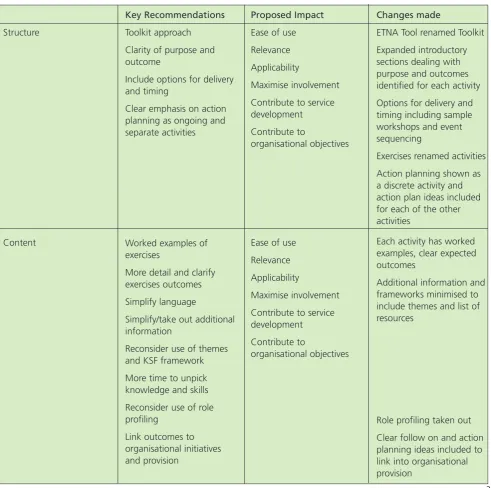
Phase 3: This phase involved producing the final ETNA Toolkit based on findings from the pilot phase. This concerned making a series of major changes to structure and content, in order to offer a flexible Toolkit that included:
■ A range of options for delivery
and timing;
■ Activities with clear purpose and
explicit outcomes;
■ Worked examples of exercises;
■ Less use of external frameworks;
■ Clear ideas for action planning to
fit in with local organisational provision.
Outcomes
Outcomes from this research include the ETNA Toolkit, and learning concerning education and training needs analysis for integrated health and social care and its development.
Outcomes: The ETNA Toolkit
process of Education and Training Needs Analysis.
The Toolkit incorporates a series of activities designed to enable people to work through education, training and development issues related to their service. The activities are:
■Introduction to Education and
Training Needs Analysis, visioning;
■Identifying knowledge and skills;
■Action planning.
Each activity comprises of a range of exercises. Although designed as a sequence the Toolkit enables activities to be facilitated as separate events.
The Toolkit introduces each activity by explaining its purpose, offering examples of how it might be used, and provides expected outcomes and potential action planning. Activities are process led and this involves using group and interactive exercises that enable participants to reach self-determined outcomes. Activities are intended to be workable for a range of services, whether established, new or proposed. Sample exercises to complete the activity are
demonstrated and the Toolkit appendices provide sample outline programmes, a glossary of terms, references and resources.
Outcomes: Learning
The development of the ETNA Toolkit has provided insights concerning education and training needs analysis for integrated health and social care and its development including:
■ Education and Training Needs
Analysis for integrated health and social care is important but competes with other priorities. As such it must therefore be seen as contributing to and part of a wider strategic development. This calls for education and training needs analysis that has relevance
to local context and recognises that needs vary from service to service and locale to locale;
■ Understanding and analysing
education and training needs for integrated health and social care is complex. Education and Training Needs Analysis may, therefore, support the identification of knowledge and skills for progressive integration beyond joint working;
■ An emergent model of education
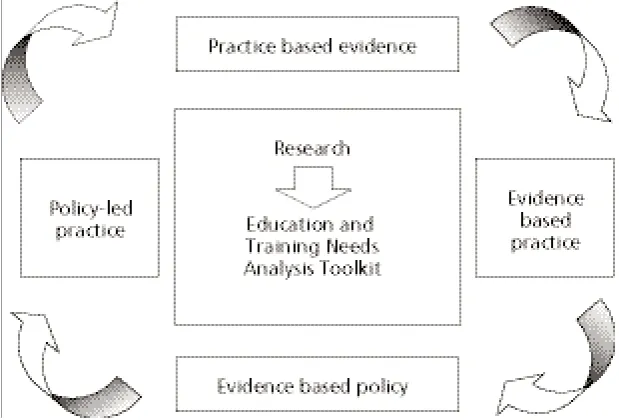
and training needs analysis based on process led activities promotes local relevance and the capacity to articulate, achieve and sustain a context relevant vision of integrated service provision. Developing the ETNA Toolkit has highlighted the interplay of policy, practice and evidence and the tensions and challenges inherent in working within policy while seeking to remain practice based. A
collaborative, learning and interactive approach to this kind of intervention enables these tensions and challenges to be made explicit, debated and interpreted at a local level. This encourages research and education and training needs analysis that offer processes in which such tensions and challenges might be mapped and understood, and that enable contributions to developing knowledge, policy and practice.
Acknowledgements
The authors wish to thank members of the project Steering Group, the project delivery team, the expert Reference Group and Pilot Sites for their help and advice. In addition, our thanks to Lidia Koloczek for her assistance during the project, and to David Collinson, Professor of Leadership and Organisation in the Department of Management Learning and Leadership at Lancaster
The Project Context
Introduction
Collaboration and partnership working between Higher Education and the National Health Service (NHS) is an essential requirement for effective delivery of care (Universities UK 2003). The North West
Universities Association (NWUA) and the North West Development Agency (NWDA) are two organisations at the forefront of creating such alliances. The research project, Shaping the Future for Primary Care Education and Training Project is a collaborative partnership between both these organisations and seven North West Higher Education Institutions. In addition, the project brings together for the first time all the key partners in the health, social care and
education sectors who are involved in supporting the delivery of integrated health and social care in the North West Region.
These include:
■ The North West Development
Agency who are funding the project as part of their key target areas, i.e. Health;
■ The North West Universities
Association;
■ Three North West Strategic Health
Authorities;
■ Primary Care Trusts;
■ Social Services;
■ Higher Education Institutions and
Further Education Colleges.
The project has a Project
Management and Development team and a participative Steering Group, which it is anticipated will be the precursor to a close regional partnership intended to create real synergies at a regional level. For ease of implementation, the project has been divided into a series of Work Packages, based on the key
objectives, each led by one of the partner Higher Education Institutions.
Aim and objectives
The main aim of the project is to identify the evidence base for delivery of integrated health and social care; the skills and knowledge required to deliver this care, together with the current and future education and training needs of the North West of England Primary Care Workforce.
The key objectives of the project are:
i. To provide a comprehensive
systematic review of the evidence base for integrated health and social care services within the regional, international and national contexts;
ii. To develop a Benchmarking Tool for achieving best practice in collaborative working and delivery of integrated health and social care;
iii. To develop a course finder tool and map the Higher
Education/Further Education provision of education and training which can support the delivery of integrated health and social care services;
iv. To identify visions for the future, for both the health and social care workforce and service users, on education and training
requirements needed to deliver integrated services;
v. To develop and pilot an Education and Training Needs Analysis Model (ETNA) for identifying the
education and training needs of the primary care workforce to meet the NHS and social care agendas.
Conclusion
Chapter 1:
Background Context
The Shaping the Future Project was developed in response to rapid organisational change and
reconfiguration of services driven by national policies challenging all stakeholders to implement and deliver increasingly integrated services (Howarth et al, 2004). In this context it could not be assumed that there was an appropriate evidence base for education and training needs analysis or that the evidence available was accessible to those engaged in the process. This report outlines the development, piloting and refinement of an Education and Training Needs Analysis (ETNA) Tool (later 'Toolkit') with the purpose of assisting agencies in identifying the education and training needs of participants in integrated service delivery environments.
The evidence base for this Toolkit builds upon outcomes of other research within the Shaping the Future Project, including a systematic review of the literature on integrated health and social care; user and carer views of integrated health and social care; and a workforce views survey. The systematic review of the literature (Howarth et al, 2004) provides an in depth account of the dynamic policy context of the Shaping the Future Project. The relationship of the development of the Toolkit to the rest of the Project is depicted in
Appendix 1.
While there are many examples of integrated health and social care in existence its achievement remains a major policy objective of successive governments in terms of strategic goals and operational priorities at local level:
"The government has made it one of its top priorities since coming to office to bring down the 'Berlin Wall' that can divide health and social care and create a system of integrated
care that puts users at the centre of service provision." (Department of Health (DoH) 1998:Chapter 3).
Much research has been undertaken to identify the characteristics of organisations and partnerships that facilitate integration (Howarth et al, 2004). The ETNA Toolkit has been developed in order to identify the knowledge and skills required of participants to work effectively within integrated services and to contribute actively to service integration.
The whole notion of integrating health and social care affects a variety of groups of people. It affects the agency, workers within health and social care, managers and leaders at all levels and also the users of the service who provide the raison d'etre for services. The integration of health and social care within the
communities served by Primary Care Trusts (PCTs) is integral to the wider goal of aiding health and social care staff to work together with service users and carers.
For workers within health and social care, integration means that roles and skill sets need to be determined within the context of the service as a whole and in relation to the
contribution of other workers and agencies. Thus education and training needs analysis links directly to the NHS policy of Agenda for Change supporting service development for integrated health and social care through workforce development and Life Long Learning for individuals in line with their development plans.
The development of the ETNA Toolkit was undertaken as a collaborative process. This collaboration involved individuals within health and social care organisations with appropriate expertise and responsibility for education and service development, and also other 'Work Packages'
within the Shaping the Future Project. Hence the following chapters
Chapter 2:
Research Methodology: A Collaborative
Approach
Three methodological commitments have underpinned the development of the ETNA Toolkit prototype:
■ Collaboration: Working
collaboratively with stakeholders in the creation of a Tool
prototype, the development of a pilot process and the final production of the ETNA Toolkit;
■ Learning: Making learning an
explicit part of this research for participants and researchers about education and training needs analysis and integrated health and social care;
■ Interaction: Including ongoing
interaction between Higher Education and health and social care agencies throughout the research and in the development of interactive evaluation
interventions as part of the pilot.
The three commitments are based on the recognition that integrated health and social care in primary care is emerging in policy and practice, and is open to wide interpretation
(Howarth et al,2004). This study was,
therefore, concerned to work within the framework of shared
understanding of integrated health and social care in practice. The commitments are also in
acknowledgement of the philosophy and aims of the Shaping the Future Project that is concerned with collaboration and partnership, furthering learning and
understanding of integrated health and social care.
The methodological commitments encouraged an approach that borrowed from research models such as collaborative inquiry (Torbert, 1981), problem-based methodologies and action research (Hart and Bond 1997, Stead et al,2001). These models have a number of features that were pertinent to this research
including recognising practitioners as co-researchers; a commitment to theory and practice development; the centrality of action and change in research; and the validity of knowledge embedded in local practice. This study therefore aimed to engage practitioners and
researchers in the joint development of an ETNA Tool prototype grounded in shared knowledge and
understanding of the local context. There was also concern that the methodological approach should remain consistent throughout the testing of the ETNA prototype and the evaluation of the pilots.
Evaluation research and methodology illustrate that interactive and
participatory interventions may help in the development of stakeholder relationships, can help to inform and influence organisational leaders and decision-makers and can contribute to meeting the needs of the evaluated and evaluators (Gregory 2000, Owen and Lambert 1995, Pawson and Tilley 1997).
Furthermore, research by Preskill and Torres (1999) argues that evaluation as an integral on-going process contributes to individual, team and organisational learning. It was therefore hoped that the collaborative development of a process, that invited interaction and participation through evaluation activities embedded within the pilot, would raise issues that might be taken forward locally and that would aid learning.
2.1 Methodology and
Structure of the Research
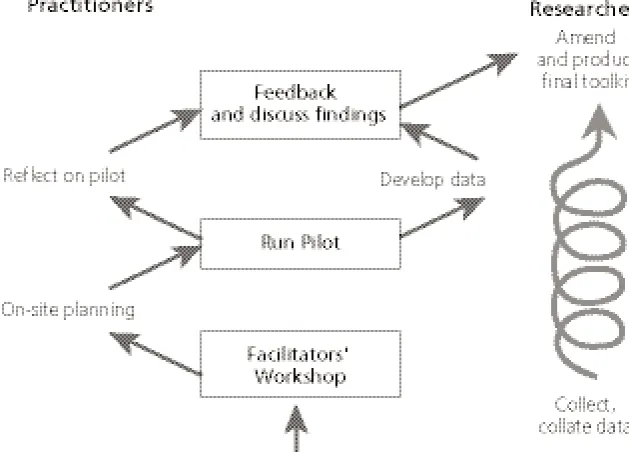
[image:10.595.233.548.538.764.2]Figure 1 summarises how the methodological approach informed the structure of this research through collaborative work and events, using interactive processes and having a central core of meetings and workshops to share and disseminate learning. This in turn enabled the clarification of individual and joint roles and responsibilities amongst the co-researchers (including researchers from Higher Education and
practitioners).
The researchers' roles and responsibilities were to plan and administer events, to collect, collate and develop ideas and data and to be responsible for final outcomes. The practitioners as co-researchers had the responsibility of sharing knowledge about their work and practice to inform the ETNA Toolkit development, and reading and commenting on draft materials. For those practitioners who also participated in pilot sites there were additional roles and responsibilities which involved on-site planning and ETNA pilot development. Joint responsibilities included working together to develop a Tool prototype and the pilot process, and meeting to share feedback for refinement of the prototype.
2.2 Methodological
Outcomes
Anticipated outcomes in keeping with this broad collaborative approach included:
■ Ownership by co-researchers of
the ETNA Tool prototype and the final ETNA product and
commitment to the pilot process;
■ Learning for the project regarding
education and training needs analysis and integrated health and social care to enable the further development and refinement of the ETNA prototype;
■ Learning for the stakeholder
representatives about theory in action concerning integrated health and social care;
■ Change and action for pilot sites
following testing and evaluation of the ETNA prototype.
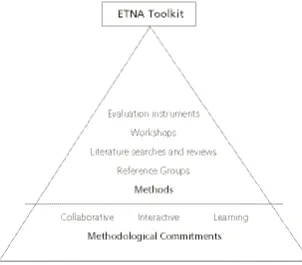
2.3 Methods
[image:11.595.49.352.474.739.2]The adoption of a collaborative, interactive and learning approach provided a framework for the methods employed within this research. These are summarised in Figure 2.
2.3.1 Reference Groups
Taking a collaborative stance meant working with recognised primary stakeholders in integrated health and social care. Within the remit of the wider Shaping the Future Project, the primary stakeholders were identified as those responsible for education, training and development within Primary Care Trusts (PCTs), teaching Primary Care Trusts (tPCTs), and Social Service Departments (SSDs).
Reference Groups were used as working groups to develop the prototype of the ETNA Tool, to plan the pilot process and to comment on feedback from pilot workshops.
2.3.2 Literature Searches and Reviews
While a systematic review of literature showed that there are key emergent themes considered to be essential requirements of effective integrated health and social care services
(Howarthet al,2004), there appears
to be little understanding of available education and training needs analysis tools. In order, therefore, to develop the Toolkit it was important to learn about currently available education and training needs analysis tools and their purpose in the field of health and social care by undertaking literature searches and reviews.
2.3.3 Workshops
Workshops were viewed by the researchers and the reference groups as a way of working within the broad methodological framework of a collaborative, learning and interactive approach. Workshops would enable practitioners and researchers to plan the pilot process collaboratively, to test out the ETNA Tool prototype interactively and to share the learning from evaluating the pilot. Workshops included:
■ A facilitators' workshop for pilot
sites to plan and prepare for delivery of the Tool prototype;
■ Pilot workshops where pilot sites
deliver the ETNA Tool prototype;
■ A final workshop to feedback pilot
results and agree amendments to produce the ETNA Toolkit.
2.3.4 Evaluation Instruments
A range of instruments were designed to evaluate the ETNA prototype in use based around aspects of proving (Does the Tool work?), improving (How can we improve the Tool?) and learning (What can we learn from undertaking this pilot?), (Easterby-Smith 1994). In keeping with the chosen
methodological approach the design of instruments was in collaboration with the reference group and pilot sites. Instruments included interactive exercises integral to the pilot
Chapter 3:
Development of the Education and Training
Needs Analysis Tool Prototype
This chapter describes how an ETNA Tool prototype was developed; how 'needs' were conceptualised,
understood and expressed within the Tool; the design of the Tool and its components and the proposed delivery of education and training needs analysis.
In brief, the ETNA Tool prototype was developed through:
■ An extensive systematic review of
the literature – University of
Salford (Howarth et al2004);
■ A survey of ETNA practice
amongst Primary Care Trusts (PCTs) in the North West of England;
■ A selective review of training
needs analysis tools available on the World Wide Web;
■ Feedback from an expert
Reference Group.
3.1 The Systematic Review
of the Literature
The systematic review of the literature (Howarth et al, 2004) took place in parallel with the development of the ETNA Tool prototype and provided résumés of key themes within the literature in relation to the policy context of integrated health and social care, education, competencies and related matters. A selective review was undertaken as part of the ETNA Toolkit development to identify what was readily available in the public domain that may be used within health and social care
organisations. This involved reviewing examples of training needs analysis tools and related literature including grey literature, for example, available on the World Wide Web. An annotated list was produced (Appendix 2), a version of which is included within the final Toolkit as a resource for users.
3.2 A Survey of Primary Care
Trust's (PCTs)
A brief survey of PCTs in the North West was undertaken during the public launch of the Shaping the Future Project in March 2003. A questionnaire was distributed seeking:
■ Information about current practice
in relation to education and training needs analysis, and
■ Recruitment of expert Reference
Group members.
The returned questionnaires and informal conversations indicated a current lack of systematic training needs analysis across PCTs and a concern to develop user friendly methods for training needs analysis. Responses to the questionnaire indicated that education and training needs analysis was not taking place to any significant extent within PCTs. Reference Group members suggested that this may be due to the following reasons:
■ Training Needs Analysis is not
viewed as a sufficiently high priority at this time owing to other pressing issues that were more urgent than important;
·■ Training Needs Analysis tools that
were available were not widely disseminated nor their uptake facilitated;
■ It is difficult to link the outcomes
of training needs analysis to organisational development internally and to educational provision secured externally.
3.3 Appraisal of Resources
for Education and
Training Needs Analysis
Work with the expert Reference Group guided the appraisal of resources available in the public domain that were considered by the researchers. This appraisal took into
account the context of policy drivers affecting integrated health and social care, especially workforce
development and the 'modernisation' agenda including human resources strategy, pay and service redesign. The resources identified are listed in Appendix 2. Some were applicable to relatively restricted contexts although could be of potential use to some users of the Tool. For example, QUILT (Quality in Linking Together Early Year's Partnerships) may have particular appeal to early years settings and emerging Children's Trusts. Others, especially from NatPaCT, focussed on organisational features rather than knowledge and skills as such. NatPaCT Competencies were included in the systematic
literature review (Howarthet al,
2004) and indirectly informed the development of content of the ETNA Tool.
Resources considered of direct value were:
■ Public Health Skills Audit Tool
(Burke et al2001);
■ Sainsbury Centre (2001) Model for
the Capable Practitioner;
■ Changing the Workforce Toolkit
for Local Change
(http://www.modern.nhs.uk);
■ NHS Knowledge and Skills
Framework and Development Review (working draft and completed versions, Department of Health, 2003 and 2004).
develop the public health workforce at a variety of levels not confined to pre existing occupational
classifications. The methods employed were congruent with the
methodological commitments of ETNA development study. The production of a Facilitators' Guide in support of participatory workshops was tried and evaluated in similar contexts to the ETNA development study and therefore had appeal to the Reference Group.
The Sainsbury Centre's model of the Capable Practitioner
(http://www.scmh.org.uk/) was also research based and developed across a wide range of practitioners engaged in mental health service provision, rather than being defined by organisational or professional designations. In particular, some members of the Reference Group had direct experience of the application of the model to training needs analysis in their own organisations. The part of the model of particular value in this context was the simple differentiation of the 'capabilities' required of all workers – 'all must have', or more selectively – 'some must have'. For the purposes of the ETNA Tool the Reference Group agreed that this might be adapted to include a third category in the form of a question – 'Who should have?', reflecting the need to articulate and identify specific roles in a potentially highly heterogeneous group. This had particular salience for the ETNA development study as the scope of who might be involved in the delivery of integrated health and social care is wide in respect of the knowledge and skills that they may bring and require to deliver services.
The issue of defining 'content' of the 'needs' that may be identified was a major challenge for the ETNA development study. The Public Health
Skills Audit Tool (Burke, Meyrick and Speller, 2001) and the Sainsbury Centre model of the Capable
Practitioner (http://www.scmh.org.uk/) both set out relevant content against which needs analysis may be undertaken. The Public Health Skills Audit
(http://www.publichealth.nice.org.uk/) provides profiles for individuals or groups that can be developed either through workshops or through use of the on-line version of the Tool. The ETNA development study was concerned to identify how and when content could be determined for the Tool. At an early stage in the Shaping the Future Project (March 2003) the Department of Health published its draft version of the Knowledge and Skills Framework (KSF) for Development and Review (Department of Health, 2003). This was recognised as a highly significant development likely to impact upon the development of an ETNA Tool. The KSF is linked to the implementation of the comprehensive job evaluation of every worker in the health service (other than doctors and dentist) known as Agenda for Change. The KSF sets out a range of domains and levels of knowledge and skills the possession or acquisition of which is linked to pay and
progression. Its use is a requirement of all NHS organisations. In the light of the earlier intelligence obtained about the priority accorded to training needs analysis it seemed plausible to infer that the use of the KSF would become a 'must do' in the NHS and that any training needs analysis would need to be at least congruent with the KSF if it were to be used. The linkage of the KSF to the ETNA Tool seemed to offer the prospect of a higher level of
organisational commitment than had been manifest hitherto.
The profiles of competencies outlined in the draft KSF were similar in design to those in the Public Health Audit Tool. Also the workshop resources provided in the Modernisation Agency's Changing the Workforce Toolkit for Local Change
(http://www.modern.nhs.uk/home/def ault.asp?site_id=58) provided similar formats with which Reference Group members had some familiarity in the context of service redesign,
sometimes in the context of service integration. A review of KSF domains by the Reference Group resulted in the selection of those domains that were applicable to all workers in integrated services and those in particular of relevance to service integration, notably partnership and communication.
3.4 The Expert Reference
Group
The expert Reference Group that worked with the researchers comprised thirteen volunteers recruited from the Project Launch questionnaire. This Reference Group was selected using purposive sampling to provide expertise representing a range of service settings and organisations throughout the northwest. In particular the group included:
■ Representation from all three
Teaching Primary Care Trusts in the North West;
■ Representation from two social
services departments and an acute NHS hospital trust; and
■ A lecturer involved in the delivery
including social workers, general practitioners, nurses and allied health professions.
There was no direct service user representation, however, the research team had direct links with a study of service user involvement in healthcare education. In addition, several of the Reference Group members were working directly with service users in service development.
The Reference Group met three times during the development of the Tool. On each occasion progress with the development of the Tool was shared with the group. Their feedback, structured by the literature, tools and practice reviews guided the next step in its development.
Work with the Reference Group indicated that education and training needs analysis was important to PCTs but not an urgent priority. At the outset of the Project many PCTs were very new organisations, having recently been formed from Primary Care Groups and either Community NHS Trusts or combined Acute and Community NHS Trusts. Major organisational restructuring and the transfer of Health Authority commissioning functions to PCTs were among a range of major challenges to which education and training could readily be viewed as of lesser urgency. Nevertheless, service modernisation and integration were viewed as important. The Reference Group were aware of a variety of resources and initiatives that could be undertaken (notably working with programmes produced by the Modernisation Agency and the National Primary and Care Trust Development Programme). However, these did not focus directly on training needs and in some cases they were seen as too resource intensive to be of practical use. Therefore, it was concluded that any education and
training needs analysis tool must be easy to use and relevant for the expressed needs of the organisation.
Service modernisation and integration were seen as requiring 'whole systems working' and therefore required 'whole systems' engagement in training needs analysis. The implication of this was that the Tool must be acceptable to a wide range of users and settings, that is, it must be generic.
A major study of training needs analysis for health promotion in Scotland (Health Education Board for Scotland, 1995) and the Health Development Agency's (Burke et al, 2001) Public Health Skills Audit Tool both provided research based accounts of training needs analysis tools in contexts of multi-professional, cross-agency working of relevance to the development of the Tool. Important implications for the education and training needs analysis development study were: Education and training needs analysis is valued for the process as much as, if not more than, the outcomes; and the greater the investment in education and training needs analysis the greater the value of the process to participants.
In light of these considerations the Reference Group agreed that the Tool should be process driven, should contribute to service design and development, and should be designed to maximise involvement at all relevant organisational levels.
3.5 Understanding 'Needs'
When discussing the content of the Tool the Reference Group revisited the concept of need as applied to education and training. It was evident that needs could not be determined in advance of a vision of what integrated health and social care might be. It was therefore accepted
that the ETNA Tool should include activities designed to facilitate a vision of integrated health and social care in the local context of service
development and delivery. Needs could then be identified in subsequent activities based on this agreed vision.
Lists of competencies of various kinds such as those found in the KSF or in occupational standards imply normative needs with an objective, authoritative status derived from their source. They also imply a need as a deficit to be made good through education and training. However, Reference Group members recognised that the language and presentation of competencies may not articulate the understandings of all participants in education and training needs analysis. On the contrary, they may alienate some participants or simply overwhelm by virtue of their eloquence and voluminous presentation, as in the case of the extensive NatPaCT competencies. There was concern within the Reference Group to recognise the importance of 'felt needs' of
participants and to enable these to be voiced as 'expressed needs'
(Bradshaw, 1994). Understanding of this issue was highlighted by reflection on the Project's definition of integrated health and social care as:
Care that is determined by partnerships between health and social care agencies and users/carers for the health and well being of the (local) community. (Emphasis added).
deficits to needs conceptualised as assets to be valued, nurtured and extended (for example through formal recognition and further learning). Research into health needs assessment in health visiting practice has raised the risk of developing tools that are not valid owing to their effect of imposing alienating language, conceptions of need and experience of need assessment (Mitcheson and Cowley, 2003; Cowley and Houston, 2003):
Use of the instruments was associated with a failure to either identify needs that were relevant to the client or to enable clients to participate in the process.
Furthermore, the controlling nature of the interactions, the number of missed cues and the possibility of distress caused by the insensitivity of questioning style are all potentially harmful side effects of using structured instruments to assess needs. (Mitcheson and Cowley, 2003: 423).
This further encouraged a focus for the ETNA Tool on needs as assets rather than deficits and the provision of a Tool that was inclusive in its language.
3.6 ETNA Tool Prototype
Design
The literature review, survey of PCT's,
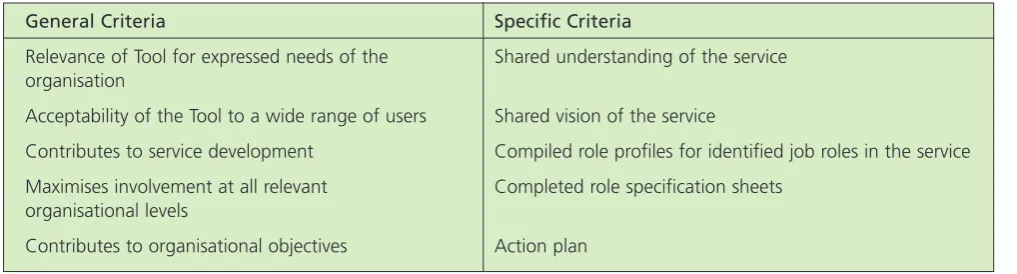
appraisal of resources and work by the Reference Group including their developed understanding of needs led to the design and delivery of the ETNA Tool based upon the following criteria:
Within the frame of these criteria the Reference Group agreed the
Structure, Process and Outcome of the ETNA Tool as detailed below:
Structure
Training needs analysis needs to be embedded in a wider structure of organisational preconditions if it is to be adopted and the outcomes utilised. The required structures are depicted in Appendix 1 mapped onto the other work package elements of the Shaping the Future Project.
Process
The tool is best applied to a specific service development. The Tool provides a guide to support facilitators in the process of needs analysis to be used in a group setting.
Tool Outcomes
The outcomes are based upon the content of the Tool in terms of skills/knowledge expressed as
competencies with competency levels. These are derived from a selection of relevant domains of the Knowledge and Skills Framework for
Development and Review
(Department of Health, 2004). This framework was adopted because it is a Department of Health requirement of all NHS organisations to use it and it is linked to pay and progression, supporting the implementation of Agenda for Change. It also allows for the inclusion of 'local competencies' that are specific to a particular service development.
It was decided not to predetermine occupational roles or role descriptions within the Tool (unlike the Public Health Skills Audit). Rather, the definition of roles would be an emergent outcome of needs analysis, expressed in terms of competencies for the role. The application of these role definitions to individuals would result in identification of needs for learning and development to achieve the required competencies. The definition of roles and competencies as emergent outcomes allows the inclusion of users and carers who are not part of the formal health and social care workforce. The adaptation of the 'field of words' technique, (Cowley and Houston, 2003) as a tool assists individuals and groups to articulate the skills, knowledge and
General Criteria Specific Criteria
Relevance of Tool for expressed needs of the Shared understanding of the service
organisation
Acceptability of the Tool to a wide range of users Shared vision of the service
Contributes to service development Compiled role profiles for identified job roles in the service
Maximises involvement at all relevant Completed role specification sheets
organisational levels
[image:16.595.56.565.652.789.2]Contributes to organisational objectives Action plan
It was decided not to predetermine occupational roles or role descriptions within the Tool (unlike the Public Health Skills Audit). Rather, the definition of roles would be an emergent outcome of needs analysis, expressed in terms of competencies for the role. The application of these role definitions to individuals would result in identification of needs for learning and development to achieve the required competencies. The definition of roles and competencies as emergent outcomes allows the inclusion of users and carers who are not part of the formal health and social care workforce. The adaptation of the 'field of words' technique, (Cowley and Houston, 2003) as a tool assists individuals and groups to articulate the skills, knowledge and experience that they bring to health and social care. These could then be mapped onto more formal
competencies to validate their co-participation in the workforce with the potential for further support of learning and development whether or not this leads into employment.
It was envisaged that the full implementation of the ETNA Tool should deliver a number of outcomes for services and for individuals, including:
■ Locally owned vision for
integrated health and social care;
■ Knowledge and Skills for all – a
'core curriculum';
■ Knowledge and Skills for selected
roles;
■ Key issues for service development
and role design;
■ Validation of individual knowledge
and skills;
■ Individual development planning.
3.7 ETNA Tool Prototype
Components
The Reference Group approved the
development of the following five components for the ETNA Tool:
1. Introduction and Icebreaker; 2. Visioning Exercise: integrated
services;
3. Identifying Knowledge and Skills;
4. Role profiling and Gap Analysis; 5. Action Planning.
3.7.1 Introduction and Icebreaker
The inclusion of an introduction and ice breaker was considered important to engage participants in a workshop characterised by a highly participatory approach similar to the Health Development Agency's Public Health Audit Tool (Burke, Meyrick and Speller, 2001). The Tool offers suggestions for facilitators but does not prescribe particular exercises so that they are free to use their group facilitation skills as they find appropriate in their local setting.
3.7.2 Visioning Exercise: Integrated Services
The inclusion of a visioning exercise builds upon the Public Health Audit Tool and the Changing the Workforce Toolkit for Local Change (see
Appendix 2). The purpose of the visioning exercise is to enable the participants:
■ To review where the service is now
in terms of integration, and
■ To explore where participants
would like the service to be in the future.
Reviewing the extent to which the service is currently integrated would enable participants to describe their own experience of working in an integrated way. It would also provide a starting point for envisaging change and identification of knowledge and skills required for the delivery of integrated services.
3.7.3 Identifying Knowledge and Skills
The decision to define roles and competencies as emergent outcomes of process of interactive dialogue endorsed the adaptation of the 'field
of words'technique (following
Cowley and Houston, 2003). This technique is intended to assist individuals and groups to articulate the skills, knowledge and experience that they bring to health and social care. In the Tool, the field of words is populated in the first instance with terms identified by workshop facilitators as triggers to stimulate group thinking. These terms are placed randomly on a piece of flip chart paper. The pilot Tool utilised six trigger terms derived from the systematic review of the literature
(Howarthet al, 2004) as a starting
point for the field of words needs assessment exercise.
These are:
■ Communication;
■ Team Working;
■ Partnership;
■ Personal/Professional
Development;
■ Service Development;
■ Practice Development.
The interactive workshop setting is intended to enable participants to extend their thinking, for example, by explaining or exploring knowledge and skills with workers from other agencies involved in the delivery of services. Work from the visioning exercise would provide the basis for identifying:
■ Knowledge and/or skill already in
use to deliver an integrated service, and
■ Knowledge and/or skill requiredto
deliver an integrated service.
knowledge and skills using these two headings, leading to a gap analysis for the service as follows:
Knowledge and/or skill requiredto
deliver an integrated service MINUS
Knowledge and/or skill already in
useto deliver an integrated
service, EQUALS
Gap analysis of knowledge/skills for an integrated health and social care service.
3.7.4 Role Profiling and Gap Analysis
The gap analysis may be further differentiated through the use of the following categories, adapted from the Sainsbury Centre model of the Capable Practitioner
(http://www.scmh.org.uk/-see Appendix 2):
■ All must have;
■ Some must have;
■ Who should have?
The Tool prototype provided guidance for facilitators to further differentiate and classify knowledge and skills according to specific roles defined by participants in relation to level within the organisation. For example, using the broad headings of strategic managerial, operational managerial and front line worker requirements. This would then enable further application through profiling of specific job roles. Job role
specification sheets were provided for completion in relation to one or more roles, based upon selected domains of the Knowledge and Skills Framework, and following the methods included in the Changing the Workforce Toolkit for Local Change and the Public Health Audit Tool (see Appendix 2).
3.7.5 Action Planning
The ETNA Tool prototype provided guidance to facilitators:
■ To identify key issues and to
inform participants of how these will be taken forward for further consideration/action within the organisation;
■ To provide opportunities for
individuals to review personal outcomes and further action plans of importance for their own development;
■ To set aside time following the
workshop along with service managers to identify priorities arising from the needs analysis for knowledge and skill development for the existing workforce and possible new roles; and
■ To evaluate the workshop and
thank participants for their contribution.
3.8 Delivery of Education
and Training Needs
Analysis
The five components of the ETNA Tool were proposed as the basis for a day workshop offered to pilot sites recruited for the programme along with locally based facilitators supported by the researchers from Higher Education. It was envisaged that the delivery of the workshops would require three phases outlined within the Tool:
■ Preparation and Planning;
■ Delivering a full day workshop;
■ Follow-up phase – review, action
planning.
Chapter 4:
Testing the ETNA Tool Prototype
Piloting the ETNA Tool prototype had two aims: To evaluate the tool in use, and to refine and amend the Tool for public use. In line with the adopted methodology the pilot phase of the research involved:
■ Working with practitioners in the
form of a Reference Group;
■ Running a facilitators' workshop;
■ Delivery of two pilot workshops;
■ A final evaluation workshop.
Each of the components of the pilot phase is discussed below.
4.1 The Pilot Reference
Group
Following the launch of the ETNA Tool prototype, existing Reference Group members and other interested PCTs and Social Service Departments were invited to work on the pilot phase of this study. This involved identifying potential pilot sites and a working process, developing an evaluation framework and criteria, and designing evaluation tools.
4.1.1 Identification of Pilot Sites
Criteria for the selection of sites to participate in the pilot phase were:
■ The target service must be either
operating or preparing to operate as an integrated health and social care service;
■ The agencies must be able to
commit facilitators and time to the process;
■ Agencies must be willing to
participate in preparation and follow-up events concerning the pilot phase;
■ Agencies must gain commitment
from the targeted services.
In addition, the researchers were keen to pilot use of the Tool in different sites, in accordance with the aim to provide a generic ETNA Tool
that would work within the framework of service development across PCTs in the North West. From the expressions of interest shown three pilot sites were initially identified as pilot sites. These included PCT A, serving an urban area and part of a larger tPCT; PCT B, serving two semi rural communities; and PCT C, within an urban area. PCT C aimed to pilot use of the Tool jointly with the local Social Services Department and within a proposed Children Disabilities Trust. However, ultimately they were unable to participate in the pilot within the time frame of the pilot phase.
Representatives from this site continued to play a key role in the ongoing pilot study. Therefore, the two pilot sites that met the criteria and could work within the project timescales were:
1. PCT A with a Community Older Peoples Team service;
2. PCT B in the proposed
development of a one stop health and social care shop for local residents.
The reference group also agreed a process of support for the identified pilot sites including regular liaison with named individuals from the pilot sites, dissemination of any plans or relevant documentation to all sites, and informing pilot sites of each others' pilot schedules. This process was significant in that sites and researchers had access to each other in between meetings and workshops.
4.1.2 Evaluation Framework and Criteria
The pilot reference group was used to develop an evaluation framework focused around proving, improving and learning (adapted from Easterby-Smith, 1994). This framework embraced evaluation criteria made up of the general criteria and specific
outcomes used in the development of the ETNA Tool prototype, as shown in Table 2 (on next page). Assessing the extent to which the Tool works and meets the criteria by which it is developed (proving) aimed to highlight also where it was not working and where it might be improved. It was also hoped that this would offer learning about education and training needs analysis in integrated health and social care.
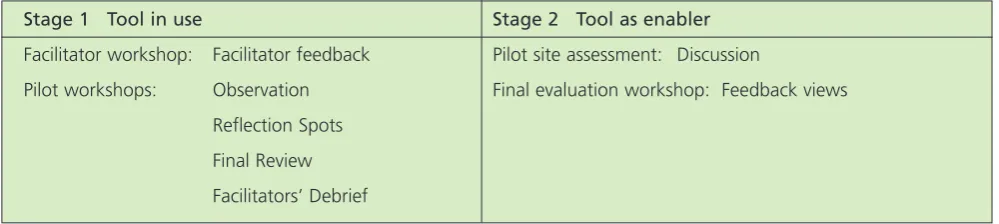
The Reference Group suggested a two staged approach to the six month pilot. Stage 1 was based on the primary focus of the pilot and involved evaluation of the Tool in use. This stage included a facilitators' workshop where pilot site facilitators came together to familiarise
themselves with the Tool and plan its delivery, and pilot workshops where the pilot sites delivered and assessed the Tool prototype. Stage 2
4.1.3 Use of Evaluation Instruments
The agreed framework encouraged the use of instruments to fit within the collaborative, interactive and learning methodology. Figure 3 summarises the evaluation instruments for each phase.
Evaluating the Prototype: Purposes
Proving: To what extent does the Tool meet its development criteria?
Improving: How can we improve it to meet the criteria more effectively?
[image:20.595.61.552.186.548.2]Learning: What have we learned from this pilot concerning education and training needs analysis and integrated health and social care.
Table 2: ETNA Pilot Evaluation Framework
Pilot Stages
Stage 1: Facilitator Workshop – Introduce the Tool and plan delivery. Pilot Workshops – Deliver and evaluate the Tool in use.
Stage 2: Final Evaluation Workshop – Reflect on impact of the Tool.
General Criteria Specific Criteria
Relevance of Tool for expressed needs of the Shared understanding of the service
organisation
Acceptability of the Tool to a wide range of users Shared vision of the service
Contributes to service development Compiled role profiles for identified job roles in the service
Maximises involvement at all relevant Completed role specification sheets
organisational levels
Contributes to organisational objectives Action plan
Stage 1 Tool in use Stage 2 Tool as enabler
Facilitator workshop: Facilitator feedback Pilot site assessment: Discussion
Pilot workshops: Observation Final evaluation workshop: Feedback views
Reflection Spots
Final Review
Facilitators’ Debrief
[image:20.595.56.556.637.749.2]Stage 1
The first stage involved evaluating the overall ETNA Tool as well as its constituent parts during delivery. Evaluation instruments agreed upon included facilitator feedback, observation, reflection 'spots' and a final review. Researchers and facilitators aimed to use pre-set prompts or questions for each of the components of evaluation that related to general criteria and specific outcomes.
Facilitator feedback:The facilitators' workshop, described in section 4.2, gave an opportunity to gain initial feedback on the ETNA Tool prototype, through participation in exercises and planning of delivery.
Observation:Project researchers intended to observe the Tool in use and in particular the processes and content with a view to improvement. This involved observing the extent to which each of the five delivery components met the identified general criteria and helped participants achieve the specific outcomes. For example, ease of use of the visioning exercise and its value in achieving a shared vision of the service. Not all general criteria would be observable within the workshop, for example, contribution to service development and contribution to organisational involvement.
Reflection Spots:Reflection 'spots' involved the facilitator asking the participating group to stop, reflect and review on the processes and exercises just undertaken. Reflection 'spots' were at key points in the delivery, for example, following the
field of wordsexercise. Reflection
'spots' were short and focused on the value of the exercise in achieving the outcome and how it might be improved. For example, following the visioning exercise the facilitator asked
the group to consider the value of the exercise in reaching a shared vision, what was useful about the exercise and any improvements to content or process that could be made. This enabled the facilitator and researchers to get an immediate reaction and to supplement observational
information.
Final Review: At the end of the workshop a final review of 45 minutes enabled participants to review the overall process and to highlight particular aspects of value and for improvement. The final review asked participants to highlight what they found most useful and why and whether the overall Tool met the general criteria.
Facilitators’ Debrief:After the workshop, facilitators had an opportunity to review the progress of the workshop. In particular,
facilitators were asked to reflect on their experience of delivering the ETNA Tool, aspects they found of value and aspects they think need improving. Stage 2 would provide an opportunity for a more in-depth review.
Stage 2
Stage 2 focused on the Tool as an enabler to support development of integrated services and involved evaluation after the pilot workshops. This stage included discussion as part of a pilot site assessment and sharing feedback in a final evaluation workshop.
Pilot site assessment:After the pilot workshops facilitators were asked to discuss the value of the Tool in supporting integrated health and social care.
Final Evaluation Workshop:A final workshop was arranged three months after the last pilot workshop to share feedback from pilot sites with the
wider Reference Group. The time lapse aimed to give pilot sites the opportunity to reflect on the value of the ETNA Tool and to gather
information about its contribution to service and practice development. At this final workshop, the researchers provided initial feedback from the pilots and invited comment, additional feedback and discussion from the facilitators' and Reference Group perspectives.
4.2 Facilitators' Workshop
The facilitators' workshop was a one day practical event aimed at
familiarising representatives from pilot sites with the ETNA Tool prototype in order to help them plan the pilot workshops. The event was run by the researchers and aimed for the following outcomes:
■ A good understanding of the Tool
and how it might work on the pilot;
■ A checklist for undertaking the
pilot;
■ Clarity about pilot site and
researcher roles throughout the pilot study;
■ An action plan including next
steps and timing.
finished with an action planning activity. Pilot sites were asked to consider what needed to be in place to run the pilot within their site and to set dates for their workshops. In addition, roles and responsibilities of the pilot sites and the researchers were confirmed. Support mechanisms were clarified including ongoing liaison, help with practical
arrangements, opportunity to attend each others' pilot sites and
documentation provision.
4.3 Pilot Workshops
The ETNA Tool prototype was piloted in two different sites: PCT A:
Community Older Peoples Team (COPT) service, which was an established service and PCT B who were proposing a new service. The researchers attended both pilot workshops to support the facilitators, to observe the pilot through
participation with groups in the activities, and to carry out short evaluation exercises with participants after the activities and at the end of the day.
4.3.1 PCT A Pilot Workshop
The PCT A COPT service was developed in 1999 to provide integrated services for older people locally as a result of national and local practice and guidance. PCT A is now seeking to further integrate its health and social care services for older people and is currently undergoing a consultation process to consider:
■ Further co-location of staff on a
neighbourhood basis;
■ The development of integrated
working arrangements including workforce, information about services, information systems and management structures;
■ The development of integrated
commissioning between the Primary Care Trust and the Social
Services Department;
■ The mainstreaming of services
focused on the needs of older people across each of PCT A's five Strategic Partnership themes (Economy & Employment; Housing & Environment and Crime).
The service has not been involved in any joint training activities before and wanted to use the ETNA Tool as part of the ongoing development of integrated provision.
Preparation for the one day workshop included sending out a pre-event questionnaire for participating teams to encourage them to think about knowledge and skills development beforehand. Over a series of
meetings, a team of three facilitators developed the agenda based on the sequence of activities within the ETNA Tool. The facilitator team then devised materials to support the activities and to act as prompts for the exercises. This material included exercise information on flip charts and small exercises to link activities and to relate them to COPT work.
There were 16 COPT members at the workshop including representation from a range of professions including physiotherapy, social work, nursing and service managers. The workshop included a series of activities from exploring current level of integration of service to how it might be in the future, identifying the knowledge and skills a COPT practitioner requires and has, and using existing roles to carry out a role profiling activity and gap analysis.
4.3.2 PCT B Pilot Workshop
PCT B became a pilot site for the ETNA Tool because they are planning an integrated Health Connections Centre to provide access to health, social and welfare services including services provided by the voluntary
sector. The Centre aims to be a drop-in service that ldrop-inks drop-into a range of other amenities such as benefits advice, a Sure Start crèche, library access, a café and learning suite. The Centre proposes to offer local people access to a range of health and social care services including Physiotherapy, Podiatry, Nutrition and dietetics, dentist and community dental services, mental health and learning disabilities services, school health practitioners, citizens' advice and youth services. The Centre hopes to develop new ways of working by building on current joint working arrangements for example child development teams that include audiology and speech therapists, health visitors and sure start workers and learning mentors. This may mean future integrated provision that includes a range of existing and new roles working together, for example, benefits advisers, housing workers, key workers and visiting volunteers working as an advocacy team.
PCT B wanted to use the ETNA Tool as a development starting point that would bring representatives from a range of agencies together to explore initial needs.
social care. The group then identified a key 'joint' role within the proposed Centre and worked with this role to analyse the knowledge and skills already available within the service for this role and any further additional requirements. The participants were then asked to develop a gap analysis and role profile for the role.
4.4 Final Evaluation
Workshop
The second stage of the pilot was concerned with the extent to which the Tool supported the development of integrated services. It aimed to do this by asking pilot sites to reflect on the value of the Tool following their pilot workshops and to share their views within a final evaluation workshop. The final evaluation workshop took the form of a half day meeting three months after the final pilot workshop. The time lapse aimed to give pilot sites the opportunity to reflect on the value of the ETNA Tool and to gather information about its contribution to service and practice development. A total of 12 people attended including pilot site
Data were collected from the range of workshops including:
■ Researchers' observation of
activities;
■ Participants' views of individual
activities;
■ Participants' views of the Tool
overall;
■ Facilitators' feedback and pilot
debrief;
■ Pilot site discussion and feedback.
The data were mapped against the general and specific ETNA Tool prototype development criteria to provide information concerning the three purposes that underpinned the evaluation framework:
■ The extent to which the Tool
worked (proving);
■ How the Tool might be refined
and amended (improving), and
■ Insights about training needs
analysis and integrated health and social care (learning).
The data are presented within each of these categories below.
5.1 Proving – Does it work?
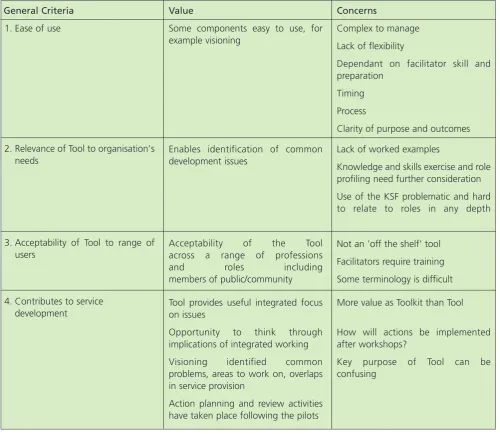
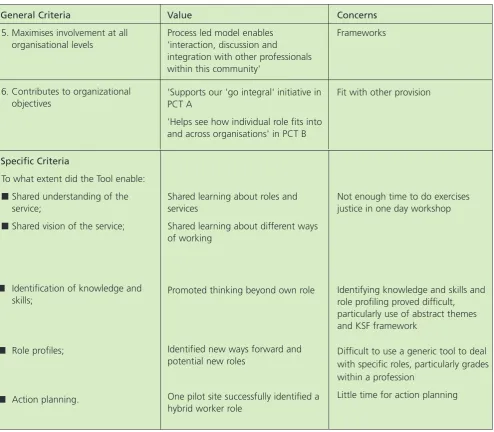
The data show, as illustrated in Table 3, that the Tool has value across each of the identified criteria with the potential to be used flexibly across a range of integrated services. However, the pilot phase also raises important concerns with the prototype.
Chapter 5:
[image:24.595.56.557.359.793.2]Research Findings
Table 3:Summary of pilot findings
General Criteria
1. Ease of use
2. Relevance of Tool to organisation's needs
3. Acceptability of Tool to range of users
4. Contributes to service development
Value
Some components easy to use, for example visioning
Enables identification of common development issues
Acceptability of the Tool across a range of professions and roles including members of public/community
Tool provides useful integrated focus on issues
Opportunity to think through implications of integrated working
Visioning identified common problems, areas to work on, overlaps in service provision
Action planning and review activities have taken place following the pilots
Concerns
Complex to manage
Lack of flexibility
Dependant on facilitator skill and preparation
Timing
Process
Clarity of purpose and outcomes
Lack of worked examples
Knowledge and skills exercise and role profiling need further consideration
Use of the KSF problematic and hard to relate to roles in any depth
Not an 'off the shelf' tool
Facilitators require training
Some terminology is difficult
More value as Toolkit than Tool
How will actions be implemented after workshops?
Specific Criteria
To what extent did the Tool enable:
■Shared understanding of the
service;
■Shared vision of the service;
■ Identification of knowledge and
skills;
■ Role profiles;
■ Action planning.
Shared learning about roles and services
Shared learning about different ways of working
Promoted thinking beyond own role
Identified new ways forward and potential new roles
One pilot site successfully identified a hybrid worker role
Not enough time to do exercises justice in one day workshop
Identifying knowledge and skills and role profiling proved difficult, particularly use of abstract themes and KSF framework
Difficult to use a generic tool to deal with specific roles, particularly grades within a profession
Little time for action planning
General Criteria
5. Maximises involvement at all organisational levels
6. Contributes to organizational objectives
Value
Process led model enables 'interaction, discussion and
integration with other professionals within this community'
'Supports our 'go integral' initiative in PCT A
'Helps see how individual role fits into and across organisations' in PCT B
Concerns
Frameworks
[image:25.595.45.540.55.487.2]Fit with other provision
Table 3:continued
5.1.1 Value of the ETNA Tool Prototype
The main value for the PCT A pilot appeared to lie in enabling a range of multi-disciplinary professionals to work together within a service rather than professional role framework, and as such supported the PCT A 'go integral' initiative. Action planning and review activities have taken place following the pilot including a greater focus on moving forward with their co-location plans, further work on communication and co-ordination of records. In addition, since the pilot PCT A has had some
cross-organisational development including integrated sessions with health and social care. The COPT service is also challenging support services to target training and development delivery at
integrated needs rather than professional roles. PCT A recognise that impact for service users may take more time to become evident and they highlighted 'hidden benefits' where the service is aware of benefits which service users may not
recognise, for example, improved communication.
The main value for the PCT B pilot appeared to lie in offering this particular group an opportunity to explore how their particular roles and services interact already and how they might interact within a different setting. Although many of the participants knew each other they had not had opportunity before to get together and to work at a service level. PCT B held a facilitators' review of the pilot and recognised that this
has put the process of integrated working more firmly on the agenda, particularly as the Head of Social Care has used the pilot as evidence to push for co-location of services.
Common values identified from use of the ETNA Tool prototype include:
■ Developing joint understandings