Journal of Chemical and Pharmaceutical Research, 2014, 6(3):813-817
Research Article
CODEN(USA) : JCPRC5
ISSN : 0975-7384
Research On the Burning Zone Temperature Control of Cement Rotary Kiln
Based on CMAC-PID Algorithm
Kong Ying
College of Medical Information Engineering, JiNing Medical University, Rizhao, China
_______________________________________________________________________________________
ABSTRACT
With nonlinearity, large lag and time-varying model parameters of cement rotary kiln, this paper proposed a burning zone temperature control system of cement rotary kiln based on CMAC neural network. By Dynamic adjustment of PID controller parameters with CMAC neural network, combined with rotary kiln temperature control mechanism, the temperature controller based on CMAC-PID was designed. Then the good dynamic and static characteristics and anti-interference ability of system were verified by simulation test. Finally hardware and software design of temperature control system were completed. In order to improve the rapidity of PID parameters online adjustment, OB35 program block in PLC was used to real-time adjustment of CMAC parameters. This control system has been applied to QuFu cement rotary kiln project, realizing none overshoot and high control precision of the burning zone temperature.
Key words: cement rotary kiln; intelligent control; PID control; CMAC neural network
_____________________________________________________________________________________________
INTRODUCTION
Burning zone temperature of cement rotary kiln is an important technological parameters and test variables, which must be stable effectively for the stability of rotary kiln thermal process and quality grade of cement clinker, so it is of great significance to realize stable and high yield of production line. System has characteristics of big inertia and large lag, and its working condition is complicated, while the model parameters are large range change and has strong nonlinear characteristics. So the traditional control strategy has been unable to get satisfactory effect.
The development of intelligent control theory laid a theoretical basis for cement industry to work effectively. Compared with the traditional control method, advanced control algorithm achieved incomparable control effect. Literature [1] adopts fuzzy control to realize the effective control of decomposing furnace temperature, but cannot eliminate static error. Literature [2] adopts a combination of predictive control and fuzzy control to improve the system control precision, but the control performance relies too much on accuracy of prediction model. As the literatures [3, 4] described, fuzzy PID control was adopted to realize the effective control of burning zone temperature, improving the adaptive ability and the capacity to cope with complicated working condition changes of PID controller, but the control accuracy depend on the optimization of control rules. So BP - PID controller was adopted to realize the rotary kiln temperature control [5, 6]. BP neural network adjust PID control parameters real-time according to the condition change, improving control precision, but the complexity of algorithm restrict optimization control speed.
complicated working characteristics of rotary kiln system, PID controller parameters can be optimized real time by CMAC neural network, improving the quality level of cement clinker. Coal feeder speed will be adjusted dynamically with optimized PID controller, realizing the stability of burning zone temperature control. Simulation experiment proves the good dynamic and static characteristics and robust performance of the controller. In order to improve the PID parameter optimization speed, timing routine embedded in PLC was adopted to implement CMAC neural network optimizer.
CONRUOL MODEL OF BURNING ZONE TEMPERATURE
Cement rotary kiln is the main equipment for clinker sintering process, while the stability of burning zone temperature directly determines the quality level of clinker. With the coal amount (coal feeder speed) as the input and burning zone temperature as the controlled object, a mathematic model of the burning zone temperature was established. Because the volume and quality of the rotary kiln is very big, there is a big inertia in rotate process, and state variable has made slow response to the change of control variable. In order to ensure the continuity of controlled objects, control model can be expressed as a first order inertia and lag model structure.
( ) 1
Ds
C
Ke s
s
(1) Where K is gain, D is time delay and C is time constant.
DESIGN FOR TEMPERATURE CONTROLLER BASED ON CMAC-PID
With the characteristic of large inertia, pure delay and model time-varying, the mathematical model of cement rotary kiln is not accurate established, while the traditional PID control can not realize the effective control. Therefore according to the change of working condition PID control parameters must be adjust with CMAC neural network, in response to the real-time change of working condition.
CMAC neural network is composed of a series of mapping (figure 1). S is the input space, in which input vector is the collection of N input signal. First input vector mapped to concept memory (A) abided by the principle that similar input mapped to A have some overlap and no relevant input are far apart. Because the learning problem is not all possible input, the memory capacity of '
AA is much smaller than A, so the mapping '
AA is a many to one random mapping which can be achieved by hash coding.
Input space Concept memory
Memory
weight adjustment
Expected output
Output y=f(s)
[image:2.595.161.458.420.735.2]B
Fig. 1: Principle of CMAC neural network
× e PID controller
-CMAC arithmetic
u
temperature transmitter burning zone
temperature setting
Cement rotary kiln temperature mode
[image:2.595.173.443.446.614.2]The control system of burning zone temperature is shown in figure 2. PID three control parameters was adjust by CMAC neural network based on the temperature deviation of burning zone, thus PID controller could realize effective control of coal feeding speed , so as to realize the effective control of burning zone temperature.
Controller input is the difference between expectations and the actual output, while control outputs are the three PID parameters. According to the effect of three PID parameters in the adjustment process, the learning algorithm can be improved as follows. Based on the gradient descent method, the output weights of the three parameters I, P, D can be respectively adjust as follows.
1 ( ( ) ( )) 1( )
( )
j I I I
E r t y t y e t w t
w c w c
(2)
( ) ( 1) ( ) ( ( 1) ( 2))
j j j I j j
w t w t w t w t w t
(3)
Where I is learning rate and I is inertia coefficient of I.
2 ( ( )1 1( 1)) 2( )
( )
j P P P
E e t e t y e t w t
w c w c
(4)
( ) ( 1) ( ) ( ( 1) ( 2))
j j j P j j
w t w t w t w t w t
(5)
Where P is learning rate and P is inertia coefficient of P.
3 ( ( )1 2 (1 1) 1( 2)) 3( )
( )
j D D D
E e t e t e t y e t w t
w c w c
(6)
( ) ( 1) ( ) ( ( 1) ( 2))
j j j D j j
w t w t w t w t w t (7)
Where D is learning rate and D is inertia coefficient of D.
SIMULATION TEST OF THE CONTROLLER
Based on the historical data of rotary kiln provided by QuFu cement plant and the effective identification of key parameters by matlab identification toolbox, the mathematical model of burning zone can be defined as follows.
9.6 152 ( )
21 1
s
e s
s
(8)
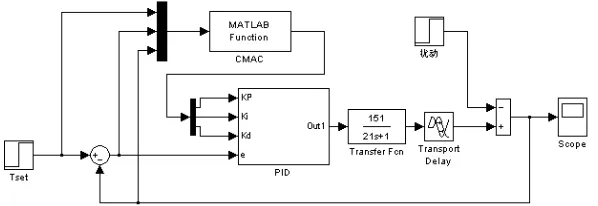
PID control model of coal amount (CA) is shown in figure 3. After repeated experiments, the PID parameter adjustments are as follows: kp=0.012,ki=0.001,kd=0.08.
[image:3.595.156.455.595.698.2]As shown in figure 4, PID control system adjusted with CMAC neural network can be quickly adjust PID three parameters in each sampling period, obtaining the best control effect, so the system basically have no oscillation, fast response, short setting time and stronger robustness. Thus the control system is superior to traditional PID control no matter on the dynamic performance and static performance.
Fig. 4: Comparison of rotary kiln temperature dynamic response based on different control algorithms
SOFTWARE AND HARDWARE DESIGN OF CMAC-PID TEMPERATURE CONTROLLER
C
em
en
t
ro
ta
ry
k
iln
Feeding coal
IP
C Ethernet
S
7
-4
0
0
P
L
C
thermocouple
A
I m
o
d
u
le
C
o
n
v
er
te
r
[image:4.595.135.473.253.358.2]Profibus
Fig. 5: hardware structure of control system
Figure 5 gives the control system hardware structure. The local control part adopts S7-400PLC, realizing the collection of burning zone temperature of cement rotary kiln. Frequency converter was controlled by PROFIBUS field bus, for sake of adjustment of feeding coal speed. Industrial Personal Computer completed Monitoring function, realizing real-time data interaction with PLC through the industrial Ethernet. 11 KW converter adopts Siemens MM440, which is a energy-saving converter designed for wind turbines and pump load, and burning zone temperature can be measured using three thermocouple with degrees number of 0 ~ 1600 ℃.
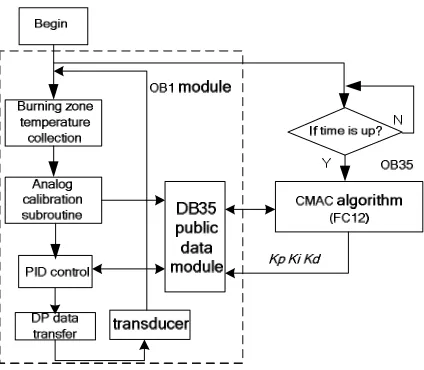
Fig. 6: The control program flow chart
[image:4.595.199.411.463.648.2]and then gave frequency values to inverter by calling SFC15, for sake of adjust the feeding coal speed. In order to improve the real-time control, CMAC algorithm used timer interruption mode, and procedure was programmed within the OB35 that cycling time was set to 100 ms.
CONCLUSION
This paper proposed a PID self-tuning control system based on CMAC neural network used in the cement rotary kiln temperature control system. Through simulation test, the control system can effectively reduce the shock and quickly reach steady state, which have the small output error, good real-time performance and strong robustness. The control approach has the very good control effect on the control object of which mathematical model can't be established accurately, and can well satisfy the control requirement of the cement rotary kiln. The control system has been used in QuFu cement plant, which runs stably with burning zone temperature constant.
Acknowledgments
The authors would like to thank JiNing Medical University Foundation (JY2013KJ031).
REFERENCES
[1] Hou yantao,Zeng hongyan,Zhou yuan. Design and Simulation of Rotary-Kiln Fuzzy Control System Based on Mat1ab[J]. Electronic Technology, 2009,25(2):17-18.
[2] Tian jian,Wang suiping,Zhang yuchi. Study on Fuzzy PID Control Algorithm for Temperature Control of Rotary Kiln[J]. Journal of Hunan Industrial Polytechnic, 2010,10(2):20-22.
[3] Hou xiaojing,Gao xiang,Shu yunxing. Simulation Study of Fuzzy Adaptive PID Temperature Control System for Cement Rotary Kiln[J]. Journal of Luoyang Institute of Science and Technology(Natural Science Edition),
2008,18(2):61-63.
[4] Wu Zhi Qiao and Masaharu Mizumoto. PID Type Fuzzy Controller and Parameters Adaptive Method[J].
Fuzzy Sets and Systems, 1996,78(1): 23-35.
[5] Yaohua Guo, Junshuang Ma and Minglin Yao. The Neural Network PID Controller for Cement Rotary Kiln Temperature Based on FPGA[C]. Third International Symposium on Information Science and Engineering,
2010,10(12)345-348.
[6] Zengtao Xue, Zheng Li. Control System Design of Cement Rotary Kiln Based on PID Neuron Networks[C]. International Conference on Test and Measurement, 2009,1(12):21-24.
[7] Niu honghai,Zhao rongxiang,Shang zhe. Research on Control Method of Permanent Magnet Synchronous Motor Based on CMAC Neural Network[J]. Electric Drive, 2006,36(5):19-21.