Study on Spray Characteristics of Biodiesel using a Rapid Compression
Machine
M. Jaat
1,a, Amir Khalid
1,b,B. Manshoor
1, S.M. Basharie
1, Adiba Rhaodah
Andsaler
1, Azwan Sapit
11Automotive Research Group (ARG), Centre for Energy and Industrial Environment Studies (CEIES), Universiti Tun Hussein Onn Malaysia, Parit Raja, Batu Pahat, 86400 Johor, Malaysia
a[email protected],b[email protected],
Key Words: Biodiesel, Constant Chamber, Mixture formation, Spray Characteristics
Abstract Mixture formation plays as a key element on burning process and controlled by the characteristics if the injection system, the nature of the swirl and turbulence in the cylinder, ad spray characteristics. Mixture formation during ignition process associated with the exhaust emissions.Measurements were made in an optically-accessible rapid compression machine (RCM) with intended to simulate the actual diesel combustion related phenomena. The diesel spray was simulated with the RCM which is equipped with the single-shot common-rail fuel injection system. Diesel engine compression process could be reproduced within the wide range of ambient temperature, ambient density, swirl velocity, equivalence ratio and fuel injection pressure. The examination of the first stage of mixture formation is very important consideration due to the fuel-air premixing process linked with the combustion characteristics. The detail behavior of mixture formation images was captured using the high speed camera.This method can capture spray penetration length, spray angle, spray evaporation and mixture formation process clearly. The spray characteristic such as the penetration length, spray angle and spray area are increasing when the injection pressure increased.
Introduction
Diesel engine is an internal combustion engine that uses the high compression pressure to ignite the combustible mixture due to high temperature in the combustion chamber. There were many studies on the fuel-air premixing that resulting from air entrainment which linked to the improvement of exhaust emissions[1-3]. The most important issue in diesel combustion is achieving sufficient rapid mixing between the injected fuel and the air in cylinder prior to ignition. The oxidation reactions at the end of endothermic period depend on the physical process such as air entrainment, the breakup of the jet spray, and droplets evaporation.
Air-fuel mixing process is a key element in diesel combustion, a good understanding of the formation of the spray is essential to improve fuel-air premixing, ignition process and combustion process. Spray atomization and fuel-air mixing play a significant role on engine performance, combustion and emissions. To understand the phenomena in the combustion chamber of diesel engine, studies using visualization techniques have been made by researchers of universities and industries[4-5].
may play an important role, and it is important to clarify these flow characteristics for a better understanding of the mechanism of combustion improvement with high pressure injection.
Experimental Setup
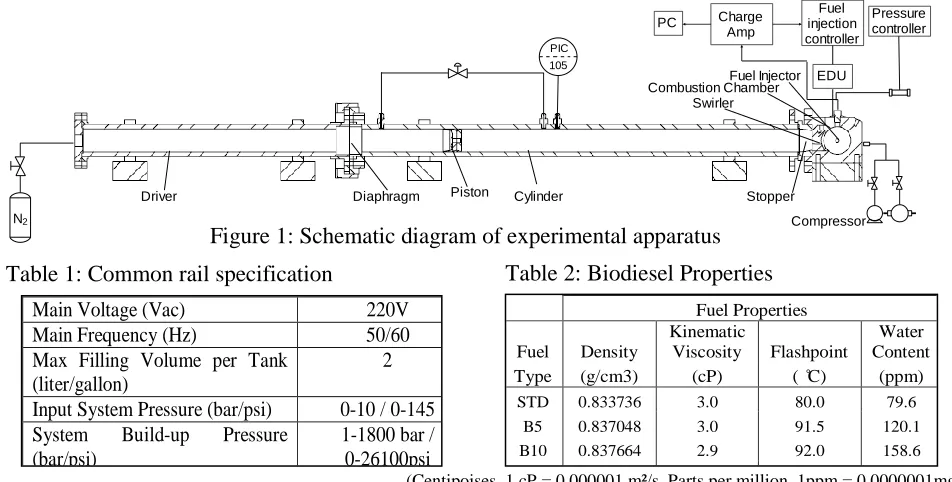
The experimental apparatus can be divided into several systems such as rapid compression machine, single-shot common rail system, data acquisition systems and exhaust emission measurement systems. The general schematic diagram of experiment apparatus is shown in Fig.1. A free-piston type rapid compression machine (RCM) was used to simulate diesel combustion in a constant volume over a wide range of ambient temperature and pressure conditions similar to actual diesel engines. In addition, systems were added with the exhausts analyzer to observe the exhaust emissions and the in-chamber pressure data are acquired with piezoelectric pressure transducer.
Table 1 summarizes the FMI-1000 Common Rail Injector system was used to simulate the common rail injection system with a constant pressure condition similar to actual diesel engine. The fuel pressure in the accumulator can increase up to 180 MPa by using a pump. The fuels tested were a grade II diesel (Standard diesel-STD) and blends of B5, B10 and B15 palm oil with the diesel fuel and the particulars of the tested fuels are detailed in Table 2.
In this study, mixture formation, initial flame and burning process were examined by measuring the in chamber pressure and observation of direct photograph taken by high-speed color digital video camera (NAC, GX-1) via a quartzes window with frame speed of 10000fps.The real spray image will be obtained by using direct photography method. Direct imaging can be used to obtain information of the flame development after ignition and also as evidence in order to understand the burning process diagnostics. This method can capture spray penetration length, spray angle, spray evaporation and mixture formation process clearly.
Result and Discussion
The effect of blending biodiesel ratio and injection pressure on mixture formation were investigated at the base standard diesel for ambient temperature (room temperature 24°C) and
Figure 1: Schematic diagram of experimental apparatus
N2
Driver Piston Cylinder Stopper
Combustion Chamber
Diaphragm
Swirler
Fuel Injector
105 PIC
Compressor Fuel injection controller Charge
Amp PC
EDU
Pressure controller
Main Voltage (Vac) 220V
Main Frequency (Hz) 50/60
Max Filling Volume per Tank (liter/gallon)
2
Input System Pressure (bar/psi) 0-10 / 0-145
System Build-up Pressure
(bar/psi)
[image:2.612.75.551.421.662.2]1-1800 bar / 0-26100psi
Table 1: Common rail specification
Fuel Properties
Fuel Density
Kinematic
Viscosity Flashpoint
Water Content Type (g/cm3) (cP) ( ̊C) (ppm)
STD 0.833736 3.0 80.0 79.6 B5 0.837048 3.0 91.5 120.1 B10 0.837664 2.9 92.0 158.6 B15 0.840428 3.0 93.5 219 Table 2: Biodiesel Properties
(Centipoises, 1 cP = 0.000001 m²/s, Parts per million, 1ppm = 0.0000001mg/kg)
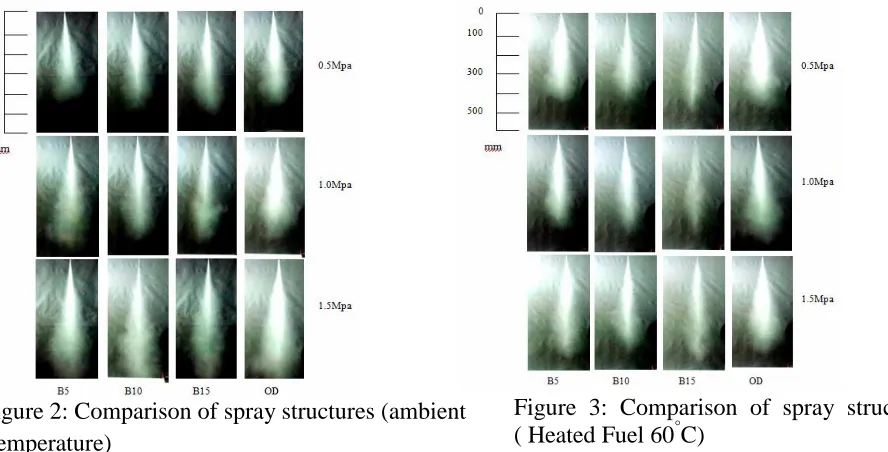
heated temperature of 60°C. Fig.2 depicts the variation in spray structures as injection pressure and blending biodiesel ratio are varied under ambient temperature. As seen in Fig.2, increased injection pressure and high biodiesel ratio, a great variation in the spray structure is observed compared with standard diesel. It promotes mixture formation and distributes larger amount of fuel between sprays thus creates good spray atomization and exhibits a greater amount of fuel-air premixing prepared for combustion. It seems that increment in injection pressure also affecting the spray tip penetration of the fuel but slightly difference in cone spray.
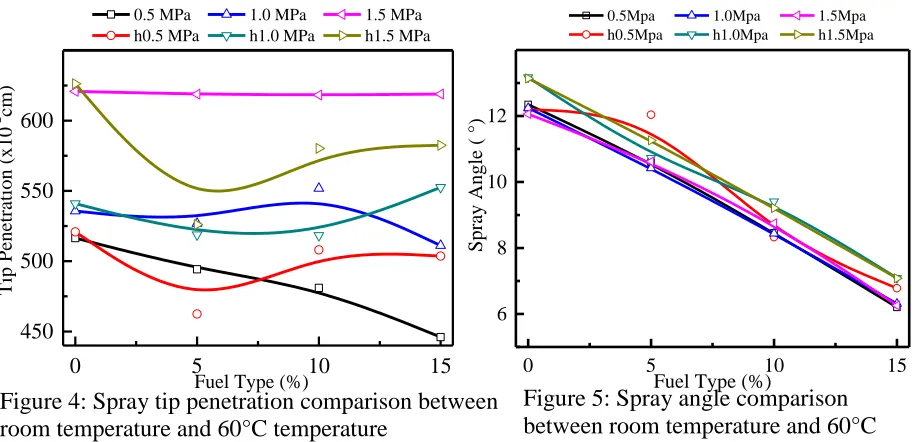
Images of spatial distribution of spray structures obtained at the variation injection pressure and heated fuel temperature at 60°C are presented in Fig. 3. Referring to the images, as compared with baseline condition of standard diesel, increased injection pressure and preheat fuel can make spray tip penetration shorten. Preheat fuel at 60°C, however, the spray cone becomes small as compared with Fig. 2 (without preheat). Changes in the spray penetration with different kind of fuel ambient condition are more clearly observed by examining the comparison of spray tip penetration as shown in Fig. 4. Spray angle is a very important parameter in a compression ignition engine such as the diesel engine. Spray angle are also referred as cone angle that is formed from the exit orifice of spray nozzle. Fig.5 illustrates the variation in spray angle comparison between room temperature (B%, B10, B15) and preheat fuel at 60°C temperature (HB5, HB10, HB15). The preheated condition fuel has higher spray angle as compared to ambient temperature. The largest spray angle heated ordinary diesel (OD) fuel at 1.0 MPa which is 13.17°. As seen in Fig. 5, under ambient condition, at the B15 ambient and 0.5MPa creates the smallest spray angle as compared with the preheat condition. This behavior could be associated with the low value of kinematic viscosity for fuel under preheat condition. As soon as the diesel is injected into the chamber, the fuel undergoes endothermic effect by absorbing the ambient heat. This phenomenon causes the kinematic viscosity of diesel fuel to decrease. Kinematic viscosity of diesel fuel affects the fuel atomization which consequently affects the engines exhaust emission[6].
Fig. 6 presents projected spray area versus the spray tip penetration for all types of blending ratio fuel. The projected spray area is increasing with the increasing of spray tip penetration. Is clearly seen that the preheat biodiesel fuel present smaller spray area and attributes to smaller spray angle.
Figure 2: Comparison of spray structures (ambient Temperature)
[image:3.612.91.535.170.396.2]Standard diesel promotes higher spray area compared to B5, B10 and B15. On the other hand, preheat fuel conditions also enhance the projected spray area, lengthen spray tip penetration and promote mixture formation at spray tip region. However, projected area is distributed at smaller region and suggests less air entrained into fuel spray under all variation blending ratio without preheat than with preheat condition.
Conclusions
The results obtained in this study are summarized as follows:
1. The biodiesel blending ratio B5, B10 and B15 gives longer spray tip penetration, smaller spray angle and projected area than diesel fuel. In ambient condition, spray penetration of biodiesels is longer than ordinary diesel (OD).
2. In the main part of fuel injection, combination of high injection pressure and an appropriate swirl ratio allows more fuel to spread to the outer part of the chamber and to be fine atomized, thus improving the mixture formation. At the same time results Figure 4: Spray tip penetration comparison between
room temperature and 60°C temperature
0 5 10 15
450 500 550 600
Ti
p Penetrat
ion (x10
-2 cm)
Fuel Type (%)
[image:4.612.78.535.72.293.2]0.5 MPa 1.0 MPa 1.5 MPa h0.5 MPa h1.0 MPa h1.5 MPa
Figure 5: Spray angle comparison between room temperature and 60°C temperature
0 5 10 15
6 8 10 12
Spra
y Angle (
°)
Fuel Type (%)
0.5Mpa 1.0Mpa 1.5Mpa
[image:4.612.169.397.371.565.2]h0.5Mpa h1.0Mpa h1.5Mpa
Figure 6 : Spray area and tip penetration
1 2 3 4 5 6
0 6 12 18 24
OD B5 B10 B15
HOD HB5 HB10 HB15
S
p
ray
A
rea
(m
2 )
lengthen spray tip penetration and promote mixture formation at spray tip region near the chamber wall.
3. High ambient density weakens the spray penetration and resulting from the increasing of boost pressure is anticipated to influence the mixture formation during ignition delay period and burning process.
4. The intensity of flame pattern is a kind of signal that tells the position where well-mixed mixture is prepared before ignition where increasing ambient density shortens ignition delay.
Acknowledgements
The authors also would like to thank the Universiti Tun Hussein Onn Malaysia and Ministry of Higher Education, Malaysia for supporting this research under the Fundamental Research Grant Scheme VOT.1054.
References
[1] J. Senda, N. Okui, T. Tsukamoto, and H. Fujimoto, “On-Board Measurement of Engine Performance and Emissions in Diesel Vehicle Operated with Bio-diesel Fuel Reprinted From : Compression Ignition Engine Performance for Use with Alternate Fuels,” SAE Pap.
No. 2003-01-0083, 2004.
[2] Amir Khalid, N. Mustaffa, A. J. Alimin, B. Manshoor, S. M. Basharie, A. Sadikin,
“Performance and Emission of a Diesel Engine Fuelled With Preheated Palm Oil Biodiesel under High Load Conditions”, Advanced Materials and Research Vols. 845 (2014), Trans Tech Publications, Switzerland, pp 61-65.
[3] Amir Khalid, Keisuke Hayashi, Yoshiyuki Kidoguchi , Tomoaki Yatsufusa, “Effect of air entrainment and oxygen concentration on endothermic and heat recovery process of diesel ignition”, (2011) SAE Technical Papers, DOI: 10.4271/2011-01-1834.
[4] M. Jaat, Amir Khalid, B. Manshoor, S.M Basharie, Him Ramsy, “Review of the
Investigation of Fuel-Air Premixing and Combustion Process using Rapid Compression Machine and Direct Visualization System”, Applied Mechanics and Materials Vols. 465-466 (2014), Trans Tech Publications, Switzerland, pp 265-299.
[5] T. Wang, J. Han, X. Xie, M. Lai, and N. A. Henein, “Direct Visualization of High Pressure Diesel Spray and Engine Combustion,” SAE Pap. No. 1999-01-3496, no. 724, 1999.
[6] Amir Khalid, “ Effect of Ambient Temperature and Oxygen Concentration on Ignition and
Combustion Process of Diesel Spray”. Asian Journal of Scientific Research 6 (3), 2013.
pp.434-444.
[7] Horibe, N., Takahashi, K., Kee, S.-S., Ishiyama, T. and Shioji, M., "The Effects of Injection Conditions and Combustion Chamber Geometry on Performance and Emissions of DI-PCCI Operation in a Diesel Engine", SAE Paper 2007-01-1874, 2007.