© 2017, IRJET | Impact Factor value: 5.181 | ISO 9001:2008 Certified Journal | Page 797
Image Processing Approach to Identify and Recognize Traffic Symbols
& Provide Voice Alerts Using Fuzzy Integral
Snehal.P.Shinde, Sneha.M.Konade, Sonali.Y.Khenat, Devika.D.Thakar, Prof. Abhay Meshram
Department of Computer Engineering, K.J. College of Engineering & Management Research,Pune.
---***---Abstract— In today’s modern world people are using
tremendous technologies so as to make there life more simpler. People are facing various issues in day to day life in which traffic plays a major role. Due to non observing traffic symbol it leads the fatal accidence which is comparatively hazardous have a system is required which automatically detects the traffic symbol and analyzes it. This paper recommended the use of various methodologies and algorithms such as block creation, block correlation, color identification, fuzzy logic and video frame creation. Most of the systems are having some performance issues that can lead to lower accuracy of the techniques so this paper proposes a novel idea of traffic symbol detection. To enhance the process of automatic traffic symbol detection and efficient image morphology our system works quite efficiently with required voice alerts.
Keywords—image block, block labeling, edge analysis,
shape and symbol identification, block correlation, fuzzy logic, voice alert.
I. INTRODUCTION
People are facing major issues in our day-to-day life. Though various solutions are confronted in order to make human life more simpler. In today’s technical world people are using different vehicles to reduce the pain of travelling from one place to another. Major accidents are taking place due to ignorance of the traffic signs and rules. As a result of increasing traffic signs, the drivers are expected to learn all the traffic signs and pay attention to them while driving. Hence a system is needed that will automatically detect and recognize the traffic signs which will comparatively ease the driving process resulting in major reduction in accidents.
In this paper the system will take the images of traffic signs as input, do the required processing and the output will be based on the required voice alerts. The building blocks the system are explained further. Almost a very large range of traffic symbols are
detected while travelling from source to destination. These symbols guide us throughout our journey. The image processing technique is widely used for this purpose. It is nothing but processing and studying the features of the various images captured.
These operations lead us to the final output where the image is captured and recognized. It makes use of the various recent algorithms for the appropriate study of the system. The traffic signs guide us to drive in a systematic manner without causing harm to living things such as animals, environment, human beings, etc. Hence the traffic signs are way important to us. Firstly the input image is captured which consist of traffic symbols. Further the images will be processed and studied in detail. The image will be divided into blocks and will be represented in a matrix form. Here the Block Creation Algorithm plays a major role. The image will be present in different blocks and further the features of the image will be studied. The next step is color identification where the consistency of the RGB will be calculated accordingly. The blocks are needed to be labelled for more accuracy. Again the edge analysis of the image is more important so as to get more accurate results.
© 2017, IRJET | Impact Factor value: 5.181 | ISO 9001:2008 Certified Journal | Page 798 reorganization is a three level process, the new ROI
extraction, the split flow cascade tree detector and a rapid occlusion robust traffic sign classification method. Further we are presenting a technology where we are supported by voice alerts. The driver will be informed in terms of the received voice-alerts. This will deliberately make the driving process a better and the amount of accidents will be reduced to a greater extent.
In this paper we are focusing on various element such as fuzzy logic and various block creation and color identification algorithms. The Fuzzy Integral is a basic abstract identifier. It is a user-friendly solution and is now-a-days preferred by many users. It provides us with a content platform where we can write our own rules and regulations for more reliability. This can be done according to the situation of the system. The centroid of the captured images is taken. We can also update the rules as per the requirement of the system. Hence the driving process can be made more easier and more relevant for the user to drive more easily. By using this various factors we can achieve the goal of more accuracy, reliability and consistency. In the proposed system we are presenting an architecture which defines the related use of voice alerts. The driving process can be made comparatively very easier as the voice alerts based on the recognized traffic symbol can lead the driver to correct path hence reducing the amount of accidents. Hence the system result in high performance as compared to the previous system. One can implement the system by using various other algorithms as well. The future work can be improved to great extent technologies can be studied in details hence resulting in more firms and challenging technology.
II. LITERATURE SURVEY
[1] This paper reveals various researches are done for traffic sign detection and recognition but they were done under various restrictions. It included camera with high-resolution, distracting obstacles occurred on road-side etc. This paper boosts the study of traffic signs with fast and robust detection system. It is categorized on the basis of two stages namely segmentation and the detection to acquire more
reliability the segmentation stages is designed which consist of segmentation with higher and lower criteria. In different challenging conditions the accuracy rate must be at least 86.7%.The datasets used is recorded with a VGA camera under various diverging condition from dark sky to cloudy sky.
Drawback :- Failure occurred due to various meteorological conditions, in particular under fog weather.
[2] This paper examines that failures may occur due to the adverse condition caused in the working of the camera based Advance Driver Assistance System (ADAS), which has intended use in traffic sign Reorganization. This paper takes the problem of reduced visibility due to the intense fog condition with respect to ADAS i.e. an algorithm in short. A database is developed which consist of synthetic images of road signs with and without Fog. The database firmly studies on the fact of reduced visibility due to fog. This is studied on the gradient based geometrical model. Comparatively the performance is analyzed on increasing level of Fog.
Drawback: Less robustness achieved due to Fog condition.
[3] This paper proposes a novel graph based traffic sign detection where the entire environment is viewed in forms of graph. This system becomes more robust and reliable due to various changes made in terms of color as well as contextual and spatial relationships among the nodes. The results of saliency, contextual and spatial relationships are combined.
The graph is divided in to super pixels and accordingly the ranking is given for comparison purpose different algorithms are implemented such as HST, CVS, Sliding window algorithm etc. Hence the experimental result rates 5% higher than the existing system.
© 2017, IRJET | Impact Factor value: 5.181 | ISO 9001:2008 Certified Journal | Page 799 [4] This paper describes the study of different
algorithms based on fuzzy integrals, sugeno algorithm. It also determines the Choquet and the Gould convergences to some extent. It represents the relationship among different multi-purpose integrals based on different measures. Here the fuzzy integrals is a strong type and the sugeno integral the Aumann Gould integral and the dunford integral are the weak type. Various new link are established among the fuzzy convergences. Hence comparative results are obtained after the comparative study of the fuzzy logic.
Drawback: The study of the sugenos Integral and the choqute integral was not done which was mandatory.
[5] This paper introduces a new concept based on the vehicle to vehicle communication. Traffic sign detection and reorganization is a two way strategy. There is a need of vehicle to vehicle communication in order to avoid the crashing of the approaching drivers. This system is based on two modules firstly the vision module detects and recognizes the traffic symbol and secondly the transmission modules is used for vehicle to vehicle communication. This paper uses various algorithm based on SVM, ROI, VM, histogram of oriented gradients.
Drawback: vehicles are not able to communicate and exchange the information in real time.
[6] This paper narrates the detailed study of TSDR. It mainly focuses on the speed limit traffic symbols. It first detects the traffic symbol and then checks whether it is related to speed limit or not the SVM classifier was used on 270 images so as to make it more robust fast segmentation techniques were used to confirm that the prohibitory sign is a speed limit sign. Hence a system is designed to detect the prohibitory speed limit signs.
Drawbacks:-Various false positive images were detected.
[7] This paper elaborates the detailed study of traffic sign detection and recognition for the high desirable performance. This paper presents an extremely fast module which boosts the detection rate
20 times faster. It presents two algorithms for fast detection and reorganization. The extracted traffic sign goes under color probability model and MSER region detector the detected images goes under various sub classes for further detection.
Drawbacks: This system is not accelerated with GPU’s. Hence low computational rate.
[8] This paper explains a novel techniques for traffic signs shape recognition that is based on analysis of the signs shape contour descriptor. The primary task of the presented method is proper recognition and classification of signs by their shapes into three basic categorized circle, triangle and square contour descriptor of different sign shape in various imaging condition are analyzed.
Drawback: Less Reliability Achieved.
III. PROPOSED METHODOLOGY
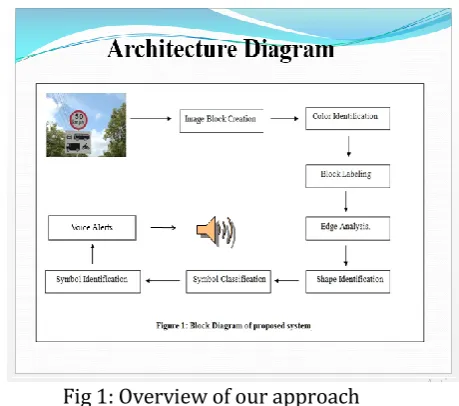
[image:3.595.328.558.437.640.2]This section elaborates the implementation details of our idea as depicted by figure1.
Fig 1: Overview of our approach
© 2017, IRJET | Impact Factor value: 5.181 | ISO 9001:2008 Certified Journal | Page 800 Step 2: This step receives the resized image from the
prior step and decides the number of blocks that to be create out of the captured images. This process is supported with the concept of redrawing the chunks as the new images which yields the blocks of the given image. And the yielded blocks are been labeled according to the matrix format.
Step 3: Due to our study on traffic symbols our process comes to know that most of the Indian traffic symbols are primarily made up of three colors like red, white and black. So our system identifies these colors for every set of blocks and assigns a score based on the on the frequency of the occurred pixels which belongs to these colors. Then the set of blocks which are having highest scores for these color protocols are marked and extracted from the main image as traffic symbol.
Step 4: This traffic image is then used to identify the edge and shape using gray scaling and binarization of the image. This process is repeated for the all the database images too to identify the proper matching traffic image. All Images are converting into gray scale by replacing every pixel by their average value which is normalized in between 0 to 255. And this can be depicted in algorithm 1.
Then this gray scale image is converted into binary image based on the black and white component of the image pixels. By doing this system will get the binary image that contains only two colored pixels like black and white. By doing this our system efficiently removes all other colored pixels which can be a barrier to identify the traffic images from the set of database image. Algorithm 2 shows clearly shows the steps of binary conversion.
Algorithm 1 : Average Grayscale Conversion
// Input: Image
// Output: Gray scale image
Step 0: Start
Step 1: Get Image path.
Step 2: Get Height and width of the Image F (L*W).
Step 3: FOR i=0 to width.
Step 4: FOR j=0 to Height.
Step 5: Get a Pixel at (i, j) as signed integer.
Step 6: Convert pixel integer value to Hexadecimal to get R, G, and B.
Step 7: AVG=(R+G+B) /3
Step 8: set AVG for R, G, B
Step 9: set RGB at i,j
Step 10: End of inner for
Step 11: End of outer for
Step 12: Stop
Algorithm 2 : Binary Conversion
// Input: Image
// Output: Binary image
Step 0: Start
Step 1: Get Image path.
Step 2: Get threshold value as T
Step 2: Get Height and width of the Image (L*W).
Step 3: FOR x=0 to width.
Step 4: FOR y=0 to Height.
Step 5: Get a Pixel at (x, y) as signed integer.
Step 6: Convert pixel integer value to Hexadecimal to get R, G, and B.
Step 7: if ( R>T and G>T and B>T)
Step 8: convert pixel to white color
Step 9: else
© 2017, IRJET | Impact Factor value: 5.181 | ISO 9001:2008 Certified Journal | Page 801 Step11: End of inner for
Step 12: End of outer for
Step 13 : Stop
Step 5: Here this step uses the binary image for which an array of integer is created for both query and database image which contains 1’s and 2’s for the labeling of the black and white pixels respectively. Which are then feed to Pearson correlation equation to evaluate the correlation between the query image and database image according to equation 1. Which yields the output of correlation in between 0 and 1 , where any value nearer to 1 indicates the perfect correlation between the images.
___________________(1)
Where
x is the entities of query image
y is the entities of database images
n is the size array
Step 6: Here in this step all the correlations of the database image are been recorded, which are in between 0 and 1. Now this value is used to generate the fuzzy crisp values like VERY LOW, LOW, MEDIUM, and HIGH AND VERY HIGH.
Images are been scrutinized for the highest crisp value factors to identify the exact matched traffic image. And then results are been announced using voice api.
IV RESULTS AND DISCUSSIONS
Proposed system of traffic symbol detection system detection is deployed as a standalone system using Netbeans as development IDE for java technology which is supported by java media file framework.
Performance is evaluated based on the precision and recall parameters. Precision is defined as the ratio of number of relevant traffic symbols are detected to the total number of relevant and irrelevant relevant
traffic symbols are detected. Relative effectiveness of the system is well expressed by using precision parameters.
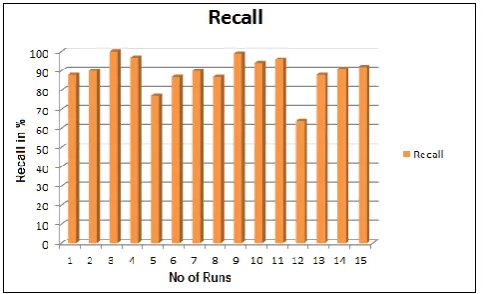
Whereas the recall can be defined as the ratio of number of relevant traffic symbols are detected to the total number of relevant traffic symbols are detected not detected. Absolute accuracy of the system is well narrated by using recall parameters.
System can be evaluated using precision and recall parameters, and they can be more clearly elaborated as follows.
• X = The numbers of relevant traffic symbols are detected,
• Y = the number of relevant traffic symbols are not detected, and
• Z = the number of irrelevant traffic symbols are detected.
So, Precision = ( X/ ( X+ Z))*100
And Recall = ( X/ ( X+ Y))*100
Fig.2. Average precision for Traffic Symbol Detection
© 2017, IRJET | Impact Factor value: 5.181 | ISO 9001:2008 Certified Journal | Page 802 Fig.3. Average Recall for Traffic Symbol Detection
Figure 3 shows that the system gives 89.33% recall for the traffic Symbol detection technique using image correlation mechanism. By comparing these two graphs we can conclude that the traffic symbol detection system using image correlation mechanism method gives high recall value compare to the precision value.
V . Conclusion and futurescope
In today’s world most of the accidents in city occurred due non following of the traffic rules. This can be avoiding by following the traffic symbols that are quite common on the roads. So to ease the driving process our system helps to identify the traffic symbols using the shape and structures from the query input image by converting them into binary through grayscale conversion.
Then by evaluating the binary image through Pearson correlation technique process which is powered with fuzzy classification to identify proper traffic symbol boosts our systems performance.
This system can enhance in the future by incorporating the same in real time vehicles using the fast processing high tech cameras to capture runtime traffic images.
REFERENCES
[1] B.T. Nguyen, J. Shim and J. Kim, Fast Traffic Sign Detection under Challenging Conditions, 2014 IEEE, Sungkyunkwan University Gyeonggi-do, South Korea, Sept 2014.
[2] R. Belaroussi and Dominique Gruyer, Impact of Reduced Visibility from Fog on Traffic Sign Detection, 2014 IEEE, Intelligent vehicles Symposium (IV), Dearborn, Michigan, USA, June 2014.
[3] J. Guo, X. Hao and H. Chen, Traffic Sign detection Via Graph-Based Ranking and Segmentation algorithms, 2015 IEEE, IEEE transaction on Systems, Man and cybernetics, Aug 2015.
[4] A. Croitoru and N. Mastorakis, Estimations, Convergences and comprises on Fuzzy Integral of Sugeno, Choquet and Gould Type, 20144 IEEE conference of Fuzzy Systems (FUZZ-IEEE), July 2014.
[5] A. Mamneri, A. Boukercha, R. Wang and J.Feng, Traffic sign detection recognization and transmission System for smart vehicles, Paradise research laboratory, Diva strategic research Center, University of Ottawa, Canada, June 2013.
[6] R. Biswas, H. Fleyeh and M. Mostakim, detection and Classification of speed limit traffic signs, BRAC University, Dhaka, Bangladesh, IEEE Dec 2014.
[7] Y. Yang, H. Luo, H. Xu and F.Wo, Towards Real Time Traffic Sign Detection and Classification, intelligent Transportation system, IEEE Transaction, Jan 2015.
[8] T. Keser, G. Kramer and D. Nozica, Traffic Sign shape Recognization Based on counter Descripter analysis, University of Osijek, Croaita, IEEE Dec 2016.
[9] M. Boumediene, J.P. Lauffenburger, J. Daniel and C. Cudel, Coupled Detection, Association and Tracking for Traffic Sign Recognition, Intelligent Vehicles Symposium Proceedings, 2014 IEEE, pp. 1402- 1407, Dearborn, 2014.
© 2017, IRJET | Impact Factor value: 5.181 | ISO 9001:2008 Certified Journal | Page 803 [11] C. Liu, F. Chang and Z. Chen, High Performance