© 2018, IRJET | Impact Factor value: 6.171 | ISO 9001:2008 Certified Journal | Page 1973
Study on behavior of Glass powder and Recycled coarse aggregate as a
partial replacement of Fine and coarse aggregate
Mohammed Jasar NT
1, Varsha Shaji
21 M- TECH Student, Department of Civil Engineering, CCET, Malappuram, Kerala, India. 2 Assistant Professor, Department of Civil Engineering, CCET, Malappuram, Kerala, India.
---***---Abstract –
The Fine and coarse aggregates are the main ingredients of concrete as the filler materials. As coarse aggregates are non- renewable resources, scarcities of these materials have been increased in recent years. Therefore, it is essential to search for other materials, which can be used as an alternative to fine and coarse aggregate. Now days, waste of glasses are been increasing ,and the powder form of waste glass(GP) can be used as a partial replacement for the fine aggregates(FA), which can cause increase in the strength of concrete due to the proper alkali aggregate reaction up to 10% replacement. Recycled coarse aggregates (RCA) can be used as coarse aggregatepartially in concrete, which reduces the strength of concrete with variation in various percentage of RCA. The combination of GP and RCA as a partial replacement of cement and coarse aggregates are used in concrete with 10% of GP and varying the percentage of RCA as 10%, 20%, 30%, 40% & 50%. Compressive strength & split tensile strength of newly prepared specimens are compared with conventional concrete. Workability test, acid test & water absorption tests are also conducted on the hardened concrete and compared with the conventional concrete. This new technology will provide new solution for the disposal glass sheet waste as well as the demolished waste of concreteKey Words: Glass powder, Recycled coarse aggregate,
compressive strength, split tensile strength, workability test, acid test, water absorption test.
1. INTRODUCTION
Conservation of resource is always the prime need of human kind. In the starting of era/civilization, we have used the resources limitedly but soon after we have started over exploitation. This result causes the scarcity of resources. Later on we have known the fact that we need to conserve the resources. Thus human have decided to use resources efficiently and wisely. This phenomenon is discussed by using the principle of 3R i.e. reduce reuse and recycle. Our study primarily focuses on these “3R” concepts. The waste glass from in and around the small shops is being disposed in waste landfill. Glass is an inert material which could be recycled and used many times without changing its chemical properties. Concrete waste is also increasing due to reconstruction and demolition of different concrete structures. Since the demand in the concrete manufacturing is increasing day by day, the utilization of river sand as fine aggregate and natural rock as the coarse aggregate leads to exploitation of natural resources, lowering of water table and sinking of the bridge piers and also reduce the non-renewable resources. The most widely used fine aggregate
for the preparation of concrete is the natural sand mined from the river beds. The present scenario demands identification of substitute materials for the river sand and coarse aggregate for making concrete because of the abundant scarcity it is facing. Attempts have been made in using crushed glass and recycled coarse aggregate as fine and coarse aggregate as replacement for river sand and natural- coarse aggregate.
In the current research, sand and natural coarse aggregate is partially replaced by glass powder and recycled coarse aggregates. The sheet glass powder is obtained from crushing the waste glass, which is disposed as landfill by the glass industries. Glass is a transparent material produced by melting a mixture of materials such as silica, soda ash, CaCO3 at high temperature followed by cooling where solidification occurs without crystallization. Glass is widely used in our lives through manufactured products such as sheet glass, bottles, glassware, and vacuum tubing. Glass is an ideal material for recycling. The use of recycled glass saves lot of energy and the increasing awareness of glass recycling speeds up focus on the use of waste glass with different forms in various fields, in the same way we have used concrete waste from the reconstructed and demolished concrete site. This will reduce the effect of concrete on the society. Then concrete is broken into various sizes (This is done by crusher and the mechanism. After this it is recycled into new cube for the study.. Using waste glass and concrete waste in the concrete construction sector is advantageous, as the production cost of concrete will go down. Most of the waste glasses and concrete waste have been dumped into landfill sites. The land filling of waste glasses and concrete waste are undesirable because they are not biodegradable, which makes them environmentally less friendly. There is huge potential for using waste glass in the concrete construction sector. When waste glasses are reused in making concrete products, the production cost of concrete will go down. Crushed glass or cullet, if properly sized and processed, can exhibit characteristics similar to that of gravel or sand and sometimes asphalt, to reclaim the aggregate.
2. LITERATURE REVIEW
© 2018, IRJET | Impact Factor value: 6.171 | ISO 9001:2008 Certified Journal | Page 1974 of concrete. Some research works were reviewed and are
presented in this paper.
D. Elavarasan [1] conducted an experimental study on waste glass as a partial replacing material in concrete for fine aggregate. While using the waste glass as the fine aggregate, it is found that the compressive strength increases 3.3% marginally up to 10 % replacement level and the split tensile strength increases 39.55 % for 20 % replacement level for 28 days curing period. The strength of waste glass concrete increased up to a point and beyond which decreases. It concluded that the permissibility of using glass powder as partial replacement of fine aggregate up to 30 % by weight for particle size of range 0 – 1.18mm.
R. Ramasubramani [2] studied the possibility of glass powder as partial replacement for fine aggregate for a new concrete. He found that the compressive strength increases 7.5 % for 50 % replacement of glass powder for fine aggregate and split tensile strength increases 6.2 % for 10 % replacement of glass powder for fine aggregate. Acid attack and alkalinity attack test conducted and found that the weight and compressive strength of glass powder concrete.
K. Aparna srivastav [3] studied on partial replacement of fine aggregate by waste glass and found that the strength parameters of waste glass concrete increased and the optimum replacement level of waste glass as fine aggregate is 10 % and also found that the marginal decrease in 15 – 20 % replacement. Workability of concrete mix is increased with the increase in waste glass content. With increase in waste glass content, percentage of water absorption is a decrease. It concluded that the permissibility of using glass powder as partial replacement of fine aggregate up to 20 % by weight for particle size of range 0 – 1.18mm.
M. Adaway [4] studied the properties of concrete made with recycled glass as partial replacement for fine aggregate in structural concrete and also studied its effect on compressive strength. Compressive strength was found to increase up to 30 % replacement of glass powder and beyond the point decreases the strength.The workability of concrete followed a decreasing trend with the addition of fine glass aggregate, due to the angular nature of the glass particles
.
M.Vijaya Sekhar Reddy [5] studied the incorporation of glass powder as partial replacement of fine aggregate in cement concrete and found to be fine aggregates can be replaced by waste glass up to 30% by weight showing 8.5% increase in compressive strength at 28 days. Workability of concrete mix increases with increase in waste glass content. Workability of concrete mix increases with increase in waste glass content. With increase in waste glass content, percentage water absorption decreases. With increase in waste glass content, average weight decreases by 5% for
mixture with 30% waste glass content thus making waste glass concrete light weight.
Shaikh Mohd. Akib [6] studied the properties of concrete made with recycled coarse aggregate and found that the workability of the concrete was gradually decreasing as the amount of replacement of RA increased. The compressive strength of the concrete mixes with up to 50% RA replacement level showed higher strength than that of the control mix. But when the percentage of recycled aggregate used increased, the compressive strength was reducing. Despite the increase in the RCA replacement level, the splitting tensile strength, water penetration and chloride penetration of the various concrete mixes did not show any significant difference.
Prafulla Kumar Tiwari [7] studied the effect of replacement recycled coarse aggregate with natural aggregate in concrete and found the strength of cubes decrease from 0% to 50% and then to 100%. The optimum value should lie in between 0% and 50% RCA used.
Fathei Ramadan salehlamein [8] conducted a research to study the effect of recycled coarse aggregate on properties of concrete and found the compressive strength decreases with increase in recycled coarse aggregate and better result shows for 35 % replacement.
Manjunath M [9] studied the effect of replacement of natural aggregates by recycled aggregates derived from field demolished concrete on workability and strength characteristics of concrete and found that the workability as well as strength parameters are decreases when increasing the recycled coarse aggregate replacement.
T. Manikandan [10] conducted strength study on replacement of coarse aggregate by re-used aggregate on concrete and found that the 50 % replacement of RCA shows the better strength for concrete but which is less than strength of conventional concrete. The recycled aggregates and hardened concrete had lower densities and higher absorption capacities than the natural aggregates mainly due to the lower density of the adhered mortar.
3. MATERIAL USED
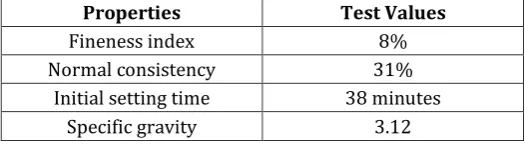
The physical properties of cement, fine aggregates, coarse aggregates, glass powder, recycled coarse aggregate and water used for mix design of M20 grade of concrete were tested in laboratory and are mentioned below.
3.1. Cement
© 2018, IRJET | Impact Factor value: 6.171 | ISO 9001:2008 Certified Journal | Page 1975 Table-1: Physical Properties of Ordinary Portland cement
Properties Test Values
Fineness index 8%
Normal consistency 31% Initial setting time 38 minutes
Specific gravity 3.12
3.2. Fine Aggregate
[image:3.595.30.294.272.331.2]The fine aggregate used in this investigation was clean river sand. The sand was dried, sieved and stored.
Table-2: Physical Properties of Fine Aggregates
Properties Test Values
Maximum size of particles 4.75 mm Grading zone Zone II Specific gravity 2.39
3.3. Coarse Aggregate
The fractions from 80 mm to 4.75 mm are termed as coarse aggregates. The shape of the coarse aggregates chosen was as per IS 2386 Part 1 (1963). The surface texture characteristics are as per IS 383:1970. The nominal size of the natural aggregates was 10 and 20 mm.
Table-3: Physical Properties of Coarse Aggregates
Properties Test Values
Specific gravity 2.76 Water absorption 2.8 %
Impact value 12.98%
3.4. Glass Powder
Specific gravity of glass powder obtained was 2.64.
3.5. Recycled Coarse Aggregate
Recycled coarse aggregate was obtained from an old demolished building. The nominal size of the recycled coarse aggregates was 10 and 20 mm.
Table-4: Physical Properties of Coarse Aggregates
Properties Test Values
Specific gravity 2.3 Water absorption 6.6%
Impact value 23.59%
3.6. Water
The water used for experiments was potable water.
4. METHODOLOGY
[image:3.595.281.544.461.741.2]The ultimate aim of the study is to study the effect of glass powder and recycled coarse aggregate as a partial replacements in concrete. The percentage of fine aggregate is kept constant as 10% GP and the coarse aggregates as replaced in different percentages as 10%, 20%, 30%, 40% and 50 % recycled coarse aggregates. The effect on compressive strength and split tensile strength are also studied. The concrete mix of M20 grade was prepared as per IS10262:2009 having mix design ratio as 1: 1.65: 2.98 and water cement ratio 0.55. To carry out the experimental investigation total of 36 cubes and cylinders were casted to determine the compressive and split tensile strength. From this, 3 cubes and cylinders are casted for conventional concrete and 3 cubes and cylinders are also casted for each combination of concrete, which is 10%, 20%, 30%, 40% and 50% replacement of coarse aggregate by recycled coarse aggregate with 10% replacement of fine aggregate by glass powder for 7 days curing, similarly for 28 days curing process and comparing the best result with conventional concrete. After the curing period, the specimens are taken for the testing of compressive strength and split tensile strength. Compression Testing Machine of 2000kN capacity was used to determine the total compressive load taken by concrete at different ages. This ultimate load divided by the cross-sectional area of the cube (150mm x 150mm) yields the compressive strength of concrete and also found the split tensile strength by using the equation (2P)/(ПDL) were, P is the ultimate load and D is the diameter and L is the length of cylinders, then compared the results of each combination of concrete specimen with conventional concrete specimen.
Figure-2: Curing of specimens
© 2018, IRJET | Impact Factor value: 6.171 | ISO 9001:2008 Certified Journal | Page 1976 Table-5: Material quantities for a cube
Type Of
Concrete Cement (kg) (kg) FA (kg) GP (kg) CA RCA (kg) Natural 1.58 2.6 0 4.7 0
10% GP &
10% RCA 1.58 2.34 0.26 4.23 0.47 10% GP &
20% RCA 1.58 2.34 0.26 3.76 0.94 10% GP &
30% RCA 1.58 2.34 0.26 3.29 1.41 10% GP &
40% RCA 1.58 2.34 0.26 2.82 1.88 10% GP &
50% RCA 1.58 2.34 0.26 2.35 2.35
Table-6: Material quantities for a cylinder
Type Of
Concrete Cement (kg) (kg) FA (kg) GP (kg) CA RCA (kg) Natural 2.48 4.1 0 7.39 0
10% GP &
10% RCA 2.48 3.69 0.41 6.651 0.739 10% GP &
20% RCA 3.69 0.41 0.514 6.912 1.478 10% GP &
30% RCA 3.69 0.41 0.514 5.173 2.217 10% GP &
40% RCA 3.69 0.41 0.514 4.434 2.956 10% GP &
50% RCA 3.69 0.41 0.514 3.695 3.695
5. RESULTS AND DISCUSSIONS
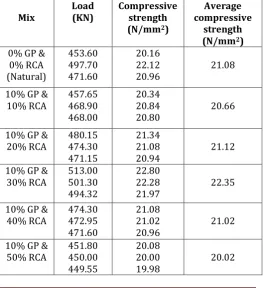
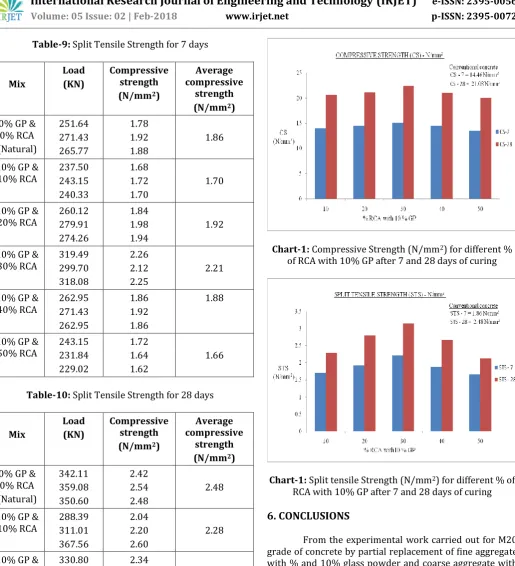
The cubes and cylinders are tested after proper curing and the compressive strength and split tensile strength are tested using the universal testing machine whose capacity is 2000KN. We have casted 3 specimens for each of the combinations; average compressive strength and split tensile strength of these three specimens are taken as the compressive and split tensile strength of specimen at 7 days and 28 days. The average compressive strength of cubes at the age of 7 days and 28 days were found to be 14.46 N/mm² and 21.08 N/mm² for conventional concrete and it increased to 15.11 N/mm² and 22.35 N/mm² when 10 % of fine aggregate was replaced with glass powder and 20% coarse aggregate replaced by recycled coarse aggregate concrete. The average split tensile strength of cylinder at the age of 7 days and 28 days were found as 1.86 N/mm² and 2.48 N/mm² for conventional concrete and it increased to 2.21 N/mm² and 3.15 N/mm² when 10 % of fine aggregate was replaced with glass powder and 30% coarse aggregate replaced by recycled coarse aggregate concrete. The increase in compressive strength of concrete after 7 and 28 days of curing was found to be 4.49% and 6.02%, when replaced 10% glass powder and 30% recycled coarse aggregate for
[image:4.595.291.566.187.456.2]fine and coarse aggregate and also increase the split tensile strength 18.81% and 27% for 7 and 28 days of curing. The compressive and split tensile strength of M20 grade of concrete for different proportions of glass powder and recycled coarse aggregate after 7 and 28 days of curing are listed below in table 7, 8, 9 and 8 respectively.
Table-7: Compressive Strength for 7 days
Mix Load (KN) Compressive strength (N/mm2)
Average compressive
strength (N/mm2)
0% GP & 0% RCA (Natural)
324.00 334.35 317.70
14.40 14.86
14.12 14.46 10% GP &
10% RCA 314.55 313.20 314.55
13.98 13.92
13.98 13.96 10% GP &
20% RCA 324.00 324.90 324.45
14.40 14.44
14.42 14.42 10% GP &
30% RCA 340.42 339.30 340.20
15.13 15.08
15.12 15.11 10% GP &
40% RCA 324.45 325.80 324.45
14.42 14.48
14.42 14.44 10% GP &
50% RCA 301.05 301.95 306.90
13.38 13.42
[image:4.595.304.568.489.777.2]13.64 13.48
Table-8: Compressive Strength for 28 days
Mix Load (KN) Compressive strength (N/mm2)
Average compressive
strength (N/mm2)
0% GP & 0% RCA (Natural)
453.60 497.70 471.60
20.16 22.12
20.96 21.08 10% GP &
10% RCA 457.65 468.90 468.00
20.34 20.84
20.80 20.66 10% GP &
20% RCA 480.15 474.30 471.15
21.34 21.08
20.94 21.12 10% GP &
30% RCA 513.00 501.30 494.32
22.80 22.28
21.97 22.35 10% GP &
40% RCA 474.30 472.95 471.60
21.08 21.02
20.96 21.02 10% GP &
50% RCA 451.80 450.00 449.55
20.08 20.00
© 2018, IRJET | Impact Factor value: 6.171 | ISO 9001:2008 Certified Journal | Page 1977 Table-9: Split Tensile Strength for 7 days
Mix
Load (KN)
Compressive strength (N/mm2)
Average compressive
strength (N/mm2)
0% GP & 0% RCA (Natural)
251.64 271.43 265.77
1.78 1.92 1.88
1.86
10% GP &
10% RCA 237.50 243.15 240.33
1.68 1.72 1.70
1.70
10% GP &
20% RCA 260.12 279.91 274.26
1.84 1.98 1.94
1.92
10% GP &
30% RCA 319.49 299.70 318.08
2.26 2.12 2.25
2.21
10% GP &
40% RCA 262.95 271.43 262.95
1.86 1.92 1.86
1.88
10% GP &
50% RCA 243.15 231.84 229.02
1.72 1.64 1.62
1.66
Table-10: Split Tensile Strength for 28 days
Mix
Load (KN)
Compressive strength (N/mm2)
Average compressive
strength (N/mm2)
0% GP & 0% RCA (Natural)
342.11 359.08 350.60
2.42 2.54 2.48
2.48
10% GP &
10% RCA 288.39 311.01 367.56
2.04 2.20 2.60
2.28
10% GP &
20% RCA 330.80 421.28 435.42
2.34 2.98 3.08
2.80
10% GP &
30% RCA 449.56 438.25 448.14
3.18 3.10 3.17
3.15
10% GP &
40% RCA 350.60 384.53 393.01
2.48 2.72 2.78
2.66
10% GP &
50% RCA 308.19 299.70 291.22
2.18 2.12 2.06
2.12
Chart-1: Compressive Strength (N/mm2) for different % of RCA with 10% GP after 7 and 28 days of curing
Chart-1: Split tensile Strength (N/mm2) for different % of RCA with 10% GP after 7 and 28 days of curing
6. CONCLUSIONS
From the experimental work carried out for M20 grade of concrete by partial replacement of fine aggregate with % and 10% glass powder and coarse aggregate with 10%, 20%, 30%, 400% and 50% recycled coarse aggregate, the following conclusions were drawn.
1. The compressive and split tensile strength increases with increase of replacement cement with recycled coarse aggregate up to 30% and coarse aggregate with 10% glass powder, beyond the limit the compressive strength decreases for both 7 and 28 days curing period.
© 2018, IRJET | Impact Factor value: 6.171 | ISO 9001:2008 Certified Journal | Page 1978 coarse aggregate, which is greater than the
compressive strength of conventional concrete for 7 and 28 days curing period.
3. The workability of newly prepared concrete will be same as the conventional concrete due higher water absorption of recycled coarse aggregate is compensated by very low water absorption value of glass powder.
4. The compressive strength concrete at 30 % replacement of CA by RCA and 10% replacement of FA by GP increases 4.49% for 7 days curing period and 6.02% for 28 days curing period compared with the conventional concrete.
5. The split tensile strength concrete at 30 % replacement of CA by RCA and 10% replacement of FA by GP increases 18.81% for 7 days curing period and 27% for 28 days curing period compared with the conventional concrete.
REFERENCES
[1] D.Elavarasan, Dr.G.Dhanalakshmi, “Experimental Study
On Waste Glass As A Partial Replacing Material In Concrete For Fine Aggregate”, International Journal Of Advanced Research In Biology Engineering Science And Technology, ISSN 2395-695X, Volume 2, Issue 3, March 2016.
[2] R. Subramani, S. Divya, Vijay, “Replacement Of Sand by
Sheet Glass Powder In Concrete”, International Journal Of Civil Engineering And Concrete Structures, ISSN XXXX-XXXX, Volume 1, Issue 1, March 2016.
[3] K. Aparna srivastav, “Partial Replacement Of Fine
Aggregate by Using Waste Glass”, International Journal Of New Innovation In Engineering And Technology, ISSN 2319-6319, Volume 4, Issue 3, March 2016.
[4] M. Adaway, Y. Wang, “Recycled Glass As Partial
Replacement For Fine In Structural Concrete – Effects On Compressive”, Electronic Journal Of Structural Engineering.
[5] Dr. M. Vijaya Sekhar Reddy, P. Sumalatha, M. Madhuria,
K. Ashalatha, “Incorporation Of Waste Glass Powder As Partial Replacement Fine Aggregate In Cement”, International Journal Of Scientific And Engineering Research, ISSN 2219-5518, Volume 6, Issue 12, December 2015.
[6] Shaikh Mohd. Akib, Sameer U. Sayyad, “Properties Of
Concrete Made With Recycled Coarse Aggregate”, International Journal Of Informative And Futuristic Research, ISSN 2347-1697, Volume 2, Issue 10, June 2015.
[7] Prafulla Kumar, Dr. Raman Nateriya, “Replacement Of
Recycled Coarse Aggregate With Natural Coarse Aggregate In Concrete”, International Journal Of Scientific Engineering And Applied Science, ISSN 2395-3470, Volume 2, Issue 7, July 2016.
[8] Fathei Ramadan Salehlamein, Mochamad. Solikin, “Effect
Of Recycled Coarse Aggregate On Concrete Properties”, International Journal Innovative Research In science, Engineering Technology, ISSN 2347-6710, Volume 4, Issue 1, January 2015.
[9] Manjunath M, Prakash K B, “Effect Of Replacement Of
Natural Aggregates by Recycled Aggregates Derived From Field Demolished Concrete On The Workability And Strength Characteristics”, International Journal Civil And Structural Engineering, ISSN 0976-4399, Volume 6, Issue 2, 2015.
[10]T. Manikandan, M. Mohan, Y. M. Sidharamaih, “Strength