© 2017, IRJET | Impact Factor value: 5.181 | ISO 9001:2008 Certified Journal | Page 1554
Analysis of Nano particle based Biodiesel Blends for a CI Engine
Mr.Abhijeet Devidas Sangle
1, Prof.Santosh Wankhede
2, Late Prof.Tushar Katratwar
3,Mr.Milind
Patil
4,Dr.S.Jaybhay
5,Dr.S Bobade
61
Department of Mechanical engineering, SESGOIFOE, Diksal,Karjat,
Maharashtra, India
2,3Department of Mechanical Engineering, YTIET, Bhivpuri Road. Maharashtra, India
5Nanotechnology Research Lab, Department. of Chemistry, Birla College, Kalyan (W), Maharashtra
6
Research Head, IBDC Baramati. Maharashtra, India
---***---Abstract - The aim of this research is to investigate the viability of using bio-diesel as an alternative, or additive, to basic diesel fuel. The engine performance is to be evaluated along with the emission characteristics for an engine running with bio-diesel and traditional fuels. Obtaining a viable solution is one which can reduce the global green house emissions over the petroleum diesel counterpart, while maintaining a similar output in performance, and efficiency. In the present investigation, an attempt has been made to produce and characterize bio-diesel from different vegetable oils like Castor & Karanja, optimization of transesterification for the production of biodiesel, engine performance of selected straight vegetable oil, biodiesel and blends of bio-diesel and bio-diesel. In this study, various properties of selected oils and their methyl esters are determined experimentally. The proportional blends of Karanja and Caster oil biodiesel can be used in existing diesel engines without any engine modifications. The results of different parameters CI engine fuelled with biodiesel blends are compared with that of baseline diesel.
Index Terms – Biodiesel, Karanja oil, Castor oil, blends
1. INTRODUCTION
Energy is a critical input for economic growth and sustainable development in both developed and developing countries. During the last century, the consumption of energy has increased a lot due to the change in the life style and the significant growth of population. The world’s energy requirement for transportation is met from non-renewable fossil fuels. Fossil fuels have limited life and the ever increasing cost of these fuels has led to the search of alternative renewable fuels for ensuring energy security and environmental protection. In the face of shrinking supplies and rising demand, oil prices are expected to continue to rise. In addition, growing concerns about human-induced climate change, as evidenced by rising temperatures and environmental pollution, are further driving the impetus for non-polluting energy sources.
It is essential to search for alternate fuels which fulfill energy demand. One such source is ethanol from plant
biomass/grain and biodiesel from processing edible and nonedible vegetable oils. A mandatory 5-10% blending of biofuels with petrol and diesel stipulated by some countries in the last 10-20 years triggered a rapid growth in the biofuel sector in the last decade. India has great potential for the production of biodiesels from non–edible vegetable oil seeds. Biodiesel made from vegetable oil have emerged as a promising alternate fuel for diesel fuel due to its renewable nature, better ignition quality, comparable energy content and higher safety without any engine modifications.
There is a need to identify new types of blends of more than one bio fuel as per the availability and examine their suitability as an alternate fuel. The biodiesel is the methyl ester formation of vegetable oil which prepared by the process known as the transesterification process. This process is actually used to remove the saturated and unsaturated acids from the vegetable oils in which alcohol is used as a catalyst and known as the alcoholysis chemical reaction process. This methyl ester form of oil is blend with diesel have make a fuel having better properties to use in compressed ignition (diesel) engine. The performance and emission parameters were resulted the variations to various blended proportions fuel with diesel and evaluate their feasibility.[1-11]
2.MATERIALSANDMETHODS
© 2017, IRJET | Impact Factor value: 5.181 | ISO 9001:2008 Certified Journal | Page 1555 compared to the increase of diesel fuels. Biodiesel has a
cetane number higher than that of diesel oil containing aromatic and contains up to 10% oxygen weight. Biodiesel features reduced carbon monoxide (CO), hydrocarbons (HC) and particulate matter (PM) in the exhaust gas compared to diesel from petroleum.Certain edible oils such as cottonseed, palm, sunflower and rapeseed can be used in diesel engines. For longer life of the engines these oils cannot be used straightway. These oils are not cost effective to be used as an alternate fuel in diesel engines at present. Some of the non-edible oils such as mahua, castor, neem (Azadiracta indica), rice bran, linseed, Karanja (Pongamia pinnata), jatropha (Jatropha curcas) etc. can be used in diesel engines after some chemical treatment.
Some properties of diesel & different biodiesels are shown in the Table 1.
A-.Materials
The castor and karanja oil used in this present study was supplied by local oil suppliers from thane,Maharshtra.The commercial diesel fuel was purchased from petrol pump which is nearer to SESGOIFOE, KARJAT (,Maharshtra). Copper (II) nitrate (Cu (NO3)2.xH2O) of 99.999% was obtained from Sigma-Aldrich Chemicals and were used as obtained. Type 1 Ultrapure Milli-Q water was used throughout the reactions. The glassware’s were rinsed thoroughly with dilute Nitric acid (HNO3) followed with wash of water, and dried in hot air oven. The flowers of Caesalpinia pulcherrima was collected from the campus of the Birla College, Kalyan (w).
Remaining chemicals(methanol,HCl) were procured during experimentation from Birla college, , Kalyan (,Maharshtra) All chemicals are brought locally and other reagents were analytical grade and large number of sample bottles were purchased from Choice beauty corner (gift items shop) to put different biodiesel sample during experimentation from Kalyan (,Maharshtra). Water bath shaker is used for transesterification of raw castor oil and Karanja oil.
1. Karanja oil (Pongamia pinnata):
The botanical name of the oilseed Karanja is Pongamia glabra family Leguminaceae. Pongamia is widely distributed in tropical Asia and is not edible oil from India. It is mainly in the Western Ghats of India, North Australia, Fiji and in some East Asian regions. It is a tree that contains oil seeds, native to humid and subtropical environments. It is very tolerant to salt content, and can be grown on degraded fallow land and a variety of soil types from clay to sand or gravel. This is one reason for the wide distribution of these plant species. The tree bears green pods, after about 10 months have changed to a dark color. It also plays an important role in improving
the quality of soil in nutrient-poor soils can be reused for agricultural purposes. [19] The drop of oil extracted from Karanja is yellow-orange to brown and unpalatable due to the presence of toxic flavonoids. Oil content of 9-46% varies with oleic acid (C18: 1) and linolenic (C18: 2) are the mainfattyacids.
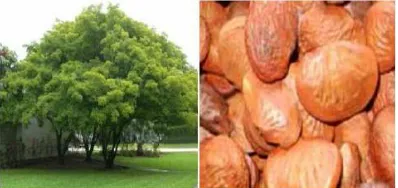
Fig. 1. Karanja-Tree-and-seeds
The pods are flat elliptical, 5-7 cm long and contain 1 or 2 grains in the form of red-brown kidney. The shaft grain yield is between 8 and 24 kg. , The grains are white and are covered by a thin reddish skin. The composition of the dried beans with typical air is as follows: 19% moisture, oil of 27.5% and 17.4% protein. The production of Karanja oil is about 200 million tons per year. The time, which varies for the mature tree from 4 and 7 years depending on the size of the shaft is the wave grain yield between 8 and 24 kg. The oil is used by people because of their low cost and ease. [10, 11]
2. Castor oil (Ricinus communis):
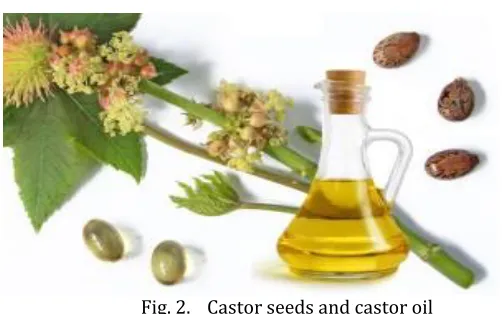
[image:2.612.347.546.180.274.2]© 2017, IRJET | Impact Factor value: 5.181 | ISO 9001:2008 Certified Journal | Page 1556 Fig. 2. Castor seeds and castor oil
It is an important raw material for the chemical industry because it is the only commercial source of ricinoleic acid, a hydroxyl-FA, which is about 90% oil. Because of the ricinoleic acid, castor oil and its derivatives are very versatile in synthetic routes to a large number of products and is rapidly used. In some parts of the world, it is used as an ornamental plant because of its flowery and dynamic coloring sheet. Castor oil is used for various purposes, namely as a lubricant in the production of soaps, transparent paper, printing inks, varnishes, linoleum and plasticizers. It is also suitable for medical purposes and lighting20].
B. Methods
I) Transesterification Process:
The transesterification process came when Rochieder described the production of glycerin by ethanolysis rate constant castor oil in the initial period of 1846. Since then, many parts of the world have started to study ethanolysis rate constants. Plant oils have a high viscosity and its use in diesel engines, its viscosity must be reduced. This can be carried out with many processes such as transesterification, pyrolysis, microemulsion or mixed with diesel fuel. The transesterification process is widespread. Oil extracted with any suitable alcohol in the presence of seeds of a catalyst is subjected to this reaction. The products formed are alkyl esters and glycerol. Alkyl esters are so-called biodiesel. First, pure Karanja and castor oil (100 g) was collected in a 500 ml beaker separately and the water content was cooled to 100 and then to room temperature to remove after oil mixing with methyl alcohol (CH 3 OH) in proportion to the molar ratio of (1: 4 and 1: 6) after the addition of the green synthesized nanocatlyst catalyst CuO [25] in the range of (0.5%, 0.75% and 1%) or 0.5 g of weight oil. Then adding sulfuric acid to 0.1% by weight. Giving a little time for the right mixture of alcohol and oil. Then putting the mixture into the reactor, check sonication probe is completely immersed in the liquid mixture to give ultrasonic vibration at a frequency of 50 kHz and maintaining the temperature of 45
to 50 ° C on the screen. In the mixture, when two different layers appeared, the reaction was terminated. The density of the fatty acid is greater so that it is on the ground. Methyl ester (Cator Oil Methyl Ester COME, Karanja Oil Methyl Ester KOME) and glycerin were separated after 1.30 hrs for Karanja and 2.30 hrs for Castor due to large viscosity. Then biodiesel (methyl easter) is in the upper part and the lower part is glycerin. Then cut the bio diesel centrifuge. Then, to remove mixtures of biodiesel catalysts with distilled water, then after 2 hours of water due to the high density at the bottom and the biodiesel in the upper layer were collected. For the distillation process for methanol biodiesel, separate from it. Two molar ratio of alcohol to oil 1: 4 to 1: 6 is used for the process. The yield of this process around 90-96% for both molar ratios.
II) Production of biodiesel with nano catalyst:
Nanotechnology may be defined as the manipulation of particle with one of its size dimension smaller than 100nm and having specific properties which can be used in particular applications. Nanoparticles are of great interest because they act as bridge gap between the molecular structureto material in bulk as they exhibit completely new or improved properties based on specific characteristics such as size, distribution, shape, ionic strength, capping agent and morphology.[25]
The use of ‘‘a green” method based on heterogeneous catalysts is a new trend in the preparation of biodiesel. Biodiesel synthesis using solid catalysts instead of homogeneous ones could potentially lead to cheaper production costs by enabling reuse of the catalyst and opportunities to operate in a fixed bed continuous process. Heterogeneous catalytic methods are usually mass transfer resistant, time consuming and inefficient. Despite the solid phase, catalytic methods are intensively studied, the industrial applications are limited. This fact suggests that further research is necessary to solve current problems. Nano catalysts that have high specific surface and high catalysis activities may solve the above problems. A number of researchers have studied the preparation of nano sized heterogeneous catalysts to increase the catalytic activity. It is evident that the large surface area, which is characteristic of nano sized material, resulted in a rise within the amount of the catalytically basic and acidic sites.[21]
[image:3.612.41.293.91.248.2]© 2017, IRJET | Impact Factor value: 5.181 | ISO 9001:2008 Certified Journal | Page 1557
III)Ultrasonication method:
Influence of ultrasound on transesterification reaction is of purely physical nature. Ultrasound is the process of propagation of the compression waves with frequencies above the range of human hearing. Ultrasound frequency ranges from 20 kHz to l0 MHz, with associated acoustic wavelengths in liquids of about 100- 0.15 mm.. Instead, the chemical effects of ultrasound derive from several nonlinear acoustic phenomena, of which cavitation is the most important.Acoustic cavitation is the formation, growth, and implosive collapse of bubbles in a liquid irradiated with sound or ultrasound. When sound passes through a liquid, it consists of expansion (negative pressure) waves and compression (positive pressure) waves. These cause bubbles filled filled with solvent and solute vapour and with previously dissolved gases to grow and recompress.
Under proper conditions, acoustic cavitation can lead to implosive compression in such cavities. Such implosive bubble collapse produces intense local heating, high pressures, and very short life-times. Cavitation is an extraordinary method of concentrating the diffused energy of sound into a chemically useable form. Ultrasonication provides the mechanical energy for mixing and the required activation energy for initiating the transesterification reaction. Effect of low-frequency ultrasound was studied on the production of biodiesel via transesterification of castor and Karanja oil with methanol using Copper oxide as nano catalyst.[27,28]
It can be seen from this table that the fuel properties of B100 are comparable with those of diesel. The Castor oil, however, was found to have much higher values of fuel properties, especially viscosity, thus restricting its direct use as a fuel for diesel engines. The kinematic viscosity of Karanja oil was also found more than that of diesel determined at 400 C. After
[image:4.612.320.582.117.465.2]transesterification, the
Table 1 Properties of diesel & biodiesels
kinematic viscosity reduced than that of pure vegetable oil. It further reduced with increase in diesel amount in the blend. A similar reduction in specific gravity was also observed. The flash points of Karanja oil and Castor oil biodiesels were found to be greater than 1000 C, which is safe for storage and
handling. The pour point of Castor oil was higher than that of diesel. This might be due to the presence of wax, which begins to crystallize with the decrease in temperature. The problems of higher pour point of Castor biodiesel could be overcome by blending with diesel.
Studying the chemical properties of dual biodiesel fuel, its calorific value is about 38.7 MJ/L, which is 9% lower than regular petrodiesel. It has practically no sulfur content, and is frequently used as an additive to Ultra-Low Sulfur Diesel (ULSD) fuel. Biodiesel fuel has an effect on copper-based materials and as well as zinc, tin, lead, and cast iron. However, the stainless steels and aluminum are not affected by bio fuel.
Fuel Property
Diese l
Karanja oil
Castor
oil DuB
Specific Gravity 0.84 0.860 0.9268 - Density ( Kg/m3) 831 860 932 876
API Gravity 40.24 29.3 39 - Ash Content (%) 0.05 0.094 0.01 .05
Water Content
(%) 0.070 NA 0.05 - Carbon residue
(%) 0.080 0.530 0.037 - Flash Point (°C) 64 165 190 147
Pour Point (°C) 15 7 45 7 Fire Point (°C) 72 134 200 - Calorific Value
(KJ/Kg)
4250
0 37700 38600
3870 0 Viscosity (cSt) 2.7 4.8 9.8 5.4 Cetane Number 49 49 48 51.32
Stoichiometric
© 2017, IRJET | Impact Factor value: 5.181 | ISO 9001:2008 Certified Journal | Page 1558 Some of the properties are discussed here comparatively
1) Density: Density of the COME and KOME biodiesel must be as close to the pure diesel so that blending becomes better. Density of dual Biodiesel blend also close to the density of pure diesel.. If there is a large variation in density, the fluids separate out from each other forming two different layer of fluids.here from table it is seen that dual B100 blend has density smaller than COME.so dual biodiesel blend can be use as fuel for engine directly. It has been observed that Bio diesel has higher density tha petroleum diesel which means that volumetrically operating fuel pumps will inject greater mass of biodiesel than conventional diesel fuel. This in turn will affect the air−fuel ratio hence the local gas temperatures and NOx emissions increases.
2) Flash and Fire Point: Flash point and fire point of the fuel must be higher so that the fuel doesn’t catch fire during storage. Hence, to be on safer side, the preferred flash point values must be above 100°C for B100. From the table it is evident that diesel has lesser value of flash point in comparison with Blends because diesel is less volatile when compared to biodiesel.also dual biodiesel blend has intermediate value between the value of KOME AND COME.so dual biodiesel blend is safe to use directly
3) Kinematic Viscosity: The viscosity of the biodiesel must be in the range of 3-6 centistokes. Higher viscosity leads to less accurate operation of the fuel injectors because of which there is poor atomization and increase in fuel droplet size. But in mean time fuel leakages will be reduced and that also leads to higher injection pressures.it is sen after testing the COME has viscosity greater than among all three fuels it can be reduced with dual blend.
4) Gross Calorific Value: The calorific value of pure diesel is 44000 KJ/KG. The calorific value will directly affect the efficiency of the fuel as it gives the amount of heat of combustion. The oxygen is generally 10-12% in biodiesel because of which it has lower energy density and heating value, so it needs more amount of fuel to be injected for same Engine power output.from table it is seen that after blending the heating value of the new fuel increses
5) pH: The pH value is found to be nearer to that of neutral value of 7, Hence pH for all the sample and diesel is neutral
3. EXPERIMENTAL WORK A. Experimental setup
A single cylinder, four-stroke, direct injection (DI), water-cooled, diesel engine with mechanical rope brake loading
was used for this study which is developing a power output of 5 kW @ 1500 rpm. The engine specifications are given in Table 2.
Table 2 Engine Specifications
Rated Power 5 kW
Speed 1500 rpm
No. of cylinders One Compression Ratio 16.5:1
Bore 80 mm
Stroke 110 mm
Orifice Diameter 20 mm
Type of Ignition Compression Ignition Method of Loading Rope Brake
Meyhod of Starting Crank Shaft
B. Engine testing
The karanja oil and castor oil are used to derive biodiesel. The bidiesel is blended with diesel in various proportions to prepare testing blends which are tested on 4 stroke CI engine. The study of performance and emission characteristics of CI engine is carried out.
4. RESULTS AND DISCUSSIONS A. Engine performance
The biodiesel was blended with additive in various proportions to prepare a number of test fuels which are tested on a diesel engine to study various parameters. The Engine performance are measured using 100% Diesel, 5%, 10%, 15% and 20% blends of Castor, Karanja and Dual biodiesel. In dual biodiesel blending, we are going to blend two different biodiesel like combination of 50% Castor oil & 50% Karanja oil derived biodiesel. The dual blending contains equal blending quantity of two different biodiesels.This blend ratio was selected because it is practically viable with the intention of the Government of India. This blends are mixed in the homogenizer
I) Brake Power:
© 2017, IRJET | Impact Factor value: 5.181 | ISO 9001:2008 Certified Journal | Page 1559 At full load (5kW) condition
4.554.6 4.654.7 4.754.8 4.854.9
5 10 15 20
B
.P.
(
k
W
)
Biodidel % in Blends
Comparison of B.P. (kW) for Biodiesel Blends
Castor Karanja DuB
Fig. 3. Comparison of B.P. (kW) for Biodiesel Blends
Brake power can be termed as pure power, useful power or power required to move the wheels. It was seen that with increasing amount of biodiesel content in the fuel the brake
power also get reduced .This is mainly due to lower calorific
value, low flash point, high viscosity and delayed combustion process.it was seen that COME blends has low BP value than other two blends due to high viscosity.
II) Brake Specific Fuel Consumption:
The comparison of BSFC (Kg/kWh) for different biodiesel blends is shown in Fig. 4.
At full load (5kW) condition
0.3 0.32 0.34 0.36 0.38
5 10 15 20
B
S
F
C
(
K
g
/k
W
H
h
Biodidel % in Blends
C omparison of BSFC (Kg/kWh) for Biodiesel Ble nds
Castor Karanja DuB
Fig. 4. Comparison of BSFC (Kg/kWh) for Biodiesel Blends
From the graph It was observed that the brake specific fuel consumptions COME is lower among these three fuel and higher than diesel. Also it was observed that ternary blends of biodiesel has intermediate value for all concerning blends between COME and KOME Due to lower calorific value of biodiesels, more biodiesel is consumed in order to meet the load demand It is seen from above graph that by increasing
biodiesel content in the fuel the value of BSFC goes up in increasing order for all these fuels because The specific fuel consumption was found to be higher than diesel at full load because of the combined effects of lower heating value and the higher fuel flow rate due to high density of the blends.
III)Brake Thermal Efficiency:
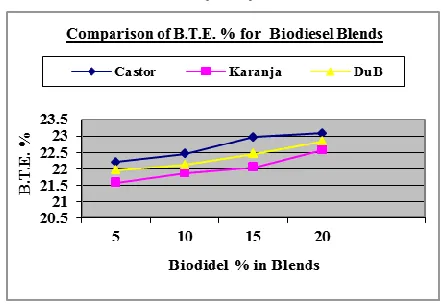
The comparison of B.T.E. (%) for different biodiesel blends is shown in Fig. 5.
At full load (5kW) condition
Fig. 5. Comparison of B.T.E. % for Biodiesel Blends
[image:6.612.334.556.231.384.2] [image:6.612.63.272.462.604.2]© 2017, IRJET | Impact Factor value: 5.181 | ISO 9001:2008 Certified Journal | Page 1560
IV)Exhaust Gas Temperature:
The comparison of E.G.T. (0C) for different biodiesel
blends is shown in Fig. 6.
At full load (5kW) condition
Fig. 6. Comparison of E.G.T. 0C for Biodiesel Blends
The observation was made by EGT readings with the increase in % of biodiesel the EGT will also increses for all three blends.The reason for higher exhaust gas temperature was incomplete combustion in the cylinder at high load which intern causes increase in temperature of exhaust gas.Also poor atomization of vegetable oil due to higher viscosity which causes slow combustion and part of the oil supplied may burn late in cycle.
B. Engine Emissions
I) Hydrocarbons Emissions:
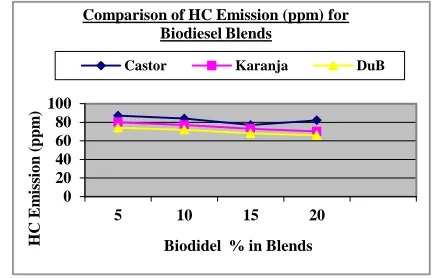
The comparison of HC Emission (ppm) for different biodiesel blends is shown in Fig. 7.
At full load (5kW) condition
0 20 40 60 80 100
5 10 15 20
HC
E
m
issi
o
n
(
p
p
m
)
Biodidel % in Blends Comparison of HC Emission (ppm) for
Biodiesel Blends
Castor Karanja DuB
Fig. 7. Comparison of HC Emission (ppm) for Biodiesel Blends
Due to the higher viscosity, all of the hydrocarbons present in the COME do not get completely burnt, so come out in the engine exhaust in the form of carbon particles that’s why castor oil biodiesel shows maximum HC % in engine exchaust than ternary and KOME.HC % also reduced by higher Cetane no.Higher cetane number of biodiesel will reduce the burning delay, which in turn results in the HC emissions reduction.It was seen that by increasing amount of biodiesel the HC emissions also reduces for all three blends .With the increase in the percentage of biodiesel in blends, HC emissions followed a trend of decreasing consequently
II) CO2 Emissions:
The comparison of CO2 Emission (ppm) for different
biodiesel blends is shown in Fig. 8.
At full load (5kW) condition
8 9 10 11 12
5 10 15 20
CO
2
E
m
issi
o
n
(
p
p
m
)
Biodidel % in Blends Comparison of CO2Emission (ppm) for
Biodiesel Blends
Castor Karanja DuB
Fig. 8. Comparison of CO2 Emission (ppm) for Biodiesel
Blends
[image:7.612.57.278.166.321.2] [image:7.612.338.552.318.458.2] [image:7.612.56.274.560.699.2]© 2017, IRJET | Impact Factor value: 5.181 | ISO 9001:2008 Certified Journal | Page 1561
III)CO Emissions:
The comparison of CO Emission (ppm) for different biodiesel blends is shown in Fig. 9.
At full load (5kW) condition
0 0.5 1 1.5 2
5 10 15 20
C
O
E
m
is
si
o
n
(
p
p
m
)
Biodidel % in Blends C omparison of CO Emission (ppm) for
Biodiesel Blends
Castor Karanja DuB
Fig. 9. Comparison of CO Emission (ppm) for Biodiesel Blends
The observation made by above graph are CO emission is due to improper combustion of fuel and it mainly depends on many engine temperature, and A/F ratio[22] The CO emissions are found to be increasing with increase in load since the air-fuel ratio decreases with increase in load such as all typical internal combustion engines.Due to cleaner combustion of mixture. With use of biodiesel, reduction in CO emissions is found which may be due to oxygen enriched biodiesel, in which increase in the proportion of oxygen and promotes oxidation of CO during the engine exhaust process .
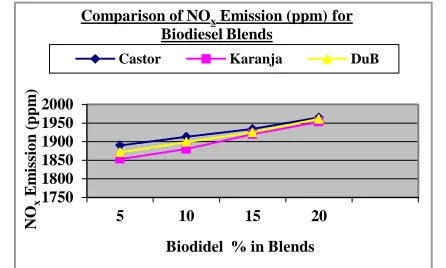
IV)NOx Emissions:
The comparison of NOX Emission (ppm) for different
biodiesel blends is shown in Fig. 10.
At full load (5kW) condition
1750 1800 1850 1900 1950 2000
5 10 15 20
NO
x
E
m
issi
o
n
(
p
p
m
)
Biodidel % in Blends Comparison of NOxEmission (ppm) for
Biodiesel Blends
Castor Karanja DuB
Fig. 10. Comparison of NOx Emission (ppm) for Biodiesel
Blends
From the graph it is observed that the NOx emission increases with increase in the biodiesel content(%). It was
found that NOx emission was found to be maximum for 20% for all three different fuels and minimum for diesel.It seen that with the increasing % of biodiesel in pure diesel the NOx emission will increses.the value of the Ternary biodiesel blend lie in between the value of the COME and KOME NOx emission is increased because of more amount of the oxygen in biodiesel due to which more amount of nitrogen reacts with the oxygen to form NOx. Also Density also has an effect on NOx emission i.e. bio diesel has higher density which causes more amount of fuel to be sprayed into the combustion chamber as a result of which NOx increases. This has adverse effect on the atmosphere causing smog and acid rain however the NOx can be reduced by using catalytic converter or by delaying the ignition timing or by using additives like water emulsified diesel. Main factors for NOx are equivalence ratio, oxygen concentration, combustion temperature and time. NOx are produced in cylinder areas where high temperature peaks appeared during the uncontrolled combustion. The NOx from biodiesel are found greater than petroleum diesel at all load conditions. This is mainly due to presence of oxygen and higher cetane number of biodiesel blends.
5. CONCLUSION
An experimental investigation conducted to explore the performance of using karanja and castor biofuel blends with diesel in a direct–injection single–cylinder diesel engine and the results obtained.From the above results, it is concluded that biodiesel in various concentration blends can be readily used as alternate fuels to augment diesel supplies.
1)It is seen from properties derived after transesterification all three biodiesel blends shows all properties nearer to Petrodiesel(n-hexadecane
2) It is observed that the viscosity of the COME is greater than the other fuels due to larger viscosity castor oil have some obstacles for biodiesel feed stocks although it have large production in India and great potential for assured Biodieselk feed stock. This problem can be solved ternary blends of COME+KOME+B00 which marginally reduces its viscosity.It is cleared from Property table
3)Also by using green synthesized nanocatalyst CuO with Ultrasonicated transesterification method the viscosity shows significantly less variation than other acid and base catalyst.also it reuires less time than other two method for formation of methyl esters.That’s why it will be very economical if we use it on industrial scale for continues reactor.
[image:8.612.59.274.165.308.2] [image:8.612.55.278.535.669.2]© 2017, IRJET | Impact Factor value: 5.181 | ISO 9001:2008 Certified Journal | Page 1562 5)The ternary blends(BKC) shows intermediate nature
for BTE ,BP and BSFC while EGT has low value for ternary blend than other two dual blends.
6)Emission characteristics,The HC emissions for ternary blends seen to be less than other two dual blends and intermediate value for NOx,CO and CO2 emission.
7)From all above points we can make conclusion in the perspective of industrial production of biodiesel, the results obtained have significance in the sense that in case of scarcity of feedstock both oils and viscosity could be mixed as well to maintain the constant supply of the feedstock as well as fuel for various purpose
ACKNOWLEDGMENT
we would like to give special thanks to Birla college Kalyan and Mrs Supriya Bobade .
REFERENCES
[1] Nagarhalli M. V., Nandedkar V. M. and Mohite K.C. Karanja biodiesel and its blends in a C.I. engine and it’s economics. AJEAS. Feb 2010.
[2] R.Sattanathan. Production of Biodiesel from Castor Oil with its Performance and Emission Test. IJSR. 2013. [3] Marta M. Conceicüa, Valter J. Fernandes et al. Thermal
and Oxidative Degradation of Castor Oil Biodiesel. Energy & Fuels-ACS. 2007.
[4] Mookan Rangasamy, Krishnasamy Anbalagan, Sundaresan Mohanraj,Velan Pugalenthi. Biodiesel Production from Pongamia pinnata Oil using Synthesized Iron Nanocatalyst. IJCR. Sept. 2014.
[5] Singh Y., Singla A. Comparative analysis of jatropha and karanja-based biodiesel properties, performance and exhaust emission characteristics in an unmodified diesel engine. Pollution 1(1): 23-30. Winter 2015.
[6] G. Baskar, S. Soumiya. Production of biodiesel from castor oil using iron (II) doped zinc oxide Nanocatalyst. Renewable Energy. 2016.
[7] Mookan Rangasamy, Krishnasamy Anbalagan, Sundaresan Mohanraj,Velan Pugalenthi. Biodiesel Production from Pongamia pinnata Oil using Synthesized Iron Nanocatalyst. IJCR. Sept. 2014
[8] Nagarhalli M. V., Nandedkar V. M. and Mohite K.C. Karanja biodiesel and its blends in a C.I. engine and it’s economics. AJEAS. Feb 2010.
[9] Shashi Kumar Jain, Sunil Kumar, and Alok Chaube. Technical Sustainability of Biodiesel and Its Blends with Diesel in C.I. Engines: A Review. IJCEA. April 2011.
[10]M.P.Sudesh Kumar, B.Shunmuga Raj, D.Venkatakrishnan, J.Sai Kiran. Vegetable derived biodiesel fuel as an alternate fuel for diesel engines- a review. ICRAMET. 2015
[11]Raghavendra Prasada S.A., K. V. Suresh. Pongamia Pinnata (karanja) Biodiesel as an Alternative fuel for Diesel Engine: A Review. AEAS-URJ. 2014.
[12]R.Sattanathan. Production of Biodiesel from Castor Oil with its Performance and Emission Test. IJSR. 2013. [13]Marta M. Conceicüa, Valter J. Fernandes et al. Thermal
and Oxidative Degradation of Castor Oil Biodiesel. Energy & Fuels-ACS. 2007.
[14]Mookan Rangasamy, Krishnasamy Anbalagan, Sundaresan Mohanraj,Velan Pugalenthi. Biodiesel Production from Pongamia pinnata Oil using Synthesized Iron Nanocatalyst. IJCR. Sept. 2014.
[15]Singh Y., Singla A. Comparative analysis of jatropha and karanja-based biodiesel properties, performance and exhaust emission characteristics in an unmodified diesel engine. Pollution 1(1): 23-30. Winter 2015.
[16]Mandana Akia1, Farshad Yazdani et al. A review on conversion of biomass to biofuel by nanocatalysts. BRJ. 2014.
[17]G. Baskar, S. Soumiya. Production of biodiesel from castor oil using iron (II) doped zinc oxide Nanocatalyst. Renewable Energy. 2016.
[18]G Basavaraj, P Parthasarathy Rao, Ch Ravinder Reddy,A Ashok Kumar, P Srinivasa Rao and BVS Reddy,” A Review of the National BiofuelPolicy in India: A critique of the Need to Promote Alternative Feedstocks”, Working Paper Series no. 34 RP – Markets, Institutions and Policies,ICRISAT
[19]Kumar A, Sharma S. Potential non-edible oil resources as biodiesel feedstock: An Indian perspective. Renewable and Sustainable Energy Reviews 15 (4): 1791-1800 (2011).
[20]L.S. Severino, D.L. Auld, M. Baldanzi, M.J.D. Candido, G. Chen, W. Crosby, D. Tan, X.H. He, P. Lakshmamma, C. Lavanya, O.L.T. Machado, T. Mielke, M. Milani, T.D. Miller, J.B. Morris, S.A. Morse, A.A. Navas, D.J. Soares, V. Sofiatti, M.L. Wang, M.D. Zanotto, H. Zieler. “A Review on the Challenges for Increased Production of Castor. Agronomy Journal”,104 (2012) 853-880
[21]J B Galchar,” Production of biodiesel using Nano Catalysts, Review
© 2017, IRJET | Impact Factor value: 5.181 | ISO 9001:2008 Certified Journal | Page 1563 [22] Puneet Verma and M.P. Sharma,”Performance and
Emission Characteristics of Biodiesel Fuelled Diesel Engines” INTERNATIONAL JOURNAL of RENEWABLE ENERGY RESEARCH Vol.5, No.1, 2015
[23]Krishna Kini H., Hanock S. Dsouza, N. Satheesh Kumar, “Investigation of Properties of Different Blends of Castor and Pongamia Biodiesels and Their Performance in a Compression Ignition Engine”, Scientific & Academic Publishing. pISSN:2163159 XeISSN:216316032016; 6(1A): 814
[24]T. Ozgur, G. Tuccar, M. Ozcanli, K. Aydin Prediction of emissions of a diesel engine fueled with soybean biodiesel using artificial neural networks. Energy Edu Sci Technol, 27, (2011) 301–12
[25]Rinkesh Kurkure , Sandesh Jaybhaye, Abhijeet Sangle,” Synthesis of Copper / Copper Oxide nanoparticles in eco-friendly and non-toxic manner from floral extract of Caesalpinia pulcherrima”, International Journal on Recent and Innovation Trends in Computing and Communication ISSN: 2321-8169, Volume: 4 Issue: 4, 363 – 366
[26]Nwafor, O.M.I. (2004) ‘Emission characteristics of diesel engine running on vegetable oil with elevated fuel inlet temperature’, Biomass and Bioenergy, Vol. 27, No. 5, pp.507–511
[27] A. K. Singh, S. D. Fernando and R. Hernandez, “Base- Catalyzed Fast Transesterification of Soybean Oil Using Ultrasonication,” Energy &Fuels, Vol. 21, No. 2, 2007, pp. 1161-1164. doi:10.1021/ef060507g
[28]A. P. Vyas, J. L. Verma and N. Subrahmanyam, “A Review on FAME Production Processes,” Fuel, Vol. 89, No.1, 2010, pp. 1-9. doi:10.1016/j.fuel.2009.08.014