PSYCHOSOCIAL DYNAMICS AND TEACHING PERFORMANCE:
Jose Rizal Memorial State University
ARTICLE INFO ABSTRACT
The climax of pre
teacher. Hence, this study has
enhance the personality of the student teachers. Standardized tests for personality, work values, mental health, IQ and inter
tools such as freque
summarize and infer the data set. Student teachers from the government and private training institutions in Zamboanga del Norte were the respondents in the study. Results revealed that the
in their interpersonal value and the teaching performance is satisfactory. Moreover, multi level analysis shows a significant relationship between teaching performance and psychosocial dynamics. The findings in the study demonstrate that a student teacher who possesses a wholesome personality indeed would become an effective and efficient teacher. Consequently, enhancement program have been formulated
Copyright © 2018, Joven E. Perey, Ed. D. This is an open use, distribution, and reproduction in any medium, provided
INTRODUCTION
In the Philippines, teaching is considered as a profession, and like other profession, it requires an extended period of specialized pre-service preparation and eventual licensing before the candidate is authorized to become a practitioner. The main concern of Teacher Education is the preparation of teachers who are imbued with the ideals, aspirations and traditions of Philippines life and culture and sufficiently equipped with a good knowledge of effective delivery system. With many graduates every year, there has been clearl perceived danger over production of teachers. So there is a need to appropriate selection and an assessment of the suitability of courses for the preparation of teachers. According to Harmer (2000), the heart of the professional’s skills in teaching is the knowledge of what to teach and how to teach it. To teach effectively, one must possess considerable skills, knowledge and understanding. He must understand himself and those with whom he works. To become a teacher is a master of being chosen as well as choosing to teach (Duke, 2000). In spite the fact that most teacher training institutions furnish students with the essential intellectual mastery of the
Corresponding author: Joven E. Perey, Ed. D.
Jose Rizal Memorial State University-Katipunan Zamboanga del Norte, Philippines.
ISSN: 0975-833X
Article History:
Received 29th January, 2018
Received in revised form 17th February, 2018
Accepted 24th March, 2018
Published online 30th April, 2018
Citation: Joven E. Perey, Ed. D. 2018. “Psychosocial dynamics and teaching performance: basis for enhancement program
Current Research, 10, (04), 68471-68475.
Key words:
Psychosocial dynamics, Teaching performance, Student teachers
RESEARCH ARTICLE
PSYCHOSOCIAL DYNAMICS AND TEACHING PERFORMANCE:
ENHANCEMENT PROGRAM
*Joven E. Perey, Ed. D.
Jose Rizal Memorial State University-Katipunan Campus, Katipunan, Zamboanga del Norte,
ABSTRACT
The climax of pre-service preparation is to develop competence and attitude needed by a teacher. Hence, this study has been envisioned to come up with a program designed to enhance the personality of the student teachers. Standardized tests for personality, work values, mental health, IQ and inter-personality relationship were administered. Statistical tools such as frequency count, percentage, mean and multiple regressions were used to summarize and infer the data set. Student teachers from the government and private training institutions in Zamboanga del Norte were the respondents in the study. Results revealed that the respondents have above average IQ, normal mental health conditions but were low in their interpersonal value and the teaching performance is satisfactory. Moreover, multi level analysis shows a significant relationship between teaching performance and
hosocial dynamics. The findings in the study demonstrate that a student teacher who possesses a wholesome personality indeed would become an effective and efficient teacher. Consequently, enhancement program have been formulated.
open access article distributed under the Creative Commons Attribution provided the original work is properly cited.
teaching is considered as a profession, and like other profession, it requires an extended period of service preparation and eventual licensing before the candidate is authorized to become a practitioner. on is the preparation of teachers who are imbued with the ideals, aspirations and traditions of Philippines life and culture and sufficiently equipped with a good knowledge of effective delivery system. With many graduates every year, there has been clearly perceived danger over production of teachers. So there is a need to appropriate selection and an assessment of the suitability of courses for the preparation of teachers. According to Harmer (2000), the heart of the professional’s
the knowledge of what to teach and how to teach it. To teach effectively, one must possess considerable skills, knowledge and understanding. He must understand himself and those with whom he works. To become a teacher choosing to teach (Duke, In spite the fact that most teacher training institutions
students with the essential intellectual mastery of the
Katipunan Campus, Katipunan,
subjects they will teach and with sufficient practical guidance to enable them to become effective teachers capable of directing children’s work and ensuring their good discipline, the researchers had observed that these are not fully internalized by a good number. For the past semesters, in the laboratory schools, the researchers found out that student’s attitudes towards a job and their behavior in relation to their pupils are diminishing and unbecom
observations that this study had been envisioned in order to come up with a developmental program to enhance their vital role as teachers.
Objectives of the Study
This study aimed to find out the relationship between
performance and psychosocial dynamics of the students teachers in Jose Rizal Memorial State University (JRMSU) and private higher educational institutions in Zamboanga del Norte for SY 2013-2014. Specifically, this study looked into the profile of the student teachers psychosocial dynamics in terms of IQ, work values, mental health, interpersonal relationship and personality. It intended to determine the teaching performance profile of the student teachers and find out the relationship between the student teachers teaching performance and their psychosocial dynamics profile with the purpose of coming up with an enhancement program.
International Journal of Current Research
Vol. 10, Issue, 04, pp.68471-68475, April, 2018
Psychosocial dynamics and teaching performance: basis for enhancement program
BASIS FOR
Katipunan Campus, Katipunan, Zamboanga del Norte, Philippines
service preparation is to develop competence and attitude needed by a been envisioned to come up with a program designed to enhance the personality of the student teachers. Standardized tests for personality, work personality relationship were administered. Statistical ncy count, percentage, mean and multiple regressions were used to summarize and infer the data set. Student teachers from the government and private training institutions in Zamboanga del Norte were the respondents in the study. Results revealed respondents have above average IQ, normal mental health conditions but were low in their interpersonal value and the teaching performance is satisfactory. Moreover, multi-level analysis shows a significant relationship between teaching performance and
hosocial dynamics. The findings in the study demonstrate that a student teacher who possesses a wholesome personality indeed would become an effective and efficient teacher.
.
ribution License, which permits unrestricted
subjects they will teach and with sufficient practical guidance to enable them to become effective teachers capable of directing children’s work and ensuring their good discipline, observed that these are not fully internalized by a good number. For the past semesters, in the laboratory schools, the researchers found out that student’s attitudes towards a job and their behavior in relation to their pupils are diminishing and unbecoming. It is because of these observations that this study had been envisioned in order to come up with a developmental program to enhance their vital
This study aimed to find out the relationship between teaching performance and psychosocial dynamics of the students teachers in Jose Rizal Memorial State University (JRMSU) and private higher educational institutions in Zamboanga del Norte 2014. Specifically, this study looked into the the student teachers psychosocial dynamics in terms of IQ, work values, mental health, interpersonal relationship and personality. It intended to determine the teaching performance profile of the student teachers and find out the student teachers teaching performance and their psychosocial dynamics profile with the purpose of coming up with an enhancement program.
INTERNATIONAL JOURNAL OF CURRENT RESEARCH
MATERIALS AND METHODS
The descriptive method of investigation was used in the study. The respondents of the study were the fourth year Bachelor of Science in Education (BSEd) and Bachelor of Elementary Education (BEED) graduating students of school year 2013-2014 of the five campuses of Jose Rizal Memorial State University and six private teacher training institutions within the province of Zamboanga del Norte namely; Saint Vincent College, Andres Bonifacio College, St. Mary’s College and Rizal Memorial Institute. The researchers together with the Guidance Counselors administered the different standardized instruments. In conducting the test, the student teachers were scheduled during their free time. After administering the standardized instruments the data were gathered, collated, treated statistically, tabulated, analyzed and interpreted.
Otis nnon School Ability Test (OLSAT) was used to determine the intellectual capacity of the student teachers. This is designed to provide an accurate and efficient measure of the abilities needed to acquire the desired cognitive outcome of formal education. Mental Health Analysis (MHA) devised by l. Thorpe and W. Clark (2000) was used to assist in obtaining a better understanding of the subtle forces which contribute to mental health.
The Filipino Work Values Scale (FWVS) designed by Cervera (2002) was used to determine a person’s work values. Myers Briggs Temperament Indicators (MBIT) was used to determine the respondent’s type of perception and judgment. The other instrument used was the Survey of Interpersonal Values (SIV) formulated by Gordon (2000) to measure certain critical values involving the individual’s relationships to other people or their relationship to him. To determine the performance of the student teachers an evaluation instrument used by the College of Education of Jose Rizal Memorial State University was adopted. Computation of the means score and the results were compared with the standard norms of each instruments; hence the tools used for I.Q., work values, mental health, interpersonal values, were standardized instruments. While in personality, each type was categorized and frequency was used. Weighted mean was also used to determine the performance profile of student teachers. Multiple regression and coefficient contingency was used to .find out the relationship between the respondents ‘teaching performance and psychosocial dynamics.
RESULTS
Student Teachers Psychosocial Dynamics
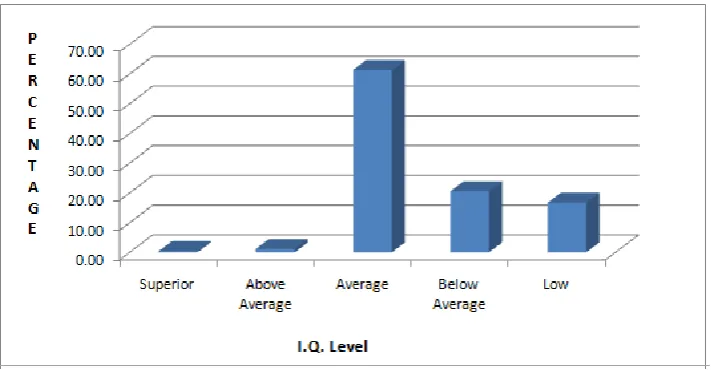
Student Teachers IQ Profile: Figure 1 shows that majority
of the student teachers or 323(61.29) percent obtained an average rating.
Student Teachers Work Values Profile: It can be gleaned
(Table 1) that organizational values was rated importantly by the majority of the respondents (74.922) percent.
[image:2.595.121.477.592.777.2]Student Teacher’s Mental Health Profile: As revealed on
Table 2, the student teachers indicated a normal or an average rating in all components of the mental assets. Based on the mean percentile 58.482 it obtains a normal or average rating. This particular rating as interpreted based on the Manual of Thorpe and Clark (2000) which showed that the student teachers were satisfied with their present undertakings. On Student Teacher’s Interpersonal Value Profile.
Student Teacher’s Interpersonal Values Profile: Figure 4
demonstrates the student teachers profile relative to interpersonal value. The respondents considered conformity value of average importance as reflected by 65.778 mean percentile.
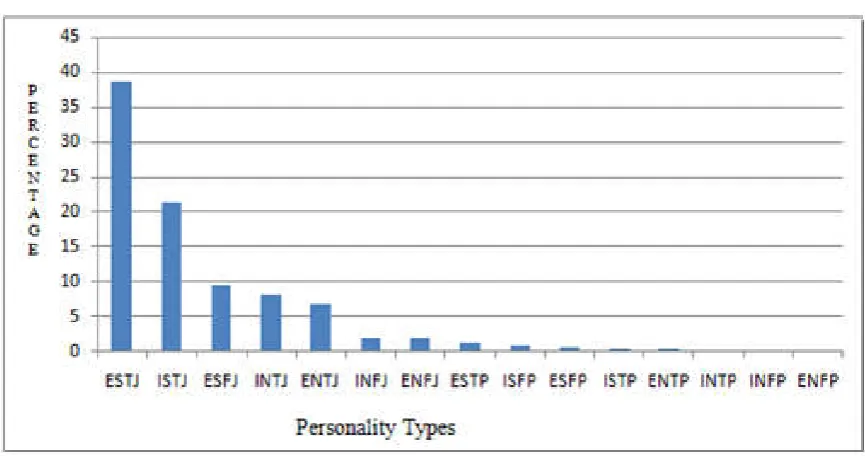
Student Teacher’s Personality: As shown in Figure 2,
(38.52%)of the respondents were Extroverts. They are sensing, thinking, judging type (ESTJ).
Student Teachers’ Teaching Performance Profile: Figure 3
reveals the student teachers teaching performance, majority of the respondents (56.2 %), had a mean percentile whose rating given by their cooperating teachers as satisfactory.
On the Relationship between the Teaching Performance and Psychosocial Dynamics
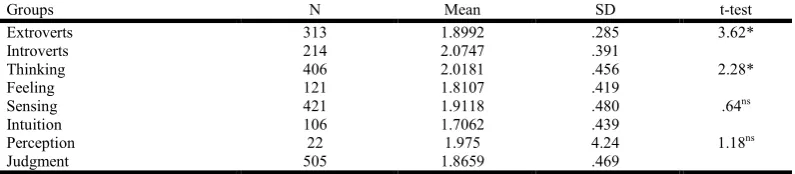
There is a significant relationship between teaching performance and psychosocial dynamics; (I.Q. f=67.226, .0000), (Work Values f=20.234, .0000), (Mental Health f=44.89, .0017) and (Interpersonal Values f=11.199, 0009) summarized in Table 4. On the personality groups, Extrovert-Introverts (t=3.62) and Thinking-Feeling (t=2.28) affect the performance rating of the student teachers shown on Table 5.
Table 1. Student Teacher’s Work Values Profile
Mean Percentile Description Rank
Organization 74.922 Important 1
Religion 66.257 Neutral 2
Familial 58.221 Neutral 3
Interpersonal 55.912 Neutral 4
Variety 48.843 Neutral 5
Environmental 44.946 Neutral 6
Intellectual Achievement 44.290 Neutral 7
OrientedManagerial 37.188 Neutral 8
Material 35.380 Neutral 9
Occupational 33.278 Neutral 10
[image:3.595.114.480.254.398.2]Category of Percentile Rank: 94-99 Very Important, 70-93 Important,32-69 Neutral, 8-31 Unimportant 1-7 Very Unimportant.
Table 2. Student Teacher’s Mental Health Profile
Sub-Scale Mean Percentile Description Rank
I. Assets
Satisfying Work and Recreation 58.48 Normal 1
Adequate Outlook and Goals 58.46 Normal 2
Social Participation 50.79 Normal 3
Interpersonal Skill 49.78 Normal 4
Close Personal Relationship 47.03 Normal 5
II. Liabilities
Physical Defects 29.97 Low 1
Nervous Manifestation 20.13 Low 2
Feelings of Inadequacy 17.97 Low 3
Emotional Instability 16.78 Low 4
Behavioral Immaturity 13.31 Low 5
Category of Percentile Rank: 94-99 Very Good, 70-93 Good,32-69 Normal, 8-31 Low, 1-7 Very Low
Table 3. Student Teacher’s Interpersonal Value Profile
Sub-Scale Mean Percentile Description Rank
Conformity 65.78 Average 1
Benevolence 37.96 Average 2
Leadership 36.16 Average 3
Independence 26.85 Low 4
Support 22.13 Low 5
Category of Percentile Rank: 94-99 Very High, 70-93 High,32-69 Average 8-31 Low, 1-7 Very Low
[image:3.595.148.448.446.507.2] [image:3.595.80.513.527.755.2]DISCUSSION
The data showed that the average IQ rating of the respondents as revealed in the OLSAT means that the student teachers had the mental capacity or potential to learn on the job. The results were indicative of the student teachers learning ability in situation other than school context. As prospective teachers, they must be able to demonstrate a specific level of competence by the end of pre-service stage in order to be allowed entry into profession (Lanier and Featherstow, 2008). The organizational values were upheld important by the student teachers. This particular value could be related to one’s membership in the work organization-knowledge and acceptance of organizational goals and willingness to help reach three goals (Cervantes, 2001).The student teachers at this stage of development were most likely to follow school policies and very much aware of issues affecting their practice teaching. This was in consonance with Erik Erikson’s right stages of psychosocial development (2004) which pointed out that young adult tend to develop cooperative, affiliated relationships with others and were willing and able to commit themselves to relationships that demanded compromise. The state of mental health among prospective teachers’ is normal and their mental health liabilities are low which imply that they have the potential to promote positive mental health although there are some components in mental health liabilities that need to be enhanced through self-awareness, self-acceptance, coping mechanism to stress and personal recognition. The student teachers revealed a low regard for support and independence while the other three interpersonal values; conformity, benevolence and leadership were rated average.
This implies that the respondents are in need of encouragement, praises and feeling of self-worth. In Maslow’s hierarchy of needs, before an individual becomes self-actualize being, these values on support recognition and independence must be satisfied first. The personality type of the respondents belongs to the Extrovert-Sensing-Thinking-Judging type of personality. Myers and Briggs (2003) described this personality as a decisive type, logical, objectively critical and concerned with the here-and-now. This implies that the prospective teachers need more exposure to develop the act of appreciation and the need to work up taking feeling values into account.
[image:4.595.126.479.56.223.2]The respondent of the study were rated satisfactory by their cooperating teachers which was in consonance with Taganile’s (2008) finding. This means that the student teachers were affected by a number of factors that contribute to the increasing concern and anxieties on the difficulty of teaching. According to Fuller (2006) regardless of the adequacy of their in-service preparation program, a student teacher goes through a transition from theory to practice and from a role of a student to the role of a teacher. This abrupt transition could probably explain the result of the findings. The study found that the student teachers psychosocial dynamics is a predictor of teaching perfor0mance. This finding supported the study of Pada (2002) and Ornstein (2000). Moreover, the study revealed that Extroverts and Introverts preferably affected the performance as well as the feeling personality rather than thinking. These are the qualities prospective teachers need to acquire to become effective and efficient in their teaching profession.
[image:4.595.107.492.269.322.2]Figure 3. Student Teachers’ Teaching Performance Profile
Table 4. Relation of Student Teachers’ Performance Rating and Their Psychosocial Dynamics
Variable Computed F Level of Significance
Teaching Performance and I.Q. 67.226 .0000
Teaching Performance and Work Values 20.234 .0000
Teaching Performance and Mental Health 44.89 .0017
Teaching Performance and Interpersonal Values 11.199 .0009
Table 5. Teaching Performance and Its Relation to the Different Personality Groups
Groups N Mean SD t-test
Extroverts 313 1.8992 .285 3.62*
Introverts 214 2.0747 .391
Thinking 406 2.0181 .456 2.28*
Feeling 121 1.8107 .419
Sensing 421 1.9118 .480 .64ns
Intuition 106 1.7062 .439
Perception 22 1.975 4.24 1.18ns
[image:4.595.102.500.354.441.2]Effective teachers are those who possess the characteristics needed to educate learners to become successful individuals (Barrett and Kepler, 2001).
Conclusion
The student teachers in the teacher training institutions of Zamboanga del Norte are above average in I.Q.; therefore they are ready to teach and are capable of coping up with the challenge of the real world of work. Their mental health conditions are just normal so they can improve given the opportunities and reduced mental health liabilities given good administrators who can guide and help them. The respondents are low in their interpersonal value, specifically in support recognition and independence; so these values should be enhanced through activities of seminars to develop their competencies and skills to become better teachers. Along personality, the student teachers’ belonged to the Extroverts, who are sensing, thinking and judging type of personality and so they are alive and capable of training and improvement. The teaching performance of the student teachers as perceived by the cooperating teacher is satisfactory and therefore they have acquired the skills for beginning teachers and so they are ready to teach. The student teachers in this study show similar traits as professional have; they have viable teaching performance and they possess the psychosocial dynamics called for to become good teachers. There is significant relationship between the student teachers psychosocial dynamics and teaching performance.
Recommendations
The Psychosocial Dynamics Enhancement Program should be adopted to meet the needs of the student teachers for their professional growth and development.
It is suggested that this development program be part of the curricular offerings in the teacher training institutions from first year teacher education course to fourth year study group. This should be so because the process of development will take a longer period of time and the skills should be imbibed slowly but surely in the students. It is also recommended further that this development program be part of the syllabus for the observation and participation unit of the fourth year students, while for the first year to third year education students this should have three year program in their social orientation with an additional unit, to meet twice or thrice a week.
REFERENCES
Clevery, John F. and Habbana, Pacita I. 2002. Values in Action. SEAMEO Regional Center for Educational Innovation and Technology.
Duke and Daniel Linden. 2000. Teaching: an Introduction. Chicago: McGraw-Hill Book Company.
Harmer and Earl, 2000. Instructional Strategies for Student Teachers. Chicago: Mc Graw-Hill Book Company.
Ornstien and Allan C. 2000. Strategies for Effective Teaching. Harper Collins Publisher.
Pada and Annabelle, G. 2002. “The ability of beginning teachers as perceived by the experienced teachers assigned in the District of Tanjay North, Division of Negros Oriental. Unpublished Dissertation. University of San Carlos.