An analysis of the feasibility of developing a generic model
for the implementation of total quality management within
the NHS.
NWABUEZE, Uche.
Available from Sheffield Hallam University Research Archive (SHURA) at:
http://shura.shu.ac.uk/20129/
This document is the author deposited version. You are advised to consult the publisher's version if you wish to cite from it.
Published version
NWABUEZE, Uche. (1995). An analysis of the feasibility of developing a generic model for the implementation of total quality management within the NHS. Doctoral, Sheffield Hallam University (United Kingdom)..
Copyright and re-use policy
I r ^>TVj¥U \J*J
SHEFFIELD S1 1WB
Sheffield Hallam University
ProQuest Number: 10697436
All rights reserved
INFORMATION TO ALL USERS
The quality of this reproduction is dependent upon the quality of the copy submitted.
In the unlikely event that the author did not send a com plete manuscript and there are missing pages, these will be noted. Also, if material had to be removed,
a note will indicate the deletion.
uest
ProQuest 10697436
Published by ProQuest LLC(2017). Copyright of the Dissertation is held by the Author.
All rights reserved.
This work is protected against unauthorized copying under Title 17, United States C ode Microform Edition © ProQuest LLC.
ProQuest LLC.
789 East Eisenhower Parkway P.O. Box 1346
An Analysis of the Feasibility of Developing
a Generic Model for the Implementation of
Total Quality Management
within the National Health Service
Uche Nwabueze
A thesis submitted in partial fulfilment
of the requirements of
Sheffield Hallam University
for the degree of Doctor of Philosophy
CONTENTS
PAGE
ACKNOWLEDGEMENTS (iv)
ABSTRACT (vi)
DECLARATION (ix)
CHAPTER ONE: 1
INTRODUCTION 1
RATIONALE 3
SCOPE OF RESEARCH 6
AIMS AND OBJECTIVES OF THE STUDY 9
OVERVIEW OF THE THESIS 10
BACKGROUND TO THE RESEARCH 13
CRITICISM 15
BACKGROUND TO RESEARCH METHODOLOGY 17
DATA COLLECTION 20
QUALITATIVE/QUANTITATIVE ARGUMENT 28
OVERVIEW OF FIELD WORK 29
SAMPLING 31
HOSPITALS 33
DATA ANALYSIS 33
HOW THE QUESTIONNAIRES WOULD BE ANALYSED 36
RELIABILITY AND VALIDITY 39
EXTERNAL VALIDITY 39
REFERENCES 40
CHAPTER TWO: 47
CREATING THE NATIONAL HEALTH SERVICE 47 POLICIES TOWARD THE NHS AND THE YEARS OF
CONSENSUS POLITICS 50
THE NHS SINCE 1979: THE CONSERVATIVES AND
THE ENDING OF CONSENSUS 55
THE NHS SINCE 1990: THE INTRODUCTION OF
TOTAL QUALITY MANAGEMENT 61
CHAPTER THREE: 67
HISTORICAL DEVELOPMENT OF QUALITY 67
WHAT IS QUALITY? 72
QUALITY IN HEALTHCARE 81
WHAT IS TOTAL QUALITY MANAGEMENT? 99 QUALITY MANAGEMENT PHILOSOPHIES 125
THE DEMING PHILOSOPHY 125
JOSEPH M. JURAN 128
THE PHILIP CROSBY PHILOSOPHY 131 OTHER QUALITY PHILOSOPHERS 134 PRINCIPLES OF TOTAL QUALITY MANAGEMENT 136
REFERENCES 139
CHAPTER FOUR: 155 _
IMPLEMENTATION OF TQM 155v
TRADITIONAL TQM; A CULTURE CHANGE PERSPECTIVE 187 THE GURUS ON IMPLEMENTATION 1897 THE STRATEGIC APPLICATION OF TQM 196x TRADITIONAL TQM MODELS; A HEALTHCARE
PERSPECTIVE 2 0 0 y
EMPIRICAL FINDINGS 208/
ANALYSIS 211
REFERENCES 220
CHAPTER FIVE: 228
PITFALLS OF TQM 228 /
PITFALLS OF TQM; A PUBLIC SECTOR PERSPECTIVE 252 / PITFALLS OF TQM; A HEALTHCARE PERSPECTIVE 256 PITFALLS OF TQM; NHS PERSPECTIVE 261
EMPIRICAL FINDINGS 279
REFERENCES 3 0 3 ^
-CHAPTER SIX: 313
BACKGROUND TO THE CASE STUDIES 313
ANALYSIS 315
CHAPTER SEVEN: 387
EMBARKING ON TQM 387
EMBARKING ON TQM IMPLEMENTATION 399 IMPLEMENTATION: INFRASTRUCTURAL MANAGEMENT 402 HOW IT WORKS: PRE-SET-UP PHASE 406
SET-UP PHASE 409
EDUCATION AND TRAINING 414
GET-UP PHASE 419
THE ‘HOW-TO-DO’ APPROACH TO TQM IMPLEMENTATION 421 SUCCEEDING WITH THE ‘HOW-TO-DO’ APPROACH TO TQM 424 USING THE MODEL; IMPLEMENTATION 425
STAY-UP PHASE 436
MOVE-UP PHASE 437
COMPARISON BETWEEN THE HOW-TO-DO APPROACH
AND THE MIXED MODEL 439
ADVANTAGES OF THE HOW-TO-DO MODEL 446
REFERENCES 448
CHAPTER EIGHT: 451
CONCLUSION 451
RESEARCH FINDINGS 452
RECOMMENDATIONS FOR FUTURE RESEARCH 458
REFERENCES 460
BIBLIOGRAPHY 461
ACKNOWLEDGEMENTS
"If I have been able to see further than others, it is because I have stood on the shoulders of giants".
Sir Isaac Newton.
I am grateful and indebted to my two supervisors, Professors Dave Morris and Bob Haigh who helped make this thesis possible. Bob and Dave have over the last three years provided fatherly warmth, wisdom, encouragement, and first-rate guidance upon which the completion of this thesis was made a lot easier. To Bob and Dave I would say, the journey through to fruition was facilitated by the inspiration you guys imbibed in me. Thus, my confidence and intellectual capacity blossomed underlying the outstanding contributions in the form of nine refereed conference papers I have so far made in the quality management literature. Beyond these two exceptional individuals, I am indebted to my wife and two lovely children who have had to cope with my constant absence from home. To my wife Kathleen, I thank you for your understanding, love and financial support throughout the most difficult time in our relationship. I am most grateful you had the strength of character to overcome what seemed an impossible task.
Finally, I want to thank Marie-Cecil Brohon of the Policy Research Centre for all her help in typing most of my paper work despite her overwhelming workloads. I am also indebted to Mrs. Kim Fendick of Keytappers for having the patience and understanding in typing the thesis despite many changes to the original manuscript. Kim you have been most helpful in the five years we have worked together. To all my friends and acquaintances who have helped in one way or the other, thank you all. To the Almighty God I thank you for guiding and protecting me throughout the duration of my research work, particularly on many travels up and down the motorway. I shall endeavour to worship at your feet as long as I live.
Uche Nwabueze
ABSTRACT
Analysis of the Feasibility of Developing
a Generic Model for the Implementation of
TQM in the National Health Service
Uche Nwabueze
May 1995
This is an exploratory case study evaluating the process of TQM implementation in the 23 TQM demonstration sites in the NHS. These sites were set up in 1989 by the Department of Health as centres of excellence for the implementation of TQM. An earlier study1 evaluating TQM in the NHS failed to adequately contextualise the reasons for the argument that orthodox TQM has failed in the NHS. Against this background, it became necessary to carry out an extensive reassessment of TQM initiatives in the NHS. The central thrust of the study involves the identification of:
• the differing modes of implementation of TQM across the sites;
• the difficulties managers were encountering in the implementation of TQM - barriers to the implementation of TQM;
• the critical key success factors for the successful implementation of TQM in the NHS; and
• based on empirical evidence seeks to determine whether a specific model of TQM is required in the NHS.
As Francis Bacon noted, ‘if anyone wants to understand nature, he has to study nature rather than base their understanding on Aristotle’s postulations of nature. This is because Aristotle did not understand nature, his ideas about nature were not empirically determined’2 Hence, to gain a conceptual understanding of TQM, it is necessary to understand ‘implementation’ and not base understanding on the outmoded ideas of the Gurus, whose philosophies are not grounded in empirical data. Thus, the TQM literature is inundated with TQM models that are based on anecdotal evidence and the personal prescriptions of TQM writers3. This situation has led to a call by a number of writers4 for an empirically determined implementation model for TQM; particularly in the healthcare setting. To determine whether such a model is required in the NHS, this exploratory study used a unique combination of qualitative and quantitative data to sample 23 Quality Managers at the 23 TQM sites in order to provide an accurate rendition of the TQM process in the NHS. The study makes a valid contribution to the quality literature, by contending that TQM has not failed in the NHS as earlier suggested by one study5, but is yet to be tried. Allegations of failure arise from improper implementation, which is itself symptomatic of the lack of a context-specific model for the implementation of TQM in the NHS. The conclusion was reached from a number of perspectives:
(1) the critique of current TQM literature which is based on the personal ideas of quality management proponents (Chapter Three).
(3) the study also found that the suggestions in the literature that the barriers to the implementation of TQM have generic applicability across organisations is a misnomer. In most of the hospitals the difficulties that quality managers were facing were specific to the organisational context (Chapter Five).
(4) seventeen critical success factors were identified as valid and specific to the NHS. These factors, unlike the ‘Ten Critical Success Factors’ identified by Black6 are of equal importance for the implementation of TQM and are not categorised on a scale of importance (Chapter Seven).
In the final analysis, the study, as a major contribution to knowledge in the quality management field, provides the first empirically determined context specific model for the implementation of TQM in the NHS. The model represents the first problem specific model validated by the experiences of fifteen quality managers in the NHS. It provides an empirical understanding of the ‘nature’ of the implementation of TQM within the confines of the British National Health Service. In addition, a measurement framework to monitor the progress of TQM at various stages of the implementation process is offered (Chapter Seven).
REFERENCES
1. Joss, R., Kogan, M. and Henkel, M. (1994) "Total Quality Management in the National Health Service: Final Report of an Evaluation", Centre for the Evaluation of Public Policy and Practice, Brunei University.
2. See Bacon, F. (1931).
3. Black, S. (1993) "Measuring the Critical Factors of Total Quality Management", Unpublished Ph.D. Thesis, Bradford University.
4. Black, S., op. cit.
DECLARATION
Whilst the author acknowledges the referenced materials used in this study, no portion
of the work in this thesis has been submitted in support of an application for another
degree or qualification at any other University.
® All rights reserved. No part of this thesis may be used or reproduced in any manner
CHAPTER ONE INTRODUCTION:
A growing number of hospitals within the National Health Service are promoting and adopting the practices of Total Quality Management (TQM) or Quality Improvement1. Under this approach, patients should be viewed as active partners in the provision of healthcare. However, efforts in both provider and purchaser settings to implement this radical understanding of the new role and function of the patient have yet to come to fruition2. The experience of a number of health service provider units will be explored.
Consistent with the principles of Total Quality Management, the Department of Health, through its reforms for change, actively promotes patient involvement in quality improvement. For example, the Department of Health working paper, "The Patient Charter", The King’s Fund "Organisational Audit", both encourage accountability, innovative leadership, feedback from internal and external users of services, and total organisational commitment to continuous improvement in the provision of healthcare. In addition, an organisational culture that involves patients, and all who use the services, is advocated. This means that hospitals should seek "ongoing feedback on the quality of care from patients, their families, General Practitioners (GPs), GP fundholders, etc.". This patient inclusive approach to Total Quality Management, when compared with the traditional notion of "we know what’s best for our patients", is one of the greatest challenges presented by the TQM initiative?.
This inaptness is noteworthy, given that the roots of Total Quality Management lie in the industrial sector4 where the meaning of quality is that ascribed by interested, involved parties in any given transaction or set of transactions. In TQM, the customer plays a critical role in defining quality.
"The customer is the most important part of the production and service line. Quality should be aimed at the needs of the consumer, present and future"5.
Quality is defined as
"fitness for use, which means product features that meet customer needs and freedom from deficiency"6.
Fitness for use clearly has the customer as its central thrust. This could be stated as:
"Quality is a customer determination, not an engineers determination, not a marketing determination. It is based upon the customers actual experience with the product or service, measured against his or her requirements - stated or unstated, conscious or merely sensed, technically operational or entirely subjective and always representing a moving target in a competitive market. The purpose of quality measurement is to determine and evaluate the degree or level to which the product or service meets the expectation of the customer"7.
The differences between the industrial and health service approaches to defining quality is forcible. In industry, the customer together with the manufacturer and/or service provider defines quality; in the health service the provider unit defines quality. Yet Total Quality Management cannot be fully implemented in the health service, without accepting that the nature and direction of change must be driven by the needs and preferences of the patient, not the values of the provider8.
be replaced by the attitude of "when it ain’t broke is maybe the only time you can fix it"9. From an organisational prospective, to do a better job must entail expanding the focus of quality improvement and managerial activities to include both processes that are "broken" and processes that are not yet at a crisis stage. Total Quality Management provides such a mechanism for the prevention of organisational defects.
The NHS faces many challenges to successful implementation and integration of TQM. Recognising these challenges and their associated pitfalls and the development of a comprehensive generic model for implementation are essential for making progress towards continuous quality improvement and a more responsive and efficient system of patient care. This study analyses the implementation process of TQM in the NHS by exploring the difficulties encountered from its origins through to fruition.
A growing number of academics, practitioners and experts have taken up the issue of the implementation of TQM in healthcare10’14. But none have addressed the issue of the difficulties healthcare organisations face in implementing TQM. This thesis will attempt to address this gap by providing a comprehensive analysis of "pitfalls" with the aim of generating a solution leading to their eradication.
RATIONALE:
on the failures or pitfalls of TQM’. Despite the attention given to TQM in the real- world organisations, relatively little academic research has addressed the topic of the difficulties managers face in the implementation of TQM21.
Given the lack of systematic research in this area, the author decided to embark on a Doctoral research to unravel the difficulties Quality Managers, or whoever is responsible for the introduction and implementation of TQM, were facing in the process of implementing TQM in the NHS. However, it must be noted that, it would be impossible to determine the exact difficulties of TQM without an indepth study of its implementational process. Hence, the remit of this study is the exploration of the TQM process in the NHS. In the main, the complementary attributes which are concomitant to the successful implementation of TQM will be examined. These characteristics include:
Mode of implementation
Difficulties of implementation
Critical success factors for implementation
FIGURE 1
THE CONCEPTUAL FRAMEWORK OF THE STUDY
IMPLEMENTATION OF PITFALLS OF
TQM TQM
* MODE (HOW?) ♦PROCESS (WHY?)
P (WHAT?)
C-*
---TQM
¥
---MEASUREMENT KEY SUCCESS
(QMMG) ... FACTORS
(WHERE?) (WHAT?)
IS THERE A NEED FOR A MODEL (HOW & WHY?)
2. whilst the number of quality programmes seem to increase in the NHS, the scholarly published material on healthcare quality programmes is rather limited. This can be explained by the fact that some writers have argued that quality is rather a vague phenomenon23. Thus, it seems appropriate to provide a systematic overview of quality programmes as they appear in the twenty-three government selected sites. The purpose being to determine precisely where the NHS stands in relationship to quality. The importance of this determination is an assessment measure upon which quality improvement interventions can then be based.
The National Health Service (NHS) was chosen as the setting for the research because:
1. the author has a consultancy interest in quality provision in the healthcare sector, but lacks experience in what is required for the effective implementation of TQM in public sector health organisations.
2. despite the attempt by two earlier studies24,25 to evaluate TQM initiatives in the NHS, those studies failed to fully address the issue of the ‘pitfalls’ managers were facing in adopting this initially, industrially based quality paradigm.
In addition, the National Health Service plays a huge role in supporting the British economy. The NHS is the largest single employer of labour in Britain employing 1.25 million personnel, provides healthcare for a population of about 60 million with a budget of about £36 billion per annum26. So it becomes interesting to study how such an ‘elephant’ sought to implement the tenets of Total Quality Management.
SCOPE OF RESEARCH:
Case studies have the advantage over the other two considered approaches because they present the reader with a richer and holistic view of how three NHS hospitals have implemented TQM by giving an accurate rendition of actual events29. The case study is unique in its ability to deal with a full variety of evidence: documents, artifacts, interviews and observations30. Whereas surveys can try to deal with phenomenon and context, their ability to investigate the context is extremely limited31. The survey designer, for instance, constantly struggles to limit the number of variables to be analysed, hence limiting the number of questions that can be asked32, whilst an experiment has the disadvantage of divorcing the phenomenon from its context in order to focus on a few variables33.
This study represents an exploration to identify the ‘how’ and ‘why’ of TQM in the NHS. The ‘how’ in this instance, represents ‘how’ the NHS has approached the implementation of TQM. The why deals with the question ‘why’ a certain approach was chosen against other competing or complementary models. Yin34 notes, that the case study:
"is an empirical inquiry that:
• investigates a contemporary phenomenon within its real-life context; when
• the boundaries between phenomenon and context are not clearly evident; and on which
• multiple sources of evidence are used."35
To effectively conduct the investigation and substantiate the ‘how’ and ‘why’ questions, it was decided that the best person to provide answers to these key questions would be the people charged with the responsibility of implementing TQM as it is their responsibility to decide on the approach to TQM and how to go about implementing it.
Furthermore, those people have experienced at first hand the problems of implementing TQM in an alien setting. They are in a vantage position to recount the nuances of the organisation’s TQM initiative. Hence, it was decided that the contact person in the TQM demonstration sites would be the Quality Managers who have as their functional remit the introduction and implementation of TQM.
In the NHS, as in most traditional organisations, one person is chosen and charged with the responsibility to "get on" with quality. Thus, in such a situation only that person would have an insight into the factors which have helped or hindered the progress of TQM. At the time of writing there were 292 Trust hospitals in the United Kingdom35. However, only 23 were considered to have a fully developed TQM programme36. Since the research was not a comparative study between TQM and non-TQM hospitals, the study concentrates its investigation on the 23 TQM hospitals established in 1989 by the Department of Health (DOH) to serve as centres of excellence for the implementation of TQM. When this study started, the 23 hospitals were already four years into TQM which made them appropriate for research because they had established TQM programmes.
At a micro level, the research will explore, in-depth and extensively, the implementation process in 3 Trust hospitals. Whilst at the macro level, through the use of questionnaires, it will further explore the process of TQM, its difficulties and key success factors in 20 hospitals. In the author’s opinion, the multiple approach affords ample opportunity for generalisation from the discrete empirical data. Hence, both quantitative and qualitative data would be collected. The 3 TQM sites were chosen because they agreed in writing when the author made his first initial contact with the Quality Managers of the 23 TQM sites to serve as industrial collaborators to the research. Nonetheless, the three Trust hospitals represent a wide geographical spread and are amongst the first wave of Trust hospitals which had, as a policy requirement, a need to introduce an on-going TQM programme. These hospitals present perhaps the best vantage point from which to explore the process of the implementation of TQM in the NHS.
AIMS AND OBJECTIVES OF THE STUDY:
The aims include:
(1) a critical assessment of the characteristics and tenets of TQM as posited by leading writers and practitioners. Among the works that will be considered will be those of Deming, Juran, Crosby, Feigenbaum and Conway.
(2) a critical assessment of the orthodox model of TQM to determine its suitability for application within the NHS.
(3) an analysis focusing on the identification of ‘pitfalls’ of TQM which have impeded the TQM process.
(6) on the basis of empirical findings, a determination of whether a generic model is required for the implementation of TQM in the NHS.
OVERVIEW OF THE THESIS:
The thesis is structured into eight distinct but interrelated Chapters. Each is a "standalone" chapter which makes a discrete contribution to knowledge. The aim was to make certain that each chapter could constitute an academic publication. However, each of the chapters represents an essential element for the successful implementation of TQM. These elements include: the approach to implementation, pitfalls of TQM, implementation and the key success factors of TQM specific to the NHS. The aim in the chapters is to first undertake an in-depth review of the literature relating to each element before testing the relevance of theory to practice. The author is of the opinion that TQM is a practical subject and, as such, theory should be grounded in empirical evidence. Thus, what will be found throughout the chapters, is an attempt to marry theory to practise but overall the study represents a thorough analysis of the TQM process in the NHS unlike earlier studies which represent anecdotal accounts. The chapters include:
Chapter Two: provides a historical account of the different changes the NHS have undergone (1979-1990), and includes the reasons why the NHS embarked on TQM by setting up 23 TQM sites in 1989.
Chapter Three: provides an assessment of the meaning of quality and total quality management. A literature review is undertaken to establish whether a generic definition of quality exists. An insight is offered as to what quality means in the context of the NHS. Furthermore, a historical account of the evolution of TQM is offered. The chapter concludes by delineating the principal elements of TQM.
Chapter Five:
TQM models represent, in the main, piecemeal approaches to TQM. This leads to a reconceptualisation of TQM implementation. A contribution is made to knowledge in the form of delineating, from the literature, a set of common implementational characteristics amongst the leading proponents of TQM. The model, which the author terms a "TQM infrastructural framework" made up of five different but interrelated stages designated as Pre-Set-up, Set-up, Get-up, Stay-up and Move-up, is defined. The model represents the first contextualised infrastructural framework in the field of quality. A further contribution is made to the field of TQM by the offering of a holistic model of TQM. The chapter concludes by arguing that orthodox models of TQM are inappropriate for the NHS because they are not problem-specific, that is they are not grounded in empirical data and cannot, therefore, deal with the complexities of the NHS. A call for a specific model for the implementation of TQM is made. Furthermore, a summarised tabulation of the TQM process in 12 Trust hospitals is offered.
not applicable within the confines of the NHS. Detail on the ‘pitfalls’ to TQM in the NHS is offered.
Chapter Six:
Chapter Seven:
contains the case studies. A detailed account is offered as to how three Trust hospitals implemented TQM. In addition, a cross-case analysis of the three cases is presented to determine elements of commonality between the cases. Furthermore, a questionnaire survey based on the Crosby Quality Management Maturity Grid (QMMG) is undertaken. This represents the first time the QMMG has been applied and utilised in the context of the NHS. A contribution to knowledge is made to the effect that the results of the survey repudiates the conclusion of the Brunei University Report, Evaluating TQM Initiatives in the NHS, which erroneously concluded that TQM has failed in the NHS. The chapter concludes by reiterating the earlier call for a model for TQM and advocates a context specific model for the implementation of TQM in the NHS.
undertook an evaluation of TQM in the NHS in May 1994. The context specific model represents the first TQM model to encompass both an infrastructural and measurement framework.
Chapter Eight: is the conclusion of the study. The key points of each chapter are offered and conclusions drawn to the effect that TQM has not failed in the NHS. It has yet to be tried. The problem of TQM in the NHS is highlighted as improper implementation due to the lack of a context specific model for implementation. In addition, recommendations for future research is offered.
BACKGROUND TO THE RESEARCH
A CRITIQUE OF THE BRUNEL UNIVERSITY REPORT:
EVALUATION OF TQM INITIATIVES IN THE NHS, JOSS ET AL
The Brunei Report by Joss et al38, ‘Evaluation of TQM Initiatives in the NHS (1991- 1994)’ formed the main background to this study. That Report was sponsored by the Department of Health and the remit of the research was an ‘evaluation of the usefulness and feasibility of installing orthodox TQM’. The research evaluated TQM projects in eight TQM sites. It included an assessment of the aims and objectives of each project and considered alternative approaches to the development of TQM. It monitored the progress of the project at different stages of installation and completion, through a process sequence. It made comparisons with NHS sites not involved with TQM. It noted the contribution of different processes in introducing and achieving TQM, paying particular attention to the use of special initiatives as against the ordinary or organic models of introduction and installation39. The project coordinated sites and evaluated the outcome of the projects on a wide range of criteria and involved all of those with a stake in TQM.
1. Technical - those concerned with the employment of specialist knowledge and expertise;
2. Generic - those concerned with generally agreed standards of conduct; and
3. Systemic - making sure that the whole organisation works in a coherent and well planned way.
Furthermore, the Report identified critical success factors underpinning each of the quality assurance mode:
• Senior Management commitment • Funding
• Training
• Recognition and reward
It also identified the following as problems inhibiting TQM:
• Lack of infrastructural management • Lack of funding
• Lack of adequate conceptualisation of TQM before implementation o Unempowered Quality Officers.
The Report concluded that only two TQM sites have made significant progress in systematic quality. Most of the sites have failed to make any significant progress in implementing an ideal - typical model of TQM. In addition, TQM has failed in the NHS for two reasons:
(1) TQM implementation in the NHS was underpinned by commercial models of TQM.
CRITICISM
The Report also stated that the reason why TQM has failed in the NHS is because of the adoption of commercial based TQM models. In fact, no attempt was made by the researchers to establish whether there were other fundamental reasons for failure. Their reason for the failure of TQM smacks of the obvious. What could have been expected from the study, given that it was sponsored by the Department of Health, was a more thorough insight into the reasons for failure and a more convincing argument to justify the use of orthodox models of TQM in the NHS. The researchers should have given examples of which hospitals in the NHS have actually adopted an orthodox model of TQM. The use of a case study would have illuminated this; instead what the study provided was an anecdotal account of TQM in the NHS.
The Brunei Study also gave insights into the existence of three differing types of quality assurance initiatives in the NHS. In contrast, on closer examination of TQM initiatives, what is prevalent in the NHS is professional quality rather than technical, generic, or systemic quality. There seems to be a tendency amongst the staff of the NHS to regard standard setting and monitoring as quality. The NHS has, in essence, adopted an essentially medically-driven, or medically determined, approach to TQM.
in the 23 TQM sites, in order to present a systematic accurate account of TQM initiatives in the NHS.
BACKGROUND TO RESEARCH METHODOLOGY:
The author would argue that, research is generally structured along three lines: courses in subject matter, in theory, and in research methods. Some researchers foster the unfortunate idea that subject matter, theory, and methods are either independent of one another or that they can be integrated only at the highest level of abstraction. However, theory, method and substance are inseparable. Miles43 observed that each social scientist must be a theorist and a methodologist. Therefore, it can be argued that the pursuit of research information necessitates an integrated approach encompassing quantitative and qualitative data; as evidenced by this research.
Whilst it is true that theory and method can themselves be objects of study, it is also true that ‘research’ cannot proceed profitably unless it is encompassed with a fundamental theoretical and methodological framework. Furthermore, the relationships between data, theory and method are important as a continual process of interaction in research methodology:
FIGURE 2
RELATIONSHIPS OF THEORY. METHOD AND SUBSTANCE
DATA Information about the empirical world
THEORY
Logical explanations about the empirical world
Nevertheless, there are various forms of research depending on the expertise of the researcher. For example, sociological research, which like all scientific enquiry is fundamentally promoted by simple human curiosity; i.e. investigations of why people commit suicide44. Some research aims only to describe, in detail, a situation or set of circumstances. It aims to answer questions like ‘how many?’ and ‘who?’ and ‘what is happening?’45. Whilst other research seeks to explain a social phenomenon; it asks "why?" and tries to find the answer to a problem. This may be a social problem or a sociological problem46. However, the purpose of this study is to examine how the NHS have approached the implementation of TQM over a six year (1989-1995) period.
The approach which affords the researcher the opportunity of presenting a rich account of the exact situation regarding implementation of TQM in the NHS is the case study approach. The case study affords the researcher enormous flexibility in that the design process can be altered, changed or developed as the researcher becomes more acquainted with the phenomenon being investigated47; whereas the experiment and survey techniques require that the design format be established at the beginning and then put into practice48; with any deviation from the initial design being considered a disaster of such magnitude as to necessitate starting all over again49. The study of TQM implementation in the NHS requires advancing with an open mind to explore findings, and allowing theory to be grounded in data. This is because the NHS is a complex organisation with more complexities than might be discerned by an outsider. For example, anecdotal evidence suggests that the NHS is not uniquely different from any other organisation and, thus, that any model that has worked in the commercial sector is bound to work in the NHS. However, on closer examination, the NHS is indeed uniquely different on three major counts:
(1) its close linkage to politics
(2) its complex organisational structure (Directorates)
Carrying out a research investigation into the NHS with a strictly determined research design format, particularly an investigation on the implementation of TQM, would be inappropriate because what the researcher would find would be an aberration to the pre-structured design, thus jeopardising the reliability of the data. At the time this study was embarked upon there were only two previous studies50,51 which had attempted to evaluate TQM initiatives in the NHS. The first study52 did not specifically address TQM in the NHS but focused upon what its authors called quality initiatives in hospitals in the whole of England and Wales. The research methodology was based on questionnaire surveys; the validity and reliability of which are open to question53. From the author’s experience, NHS employees are wary of completing questionnaires that would portray them as being too negative of their organisation. In fact, staff are required to clear with their superiors before the completion of questionnaires that ask intimate questions about the organisation. On the basis of this finding, research into the NHS which is strictly based on a questionnaire survey could be open to enforced managerial bias.
DATA COLLECTION
(A) INTERVIEWS
expressions of ‘how’ the TQM programme was first introduced and implemented, their perception of the ‘difficulties’ they were experiencing and ‘what’, in their experience, were the key success factors of TQM in the NHS.
The ‘open-ended’ approach enabled the Quality Managers to talk frankly about what they considered to be the barriers to the implementation of TQM within their respective organisational settings. Sometimes their frankness surprised the author. They all gave detailed accounts of their TQM programme. One factor not recognised in the methodological literature and which helped the author in facilitating the collation of the real facts as seen by the Quality Managers was the author’s practical background derived from his consultancy experience in the implementation of TQM. Hence, the author spoke relatively the same language as the Quality Managers. The author also distanced himself from academia by telling the Quality Managers during the first contact that the research would be practically based devoid of all academic jargons. This helped relax the respondents as they saw the author as one of themselves. Thus, they were able to "open up", giving, at times, detailed and confidential information concerning the TQM programme. For example, the Quality Managers allowed the author to tape the two hour long interviews; a practice almost unheard of in the NHS. In addition, because of the close link forged with these managers, the author was at liberty to telephone them during the writing-up phase of the research to confirm or reconfirm statements. This rare closeness to the interviewees helped rule out the question of ambiguous responses which is often the criticism of interviews.
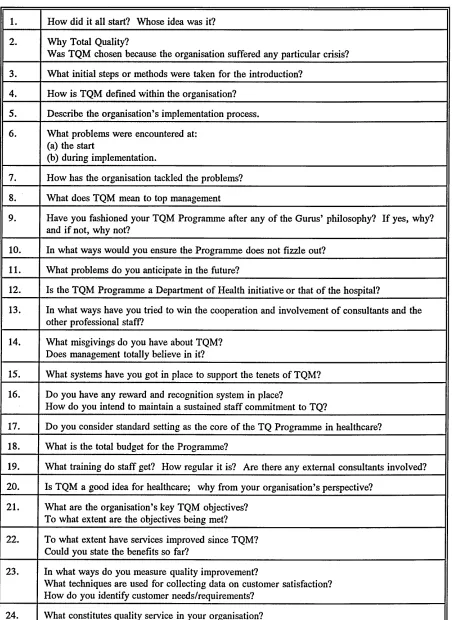
TABLE 1
THE RESEARCH QUESTIONS
1. How did it all start? Whose idea was it?
2. Why Total Quality?
Was TQM chosen because the organisation suffered any particular crisis?
3. What initial steps or methods were taken for the introduction?
4. How is TQM defined within the organisation?
5. Describe the organisation’s implementation process.
6. What problems were encountered at: (a) the start
(b) during implementation.
7. How has the organisation tackled the problems?
8. What does TQM mean to top management
9. Have you fashioned your TQM Programme after any of the Gurus’ philosophy? If yes, why? and if not, why not?
10. In what ways would you ensure the Programme does not fizzle out?
11. What problems do you anticipate in the future?
12. Is the TQM Programme a Department of Health initiative or that of the hospital?
13. In what ways have you tried to win the cooperation and involvement o f consultants and the other professional staff?
14. What misgivings do you have about TQM?
Does management totally believe in it?
15. What systems have you got in place to support the tenets of TQM?
16. Do you have any reward and recognition system in place?
How do you intend to maintain a sustained staff commitment to TQ?
17. Do you consider standard setting as the core of the TQ Programme in healthcare?
18. What is the total budget for the Programme?
19. What training do staff get? How regular it is? Are there any external consultants involved?
20. Is TQM a good idea for healthcare; why from your organisation’s perspective?
21. What are the organisation’s key TQM objectives? To what extent are the objectives being met?
[image:36.612.88.540.68.688.2](B) POSTAL QUESTIONNAIRES
The postal questionnaire was used in order to facilitate a wider coverage of the 23 TQM sites. Since three of the sites were chosen for visits, because of their geographical spread and ease of access, the other twenty had to be covered by means of a questionnaire. In total, the study used five different but interrelated postal questionnaires to aid the internal validity of the research.
(1) The first questionnaire dealt with the preparation of the TQM programme. Respondents (Quality Managers) in twenty hospitals were asked to provide information regarding their TQM programme in four sections. The first section asked about the initial preparation for TQM. The second section asked the question of what followed on from the initial preparation. The third section asked for information about the process of implementation whilst the fourth asked for comments about the programme. This questionnaire aided the coverage of the TQM sites that the author was unable to visit for interviews due to their refusal of access and disinclination to serve as industrial collaborators to the research.
(2) The second questionnaire was based on the Crosby Quality Maturity Grid (QMMG)64 in order to determine systematically where the 23 TQM sites were in relationship to quality. As Schmele and Foss noted, ‘the QMMG represents an evaluative tool to determine where an organisation lies in relation to quality’65. In line with this argument, it is anticipated that the QMMG would aid the provision of where exactly the NHS is in relation to quality. This would enable answers to be provided as to whether TQM had failed in the NHS. The Grid would also formally enable the Quality Managers to be aware of where their organisation stood in relation to TQM. Furthermore, it would serve to inform the reader how far the NHS had progressed along the TQM route.
1. determine whether the generic factors are applicable within the context of the NHS
2. provide the practising Quality managers with a tabulation of the factors that inhibit TQM in the NHS.
It is important that Quality Managers are aware of the potential difficulties of TQM prior to and during implementation, so that they can learn how to avoid them. As Hammer and Champy66 note in the implementation of re-engineering, ‘the first logical step in re-engineering is for managers to know what the mistakes are and avoid them’. Business writers often claim that the pitfalls of TQM are generic, but is that really true? Thus, the analysis of this third questionnaire would provide the answer to that question but, of more importance, is the identification of the ‘pitfalls’ to the implementation of TQM in the NHS. This would enable managers to build upon, and improve upon, the existing organisational weaknesses. Thus, on a five point scale; Most Significant, Significant, Least Significant, Not Significant and Does Not Apply, the Quality Managers were asked to rate each of the forty factors as it applies to the context of their organisation.
(4) The fourth questionnaire was based on the Parasuraman et al67 Gap Analysis Model. This was used in order to further elucidate the difficulties of TQM. As Parasuraman et al noted, ‘the existence of the gaps in any organisation implies the provision of poor quality service to the customer’68. This questionnaire asked the Quality Managers to rate their organisation against each gap (see Appendix 4). The aim being to determine whether the NHS was providing a quality service.
The fifth questionnaire would provide the Quality Managers, and also the researcher, with the critical success factors of TQM in the NHS. Thus, a tabulation of the critical success factors would be provided at the end of the analysis so that Quality Managers in the NHS would be aware of the factors that should be present in their TQM programme in order to facilitate success. Often managers are not aware of the essential requirements of TQM which would enable its ‘holistic’ implementation. It is hoped that, through the analysis of the returned data, managers can benchmark the characteristics of their approach against the essential requirements; thus, building upon the potential strengths of those factors. The decision to base the fifth questionnaire on Parker and Porters’ Eight Critical Success Factors was informed by one writer’s70 suggestion that Parker and Porters’ Eight Critical Success Factors represented the most elaborate collection of the success factors for TQM. The suggestion goes further to note that the critical factors were compiled after an extensive review of the literature by the authors.
Secondly, a recent PhD71 on the critical success factors of TQM in the manufacturing industry was based on the adaptation of Parker and Porters’ model.
Thirdly, a comparison of Parker and Porters’ Eight Critical Success factors to the eight success factors identified by Saraph et al72, showed little, if any, difference between them. Against this background the Parker and Porter model was chosen as the evaluatory tool by which to measure and determine success factors specific to the NHS.
Questionnaires 1, 2, 3 and 4 were clipped together as one and sent out to 20 TQM sites. In total, 12 out of the 20 questionnaires sent out were returned. The 20 questionnaires were first sent out in June 1994 and respondents were given 8 weeks to complete and return them. Remarkably, the 12 questionnaires were returned within four weeks. A follow-up of the same questionnaires was sent to the eight hospitals which had failed to return their questionnaires in October 1994, but they still declined to cooperate. Thus, the analysis of questionnaires 1-4 is based on:
In total 15 out of the 23 TQM sites participated, representing a response rate of approximately 65 per cent.
The extensive use of questionnaires in combination with the in-depth interviews was mainly utilized for two reasons:
(1) to provide a wider coverage of the 23 TQM sites since it was impossible on the basis of finance and access to visit all 23 hospitals.
(2) to facilitate the notion that no research technique is without bias, although as Atkinson has noted, ‘Methods of research rely on different assumptions... thus we should not assume, therefore that contrasting methods can be combined in a simple additive way’73. However, the author is of the opinion that a triangulation method as used in this study would be useful in validating the information and data provided.
For example, for questionnaires 3, 4 and 5, but, in particular, questionnaires 3 and 5, which contained the 40 generic factors inhibiting TQM and the eight critical success factors respectively, the author supplemented these by asking the three Quality Managers in the face-to- face interview sessions to identify other inhibiting, as well as success factors, within their specific environment that have aided or inhibited TQM but which had not been identified in the questionnaires. This approach served to substantiate the reliability of the responses.
(c) DOCUMENTARY SOURCES
and the critical success factors of TQM. Thus, overall, the documentary evidence was not very useful in addressing the research questions of ‘how’ the organisation implemented TQM and ‘why’ a particular approach was chosen. The semi structured interview, however, provided that data.
QUALITATIVE/QUANTITATIVE ARGUMENT
The author, in line with Bryman74, argues that it would be methodologically naive to argue that quantitative research methods are more appropriate to business research than qualitative methods but that the distinctions between the two approaches are merely technical. Thus, there exist both qualitative and quantitative data which have to be dealt with in rather different ways and from a variety of approaches rather than from a quantitative or qualitative perspective75.
There is no rule in research that says that only one method must be used in an investigation76. Using more than one method in an investigation can have substantial advantages. One important benefit of multiple methods lies in the reduction of inappropriate certainty77. Using a single method and finding a clear-cut result may delude investigators into believing that they have found the ‘right’ answer. Using other, additional methods, may point to differing answers which remove specious certainty78.
Research employing both quantitative and qualitative data can be used to address different but complementary questions within a study - ‘the complementary purposes model’. This focuses on the use of different methods for alternative tasks. It deals with what happens when initial exploratory work is done by means of unstructured interviews, and subsequent, descriptive and explanatory work employs a sample survey79. For example, to explore the process of TQM in three of the 23 TQM sites, the semi structured interviews were used. Whilst the postal questionnaires were employed in the explanatory aspect of the study which involved:
• measurement of where the NHS is, in relation to TQM • identification of key success factors
The intention was to use the quantitative and the qualitative methods in a complementary fashion to enhance the ‘interpretability’ of the data collected. As Robson notes, ‘researchers need not be prisoners of a particular model or technique when carrying out an enquiry’80.
OVERVIEW OF FIELD WORK
The data collection period started in April 1993. The intention was to visit each of the sites periodically over two years. Since the NHS operates in an environment where the goal posts are constantly shifting it was important not to be away from the scene for too long. At the beginning, the author thought that returning to a hospital every four months was too short a time for any remarkable changes to take place, however, the visit each quarter saw more remarkable, and at times ridiculous, changes; particularly in the mobility and redundancy of staff. On some occasions, due to concurrent government interventions, the TQM programme was stalled whilst Quality Managers turned their attention to ensuring that the hospital met with both Patient Charter and Purchaser specifications. At other times, the Quality Managers were measuring this or that service element to meet with the King’s Fund organisational audit. In short, each visit was filled with different quality perspectives that made the fieldwork an intriguing experience.
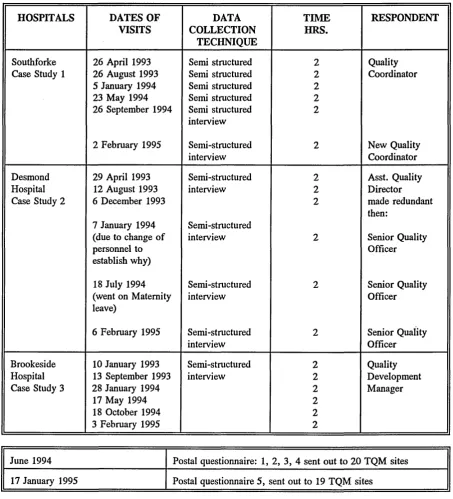
TABLE 2
INTERVIEW SCHEDULE AT 3 NHS HOSPITALS APRIL 1993 - FEBRUARY 1995
HOSPITALS DATES OF
VISITS COLLECTIONDATA
TECHNIQUE
TIME HRS.
RESPONDENT
Southforke 26 April 1993 Semi structured 2 Quality
Case Study 1 26 August 1993 Semi structured 2 Coordinator
5 January 1994 Semi structured 2
23 May 1994 Semi structured 2
26 September 1994 Semi structured 2
interview
2 February 1995 Semi-structured 2 New Quality
interview Coordinator
Desmond 29 April 1993 Semi-structured 2 Asst. Quality
Hospital 12 August 1993 interview 2 Director
Case Study 2 6 December 1993 2 made redundant
then:
7 January 1994 Semi-structured
(due to change of interview 2 Senior Quality
personnel to Officer
establish why)
18 July 1994 Semi-structured 2 Senior Quality
(went on Maternity interview Officer
leave)
6 February 1995 Semi-structured 2 Senior Quality
interview Officer
Brookeside 10 January 1993 Semi-structured 2 Quality
Hospital 13 September 1993 interview 2 Development
Case Study 3 28 January 1994 2 Manager
17 May 1994 2
18 October 1994 2
3 February 1995 2
June 1994 Postal questionnaire: 1, 2, 3, 4 sent out to 20 TQM sites
17 January 1995 Postal questionnaire 5, sent out to 19 TQM sites
Source: Compiled by the author
of TQM within the healthcare setting; particularly the difficulties of getting both top management and the professional staff on board the TQM programme. Of interest was their scepticism of academic postulations and of traditional models for the implementation of TQM. They argued that academics theorise about issues in the NHS but lack the practical tools to bring change about. The biggest indictment to come out of the fieldwork was the failure of the traditional TQM paradigm to have any meaningful influence on the approaches adopted by the managers.
SAMPLING
Furthermore, the three samples met the objectives suggested by Schatzman and Strauss85:
(a) suitability: the three hospitals had been operating an on-going TQM programme since 1989; as part of the TQM demonstration project.
(b) feasibility: the hospitals were accessible, allowing for regular visits. In addition, the respective quality managers were receptive to the author throughout the entire period of fieldwork.
(c) tactics: the Quality Managers are evangelists of the quality movement. They strongly believe that TQM is the way forward for the NHS; thus enabling a common ground for discussion. This aided the frank and in- depth answers they gave to questions posed by the author.
Prior to the acceptance of collaboration by these hospitals, the author had already determined;
Who : which person would be interviewed? Where : setting for data collection
When : at what times?
What : which events, processes were to be explored?
In the author’s opinion, for TQM to succeed entails four essential characteristics:
(1) the mode or approach to implementation must be ‘holistic’.
(2) the manager or the organisation needs to be aware of the ‘pitfalls’ or the common mistakes of TQM and learn to avoid them, and improve upon them.
(3) the organisation should build on its key success factors critical to its survival.
(4) there must be constant measurement of the progress made.
Thus, in investigating the progress of TQM in the NHS, it was imperative to carry out an in-depth analysis of these four key components of any TQM initiative. This was the main failure of the Joss et al study. It failed to critically evaluate the TQM initiatives from these key interrelated sequential parts of TQM.
HOSPITALS
The three hospitals which represent the Case Studies will be called Southforke (Case 1), Desmond Hospital (Case 2) and Brookeside Hospital (Case 3) respectively to preserve their anonymity. However, the background to the hospitals is provided in Chapter Six.
DATA ANALYSIS
meaningful and useful manner89. Bromley90 in his argument for the quasi-judicial approach for analysis of case studies, suggests that throughout the process, four important questions should be kept in mind:
(1) what is at issue?
(2) what other relevant evidence might there be? (3) how else might one make sense of the data? and (4) how was the data obtained?
The quasi-judicial approach is concerned with evidence and argument. Miles and Huberman91, Lofland and Lofland92, Tesch93, and Robson94, suggest basic rules for dealing with qualitative data:
TABLE 3
BASIC RULES FOR DEALING WITH QUALITATIVE DATA
1. Analysis of some form should start as soon as data is collected. Don’t allow data to accumulate without preliminary analysis.
2. Make sure you keep tabs on what you have collected (literally - get it indexed). 3. Generate themes, categories, codes, etc. as you go along. Start by including
rather than excluding; you can combine and modify as you go on.
4. Dealing with the data should not be a routine or mechanical task; think, reflect! Use analytical notes (memos) to help to get from the data to a conceptual level. 5. Use some form of filing system to sort your data. Be prepared to re-sort. Play
with the data.
6. There is no one ‘right’ way of analysing this kind of data - which places even more emphasis on your being systematic, organised and persevering.
7. You are seeking to take apart your data in various ways and then trying to put them together again to form some consolidated picture. Your main tool is comparison.
will provide results from which deductions can then be made. This will ensure that the theoretical postulation to be offered in this study is ‘grounded’ in data.
HOW THE QUESTIONNAIRES WOULD BE ANALYSED
QUESTIONNAIRE Is
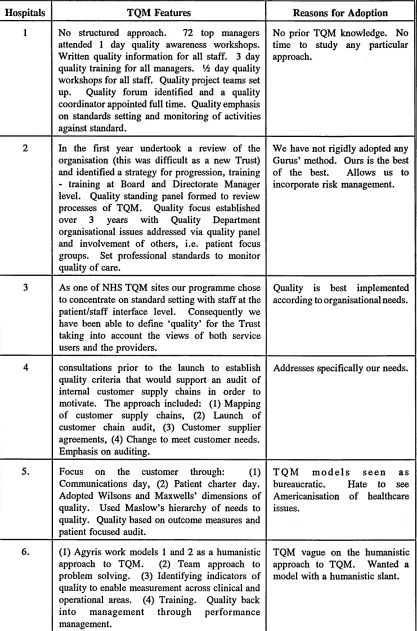
A tabulation representing a brief summary of the implementation process of the 12 hospitals that replied to the survey. As Yin102 suggests... ‘there is no need for any simple case report but a brief summary of individual cases’. The aim of the tabulation is to support the ‘explanation’ that the NHS has adopted individualised approaches to TQM rather than the orthodox TQM models.
QUESTIONNAIRE 2:
The Crosby Quality Maturity Grid103 will be analysed using Crosby’s suggested scoring format. Each stage of the grid has a score corresponding to the stage number. Example: Stage 1, Score = 1; Stage 3, Score = 3. Each stage has five categories, hence a maximum score of 30 is achievable.
QUESTIONNAIRE 3:
Stoner and Freeman104 identified four interrelated activities expected of any managerial process; planning, organising, controlling and leading. Similarly, in extending Stoner and Freemans’ work, the author has identified four key elements of any managerial process, essential for the successful implementation of TQM. These include:
(1) management systems and processes (2) workforce
(3) senior management
The 40 generic factors were broadly categorised to fit each of the four elements. Thus, questionnaire 3 will be analysed from the four complementary perspectives which are essential and which must work in unison for TQM to work. Furthermore, a table with percentages will be provided to show the pattern of responses. The percentages represent highest scoring statements of which 40 per cent is seen as least score. Scores between 40-100 are taken as significant. The computation of the percentages will be done using the Statistical Package for Social Science (SPSS). Thus, Table 18 in Chapter Five will show hospitals by obstacles, observation rate and row percentages. This is in contrast with the widely held view that qualitative research is incapable of statistical analysis.
QUESTIONNAIRE 4:
The analysis of questionnaire four would be based on the presentation of a table which shows the pattern of responses for each of the seven gaps in percentages for the individual hospitals.
QUESTIONNAIRE 5:
Because questionnaire 5 asked the respondents to answer Yes or No to each of Parker and Porters’ eight critical success factors, for the purpose of coding, before the questionnaires were sent out, two numbers were attached to each question. For example, question number one in the questionnaire reads:
‘Necessary Management Behaviour: Clear leadership, commitment and vision is required for senior management’. Is this significant in the NHS in your experience?
YES NO
The numbering is known as nominal scales106. For instance, the analysis of the nominal data collected in the 23 TQM sites would be the totalling of the ‘yes’ responses (coded 1) and the ‘no’ responses (coded 2). For example, if out of the 20 returned data, eleven have responded yes, the percentages would be represented in a table of the total number, i.e.
For the yes responses, it would read:
i i
20 x 100 = 55%
Thus, the table for each of the questionnaires 2-5 will show percentage scores. Nevertheless, the aim is to draw implications from the data in order to build theory.
Qualitative and quantitative research, as earlier noted, differ in that qualitative research is often developed when little information is available on a topic107. The researcher plans to look for and describe attributes, themes, and underlying dimensions of a particular unit in order to discover what distinguishes the characteristics or attributes of the unit. The quantitative research aims to measure the magnitude, size, or extent of the units108. Although polar types of qualitative and quantitative research may be developed, this research contains features of both.
Features of qualitative research include the case study method which is usually inductive and deductive. The methods for data collection, included in-depth face-to- face semi structured interviews. This enabled the collation of the opinions of experts; that is the Quality Managers. Features of quantitative research include the use of postal questionnaires which were mainly deductive i.e. to identify modes of TQM, difficulties, measurement and critical success factors of TQM in the NHS.
(1) how well does the technique illuminate the views or experiences of the respondents?
(2) representativeness; to which other groups in the population or the organisation does the information elicited relate?
(3) resources; what expertise, people, time, cash, would be required by the technique?
RELIABILITY AND VALIDITY
To ensure that the data collected is reliable and valid, on writing up the three cases, the author sent it to the respective Quality Managers for their review and input, in order to ensure that the rendition of the cases are accurate from the information they gave during interviews.
EXTERNAL VALIDITY
The findings in the study were compared to earlier studies in the field which had previously evaluated TQM initiatives in the NHS. This was done in order to establish:
(a) consistency of results
(b) provision of new evidence
REFERENCES
1. Kogan, M., Henkel, M. and Spink, M. (1991) "Evaluation of Total Quality Management Projects in the NHS", First Interim Report to the Department of Health, Centre for the Evaluation of Public Policy and Practice, Brunei University.
2. Kogan et al, op. cit.
3. Kogan et al, op. cit.
4. Ente, B. H. (1989) Brief Overview of the Joint Commission’s "Agenda for Change", Chicago.
5. Deming, W. E. (1986) ‘Out of the Crisis’, Cambridge Massachusetts Institute of Technology.
6. Juran, J. M. (1988) "Juran on Planning for Quality", New York; Free Press.
7. Feigenbaum, A. V. (1983) "Total Quality Control", McGraw Hill.
8. McLaughlin, C. P. and Kaluzny (1990) Total Quality Management in Health: Making it Work. Health Care Management Review 15:7-14.
9. Personal communication (1993).
10. Donabedian, A. (1988) Quality Assessment and Assurance: Unity of Purpose, Diversity of Means. Inquiry 25:173-192.
11. Nwabueze, U., Morris, D. and Haigh, R. (1994) "Quality: The Linkage between Definition and Doing in the British National Health Service". Paper presented at the EFQM Conference, Barcelona, Spain.
12. Lanning, J. A. (1990) "The Healthcare Quality Quagmire: Some Signposts". Hospital and Health Services Administration 35:1 Spring.
13. Kelman, H. (1976) "Evaluation of Health Care Quality by Consumers". Journal of Health Services 6, No. 3.
14. Sandrick, K. (1986) "Quality: Will it Make or Break Your Hospital?" Hospitals 60, No. 13:54-58.
15. Eskildson, L. (1994) ‘Improving the Odds of TQM’s Success’. Quality Progress, April.
17. Clemmer, J. and Sheehy, B. (1992) "Firing on All Cylinders: The Quality Management System for High-Powered Corporate Performance". Piatkus Publishers.
18. See BBC Business Programme September 1993.
19. Smith, S., Whittle, S., Tranfield, D. and Forster, M. (1991) "Implementing Total Quality: Erecting Tents or Building Palaces". Paper presented at the Sixth International Conference of OMA. U.K.
20. Kogan et al, op. cit.
21. Shani, A. B. and Rogberg, M. (1994) "Quality, Strategy and Structural Configuration". Journal of Organisational Change Management. Vol. 7 No. 2.
22. Joss, R., Kogan, M. and Henkel, M. (1994) "Total Quality Management in the National Health Service: Final Report of an Evaluation". Centre for the Evaluation of Public Policy and Practice, Brunei University.
23. Grant, R. M., Shani, A. B., and Krishnan, R. (1994) "TQM’s Challenge to Management Theory and Practice", Sloan Management Review. Vol. 35 No. 2, pp. 25-35.
24. Joss et al, op. cit.
25. Dailey, G., Baldwin, S., Carr-Hill, R., Hennessey, S. and Smedley, E. (1991) "Quality Management Initiatives in the NHS: Strategic Approaches to Improving Quality". OMI Series No. 3. University of York.
26. Haigh, R. and Morris, D. (1991) "Introducing Total Quality Management into an Alien Organisational Culture". Paper presented at the Annual National Quality Conference, Atlanta, Georgia, February 14-15.
27. Yin, R. K. (1989) "Case Study Research: Design and Methods". Applied Social Research Methods Series Vol. 5, Sage Publications.
28. Yin, R. K., op. cit.
29. Yin, R. K., op. cit.
30. Yin, R. K., op. cit.
35. NHS Trusts: A Working Guide (1990) ‘Working for Patients’. HMSO London.
36. Personal communication. NHS Management Executive Office Leeds (1993).
37. Gummesson, E. (1991) "Qualitative Methods in Management Research". Sage Publication.
38. Joss et al, op. cit.
39. Joss et al, op. cit.
40. Joss et al, op. cit.
41. Nwabueze, U. (1995) "TQM in the NHS: Rhetoric or Reality". Proceedings of the First World Congress Sheffield, U.K., 10-12 April.
42. Ovretveit, J. A. (1992) "Towards Market-Focused Measures of Customer/Purchaser Perceptions of Service". Quality Forum Vol. 18 No. 1, March.
43. Miles, M. B. (1979) ‘Qualitative Data as an Attractive Nuisance: The Problem of Analysis’. Administrative Science Quarterly 24, 590-601.
44. Eckhardt and Ermann, op. cit.
45. Patton, M. Q. (1990) ‘Creative Evaluation’. Sage Publication.
46. Patton, M. Q. (1990) ‘Creative Evaluation. Sage Publication.
47. Yin, R. K., op. cit.
48. Robson, C. (1994) ‘Real World Research. A Resource for Social Scientists and Practitioner Researchers. Blackwell, Oxford, U.K.
49. Robson, C. (1993) ‘Real World Research. A Resource for Social Scientists and Practitioner Researchers, Blackwell, Oxford, U.K.
50. Joss, R., Kogan, M. and Henkel, M. (1994) "Total Quality Management in the National Health Service". Final Report of an Evaluation. Centre for the Evaluation of Public Policy and Practice, Brunei University.
51. Dailey, G., Baldwin, S., Carr-Hill, R., Hennessey, S. and Smedley, E. (1991) "Quality Management Initiatives in the NHS: Strategic Approaches to Improving Quality". OMI Series No. 3, Centre for Health Economics, University of York.