http://dx.doi.org/10.4236/gm.2014.41005
Hole Cleaning Prediction in Foam Drilling Using Artificial
Neural Network and Multiple Linear Regression
Reza Rooki1, Faramarz Doulati Ardejani2, Ali Moradzadeh2 1
Birjand University of Technology, Birjand, Iran
2
Schoolof Mining, College of Engineering, University of Tehran, Tehran, Iran Email: [email protected]
Received December 11,2013; revised December 31, 2013; accepted January 7, 2014
Copyright © 2014 Reza Rooki et al. This is an open access article distributed under the Creative Commons Attribution License, which permits unrestricted use, distribution, and reproduction in any medium, provided the original work is properly cited. In accor-dance of the Creative Commons Attribution License all Copyrights © 2014 are reserved for SCIRP and the owner of the intellectual property Reza Rooki et al. All Copyright © 2014 are guarded by law and by SCIRP as a guardian.
ABSTRACT
Foam drilling is increasingly used to develop low pressure reservoirs or highly depleted mature reservoirs be-cause of minimizing the formation damage and potential hazardous drilling problems. Prediction of the cuttings concentration in the wellbore annulus as a function of operational drilling parameters such as wellbore geometry, pumping rate, drilling fluid rheology and density and maximum drilling rate is very important for optimizing these parameters. This paper describes a simple and more reliable artificial neural network (ANN) method and multiple linear regression (MLR) to predict cuttings concentration during foam drilling operation. This model is applicable for various borehole conditions using some critical parameters associated with foam velocity, foam quality, hole geometry, subsurface condition (pressure and temperature) and pipe rotation. The average absolute percent relative error (AAPE) between the experimental cuttings concentration and ANN model is less than 6%, and using MLR, AAPE is less than 9%. A comparison of the ANN and mechanistic model was done. The AAPE values for all datasets in this study were 3.2%, 8.5% and 10.3% for ANN model, MLR model and mechanistic model respectively. The results show high ability of ANN in prediction with respect to statistical methods.
KEYWORDS
Foam Drilling; Hole Cleaning; Artificial Neural Network; Multiple Linear Regression
1. Introduction
Underbalanced drilling (UBD) is increasingly used in the development of oil and gas fields because of minimizing the damage caused by invasion of drilling fluids into the formation, minimizing lost circulation, decreasing pres-sure differential sticking, increasing penetration rate, increasing production and extending bit life. UBD tech-niques are classified into gas, foam, gasified-liquid and liquid underbalanced drilling. The choice of drilling fluid type is determined by the formation pressure and forma-tion properties. Foam is gaining increasing applicaforma-tions in the petroleum industry including drilling, cementing, fracturing and oil displacement. In drilling operations, foam can be used for both UBD and Managed Pressure Drilling (MPD). Foam fluids generally include 5% - 25% liquid phase and 75% - 95% gaseous phase. The liquid phase could be fresh water or brines. The gaseous phase
pipe sticking, premature bit wear, slow drilling, forma-tion fracturing and high torque and drag. Cuttings trans-port is mainly controlled by many variables, such as the well inclination angle, hole and drillpipe diameters, drill-pipe rotation, drilldrill-pipe eccentricity, rate of penetration, cuttings characteristics (size, porosity of bed), flow rate, fluid velocity, flow regime, mud type and complex non- Newtonian mud rheology. An outstanding review of the cuttings transport discussion was given by Nazari et al. [3]. Many researchers have been carried out on cuttings transport with conventional drilling fluids in horizontal and directional wells. In addition, some empirical and mechanistic models have been developed in cuttings transport [4-6]. Foams can have extremely high viscosity, in all instances in which their viscosity is greater than that of both the liquid and the gas that they contain. At the same time, their densities are usually less than one- half of water. They are stable at high temperatures and pressures. Hence, if foam is applied as drilling fluid, high viscosity of the foam permits efficient cuttings transport. In addition, its low density allows underbalanced condi-tions to be established, and formation damage to be minimized. Furthermore, compression requirement is decreased. Efficient cuttings removal is of critical signi-ficance according to multiphase flow and foam drilling hydraulic, for wells are drilled with foams [7-9]. The majority of publications of cuttings transport with foam describe operators’ experiences, field practices, 1D nu-merical simulation of cutting transport and equipment used [10-16]. Artificial neural networks (ANNs) are sim-ple and more reliable predictive tools inspired by studies on the human nerve and brain system that can be used to model and investigate various highly complex and nonlinear phenomena [17-19]. ANN has been applied in the multiphase flow fields and acceptable results were achieved compared with the conventional methods in-corporating correlations and mechanistic models [20-27]. The aim of this study is to determine the hole cleaning efficiency of foam fluid flow through a horizontal annuli using back propagation neural network (BPNN) from affecting parameters on cuttings transport. The BPNN model was verified by experimental data obtained from the literature. The results show that adequate accuracy was obtained by the model to predict hole cleaning effi-ciency.
2. Cuttings Concentration Prediction
Using BPNN
The feed-forward neural networks with back propagation (BP) learning algorithm are very powerful in function optimization modelling [28,29]. BPNNs are recognised for their prediction capabilities and ability to generalise well on a wide variety of problems. Automated Bayesian Regularization (ABR) method can be applied to avoid
over fitting problem in BPNN [27]. In this study, 77 cut-ting transport experimental datasets at Tulsa University obtained from the literature [8,9] were used to create BPNN model. Table1 gives test matrix of experiments. Input parameters of BPNN include foam velocity (V), foam quality (Γ), eccentricity of annulus
(e=E R
(
o−Ri)
),where E is offset distance between the centers of the in-ner tube, Ri, and the outer tube, Ro, of annulus),
subsur-face condition (pressure, P, and temperature, T), and pipe rotation (RPM). Other parameters in Table1 are constant. The output of network is cutting concentration (CC%) in annulus.
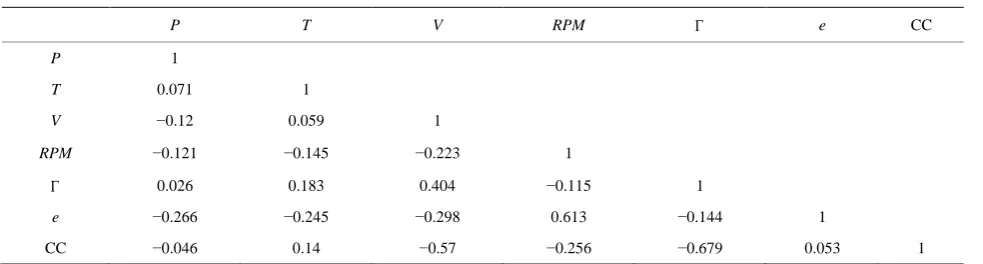
Table 2 outlines the correlation matrix between
cut-tings concentration (CC) and independent variables that effect on cuttings transport using SPSS software. Ac-cording to this table, foam quality (Γ), foam velocity (V) and pipe rotation (RPM) are more effective on cuttings transport phenomenon.
Considering the requirements of the ANN computation algorithm (better identification of parameters), both input and output data were normalised to an interval by a sim-ple transformation process. In this study, normalization of data was carried out within the range of
[
−1,1]
using Equation (1) [17],min
max min
2 1
n
p p p
p p
−
= −
− (1)
where, pn is the normalised parameter, p denotes the
[image:2.595.308.539.561.736.2]ac-tual parameter, pmin represents a minimum of the actual parameters and pmax stands for a maximum of the actual parameters. About 70% of the total data sets (60 out of 77 of the data) were selected for training and the rest for testing purposes. Several architectures comprising varied numbers of neurons in hidden layer with ABR algorithm were tried to predict cutting concentration using BPNN.
Table 1. Test matrix of cuttings transport using aqueous foam [8,9].
Value Testing parameter
5.76’’ by 3.5’’ Annular size
0, 40, 80, 120 Pipe rotation (rpm)
2, 3, 4, 5, 6 Foam velocity (ft/s)
60, 70, 80, 90 Foam quality (%)
0, 0.78 Eccentricity (-)
80, 120, 160, 170 Temperature (F)
100, 200, 250, 400 Pressure (psi)
3 Cuttings size (mm)
2610 Cuttings density (kg/m3)
Table 2. Correlation matrix between cuttings concentration and independent variables.
P T V RPM Γ e CC
P 1
T 0.071 1
V −0.12 0.059 1
RPM −0.121 −0.145 −0.223 1
Γ 0.026 0.183 0.404 −0.115 1
e −0.266 −0.245 −0.298 0.613 −0.144 1
CC −0.046 0.14 −0.57 −0.256 −0.679 0.053 1
Two criteria were employed in order to assess the effec- tiveness of each network and its ability to make accurate predictions; they are: average absolute percent relative error (AAPE) and the correlation coefficient (R) [31].
The AAPE concept gives an idea of absolute relative deviation of estimated from the measured data. It can be calculated from the following equation:
(
)
1 ˆ 1
100
N
i i
i i
y y AAPE
N = y
−
= ×
∑
(2)where, yi is the measured value, ˆyi denotes the
pre-dicted value, and N stands for the number of samples. The lowest AAPE values, the more accurate the predic-tion is.
The last measure, known as the efficiency criterion, R represents the percentage of the initial uncertainty ex-plained by the model. It is given by:
(
)
21
2
2 1
1 ˆ 1
ˆ
N
i i
i N
i N
i i i
y y R
y y
N =
=
= −
= −
−
∑
∑
∑
(3)
The best fitting between predicted and measured val-ues, which is unlikely to occur, would have RMS = 0 or R = 1. The optimal network of this study is a feed for-ward multilayer perceptron [28,29]. This network com-prises one input layer with 6 inputs (P, T, V, RPM, e, Γ) and one hidden layer with 10 neurons. Fletcher and Goss [30] suggested that the appropriate number of nodes in a hidden layer varies between ( 2 n + m) and (2n + 1), where n is the number of input nodes and m represents the number of output nodes. Each neuron has a bias and is fully connected to all inputs and employs a log-sig- moid activation function. The output layer has one neu-ron (CC%) with a linear activation function (purelin) without bias. Training function of this network is ABR algorithm (trainbr). In this study, (n = 6) and (m = 1) and thus the appropriate number of hidden layer neurons was chosen as 10 (6-10-1). Figure1 shows the BPNN archi-tecture constructed in this work.
3. Cuttings Concentration Prediction
Using MLR
Multiple linear regression (MLR) is an extension of the regression analysis that incorporates additional indepen-dent variables in the predictive equation. Here, the model to be fitted is:
1 2 2 n n
y=B +B x + + B x +e (4)
where, y is the dependent variable, xis are the
indepen-dent random variables and e is a random error (or resi-dual) which is the amount of variation in y not accounted for by the linear relationship. The parameters Bis, stand
for the regression coefficients, are unknown and are to be estimated. However, there is usually substantial variation of the observed points around the fitted regression line. The deviation of a particular point from the regression line (its predicted value) is called the residual value. The smaller the variability of the residual values around the regression line, the better is model prediction. In this study, regression analysis was performed using the train and test data employed in neural network data. The cut-tings concentration considered as the dependent variable and V, Γ, P, T, RPM and e were considered as the in-dependent variables. A computer-based package called SPSS (Statistical Package for the Social Sciences) was used to carry out the regression analysis.
4. Results and Discussion
4.1. BPNN Results
V
CC P
T RPM
e
[image:4.595.97.256.80.238.2]Γ
Figure 1. BPNN architecture (6-10-1).
output for testing phase, were n × N = 6 × 17 and m × N = 1 × 17 respectively. The correlation coefficient (R) and AAPE were used for comparison of the ANN model pre-dictions with experimental data [8,9] and the results of mechanistic model [9,16]. Figure 2 compares the pre-dicted cuttings volumetric concentration (%) and the ex-perimental values for the training data set. The correla-tion coefficient (R) to the linear fit (y = ax) is 0.993 with the AAPE value of 2.38%; describing almost a perfect fit. This indicates the fact that the training stage was done very well.
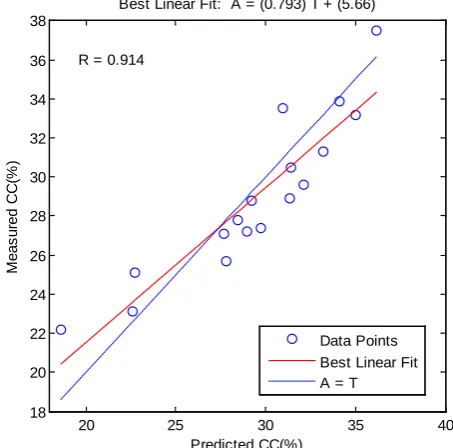
For testing stage, those data sets which were not em-ployed by the ANN model during training process were used. A comparison of the cutting concentrations pre-dicted by the network and the measured values for the test data set is shown in Figure 3. A correlation coeffi-cient (R) of 0.914 together with an AAPE of 5.93% de-scribes a very satisfactory model performance. These results verified the success of neural networks which recognize the implicit relationships between input and output variables.
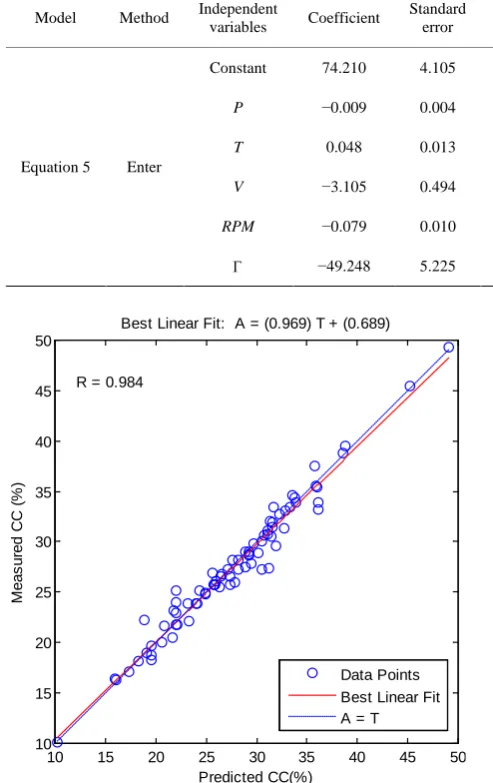
A comparison of the network predictions and the measured values for the all data sets used in this study with a population of 77 is shown in Figure4. The corre-lation coefficient (R) is 0.984 with an AAPE of 3.18%; indicating a very satisfactory model performance. These results verified the success of neural networks which recognise the implicit relationships between input and output variables.
4.2. MLR Results
Using MLR approach in SPSS software, the estimated regression relationship for cuttings concentration (CC) is given as below:
( )
CC % =74.21 0.009 0.048 3.105
0.079 49.248
P T V
RPM
− ∗ + ∗ − ∗
− ∗ − ∗Γ (5)
The statistical results of the model are given in Table
3.
[image:4.595.310.535.83.308.2]Figure 2. ANN prediction versus measured cutting concen-tration [8,9] for the training data.
Figure 3. ANN prediction versus measured cutting concen-tration [8,9] for the test data.
Cuttings concentration was estimated according to the Equations 5. Figures5 and 6 compare the MLR cuttings concentration (%) versus the experimental values for the training and test data set respectively. The correlation coefficient (R) and AAPE for train data are 0.916 and 6.5% and for test data, they are 0.84 and 7%.
A comparison of the ANN, MLR and mechanistic model [9,16] predictions with the measured values for the all data sets used in this study with a population of 77 is shown in Figure 7. The correlation coefficient (R) is
10 15 20 25 30 35 40 45 50
10 15 20 25 30 35 40 45 50
Predicted CC(%)
M
eas
ur
ed C
C
(
%
)
Best Linear Fit: A = (1.01) T + (-0.283)
R = 0.993
Data Points Best Linear Fit A = T
20 25 30 35 40
18 20 22 24 26 28 30 32 34 36 38
Predicted CC(%)
M
eas
ur
ed C
C
(%
)
Best Linear Fit: A = (0.793) T + (5.66)
R = 0.914
Data Points
[image:4.595.309.536.352.576.2]Table 3. Statistical characteristics of the multiple regression models.
Model Method Independent
variables Coefficient
Standard error
Standard error
of estimate t-value F-ratio Sig. level
Determination Coefficient (R2)
Equation 5 Enter
Constant 74.210 4.105
2.98
18.078
45.98
0.000
0.8388
P −0.009 0.004 −2.019 0.049
T 0.048 0.013 3.635 0.001
V −3.105 0.494 −6.280 0.000
[image:5.595.276.543.103.423.2]RPM −0.079 0.010 −7.665 0.000 Γ −49.248 5.225 −9.426 0.000
Figure 4. ANN prediction versus measured cutting concen-tration (%) for the all data [8,9].
[image:5.595.54.301.109.501.2]Figure 5. MLR prediction versus measured cutting concen-tration [8,9] for the train data.
Figure 6. MLR prediction versus measured cutting concen-tration [8,9] for the test data.
Figure 7. Comparison ofmeasured all datasets versus ANN, MLR and mechanistic model predictions.
0.984, 0.909 and 0.8568 for ANN, MLR and mechanistic model respectively. The AAPE values are 3.2%, 8.5% and 10.3% for ANN, MLR and mechanistic model re-spectively.
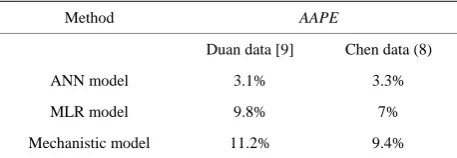
Table4 compares the results of ANN, MLR and
me-chanistic models for measured data from Duan [9] and from Chen [8]. It is well illustrated in Table4 that the
10 15 20 25 30 35 40 45 50
10 15 20 25 30 35 40 45 50
Predicted CC(%)
M
eas
ur
ed C
C
(
%
)
Best Linear Fit: A = (0.969) T + (0.689)
R = 0.984
[image:5.595.310.539.460.608.2] [image:5.595.61.288.544.705.2]Table 4. The comparison of the results of three methods.
AAPE
Method
Chen data (8) Duan data [9]
3.3% 3.1%
ANN model
7% 9.8%
MLR model
9.4% 11.2%
Mechanistic model
ANN method has high capability in prediction respect to statistical and mechanistic models.
5. Conclusion
In this study, cuttings concentration within the foam drilling in horizontal annular geometries was estimated using ANN and MLR models. The ANN presented here has three layers, namely, input layer, hidden layer and output layer. Input layer has six neurons including foam velocity, foam quality, eccentricity of annulus, subsur-face condition (pressure and temperature) and pipe rota-tion. Hidden layer has ten neurons with a log-sigmoid activation function in all neurons. Output layer has one neuron (cutting concentration, CC%) with a purelin acti-vation function. The correlation coefficients between measured and prediction values in training and testing data are 0.994 and 0.914 respectively. The AAPE values of training and testing data in ANN model are 2.38% and 5.93% respectively. A comparison of the ANN, MLR and mechanistic model was done. The results obtained from this study reveal that ANN could accurately predict the hole cleaning efficiency using foam drilling with re-spect to MLR and mechanistic models.
REFERENCES
[1] T. Zhu, L. Volk and H. Carroll, “Industry State-of-the-Art in Underbalanced Drilling,” Project Report, 1995.
[2] R. Wang, R. Cheng, H. Wang and Y. Bu, “Numerical Simulation of Transient Cuttings Transport with Foam Fluid in Horizontal Wellbore,” Journal of Hydrodynamics, Vol. 21, No. 4, 2009, pp. 437-444.
http://dx.doi.org/10.1016/S1001-6058(08)60169-9
[3] T. Nazari, G. Hareland and J. J. Azar, “Reviw of Cuttings Transport in Directional Well Drilling, Systematic Ap-proach,” SPE 132372, California, 2010.
[4] T. I. Larsen, A. A. Pilehvari and J. J. Azar, “Development of a New Cutting Transport Model for High Angle Well- bores Including Horizontal Wells,” SPE Drilling and Completion, Vol. 12, No. 2, 1997, pp. 129-136.
http://dx.doi.org/10.2118/25872-PA
[5] M. Yu, N. E. Takach, D. R. Nakamura and M. M. Shariff, “An Experimental Study of hole Cleaning under Simu-lated Downhole Conditions,” Saudi Aramco of Technol-ogy, 2007, pp. 2-16.
[6] B. V. Loureiro, R. S. de Paula and M. B. Serafim,
“Expe-rimental Evaluation of the Effect of Drillstring Rotation in the Suspension of a Cuttings Bed,” SPE Latin Ameri-can and Caribbean Petroleum Engineering Conference, Lima, 1-3 December 2010, 14 p.
http://dx.doi.org/10.2118/122071-MS
[7] M. E. Ozbayoglu, S. Z. Miska, T. Reed and N. Takach, “Using foam in Horizontal Well Drilling, a Cuttings Transport Modeling Approach,” Journal of Petroleum Science and Engineering, Vol. 46, No. 4, 2005, pp. 267- 282.http://dx.doi.org/10.1016/j.petrol.2005.01.006
[8] Z. Chen, “Cuttings Transport with Foam in Horizontal Concentric Annulus under Elevated Pressure and Tem-perature Conditions,” Ph.D. Thesis, Tulsa University, Tulsa, 2005.
[9] M. Duan, “Study of Cuttings Transport Using Foam with Drill Pipe Rotation under Simulated Downhole Condi-tions,” Ph.D. Thesis, Tulsa University, Tulsa, 2007.
[10] S. Saintpere, Y. Marcillat, F. Bruni and A. Toure, “Hole Cleaning Capabilities of Drilling Foams Compared to Conventional Fluids,” SPE Annual Technical Conference and Exhibition, Texas, 2000.
[11] A. L. Martins, A. M. F. Luorenco and C. H. M. de Sa, “Foam Properties Requirements for Proper Hole Cleaning While Drilling Horizontal Wells in Underbalanced Con-ditions,” SPE Drilling and Completion, Vol. 16, No. 4, 2001, pp.195-200.http://dx.doi.org/10.2118/74333-PA
[12] Y. Li and E. Kuru, “Numerical Modeling of Cuttings Transport with Foam in Horizontal Wells,” Journal of Canadian Petroleum Technology, Vol. 42, No. 10, 2003, pp. 54-61.http://dx.doi.org/10.2118/03-10-06
[13] Y. Li and E. Kuru, “Numerical Modeling of Cuttings Transport with Foam in Vertical Wells,” Journal of Ca-nadian Petroleum Technology, Vol. 44, No. 3, 2005, pp. 31-39.
[14] J. Capo, M. Yu, S. Z. Miska, N. E. Takach and R. Ahmed, “Cuttings Transport with Aqueous foam at Intermediate Inclined Wells,” SPE Drilling and Completion, Vol. 21, No. 2, 2006, pp. 99-107.
http://dx.doi.org/10.2118/89534-PA
[15] Z. Chen, R. M. Ahmed, S. Z. Miska, N. E. Takach, M. Yu, M. B. Pickell and J. Hallman, “Experimental study on cuttings transport with foam under simulated horizontal downhole conditions,” SPE Drilling and Completion, Vol. 22, No. 4, 2007, pp. 304-312.
http://dx.doi.org/10.2118/99201-PA
[16] M. Duan, S. Miska, M. Yu, N. Takach, R. Ahmed and J. Hallma, “Experimental Study and Modeling of Cuttings Transport Using Foam with Drillpipe Rotation,” SPE Drilling and Completion, Vol. 25, No. 3, 2010, pp. 352- 362.http://dx.doi.org/10.2118/116300-PA
[17] H. Demuth and M. Beale, “Neural Network Toolbox for Use with MATLAB,” Handbook, 2002.
[18] S. Haykin, “Neural Networks: A Comprehensive Founda-tion,” 2nd Edition, Prentice Hall, Upper Saddle River, 1999.
[19] M. T. Hagan, H. B. Demuth and M. H. Beale, “Neural network design,” PWS Publishing, Boston, 1996.
Measurements in Pipes: Part 2, Liquid Holdup and Flow Pattern Correlations,” SPE Eastern Regional Conference & Exhibition, Morgantown, 18-20 September 1995, 5 p. [21] M. E. Ozbayoglu, S. Z. Miska, T. Reed and N. Takach,
“Analysis of Bed Height in Horizontal and Highly-In- clined Wellbores by Using Artificial Neural Networks,”
International Horizontal Well Technology Conference,
Calgary, 4-7 November 2002, 7 p.
[22] E. S. A. Osman, “Artificial Neural Network Models for Identifying Flow Regimes and Predicting Liquid Holdup in Horizontal Multiphase Flow,” SPE Production & Fa-cilities, Vol. 19, No. 1, 2004, pp. 33-40.
http://dx.doi.org/10.2118/86910-PA
[23] M. E. Shippen and S. L. Scott, “A Neural Network Model for Prediction of Liquid Holdup in Two-Phase Horizontal Flow,” SPE Production & Facilities, Vol. 19, No. 2, 2004, pp. 67-76.http://dx.doi.org/10.2118/87682-PA
[24] E. M. Ozbayoglu and M. A. Ozbayogl, “Estimating Flow Patterns and Frictional Pressure Losses of Two-Phase Fluids in Horizontal Wellbores Using Artificial Neural Networks,” Petroleum Science and Technology, Vol. 27, No. 2, 2009, pp. 135-149.
http://dx.doi.org/10.1080/10916460701700203
[25] R. Ashena and J. Moghadasi, “Bottom Hole Pressure Estimation Using Evolved Neural Networks by Real Coded Ant Colony Optimization and Genetic Algorithm,”
Journal of Petroleum Science and Engineering, Vol. 77, No. 3-4, 2011, pp. 375-385.
http://dx.doi.org/10.1016/j.petrol.2011.04.015
[26] A. E. F. Monfared, M. Ranjbar, H. Nezamabadi Pour, M. Schaffie and R. Ashena, “Substantial Improvement of the Bottom Hole Circulating Pressure Prediction by the Combination of GA and ANFIS,” Energy Source Part A, Vol. 33, No. 24, pp. 2272-2280.
[27] R. Rooki, F. Doulati Ardejani, A. Moradzadeh, V. C. Kelessidis and M. Nourozi, “Prediction of Terminal Ve-locity of Solid Spheres Falling through Newtonian and Non-Newtonian Power Law Pseudoplastic Fluid Using Artificial Neural Network,” International Journal of Mineral Processing, Vol. 110-111, 2012, pp. 53-61. http://dx.doi.org/10.1016/j.minpro.2012.03.012
[28] G. Cybenko, “Approximation by Superposition of a Sig-moidal Function,” Mathematics of Control, Signals and Systems, Vol. 2, No. 4, 1989, pp. 303-314.
http://dx.doi.org/10.1007/BF02551274
[29] K. Hornik, M. Stinchcombe and H. White, “Multilayer Feed Forward Networks Are Universal Approximates,”
Neural Networks, Vol. 2, No. 5, 1989, pp. 359-366. http://dx.doi.org/10.1016/0893-6080(89)90020-8
[30] D. Fletcher and E. Goss, “Forecasting with Neural Net-works: An Application Using Bankruptcy Data,” Inform Manage, Vol. 24, No. 3, 1993, pp. 159-167.
[31] SPSS Inc., “PASW® Statistics 18 Core System User’s Guide,” 233 South Wacker Drive, 11th Floor Chicago, IL60606-6412, 1993.
Nomenclature
AAN: Artificial neural network
AAPE: Average absolute percent relative error (%) BPNN: Back Propagation neural network
E: Offset distance between the centers of the inner tube and outer tube e: Eccentricity of annulus (-)
MLR: Multiple linear regression P: Pressure (psi)
R: Correlation coefficient (-) Ri: tube radius (in)
ROP: Rate of penetration (ft/hr) RPM: Pipe rotation (rpm) T: Temperature (°F) V: Foam velocity (ft/s)
Greek Letters
Γ: Foam quality (%)
SI Metric Conversion Factors
ft × 0.3048 E + 00 = m in × 25.4 E − 03 = m psi 6.8948 E − 03 = MPa
![Table 1. Test matrix of cuttings transport using aqueous foam [8,9].](https://thumb-us.123doks.com/thumbv2/123dok_us/7980446.756564/2.595.308.539.561.736/table-test-matrix-cuttings-transport-using-aqueous-foam.webp)