International Journal of Emerging Technology and Advanced Engineering
Website: www.ijetae.com (ISSN 2250-2459,ISO 9001:2008 Certified Journal, Volume 5, Issue 7, July 2015)
336
Multi Tier Web Application and Internal Database Security by
Double Guard
Shyam A. Gade
1, Prof. M. B. Vaidya
21Student, 2Asst. Prof., AVCOE, Sangamner, India
Abstract— This framework averts these kind of assaults and keep the client account from intruders from hacking. By utilizing IDS it can give security to both web server and database server utilizing mapping of sender request and the query from web server to database.
This frame work is capable to detect the assaults that past intrusion detection system was not able to do. This framework or system does this work by segregating the stream of data from every web serer session.
It evaluates the discovery exactness when system endeavor to model static and dynamic web request and queries. Also this system demonstrates that this remained true for dynamic request where both recovery of data and overhauls to the back end database happen utilizing the web server front end.
Keywords —Intrusion Detection, Direct Database Attack, SQL Injection Attack, Brute Force Attack, Privileged Escalation Attack, Session Hijack.
I. INTRODUCTION
A. Pitfalls in current models.
1.In current model database server and web server both may be come into attack.
2.These attacks generally come though the network and
web customer. They can dispatch application layer assaults to bargain the web server they are joining. 3.The assailants can side step the web server to
specifically assault the database server.
4. Attacker may assume the control over the web server after the attack and that subsequently they can get full control of web server to dispatch consequent attack. E.g. Attacker spy of seize other clients web demand or block or alter the database quires to steal information past.
B. New Proposed System
Some past methodologies have identified interruption or vulnerability by statically dissecting the source code or executable. Others dynamic track the database stream to trade off degenerate spread and recognize interference. New container based web server construction modeling empowers us to isolate the diverse data stream by every session, in double guard effectively. Splitting down or analyzing the server code or any application rational or logic, is not needed in our concept.
For the static web page double guard guarding methodology does not require application logic for building a model, as we examine in spite of fact that we don‟t require the full application logic for dynamic web administration.
C. Proposed System Benefits
1. Different type of attack can be detected with effective manner by this proposed system.
2. It considers both traffic web server and database server to create casual mapping profile.
3. It detect wider range of attack since intrusion sensor are more precise normality model, and provide good feature of anomaly detection.
4. This system differentiates the information or dataflow from every session so that it remains lightweight.
D. Issues in Current System
Many intrusion detection systems analyze and examine the network package individually in web server and database server. There is also less detailed work is done for multitier attack detection. Where these kind models analyze the behavior of both database and web server intervals.
In these multilayer models, backend database is protected by firewall but web server is accessible to the internet. In this way through database is not attack directly by remote internet attack but it may be attack through by the web server which is remotely accessible to attacker. For this purpose to protect multitier web services an effective intrusion detection system was required which can be preventingthe traffic which is misused by attacker
.
II. RELATED WORK
A.Knowledge based Intrusion Detection System
Current exist intrusion detection and prevention system are signature based framework which recognized the dangers and vulnerabilities by cross referencing, which are stored in their database [1]. These frameworks are unequipped for exploiting.
International Journal of Emerging Technology and Advanced Engineering
Website: www.ijetae.com (ISSN 2250-2459,ISO 9001:2008 Certified Journal, Volume 5, Issue 7, July 2015)
337
B. Attack Alerts.
Intrusion detection system can be grouped into two parts on basis of their working principle
i) Anomaly detection ii) Misuse detection
In anomaly detection system feature, right and adequate static structure of dynamic behavior should be defined. This will help to determine the unusual changes in the framework [2].Acceptable and anomalous forms are previously defined. This kind of model is built on historical data analyzing [5] or it may be using rule based considerations which express the behavior patterns.
Such kind of intrusion detection system compare the real information traffic pattern with the previously stored anomaly pattern, for recognize the abnormal pattern.
Our model is based on anomaly detection and used the training phase to build the correct model.
Intrusion alert correlation [4] is component integration which transform intrusion sensor alert into intrusion which are succinct which help to minimizing the replication of same alert and non-relevant alert. It also melds the cautions from distinctive levels depicting a solitary attack.
Our model is not the same as this model which is worked on connection alarms, created by distinctive IDS creates cautions which is without associating to various alarms, created in diverse session. Our approach is also not dependent upon time therefore it avoid alert which generated simultaneously may not be detected one or two of them. If we considers that events which are independent but are concurrent , since it uses the container ID to each separate traffic and separate session no, our model have not any constraint to impact if assault are happen simultaneously or not.
C. Taint Process and IDS
Some past methodology have recognized interruption or vulnerabilities. Other rapidly tracks the data stream to get it. Some intrusion detection system arbitrarily search the data traffic flow to recognized the spoil propagation and detect intrusion.
In our framework container based web server structure allow us to different session. This keeps the track for information of each session from web server to database server. It is not needed to know about application logic or analyzing source code in static page building logic or application logic. For dynamic web page also same logic is true for web services.
Also not need to know what will user operation to find out normal behavior of model.
For prevention SQL or XSS injection attack, acceptance of input is very useful [6], [8]. This is additional defense of input validation in our approach.
In our approach SQL injection attack is found by analyzing the web request and database query Structure without looking is into input parameters.
D. lightweight Virtualization
Virtualization [2] is utilized to separate protest and improve security execution. Full virtualization and Para virtualization are by all account not only the methodology being taken. An another option is open virtualization such as open VZ[9], Linux-Vserver or parallels virtuozzo[7].
These are view or something to that affect or container idea. Yet it running in a separated environment.
In 1999 S. Mangesh Kumar , E Anbalagon and Dr. Siva subromanin show point of interest over full virtualization or Para virtualization on single physical host large no of container can be run. Some kind of system also [1] that uses the light weight virtualization to different application instance. These kinds of situation are generally used for isolation and containment assaults.
But in our tech we are giving separate identification no. to all session traffic, to determine of casual relationship in between web server and database query request.
E. Clamp Architecture
Clamp [10] is frame works which prevent the data leaks attack even if it is surrounded by attack. It isolates the code at web server layer and data at the database layer. Clamp also give surety to user that his sensitive data not got by other, but in our approach we focuses mapping between web request and database queries to identify the malicious user container session. There is also difference between our model and clamp model inters to requirement and focus.
Existing application code is modified by clamp and query restrictor behaves as a proxy to handle the all database query. Our framework does the process separation and clamp demands platform virtualization. More coarse grained segregation is obtained by clamp than double guard.
If course grained isolation is used in double guard as clamp the double guard become ineffective. Our approach requires more and more no of separated instance for mapping pattern would be appear
III. ATTACK SCENARIO
International Journal of Emerging Technology and Advanced Engineering
Website: www.ijetae.com (ISSN 2250-2459,ISO 9001:2008 Certified Journal, Volume 5, Issue 7, July 2015)
338
A. Brute force Attack
This is the password assaults that does not decode any data however proceed with to attempt. Dictionary of all word is the one of brute force attack.
For login attacker try to used password, he makes try to use all kind of word to try and error basis. There is another option also available in to brute force attack i.e. a program which use the all number or letter till it match. This kind of attacker can be getting success within hours and day or month even they required some year also.
[image:3.612.314.578.140.310.2]The time require to detect original password or match original password is depend upon how much the original password is complex and attacker is aware about the password sender or target. To prevent or avoid brute force attack large number of system allow the user to enter into system with wrong password by entering mistake three to four time after that system may be block or denied to all kind of user for set amount of time.
Fig 1. Brute force Attack
B. SQL Injection Attack
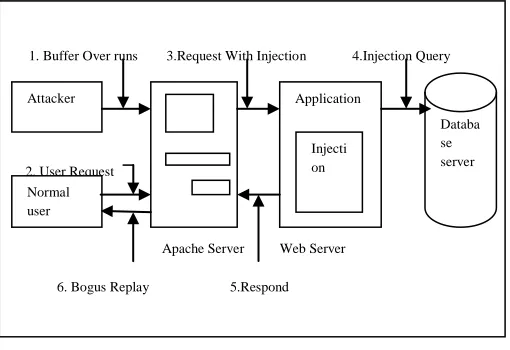
[image:3.612.50.301.354.508.2]This is such kind of attack which does not require trading of the web server. Here the attacker utilize the existing vulnerabilities in the web server rational for infuse the contents abuses and then use web server to transfer these misuses attack to back end database.
Fig 2. SQL Injection Attack
C. Hijack future Session Attack
The third party individual gets to the username and password of typical person or client and abuses them.
Figure shows how this attack end adored by center attacker
Fig 3. Hijack future Session Attack
In voyaging, banking individual accounts these sorts of assaults will be happened to get the individual data or typical client. But in our approach this is not possible. Since every individual will get separate his/her own session which no one can get it to. Therefore by double guard we can avoid such kind of attack
.
Give many time user ID and password Request for login
Display main page Retrieve main Page
Attacker (Many User ID and password)
Web Server
Database
1. Attacker request as 2.Request with Injection 3.Injection Queries Normal User
Apache server Web Server
6. Privileged Information 5.Privileged information 4.Previleged respond Response
Attacker
Apache server
Application
Databas e Server Injec
tion
1. Buffer Over runs 3.Request With Injection 4.Injection Query
2. User Request
Apache Server Web Server
6. Bogus Replay 5.Respond Attacker
Normal user
Application
Databa se server Injecti
[image:3.612.320.575.407.582.2]International Journal of Emerging Technology and Advanced Engineering
Website: www.ijetae.com (ISSN 2250-2459,ISO 9001:2008 Certified Journal, Volume 5, Issue 7, July 2015)
339
D. Direct Database Attack
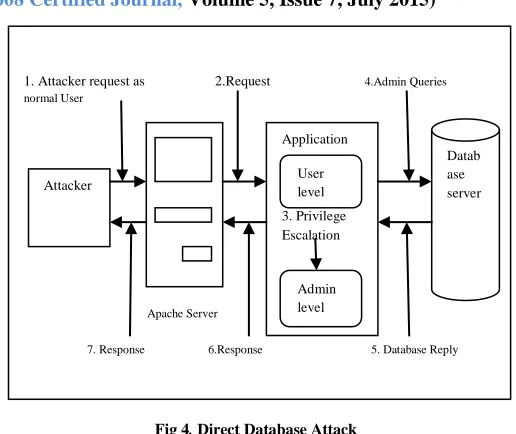
[image:4.612.316.574.124.341.2] [image:4.612.46.303.250.434.2]By passing the web server or firewall join straightforwardly to the database. Some attackers do the direct database attack. Attacker may be control over web server and sent such kind of queries from it that web request generating. Our approach can be detect such kind of attack by matching web request to the database request if such web request is not found for database queries then such attack can be detected.
Fig 4. Direct Database Attack
E. Privilege Escalation Attack
The attack demonstrates how the attacker can get to the adman‟s credentials and go as administrator in the frame work. The attackers get the administrators client id and give the order to the web server to get the private database of client.
Assume that attacker login into web server as an ordinary client and trigger administrator queries to get the client related information or data. This sort of attack can never distinguish by the IDS or by typical intrusion detection technique.
As our frame work will be allotting the diverse session for distinctive client we can without much of a stretch identify this sort of attack.
Fig 4. Direct Database Attack
IV. ARCHITECTURE
In network all traffic from both genuine client or user and enemies gotten intermixed at same web server. If any attacker can take control over to web server then he/she can be control all the next session
It will not realistic to assigning every session to dedicate server as it exhaust the web server assets. For maintaining the low performance and resource overhead we are going to utilize lightweight virtualization.
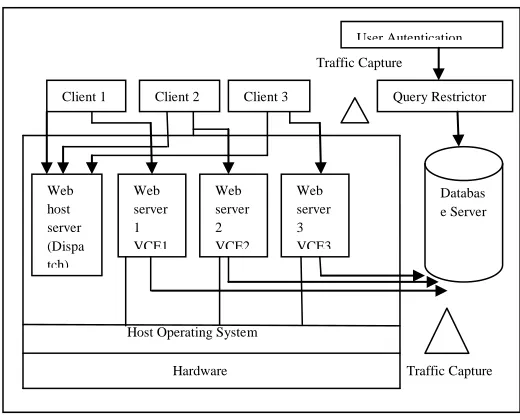
In our structure we are utilizing the process container we are called it as „container‟ which can be dispose easily client session. Such type of many containers can be possible to initialize on a single machine. Main feature of these containers is that, this type container can be close easily or we can reinitialize easily when required or it also can be reverted.
Many containers run as a single web server which is exact copy of original web server. Our frame works dynamically created these containers and also reuse the used one. Due to this physical alone machine work continuously and give service to each and all web request. By passing the web server and sending queries
2. Request 3.User Queries
1. User Request
Apache server Web Server
6. User Response 5.Responce 4.Query Response Attacker
Normal user
Application
Databa se Server
1. Attacker request as 2.Request 4.Admin Queries normal User
Apache Server
7. Response 6.Response 5. Database Reply
Attacker
Application
3. Privilege Escalation
Datab ase server User
level
International Journal of Emerging Technology and Advanced Engineering
Website: www.ijetae.com (ISSN 2250-2459,ISO 9001:2008 Certified Journal, Volume 5, Issue 7, July 2015)
340 Logically each session on the web server is utilized detected web server and it is also separated from other session. Since each virtualization container utilizing a read just clean format we can give surety that every session will be presented with clean web server. We will think different communication with each session. So that one client always deals the same web server. Session can be different to different user and every session communicates to same dedicated web server.
If we found that any session is behave as abnormal then we can conclude that data traffic in that session should be compromised. It vanilla web server is compromised with attacker then other communication may also be affected. In our concept if attacker can possible to break the security in one container then it remain only within that container or session, it does not able to communicate or compromise the other session.
[image:5.612.307.564.136.348.2]Thus we can give guarantee that legitimate session not become hijacked or compromised.
Fig 6. Classical Architecture
From above the figure at the database side, we are not able to advice which exchange or which request compare to which customer solicited. Correspondences between the web server and database server are not isolated and we can scarcely understand connection among them.
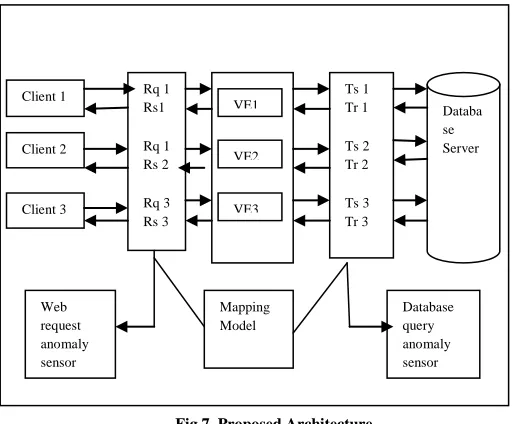
[image:5.612.48.295.357.531.2]From next figure it is shown how correspondence are sorted as session and how database exchange can be identified with a relating session. By the concept of three tire architecture, if client 2 is malicious and assume control over the web server all consequent database exchange get to be suspect and also the reaction to the customer by different as per the figure of the web server case running in container client 2 will be just trade of the VE2 and relating database exchange set 2 will be the main influenced area of data inside of the database.
Fig 7. Proposed Architecture
V. NORMALITY MODEL BUILDING
It is isolated and container based web server model not only provide good security but also provide us the with separated data stream are isolated in every container session. It permits us to distinguish the mapping between the web server demand and consequent DB queries and to use such mapping model to recognize unusual practice on a session/ customer level. In normal three tire architecture web server building design the web server get HTTP request for from client, customer and afterword issue SQL queries to the database server to recover and overhauls information. These SQL queries are casually related on web server. We need to model such causal mapping relationship of all legitimate true activity in order to recognize strong or attacker traffic. Practically speaking we are not fabricated such mapping under a classical three tire architecture.
Despite the fact that web server can recognize session from diverse customer. The SQL queries are blended and all from web server. It is incomprehensible for a database server figure out which SQL queries are result of which web request, significantly less to discover the relationship between them. Regardless of the possibility that we know the application logic of web server and were the fabricate correct model, It will difficult to utilized such a model to identify attack with in larger amount of huge traffic movement unless we had a system to recognize pair of HTTP request and SQL queries that are casually produced by the HTTP request.
Rq1 Rs1 Rq2
Rs2 Rq3
Rs3 Client S1
Client S2
Client S3
Web Server
Database Server
Database Query Database Query
Client 1 Rq 1 Rs1
Rq 1 Rs 2
Rq 3 Rs 3
Databa se Server Ts 1
Tr 1
Ts 2 Tr 2
Ts 3 Tr 3 Client 2
Client 3
VE1
VE2
VE3
Mapping Model Web
request anomaly sensor
International Journal of Emerging Technology and Advanced Engineering
Website: www.ijetae.com (ISSN 2250-2459,ISO 9001:2008 Certified Journal, Volume 5, Issue 7, July 2015)
341 Nonetheless inside our container based web server it is clear matter to distinguish the causal sets of web request and coming about SQL queries in a give session. In session traffic is also separated in this model. Different request and queries in the session can be compare and analyze.
In next further section we will again talk about how to construct mapping by profiling session mapping. To that end we will put sensors at the both ends of the server. At the web server our sensor are conveyed on the host framework and can‟t be attacked and we are assume they always capture correct traffic information from both side as we build the model we can used for to find out the abnormal behavior accordance with our model both the web request and database query should be remain. If one of the web request or any database query which is not obey the our normality model within session then that session should be harmful and should be treated as a conceivable assaults.
VI. TECHNIQUE
Because of the different usefulness diverse web application show distinctive qualities, a few sites permits normal clients with the non-authoritative benefits to the upgrade the content of the server information. This makes the challenges for IDS framework on the ground that the HTTP request can contain variable value in both HTTP request, protecting the structure of the request and queries. Consider the session an arrangement of request (Ri) and additionally arrangement of queries (Qi). If all the training phase session is N no. then we have the arrangement of the aggregate web request (REQ) and the arrangement of total aggregate SQL queries (SQL) across all session. Every single web request rm REQ might likewise seem a few times in divers Ri where i=1,2……..N. the same remain constrain for qn SQL we group the four conceivable mapping examples.
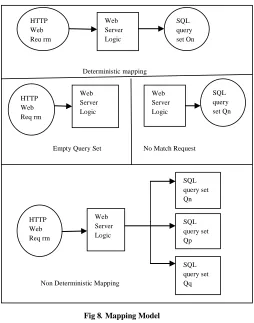
Since the request is the root of information stream, we regard every request as the mapping source. The mapping is one of from the request to query set from rmQn. The conceivable mapping examples are deterministic mapping, empty query set, no match request and non deterministic mapping.
SQL query set Qn
[image:6.612.322.576.137.460.2]HTTP Web Req rm
Fig 8. Mapping Model
VII. DISPLAYING FOR STATIC AND DYNAMIC WEBSITES
An account of static website, non deterministic mapping does not exist as there are no accessible input variable or state for static content. We can surely integrates the traffic gather by sensors from 1 to N for each rm REQ we keep up a set A rm to record the IDS of session in which rm shows up. The same keep true for database queries. We find out the AQs that equal the A rm. At the place when Arm =AQs this shows that each time rm shows up in a session, then qs will likewise show up in the same session and the other way around.
Some web requests that are independently are still present as a unit.
Deterministic mapping
Empty Query Set No Match Request
Non Deterministic Mapping
HTTP Web Req rm
SQL query set Qn Web
Server Logic
HTTP Web Req rm
Web Server Logic
SQL query set Qn Web
Server Logic
HTTP Web Req rm
Web Server Logic
SQL query set Qn
SQL query set Qp
International Journal of Emerging Technology and Advanced Engineering
Website: www.ijetae.com (ISSN 2250-2459,ISO 9001:2008 Certified Journal, Volume 5, Issue 7, July 2015)
[image:7.612.315.575.228.438.2]342 Rather than static page, dynamic site page permit client to produce same web request with diverse parameter moreover dynamic pages regularity utilized POST instead of GET technique to confer client input. In view of the server application logic diverse input would be bring about distinctive database queries. By setting each rm or the arrangement of related request rm in isolated session with a wide range of possible inputs we acquire the same number of candidates request set {Qn, Qp,Qq……..}as would be prudent. This mapping models both deterministic and non deterministic mapping and set EQS still used to hold static record demand
Fig 9. Deterministic mapping utilization session ID of the container
VIII. EXECUTION EVALUATION
Web server and back end database are the main prototype in our implementation. Static and dynamic website we utilize for testing. We break down three class of attack and measured the false positive rate for each of the two web sites. For different set of user finally we compared client for behavior each session. Following is the representation of execution of our model and attack recognize rate. In our model we make such adjustment like assign or use every user session to isolated holder as point of security. The session time out is thought to be 30 moments.
In this way we are fit for running different case in a solitary server. The beneath figure portrays the building design and session administration of our model, where the host web server goes about as the dispatcher.
On account of static web site, we served 15 interesting pages and gathered genius traffic to this site and acquired 350 client session on account of dynamic sites the sites guest are permitted to person post and remark on article.
Fig10. Overall architecture of our prototype
IX. RESULT AND TEST
The main aim of this paper was to be come close and avert the interruption in multitier web use of the client, in front end (HTTP web request) and back end database (SQL queries).One of imperative thing in security will be the distinguish attack while web server will be continuously assaulted by the aggressor.
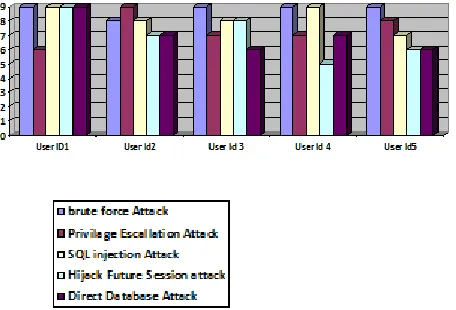
We have test the approach by constantly assaulting the web server. For this reason we have consider pool of 10 assaults are performed by every client. Five clients constantly assault the web server i.e. in every pool among the four assaults each assaults is performed on 10 times.
We can determine these assaults
in taking after following number of times. Traffic Capture
Host Operating System
Hardware Traffic Capture
Session 1
(VE1)
Session 2 (VE2)
Session 3 (VE3)
Session 4 (VE4)
Session 5 (VE5) HTTP
Web reques t Req A
HTTP Web Req B
SQL query X
SQL Query Y
Client 1 Client 2 Client 3 Query Restrictor
Databas e Server Web
host server (Dispa tch)
Web server 1 VCE1
Web server 2 VCE2
Web server 3 VCE3
International Journal of Emerging Technology and Advanced Engineering
Website: www.ijetae.com (ISSN 2250-2459,ISO 9001:2008 Certified Journal, Volume 5, Issue 7, July 2015)
343
A. Data Set
User ID Brute Force Attack
Privilege Escalation
Attack
SQL Injection
Attack
Hijack Future Session
Attack
Direct Database
Attack
1 9 6 7 8 7
2 8 9 7 7 8
3 9 8 8 9 7
4 9 7 8 5 6
[image:8.612.43.296.144.334.2]5 9 7 6 7 6
Fig. user to data relation
B.Results
JAVA is used for algorithm implementation. For test we utilized Pentium IV (CPU 2.50 GHZ and 4 GB Ram) and My SQL database by considering the most extreme of 10 iteration and independent test runs
.
Figure 1 User to Data Relation
X. CONCLUSION
For three tier architecture we model intrusion detection system which builds a normality model. This kind of approach is container based approach and it accepts many inputs simultaneously and give alert if given input is attack type. Also light weight virtualization technique is utilized to assigning session ID for different container. This different container is nothing but differentiated virtual computing environment to each web query and web request. By using this model we could easily identified attack like brute force attack, SQL injection attack, direct database attack, future session hijack attack, and privilege escalation attack. We could also generate and also prepare log report of such kind of attack and also block if require such kind of virtual environment and session ID.
REFERENCES
[1] A Knowledge-Based Approach to Intrusion Detection Modeling Sumit More, MaryMatthews, Anupam Joshi, Tim Finin Computer Science and Electrical Engineering University of Maryland, Baltimore County Baltimore, MD, USA fsumitm1, math1, joshi,[email protected]
[2] Anomaly Detection of Web-Based Attacks. C. Kruegel and G.Vigna Proc. 10th ACM Conf. Computer and Comm. Security (CCS ‟03), Oct. 2003
[3] Y. Huang, A. Stavrou, A.K. Ghosh, and S. Jajodia. Efficiently tracking application interactions using lightweight virtualization. In Proceedings of the 1st ACM workshop on Virtual machine security, 2008.
[4] F. Valeur, G. Vigna, C. Kr¨ugel, and R.A. Kemmerer. A omprehensive approach to intrusion detection alert correlation. IEEE Trans. Dependable Sec. Comput, 1(3), 2004.
[5] H. Debar, M. Dacier, and A. Wespi, “Towards a Taxonomy of Intrusion- Detection Systems,” Computer Networks, vol. 31, no. 9, pp. 805-822, 1999.
[6] Intrusion Detection and Prevention System: SQLInjection Attacks Varian Luong San Jose State University
[7] Virtuozzo containers. http://www.parallels.com/products/pvc45/. [8] Greensql. http://www.greensql.net/.
[9] Openvz. http://wiki.openvz.org.
[image:8.612.52.280.415.570.2]