R E S E A R C H
Open Access
Approximate equiangular tight frames for
compressed sensing and CDMA applications
Evaggelia Tsiligianni
1, Lisimachos P. Kondi
1*and Aggelos K. Katsaggelos
2Abstract
Performance guarantees for recovery algorithms employed in sparse representations, and compressed sensing highlights the importance of incoherence. Optimal bounds of incoherence are attained by equiangular unit norm tight frames (ETFs). Although ETFs are important in many applications, they do not exist for all dimensions, while their construction has been proven extremely difficult. In this paper, we construct frames that are close to ETFs. According to results from frame and graph theory, the existence of an ETF depends on the existence of its signature matrix, that is, a symmetric matrix with certain structure and spectrum consisting of two distinct eigenvalues. We view the construction of a signature matrix as an inverse eigenvalue problem and propose a method that produces frames of any dimensions that are close to ETFs. Due to the achieved equiangularity property, the so obtained frames can be employed as spreading sequences in synchronous code-division multiple access (s-CDMA) systems, besides compressed sensing.
Keywords: Equiangular unit norm tight frames, Signature matrix, Compressed sensing, Spreading sequences
1 Introduction
Recent theoretical and practical results in mathematics, computer science, and engineering highlight that frame theory is fundamental in many research areas, and frames are useful in numerous applications requiring redundancy [1]. Among all frames, equiangular unit norm tight frames (ETFs) have a special structure that makes them particu-larly important in many fields like signal processing [2, 3], quantum information theory [4, 5], and communications [6–9].
From a geometrical perspective, an ETF is a set of unit norm vectors in a Hilbert space forming equal angles, therefore, having identical correlation, which is also the smallest possible [6]. Besides small column correlation, ETFs exhibit row orthogonality, a property known as tightness. These properties are important when consider-ing overcomplete spannconsider-ing systems, as they lead to frames that are close to orthonormal bases. However, ETFs either do not exist for arbitrary frame dimensions or their con-struction is difficult [6, 10], thus, in many problems, closely related frames are used as substitutes.
*Correspondence: [email protected]
1Department of Computer Science and Engineering, University of Ioannina,
Ioannina, Greece
Full list of author information is available at the end of the article
According to well-known results from frame and graph theory [6, 7], an equiangular frame can be defined up to unitary equivalence by its so called signature matrix. Considering real equiangular frames, the corresponding signature matrix is a symmetric matrix with zero diagonal and±1’s off-diagonal entries, and it can be thought of as the Seidel matrix of a graph. It is known that the signature matrix corresponding to a real ETF has exactly two dis-tinct eigenvalues [7]. Therefore, the problem of designing an ETF can be reduced to an inverse eigenvalue problem, that is, the construction of a matrix with specific structure and spectrum consisting of two distinct eigenvalues.
Many signature matrices that correspond to ETFs are known and constructions of ETFs based on signature matrices have been proposed in [6]. These techniques impose certain restrictions on frame dimensions. In this paper, we consider frames of arbitrary dimensions and construct a symmetric matrix with spectrum that approximates the spectrum of the corresponding signa-ture matrix. The obtained matrix is then used for the construction of frames that are close to ETFs. The pro-duced frames are almost tight, with frame vectors forming angles that approximate the optimal value.
Small column correlation as well as tightness are impor-tant when designing sensing matrices for compressed
sensing (CS) [11, 12]. CS is a new acquisition tech-nique for sparse signals that can reduce the sampling rate drastically, as long as the matrix implementing the sens-ing mechanism satisfies the aforementioned properties. These properties play an important role in the perfor-mance of the numerical algorithms deployed to recover sparse signals [13]. Therefore, any improvement concern-ing the sensconcern-ing matrix results in higher reconstruction accuracy and reduction of the number of necessary mea-surements.
Tight frames are considered the best candidates when designing spreading sequences in code-division multiple access (CDMA) systems. Equal norm tight frames [14], also known as Welch bound equality (WBE) sequences [15], are considered capacity optimal spreading sequences and minimize the interference experienced by the indi-vidual users. However, it was shown in [9] that when the number of active users in the system changes, only ETFs result in the same interuser interference. Our sim-ulations show that if an ETF construction is not avail-able, nearly equiangular nearly tight frames can reduce interuser interference substantially when used as spread-ing sequences.
The rest of the paper is organized as follows: Section 2 reviews some results of frame theory and the connection of frames to graphs. In Section 3, we present two algo-rithms for constructing signature matrices, which we use to obtain nearly equiangular frames. In Section 4, we use the proposed frames as sensing matrices for compressed sensing and spreading sequences for synchronous CDMA systems. Conclusions are drawn in Section 5.
2 Frames review 2.1 Finite frames basics
A finite frame in a real or complexm-dimensional Hilbert space Hm is a sequence ofN ≥ mvectorsfk
N k=1, fk ∈
Hm, satisfying the following condition
αf22≤ lower and upper frame bounds, respectively. Them×N matrixF =[f1f2 . . .fN], with columns the frame vectors
fk, is usually identified with the frame itself.
The following notions are related to a framefk
N k=1[1]:
(a) The ratioρ=N/mis referred to as the redundancy
of the frame and is a “measure of overcompleteness” of the frame.
(b) Whenα=β, we say that the frame isα-tight.
(c) A frame is called uniform or equal norm, when
fk=C,C>0, for allk∈ {1,. . .,N}, and unit
norm, whenfk=1for allk∈ {1,. . .,N}.
(d) For a unit norm frame, the absolute value of the inner product between two frame vectors equals the cosine of the acute angle between the lines spanned
by the two vectors. If there is a constantc>0for
which|fk,f| =c,k=, then the frame is called
equiangular.
An important operator of frames is the Grammian oper-ator [1]. The matrix representation of the Grammian of a frame is called the Gram matrix. The Gram matrix is the N×N matrixR = F∗F, whereF∗denotes the conjugate transpose ofF. It is known [1] thatFis anm×Nframe if and only if the Gram matrix is a self adjointN×N pro-jection with rankm. FramesF= {fk}N
k=1andG= {gk}Nk=1 are unitarily equivalent, if there is a unitary transforma-tionU:Hm→HmwithF=UG:= {Uf
k},k∈ {1,. . .,N}.
A frame is determined by its Gram matrix up to unitary equivalence. family, each with norm √α. It follows immediately that FF∗ =αIm, whereImis them×midentity matrix.
Con-sidering the spectral properties of an α-tight frame, the following proposition summarizes well-known results.
Proposition 1(Spectral properties of tight frames [1]) A frame is α-tight if and only if one of the following conditions holds:
(a) The non-zero eigenvalues of the Gram matrix equal
α.
(b) The non-zero singular values of F equal√α.
(c) The spectral norm of F equals√α.
Constructing a tight frame is straightforward; we take an orthonormal basis and select the desired number of rows. For example,m×N harmonic tight frames are obtained by deleting(N−m)rows of anN×NDFT matrix.
2.1.2 Unit norm tight frames
Theorem 1([16])If{fk}Nk=1is a finite unit normα-tight
frame for an m-dimensional Hilbert spaceHm, thenα = N/m.
Therefore, a UNTF in a finite dimensional space is an m×Nmatrix such that (a) the rows are orthogonal, (b) each row has norm√N/m, (c) each column has norm 1. The spectral properties of a UNTF are obtained by Propo-sition 1 by settingα = N/m. The value of the spectral norm of a UNTF is the lowest possible bound form×N frames and is often used as a measure of how close a given frame is to a UNTF.
2.1.3 Equiangular tight frames
When a unit norm tight frame has vectors forming equal angles, we obtain an equiangular tight frame. ETFs exhibit equal column correlation, which is also the smallest pos-sible [6]; thus, they are maximally incoherent equiangular frames. ETFs are arguably the most important class of finite-dimensional frames, and they are the natural choice when one tries to combine the advantages of orthonormal bases with the concept of redundancy provided by frames. The maximal correlation between different normalized frame vectors, also known as mutual coherence, is defined as μ(F) = max1≤k,≤N
k= |fk,f|. Mutual coherence is bounded according to
μ(F)≥ N−m
m(N−1), (3)
which is referred to as Welch bound [6]. Equality holds, if and only if F is an equiangular tight frame [6]. As unit norm tight frames with dimensionsm,N exist for a specific tightness parameter (α = N/m), an ETF is an equiangularN/m-tight frame.
Despite their important properties and their numer-ous practical applications, there is no explicit way of constructing ETFs. This problem is connected with other important problems such as packings in Grass-mannian spaces and antipodal spherical codes. It has also connections to graph theory, equiangular line sets, and coding theory. The techniques reported in [3, 6, 17–19] construct only a few of the existent frames.
2.2 Connection between ETFs and graphs
Studies concerning the connection of frames with graphs have shown that the existence of an ETF in a real Hilbert space depends on the existence of a matrixQwith zero diagonal and±1’s off-diagonal entries. This matrix cor-responds to the Seidel matrix of a special type of strongly regular graphs [6]. Recall that the Seidel matrix of a graph withN vertices is anN ×N matrix with the(i,j)entry defined to be 1 if theiandjvertices are adjacent,−1 if the
iandjvertices are not adjacent, and 0 ifi=j. From [6, 7] we obtain the following definition.
Definition 1Given an m×N ETF F=[f1f2 . . .fN], the
Gram matrix can be written in the form
R=I+cQ, (4)
where I is the N ×N identity matrix and c is the Welch bound given by(3). The N×N matrix Q, is known as the signature matrix of the frame F.
The main results about signature matrices are summa-rized in the following theorem.
Theorem 2([7]) Let Q be a self-adjoint N×N matrix, with qi,i = 0for all i andqi,j= 1for all i=j. Then the
following are equivalent:
i. Q is the signature matrix of anm×NETF.
ii. Q2=(N−1)I+νQfor some necessarily real
numberν.
iii. Q has exactly two distinct eigenvalues, denoted as
λ1< λ2.
When any of the above conditions hold, the parame-tersm,N,ν,λ1,λ2are related with certain equations [8], implying that for many values ofm,N ETFs do not exist. It can be shown that [19]
λ1= −
m(N−1)
N−m , with multiplicityN−m,
λ2=
(N−m)(N−1)
m , with multiplicitym. (5)
According to [7], there are finitely many possibleN× N signature matrices and finitely many real equiangular frames ofNvectors. For more details about the connec-tion between graphs and frames, the reader is referred to [6–8, 19, 20].
3 Construction of nearly equiangular frames 3.1 Previous work and our contribution
When designing a frame, the design specifications arise from the application of interest. As a result, there exist a large number of construction methods, as diverse as the applications requiring a frame. Usually, the constructions that come to address specific requirements are difficult to generalize to solve different types of frame design prob-lems. On the other hand, more general constructions [3, 6, 17–19, 21] impose certain restrictions on the frame dimensions.
of algorithms that produce incoherent frames has been developed in the latest years [22–30]. Most of the exist-ing algorithms are inspired by the work of [17] and are based on a “shrinkage” operation on the Gram matrix. For example, the algorithm proposed in [22] starts from an arbitrarym×Nframe that has full rank, and sequentially “shrinks” the absolute values of the off-diagonal entries of the Gram matrix in order to reduce frame’s column corre-lation. Then, truncated SVD is used to obtain a frame with rankm.
Our motivation in frame design originates from the application of incoherent frames in sparse recovery and compressed sensing. However, in contrast to the existing methods that operate on the absolute values of the Gram matrix entries, the method proposed here is inspired by the results presented in Theorem 2 and aims at finding the right signs of these entries. While the approach in this paper involves some operations on the Gram matrix, the proposed methodology is based on the construction of an appropriate “signature” matrix. Compared to exist-ing algorithms that produce incoherent frames, that is, frames exhibiting small maximum column correlation, the proposed frames not only exhibit small column cor-relation but the degree of corcor-relation between different pairs of columns is similar. Thus, the obtained frames are approximately equiangular.
Before proceeding, we need to define the signature matrix of an arbitrary real frame. Suppose we are given an ETF with dimensions m, N. From Eq. (4) we see that we can derive the N × N signature matrix from the corresponding Gram matrix by keeping the signs of the off-diagonal entries and zeroing the diag-onal. In the same manner, we can obtain an N × N symmetric matrix with ± 1’s off-diagonal entries and zero diagonal from the Gram matrix of an arbi-trary m×N frame. Therefore, we obtain the following definition.
Definition 2The signature matrix Q of an arbitrary m×N real frame F =[f1f2 . . .fN]is the N×N matrix
with entries derived from the corresponding Gram matrix, R=FTF, according to
qij=
sgn(rij), i=j,
0, i=j, (6)
where rijis the(i,j)entry of R.
Obviously, the eigenvalues of an arbitrary signature matrix do not satisfy (5).
According to Theorem 2 the construction of anm×N ETF reduces to finding the correspondingN×Nsignature matrix. Therefore, if we construct a signature matrix that approximates the signature matrix of an ETF, using Eq. (4), we can obtain a frame that is close to an ETF. The method
we propose here directly operates on the signature matrix of an initial m× N frame, in order to obtain a matrix that approximates the spectral and structural properties defined in Theorem 2. Then, the Gram matrix calculated by Eq. (4) yields a frame with small mutual coherence, almost tight, with the additional property of approximate equiangularity, that is, the frame columns form similar angles. To our knowledge, this property is not achieved by any other method in the literature. Approximate equian-gularity makes the produced frames appropriate for other applications besides compressed sensing. In our experi-mental results, we demonstrate the employment of these frames as spreading sequences for s-CDMA systems.
Construction of ETFs based on signature matrices has been proposed by the frame community in [6]. The authors of [6] have proved that an explicit construc-tion of an ETF of dimensions m×N can be obtained,
if N = 2m and N = pα + 1, where p is an odd
prime number and α ∈ N. For frame dimensions satis-fying these constraints, an N ×N symmetric signature matrix, the so called conference matrix, can be obtained through a recursive process. The algorithm we propose here produces signature matrices that yield frames close to ETFs without imposing any restrictions on frame dimensions.
3.2 Problem formulation
A problem concerning the construction of a matrix from prescribed spectral data is an inverse eigenvalue problem (IEP). A large category of IEPs includes structured inverse eigenvalue problems (SIEPs), where given a setN of spe-cially structured matrices and a set of scalars{λi}Ni=1,λi ∈
R, corresponding to the desired spectrum, we want to find a matrixX ∈ N such thatσ(X) = {λi}Ni=1, whereσ(X) denotes the spectrum ofX[31]. SIEPs are difficult to solve and most of the existing algorithms have been designed to solve problems of special type [31, 32].
The signature matrix of an ETF is a symmetric matrix with zero diagonal, ±1’s off-diagonal entries, and spec-trum containing the eigenvalues given by (5). The problem we need to solve to find a signature matrix is formulated as follows:
Signature matrix inverse eigenvalue problem (SMIEP). Considering a set of two real numbers,λ1,λ2, given by (5), find a symmetricN×Nmatrix with zero diagonal,±1’s off-diagonal entries and spectrum
σ= {λ 1,. . .,λ1, N−m
λ2,. . .,λ2
m
}, m<N. (7)
Therefore, the signature matrix problem is a special type of SIEP.
finding a symmetric matrix with non-negative entries and specific spectrum. The numerical method for the solution of SNIEP presented in [32] utilizes alternating projec-tion ideas, proposing an algorithm in which, first, the eigenvalue decomposition is used to impose the desired spectrum, and, then, every negative entry of the obtained matrix is set to zero to obtain a non-negative matrix. The numerical method we propose here for the construction of a signature matrix is inspired by the work of [32].
3.3 Construction of signature matrices
A solution to SMIEP would be a matrix satisfying the structure of a signature matrix and the spectrum defined by (7). LetA denote the set of N × N real symmetric matrices with zero diagonal and±1’s off-diagonal entries
A=Q∈RN×N|qij= ±1,i=j, andqii=0
. (8)
LetB denote the set of real symmetric matrices with spectrumσ,
B=Q∈RN×N|Q=P P−1, (9) where =diag(σ)andPis some orthogonal matrix. The signature matrix problem (SMIEP) can be stated as
FindX∈A∩B. (10)
The numerical method we propose alternatively projects between A and B. The projection onto A is straightforward. Concerning the projection onto B, we use Theorem 3.2 found in [32]. Given a matrix M∈ RN×N, withM = Pdiag(μ1,μ2,. . .,μN)P−1, where
Pis a real orthogonal matrix andμ1≥μ2≥ · · · ≥μN, a
projection ontoBis given byP P−1.
Therefore, starting from an initial symmetric matrix Q0 of dimensions N × N, with zero diagonal, ± 1’s off-diagonal entries and arbitrary spectrum, in the k-th iteration we do the following:
• Step 1. Compute the eigenvalue decomposition
Qk−1=PP−1, whereis a diagonal matrix
containing the eigenvalues ofQk−1andP is the
matrix of the corresponding eigenvectors. Then,
project ontoBapplyingQk=P P−1, where
:=diag(σ)is the diagonal matrix with entries the
desired eigenvalues.
• Step 2. Project ontoAobtaining a matrixQkwith the
desired structure that is approximant toQk, by
keeping the signs of the off-diagonal entries ofQk
and set the diagonal to zero,
qij=
sgn(q˜ij), i=j,
0, i=j. (11)
Step 1 replaces the eigenvalues of the given matrix with the requested ones, thus, it yields a matrix with the desired spectrum, impairing the matrix structure. Step 2 yields a
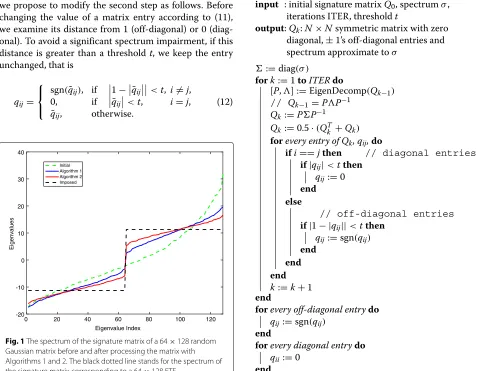
matrix exhibiting the requested structure, impairing the matrix spectrum. The above steps bring up Algorithm 1. Note that, due to small numerical inaccuracy,Qk from
step 1 may not be perfectly symmetric, thus, we perform the following operation:Qk :=0.5·(QTk +Qk).
Algorithm 1:Signature matrix construction I input : initial signature matrixQ0, spectrumσ,
iterations ITER
output:Qk:N×Nsymmetric matrix with zero
diagonal,±1’s off-diagonal entries and spectrum approximate toσ
:=diag(σ)
fork:=1toITERdo
[P,] :=EigenDecomp(Qk−1) // Qk−1=PP−1
Qk :=P P−1
Qk :=0.5·(QTk +Qk)
forevery entry of Qk, qij,do
ifi==jthen // diagonal entries
qij:=0
else
qij:=sgn(qij)// off-diagonal
entries end
end k:=k+1 end
Studying the convergence of the proposed algorithm is not a trivial task. Well-known results from alternat-ing projections cannot be applied here because convexity conditions for the employed sets are not satisfied, and in case the corresponding ETF does not exist, SMIEP is not solvable. Therefore, the proposed numerical method for SMIEP does not always produce an exact solution. However, it can produce an approximate solution satis-fying structural constraints and approximating spectral constraints. Although such a matrix is not the signature matrix of an ETF, it can be used to obtain a frame that is close to an ETF as we will see next.
this is that the algorithm may converge locally, thus, find-ing a solution depends on the startfind-ing matrix. Considerfind-ing that the construction of ETFs with the aforementioned dimensions is a problem that has already been solved (see [33] for a list of known ETFs), the most important results of Algorithm 1 concern finding the signature matrices of nearly equiangular frames of arbitrary dimensions. To test the proposed algorithm, we employ an initial signature matrix obtained from a randomly generated frame. We use frames of various dimensions. After a few iterations, the proposed algorithm produces a signature matrix with the requested structure and significantly improved spec-trum that approximates (7); therefore, Algorithm 1 yields an approximate solution to SMIEP. Figure 1 demonstrates results concerning the spectrum of a signature matrix before and after applying Algorithm 1. The initial signa-ture matrix was obtained by a random Gaussian 64×128 matrix.
Our experiments with Algorithm 1 have shown that, even though the proposed processing improves the signa-ture matrix spectrum substantially, it becomes ineffective after a few iterations. To further improve our results, we propose to modify the second step as follows. Before changing the value of a matrix entry according to (11), we examine its distance from 1 (off-diagonal) or 0 (diag-onal). To avoid a significant spectrum impairment, if this distance is greater than a threshold t, we keep the entry unchanged, that is
qij=
⎧ ⎨ ⎩
sgn(q˜ij), if 1−q˜ij<t, i=j,
0, if q˜ij<t, i=j, ˜
qij, otherwise.
(12)
0 20 40 60 80 100 120
Eigenvalue Index -20
-10 0 10 20 30 40
Eigenvalues
Initial Algorithm 1 Algorithm 2 Imposed
Fig. 1The spectrum of the signature matrix of a 64×128 random Gaussian matrix before and after processing the matrix with Algorithms 1 and 2. The black dotted line stands for the spectrum of the signature matrix corresponding to a 64×128 ETF
According to (12), an off-diagonal positive (negative) entryq˜ijis projected on+1 (−1), if the distance between
the current entry and the target value is less than t. Similarly, a diagonal entry is projected on 0, if its dis-tance from 0 is smaller than t. In the experiments presented in this paper, we choose t = 1/2, but fine tuning is possible depending on the frame dimen-sions. Thus, the second step of the algorithm does not actually project on A, but on a broader set; equiva-lently, the steps towards A are smaller compared to Algorithm 1.
This way thek-th iteration does not produce a matrix having the appropriate entries, but structure is improved gradually. After a number of iterations is reached, we apply (11) to finally produce a matrix with the desired struc-ture. Thus, we obtain Algorithm 2. Experimental results showing the improvement achieved with Algorithm 2 are presented in Fig. 1.
Algorithm 2:Signature matrix construction II input : initial signature matrixQ0, spectrumσ,
iterations ITER, thresholdt
output:Qk:N×Nsymmetric matrix with zero
diagonal,±1’s off-diagonal entries and spectrum approximate toσ
:=diag(σ) fork:=1toITERdo
[P,] :=EigenDecomp(Qk−1) // Qk−1=PP−1
Qk:=P P−1
Qk:=0.5·(QTk +Qk)
forevery entry of Qk, qij,do
ifi==jthen // diagonal entries
if|qij|<tthen
qij:=0
end else
// off-diagonal entries if|1− |qij||<tthen
qij:=sgn(qij)
end end end k:=k+1 end
forevery off-diagonal entrydo qij:=sgn(qij)
end
forevery diagonal entrydo qii:=0
Algorithm 2 is a modified alternating projections method. Instead of taking full projection steps, it moves slowly towards the target setAby selectively projecting on {−1, 0,+1}the entries of the signature matrix that satisfy a threshold requirement. The idea to move slowly towards the target sets when applying alternating projections is not new. In [34, 35], a method referred to as relaxed alter-nating projectionsreplaces the unrelaxed projection steps by underrelaxed versions. According to this method, the projection operatorsPAandPBproviding the projections of the signature matrix on the setsAandB, respectively, may be replaced by (1−λ)IN − λPA and(1−μ)IN − μPB, where λ,μ ∈ (0, 1] are the relaxation parameters and IN, the N × N identity matrix. Moving only
part-way towards the constraint set may enlarge the regions of convergence. Applying relaxed alternating projections in our problem did not yield better results than Algorithm 1. In our experiments, we have also tried other relaxation schemes; the projections expressed by (12) yielded the best results. Algorithm 2 can be viewed as a modified ver-sion of relaxed alternating projections and its convergence will be studied in our future work.
3.4 Nearly equiangular frames based on signature matrices
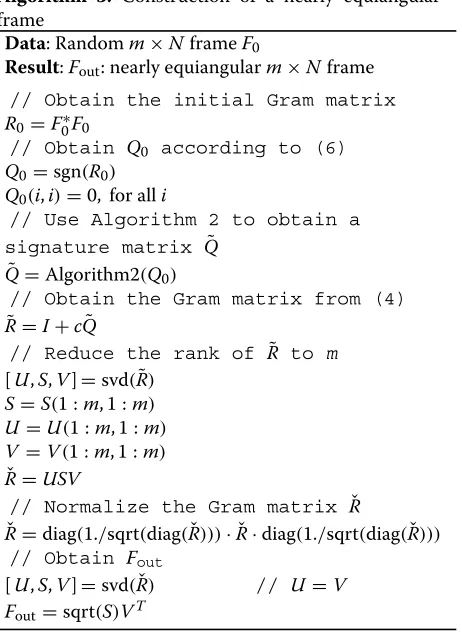
The signature matrix obtained by Algorithm 2 will be used next to construct a nearly equiangular frame. First, we construct the Gram matrix R according to (4). A sym-metricN×N matrix obtained by (4) corresponds to an m×N frame if it is of rank m. Thus, a rank reduction step follows. Using singular value decomposition (SVD), we keep themlargest eigenvalues and set the rest to zero. The matrix produced after rank reduction may not have ones in the diagonal, therefore, a normalization step fol-lows to ensure that the Gram matrix corresponds to a unit norm frame. Finally, using SVD, we obtain anm×Nframe, which is unit norm, almost tight, with the frame vectors forming angles near the optimal value. More particularly, let R = USVT be the singular value decomposition of the obtained Gram matrix, after rank reduction and nor-malization. Considering that R is a symmetric matrix, thus U = V, we can obtain a frame F determined by Raccording to F = √SV, where √S is a diagonal matrix with entries the square roots of the singular val-ues of R. The above steps bring up Algorithm 3. Recall that the frame obtained this way is unique up to unitary equivalence.
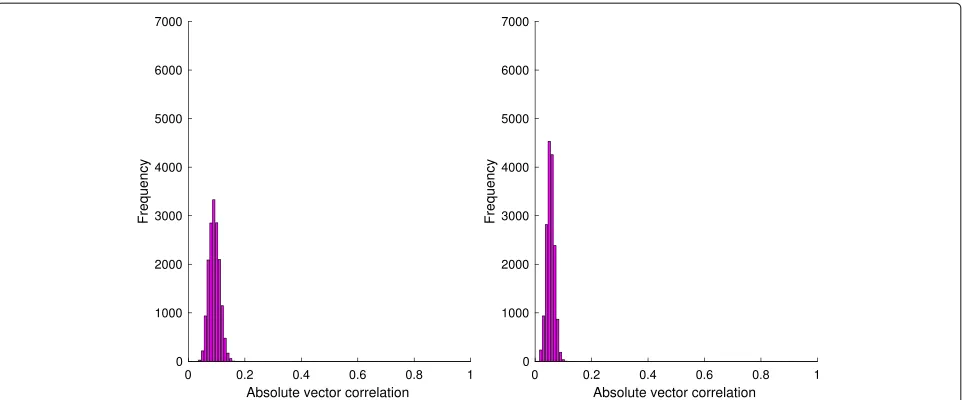
Some results of the produced frames are presented in Fig. 2. The demonstrated results include the frame vec-tors’ correlation for a 64×128 and a 96×128 frame. The results show that the angles formed by the frame vectors have values that are concentrated near the optimal bound corresponding to an ETF, that is, the obtained frames are approximately equiangular. For a 96×128 frame that
Algorithm 3: Construction of a nearly equiangular frame
Data: Randomm×NframeF0
Result:Fout: nearly equiangularm×Nframe
// Obtain the initial Gram matrix R0=F0∗F0
// Obtain Q0 according to (6)
Q0=sgn(R0) Q0(i,i)=0, for alli
// Use Algorithm 2 to obtain a
signature matrix Q˜
˜
Q=Algorithm2(Q0)
// Obtain the Gram matrix from (4) ˜
R=I+cQ˜
// Reduce the rank of R˜ to m
[U,S,V]=svd(R˜) S=S(1 :m, 1 :m) U=U(1 :m, 1 :m) V =V(1 :m, 1 :m)
ˇ
R=USV
// Normalize the Gram matrix Rˇ
ˇ
R=diag(1./sqrt(diag(Rˇ)))· ˇR·diag(1./sqrt(diag(Rˇ)))
// Obtain Fout
[U,S,V]=svd(Rˇ) // U=V Fout=sqrt(S)VT
exhibits a lower redundancy the results are more impres-sive. The proposed constructions are compared with random Gaussian matrices and incoherent tight frames produced with [26] and [30]. Both [26] and [30] attain small mutual coherence; however, they do not exhibit the approximate equiangularity property like the proposed constructions.
3.5 Nearly equiangular, nearly tight frames based on signature matrices
Algorithm 3 produces frames of any dimensions with the frame vectors forming angles near the optimal value. Even though the obtained frames exhibit good spectral prop-erties, they are not exactly tight, a characteristic that is important for many applications. One way to improve tightness is the following well-known theorem.
Algorithm 4: Construction of a nearly equiangular, nearly tight frame
input : Randomm×NframeF0, iterations ITER output:Fk: nearly equiangular, nearly tightm×N
frame
ComputeQ0the signature matrix ofF0. Obtain a nearly equiangular frameF1with Algorithm 3.
Having produced a nearly equiangular m× N frame with Algorithm 3, we apply Theorem 3 withα = N/m. As tightness opposes unit-normness, we must carry out a few iterations, alternating between these two properties according to Algorithm 4 to obtain a nearly equiangular, nearly tight unit norm frame.
A metric to evaluate how close the obtained frame is to a tight frame is the spectral norm. Recall that the spectral norm of a tight frame equals the lowest possible bound √
N/m. To see the improvement of tightness achieved by Algorithm 4 we construct frames of various dimensions and compute their spectral norm. The results presented in Table 1 are averaged over 500 frame samples and concern m×Nframes withm=32 : 16 : 96 andN=128.
While Algorithm 4 reduces the spectral norm of the obtained frames, it also affects the frame vectors’ corre-lation. Figure 3 demonstrates results of the frame vectors’ correlation for a 64×128 and a 96×128 frame produced by Algorithm 4. Comparing Fig. 3 to Fig. 2, we observe a slight deterioration of correlation’s distribution, as a price of the improvement of tightness. Therefore, the choice between Algorithm 3 and Algorithm 4 for the construc-tion of nearly equiangular frames, depends on the specific requirements of the related application.
3.6 Comparison with existing methods
In this section, we discuss the differences between the proposed work and existing approaches, while enlight-ening some aspects of our method. Considering the one-to-one correspondence between ETFs and signature matrices, we will compare the different algorithms using as a performance criterion the spectrum of the signa-ture matrix, i.e., we will graphically examine how close the spectrum is of an obtained signature matrix to the ideal spectrum given by Eq. (5). Our comparison includes the work presented in [22] and [26]; similar results were
obtained by comparing with other existing algorithms [23, 24, 30]. Figure 4 demonstrates typical results obtained with [22] and [26] for a 64×128 frame.
The algorithm presented in [22] focuses on incoher-ence. The iterative operations applied on the Gram matrix include shrinkage and rank reduction. Denoting with rij
the(i,j)entry of the Gram matrix, the following modifi-cation is applied:
whereγ,tare appropriate parameters. For the results pre-sented in Fig. 4, we usedγ = 0.7,t = 0.5. Eq. 13 leaves the signs of the Gram entries unchanged; therefore, it does not modify the signature matrix. However, the shrinkage operation impairs the matrix rank, and a rank reduc-tion step must follow to yield an acceptable Gram. Rank reduction implicitly affects the signature matrix. The spectrum demonstrated in Fig. 4 reflects these changes. The method of [22] is an alternating projections method. The involved sets include the set of N × N symmetric matrices with bounded absolute values (the bounds are defined according to (13)) and the set of N × N sym-metric rankmmatrices, that is, the set of matrices with mnon-zero eigenvalues. Nevertheless, the imposed con-straints do not improve the signature matrix sufficiently as another important property of ETFs, namely, tightness is not addressed by the optimization algorithm.
The optimization process proposed in [26] leads to a better spectrum compared to [22]. The goal of [26] is to find a frame that satisfies both incoherence and tightness, thus, it produces frames that are closer to ETFs. Concern-ing the correspondConcern-ing Gram matrix, incoherence involves explicit operations on the absolute values, while tightness involves operations on the eigenvalues. Therefore, the averaged projections method proposed in [26] concerns one more constrained set, i.e., the set ofN×N symmet-ric matsymmet-rices with specific eigenvalues (see Proposition 1). Similarly to rank reduction, operations on the eigenval-ues may change the signs of the Gram entries, implicitly improving the signature matrix.
Fig. 2Correlation distribution of frame vectors of 64×128 (left) and 96×128 (right) frames constructed with [26], [30] and proposed method. The optimal lowest bound (Welch bound) for these dimensions isμopt=0.0887 andμopt=0.0512, respectively
an ETF that enables a decoupling optimization strategy: the signature matrix can be directly optimized without being subjected to incoherence constraints. The incoher-ence constraints are applied to the Gram matrix in a single step by multiplying the signature matrixQwith the Welch bound c. A direct optimization of the signature matrix that does not involve incoherence constraints is more efficient. The proposed construction of approximate ETFs assigns the Gram entries identical absolute values equal to the Welch bound in a single step and results in frames that exhibit approximate equiangularity, a prop-erty that is not achieved by any other method. Such a strict incoherence constraint cannot be applied with alternating projections methods; experimental results show that both
[22] and [26] do not converge. Therefore, in this paper, the joint optimization of the Gram matrix with respect to both structural and spectral constraints is replaced by an equivalent two-fold problem, the optimization of the signature matrix and the absolute Gram entries. These problems can be tackled separately, resulting in a more efficient optimization strategy that leads to a different set of solutions, namely, approximate equiangular frames.
Table 1Spectral norm ofm×Nframes withm=32 : 16 : 96 andN=128 obtained with Algorithm 3 and Algorithm 4
mdimension Spectral norm
Algorithm 3 Algorithm 4 Optimal
32 2.074 2.015 2.000
48 1.716 1.655 1.633
64 1.499 1.440 1.414
80 1.351 1.288 1.265
96 1.250 1.171 1.155
must be followed by a rank reduction step, which may not preserve the properties (i.e., the spectrum) of the optimal signature matrix. Even though there is no theoretical evi-dence that a decoupling strategy will perform well for the case of approximate ETFs, we assert that the experimental results presented here are promising. Nevertheless, a the-oretical study about the relation between an approximate solution of the signature matrix problem (especially when an accurate solution does not exist) and the corresponding constrained Gram remains a challenge.
We continue with a comment on the complexity of the tested algorithms. The work of [26] and [22] applies explicit operations on the Gram matrix to impose struc-tural and spectral constraints. These operations involve projections on sets of matrices with specific structural and spectral properties; the projections are performed iter-atively and both algorithms exhibit similar complexity. In our algorithm, the explicit construction of the Gram matrix is a two step non-iterative procedure: first we apply (4) and then we perform rank reduction. However, the construction of the signature matrix involved in (4) is
performed through an iterative process which imposes structural and spectral constraints on a matrix of the same dimensions of the Gram matrix. Therefore, we can-not argue that the proposed algorithm is less complex compared to [26] and [22].
Before ending this discussion, we would like to note that the major contribution of the proposed work is the intro-duction of a different strategy towards the optimization of the Gram matrix of an approximate ETF, which, for the first time, addresses the construction of the correspond-ing signature matrix. Takcorrespond-ing into account that the frames obtained with the proposed method, besides incoherence and tightness, exhibit the additional property of approx-imate equiangularity, we conclude that our optimization strategy is more effective compared to the state of the art algorithms.
4 Applications of nearly equiangular frames As we have already mentioned in the introduction, frames that are close to ETFs have many applications in sig-nal processing and communications. In this section, first, we employ the proposed constructions to acquire sparse synthetic signals with compressed sensing and study the reconstruction performance of Orthogonal Match-ing Pursuit (OMP) [37] in this settMatch-ing. Then, we use nearly equiangular nearly tight frames to obtain spread-ing sequences for synchronous CDMA systems and show their superiority against WBE sequences when the num-ber of users in the system changes.
4.1 Sensing matrices for compressed sensing
Compressed sensing is a novel theory [11, 12] that exploits sparsity to recover signals that have been sampled at
0 20 40 60 80 100 120 Eigenvalues Index
-20 -10 0 10 20 30 40
Eigenvalues
Initial Proposed [22] [26] Imposed
Fig. 4The spectrum of the signature matrix of a 64×128 random Gaussian matrix, a frame obtained with the proposed Algorithm 4, and frames obtained with [22], [26]. The black dotted line stands for the spectrum of the signature matrix corresponding to a 64×128 ETF
a drastically smaller rate than the conventional Shan-non/Nyquist theorem imposes. Undersampling implies that the number of measurementsmis much smaller than the dimensionNof the signal. Letαbe a sparse signal with a few non-zero coefficients, that is,α0 = T,T N, where·0is the so-called0norm (which is actually not a norm) counting the non-zero coefficients of the respective signal. We obtainmmeasurements according to
y=Φα, (14)
where Φ ∈ Rm×N is a matrix describing the sensing mechanism. Equation (14) defines an underdetermined linear system with more unknowns than equations. A sparse solution satisfying (14) can be computed numeri-cally, as long as the matrixΦsatisfies the restricted isom-etry property (RIP) [38]. We can loosely say that when a matrix obeys RIP of orders, then all subsets ofscolumns are nearly orthogonal. Random Gaussian or Bernoulli matrices are known to satisfy RIP with high probability [39], however, research still goes on aiming either at the improvement of performance guarantees or at the dis-covery of sensing operators that are more appropriate for practical applications [40].
A very coarse estimate on a matrix RIP bounds is the mutual coherence of a matrix. According to [13], recon-struction algorithms such as OMP and basis pursuit (BP) [41] can recover a sparse signal acquired with CS as long as the sensing matrix forms an incoherent UNTF. ETFs are optimal CS matrices with respect to mutual coherence as they achieve the Welch bound. The nearly equiangu-lar frames produced in this paper with Algorithms 3 and
4 have frame vectors exhibiting correlation that approx-imates the optimal value of an ETF. Next, we investigate the behavior of the proposed frames in CS.
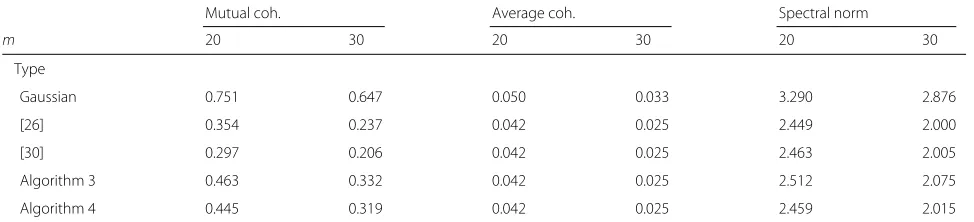
Considering synthetic sparse signals of length N = 120, withT = 4 non-zero coefficients, we obtain mea-surements according to (14). The obtained meamea-surements are used to find the unknown sparse signal, using OMP, a well-known algorithm for sparse signal recovery. The experiments are realized using random Gaussian matri-ces, incoherent UNTFs produced with [26], [30], and the frames produced with Algorithms 3 and 4. Varying the number of measurements m = {15, 20, 25, 30, 35}, for every value of m, we perform 10,000 experiments. The quality of the recovered signal is measured computing the mean squared error (MSE). The results demonstrated in Table 2 include average values.
According to Table 2, the proposed nearly equiangu-lar frames outperform random Gaussian matrices, and yield results similar to incoherent UNTFs. In order to explain the obtained results of sparse reconstruction, next, we present results regarding the mutual coherence of the matrices employed in our CS experiments. Table 3 includes average values over 10,000 realizations for sens-ing matrices with dimensions 20× 120 and 30× 120. According to these results, the superiority of the pro-posed frames against random Gaussian matrices is obvi-ously expected, considering their incoherence. We cannot assert the same comparing nearly equiangular frames to incoherent UNTFs obtained with [26] and [30]. Frames produced with [26] and [30] exhibit mutual coherence that is smaller than the proposed frames, especially when the frame dimensions yield high redundancy. However, the smallest mutual coherence does not necessarily lead to the highest reconstruction accuracy.
The above results are not that surprising if we take into account that many authors have argued that mutual coher-ence may not express well the effectiveness of a matrix in sparse signal recovery [22, 42]. Clearly, other proper-ties of the sensing matrix such as average coherence and spectral norm seem to determine the effectiveness of the employed matrix as well. The role of the spectral norm in
Table 2MSE for sparse signals of lengthN=120 obtained with CS, for variable number of measurements,m=15 : 5 : 35, and various types of sensing matrices
m MSE
Gaussian [26] [30] Alg. 3 Alg. 4
15 0.01000 0.00821 0.00864 0.00837 0.00825
20 0.00506 0.00287 0.00276 0.00300 0.00287
25 0.00180 0.00056 0.00062 0.00059 0.00059
30 0.00038 5.650·10−5 2.320·10−5 5.609·10−5 6.887·10−5
Table 3Properties of sensing matrices employed in CS experiments
Mutual coh. Average coh. Spectral norm
m 20 30 20 30 20 30
Type
Gaussian 0.751 0.647 0.050 0.033 3.290 2.876
[26] 0.354 0.237 0.042 0.025 2.449 2.000
[30] 0.297 0.206 0.042 0.025 2.463 2.005
Algorithm 3 0.463 0.332 0.042 0.025 2.512 2.075
Algorithm 4 0.445 0.319 0.042 0.025 2.459 2.015
Results involvem×Nmatrices withm= {20, 30},N=120
sparse recovery was studied in [13]. The notion of average coherence was defined in [42] as
μg(F)=
1 N(N−1)
N
i=1 N
j=1 i=j
|fi,fj|2. (15)
The authors of [42] conjecture its important role in sparse recovery based on experimental results. While the frames obtained with [30] exhibit the smallest mutual coherence, the values of average coherence computed by (15) are identical for all matrix constructions except for random Gaussian matrices. We conclude that the results obtained in Tables 2 and 3 indicate that the effectiveness of a matrix involved in sparse recovery seems to depend on all the aforementioned properties, with average coherence playing a rather important role.
Before proceeding to another application of nearly equiangular frames, we would like to make a comment concerning Algorithms 3 and 4. While Algorithm 4 pro-duces frames with smaller spectral norm, the achieved improvement slightly affects the reconstruction perfor-mance of OMP. Taking into account the additional com-putational cost introduced by Algorithm 4 and the fact that the matrices employed in CS are practically of large dimensions, we suggest that Algorithm 3 is the best choice for the construction of sensing matrices, consider-ing both effectiveness and computational cost. Compari-son between Algorithm 3 and [26], [30] leads to a similar conclusion, strengthening our preference to Algorithm 3 especially when the application necessitates limitation of resources.
4.2 Spreading sequences for CDMA systems
In synchronous CDMA systems, the users share the entire bandwidth and each user is distinguished from the others by its spreading sequence or code. (the term signature is also extensively used, but we avoid using it here as it might confuse the reader. Clearly, a signature sequence is not related to a signature matrix by any means). The capac-ity region defined as the set of information rates at which users can transmit while retaining reliable transmission
is characterized as a function of the spreading sequences and average input power constraints of the users. Capac-ity optimal sequences are functions of codebook length as well as the number of users [14, 15].
Suppose thatx1,x2,. . .,xNis a set of vectors inRm
cor-responding to N possible users of an s-CDMA system. These vectors form a set of sequences of lengthm. Opti-mal spreading sequences have been characterized in [14] to be the WBE sequences, that is, equal norm tight frames. WBE sequences minimize the total squared correlation, that is,
TSC=
N
i=1 N
j=1
xi,xj2, (16)
which results in that the interference experienced by any user is exactly the same.
The design of WBE sequences for s-CDMA has gained a lot of interest in the last decades [15, 43, 44]. However, WBE sequences do not perform well when the number of users in the cell changes. If the number of the active users is smaller thanN, then a code set designed forN users is no longer optimal and new codes should be assigned to all users [9].
The interference experienced by the j-th user in the system depends on the term [14]
I(j)=
i=j
xi,xj2. (17)
Consider a system with K < N active users. In [9] it was shown that all users experience the same interference, which depends only onK, the current number of active users, if and only if the code set is an equiangular sequence set. As we have mentioned in Section 3.1, the authors of [9] use conference matrices to construct ETFs that are employed as spreading sequences. However, construction techniques for conference matrices impose restrictions on frame dimensions.
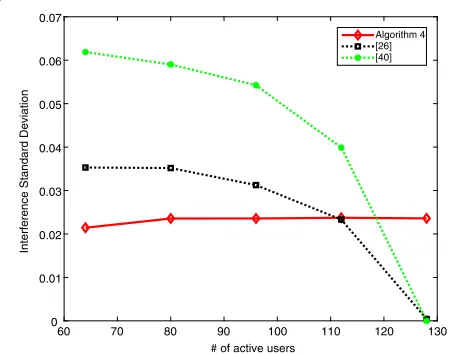
presented here involve the computation of interuser inter-ference when employing the proposed frame vectors as codes of a CDMA system with variable number of users. The performance of the proposed frames in s-CDMA is compared to a method presented in [44] for spread-ing sequence design. The authors of [44] produce WBE sequences from an appropriate Gram matrix. The con-struction of the Gram matrix is addressed as an inverse eigenvalue problem, which is solved using finite-step algo-rithms from matrix theory. The code set we use in our experiments is designed for 128 users with codes of length 64, obtained by a 64× 128 frame produced with Algo-rithm 4. For each subset of K ≤ 128 active users, we randomly chooseK codes and examine the interference term given by (17). As a measure of how close we are to the target that all users experience the same interference, we compute the standard deviation of the interference term for every active subset of users. The results are averaged over a series of random trials.
Figure 5 demonstrates results when the number of users in the cell varies from 64 to 128. The perfor-mance of the proposed frame when used as a spread-ing sequence set is also compared to an incoherent UNTF (WBE sequence set) produced by our previous work [26]. It is obvious that the proposed nearly equian-gular nearly tight frame, outperforms WBE sequence sets, when the system works with a load up to 85% its total load.
Next, we demonstrate results for total squared cor-relation for comparison with other work on spreading sequence design based on TSC. Total squared correlation is related to the total mean squared error (MSE) in the system, that is, the sum of MSEs observed by all users. In [43] it is shown that for a link with additive Gaussian noise of zero power and spectral densityσ2, assuming that the
60 70 80 90 100 110 120 130
Fig. 5Standard deviation of the interference term for variable number of active users in a s-CDMA system designed for 128 users
users receive signals of equal powerp, the total MSE forK users in the system is given by
MSE=p
For unit norm codesxi, we receive
MSE=pTSC+(1+σ2−2√p)K. (19)
From (19) it is obvious that minimizing TSC is equiv-alent to minimizing MSE. Algorithms like the one pre-sented in [43] produce spreading sequences that minimize TSC.
Table 4, presents averaged values of TSC observed in the above scenarios of active subset of users. ForK =
{64, 80, 96, 112, 128} users in the system, we randomly chooseK codes and calculate TSC. The results are aver-aged over a series of random trials. The measured values are similar for all methods showing that the proposed construction yields results similar to [26] and [44]. There-fore, compared to WBE sequences, the proposed frames reduce the interference experienced by the users without affecting the total MSE in the system.
5 Conclusions
Signature matrices are matrices with specific structure and spectrum, and define ETFs up to unitary equiva-lence. While signature matrices of ETFs exist for certain frame dimensions, in this paper, we propose a numer-ical method that produces signature matrices of nearly equiangular frames of arbitrary dimensions. These frames are almost tight, with frame vectors exhibiting near opti-mal correlation. Using the obtained frames as spreading sequences for CDMA systems, we reduce the interference experienced by the individual users, when the number of active users in the system changes. We also employ nearly equiangular frames to obtain sparse signals with CS, achieving high reconstruction performance of sparse recovery algorithms. The proposed frame constructions, which are based on signature matrices, rely on the solu-tion of a structured inverse eigenvalue problem. Any
Table 4Average total squared correlation (TSC) for variable number of active users
# of active users TSC
progress towards the solution of similar inverse eigen-value problems could improve the proposed constructions substantially.
Acknowledgements
The authors would like to thank the authors of [30] for providing the code implementing the related method.
Funding
There are no funding resources.
Availability of supporting data
The authors wish to share the code implementing the proposed method, if the paper is accepted for publication.
Authors’ contributions
The authors have contributed to this paper equally.
Ethics approval and consent to participate Not applicable.
Consent for publication Not applicable.
Competing interests
The authors do not have any competing interest.
Publisher’s Note
Springer Nature remains neutral with regard to jurisdictional claims in published maps and institutional affiliations.
Author details
1Department of Computer Science and Engineering, University of Ioannina,
Ioannina, Greece.2Electrical Engineering and Computer Science,
Northwestern University, 2145 Sheridan Road Evanston, 60208 Evanston, USA.
Received: 26 April 2017 Accepted: 4 September 2017
References
1. PG Casazza, G Kutyniok,Finite frames: theory and applications. (Birkhäuser, Boston, 2012)
2. AS Bandeira, M Fickus, DG Mixon, P Wong, The road to deterministic matrices with the restricted isometry property.19(6), 1123-1149 (2013) 3. M Fickus, DG Mixon, JC Tremain, Steiner equiangular tight frames. Linear
Algebra Appl.436(5), 1014–1027 (2012)
4. JM Renes, R Blume-Kohout, AJ Scott, CM Caves, Symmetric informationally complete quantum measurements. J. Math. Phys.45, 2171–2180 (2004) 5. AJ Scott, Tight informationally complete quantum measurements. J.
Math. Phys.39, 13507–13530 (2006)
6. T Strohmer, RW Heath, Grassmannian frames with applications to coding and communication. App. Comp. Harm. Anal.14(3), 257–275 (2003) 7. RB Holmes, VI Paulsen, Optimal frames for erasures. Linear Algebra Appl.
377, 31–51 (2004)
8. BG Bodmann, VI Paulsen, Frames, graphs and erasures. Linear Algebra Appl.404(15), 118–146 (2005)
9. RW Heath, T Strohmer, AJ Paulraj, On quasi-orthogonal signatures for CDMA systems. IEEE Trans. Inf. Th.52(3), 1217-1226 (2006) 10. MA Sustik, JA Tropp, IS Dhillon, RW Heath, On the existence of
equiangular tight frames. Linear Algebra Appl.426, 619–635 (2007) 11. EJ Candès, J Romberg, T Tao, Stable signal recovery from incomplete and
inaccurate measurements. Comm. Pure Appl. Math.59(8), 1207–1223 (2006)
12. DL Donoho, Compressed sensing. IEEE Trans. Inf. Th.52(4), 1289–1306 (2006)
13. JA Tropp, On the conditioning of random subdictionaries. App. Comp. Harm. Anal.25, 1–24 (2008)
14. JL Massey, T Mittelholzer, inSequences II: methods in communication, security and computer sciences. Welch’s bound and sequence sets for code-division multiple-access systems (Springer, Heidelberg, 1993), pp. 63–78
15. P Viswanath, V Anantharam, Optimal sequences and sum capacity of synchronous CDMA systems. IEEE Trans. Inf. Th.45(6), 1984–1991 (1999) 16. JJ Benedetto, M Fickus, Finite normalized tight frames. Adv. Comput.
Math.18, 357–385 (2003)
17. JA Tropp, IS Dhillon, RW Heath, T Strohmer, Designing structured tight frames via an alternating projection method. IEEE Trans. Inf. Th.51(1), 188–209 (2005)
18. P Xia, S Zhou, GB Giannakis, Achieving the Welch bound with difference sets. IEEE Trans. Inf. Th.51(5), 1900–1907 (2005)
19. S Waldron, On the construction of equiangular frames from graphs. Linear Algebra Appl.431(11), 2228–2242 (2009)
20. BG Bodmann, VI Paulsen, M Tomforde, Equiangular tight frames from complex seidel matrices containing cube roots of unity. Linear Algebra Appl.430(1), 396–417 (2009)
21. BG Bodmann, PG Casazza, The road to equal-norm Parseval frames. J. Funct. Anal.258(2), 397–420 (2010)
22. M Elad, Optimized projections for compressed sensing. IEEE Trans. Signal Process.55(12), 5695–5702 (2007)
23. J Xu, Y Pi, Z Cao, Optimized projection matrix for compressive sensing. EURASIP J. Adv. Signal Process.2010(1), 560349 (2010)
24. H Huang, A Makur, inProceedings of Intl. Conf. Sampling Th. App.(SampTA), Singapore. Optimized measurement matrix for compressive sensing, (Singapore, 2011)
25. E Tsiligianni, LP Kondi, AK Katsaggelos, inProceedings of the 20th European Signal Processing Conference (EUSIPCO), Bucharest. Use of tight frames for optimized compressed sensing, (Bucharest, 2012)
26. E Tsiligianni, LP Kondi, AK Katsaggelos, Construction of incoherent unit norm tight frames with application to compressed sensing. IEEE Trans. Inf. Th.60(4), 2319–2330 (2014)
27. S Li, G Ge, Deterministic sensing matrices arising from near orthogonal systems. IEEE Trans. Inf. Th.60(4), 2291–2302 (2014)
28. S Li, G Ge, Deterministic construction of sparse sensing matrices via finite geometry. IEEE Trans. Signal Process.62(11), 2850–2859 (2014) 29. C Rusu, N González-Prelcic, Optimized compressed sensing via
incoherent frames designed by convex optimization (2015). http://arxiv. org/abs/1507.02454. Accessed 1 Apr 2015
30. H Bai, S Li, X He, Sensing matrix optimization based on equiangular tight frames with consideration of sparse representation error. IEEE Trans. Multimed.18(10), 2040–2053 (2016)
31. MT Chu, GH Golub,Inverse eigenvalue problems: theory, algorithms, and applications. (Oxford University Press, Oxford, 2005)
32. R Orsi, Numerical methods for solving inverse eigenvalue problems for nonnegative matrices. SIAM J. Matrix Anal. Appl.28, 190–212 (2006) 33. M Fickus, DG Mixon, Tables of the existence of equiangular tight frames
(2012). https://arxiv.org/abs/1504.00253
34. A Cegielski, A Suchocka, Relaxed alternating projection methods. SIAM J. Optim.19(3), 1093–1106 (2008)
35. HH Bauschke, HM Phan, X Wang, The method of alternating relaxed projections for two nonconvex sets. Vietnam J. Math.42(4), 421–450 (2014)
36. R Horn, C Johnson,Matrix analysis. (Cambridge University Press, New York, 1985)
37. G Davis, S Mallat, M Avellaneda, Greedy adaptive approximation. Constr. Approx.13, 57–58 (1997)
38. EJ Candès, T Tao, Near-optimal signal recovery from random projections: universal encoding strategies? IEEE Trans. Inf. Th.52(12), 5406–5425 (2006) 39. R Baraniuk, M Davenport, R DeVore, M Wakin, A simple proof of the
restricted isometry property for random matrices. Constr. Approx.28(3), 253–263 (2008)
40. E Tsiligianni, LP Kondi, AK Katsaggelos, Preconditioning for
underdetermined linear systems with sparse solutions. Sig. Process. Lett. IEEE.22(9), 1239–1243 (2015)
41. SS Chen, DL Donoho, MA Saunders, Atomic decomposition by basis pursuit. SIAM J. Sci. Comput.20(1), 33–61 (1999)
42. JM Duarte-Carvajalino, G Sapiro, Learning to sense sparse signals: simultaneous sensing matrix and sparsifying dictionary optimization. IEEE Trans. Image Process.18(7), 1395–1408 (2009)
43. S Ulukus, RD Yates, Iterative construction of optimum signature sequence sets in synchronous CDMA systems. IEEE Trans. Inf. Th.47(5), 1989–1998 (2001)
![Fig. 2 Correlation distribution of frame vectors of 64 × 128 (left) and 96 × 128 (right) frames constructed with [26], [30] and proposed method](https://thumb-us.123doks.com/thumbv2/123dok_us/882716.1106062/9.595.59.543.85.514/correlation-distribution-frame-vectors-frames-constructed-proposed-method.webp)
![Fig. 4 The spectrum of the signature matrix of a 64 × 128 randomGaussian matrix, a frame obtained with the proposed Algorithm 4,and frames obtained with [22], [26]](https://thumb-us.123doks.com/thumbv2/123dok_us/882716.1106062/11.595.57.291.86.269/spectrum-signature-matrix-randomgaussian-obtained-proposed-algorithm-obtained.webp)