ENHANCING THE DELIVERY OF LIBRARY’S SERVICES
THROUGH THE IMPLEMENTATION OF AN EMERGING
INFORMATION TECHNOLOGY: A PROCESS FRAMEWORK
Shamshul Bahri, Department of Operations and Management Information Systems, Faculty
of Business and Accountancy, University of Malaya, Kuala Lumpur, Malaysia
([email protected])
Abstract
This paper presents a process framework for implementing an emerging information technology in library. The motivation for this framework came from the lack of such tool to managers in service organizations such as libraries that have been actively implementing emerging technologies to enhance the delivery of their services. To develop the framework, a study was conducted on the implementation of Radio Frequency Identification (RFID) by the first public library in the UK to adopt the technology. Using the Lewin’s model of change as the study’s theoretical framework and the grounded theory approach as the study’s research method, an implementation process framework of an emerging technology was developed. The contribution of the framework is twofold. First, the framework contributes towards the state-of-the-art knowledge on service sciences and emerging technology implementation. Second, it provides guidance to future managers in service organizations on how best to manage the implementation of an emerging technology.
Keywords: process framework, implementation, emerging technology, RFID, services.
1
INTRODUCTION
This paper presents an emerging information technology (IT) implementation process framework. The motivation for this paper comes from the lack of framework that can offer guidance to managers in service organizations such as libraries on how to implement emerging information technology. This lack of framework is surprising because libraries have been actively implementing emerging technologies to enhance the delivery of their services to the patrons (Kajewski, 2006). The lack of such framework may lead to difficulties in managing the challenges of deploying emerging technologies (Day & Schoemaker, 2000)
Thus, this paper seeks to develop a framework of emerging IT implementation process framework. The framework is developed from the study of a United Kingdom’s (UK) library effort in implementing Radio Frequency Identification (RFID) technology. As the first library in the UK to implement the technology in 2000, this site presents a very good opportunity to study the difficult issues faced by managers in implementing an emerging technology. From the investigation, a framework was developed to identify and narrate the key activities in the implementation of an emerging technology in a library. Hopefully, this framework will be a useful guide to managers who are implementing or considering RFID in service organizations.
The paper is arranged as follows. The introduction section (this section) will be followed with the literature review section. The third section will describe the research method employed by the study. The fourth section will present the implementation framework of an emerging technology in a library. The fifth section will provide a discussion of the findings and conclude the paper.
2
LITERATURE REVIEW
2.1 Service Sciences, Emerging Technologies in Libraries, and RFID
Whilst studies on service sciences have been limited (Chesbrough, 2005; Chesbrough & Spohrer, 2006), concepts from that knowledge domain (Maglio & Spohrer, 2007) which emphasizes the need of an organization to become customer-centric (Rust & Miu, 2006) had long been embraced by libraries. They have fulfilled that need through the implementation of service systems such as proprietary online integrated systems and RFID. These applications were emerging technologies when they were first implemented (Kajewski, 2006).
Emerging technologies may spring from a new technology or a new application of an existing technology. It is defined as science-based innovations that have the potential to create a new industry or transform an existing one (Myers, 2006). Emerging technologies such as the RFID has been applied by libraries for two reasons. First, the libraries need to meet the continuous demands for better services from their patrons (Moore, 2006). Second, the libraries see the use of innovative technologies as a better option in meeting those demands (Kathryn, 2004). However, few organizations, including libraries have implemented emerging technologies successful (Day & Schoemaker, 2000).
The lack of success in implementing emerging technologies could be attributed to a number of reasons. Emerging technologies pose new ethical issues (Moor, 2005) such as the privacy of patrons’ data. In addition, library workers need to learn new roles (Goestsch, 2008) such as shifting from the role of handling basic library transactions to serving the information need of the patrons. There is also uncertainty about the returns from the investment on the emerging technologies. As a result, the senior management will be very sceptical about investing in the technology. The scepticism of these technologies will be even greater during the current economic recessions (Davis, 2009).
Despite those problems, libraries have continuously been deploying emerging technologies, including RFID technology. A review of the literature on RFID in libraries (Zakaria, 2009) revealed that a large
number of literature introduced the technology, discussed the issues surrounding the technology’s implementation, and presented advanced applications of the technology. A number of literature that narrated the implementation of RFID in a single library was also found. However, none of the literature provided the framework to implement RFID as an emerging technology. This paper aims to provide the implementation process framework. Before the implementation process is presented, the theoretical framework used by this study will be discussed.
2.2 The Theoretical Framework
Lewin’s change model was chosen as the study’s theoretical framework over other theories such as structuration theory (Giddens, 1984), actor-network theory (Callon, 1986) and adoption-diffusion theory (DOI) (Rogers, 1995). Although those theories (actor-network, structuration, DOI theories) have contributed significantly towards the understanding of IS implementation, they were found to be less relevant because of their emphasis on organizational dynamics. Organizational dynamics would be appropriate had this study intended to present a complicated view of the technology’s implementation. Instead, this study intends to present a simpler picture of the process that would help existing and potential RFID managers in the public sector.
On the other hand, the Lewin’s model of change was a more relevant and appropriate theoretical framework. First, a study of an information system (IS) implementation such as RFID would be inadequate without the investigation on how it will cause changes to the individuals, responsibilities, and social-political structure of an organisation (Chu and Smithson, 2007; Krovi, 1993). Because of the changes involved, IS implementation requires an understanding of how these changes should be managed (Cule & Robey, 2004; Narasimhan & Schroader, 1979; Van De Ven & Huber, 1990; Zmud & Cox, 1979). Change models such as Lewin’s would assist the study in understanding these requirements.
Lewin’s model of change is based on a series of papers written by Kurt Lewin (Ash, 1992). The model divides change process into three stages: unfreezing, moving and refreezing. The unfreezing stage relates to destabilizing the equilibrium before old behaviours can be discarded (unlearnt) and new behaviours successfully adopted. The moving stage relates to unlearning old behaviours and learning new behaviours while the unfreezing stage seeks to stabilize the group at a new quasi-stationary equilibrium in order to ensure that the new behaviours are relatively safe from regression (Lewin, 1947).
3
RESEARCH METHOD
3.1 The Research Design
This study had chosen the qualitative research approach. The approach had enabled the encapsulation of the RFID implementation process phenomenon through the experience of those who were personally involved in leading the implementation. From their experience, the study was able to reveal the socio-technical aspects of the implementation process (Galliers and Land, 1987). In addition, it had enabled the study to construct the knowledge of the process in the form of the emerging technology’s implementation process framework (Stake, 1995).
Under the methods associated with qualitative research (Creswell, 2003), the grounded theory approach (Strauss and Corbin, 1998; Turner, 1983; Locke, 1996) was adopted. The grounded theory approach provided the guidance in selecting the informants for the study and the method to develop the emerging technology implementation process framework.
3.2 The Research Process
Data was collected from in-depth personal interviews with the library’s RFID project managers and one focus group interview with the library staffs. They were asked to relate their experience in the technology’s implementation. Their responses were recorded, transcribed verbatim and passed back to
them to ensure that they were accurate. After the informants had verified the accuracy of the transcriptions, they went through several stages of analysis:
1. Analysis of single interview / focus group interview
a. Open coding (Locke, 1996; Strauss & Corbin, 1998; Walker & Myrick, 2006): identification of initial categories (or activities) by reading the transcriptions line-by-line.
b. Axial coding (Locke, 1996; Strauss & Corbin, 1998; Walker & Myrick, 2006): more general activities were formed from similar activities.
2. Analysis of the activities
a. Determining in which stage (unfreezing, moving or refreezing) each activity belongs to.
b. Determining the sequence of activities in each stage
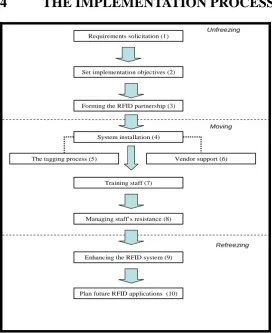
Figure 1 displays the framework of the emerging technology’s implementation process. During the unfreezing stage, the implementation starts with the library soliciting requirements for the emerging technology, followed by the setting of the implementation objectives and formation of the RFID partnership. During the moving stage, the implementation starts with the installation of the RFID system, which occurred together with the tagging process and getting the support of the vendor. The activities were followed by the training of staff and the management of staff’s resistance. Meanwhile, the refreezing stage starts with the enhancement to the RFID system followed by the future RFID applications planning. The next three sub-sections will describe each implementation stage in detail.
3.3 The implementation process during the unfreezing stage
The first step in this stage involved soliciting the requirements for the new RFID system. Here, the RFID managers faced some problems. There was very little literature on the technology which they could refer to. Additionally, they could not consult other libraries in the UK that had implemented the technology earlier. Furthermore, the library’s own staffs have very little knowledge on the technology. As a result, the library had to rely heavily on the vendor in soliciting the requirements for the new RFID system.
When the requirements had become clearer, two implementation’s objectives were set for the RFID system. The first objective was to provide an easy-to-use self service facility. The second objective was to redirect staff time towards providing service to the library. According to the Assistant Head of Service:
“... we chose RFID because it was an emerging technology we felt we could use to help us to deliver our service ...”
After the objectives were set, the implementation progressed with the formation of a four-way partnership between the library, the RFID vendor, a RFID tag and reader vendor, and a library management system (LMS) vendor. The formation of the partnership was crucial because each member lacked the experience in implementing the technology in a library setting. By forming the partnership, the members hoped that they would be able to share their knowledge and developed a feasible RFID solution together. Consequently, it will reduce the risk associated with the implementation of an emerging technology.
4
THE IMPLEMENTATION PROCESS FRAMEWORK
Requirements solicitation (1)
Unfreezing
Moving
Refreezing Set implementation objectives (2)
Forming the RFID partnership (3)
System installation (4)
Enhancing the RFID system (9) Managing staff’s resistance (8)
Plan future RFID applications (10) Training staff (7)
[image:5.595.72.345.78.412.2]The tagging process (5) Vendor support (6)
Figure 1 The emerging technology’s implementation process framework
4.1 The implementation process during the moving stage
The implementation process in this stage started with the installation of the RFID system. Here, several issues emerged which required the library to make decisions. The most pressing issue involved tagging the library’s materials. This issue was resolved after lengthy discussions with the library’s management team and several senior librarians. Table 1 outlines the sub-issues involved in the RFID tagging process and how the library solved them.
The emerging issues The approach taken by the libraries to resolve the issues
Whether to include or exclude barcodes in the library’s materials
A decision was made to include barcodes in its materials because its branch libraries did not have the RFID system
The amount of data to be entered into the RFID tag
For privacy reasons, a decision was made to enter the ascension number only.
The materials to exclude from being RFID tagged
A decision was made to exclude less RFID-friendly materials such as CDs and DVDs. The persons to perform the tagging The task to perform the tagging was assigned
to a team of library staff and temporary agency staff
Table 1. The sub-issues in the tagging process
The RFID system’s installation presented fewer problems to the library. The activity involved developing the RFID software that enabled the system to transmit data (developed by the RFID software vendor) and linking the RFID system to the library’s LMS (developed by the main RFID
vendor). In addition, the system was refined by the main RFID vendor to enable it to accept materials with RFID tags or barcodes. An on-duty engineer was also placed at the library to immediately address any shortcomings in the system.
When the RFID system has been fully installed, the library staffs received training on how to use the system. This training however did not prevent a small amount of resistance from some librarians. This resistance was identified particularly when the RFID system was not working well such as when the system failed to capture the data on the tags or when the security alarm at the gates went off even when the books have been recorded by the system. The Assistant Head of Services noted:
“... We were one of the first places in the UK to install RFID. And so, we had to deal with a lot of problems that we weren't anticipating. To deal with read rates, to deal with the fact that the RFID antenna had quite big read ranges ...”
This situation was aggravated by the lack of involvement by most of the library staffs in the planning of the new system. This lack of involvement was probably caused by the staffs’ limited knowledge of the technology. Nevertheless, it did cause some staffs to feel left out in the midst of the implementation. As one staff succinctly put it:
”... They've given a little bit of warning about it. But anyway, they have pretty much made up their mind ...”
To counter the small amount of resistance, the RFID managers employed two tactics. First, they put pressure on the RFID vendors to resolve the system’s technical glitches as fast as possible. The reduction in the system’s technical glitches reduced the restlessness among the staffs and eventually minimized their resistance towards the system. Second, the RFID managers decided to talk to the staffs that resisted the new system. The staffs were convinced of the feasibility of the system when they saw how well it works without any technical glitch.
4.2 The implementation process during the refreezing stage
Because the RFID system was still having some minor glitches, the library decided to enhance the system. The first step in the enhancement activity was to conform to the new RFID standards for libraries by purchasing new tags and readers. The new RFID standards made the system more stabile and allowed the library to source its RFID equipments from more than just one manufacturer. The second step was to meet the demand of the patrons who wanted the new system to be able to renew their borrowings of the library’s materials. To meet that demand, the software for the RFID system was upgraded to enable it to accept renewals of the library’s materials. These efforts have stabilized the system and allowed the library to move forward with its RFID system. Consequentially, the library was planning to extend the RFID system to its branch libraries.
5
DISCUSSION AND CONCLUSION
The process framework highlights the different emphasis required at different stages of the implementation of an emerging technology. During the unfreezing stage, emphasis was given on forming a viable partnership. The formation of a partnership allowed the library to pool the knowledge of each partner. Pooling each partner’s knowledge was crucial because there was very limited literature on the technology, the partners themselves were unclear on how to apply the technology in a library setting and there were very few people to consult to for advice on the technology’s implementation. Working together as partners was the only viable option to develop the emerging technology in the library.
Whilst the emphasis during the unfreezing stage was on the formation of a viable partnership, the emphasis during the moving stage was on deploying a glitch-free system and overcoming any resistance towards the new technology from the staffs. Deploying a glitch-free system was crucial to win the hearts and minds of the library’s staffs and patrons. Consequently, it will reduce any possible anxiety that the two groups of people would have over the new technology and eventually minimize their resistance. However, deploying a glitch-free system was no easy feat. The library needed to
address new issues and the technology vendor has to be on stand-by all the time to resolve any technical issues immediately. Even then, there were flaws in the new system and the library has to find ways to overcome any resistance that resulted from those flaws.
When the library had successfully managed the implementation process during the unfreezing and moving stages, its path during refreezing stage was relatively easier. The library had to ensure that the system was up-to-date with the latest standards for the emerging technology. When the system was up-to-date, the library may then think about extending the RFID applications or possibly adding more RFID-based applications in the library.
Although the study had uncovered some issues in the implementation of an emerging technology, the study had several limitations. First, the study was based on a single library. Although this library was extremely relevant to the aim of the study, its generalizability to other libraries may be limited. Furthermore, the extent to which the findings from this study are generalizable to domains other than libraries may be limited because of the differences in contexts. Second, the study had to rely on the retrospective accounts of the RFID managers and some library staffs. Although several tactics had been employed to verify the accuracy of those accounts (Maxwell, 1992; Easterby-Smith et al., 1991), the extent of the verification was limited because the researcher did not directly observe the implementation of the emerging technology (Woodside & Wilson, 2003).
Nevertheless, the study was able to develop, hopefully, a useful framework for managing the implementation of an emerging technology. The framework provided two major contributions. First, it adds to the state-of-the-art knowledge on services sciences and emerging technology implementation by narrating the process of implementing an emerging technology to enhance services to the clients. Second, it provides guidance to managers who are responsible in leading the implementation of emerging technologies in their organizations. These managers could use the framework by understanding the different emphasis in each stage of the implementation, the possible activities that they could employ in each stage, and how they may approach each activity differently in their organizations. Hopefully, this framework will contribute towards reducing the failure of implementing an emerging technology, especially in service organizations.
References
Ash, M. G. (1992). Cultural contexts and scientific change in psychology. American Psychologist, 47 (2), 198.
Callon, M. (1986). The sociology of an actor-network: The case of the electric vehicle. In Mapping the Dynamics of Science and Technology (Callon, M., Law, J., Rip, A., Eds.), Macmillan Press: London.
Chesbrough, H. (2005). Breakthrough ideas for 2005. Harvard Business Review, 83 (2), 17-54
Chesbrough, H. and Spohrer, J. (2007). A research manifesto for service sciences. Communications of the ACM, 49 (7), 35-40.
Chu, C. and Smithson, S. (2007). E-business and organizational change: a structurational approach. Information Systems Journal, 17(4), 369 – 389.
Creswell, J. W. (2003). Research Design: Qualitative, Quantitative, and Mixed Method Approaches. 2nd Edition. Sage Publications, Thousand Oaks, California.
Cule, P. and Robey, D. (2004). A dual-motor, constructive process model of organizational transition. Organizational Studies, 25 (2), 229–260.
Davis, D. M. (2009). Challenges to sustaining library technology in a tough economy. Public Libraries, 48 (4), 12-17.
Day, G. S. and Schoemaker, P. J. H. (Eds.) (2004). Wharton on Managing Emerging Technologies. Wiley.
Easterby-Smith, M., Thorpe, R. and Lowe, A. (1991). Management Research: An Introduction. Sage Publication, London.
Galliers, R. D. and Land, F. F. (1987). Choosing appropriate information systems research methodologies. Communications of the ACM, 30, 900-902.
Giddens, A. (1984). The Constitution of Society: Outline of the Theory of Structuration, Cambridge.
Goetsch, L. A. (2008). Reinventing our work: New and emerging roles for academic librarians. Journal of Library Administration, 48 (2), 157-172.
Kajewski, M. A. (2006). Emerging technologies changing public library service delivery models. Aplis, 19 (4), 157-163.
Kathryn, J. D. (2004). Innovation and strategy: Risk and choice in shaping user-centred libraries. Library Trends, 53 (1), 17.
Krovi, R. (1993). Identifying the causes of resistance to IS implementation: A change theory perspective. Information & Management, 25 (6), 327.
Lewin, K. (1947). Frontiers in group dynamics. Human Relations, 1 (1), 5-41.
Locke, K. (1996). Rewriting the discovery of grounded theory after 25 years? Journal of Management Inquiry, 5 (3), 239-245.
Maxwell, J. A. (1992). Understanding and validity in qualitative research. Harvard Educational Review, 62 (3), 279.
Moor, J. H. (2005). Why we need better ethics for emerging technologies. Ethics and Information Technology, 7 (3), 111.
Moore, K. (2006). The Impact of Technology on Community College Libraries. Unpublished DSc dissertation, Robert Morris University, Pennsylvania, United States.
Myers, M. L. (2006). Emerging technologies. Professional Safety, 51(10), 20.
Narasimhan, R. and Schroader, R. G. (1979). An empirical investigation of implementation as a change process. In The implementation of management science (Doktor, R., Schultz, R. L. & Slevin, D. P., Eds.) p. 63-83, North-Holland Publishing Company.
Rogers, E. M. (1995). Diffusion of Innovations, 4th edition. Free Press, New York.
Rust, R. T. and Miu, C. (2006). What academic research tells us about service? Communications of the ACM, 49 (7), 49-54.
Stake, R. E. (1995). The Art of Case Study Research. Sage Publications, Thousand Oaks, CA. Strauss, A. L., and Corbin, J. M. (1998). Basics of Qualitative Research: Grounded Theory
Procedures and Techniques. 2nd edition. Sage Publication, Newbury Park, CA.
Turner, B. A. (1983). The use of grounded theory for the qualitative analysis of organizational behavior. Journal of Management Studies, 20, 333.
Van de Ven, A. H. and Huber, G. P. (1990). Longitudinal field research methods for studying processes of organizational change. Organization Science, 1 (3), 213-219.
Walker, D. and Myrick, F. (2006). Grounded theory: An exploration of process and procedure. Qualitative Health Research, 16 (4), 547-559.
Woodside, A. G. and Wilson, E. J. (2003). Case study research methods for theory building. The Journal of Business & Industrial Marketing, 18(6/7), 493
Zakaria, S. B. (2009). In Search of the RFID Implementation Process Framework. Unpublished PhD Dissertation, Brunel University, West London, United Kingdom
Zmud, R. W. and Cox, J. F. (1979). The implementation process: A change approach. MIS Quarterly, 3(2), 35-43.