International Journal of Emerging Technology and Advanced Engineering
Website: www.ijetae.com (ISSN 2250-2459,ISO 9001:2008 Certified Journal, Volume 4, Issue 7, July 2014)
343
VLSI Implementation of Neural Signal Processor for
Multi-Channel Spike Analysis
Sunitha. N
1, Asha. R
2, Aaron James. S
31,2,3
Electronics and Insrumentation Engineering, Sathyabama University, Chennai
Abstract— Neural signal processor(NSP) used for monitoring or manipulating brain activity typically require on-chip real-time processing of multichannel neural data computation. The EEG signal is given as the input signal, the waves of the these signal is converted from analog form to digital form and is then stored in a memory. A random signal which is the input will be sent to analog to digital converter and its sent to NSP .The output from the NSP is compared from the memory and corresponding output is concluded.
Keywords— A/D Converter, EEG Signal, Neural Signal processor, Pattern Recognition Spike Sorting.
I. INTRODUCTION
Neural signal processor has been recognized as a powerful synthesizer in helping patients to detect neural disorders. Its works with the computation of the activity of the brain signals. It provides greater energy efficiency is to enable longer periods of operation with little available power.
Electroencephalography is a medical imaging technique that reads scalp electrical activity generated by brain structures. The electroencephalogram (EEG) is defined as electrical activity of an alternating type recorded from the scalp surface after being picked up by metal electrodes and conductive media [1]. The EEG measured directly from the cortical surface is called electrocardiogram while when using depth probes it is called electro gram. EEG is measured from the scalp of the head surface. Thus EEG readings are completely non-invasive procedure that can be applied repeatedly to patients, normal adults, and children with no risk.
II. EEGWAVES
The wave shapes of brain wave patterns are commonly sinusoidal. It is measured from the value of peak to peak is normal in amplitude, which is nearly 100 times lower than ECG signals. The raw EEG signal is derived from the Fourier series transform. Different frequencies of sine wave are visible in power spectrum contribution. The spectrum is continuous, from 0 Hz up to one half of sampling frequency, making certain frequencies of the brain state of the individuals are dominant. Brain waves are categorized into four main groups.
They are - Beta (>13 Hz), - Alpha (8-13 Hz), - Theta (4-8 Hz), - Delta (0.5-4Hz).
Fig-1 Brain wave samples with dominant frequencies of beta, alpha, theta, and delta band.
Delta: Adults, slow wave sleep in babies,Theta: young children ,drowsiness in young children and adults, Alpha : seen when closing of eyes with relaxation, alertness, open eyes or meditation, Beta: Active ,busy, anxious thinking and active concentration.
Application of EEG are monitor alertness, coma and brain death, locate areas of damage following head injury, stroke, tumour,etc.; test afferent pathways (by evoked potentials); monitor cognitive engagement (alpha rhythm); produce biofeedback situations, alpha, etc.;control anaesthesia depth (―servo anaesthesia‖); investigate epilepsy and locate seizure origin; test epilepsy drug effects; assist in experimental cortical excision of epileptic focus; monitor human and animal brain development test.
III. NEURAL SIGNAL-PROCESSING BLOCK DIAGRAM AND
ARCHITECTURE
International Journal of Emerging Technology and Advanced Engineering
Website: www.ijetae.com (ISSN 2250-2459,ISO 9001:2008 Certified Journal, Volume 4, Issue 7, July 2014)
[image:2.612.321.577.135.279.2]344
Fig. 2 shows the interface among different constituent blocks of a typical implantable system.
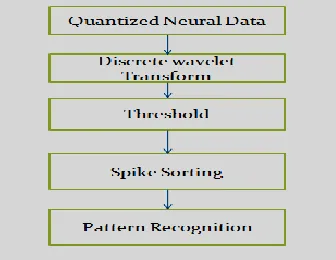
Neural data is encoded as packets containing the information about the detected spikes To de noise the data, multi resolution wavelet analysis [17] of the recorded signal is used and then spikes are sorted , and recognized as meaningful burst patterns across multiple channels.. The process is implemented in VHDL. Fig. 2 shows the simulation results for spike detection from extracellular neural data.
The intracellular recording showing the actual action potentials to check the accuracy of spike for spike detection from the extracellular data. The original noisy data is predicted with the de noised data and superimposed over them. The four different spikes are enlarged to show the quality of the reconstructed spikes. The DWT block constitutes the central part in the NSP unit. The wavelet transform [24] decomposes the input signal in time and frequency domains, giving rise to low- frequency coefficients, and high-frequency coefficients, called the ―approximations‖ and ―details‖ which helps to highlight the presence of spikes by de-emphasizing the noise. The multi resolution wavelet transform is normally realized as high-pass and low-high-pass filters [21].
[image:2.612.49.287.136.263.2]Fig. 3. (a) Flowchart of a sample neural signal-processing algorithm using the wavelet transforms.
Fig. 4. Functional block diagram of the main processing element (PE) for each step of the lifting wavelet transform
Fig. 5 shows the interface among different constituent blocks of a typical implantable system.
Based on area of minimization, the integer arithmetic
lifting approach [22] is suitable for sequential
implementation. Each of the five lifting steps requires similar computational hardware, ―processing element‖ (PE) as the basic computational block for the DWT module. It consists of two signed multipliers and two signed adders, as shown in Fig.4.For the overall DWT architecture, a parallel implementation is chosen, as shown in Fig.5, where the windowing module buffers enough samples before the lifting operations take place.
[image:2.612.340.549.318.483.2] [image:2.612.85.253.561.691.2]International Journal of Emerging Technology and Advanced Engineering
Website: www.ijetae.com (ISSN 2250-2459,ISO 9001:2008 Certified Journal, Volume 4, Issue 7, July 2014)
345 For neural signal processing, the frequency range of interest, which determines the sampling frequency, is on the order of a few kilo hertz. Considering a sampling frequency of 10 kHz, a new data sample each channel arrives every 100 s. If we consider 20 channels with time-multiplexed operation, the five-cycle DWT operations in each PE need to be complete in 5seconds, giving a minimum operating frequency target of 1 MHz The remaining operations overlap with the computation of wavelet coefficients for other channels.
IV. SIMULATION AND ITS OUTPUT
The figure (6-10) below shows the corresponding output of the paper which explains the four different types of waves and its digital form is taken and compared with the details that are already stored in the memory. The simulation is done by using VHDL Language. The simulation involves the formation of delta wave (0-4Hz), Theta (4-7Hz), Alpha (8-12Hz), beta (13-30Hz).
Delta
Fig-6 Delta Wave (0-4Hz)
Theta
Fig-7 Theta Wave (4-7Hz)
Alpha
International Journal of Emerging Technology and Advanced Engineering
Website: www.ijetae.com (ISSN 2250-2459,ISO 9001:2008 Certified Journal, Volume 4, Issue 7, July 2014)
346
Beta
Fig-9 Beta wave (13-30Hz)
Fig-10 Pattern recognition of stored value from the memory
V. CONCLUSION
The Neural signal processor accepts the random wave form of brain as input and it processes the functioning .Its digital values already stored in the memory is compared with the neural signal processors output. This helps the physicians to make a confirmed conclusion of the problem of the diseased patients. Future work will involve the application of the approach to other neural processing steps as well as other biomedical signal-processing.
Apart from the EEG as the signal given to the input EMG and ECG signals can be traced out and compared. Also data can be analysed efficiently with low power and low noise. The simulation can be done by vhdl, veriog, matlab.
REFERENCES
[1] Wise.K.D, Anderson.D.J, J. F. Hetke, Kipke. D.R, and Najafi.K,―Wireless implantable microsystems: High-density electronic interfacesto the nervous system,‖ Proc. IEEE, vol. 92, no. 1, pp. 76–97,Jan. 2004.
[2] Chi.B, J. Yao.Y, Han.S, Xie.X,Wang.Z,―Low-power transceiver analog front-end circuits for bidirectional high data rate wireless telemetry in medical endoscopy applications,‖ IEEE Trans. Biomed. Eng., vol. 54, no. 7, pp. 1291–1299, Jul. 2007.
[3] Harrison.R,―The design of integrated circuits to observe brain activity,‖Proc. IEEE, vol. 96, no. 7, pp. 1203–1216, Jul. 2008. [4] Olsson.R.H, and Wise.K.D, ―A three-dimensional neural recording
microsystem with implantable data compression circuitry,‖IEEE J. Solid-State Circuits, vol. 40, no. 12, pp. 2796–2804, Dec.2005. [5] Sodagar.M, Wise.K.D, and Najafi.K, ―A fully integrate mixed-signal
neural processor for implantable multichannel cortical recording,‖ IEEE Trans. Biomed. Eng., vol. 54, no. 6, pp. 1075–1088, Jun. 2007 [6] Fröhlich, B. and Plate, J. 2000. The cubic mouse: a new device for
three-dimensional input. In Proceedings of the SIGCHI Conference on Human Factors in Computing Systems
[7] Horiuchi.K, Swindell.T,Sander.D, and Abshire.P,‖ CMOS neural amplifier with amplitude measurements for spike sorting,‖ in Proc. IEEE Int. Symp. Circuits Syst., 2004, vol. 4, pp.29–32.
[8] Guillory.K.S and NormannR.A, ―A 100-channel system for real detection and storage of extracellular spike waveforms,‖ J. Neurosci Meth., vol. 91, no. 1–2, pp. 21–29, Sep. 1999.
[9] Chae.M, Liu.W, Yang.Z, Chen.T, Kim.J,Sivaprakasam.M, and . Yuce.M, ―A 128-channel 6 mW wireless neural recording IC with on-the-fly spike sorting and UWB transmitter,‖ in Proc. IEEE Int. Solid-State Circuits Conf., 2008, pp. 146–603.178 IEEETransaction. Transactionon on biomedical circuits and systems, vol. 5, no. 2, April 2011
[10] Roy.K,Mukhopadhyay.S, and Mahmoodi-Meimand.H, ―Leakage current mechanism and leakage reduction techniques in deepsubmiicron CMOS circuits,‖ Proc. IEEE, vol. 91, no. 2, pp. 305–327,Feb. 2003.
[11] Borkar.S, Karnik.T, Narendra.S,Tschanz.J, Keshavarzi.A, ―Parameter variations and impact on circ impact on circuits and micro architecture,‖ in Proc. Design Automation Conf., 2003, pp. 338–342.in Proc.uits and micro architecture,‖ in Proc.
[12] Chandrakasan.A.P,Verman.N, and Daly.D.C, ―Ultralow-power electronicsfor biomedical applications,‖ Annu. Rev. Biomed Eng., vol. 10,pp. 247–274, 2008
[13] Narasimhan.S,Chiel.H.J, and Bhunia.S, ―A preferential design approachfor energy-efficient and robust implantable neural signal processing hardware,‖ in Proc. 31st Int. Annu. Conf. IEEE Engineering in Medicine and Biology Soc., 2009, pp. 6383–6386. [14] Gonzalez.R,Gordon.B.M, and Horowitz.M.A, ―Supply and
International Journal of Emerging Technology and Advanced Engineering
Website: www.ijetae.com (ISSN 2250-2459,ISO 9001:2008 Certified Journal, Volume 4, Issue 7, July 2014)
347 [15] Wilson.S.B and Emerson.R, ―Spike detection: A review and
comparison of algorithms,‖ Clin. Neurophys, vol. 113, pp. 1873– 1881, 2002.
[16] Shahid.S,Walker.J, and SmithL.S, ―A new spike detection algorithm for extracellular neural recordings,‖ IEEE Trans. Biomed. Eng., vol. 57,no. 4, pp. 853–866, Apr. 2010.
[17] Narasimhan.S,Cullins.M, Chiel.H.J, and Bhunia.S, ―Wavelet-based neural pattern analyzer for behaviorally significant burst pattern recognition,‖in Proc. 30th Annu. Int. Conf. IEEE Engineering in Medicine and Biology Soc., 2008, pp. 38–41.
[18] Chandler.S, Gibson.S. Karkare.V, Farshchi.S, Markovic.D, JudyJ.W, ―A system-level view of optimizing high-channel-count wireless biosignal telemetry,‖ in 31st Annu. Int. Conf. IEEE Engineering in Medicine and Biology Soc., 2009, pp. 5525–5530. [19] Oweiss.K.G Mason.A,Suhai.Y, KambohA.M, and ThomsonK.E, ―A
scalable wavelet transform VLSI architecture for real-time signal processing in high-density intra-cortical implants,‖ IEEE Trans. Circuits Syst., vol. 54, no. 6, pp. 1266–1278, Jun. 2007.
[20] Parhi.K.K and Nishitani.T, ―VLSI architectures for discrete wavelet transforms,‖ IEEE Trans. Very Large Scale Integrated. Circuits, vol. 1, no.2, pp. 191–202, Jun. 1993.
[21] Zhai.S,Hanson.S, D. Blaauw, and Sylvester.D,―Analysis and mitigation of variability in subthreshold design,‖ in Proc. Int. Symp. Low Power Electronics and Design, 2005, pp. 20–25.
[22] Mutoh.S, Dousek.Ti, Matsuya.Y, Aoki.T, . Shigematsu.S, and Yamada.Y,―1-V power supply high-speed digital circuit technology with multithreshold-voltage CMOS,‖ IEEE J. Solid-State Circuits, vol. 30,no. 8, pp. 847–854, Aug. 1995.
[23] Gosselin.B, Ayoub.A.E, Roy.F.J, Sawan.M, F. Lepore.F, A. Chaudhuri.A,and D. Guitton.D, ―A mixed-signal multichip neural recording interface with bandwidth reduction,‖ IEEE Trans. Biomed. Circuits Syst., vol. 3, no. 3, pp. 129–141, Sep. 2009
[24] Kamboh.A.M, Raetz.M,Oweiss.K.G, and Mason.A, ―Area-power efficient VLSI implementation of multichannel DWT for data compression in implantable neuroprosthetics,‖ IEEE Trans. Biomed. Circuits Syst., vol. 1, no. 2, pp. 128–135, Jun. 2007.