International Journal of Emerging Technology and Advanced Engineering
Website: www.ijetae.com (ISSN 2250-2459, ISO 9001:2008 Certified Journal, Volume 6, Issue 7, July 2016)
Technology Transfer in Pharmaceutical Industries through
Product Development and Scale-Up Process Approaches:
Challenges and Opportunities for Developing Countries
Biruk Abate
Faculty of Chemical and Food Engineering, Bahir Dar Institute of Technology, Bahir Dar University, Bahir Dar, P.O.Box 26, Ethiopia
Article-This review article discloses the issue of pharmaceutical technology transfer in developing countries that has generated and debated for many years. Given technology centrality to development, and technology acquisition necessity by developing countries for further development and benefit, it is desirable to generate, transfer and diffuse the best available pharmaceutical technology in these countries through product development and scale-up techniques. Unfortunately, most of the world’s advanced technology is generated privately by transnational corporations, whose principal research and development activity is located in developed countries, creates an asymmetry between technology possession and technological need location. There is a gap between the technology developed and owned by firms in developed countries and that can be obtained and utilized by developing countries. The main objective of this review article is to disclose the working procedure of product development and scale-up techniques and keystone professions for technology transfer process in pharmaceutical industries in developing countries through taking an invention from its inception in a laboratory to a commercialized drug product and to highlight how technology is transferred, importance of technology transfer, reasons for technology transfer, factors influencing technology transfer : drivers and barriers, steps involved in technology transfer and to identify policy approaches that might overcome those barriers.
Keywords: Developing countries, pharmaceutical, product development, scale-up, technology transfer
I. INTRODUCTION
Transfer of advanced technology is essential for economic development as it is one means by which low- and middle-income countries can accelerate the acquisition of knowledge, experience and equipment related to advanced, innovative industrial products and processes. It has been credited with the potential to help improve health, increase the reliability of supply and decrease reliance on imports, raise the competence of the local workforce, and reverse the “brain drain” from low and middle income countries, by increasing local “high-tech” employment opportunities [7].
Transfer of technology is the practice of transferring scientific findings from one organization to another for further development, so that new products and health services can become available to the public [3]. Technology transfer is the intersection between business, science, engineering, law and government and is both integral and critical to the drug discovery and development process for new medicinal product [17]. Here chemical engineers produce bulk pharmaceutical compounds used in safety assessment and clinical trials. They can handle synthetic organic processes using complex organic chemistry and advanced separation technology to recover
products. They can monitor and evaluate new
pharmaceutical processing technologies together working in process research and developmental areas and their work provides the foundation for the ultimate pharmaceuticals manufacturing process.
I-A. Importance of technology transfer
The process is important to elucidate necessary information for technology transfer from research & development to product development laboratory and for development of existing products to the production for commercialization [14]. In the pharmaceutical industry technology transfer refers processes that are necessary for successful progress from drug discovery to product
development, to clinical trials to full scale
International Journal of Emerging Technology and Advanced Engineering
Website: www.ijetae.com (ISSN 2250-2459, ISO 9001:2008 Certified Journal, Volume 6, Issue 7, July 2016)
Generally scale up involves the transfer of technology and the transfer of knowledge that has been accumulated during the small scale development of product and processes [12, 18, 19]. It is important to realize that good communication is critical for formulation and process transfer to be successful. It is essential for a researcher or developer of technology to make available this technology to another person’s to exploit for the progress of development of technology and for exploitation of a technology in different fields of applications and to make is use with another organization that may have better manufacturing capability, marketing capability and commercial capability. In the pharmaceutical industry,
technology transfer by collaborating with other
departments and other organizations to commercialize a pharmaceutical product is a common process [13, 16]. Over and above the beneficial impact on economic and social development normally credited to technology transfer, in the field of pharmaceuticals, transferring technology can help improve the health of recipient countries’ populations by increasing access to innovative medicines and vaccines [7, 13, 17].
IB- Reasons for technology transfer
Due to lack of manufacturing capacity: The developer of technology may only have manufacturing equipment which is suitable for small scale operation, and must collaborate with another organization to do large scale manufacturing. Due to lack of resources to launch product commercially: The original inventor of technology may only have the resources to conduct early-stage research such as animal studies and toxicology study, but doesn’t have the resources to take technology through its clinical and regulatory phases.
Due to lack of marketing and distribution capability: The developer of technology may have fully developed the technology and even have obtained regulatory approvals and product registrations, but it may not have the marketing and distribution channels.
Exploitation in a different field of application: Each partner may have only half of the solution i.e. the developer of the technology might be capable of exploiting the technology itself in the field of diagnostic applications and may grant exploitation right to commercial partner for the exploitation of therapeutics application [10, 13].
I-C. Technology transfer steps
It’s much more than simply handing over technology - The transfer of R&D pharmaceuticals is more than a question of “bricks and mortar” or providing a “tool box”.
It occurs through many channels, all of which result in improving the economic capabilities of the recipient. What is transferred may be a physical object or pure knowledge. Following one definition, one can identify the following elements:
“Techno-ware”: for the pharmaceutical industry this would include the transfer of physical objects such as equipment for use in research laboratories or production equipment for manufacture of pharmaceuticals ingredients, or formulation or packaging of final products.
“Human-ware”: skills and human aspects of technology management and learning, such as a training course for researchers or general practitioners across the world. Technology transfer can also create positive spillover effects into associated industries and into the supporting public sector research infrastructure.
“Info-ware”: all techniques related to knowledge, information and technology, in the form of a technology license.
“Orga-ware”: organizational and procedural knowledge needed to operate a given technology relating to a chemical or biological compound. This tells us that technology transfer is not a single way process. Whether a tablet, a transdermal patch, a topical ointment, or an inject able, the transformation of a pharmaceutical prototype into a successful product requires the cooperation of many individuals. The classic view of a flow from basic to applied technology is a great over simplification-sometimes, e.g. problems or insights arising at the production level give rise to new ideas that contribute to fundamental basic advance. At least in some sectors, close links between the basic researchers and manufacturing experts, and even marketing personnel contribute to competitiveness and advancement [3, 11, 18]. Development of new formulation goes through many stages as shown in figure1. During development of a formulation, it is important to understand procedure of operations used, critical and non-critical parameters of each operation,
production environment, equipment and excipient
International Journal of Emerging Technology and Advanced Engineering
Website: www.ijetae.com (ISSN 2250-2459, ISO 9001:2008 Certified Journal, Volume 6, Issue 7, July 2016)
[image:3.612.47.301.184.347.2]It illustrates the technology transfer success criteria that is sending and receiving unit of technology transfer is not a “one way street”. The sending unit and receiving unit must be equally involved in the process to ensure success [1, 8].
Figure 1. Schematic representation of technology transfer process [9, 15]
II. PHARMACEUTICAL TECHNOLOGY TRANSFER
II-A. Development of technology by research & development during research phase
Design of procedure and selection of excipients by research & development
Selection of materials and design of procedures is developed by research & development on the basis of innovator product characteristics. For this different tests and compatibility studies are done.
Identification of specification and quality by research & development
Generally it should be considered by research & development that quality of product should meet the specifications of an innovator product. For this different stability studies are carried out for innovator product and for product which is to be manufactured.
II-B. Technology transfer from research & development to production during development phase
Research & development provides technology transfer dossier document to product development laboratory, which contains all information of formulation and drug product as given below:
Master formula card
It includes product name along with its strength, generic name, master formula card number, page number, effective date, shelf life and market.
Master packaging card
It gives information about packaging type, material used for packaging, stability profile of packaging and shelf life of packaging.
Master formula
It describes formulation order and manufacturing
instructions. Formulation order and manufacturing
instructions gives idea of process order, environment conditions required and manufacturing instructions for dosage form development.
Specifications and standard test procedure
It helps to know active ingredients and excipients profile, in process parameters and specifications, product release specification and finished product details.
II-C. Optimization and Production (Production Phase)
Validation studies
Production is implemented after validation studies that can verify that process is able to stabilize the product based
on transferred manufacturing formula. While the
manufacturing department accepting technology is
responsible for validation, the research and development
department transferring technology should take
responsibility for validation such as performance qualification, cleaning validation, and process validation which are unique to subject drugs.
Scale up for production
International Journal of Emerging Technology and Advanced Engineering
Website: www.ijetae.com (ISSN 2250-2459, ISO 9001:2008 Certified Journal, Volume 6, Issue 7, July 2016)
Operators concentrate on keeping their segment of the production process running smoothly. But the whole manufacturing line can be improved, even before production begins, if technology transfer is implemented thoughtfully. Effective technology transfer helps to provide process efficiency and control and maintain product quality [16, 18]. To avoid scale up problems, it is important for chemists – with expert advice from chemical engineers -to choose the correct conditions to scale [20]. For example scale up of agitation can be based on a number of factors but it is recommended to use constant power per unit volume or mass [21]. This mixing energy dissipation is given by:
Ei = NpN3d5/V, where
d = impeller diameter (m) Np = power number
N = rotational speed (sec-1)
V = volume (m3)
Specifications and standard test procedure
It helps to know active ingredients and excipients profile, in process parameters and specifications, product release specification and finished product details.
II-D. Technology transfer documentation
Technology transfer documentation is generally
interpreted as document indicating contents of technology transfer for transferring and transferred parties. Each step from research & development to production should be documented, task assignments and responsibilities should be clarified and acceptance criteria for completion of technology transfer concerning individual technology to be transferred. It is duty of quality assurance department to check and approve the documentation for all processes of technology transfer.
Development report
The ultimate goal for successful technology transfer is to have documented evidences. The research & development report is a file of technical development, and the research and development department is in charge of its documentation. This report is an important file to indicate rationale for the quality design of drug substances and drug specifications and test methods. The development reports before the approval inspection. Although the development report is not prerequisite for the application for approval, it can be used at the preapproval an inspection as valid document for quality design of new drug. In addition, this report can be used as raw data in case of post-marketing technology transfer.
The development report contains data of pharmaceutical development of new drug substances and drug products at stages from early development phase to final application of approval, information of raw materials and components, rational for dosage form & formula designs and design of manufacturing methods, change in histories of important processes and control parameters, stability profile, specifications and test methods of drug substances,
intermediates, drug products, raw materials, and
components, which also includes validity of specification range of important tests such as contents impurities and dissolution, rational for selection of test methods, reagents and, columns, and traceability of raw data of those information.
Technology transfer plan
The technology transfer plan is to describe items and contents of technology to be transferred and detailed procedures of individual transfer and transfer schedule, and to establish judgment criteria for the completion of the transfer. The transferring party should prepare the plan before the implementation of the transfer and reach an agreement on its contents with the transferred party.
Report
Report completion of technology transfer is to be made once data are taken accordingly to the technology plan and are evaluated to confirm that the predetermined judgment criteria are met. Both transferring and transferred parties can document the technology transfer report however; they should reach an agreement on its contents [3].
Exhibit
After taking scale up batches of the product, manufacturing of exhibit batches take place. In case of exhibit, batch sizes are increased along with equipments and their processes involved. They are done for filing purposes in different regulatory agencies [5].
II-E. Stages in the development of a new medicine and why technology transfer
Continuous knowledge transfer and industry’s paradigm shift:
International Journal of Emerging Technology and Advanced Engineering
Website: www.ijetae.com (ISSN 2250-2459, ISO 9001:2008 Certified Journal, Volume 6, Issue 7, July 2016)
Continuous knowledge
Transfer- and Regulatory Stakeholder Opportunities Regulatory stakeholder opportunities which should contain highly interpretable regulations and guidelines, intermittent transfer of knowledge, reactive inspection and review practices as mentioned below.
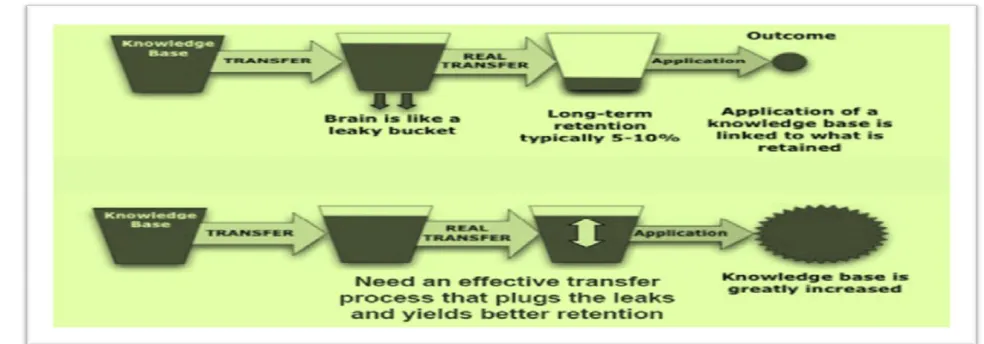
Technology transfer- How and When - Knowledge Transfer Process
[image:5.612.69.547.220.593.2]- Technology Transfer Success Criteria
International Journal of Emerging Technology and Advanced Engineering
[image:6.612.65.550.141.504.2]Website: www.ijetae.com (ISSN 2250-2459, ISO 9001:2008 Certified Journal, Volume 6, Issue 7, July 2016)
International Journal of Emerging Technology and Advanced Engineering
[image:7.612.62.551.143.322.2]Website: www.ijetae.com (ISSN 2250-2459, ISO 9001:2008 Certified Journal, Volume 6, Issue 7, July 2016)
Figure 4. Continuous knowledge transfer and industry’s Figure 5. Continuous knowledge transfer and regulatory
stakeholder opportunities [8] paradigm shift [8]
Figure 6. Knowledge transfer process-how and when [8]
[image:7.612.53.545.365.537.2]International Journal of Emerging Technology and Advanced Engineering
[image:8.612.57.556.123.625.2]Website: www.ijetae.com (ISSN 2250-2459, ISO 9001:2008 Certified Journal, Volume 6, Issue 7, July 2016)
[image:8.612.71.550.394.623.2]Figure 7. Knowledge Based Technology Transfer Process [10]
International Journal of Emerging Technology and Advanced Engineering
[image:9.612.64.550.157.305.2]Website: www.ijetae.com (ISSN 2250-2459, ISO 9001:2008 Certified Journal, Volume 6, Issue 7, July 2016)
Table II-A
Stages in the Development of a New Medicine and technology transfer [8]
Discovery 4-10 years Exploratory Development 3+ years Regulatory Development 3+ years Commercialization 3+ years Research target: -Biological Evaluation -Integrated Research -Candidate Drug -Formulation -Patents Formulation Development &Process Development Phase I-Clinical trials Phase II-Clinical trials Phase III-Clinical trials * Build /Select API Manufacturing Manufacturing Registration * Built/Select Manufacturing Facilities Launch * Sales
Optimization using statistical methods for scale up:
When dosing solutions of reagents in the laboratory, chemists usually add to the surface of the agitated liquid and this works fine on small scale. If this is done on the plant, however, poor mixing may occur in large reactors. The key is to add the reagents into a region of high turbulence, such as close to the tip of the agitator, using a dip pipe, or to add reagents via a recirculation loop.
In many companies process optimization using one parameter at a time variations is carrying out whereas the trend elsewhere is to use the Design of Experiments (DoE) approach, recognizing that variables are rarely independent of each other for example rate of addition and temperature. For these detailed parameter studies it is important to study variables which affect scale up, such as dosing time and mixing, and parameters in the work-up and product isolation as well as in the reactions. Only by looking at the effect of all these interacting parameters can a truly optimized process, which works well on scale and is efficient and robust, be developed [20].
For pharmaceutical processes, regulatory authorities are keen to see the DoE approach used in new submissions, since it shows that “quality has been is designed into the process” and gives assurance that the process robust, and that the manufacturer knows the design space in which to operate and where the edge of failure lies. Such data is of course important and extremely useful for a plant manager operating any pharmaceutical or chemical process and process understanding always leads to better process control and usually to more successful scale-up![20].
II-G. Technology transfer team
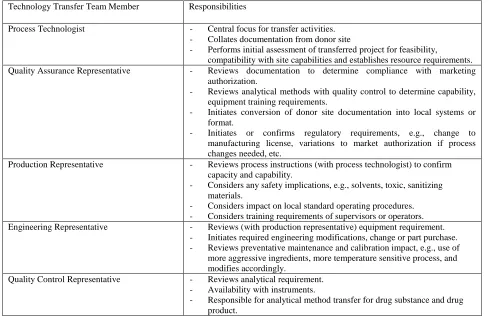
The technology transfer team members and their responsibilities are tabulated in Table II-B [2].
II-H. Factors influencing technology transfer
Drivers for technology transfer:
Good business and manufacturing practices: The Company’s success is primarily the result of its adoption of good business and manufacturing practices, particularly in the areas of product identification and formulation technology.
Potential for competitive pricing:
Balance cost to remain competitive by having higher private sector prices and very low public sector prices. Strategic planning: Create an enabling environment for vertical integration, with prospects for higher capacity utilization and eventual lowering of production costs. Strong economy and environment: For technology transfer to be successful there needs to be supportive business and scientific environment in the recipient country, and that environment should include skilled workers, economic and political stability, supportive regulatory environment, market size and potential and a well developed national infrastructure of natural resources and transport.
Transparent and efficient regulation:
Pharmaceuticals are necessarily a high regulated industry and the regulatory function must be efficient and transparent for technology transfer to be economically viable.
Opportunities for contingency supply:
International Journal of Emerging Technology and Advanced Engineering
Website: www.ijetae.com (ISSN 2250-2459, ISO 9001:2008 Certified Journal, Volume 6, Issue 7, July 2016)
Access to new machinery, training, knowhow and business partnership:
[image:10.612.70.545.199.374.2]This makes the prospect of technology transfer very desirable to local pharmaceutical manufacturers since the technology, equipment, etc. could be applied profitably beyond the initial purpose.
International Journal of Emerging Technology and Advanced Engineering
[image:11.612.64.553.158.476.2]Website: www.ijetae.com (ISSN 2250-2459, ISO 9001:2008 Certified Journal, Volume 6, Issue 7, July 2016)
Table II-B
Constitution of technology transfer team and their responsibilities
Technology Transfer Team Member Responsibilities
Process Technologist - Central focus for transfer activities.
- Collates documentation from donor site
- Performs initial assessment of transferred project for feasibility,
compatibility with site capabilities and establishes resource requirements. Quality Assurance Representative - Reviews documentation to determine compliance with marketing
authorization.
- Reviews analytical methods with quality control to determine capability, equipment training requirements.
- Initiates conversion of donor site documentation into local systems or format.
- Initiates or confirms regulatory requirements, e.g., change to manufacturing license, variations to market authorization if process changes needed, etc.
Production Representative - Reviews process instructions (with process technologist) to confirm capacity and capability.
- Considers any safety implications, e.g., solvents, toxic, sanitizing materials.
- Considers impact on local standard operating procedures. - Considers training requirements of supervisors or operators. Engineering Representative - Reviews (with production representative) equipment requirement.
- Initiates required engineering modifications, change or part purchase. - Reviews preventative maintenance and calibration impact, e.g., use of more aggressive ingredients, more temperature sensitive process, and modifies accordingly.
Quality Control Representative - Reviews analytical requirement. - Availability with instruments.
- Responsible for analytical method transfer for drug substance and drug product.
The Chemical Engineer’s Challenge in Pharmaceuticals industries
As a profession, Chemical Engineers must now ensure that they are involved with pharmaceutical product development in the laboratory, so that they can use their skills to ensure that the most efficient process is used to manufacture pharmaceutical products. If they work together with the other professionals in the industry they have the opportunity to bring about the level of change that came about within the oil and gas industry during the 1950s and 1960s.
Since the health mankind and the industry’s impact on the natural environment of the world will be to a great extent dependent of their efforts to improve efficiency, it is believed that the Chemical Engineers working within the pharmaceutical industry are duty bound to set about changing their own mind set and helping to change that of others. If this opportunity is missed, it is unlikely that the profession will have another opportunity to have such an impact on the industry and the initiative will pass to a
It is unlikely than any other group will have the required skill to reap all of the benefits to mankind that chemical engineers can and we will all be the poorer for their failure.
Challenges or Barriers of Technology Transfer
Lack of efficiency Automation of production processes to improve efficiency and lower costs. Low market share: Local producers face significant challenges in meeting International Quality Standards and capturing a critical market share. Greater market share would increase profitability.
International Journal of Emerging Technology and Advanced Engineering
Website: www.ijetae.com (ISSN 2250-2459, ISO 9001:2008 Certified Journal, Volume 6, Issue 7, July 2016)
The possible solutions or policy approaches to overcome barriers in technology transfer and commercializing publicly funded technologies:
The basic pattern envisioned is to give institutions receiving public research funds the right to obtain and exploit patents on inventions developed in the course of research. Research tool patents and freedom to operate for the public sector: Patents sometimes make it difficult for public researchers to carry out their research or to make the products of that research available. It is intensified by the tendency of some publicly funded research laboratories to avoid use of a patented technology without permission even in nations where no relevant patent is in force. Web access and scientific publication: Limited access to scientific journals led to enormous problems for developing nations scientists. National security issues and restrictions on exports of particular technology: International controls designed to protect national security and to prevent the proliferation of important technologies also restrict the flow of technologies. Inadequate funding in important areas and possible treaties: There are areas of research of importance to the developing world that are being funded inadequately. Co-operative research agreements: Global support for public sector research might be encouraged is through co-operative research agreements designed to meet specific goals. It would seem more feasible to focus efforts on technologies of significant social benefit to the developing nations. Possible treaty on scientific access: There has also been a proposal for an international treaty on access to knowledge and technology negotiated on the basis of the type of reciprocity found in normal international trade negotiations. The concept is mean to be non- zero sum in the sense that, like free trade in goods, free trade in scientific ideas benefits all, and such arrangements could be made bilaterally as well as multilaterally [4,16].
Technology transfer isn’t done right
Process Validation may be unsuccessful. Delayed regulatory approval and or product launch. Flawed processing may result– high rate of batch rejections, costly schedule revisions and excessive labour requirements. Analytical methods cannot support production. Product does not perform as intended.
Issues in the Technology Transfer Process
Pharmaceutical and biotech industry is becoming increasingly competitive many players are boosting their
in-licensing activities, consolidating manufacturing
networks and outsourcing production to less costly third-party manufacturers.
All these strategic initiatives require effective
technology transfer–smoothly moving technical knowledge processes and analytical requirements between the different parties involved. The issues to be focused are: Lack of repeatable and scalable business processes– Many organizations manage transfers as isolated, non strategic events involving little more than a procedural exchange of process documents between sending and receiving parties. But without repeatable and scalable processes companies are forced to reinvent the wheel each time technology changes hands. This leads to variety of inefficiencies such as suboptimal allocation of resources, higher development costs, and quality and compliance issues.
Lack of experience working with Contract
Manufacturing Organizations–The key building blocks of this approach include: rigorous selection process of
contract manufacturing partner, clear and well
documentation objectives and expectations, leading-edge process guide-lines and project management tools and high-performance, dedicated cross functional technology transfer teams.
III. CONCLUSION
For many in the developing world, “technology transfer” is seen simply in terms of developing local manufacturing capacity. Manufacturing medicines is a complex, time-consuming, capital intensive, highly regulated process requiring an efficient supply chain and supporting infrastructure of highly qualified staff, and reliable and continuous supplies of water, gas and electricity.
International Journal of Emerging Technology and Advanced Engineering
Website: www.ijetae.com (ISSN 2250-2459, ISO 9001:2008 Certified Journal, Volume 6, Issue 7, July 2016)
To assure the drug quality, it is desire to make sure that is what, when, and why information should be transferred to where and by whom and how to transfer, then share knowledge and information of the technology transfer each other between stake holders related to drug manufacturing [5,7]. Appropriate transfer of technology is important to upgrade the quality of design to be the quality of product, and ensure stable and high quality of the product.
Technology transfer can be reflected successful if a receiving unit can routinely reproduce the transferred product, process or method against a predefined set of specifications agreed with a sending unit and/or a development unit. In general, progressive pharmaceutical companies should give more attention to streamlining and optimizing their technology transfer process to ensure the rapid and successful introduction of new medicinal products to market. A devoted technology transfer organization should set up to facilitate and execute the process. To achieve this end, it’s recommended that company should adopt a rigorous process to select its contract manufacturing partners to prevent issues in the future collaboration process. Provide strong support for scientific education and for basic research in areas that are important to the nation. It is important to remove barriers to the free flow of science and technology. Heading global technological integration is far better for a world than political restrictions on the transfer of technology.
IV. RESEARCH HIGHLIGHTS
Scale-up of pharmaceutical processes, particularly those involving batch or semi-batch manufacture is well-known
to be a problematic area of chemistry and chemical
engineering, and can be costly when it goes wrong. By correctly choosing and designing the synthetic route to a fine drug substance, as well as controlling the reaction and work up/product isolation parameters, many of the difficulties in scale up can be avoided. The more complex a process is in terms of chemistry and unit operations, the more there is to go wrong. Therefore this review study highlights what chemists and engineers can do in advance, both in the laboratory and kilo laboratory, to prevent or at
least minimize scale up issues in pharmaceutical industries.
Therefore, pharmaceutical technology transfer can help to develop dosage forms in various ways as it provides efficiency in process, maintains quality of product, helps to achieve standardized process which facilitates cost effective production. Pharmaceutical technology transfer has important in extended benefits of R&D to the society especially in developing countries in preparation of dosage form needs scale up at several stages.
Developing countries are experiencing unprecedented levels of economic growth and development, transfer and use of pharmaceutical technologies which are promising ways towards for production of high quality and low priced drug product even though it costs high investment during lab scale, scaling up and the beginning of the batch size manufacturing processes. Technology transfer is the useful process and needed for successful progress from drug discovery to product development to clinical trials to full scale commercialization. So the present research will provide a milestone for the further research of
pharmaceutical technology transfer which actively
manipulated by the continual upside down efforts of chemists and chemical engineers in their pilot plants as well as in the pharmaceuticals processing units both in primary or Active Pharmaceutical Ingredients synthesis (APIs) and secondary processing stages.
V. LIMITATIONS
There may be a variation in this review results due to type of technology selection and justification, the planning stage, negotiation and technology transfer implementation can influence the interpretation results of pharmaceuticals technology transfer. In addition to these missing of scale-up and product development techniques may enhance pharmaceuticals technology transfer problems due to miss assigning of professionals instead of focusing on chemists and chemical engineers skill and knowledge input in process development and scale up operations.It is unlikely than any other group will have the required skill to reap all of the benefits to mankind that chemical engineers can and we will all be the poorer for their failure.
VI. RECOMMENDATIONS
During the development of a formulation, it is necessary to understand the procedure of operations used ,critical and non-critical parameters of each operation, production environment, equipment and excipients availability should be taken into account during the early phases of development of formulation so that successful scale up can be easily carried out.
International Journal of Emerging Technology and Advanced Engineering
Website: www.ijetae.com (ISSN 2250-2459, ISO 9001:2008 Certified Journal, Volume 6, Issue 7, July 2016)
Regarding to funding and policy aspects as far as my knowledge is concerned it has to be facilitated or arranged viz government private/ has to work jointly for any funding issue of the scenario.
Author’s Contribution
The reviewed work is carried out by Biruk Abate (the author). This research article was collected, organized and
reviewed from previous research articles and
pharmaceutical technology transfer guide books.
Acknowledgement
The author is very grateful to Dr. Merkuz Abera, associate professor at Bahir Dar University College of Agriculture and Environmental Science and Mr. Admassu Fanta, Lecturer and Researcher at Bahir Dar Institute of Technology Faculty of Chemical and Food Engineering, Bahir Dar University for their giving me moral and directing my attention to research and development in addition to lecturing and advising activities in our University.
REFERENCES
[1] Ali S., Pandit V., Chander S., 2012. Technology Transfer in Pharmaceuticals. Int Res J Pharm, 3(6), 43-48.
[2] Allameni Y., Chary P.D., Kumar S.C., Rao V.B., 2012.Technology Transfer Process in Pharmaceutical Industry: An Overview. Cited
on: 2012 July 12. Available from: URL:
http://www.pharmatutor.org/articles/overviewoftechnology- transfer-in-pharmaceutical-industry
[3] Amanjeet S. and Geeta A., 2010. Technology transfer in pharmaceutical industry: A discussion international journal of pharma 3/julsep.2010www and bio sciences, vol.1/issue .ijpbs. net pharmaceutics
[4] Barton J.H. 2007 New Trends in Technology Transfer Implications for National and International Policy. ICTSD Programme on IPRs and Sustainable Development 2007, 18, 14-31.
[5] Gibson. M, 2010.Technology Transfer Introduction and Objectives, 1-11.Cited on 2010 February 02. Available from URL:
https://store.pda.org/bookstore/table of con
tents/tech_transfer_Ch01.pdf
[6] HBOPGD (Hand Book of Pharmaceutical Generic Development), 2000. The Complete Handbook Series of Pharmaceutical Drug Development, Oral Tablets, ISBN 0793 8632-Electronic Version – Handbook Development 24 Volume Series ISSN Series Number 0793 761X - Electronic Version, Volume I0 – Part One, Second international Edition-02 First to Fourth Print, January, 2000. [7] IFPMA (International Federation of Pharmaceutical Manufacturers
Associations), 2011. Technology Transfer: a Collaborative Approach to Improve Global Health, the Research-Based Pharmaceutical Industry Experience.
[8] Le T.V., 2006. Joint CVG/Therapeutic Products Directorate International Convention and Exhibition Toronto, Canada, October 5-6, 2006, Technology Transfer Challenges in Pharmaceutical Industry.
[9] Le Trong Vu, P. Eng. Manager, Validation, and Purdue P., Luis A.R., Nuria S., Carmen T., 2007. Guidelines for a pharmaceutical technology transfer towards a drug manufacturing plan.
[10] Mahboudi M., Ananthan R.B., 2010. Technology Transfer Process (Source: Effective Factors in Technology Transfer in the Pharmaceutical Industries of Iran, University of Mysore, and February 1, 2010
[11] Mendes P, 2010. Licensing and Technology Transfer in the Pharmaceutical Industry cited 2010 February23. Available from:
URL: http://www.wipo.int/sme/en/documents/phar
ma_licensing.html
[12] Michael L., 2001. Pharmaceutical Process Scale-Up edited by Michael Levin Metropolitan Computing Corporation East Hanover, New Jersey Copyright © 2001 by Marcel Dekker, Inc.
[13] Ortega A.J., Arce N.A., Sequeda F., Gribenchenko I., 2009. Management of Innovation and Technology
[14] Pyle H.R., Silvestri L.J., 2012. Good Development Practices. Cited on: 2012 July 8. Available from: URL
[15] Rajesh K., Bharat P., Pankaj S., Subash C., 2013. Review on Premna Species: Internationale pharmaceutical sciencia, July-September
2012, vol. 2, issue 3, available online
http://www.ipharmsciencia.com, ISSN 2231- 5896, ©2012 ips [16] Rajkumar P., Patel, 2010. Technology Transfer in Pharmaceutical
Industry: Objective, Issues and Policy Approaches, International journal pharma. Research and Development. Online (IJPRD) [17] Reamer A., Icerman L., Youtie J., 2010. Technology Transfer and
Commercialization: Their Role in Economic Development,
2003.cited 2010 january31.Availablefrom:
URL:http://www.eda.gov/ImageCache/EDAPublic/documents/pdfdo cs/eda5fttc_2epdf/v1/eda_5fttc.pdf
[18] Ruegger E., Royce E., Mollan J., Wagner F., Valazza J., Mecadon R., 2009. Scale up of Solid Dosage Forms. 2006. Cited 2009
October 08. Available from: URL:
http://www.informaworld.com/smpp/content ~db=all
content=a758580018
[19] Skelly P., Van Buskirk A., Savello R., Amidon L., Arbit M., Dighe. S, Fawzi. M, Gonzalez A., Malick M., Malinowski H., 1993. Scale up of Immediate Release Oral Solid Dosage Forms, Pharmaceutical Research, 10(2), 313-316.
[20] Trevor L., Chemical Industry Digest. July 2010. How to minimize scale up difficulties.
[21] E.L. Paul, Y.A.Atiemo-Obeng and S.M.Kresta, Handbook of Industrial Mixing, Wiley-Interscience, 2004.
![Figure 1. Schematic representation of technology transfer process [9, 15]](https://thumb-us.123doks.com/thumbv2/123dok_us/8691025.877165/3.612.47.301.184.347/figure-schematic-representation-technology-transfer-process.webp)
![Figure 2. Product development flowchart, source: Handbook of pharmaceutical [6, 19]](https://thumb-us.123doks.com/thumbv2/123dok_us/8691025.877165/5.612.69.547.220.593/figure-product-development-flowchart-source-handbook-pharmaceutical.webp)
![Figure 3. Product development flowchart continued from figure 2 [6, 19]](https://thumb-us.123doks.com/thumbv2/123dok_us/8691025.877165/6.612.65.550.141.504/figure-product-development-flowchart-continued-figure.webp)
![Figure 7. Knowledge Based Technology Transfer Process [10]](https://thumb-us.123doks.com/thumbv2/123dok_us/8691025.877165/8.612.57.556.123.625/figure-knowledge-based-technology-transfer-process.webp)
![Table II-A Stages in the Development of a New Medicine and technology transfer [8]](https://thumb-us.123doks.com/thumbv2/123dok_us/8691025.877165/9.612.64.550.157.305/table-ii-stages-development-new-medicine-technology-transfer.webp)
![Figure 9. The Drug Discovery and Development Process and Technology Transfer [22].](https://thumb-us.123doks.com/thumbv2/123dok_us/8691025.877165/10.612.70.545.199.374/figure-drug-discovery-development-process-technology-transfer.webp)