International Journal of Emerging Technology and Advanced Engineering
Website: www.ijetae.com (ISSN 2250-2459, ISO 9001:2008 Certified Journal, Volume 6, Issue 11, November 2016)
127
A Method for Order of the Poles of the Propagation Constant in
Its Laurent Series for Lossless Closed Waveguides using
Algebraic Function Theory
Ersoy Kelebekler
1, Namık Yener
21Electricity and Energy Dep. Uzunciftlik Nuh Cimento VHS of Kocaeli University, Kocaeli, Turkey 2
Department of Biomedical Engineering, Kocaeli University, Kocaeli, Turkey
Abstract—The propagation characteristic in the vicinity of the pole points have been studied based on the algebraic function theory. The propagation characteristics in the neighborhood of the poles have been obtained from the MoM and the Laurent series expansion using the algebraic function theory. A numerical method has been proposed to determine order of any pole. The poles of the closed plasma column loaded cylindrical waveguides have been studied as a numerical example.
Keywords— pole, algebraic function theor, method of moment, Laurent series expansion.
I. INTRODUCTION
The Maxwell equations are differential equations which depend on three variables of dimensions in space and time. As known, the Maxwell equations do not permit closed form solutions for all physical structures. In such cases, numerical and/or semi analytical solutions can be obtained for closed and sourceless waveguides, as presented for example in Schelkunoff’s classical paper [1]. Schelkunoff transformed Maxwell’s partial differential equations into ordinary differential equations depending on only the propagation direction variable by modeling the waveguide as a system of infinite transmission lines. Eigen functions of the empty waveguide, trigonometric functions for rectangular structures and Bessel functions for cylindrical structures, are used in the method to represent the unknown fields as infinite series of these eigen functions. If the variation in accordance with propagation direction is
assumed , the ordinary differential equations system
transforms into a linear algebraic equations system as given in Eq.(1) for fully/partially gyrotropic medium loaded closed waveguides. As a result, the problem transforms into an eigenvalue problem.
[ ( ) ( ) ( ) ( )] [
( ) ( ) ] [
( )
( )]
Here, γ is the propagation constant. Z(p) and Y(p) are the series impedance and the shunt admittance coupling matrices, per unit length. v(p) and i(p) are vectors of transmission line voltages and currents, respectively. Besides, p=σ+jω is the complex frequency. The eigenvalues of the system in Eq.(1) give directly the propagation constants of the structure. In the method, the field expressions consist of infinite summations with the current and the voltage values as the coefficients. The method uses analytic eigen solutions of the empty structures and it is necessary to truncate the series summation in a certain value. So, the method is a semi analytical method and also called the Method of Moment (MoM).
The necessity of truncation of infinite summation at a certain point gives approximate solution of the problem.
γ2(p) is the eigenvalue of the matrix product Z(p)Y(p) and
Y(p)Z(p) which share the same eigenvalues. v(p) and i(p) are the eigenvectors of Z(p)Y(p) and of Y(p)Z(p),
corresponding to γ2(p) [2].
While the eigenvalue of product of non-truncated infinite dimensional Z(p) and Y(p) gives actual physical
eigenvalue, γ2phys(p), it was shown in [3] that there always
exists a finite dimension of truncated Z(p) and Y(p) whose product has at least one eigenvalue arbitrarily close to
physical eigenvalue, γ2phys(p). Considering this fact, MoM
is used as base for the presented method. Besides, the
validation of the MoM for investigated structure in this paper, the plasma column loaded cylindrical waveguide, was investigated in previous studies by the authors [4]-.[9]. It has been shown to be valid for gyro-resonance region where the normalized frequency (Ω) is between 0 and min(1,R) in[4]-[5] and for plasma-resonance region where
the normalized frequency is between max(1,R) and Ωu in
International Journal of Emerging Technology and Advanced Engineering
Website: www.ijetae.com (ISSN 2250-2459, ISO 9001:2008 Certified Journal, Volume 6, Issue 11, November 2016)
128
Additionally, the exact solution, the MoM solution and quasitatic solutions belonging to the structure were given and validation of MoM results was achived by presenting comparatively complex dispersion curves obtained from these solutions in [9].
√
In above expressions, Ω, R and Ωu denote the
normalized operating frequency, the normalized cyclotron frequency and the normalized upper hybrid frequency, respectively and are described in (2) where, ω is the
operating frequency, ωp is the plasma frequency and ωc is
the cyclotron frequency. The variation of the field for plasma column loaded cylindrical waveguide is described as below.
( ) ( )
( )
where, n is the azimuthal variation number, and r, φ, z are the cylindrical coordinates. γ = α+jβ is the complex propagation constant while α is the attenuation constant and β is the phase constant. Plasma column tensor permittivity is given in cylindrical coordinate system below.
̃ ( ⃗ ⃗ ⃗ ⃗⃗⃗ ⃗⃗⃗ ⃗ ⃗⃗⃗ ⃗⃗⃗ ⃗ ⃗)
where, ε0 is the free space permittivity and
( )
The permeability in entire structure is equal to free space permeability of free space.
It has been shown by Yener in [10] that characteristic equation of truncated finite (mxm) dimension of Z(p)Y(p), which the square of approximate propagation constant satisfies because of (1), is an algebraic equation of degree
m in γ2(p) whose coefficients are polynomials in p.
G( ,p)=a0(p) + 1(p) + +am(p)=0
The coefficient polynomials a1(p), a2(p),…,am(p) can be
computed form G(γ2, p)=det[γ2(p)I-Z(p)Y(p)] where det
and I denote determinant and identity matrix [11].
The main point of the presented method is relation between the characteristic equation of Z(p)Y(p) resulting
from the MoM and an algebraic equation G(γ2, p)=0. The
approximate propagation constants are obtained from solution of the characteristic equation and the behavior of the propagation at the pole points is modeled with the algebraic function theory. The singular points which can be poles or branch points or pole branch points are obtained from poles of Z(p)Y(p) and zeros of the discriminant of
G(γ2
, p)=0. In the portion of the dispersion curve, We are interested in, if the phase constant β(ω) approaches infinity
while operating frequency approaches ω0, it means that
there is a singular point at ω0. Besides, a0(jω0) vanishes in
Eq.(6), if jω0 is pole or pole branch point. It is stated by
Yener in [2] that jω0 is a pole and cannot be pole branch
point for closed lossless guiding system with Hermitian
constituent ̃ and ̃ matrices that do not couple transverse
to longitudinal field components and whose entries are rational function of p. For plasma column which conforms with this description, there exist no pole branch points as singular points.
The algebraic function theory provides some advantages and it can be used in theoretical analysis. The propagation constant can be expressed as an analytical function in the form of infinite series. It also provides a deeper physical insight of the problem [2].
In the study, characteristics of the propagation have been investigated based on the algebraic function theory. The propagation characteristic of the plasma column loaded cylindrical waveguide has been obtained from the MoM and the Laurent series with different orders using the algebraic function theory. Besides, a numerical method has been proposed to determine the order of the pole. In the paper, the pole points are determined analytically in the next section, the theory of the presented method is given in section 3, the poles of the plasma column loaded cylindrical waveguide are obtained in section 4 and the paper ends with the conclusion.
II. ANALYTICAL INVESTIGATION OF THE POLES
International Journal of Emerging Technology and Advanced Engineering
Website: www.ijetae.com (ISSN 2250-2459, ISO 9001:2008 Certified Journal, Volume 6, Issue 11, November 2016)
129
When ε1 and ε2 in Eq. (5) are considered, it is seen
obviously that there is a pole at Ω=R. Separately, ε3 causes
a singular point and a pole at Ω=1 because it appears as a denominator in the exact dispersion relation given in [13]. Behavior of the propagation constant in the neighborhood of the pole points described asymptotically in [6]-[8],[13] cannot be obtained numerically from the exact dispersion relation because some components of the exact solution, which involve γ as a parameter, approaches infinity while γ increases. Besides it has been shown that the validation of the MoM for the structure is better than the asymptotic dispersion relation [8]. Therefore behavior of the propagation constant in the neighborhood of the pole points known analytically Ω=R and Ω=1 has been investigated by using the MoM.
III. CHARACTERISTIC OF THE POLES USING PRESENTED
METHOD
Behavior of the propagation constant in the
neighborhood of the pole point has been investigated by using the Laurent series expansion. If the propagation constant is pure imaginary or pure real in the neighborhood
of the pole, γ2(jω) is pure real negative or positive.
( ) ∑ ( )
∑ ( ) ( )
Characteristic of neighborhood of a pole at jω0 where
first coefficient of the algebraic eigen function, a0(p), is
equal to zero can be modeled by Laurent series expansion with negative power term. The Laurent series for a pole at
jω0 is given in (7). The conditions for γ2(jω) to be negative
or positive pure real have been presented in detail in [11]
and outlined below. It is obvious that Cn has to be pure
imaginary for odd powers of negative power terms of Laurent series and pure real for even powers of negative power terms of Laurent series in order to ensure pure real
γ2(jω). The lowest negative index value n
1 is the dominant
term in the Laurent series expansion, then the cases have
been summarized for it. The cases in which n1 is odd and
so, Cn is pure imaginary have been given below. In the
immediate vicinity of a pole
( )( )
( )
will dominate all of the other terms in (7). In this case, γ2
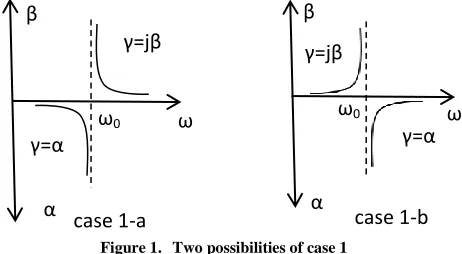
will be positive for ω<ω0 and negative for ω>ω0, if
( )( )
is negative (case 1-a). γ2 will be negative
for ω<ω0 and positive for ω>ω0, if ( )( ) is
[image:3.612.332.563.220.347.2]positive (case 1-b). These cases have been illustrated in Fig. 1.
Figure 1. Two possibilities of case 1
The cases where n1 is even and so, Cn is pure real have
been given below. In the immediate vicinity of pole
( )
( )
will dominate all of the other terms in (7). In this case,
the value of ( ) is positive because of even n1
and γ2 will be negative, if ( )
is negative (case
2-a). γ2 will be positive, if ( ) is positive (case
[image:3.612.329.544.472.587.2]2-b). These cases are illustrated in Fig. 2.
Figure 2. Two possibilities of case 2
The characteristic of the pure imaginary propagation constant is called forward wave when the phase velocity and the group velocity have the same sign as in left side of case 1-b and case 2-a or backward wave when the phase velocity and the group velocity have the opposite sign as in in right side of case 1-b and case 2-a. if it is pure real, it is called evanescent wave as in left side of case 1-a and right side of case 1-b and case 2-b.
γ=jβ
γ=α
β β
α α
ω0
ω0
ω ω
case 2-a case 2-b
ω
ω
ω
0ω
0β
α
α
γ=α
γ=jβ
β
case 1-a
γ=α
γ=jβ
International Journal of Emerging Technology and Advanced Engineering
Website: www.ijetae.com (ISSN 2250-2459, ISO 9001:2008 Certified Journal, Volume 6, Issue 11, November 2016)
130
IV. POLE CHARACTERISTICS OF PLASMA COLUMN
LOADED CYLINDRICAL WAVEGUIDE
The propagation characteristic in the neighborhood of the pole points has been investigated by using the MoM and the Laurent series expansion for plasma column loaded cylindrical waveguide. The Laurent series expansion with negative power terms can model the behavior of the propagation characteristic in the neighborhood of a pole. Here the degree of the highest negative power of the Laurent series is determined from the degree of the pole. There is no direct method to determine the degree of the pole. In the study, a numerical approximation has been proposed to determine it. Firstly, the characteristic of the propagation constant in the neighborhood of the pole has been obtained numerically from the MoM. Later, different coefficient sets in which the lowest negative index values
are -n1 = -3, -2, -1 and the highest positive index value is
two for each set have been computed from the presented
method below. Finally, the propagation constant
characteristics obtained from the Laurent series for each set has been compared with the characteristic from the MoM.
The coefficients of the Laurent series expansion have been computed by using numerical values obtained from the MoM. Eq. (7) can be rearranged as below.
( )( ) ∑ ( )
So, can be computed from the limit of the left sidet
of Eq. (8), while ω approaches ω0.
( )( )
It is necessary to differentiate Eq. (8) and compute the
limit of the differentiated expression while ω approaches ω0
for each coefficient.
( )
{
( )
( )( )[ ( )(
) ]}
The central differences formula has been used for the numerical computations of the higher order derivatives. In numerical computations, three different coefficient sets have been obtained to determine the order of the poles.
These sets are {C3-3, C3-2, C3-1, C30, C31,C32} called 3rd
order, {C2-2, C2-1, C20, C21,C22} called 2nd order, {C2-1,
C20, C21, C22} called 1st order. The behavior of the
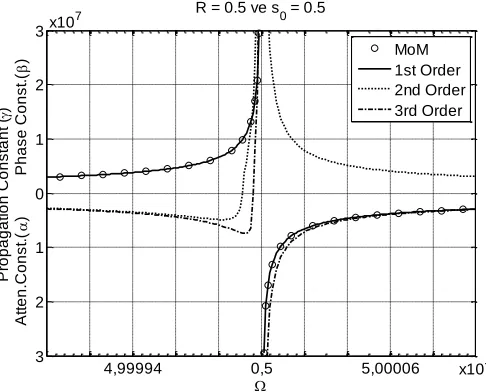
[image:4.612.328.571.228.424.2]propagation constant in neighborhood of the pole at Ω=R obtained from the Laurent series for these sets and the MoM has been given for the plasma column loaded cylindrical waveguide in Fig. 3.
Figure 3. The propagation constant in neighborhood of the pole obtained from the Laurent series and the MoM
The parameters of the structure investigated in Fig. 3 are as follows: waveguide radius is 3cm, plasma column ratio
s0=0.5, R=0.5 and ωp=1010 rad/s. Besides, 150 TM and 150
TE modes of the empty waveguide have been used for the MoM.
The propagation constant acts as a forward wave for lower frequencies from the pole point, Ω=0.5, and as an evanescent wave for higher frequencies. As seen in the figure, odd orders of the Laurent series expansion have a pure imaginary propagation constant, forward wave, on the left side of the pole point and a pure real propagation constant, evanescent wave, on right side of the pole point. For even orders of the Laurent series, there are two pure imaginary propagation constants in the vicinity of the pole point as described in case 2-a. Therefore we can say that the order of the pole at Ω=R for the structure cannot be two. Besides we can generalize this consequence for entire even orders.
The term with the lowest negative index in Laurent series dominates the series expansion in the neighborhood of the pole and determines the order of the pole.
4,99994 0,5 5,00006
3 2 1 0 1 2 3
R = 0.5 ve s0 = 0.5
P
ro
p
a
g
a
ti
o
n
C
o
n
s
ta
n
t
(
)
A
tt
e
n
.C
o
n
s
t.
(
)
P
h
a
s
e
C
o
n
s
t.
(
) MoM
1st Order 2nd Order 3rd Order
x107
International Journal of Emerging Technology and Advanced Engineering
Website: www.ijetae.com (ISSN 2250-2459, ISO 9001:2008 Certified Journal, Volume 6, Issue 11, November 2016)
131
If Fig. 3 is inspected, it can be seen that the Laurent series with three negative index term deviates while moving away from the pole point on the left side of the pole and it is not compatible with the propagation constant compared with the Laurent series with one negative index term on the right side of the pole. The Laurent series with one negative index term is more compatible with the pole characteristic obtained from the MoM for the vicinity of the pole. This shows that the pole is a simple pole and its order is one.
The numerical computations and comparisons have been performed for the poles of different structures, R=0.5 and
1.5, s0=0.1, 0.5 and 0.9. As a result of the comparisons, it
has been determined that all poles at Ω=R and Ω=1 are the simple poles.
V. CONCLUSION
The propagation characteristic in the neighborhood of the pole points have been studied based on the algebraic function theory in the paper. The MoM transforms the differential equations system into the linear algebraic system. The poles of linear algebraic system or the discriminant of the characteristic equation of the system gives poles, branch points or pole branch points. Only poles have been investigated in the study. The propagation characteristics in the vicinity of the poles have been obtained from the MoM and the Laurent series expansion using the algebraic function theory. Besides, a numerical approximation has been presented to determine order of any pole. It has been also shown that the order of the poles of the plasma column loaded cylindrical waveguide is one by using presented method.
REFERENCES
[1] Schelkunoff, S., A., 1952. Generalized telegraphist’s equation for waveguide,Bell System Tech. Journ., pp. 785-801.
[2] Yener, N., 2006. Algebraic function approximation in eigenvalue problems of lossless metallicwaveguides: examples, J. of Electromagn. Waves and Appl., vol. 20, pp. 731-745.
[3] Nobel, D., F. 1971 Circuit Properties of Dispersive Coupled Transmission Lines and Waveguides. Doctoral Thesis. NY : Cornell University.
[4] Kelebekler, E., 2009. Investigation of the Gyro-resonance Region Modes by Using the MoM for Plasma Column Loaded Cylindrical Waveguide”, IEEE Electrical Design of Advanced Packaging & Systems Symposium.
[5] Kelebekler, E., and Yener, N., 2009 Farklı Yapıdaki Silindirik Dalga Kılavuzlarının Dispersiyon Eğrilerinin İletim Hattı Eşdeğerlikleri Yöntemi ile Elde Edilmesi. Elektrik, Elektronik, Bilgisayar, Biyomedikal Mühendisliği 13. Ulusal Kongresi.
[6] Kelebekler, E., and Yener, N., 2011 Backward Wave Modes of Partially Plasma Column Loaded Cylindrical Waveguide. PIERS Proceedings, pp. 1084-1088.
[7] Kelebekler, E., and Yener, N., 2009 Obtaining the Backwards Waves of Fully Plasma Filled Cylindrical Waveguide by Using the MoM. 17th Telecommunications Forum (TELFOR 2009), pp. 895-898.
[8] Kelebekler, E., 2009 Comparison of Some Semi Analytic Methods for Plasma Column Loaded Cylindrical Waveguide. IEEE Applied Electromagnetics Conference.
[9] Kelebekler, E., 2013 Complex Surface Wave Modes Of Plasma Column Loaded Closed Cylindrical Waveguide, Progress In Electromagnetics Research B, vol. 54, pp. 357-383.
[10] Yener, N. 2005 Algebraic function approximation in eigenvalue problems of lossless metallic waveguides (Revisited), Progress In Electromagnetics Research, vol. 55, pp. 147-174.
[11] Yener, N., 2004 Application of algebraic function theory to backward wave problems, J. of Electromagn. Waves and Appl., vol.
18, No.10., pp. 1399-1417.
[12] Yener, N. 2003 Necessary and suffcient conditions for the existence of backward waves in metallic, Journal of Electromagnetic Waves and Applications, vol. 17,pp. 1713-1722.