Protein structure protection commits gene expression patterns
Jianping Chen
*
, Han Liang
†
and Ariel Fernández
*‡§
Addresses: *Program in Applied Physics, Rice Quantum Institute, Rice University, Houston, TX 77005, USA. †Department of Ecology and Evolution, University of Chicago, Chicago, IL 60637, USA. ‡Department of Bioengineering, Rice University, Houston, TX 77005, USA. §Department of Computer Science, University of Chicago, Chicago, IL 60637, USA.
Correspondence: Ariel Fernández. Email: [email protected]
© 2008 Chen et al.; licensee BioMed Central Ltd.
This is an open access article distributed under the terms of the Creative Commons Attribution License (http://creativecommons.org/licenses/by/2.0), which permits unrestricted use, distribution, and reproduction in any medium, provided the original work is properly cited.
Protein structure regulates expression
<p>A proteomic association study between protein three-dimensional structure and transcriptional and post-transcriptional regulation in yeast and human.</p>
Abstract
Background: Gene co-expressions often determine module-defining spatial and temporal
concurrences of proteins. Yet, little effort has been devoted to tracing coordinating signals for expression correlations to the three-dimensional structures of gene products.
Results: We performed a global structure-based analysis of the yeast and human proteomes and contrasted this information against their respective transcriptome organizations obtained from comprehensive microarray data. We show that protein vulnerability quantifies dosage sensitivity for metabolic adaptation phases and tissue-specific patterns of mRNA expression, determining the extent of co-expression similarity of binding partners. The role of protein intrinsic disorder in transcriptome organization is also delineated by interrelating vulnerability, disorder propensity and co-expression patterns. Extremely vulnerable human proteins are shown to be subject to severe post-transcriptional regulation of their expression through significant micro-RNA targeting, making mRNA levels poor surrogates for protein-expression levels. By contrast, in yeast the expression of extremely under-wrapped proteins is likely regulated through protein aggregation. Thus, the 85 most vulnerable proteins in yeast include the five confirmed prions, while in human, the genes encoding extremely vulnerable proteins are predicted to be targeted by microRNAs. Hence, in both vastly different organisms protein vulnerability emerges as a structure-encoded signal for post-transcriptional regulation.
Conclusion: Vulnerability of protein structure and the concurrent need to maintain structural integrity are shown to quantify dosage sensitivity, compelling gene expression patterns across tissue types and temporal adaptation phases in a quantifiable manner. Extremely vulnerable proteins impose additional constraints on gene expression: They are subject to high levels of regulation at the post-transcriptional level.
Background
The coordination of protein roles to achieve specific biological functions requires the spatial/temporal concurrence of pro-teins so that they can form complexes [1,2] or, in general,
operate within a module [2-4]. In turn, this concurrence is tightly coordinated through the regulation of gene expres-sion, as suggested by established correlations between the transcriptome and the interactome [5,6]. However, structure-Published: 7 July 2008
Genome Biology 2008, 9:R107 (doi:10.1186/gb-2008-9-7-r107)
Received: 19 May 2008 Revised: 6 July 2008 Accepted: 7 July 2008 The electronic version of this article is the complete one and can be
encoded factors that may quantitatively control such correla-tions have not been identified. So far, protein structure has not provided organizing clues for the integration of large-scale descriptions of the molecular phenotype.
As reported in this work, by exploiting a structure-based anal-ysis of protein associations [7,8] and their correlated expres-sion patterns, we identify a structural attribute, protein vulnerability, and show that it commits gene expression pat-terns in a quantifiable manner. More specifically, protein vul-nerability is shown to determine the extent of co-expression of genes containing protein-encoding interactive domains in metabolic adaptation phases [9,10] or tissue types [11,12], while extreme vulnerability promotes significant post-tran-scriptional regulatory control.
Soluble proteins maintain the integrity of their functional structures provided the amide and carbonyl groups paired through hydrogen bonds are adequately shielded from water attack, preventing backbone hydration and, generally, the concurrent total or partial denaturation of the soluble struc-ture [13,14]. As shown in this work, this integrity is often ensured through the formation of protein complexes, which become more or less obligatory depending on the extent of structure vulnerability and the level of backbone protection provided by the association [13]. By adopting vulnerability as a structural indicator of dosage imbalance effects, the extent of reliance on binding partnerships is precisely quantified and shown to be an organizing factor for the yeast and human transcriptome.
Results
Protection of a vulnerable protein and co-expression demands
We start by defining vulnerability νof a soluble protein struc-ture as the ratio of solvent-exposed backbone hydrogen bonds (SEBHs) to the overall number of such bonds (Figure 1). The SEHBs may be computationally identified from atomic coor-dinates (Materials and methods). Thus, while backbone hydrogen bonds are determinants of the basic structural motifs [15,16], the SEHBs represent local weaknesses of the structure.
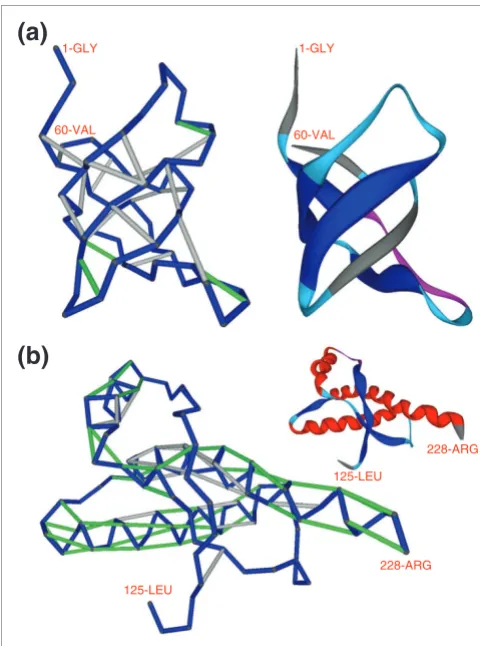
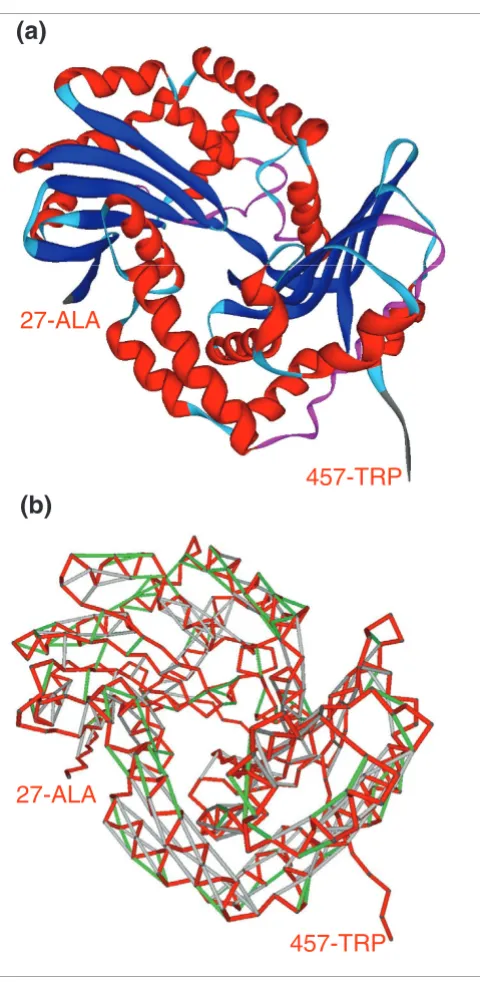
Figure 1a shows the vulnerability pattern of a well protected soluble protein, the yeast SH3 signaling domain [17], with ν= 19.0%. Figure 1b shows the most vulnerable protein structure for an autonomous folder in the Protein Data Bank (PDB) (ν = 63.0%), the cellular form of the 90-230 fragment of the human prion protein PrPC (PDB.1QM0) [18]. This extreme case was detected after exhaustive computation of the ν parameter for all conformations of isolated (those not in a complex) polypeptide chains reported in the PDB (Materials and methods). Figure 2 shows the most vulnerable structure adopted by a protein chain within a yeast complex: subunit 1 from the cytochrome b-c1 complex (COR1/YBL045C).
Unlikely to be found in isolation, this structure is found within the mitochondrial respiratory chain complex III [19].
A vulnerable soluble structure gains extra protection of its backbone hydrogen bonds through forming complexes, as nonpolar groups of a binding partner contribute to expel water molecules from the microenvironment of the pre-formed bonds [13]. On the other hand, the SEBHs promote their own dehydration as a means to stabilize and strengthen the hydrogen bond [14].
[image:2.612.313.553.85.408.2]Hydrogen-bond pattern and structural vulnerabilities (SEBHs) of the yeast SH3 domain and the human prion protein PrPC
Figure 1
Hydrogen-bond pattern and structural vulnerabilities (SEBHs) of the yeast SH3 domain and the human prion protein PrPC. (a) Hydrogen-bond
pattern and structural vulnerabilities (SEBHs) of the yeast SH3 domain from a S. cerevisiae 40.4 kDa protein (PDB.1SSH) [17]. The ribbon display is included as a visual aid. The protein backbone is shown as virtual bonds (blue) joining consecutive α-carbons in the peptide chain. Light-grey segments represent well protected backbone hydrogen bonds, and green segments represent SEBHs. The extent of solvent-exposure extent of a hydrogen bond was determined from atomic coordinates by calculating the number of nonpolar groups within its microenvironment (Materials and methods). SEBHs are those backbone hydrogen bonds protected by an insufficient number of nonpolar groups as statistically defined in Materials and methods. The level of structure vulnerability ν, defined as the ratio of SEBHs to the overall number of backbone hydrogen bonds, is 19.0% (ν= 4/21). (b) SEBH-pattern for the cellular structure of the human prion protein PrPC (PDB.1QM0) [18]. Its vulnerability parameter is ν=
63.0%, making it the most vulnerable soluble folder of all structures of unbound proteins reported in the PDB.
(a)
1-GLY60-VAL
1-GLY
60-VAL
125-LEU
228-ARG 228-ARG
To delineate the role of structure vulnerability as an organiz-ing integrative factor in large-scale descriptions of the molec-ular phenotype, we first examined the Pfam-filtered [7] protein complexes for yeast [8] and human [20]. These
asso-ciations involve domains whose PDB-reported homologs are involved in complexes.
This work quantitatively examines the relationship between the structural vulnerability of a protein and the extent of co-expression of genes encoding its binding partners. Thus, the extent of co-expression, η(i, j), for two genes i, j encoding interacting proteins is measured by the expression correla-tion of the two genes normalized to the average correlacorrela-tion over the interactome (Materials and methods). In conso-nance, the expression correlation of a complex, η (complex), may be defined by the maximum expression correlation over its constitutive underlying pairwise interactions (see Addi-tional data files 7-9 for alternative definitions).
Thus, the most highly correlated yeast complex (overall η
(complex) = 3.61) with full PDB-reported representation is
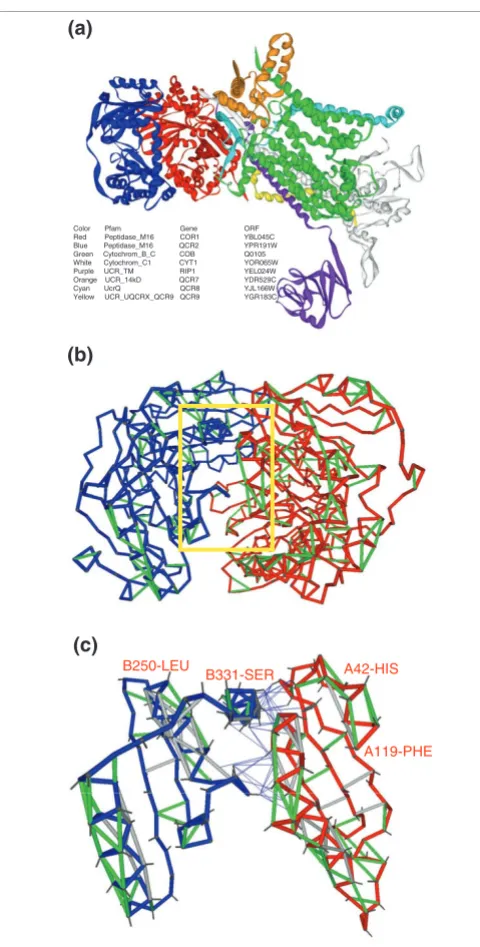
the mitochondrial respiratory chain complex III shown in Figure 3a (PDB.1KB9[19]). The most vulnerable protein within the complex (ν = 57%) is subunit 1 from the cyto-chrome b-c1 complex (Gene/ORF = COR1/YBL045C, shown in red). Its peptide chain conformation, with the SEBH pat-tern described in Figure 2, is involved in the most highly cor-related interaction (η = 3.61) within the complex (Figure 3b,c). The binding partner in this interaction is subunit 2 of cytochrome b-c1 (Gene/ORF = QCR2/YPR191W, blue chain in Figure 3a). Figure 3c shows the mutual protection of preformed SEBHs in the two subunits along part of their association interface (red, COR1 residues 42-119; blue, QCR2
residues 250-331). This intermolecular mutual 'wrapping' of local weaknesses illustrates the fact that the association con-tributes to maintain structural integrity (Figure 3c).
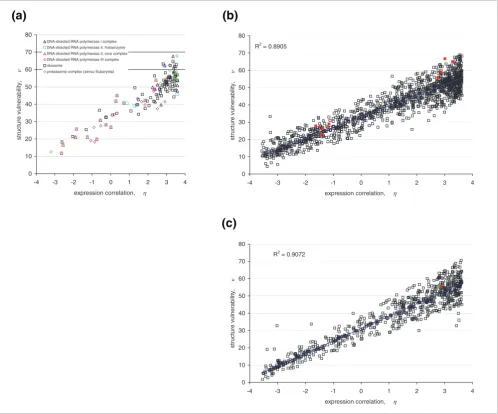
We examined the role of structure vulnerability as a factor governing the extent of co-expression of binding partners in illustrative yeast complexes (Figure 4a; Additional data file 1). Structure-based protein-protein interactions were curated through the Pfam database, so that two proteins were consid-ered to interact with each other if their respective domains (or homolog domains) were reported in a PDB complex [8,21]. The expression correlation, η, for each interaction pair within a complex was determined at the mRNA level of the genes whose open reading frames (ORFs) contained the interacting domains (Materials and methods). Vulnerabilities were com-puted either directly from PDB files, when available, as described in Figure 1, or from atomic coordinates generated by homology threading using the Pfam-homolog domain as template (Materials and methods). In the latter case, side-chain equilibration, constrained by a fixed homology-threaded backbone, was obtained from constrained molecu-lar dynamics simulations (Materials and methods). We then determined the maximum ν-value for each interactive pair and, using the comprehensive microarray database for
Sac-charomyces cerevisiae glucose→ glycerol metabolic
adapta-tion [22], we computed the expression correlaadapta-tion ηfor each Pfam interaction. A tight (η-ν) correlation (R2 = 0.891) is
[image:3.612.55.295.81.572.2]Ribbon representation and vulnerability (SEBH) pattern of subunit 1 from the cytochrome b-c1 complex
Figure 2
Ribbon representation and vulnerability (SEBH) pattern of subunit 1 from the cytochrome b-c1 complex. (a) Ribbon representation and (b) vulnerability (SEBH) pattern of subunit 1 from the cytochrome b-c1 complex (PDB.1KB9) [19]. In b, red segments represent virtual protein backbone bonds, light-grey segments represent well protected backbone hydrogen bonds, and those green segments represent SEBHs. In the cytochrome complex, this protein adopts a highly vulnerable (ν= 57.3%) conformation.
(a)
(b)
457-TRP
27-ALA
27-ALA
obtained and shown to hold across the illustrative yeast com-plexes (Figure 4a) and, furthermore, to hold across all 1,354 pairs of interacting proteins in the yeast interactome with Pfam representation (Figure 4b,c; Additional data file 2). The
(η-ν) correlation implies that the protection of a functionally competent protein structure in yeast drives co-expression of its binding partners to an extent that is determined by the structure vulnerability.
In selecting the yeast transcriptome [22], particular attention was focused on the 'perturbative' nature of the change trigger-ing the structural remodeltrigger-ing of the proteomic network across different phases. A more extensive remodeling on a vastly larger scale, as in the complete yeast developmental cycle [23], cannot be treated as a perturbation since it clearly alters the modular structure of the proteome network [4] and, consequently, yields a weaker (η-ν) correlation (Additional data file 10).
Structure vulnerability is not only an organizing factor for the metabolic-adaptation transcriptome but also steers the organization of tissue-based transcriptomes. This is revealed by a similar comparative analysis of the most comprehensive protein-encoding gene-expression data for human [11] and the structure-represented interactome [20]. Thus, a clear (η
-ν) correlation is apparent between the co-expression of 607 gene pairs and the maximum structure vulnerability for each pair of interacting domains encoded in the ORFs of the respective genes (Figure 5; Additional data file 3).
Other human transcriptomes based on normal tissue expres-sion were examined (see, for example, [24]), but none pro-vided statistically significant (>>10 genes pairs) representati-on for the gene pairs for which interactome data also exist [20], as needed for the present study.
Post-transcriptional regulation of the expression of highly vulnerable proteins
In contrast with the tighter yeast correlation, a few but signif-icant outlier pairs (Figure 5, red data points) are found beyond the confidence band defined by a width of two Gaus-sian dispersions from the linear (η-ν) fit. To rationalize this fact, we identified 115 human genes with ORFs encoding extremely vulnerable proteins (Additional data file 4). Con-sistent with the definition of structure vulnerability (Figure 1), the latter proteins are identified by large sequences (≥ 30 residues) of amino acids that are poor protectors of backbone hydrogen bonds. In principle, a sizable window of residues unable to protect backbone hydrogen bonds produces a poor folder, yielding a highly vulnerable structure [14,25]. Thus, these sequences are either probably unable to sustain a stable soluble structure, or prone to relinquish the folding informa-tion encoded in the amino acid sequence in favor of self-aggregation [25]. The poor protectors (G, A, S, Y, N, Q, P) are amino acids possessing side chains with insufficient nonpolar groups, with polar groups too close to the backbone (thus
[image:4.612.55.295.82.556.2]pre-Mutual protection of SEBHs in the two subunits of mitochondrial respiratory chain complex III
Figure 3
Mutual protection of SEBHs in the two subunits of mitochondrial respiratory chain complex III. (a) Ribbon representation of mitochondrial respiratory chain complex III (PDB.1KB9). The high structure vulnerability of subunit 1 (red; compare Figure 2) renders it highly needy for interaction with other subunits of the complex to maintain its structural integrity. (b) SEBH pattern for subunit 1 (red) and subunit 2 (blue). The interacting pair is characterized by a very high expression correlation η= 3.61. The yellow square highlights the part of the interface shown in detail in (c). (c) Illustration of mutual protections of SEBHs in the two subunits along part of their interface. One side-chain bond (between α and β carbons) is displayed. The thin blue lines, which connect β-carbons in one protein with centers of hydrogen bonds in the other protein, represent mutual protections of hydrogen bonds across the protein-association interface. Thus, a thin line is shown whenever the side chain of one protein is contributing with nonpolar groups to the microenvironment of a preformed hydrogen bond in its binding partner.
(a)
(b)
(c)
A42-HIS
A119-PHE B331-SER
B250-LEU
cluding hydrogen-bond protection through clustering of non-polar groups) [14] or with amphiphilic aggregation-nucleating character (Y) [26-28]. Charged backbone de-pro-tecting side chains (D, E) are excluded since they would entail negative design relative to protein self-aggregation. All out-lier interactions in the human (η-ν) correlation involve genes with extreme vulnerability (Figure 5; Additional data file 4). Significantly, when the same criterion for extreme vulnerabil-ity is used to scan the yeast genome (Additional data file 5), 85 genes are identified whose ORFs encode the five confirmed prion proteins for this organism [26-29]: PSI+ (SUP35), NU+ (NEW1), PIN+ (RNQ1), URE3 (URE2) and SWI+ (SWI1).
This fact is statistically significant (P < 10-10, hypergeometric test) and supports the presumed relationship between struc-tural vulnerability of the soluble fold and aggregation propen-sity [25].
The (η-ν) correlation reported in Figure 5 for human is weaker than the yeast counterpart likely because, in contrast with yeast, mRNA levels are not a reliable surrogate for pro-tein expression levels in human [30,31]. This observation led us to examine post-transcriptional regulation in human genes, to analyze the microRNA (miRNA) targeting of the predicted 115 extremely vulnerable human genes (Additional
[image:5.612.57.555.87.501.2]Correlation between maximum structure vulnerability νand co-expression similarity ηfor yeast protein interactions
Figure 4
Correlation between maximum structure vulnerability νand co-expression similarity ηfor yeast protein interactions. (a) Correlation between maximum structure vulnerability νand co-expression similarity ηfor interactions within specific yeast complexes. The ν-parameter of an interaction is defined as the maximum vulnerability between the two interacting partners, and the η-parameter is the ratio of their expression correlation to the (non-zero) expected correlation over all interacting pairs in the proteome. (b) (η-ν) correlation for all Pfam-filtered yeast protein interactions. Red points represent interactions involving extremely vulnerable proteins, including confirmed yeast prions (Additional data file 5). (c) (η-ν) correlation of Pfam-filtered yeast protein interactions involving only PDB-reported proteins. The red data point represents an interaction involving an extremely vulnerable protein, and the green point represents an interaction involving an extremely vulnerable protein reported to be a prion protein (ERF2) [24-26].
R2 = 0.9072
0 10 20 30 40 50 60 70 80
-4 -3 -2 -1 0 1 2 3 4
expression correlation, η
structure vulnerability,
ν
(c)
(b)
(a)
R2 = 0.8905
0 10 20 30 40 50 60 70 80
-4 -3 -2 -1 0 1 2 3 4
expression correlation, η
structure vulnerability,
ν
0 10 20 30 40 50 60 70 80
-4 -3 -2 -1 0 1 2 3 4
expression correlation, η
structure vulnerabilit
y,
ν
DNA-directed RNA polymerase I complex DNA-directed RNA polymerase II, holoenzyme DNA-directed RNA polymerase II, core complex DNA-directed RNA polymerase III complex ribosome
data files 4 and 6), and to contrast the miRNA-targeting sta-tistics with the generic values across the human genome [31]. To obtain statistics on miRNA targeting, we identified
putative target sites in the 3' UTR (untranslated region) of each gene for 162 conserved miRNA families (Materials and methods) [31]. Thus, 7,927 out of 17,444 genes (45.4%) are
(η- ν) correlation for human protein interactions
Figure 5
(η- ν) correlation for human protein interactions. (a) The (η-ν) correlation for all Pfam-filtered human protein interactions. Red points represent interactions involving extremely vulnerable proteins (Additional data file 4). (b) The correlation over Pfam-filtered human protein interactions that involve only PDB-reported proteins. The red point represents an interaction containing an extremely vulnerable protein.
R2 = 0.7373
10 15 20 25 30 35 40 45 50 55 60
-1 -0.5 0 0.5 1 1.5 2 2.5 3 3.5
expression correlation, η
structure vulnerability,
ν
R2 = 0.8558
20 25 30 35 40 45 50
-0.5 0 0.5 1 1.5 2 2.5 3
expression correlation, η
structure vulnerabilit
y,
ν
(a)
predicted to contain at least one miRNA target site (Addi-tional data file 6), while 87 out of 105 (82.9%) extremely vul-nerable genes are predicted to be targeted genes. Thus, human genes containing extremely vulnerable regions are more frequently targeted by miRNA (P << 1.31 × 10⁻⁵, bino-mial test). In regards to miRNA regulation complexity, the mean number of miRNA target sites for human genes is 2.66 and the median is 0, while the mean number for extremely vulnerable genes is 6.01 and the median is 5. This significant difference (P < 10-16, Wilcox rank test) strongly suggests that the deviation of extremely vulnerable genes from the (η-ν)
correlation (Figure 5), with expression correlation evaluated at the level of mRNA expression, can be explained by post-transcriptional miRNA regulation. This type of regulation influences the final protein expression level. In a broad sense, this analysis highlights the connection between protein struc-ture and gene regulation: extremely vulnerable genes require tight control at the post-transcriptional level.
Protein intrinsic disorder and transcriptome organization
The inability of an isolated protein fold to protect specific intramolecular hydrogen bonds from water attack may lead to structure-competing backbone hydration with concurrent local or global dismantling of the structure [14,25,32]. This view of structural vulnerability suggests a strong correlation between the degree of solvent exposure of intramolecular hydrogen bonds and the local propensity for structural disor-der [33-35]: in the absence of binding partners, the inability of a protein domain to exclude water intramolecularly from pre-formed hydrogen bonds may be causative of a loss of structural integrity, and this tendency is marked by the disorder propensity of the domain [32]. These findings led us to regard the predicted extent of disorder in a protein domain as a likely surrogate for its vulnerability and to contrast it with the extent of expression correlation with its interactive part-ners. The disorder propensity may be determined by a sequence-based score, fd(fd = 1, certainty of disorder; fd = 0, certainty of order), assigned to each residue. In this work, this parameter is generated by the highly accurate predictor of native disorder PONDR-VSL2 [34,35]. The extent of intrinsic disorder of a domain may be defined as the percentage of res-idues predicted to be disordered relative to a predetermined
fd threshold (fd = 0.5).
Reexamination of the expression correlations in the yeast and human transcriptomes was carried out, taking into account a proteome-wide sequence-based attribution of the extent of disorder (percentage of residues predicted to be disordered, or 'disorder content') in interacting protein domains. The dis-order predictions did not include any structural information on induced fits arising upon forming a complex, and hence, unlike structure vulnerability, the percent predicted disorder is independent of the complex under consideration. This fact introduces deviations in the estimation of vulnerability through disorder content for proteins with extensive disorder
content since their conformational plasticity may enable diverse induced-fit conformations with different vulnerabilit-ies (Figure 6a). In yeast, the extent of disorder of the most dis-ordered domain for each pair of interacting domains captures the degree of correlation in the expression patterns required for structure protection (Figure 6a). This is revealed by the correlation between the extent of disorder of the most disor-dered domain in an interacting pair and the expression corre-lation ηof the two genes encoding the respective interacting domains. While weaker than the η-νcorrelation (Figure 4), the η-disorder correlation is still relatively strong for yeast proteins (R2 = 0.752; Figure 6a), implying that disorder con-tent determines the degree of coexpression of binding part-ners to a significant extent. The large dispersion in disorder extent at high levels of coexpression (approximately 45% persion versus approximately 15% for proteins with low dis-order/low expression correlation) is indicative that highly disordered chains may adopt structures with very different levels of vulnerability depending on the complex in which they are involved (the η-νcorrelation does not widen so sig-nificantly for smaller η-values). Thus, the more disordered the chain, the more multi-valued the correspondence between disorder extent and vulnerability, conferring higher dispersion to the η-disorder correlat- ion.
The η-disorder correlation in human is considerably weaker (R2 = 0.304; Figure 6b) than in yeast. This is partly due to the fact that human proteins have a higher degree of disorder propensity than their yeast orthologs [36] and, hence, they are capable of significantly diversifying their structural adap-tation (induced folding) in different complexes. In this con-text, the extent of disorder becomes a poor surrogate of structural vulnerability, as different ν-values may correspond to a single percent predicted disorder. In addition, post-tran-scriptional regulation in humans implies that expression cor-relations at the mRNA level are not reflective of the protein concurrencies modulated by tissue type, as indicated above.
To conclude, Figure 6 reveals the role of intrinsic protein dis-order in transcriptome organization suggested by exploring the interrelationship between protein vulnerability and disor-der propensity.
Discussion
observation is validated by establishing the significance of protein vulnerability or structure protection as an organizing factor in temporal phases (yeast) and tissue-based (human)
transcriptomes. Specifically, this role was established by examining the degree of co-expressions of a protein with its binding partners in structure-represented interactions. Thus, (η-disorder) correlation for yeast and human protein interactions
Figure 6
(η-disorder) correlation for yeast and human protein interactions. Correlation between η-parameter and percent predicted disorder (disorder content) of the most disordered domain for each of (a) the 1,354 Pfam-filtered protein-interaction pairs in yeast and (b) the 607 pairs in human.
R2 = 0.7519
0 10 20 30 40 50 60 70 80 90
-4 -3 -2 -1 0 1 2 3 4
expression correlation
% intrinsic disorder
R2 = 0.304
0 10 20 30 40 50 60 70 80 90 100
-1 -0.5 0 0.5 1 1.5 2 2.5 3 3.5
expression correlation
%
int
rins
ic
dis
order
(a)
for each Pfam-filtered binding partnership, the extent of co-expression across metabolic adaptation phases (yeast) or tis-sue types (human) was found to depend quantitatively on the structure vulnerability of the proteins involved. Hence, vul-nerability may be regarded as an organizing factor encoded in the structure of gene products.
Furthermore, as shown in this work, the tight coordination between translation regulation and gene function dictates that extremely vulnerable, and hence 'highly needy', proteins are subject to significant levels of post-transcriptional regula-tion. In human, this extra regulation is achieved through extensive miRNA targeting of genes coding for extremely vul-nerable proteins. In yeast, on the other hand, our results imply that such a regulation is likely achieved through sequestration of the extremely vulnerable proteins into aggre-gated states. Intriguingly, the 85 yeast genes encoding extremely vulnerable proteins included those for the five con-firmed yeast prions [26-29]. This statistically significant result implies that if the extremely vulnerable proteins are themselves translational regulators, this sequestration may directly lead to epigenetic consequences and phenotypic pol-ymorphism [26-28].
Conclusion
In this work we adopted a structural biology perspective to reassess the fundamental notion of 'dosage imbalance effect' and examine the implications for gene expression, specifically for transcriptomal organization and post-transcriptional reg-ulation. Thus, vulnerability of protein structures and the concurrent need to maintain structural integrity for func-tional reasons prove to be quantifiers of dosage imbalance: proteins with a high degree of reliance on binding partner-ships to maintain their structural integrity are naturally expected to yield high dosage sensitivity in their respective gene expressions. Hence, structural vulnerability is shown to be a determinant of transcriptome organization across tissues and temporal phases: the need for protein structure protection compels gene co-expression in a quantifiable man-ner. Extreme vulnerability is shown to require significant additional regulation at the post-transcriptional level, mani-fested by epigenetic aggregation in yeast and miRNA target-ing in human. These latter observations will likely inspire further study of structure-encoded signals that govern post-transcriptional regulation.
Materials and methods
Expression data sources
Yeast expression data were obtained from the comprehensive
Saccharomyces Genome Database [22]. This complete
data-set contains mRNA expression levels during a transition from glucose-fermentative to glycerol-based respiratory growth. Human expression data were taken from the comprehensive Novartis Gene Expression Atlas [11]. This dataset includes
158 array images composed of 79 samples, each of which has two replicates hybridized on the human genome HG-U133A array. We discarded six samples of cancer tissues: Colorecta-lAdenocarcinoma, leukemialymphoblastic(molt4), lympho-maburkittsRaji, leukemiapromyelocytic, lymphomaburkitts Daudi, and leukemiachronicmyelogenous (k562).
Interaction data sources
Protein interaction curation based on structure provides direct physical interactions [8]. Two proteins were consid-ered to interact with each other when their respective domains or homologs of their respective domains were found in a complex with PDB-reported structure. We obtained curated yeast protein domain interactions from the Structural Interaction Network [8], and filtered them using recently published yeast interaction data [21]. For human, we focused on interactions within complexes. The complex data were obtained from the MIPS/Mammalian Protein Complex Data-base [20]. We used the protein domain descriptions in the Pfam database [7], and searched for domain-domain interac-tions using iPfam [39].
Expression correlation η
The expression correlation for a protein-protein interaction is a normalized quantity defined as the Pearson correlation of the expression vectors of the genes encoding for the interact-ing domains divided by the mean correlation over all gene pairs encoding for interacting domains. The normalization is necessary for comparative analysis across species because different species have different mean expression correlations and, hence, the significance of a correlation is necessarily a relative attribute. Given its statistical nature, the denomina-tor is non-zero for any species since, in a statistical sense, pro-tein pairs that interact are expected to be positively correlated in their expression. We use the Pearson correlation coeffi-cients of expression vectors to determine similarity between expression profiles. For two expression vectors X and Y, the Pearson correlation coefficient Corr(X, Y) is given by:
where X, Y are generic coordinates in the vectors X and Y, respectively, and < > indicates mean over the 73 normal tis-sues (human) [11] or over the 5 metabolic adaptation phases (yeast) [22].
Calculation of vulnerability ν and identification of SEBHs for soluble proteins
To determine the extent of solvent exposure of a backbone hydrogen bond in a soluble protein structure, we determine the extent of bond protection from atomic coordinates. This parameter, denoted ρ, is given by the number of side-chain nonpolar groups contained within a desolvation domain (hydrogen-bond microenvironment) defined as two inter-secting balls of fixed radius (the approximate thickness of
Corr X Y( , )= <( −< >)( −< > >)
< >−< > < >−< >
X X Y Y
three water layers) centered at the α-carbons of the residues paired by the hydrogen bond. In structures of PDB-reported soluble proteins, at least two-thirds of the backbone hydrogen bonds are protected on average by ρ = 26.6 ± 7.5 side-chain nonpolar groups for a desolvation ball radius of 6 Å. Thus, SEBHs lie in the tails of the distribution, that is, their micro-environment contains 19 or fewer nonpolar groups, so their ρ-value is below the mean (ρ = 26.6) minus one standard devi-ation (= 7.5).
In cases where the protein structures were unavailable from the PDB, we generated atomic coordinates through homology threading adopting the Pfam homolog as template and using the program Modeller [40-42]. Modeller is a computer pro-gram that models three-dimensional structures of proteins subject to spatial constraints [40], and was adopted for homology and comparative protein structure modeling. We thus generate the alignment of the target sequence to be mod-eled with the Pfam-homolog structure reported in the PDB and the program computes a model with all non-hydrogen atoms. The input for the computation consists of the set of constraints applied to the spatial structure of the amino acid sequence to be modeled and the output is the three-dimen-sional structure that best satisfies these constraints. The three-dimensional model is obtained by optimization of a molecular probability density function with a variable target function procedure in Cartesian space that employs methods of conjugate gradients and molecular dynamics with simu-lated annealing.
Homolog PDB sources
Yeast PDB homologs were obtained from the Saccharomyces
Genome Database [43], and human PDB homologs were from Pfam [44].
Micro-RNA targeting analysis
For 17,444 human genes, we identified putative target sites for 162 conserved miRNA families using TargetScanS (version 4.0), a leading target-prediction program [45]. Thus, we obtained the number of target-site types in the 3' UTR of each gene [31]. Among the genes in our analysis: 105 genes were identified as encoding extremely vulnerable proteins; 7,927 out of 17,444 genes (45.4%) are predicted to be miRNA targets (containing at least one type of miRNA target site); and 87 out of 105 genes encoding extremely vulnerable pro-teins (82.9%) are predicted to be target genes. Thus, genes encoding extremely vulnerable proteins tend to be miRNA target genes (P << 1.31 × 10⁻⁵, binomial test).
In terms of miRNA regulation complexity, the average number of miRNA target-site types for a human gene is 2.66 and the median number is 0; while the average number for a prion gene is 6.01 and the median is 5. Again, this is highly significant (P < 10-16, Wilcox rank test).
Prediction of native disorder of protein domains
The highly accurate predictor of native disorder PONDR VSL2 [34,35] exploits the length-dependent (heterogenous) amino acid compositions and sequence properties of intrinsi-cally disordered regions to improve prediction performance. Unlike previous PONDR predictors for long disordered regions (>30 residues), it is applicable to disordered regions of any length. The disorder score (0 ≤ fd ≤ 1) is assigned to each residue within a sliding window, representing the predicted propensity of the residue to be in a disordered region (fd = 1, certainty of disorder; fd = 0, certainty of order). The disorder propensity is quantified by a sequence-based score that takes into account residue attributes such as hydrophilicity, aroma-ticity, and their distribution within the window interrogated.
Abbreviations
miRNA, micro RNA; ORF, open reading frame; PDB, Protein Data Bank; SEBH, solvent-exposed backbone hydrogen bonds; UTR, untranslated region.
Authors' contributions
JC provided theoretical insight, designed methodology, gen-erated and collected data, and co-wrote the paper. HL pro-vided theoretical insight, and generated and collected data. AF provided the fundamental concepts and insights, designed methodology and wrote the paper.
Additional data files
The following additional data are available with the online version of this paper. Additional data file 1 provides raw data for Figure 4a. Additional data file 2 provides Raw data for Fig-ure 4b,c. Additional data file 3 provides raw data for FigFig-ure 5. Additional data file 4 lists extremely vulnerable proteins in human. Additional data file 5 lists extremely vulnerable yeast proteins. Additional data file 6 lists the predicted number of miRNA targets for human genes. Additional data file 7 out-lines the robustness of results with respect to alternative graph-theoretic definitions of co-expression similarity. Addi-tional data file 8 outlines how vulnerability correlates with co-expression similarity in protein complexes. Additional data file 9 provides Raw data: yeast (a) and human (b) complexes examined in Additional data file 8. Additional data file 10 shows the (η-ν) plot obtained for the yeast developmental-phase transcriptome obtained from a comprehensive identifi-cation of cell cycle-regulated genes by microarray hybridiza-tion [23].
Additional data file 1 Raw data for Figure 4a
Data in column A indicate the expression correlation ηassociated with protein interactions, and data in column B indicate the struc-ture vulnerability νfor interactions within specific complexes. The rest of the columns contain the ORF, domain and structure infor-mation (PDB accession code of interacting domain or its Pfam-homologs), respectively, for every pair of interacting proteins. Click here for file
Additional data file 2 Raw data for Figure 4b,c
Sheet 1 contains all Pfam-filtered yeast protein interactions, while sheet 2 contains only those interactions with both partners having PDB structures. In each sheet, column A lists the expression corre-lation h of interactions, and columns B and C list the structure vul-nerability n of interactions not involving or involving, respectively, extremely vulnerable proteins. The remaining columns contain ORF, domain and structure information (PDB accession code of interacting domain or of its Pfam-homologs) for every pair of inter-acting proteins.
Click here for file Additional data file 3 Raw data for Figure 5
Sheet 1 contains all Pfam-filtered human protein interactions, while sheet 2 contains only those interactions with both partners having PDB structures. In each sheet, column A contains the expression correlation h for each interaction, and columns B and C list the structure vulnerability n of interactions not involving or involving, respectively, extremely vulnerable proteins, and the rest of the columns list gene name, protein ID, domain and structure information (PDB accession code of interacting domain or of its Pfam-homologs) of every pair of interacting proteins.
Click here for file Additional data file 4
Extremely vulnerable proteins in human
The extremely vulnerable proteins in human are identified from genome-wide scanning of protein-encoding regions with sequence windows (length ≥ 30) containing mainly amino acids (G, A, S, Y, N, Q, P) that are poor protectors of the protein backbone. An extremely vulnerable protein contains at least one such window with a threshold of three amino acids allowed to be outside the group of poor protectors.
Click here for file Additional data file 5
Extremely vulnerable yeast proteins
Extremely vulnerable yeast proteins are determined in the same way as for human (Additional data file 4). The rows marked in green correspond to the five confirmed yeast prions [26-29]: SUP35 (ERF2), URE2, NEW1, RNQ1 and SWI1.
Click here for file Additional data file 6
Predicted number of microRNA targets for human genes
The number of putative target-site types corresponding to 162 con-served miRNA families determined for 17,444 human genes by interrogation of the 3' UTR using TargetScanS (version 4.0) [45]. Click here for file
Additional data file 7
Robustness of results with respect to alternative graph-theoretic definitions of co-expression similarity
The co-expression similarity for genes i, j, encoding a pair of inter-acting proteins is alternatively measured as the adjacency aij(β) = (0.5 + 0.5 η(i, j))β, where η(i, j) is the expression correlation for the
gene pair i, j and β is a soft threshold [46]. Similarly, the structure vulnerability is alternatively defined as νi, j(β) = ν (i, j)β, where ν (i, j) is the maximum ν-value for the interacting pair. (a, b) (ν(β) -a(β)) correlations for yeast for exponents β = 0.5 (a) and 10 (b). The adjacencies for β = 1 correspond simply to a linear rescaling of η already correlated with ν in Figure 4. (c, d) The same as (a, b) but for human. Notice that high exponents (β > 1) tend to amplify dif-ferences in co-expression, yielding lower correlation coefficients (R2 in (ν(β)-a(β)) plots).
Click here for file Additional data file 8
Vulnerability correlates with co-expression similarity in protein complexes
A normalized co-expression similarity γ (β, complex) for all genes encoding proteins that form a complex is obtained from the adja-cencies of the pairwise interactions within the complex as: γ (β,
complex) = [mediani, j ∈ complexaij(β)]/mediani, j aij(β)], where the
median in the denominator extends over all interactive pairs in the interactome. Similarly, the normalized structure vulnerability Λ(β,
complex) for complexes is defined as Λ(β, complex) = [mediani, j ∈
complexνij(β)]/mediani, j νij(β)]. (a-c) (Λ(β, complex)-γ (β, complex))
correlation over all 98 yeast complexes with transcriptome repre-sentation for exponents β = 0.5 (a), 1 (b) and 10 (c). (d-f) The same as (a-c) but for 53 human complexes.
Click here for file Additional data file 9
Raw data for yeast and human complexes examined in Additional data file 8
(a) Yeast complexes. (b) Human complexes. Click here for file
Additional data file 10
(η-ν) plot obtained for the yeast developmental-phase transcrip-tome obtained from a comprehensive identification of cell cycle-regulated genes by microarray hybridization
(η-ν) plot obtained for the yeast developmental-phase transcrip-tome obtained from a comprehensive identification of cell cycle-regulated genes by microarray hybridization [23]
Click here for file
Acknowledgements
References
1. Uetz P, Giot L, Cagney G, Mansfield TA, Judson RS, Knight JR, Lock-shon D, Narayan V, Srinivasan M, Pochart P, Qureshi-Emili A, Li Y, Godwin B, Conover D, Kalbfleisch D, Vijayadamodar G, Yang M, Johnston M, Fields S, Rothberg JM: A comprehensive analysis of protein-protein interactions in Saccharomyces cerevisiae. Nature 2000, 403:623-627.
2. Gavin AC, Aloy P, Grandi P, Krause R, Boesche M, Marzioch M, Rau C, Jensen LJ, Bastuck S, Dümpelfeld B, Edelmann A, Heurtier MA, Hoffman V, Hoefert C, Klein K, Hudak M, Michon AM, Schelder M, Schirle M, Remor M, Rudi T, Hooper S, Bauer A, Bouwmeester T, Casari G, Drewes G, Neubauer G, Rick JM, Kuster B, Bork P, et al.: Proteome survey reveals modularity of the yeast cell machinery. Nature 2006, 440:631-636.
3. Hartwell LH, Hopfield JJ, Leibler S, Murray AW: From molecular to modular cell biology. Nature 1999, 402:C47-C52.
4. Ravasz E, Somera AL, Mongru DA, Oltvai ZN, Barabasi AL: Hierar-chical organization of modularity in metabolic networks. Sci-ence 2002, 297:1551-1555.
5. Ge H, Liu Z, Church GM, Vidal M: Correlation between tran-scriptome and interactome mapping data from Saccharomy-ces cerevisiae. Nat Genet 2001, 29:482-486.
6. Jansen R, Greenbaum D, Gerstein M: Relating whole-genome expression data with protein-protein interactions. Genome Res 2002, 12:37-46.
7. Bateman A, Coin L, Durbin R, Finn RD, Hollich V, Griffiths-Jones S, Khanna A, Mashall M, Moxon S, Sonnhammer EL, Studholme DJ, Yeats C, Eddy SR: The Pfam protein families database. Nucleic Acids Res 2004, 32:D138-D141.
8. Kim PM, Lu LJ, Xia Y, Gerstein MB: Relating Three-dimensional structures to protein networks provides evolutionary insights. Science 2006, 314:1938-1941.
9. Velculescu VE, Zhang L, Zhou W, Vogelstein J, Basrai MA, Bassett DE, Hieter P, Vogelstein B, Kinzler KW: Characterization of the yeast transcriptome. Cell 1997, 88:243-251.
10. David L, Huber W, Granovskaia M, Toedling J, Palm CJ, Bofkin L, Jones T, Davis RW, Steinmetz LM: A high-resolution map of tran-scription in the yeast genome. Proc Natl Acad Sci USA 2006, 103:5320-5325.
11. Su AI, Wiltshire T, Batalov S, Lapp H, Ching KA, Block D, Zhang J, Soden R, Hayakawa M, Kreiman G, Cooke MP, Walker JR, Hogenesch JB: A gene atlas of the mouse and human protein-encoding transcriptomes. Proc Natl Acad Sci USA 2004, 101:6062-6067. 12. Gierman HJ, Indemans MH, Koster J, Goetze S, Seppen J, Geerts D,
Driel R, Versteeg R: Domain-wide regulation of gene expres-sion in the human genome. Genome Res 2007, 17:1286-1295. 13. Fernández A, Scheraga HA: Insufficiently dehydrated hydrogen
bonds as determinants for protein interactions. Proc Natl Acad Sci USA 2003, 100:113-118.
14. Fernández A: Keeping dry and crossing membranes. Nat Biot 2004, 22:1081-1084.
15. Pauling L, Corey RB, Branson HR: The structure of proteins: two hydrogen-bonded helical configurations of the polypeptide chain. Proc Natl Acad Sci USA 1951, 37:205-211.
16. Pauling L, Corey RB: The pleated sheet, a new layer configura-tion of polypeptide chains. Proc Natl Acad Sci USA 1951, 37:251-256.
17. Fazi B, Cope MJ, Douangamath A, Ferracuti S, Schirwitz K, Zucconi A, Drubin DG, Wilmanns M, Cesareni G, Castagnoli L: Unusual bind-ing properties of the SH3 domain of the yeast actin-bindbind-ing protein Abp1: structural and functional analysis. J Biol Chem 2002, 277:5290-5298.
18. Zahn R, Liu A, Lührs T, Riek R, Schroetter C, García FL, Billeter M, Calzolai L, Wider G, Wüthrich K: NMR solution structure of the human prion protein. Proc Natl Acad Sci USA 2000, 97:145-150. 19. Lange C, Nett JH, Trumpower BL, Hunte C: Specific roles of
pro-tein-phospholipid interactions in the yeast cytochrome bc1 complex structure. EMBO J 2001, 20:6591-6600.
20. Mewes HW, Frishman D, Mayer KFX, Münsterkötter M, Noubibou O, Pagel P, Rattei T, Oesterheld M, Ruepp A, Stümpflen V: MIPS: analysis and annotation of proteins from whole genomes in 2005. Nucleic Acids Res 2006, 34:D169-D172.
21. Krogan NJ, Cagney G, Yu H, Zhong G, Guo X, Ignatchenko A, Li J, Pu S, Datta N, Tikuisis AP, Punna T, Peregrín-Alvarez JM, Shales M, Zhang X, Davey M, Robinson MD, Paccanaro A, Bray JE, Sheung A, Beattie B, Richards DP, Canadien V, Lalev A, Mena F, Wong P, Star-ostine A, Canete MM, Vlasblom J, Wu S, Orsi C, et al.: Global
land-scape of protein complexes in the yeast Saccharomyces cerevisiae. Nature 2006, 440:637-643.
22. Roberts GG, Hudson AP: Transcriptome profiling of Saccharo-myces cerevisiae during a transition from fermentative to glycerol-based respiratory growth reveals extensive meta-bolic and structural remodeling. Mol Genet Genomics 2006, 276:170-186.
23. Spellman PT, Sherlock G, Zhang MQ, Iyer VR, Anders K, Eisen MB, Brown PO, Botstein D, Futcher B: Comprehensive identification of cell cycle-regulated genes of the yeast Saccharomyces cer-evisiae by microarray hybridization. Mol Biol Cell 1998, 9:3273-3297.
24. Haverty PM, Weng Z, Best NL, Auerbach KR, Hsiao LL, Jensen RV, Gullans SR: HugeIndex: a database with visualization tools for high-density oligonucleotide array data from normal human tissues. Nucleic Acids Res 2002, 30:214-217.
25. Fernández A, Kardos J, Scott LR, Goto Y, Berry RS: Structural defects and the diagnosis of amyloidogenic propensity. Proc Natl Acad Sci USA 2003, 100:6446-6451.
26. Krishnan R, Lindquist SL: Structural insights into a yeast prion illuminate nucleation and strain diversity. Nature 2005, 435:765-772.
27. Tessier PM, Lindquist S: Prion recognition elements govern nucleation, strain specificity and species barriers. Nature 2007, 447:556-561.
28. Queitsch C, Sangster TA, Lindquist S: Analysis of prion factors in yeast. Methods Enzymol 2002, 351:499-538.
29. Du Z, Park KW, Yu H, Fan Q, Li L: Newly identified prion linked to the chromatin-remodeling factor Swi1 in Saccharomyces cerevisiae. Nat Genet 2008, 40:460-465.
30. Bartel DP: MicroRNAs: genomics, biogenesis, mechanism, and function. Cell 2004, 116:281-297.
31. Liang H, Li W-H: MicroRNA regulation of human protein-pro-tein interaction network. RNA 2007, 13:1402-1408.
32. Pietrosemoli N, Crespo A, Fernández A: Dehydration propensity of order-disorder intermediate regions in soluble proteins. J Proteome Res 2007, 6:3519-3526.
33. Radivojac P, Iakoucheva LM, Oldfield CJ, Obradovic Z, Uversky VN, Dunker AK: Intrinsic disorder and functional proteomics. Bio-phys J 2007, 92:1439-1456.
34. Peng K, Radivojac P, Vucetic S, Dunker AK, Obradovic Z: Length-dependent prediction of protein intrinsic disorder. BMC Bioinformatics 2006, 7:208.
35. Obradovic Z, Peng K, Vucetic S, Radivojac P, Dunker AK: Exploiting heterogeneous sequence properties improves prediction of protein disorder. Proteins 2005, 61(Suppl 7):176-182.
36. Fernández A, Berry RS: Molecular dimension explored in evolu-tion to promote proteomic complexity. Proc Natl Acad Sci USA 2004, 101:13460-13465.
37. Kondrashov FA, Koonin EV: A common framework for under-standing the origin of genetic dominance and evolutionary fates of gene duplications. Trends Genet 2004, 20:287-290. 38. Veitia RA: Gene dosage balance: Deletions, duplications and
dominance. Trends Genet 2005, 21:33-35.
39. Finn RD, Marshall M, Bateman A: iPfam: visualization of protein-protein interactions in PDB at domain and amino acid resolutions. Bioinformatics 2005, 21:410-412.
40. Sali A, Blundell TL: Comparative protein modeling by satisfac-tion of spatial restraints. J Mol Biol 1993, 234:779-815. 41. Martí-Renom MA, Stuart AC, Fiser A, Sánchez R, Melo F, Šali A:
Comparative protein structure modeling of genes and genomes. Annu Rev Biophys Biomol Struct 2000, 29:291-325. 42. Eswar N, John B, Mirkovic N, Fiser A, Ilyin VA, Pieper U, Stuart AC,
Marti-Renom MA, Madhusudhan MS, Yerkovich B, Sali A: Tools for comparative protein structure modeling and analysis. Nucleic Acids Res 2003, 31:3375-3380.
43. Saccharomyces Genome Database [http://www.yeastge nome.org/]
44. The Pfam database [http://pfam.sanger.ac.uk/]
45. Lewis BP, Shih I, Jones-Rhoades MW, Bartel DP, Burge CB: Predic-tion of Mammalian MicroRNA Targets. Cell 2003, 115:787-798.