SMALL SMART COMMUNITY: AN APPLICATION OF
INTERNET OF THINGS
Yudhi Gunardi, Andi Adriansyah and Tito Anindhito
Department of Electrical Engineering, Faculty of Engineering, Universtias Mercu Buana, Indonesia E-Mail: [email protected]
ABSTRACT
Universal sensing enabled by Wireless Sensor Network (WSN) technologies cuts across many areas of modern day living. This offers the ability to measure, infer and understand environmental indicators, from delicate ecologies and natural resources to urban environments. The proliferation of these devices in a communicating-actuating network creates the Internet of Things (IoT), wherein, sensors and actuators blend seamlessly with the environment around us, and the information is shared across platforms in order to develop a smart community. This paper try to develop an Internet of Things application, small smart community, which refers to a paradigmatic class of cyber-physical systems with cooperating objects as a networked smart homes. It offers to define the small smart community architecture that presents two smart home applications that able to monitor temperature, light intensity, door condition and to control fan/AC, some lamps and give any security alert. A website based on TCP/IP protocol webserver is used to give interconnection between device systems and database system using smart phone or computer/laptop via WiFi. It can be said that all of the device system able to operate in good performance, respectively.
Keywords: internet of things, smart community, Multi-client.
INTRODUCTION
During the past several years, in the area of wireless telecommunications a novel paradigm named "the Internet of Things" (IoT) has gained more and more attention in academia and industry (Atzori et al. 2014) (Yang et al. 2010). By embedding short-range mobile transceivers into a wide array of additional gadgets and daily items, enabling new forms of communication between people and things, and between things themselves, IoT would add a new dimension to the world of information and communication. The basic idea of IoT has been summarized as the pervasive presence around us of a variety of "things" or "objects", such like Radio Frequency IDentification (RFID) tags, sensors, actuators, mobile phones, which, through unique addressing schemes, are able to interact with each other and cooperate with their neighboring "smart" components to reach common goals (Giusto et al. 2010).
Enabling the objects in our everyday working or living environment to possibly communicate with each other and elaborate the information collected from the surroundings will make a lot of applications possible (Atzori et al. 2010). From the point of view of a private user, the most noticeable effects of the IoT will be visible in both working and domestic fields. In this context, assisted living, smart homes, community and offices, e-health, enhanced learning are only a few examples of possible application scenarios in which the new paradigm will play a leading role in the near future. Similarly, from the perception of business users, the most apparent consequences will be equally visible in fields such as automation and manufacturing, logistics, business process management, intelligent transportation of people and goods.
However, many interesting issues still need to be addressed and both technological as well as social knots need to be united before the vision of IoT becomes a
reality. The central issues are how to achieve full interoperability between interconnected devices, and how to provide them with a high degree of smartness by enabling their adaptation and autonomous behavior, while guaranteeing trust, security, and privacy of the users and their data (Luigi et al. 2010). Moreover, IoT will pose several new problems concerning issues related to efficient utilization of resources in low-powered resource constrained objects (Said and Masud, 2013).
Smart homes are an appealing IoT practice.
Extensive research efforts have been made to develop various smart home systems (Mennicken et al. 2015) (Amer et al. 2014) (Adriansyah and Dani, 2014)(De Silva et al. 2012) (Dixit and Prasad, 2008). These research and development activities focus on individual homes. Then, some researchers propel the smart home concept to a further extent and introduce the notion of the smart community. A smart community is a multihop network of smart homes that are interconnected through radio frequency following wireless communication standards such as WiFi and the mobile telephony. This paper tries to develop a small smart community, which refers to a paradigmatic class of cyber-physical systems with cooperating objects as networked smart homes. The system presents two smart home applications: monitoring some conditions and controlling some actions that envision a few value added smart community services.
INTERNET OF THINSG
Introduction of Internet of Things
IoT is studied from various perspectives, thus there exist manifold definitions. The reason for seeming fuzziness of the definition stems from the fact that it is syntactically composed of two terms - Internet and things. The first one pushes towards a network focused on vision of IoT, while the second tends to move the focus on generic objects to be integrated into a common framework. According to (Atzori et al. 2010), definitions oriented from perspective of Things, Internet and semantics are summarized.
In Things perspective it focuses on how to integrate generic "objects" or "Things" into a common framework. While, the perspective of "Internet" pushes towards a network oriented definition. In Semantic perspective indicates "a worldwide network of interconnected objects uniquely addressable based on standard communication protocols" (Atzori et al. 2010).
In Figure-1, the main conceptions, technologies and standards are emphasized and categorized with reference to the three visions of IoT. The diagram clearly depicts that IoT standard will lead to the convergence of the three visions of IoT.
Figure-1. The Main Concepts, Technologies and
Standards of Internet of Things (Atzori et al. 2010).
Based on theoretical perspective, the IoT builds on three pillars, related to the ability of smart objects to: (i) be identifiable, (ii) to communicate and (iii) to interact – either among themselves, building networks of interconnected objects, or with end-users or other entities in the network (Miorandi et al. 2012). Developing technologies and solutions for enabling such a vision is the main challenge ahead of researchers.
Architecture of Internet of Things
Application of IoT is based on an architecture consisting of several layers: from the field data acquisition layer at the bottom to the application layer at the top. The layered architecture is to be designed in a way that can meet the necessities of various industries, enterprises, societies, institutes, governments etc.
Figure-2 presents a generic layered architecture for IoT (Bandyopadhyay and Sen, 2011). The layered
architecture has two distinct splitting up with an Internet layer in between to serve the purpose of a common media for communication. The two lower layers contribute to data capturing while the two layers at the top is responsible for data utilization in applications.
Application of Internet of Things
A fundamental evolution of the current Internet into a Network of interconnected objects that not only produces information from the environment and interacts with the physical world, but also uses existing Internet standards to provide services for information transfer, analytics, applications and communications.
Figure-2. Layered Architecture of Internet of Things
(Bandyopadhyay and Sen, 2011).
Fuelled by the predominance of devices enabled by open wireless technology such as Bluetooth, radio frequency identification (RFID), Wi-Fi and telephonic data services as well as embedded sensor and actuator nodes, IoT has stepped out of its infancy and is on the edge of transforming the current static internet into a fully integrated future internet. Internet revolution led to the interconnection between people at an unprecedented scale and pace. The next revolution will be the interconnection between objects to create a smart environment.
A representation of the interconnection of objects is illustrated in Figure-3 where the application domains are chosen based on the scale of the impact of the data produced. The users area from an individual to national level organizations addressing wide ranging matters (Gubbi et al. 2013).
Figure-3. Internet of Things Schematic (Gubbi et al.
The applications can be classified based on the type of network availability, coverage, scale, heterogeneity, repeatability, user involvement and impact (Gubbi et al. 2013). It categorized the applications into four application domains: (1) Personal and Home; (2) Enterprise; (3) Utilities; and (4) Mobile. This is depicted in Figure 1 which represents Personal and Home IoT at the scale of an individual or home, Enterprise IoT at the scale of a community, Utility IoT at a national or regional scale and Mobile IoT which is usually spread across other domains mainly due to the nature of connectivity and scale.
There is a huge crossover in applications and the use of data between the domains. For instance, the Personal and Home IoT produces electricity usage data in the house and makes it available to the electricity (utility) company which can in turn optimizes the supply and demand in the Utility IoT. Internet enables sharing of data between different service providers in a seamless manner creating multiple business opportunities.
Smart Community
Smart homes are an appealing IoT practice. It pushes forward a future home environment where embedded sensors and actuators are self-configured and can be controlled remotely through the Internet, enabling a variety of monitoring and control applications. These devices sense and record user activities, predict their future behavior, and prepare everything one step ahead according to the user’s preference or needs, giving him/her the most convenience, comfort, efficiency, and security (Mennicken et al. 2015) (Amer et al. 2014).
Then, some researchers propel the smart home concept to a further extent and introduce the notion of the
smart community. A smart community is a multihop
network of smart homes that are interconnected through radio frequency following wireless communication standards such as WiFi and the mobile telephony. It can be viewed as a cyber-physical system, in which homes are virtually multifunction sensors with individual needs, continuously monitoring the community environment from various aspects; and, when necessary, automatic or human-controlled physical feedback is input to improve community safety, home security, healthcare quality, and emergency response abilities (Xu et al. 2011). A smart community is also a virtual environment composed of networked smart homes located in a local geographic region. It is formed upon the agreement of participating homeowners, with respect to local geographic, terrain, and zoning features.
The realization of a smart community requires sophisticated supporting techniques, and there are many associated technical challenges to be tackled. With ever advancing wireless communication and ubiquitous sensing technologies, it envisions a proliferation of smart communities in the future.
Architecturally, a smart community consists of three domains: the home domain, community domain, and service domain, as shown in Figure-4. In home domain, a
home network is formed by a number of home automation systems (e.g., healthcare systems and security systems) for continuous real-time monitoring of residents, the home environment, and the nearby community environment.
The core of the smart community architecture is the community domain, where a connected community network is formed by home gateways (representing their hosting homes) for cooperative and distributed monitoring of the community environment and information dissemination among individual homes. And, the key component of service domain is a call center, which is a communication and computation device hosted by a trusted party like the local police department. It receives service calls from the community domain by being connected to individual homes and dispatches them to proper authorities or service providers, through a reliable communication channel such as the public telephone system or television cable system.
Figure-4. The Smart Community Architecture: a)
Community And Service Domains; b) Home Domain (Xu et al. 2011).
DESIGN OF SMALL SMART COMMUNITY
Figure-5. The Small Smart Community Blok Diagram.
Design of device system
The device system has two section, that is hardware section and software section. In hardware section, the device consists of some circuits, namely microcontroller circuit, sensors circuit and actuator circuits. Figure-6. Shows schematic of device system.
Figure-6. Device System Schematic.
The device system is based on Arduino Uno R3 as main controller in all device system. Then, the device has some sensor circuits to collect environmental data measured by sensors used as inputs to system. The sensor circuits are LM35 temperature sensor, LDR sensor and magnetic switch door sensor. Finally, the device will have some action based on drivers to activate room lamps, garden lamp and fan and also has buzzer to stimulate security alerts.
In software section, the device system used Arduino ‘likely C’ language. All process of device system is written based on flowchart depicted in Figure-7. The flowchart shows some processes, namely initialization process, getting measured parameter, controlling some
action and recording data in Database. All processes are written as subroutines that interconnected each other.
Figure-7. Flowchart of Device System.
Design of server system
Server system is a centralized that will handle all the action on both the device and the user that as an interface to every smart home system. There are several stages in building server system that is as follows:
Develop of the webserver Develop of website design
Develop of connection between website and database Develop of data communication between devices with
the website
The web server is a computer program that has the responsibility to receive HTTP requests from the client computer, which is known as a web browser. Web servers also serve them by providing an HTTP response in the form of data content, which is usually in the form of web pages consisting of an HTML document. The system use Apache applications software that contained on WampServer software. The application is compatible with Windows and has a full feature in building a webserver, which in addition there are Apache, PHP and MySQL as well.
(a)
(b).
Figure-8. Flowchart of Server System.
Design of database system
Database system design is integrations between measurement results of system devices, interaction with the web server and data collection system on the database. MySQL WorkBench is used for this design. Some tables are designed to integrate one part of data with another’s,
such as: table user, table master_device, etc. Data diagram database system is depicted in Figure-9.
Figure-9. Data Diagram Database System.
RESULTS AND ANALYSIS
Experiments of device system circuits
Generally, it can be said that all of the device system able to operate in good performance, respectively. Light intensity LDR sensor, LM35 temperature sensor and magnetic switch door sensor perform in good condition. Value of light intensity and temperature are able to display correctly to know the environment situation. Status of door is also indicated by voltage of magnetic switch door sensor output. In another side, all drivers also able to control some outputs, such as: fan, room lamps, and garden lamp to switch on or switch off condition properly. Figure-10 shows Dash Board to display all processes work properly.
Experiments of web and web server system
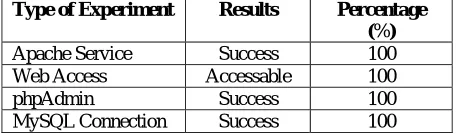
[image:6.612.71.303.205.272.2]Some experiments have be done to test appropriately connection to webserver, such as are apache server test, phpAdmin connection, database connection with MySQL Workbench. Table-1 shows the result of these experiments. Based on Table-1 the webserver perform the connection well.
Table-1. Results of Webserver Experiment.
Type of Experiment Results Percentage
(%)
Apache Service Success 100
Web Access Accessable 100
phpAdmin Success 100
MySQL Connection Success 100
Experiment of all systems
[image:6.612.65.313.386.717.2]These experiment has been done to check reliability of system both hardware and software, as well. All experiments used smart phone and computer via WiFi for both smart homes, respectively. Table-2 to 6 show accuracy of the temperature reading, some control processes and monitoring conditions to check ability of systems.
Table-2. The Accuracy of The Temperature Reading.
Experiment No.
Temperatur Error
(%)
Reading (oC) Standard (oC)
1 32 32 0
2 29 28 3.45
3 34 35 2.94
4 38 37 2.63
5 27 27 0 Average 2.34
Table-3. Control Action and Time Response.
Switch
Control Action
Time Response
(s) Average
(s) 1 2 3
Fan/AC ON 0.78 0.94 0.60 0.77
OFF 3.85 4.08 4.20 3.71 Room
Lamps
ON 0.92 0.65 1.32 0.96
OFF 1.37 1.04 1.13 1.18 Garden
Lamp
ON 0.86 1.25 0.80 0.97
OFF 0.58 0.54 0.94 0.68
Table-4. Door Status and Web Response.
Status Door Condition Alarm Condition Web Response
At Home Closed OFF NORMAL
Open OFF NORMAL Away Closed OFF NORMAL
Open RING ALERT
Table-5. Temperature Status and Alarm/Fan Conditions.
Temperature
(oC)
Web Status
Alarm Fan Condition
28 Normal OFF OFF
29 Normal OFF OFF
30 Normal OFF OFF
31 Hot OFF ON
32 Hot OFF ON
33 Hot OFF ON
34 Hot OFF ON
35 Very Hot RING ON
Table-6. Control Condition in Auto Mode Control.
Control Type Time and
Duration
Level of Success (%)
Room Lamp ON 20:57-20:59
2 minutes
100
AC/Fan ON 21:15-21:20
5 minutes
100
Table 2 to 6 proved that the system is performing well and in appropriate time to control and monitor all processes and conditions in both mode auto and scheduled one.
CONCLUSIONS
Designing of small smart community based on website with multi-client has been done. The system is able to monitor temperature, light intensity, door condition and to control fan/AC, some lamps and give any security alert. A website based on TCP/IP protocol webserver is used to give interconnection between device systems and database system using smart phone or computer/laptop via WiFi. Based on some experiments it can be said that all of the device system able to operate in good performance, respectively. In remote process, the system is performing well in appropriate time to control and monitor all processes and conditions in both mode auto and scheduled one.
REFERENCES
[1] Adriansyah A., and A. W. Dani. 2014. Design of Small Smart System based on Arduino, Electrical Powers, Electronics, Communications, Controls and Informatics Seminars (EECCIS 2014), pp. 121-125.
[2] Amer M., Naaman A., M’Sirdi N. K. and El-Zonkoly A. M. 2014. Smart Home Energy Management Systems Survey. International Conference on Renewable Energies for Developing Countries (REDEC), pp. 167-173.
[4] Atzori L., Iera A. and Morabito G. 2014. From “Smart Objects” to “Social Objects”: The Next Evolutionary Step of the Internet of Things. IEEE Communications Magazine, Vol. 52, pp. 97-105.
[5] Bandyopadhyay D. and J. Sen. 2011. Internet of Things – Applications and Challenges in Technology and Standardizations. Wireless Personal Communications, Vol. 58, pp. 49-69.
[6] De Silva L. C., C. Morikawa and I. M. Petra. 2012. State of the art of smart homes, Engineering Applications of Artificial Intelligence, Vol. 25, No.7, pp. 1-9.
[7] Dixit S. and R. Prasad. 2008. Technologies for Home Networking, Canda, A John Wiley & Sons, Inc., Publication.
[8] Giusto D., A. Iera G. Morabito and L. Atzori. 2010. Ed. The Internet of Things, Springer-Verlag.
[9] Gubbi J., R. Buyya S. Marusic M. Palaniswamia. 2013. Internet of Things (IoT): A Vision, Architectural Elements, and Future Directions, Future Generation Computer System, Vol. 29, No. 7, pp. 1645-1660.
[10]Luigi A., A. Iera G. Morabito. 2010. The Internet of Things: A survey. Computer Networks. Vol. 54, pp. 2787–2805.
[11]Mennicken S., Hwang A., Yang R., Hoey J.,
Mihailidis A. and Huang E. M. 2015. Smart for Life: Designing Smart Home Technologies that Evolve with Users. The 33rd Annual ACM Conference on Human Factors in Computing Systems, pp. 2377-2380.
[12]Miorandi, D., S. Sicari, F. De Pellegrini, I. Chlamtac. (2012). Internet of things: Vision, applications and research challenges, Ad Hoc Networks, 10, pp. 1497– 1516.
[13]Said O. and M. Masud. 2013. Towards Internet of Things: Survey and Future Vision. International Journal of Computer Networks (IJCN), Vol. 5, No. 1, pp. 1-17.
[14]Xu L. R. Lu X. Liang and X. Shen X. Lin. 2011. Smart Community: An Internet of Things Application, IEEE Communications Magazine, pp. 68-75.
[15]Yang D., F. Liu and Y. Liang. 2010. A Survey of the Internet of Things, the 2010 International Conference on E-Business Intelligence, pp. 358-366.