www.hydrol-earth-syst-sci.net/20/4079/2016/ doi:10.5194/hess-20-4079-2016
© Author(s) 2016. CC Attribution 3.0 License.
Learning about water resource sharing through game play
Tracy Ewen1,2and Jan Seibert1,3,4
1Department of Geography, University of Zurich, Zurich, Switzerland 2Center for Climate Systems Modeling, ETH Zurich, Zurich, Switzerland
3Department of Physical Geography and Quaternary Geology, Stockholm University, Stockholm, Sweden 4Department of Earth Sciences, Uppsala University, Uppsala, Sweden
Correspondence to:Tracy Ewen ([email protected])
Received: 29 January 2016 – Published in Hydrol. Earth Syst. Sci. Discuss.: 10 February 2016 Revised: 23 August 2016 – Accepted: 14 September 2016 – Published: 7 October 2016
Abstract. Games are an optimal way to teach about water resource sharing, as they allow real-world scenarios to be enacted. Both students and professionals learning about wa-ter resource management can benefit from playing games, through the process of understanding both the complexity of sharing of resources between different groups and deci-sion outcomes. Here we address how games can be used to teach about water resource sharing, through both playing and developing water games. An evaluation of using the web-based game Irrigania in the classroom setting, supported by feedback from several educators who have used Irriga-nia to teach about the sustainable use of water resources, and decision making, at university and high school levels, findsIrriganiato be an effective and easy tool to incorporate into a curriculum. The development of two water games in a course for masters students in geography is also presented as a way to teach and communicate about water resource shar-ing. Through game development, students learned soft skills, including critical thinking, problem solving, team work, and time management, and overall the process was found to be an effective way to learn about water resource decision out-comes. This paper concludes with a discussion of learning outcomes from both playing and developing water games.
1 Introduction
One of the best ways to engage students and instill enthusi-asm for hydrology is to expose them to hands-on learning. Using (serious) games in the classroom can engage students, and inspire enthusiasm, while also helping to solidify formal concepts learned in standard curriculum. Learning through
games has been shown to increase soft skills, such as criti-cal thinking, creative problem solving, and teamwork (John-son et al., 2012), skills that are important for future water re-source managers. When teaching hydrological concepts, and especially in the context of water resource sharing, where compromises between different interest groups need to be made and conflicts sometimes arise, games can be a good tool to enact different real-world scenarios. Learning through game play can thus be instructive in showing the complex-ity involved in the management of water resources, for both students and professionals alike (Douven et al., 2012; Ra-jabu, 2007). The active participation in mock decision mak-ing, through to the outcomes of those decisions using games, also allows different learning goals, including critical think-ing and problem solvthink-ing, to be better realized (Wu et al., 2012).
be-come overly complex, making it more difficult to understand and less attractive in educational settings (Jones, 2011). Ad-ditionally, the idea of an individual actor is fundamentally unrealistic; in reality there are almost always many actors in-volved in water resource decisions.
Multi-player, role-playing games, in contrast to single-player games, allow different actors to interact, and are in-herently more realistic as they provoke social learning and collaborative task activity (Hummel et al., 2010), and can thus be very useful in learning about water resource shar-ing in educational settshar-ings. Role-playshar-ing games may or may not have limited decision options that are evaluated in a quantitative way. Examples of role-playing games with a fo-cus on water resource sharing where players have limited decision options include board games like the River Basin Game andGlobalization of Water Management (Hoekstra, 2012), which demonstrate issues related to sharing a com-mon resource in upstream and downstream settings, incor-porating the concepts of a water footprint and virtual wa-ter trade. Other role-playing games based on negotiations between different players include the Irrigation Manage-ment Game(Burton, 1989, 1994) and theRiver Basin Game (Magombeyi et al., 2008). In a recent review that explores us-ing serious games for social learnus-ing and stakeholder collab-oration in transboundary watershed management, Medema et al. (2016) found that serious games, including multi-player, role-playing games, provide a promising learning platform for developing partnerships and networks, and help to in-crease interaction and communication between diverse stake-holder groups. Role-playing games allow players to better understand different player (stakeholder) interests and per-spectives, and player dynamics, leading to specific decision outcomes. Medema et al. (2016) summarize different char-acteristics of serious games that lead to success in support-ing social learnsupport-ing and stakeholder collaborations. Among these characteristics, the degree of realism is important, but the multi-player, role-playing aspects are critical in exploring the dynamics and uncertainties involved in water resource sharing over a transboundary watershed, and ultimately lead to a better understanding of how optimal outcomes can be achieved with competing interests.
Building on the idea of better understanding multi-stakeholder decisions and how multi-stakeholders reach an out-come (and not necessarily the optimal one), Madani (2010) suggested that game theory provides a suitable framework to study the behavior and decisions of stakeholders in water resource systems. Unlike conventional systems engineering methods which typically apply optimization methods, game theory offers a more realistic approach to studying water re-source systems since people inherently have different inter-ests, and do not always act with the best system-wide out-come in mind, which conventional methods might assume (Madani, 2010). Drawing on this, Seibert and Vis (2012) de-veloped a web-based, multi-player game, which illustrates game theoretical aspects, calledIrrigania, to teach about
wa-ter resource sharing between several actors (or farmers) in educational settings. InIrriganiaplayers act as farmers liv-ing in a village and decide how to irrigate their fields over several years, and are thus presented with water sharing situ-ations with other farmers that are typical in real-world water-related conflicts. This game is simple in its rules, and there are few options for making decisions, which means that game outcomes can be more easily understood by students, making it a useful addition to a course on water resource manage-ment.
In the following, we address how effective games are in teaching about water resource sharing to different educa-tional levels, through both game play and game develop-ment. An evaluation ofIrriganiain the classroom setting is first presented, supported by feedback from several educa-tors who have usedIrrigania for teaching about water re-source conflicts at both university and high school levels. We then discuss our experiences, together with student feedback, from a course on water games that we facilitated for masters students in geography, where students developed a board and computer game, to be used in secondary school classrooms.
2 Irriganiaas a teaching tool
Since its inception, Irrigania (Seibert and Vis, 2012) has been used in different classroom settings and as an outreach tool, to teach about water resource sharing and to explore the role of cooperation in, and competition for, the use of water as a limited common-pool resource (Seibert and Vis, 2012; Pierce and Madani, 2013; Cuadrado et al., 2014). The game is played between villages made up of several farmers (usually four to six farmers per village). Each farmer has 10 fields, and they can choose to irrigate the fields with a combi-nation of rain water, river water, or groundwater. Each irriga-tion source has a certain cost and revenue associated with it. Rain water and river water both have a fixed cost, while the revenue for river water depends on the number of farmers us-ing it. For groundwater, the revenue is fixed, but the cost of groundwater increases with increasing depth to groundwater, where forg< 8 : 20 and forg ≥8 : 20+(g−8)2, wheregis the depth to groundwater (in arbitrary units) and dependent upon the amount of precipitation during a given year (de-termined by a “precipitation indicator” where a normal year =1; a dry year=0, and a wet year=2) as well as the num-ber of fields irrigated with groundwater. In contrast, the cost of irrigating with river water is fixed at 20, but the revenue depends on the precipitation indicator (0; 1; 2), the number of fields irrigated with river water, and the number of farmers in the village.
Table 1.TwoIrriganiagame scenarios played with international students during a course at CABI (Centre for Agriculture and Biosciences International), Delemont, Switzerland: Game 1 (top), a cooperative game, and Game 2 (bottom), a non-cooperative game, for farmer Susan in the village of Raintown. Farmer Susan tends to irrigate more heavily in Game 2, acting more selfishly, ending up with a lower individual income and a lower accumulated income for her village, as compared to Game 1 where the other farmers in Raintown are known to her.
Game 1: cooperative
Year GW level
Irrigation
GW
Irrigation
river
Rainfed Income Accum. income
Accum income village Village: Raintown 1 7.25 2 3 5 525.00 525.00
Farmer: Susan 2 9.25 2 2 6 453.54 978.54 3 11.25 3 3 4 548.31 1526.85 4 11.75 3 2 5 442.81 1969.67 5 12.25 2 1 7 378.88 2348.54 6 13.5 3 4 3 530.92 2879.46 7 15.25 2 1 7 309.88 3189.33 8 17.75 3 2 5 239.81 3429.15 9 18.25 2 3 5 294.88 3724.02
10 19 3 4 3 272.00 3996.02 16 745.02 Game 2:
non-cooperative
Year GW level
Irrigation
GW
Irrigation
river
Rainfed Income Accum. income
Accum. income village Village: Raintown 1 6.5 4 4 2 650.00 650.00
Farmer: Susan 2 8 4 4 2 663.33 1313.33 3 10.25 4 4 2 669.75 1983.08 4 12.25 5 4 1 601.35 2584.44 5 14.75 5 4 1 517.19 3101.63 6 17 6 6 −2 424.00 3525.63 7 19.75 4 5 1 142.75 3668.38 8 23 5 5 0 −325.00 3343.38 9 22.5 1 5 4 236.42 3579.79
10 23 1 5 4 271.67 3851.46 11 012.46
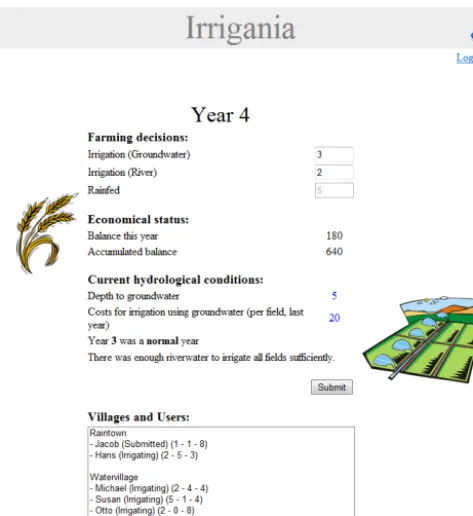
Before play the moderator (teacher) sets the length of the game, rainfall conditions, whether or not communication be-tween farmers and/or villages occurs (making the game ei-ther cooperative or non-cooperative), and wheei-ther users can see each other’s input (information is shared). It is recom-mended that several rounds be played, and the settings ad-justed so that different levels of information and cooperation can be explored. The game can also be played over several days, to give students more time to strategize and discuss re-sults after a certain number of years have occurred, before continuing. The student enters the “farming decisions”, i.e., the number of fields irrigated with groundwater and river water, and the number of rainfed fields (for a total of 10 fields), through a simple interface (Fig. 1). The “economical status” with balance (annual income) and accumulated bal-ance (accumulated income) of the farmer is shown, as well as the “current hydrological conditions”, on which the current year’s farming decisions can be based. The student can also see when all the farmers have made their decisions at the bot-tom (either “submitted” or “irrigating”). Two game scenarios are shown in Table 1: the columns (from left to right) show the game scenario (Game 1, cooperative, vs. Game 2,
non-cooperative), the year (1–10) for the given round, the ground-water level at the start of each year (GW level), the farming decisions taken (how many fields are irrigated with ground-water – Irrigation GW), and river ground-water (Irrigation River) and the number of rainfed fields. The outcomes for each year fol-low, including the income (net revenue and costs) for each year, the accumulated income for the round, and finally the accumulated income for the entire village.
ground-Figure 1.The student (farmer) web-interface during a game of Irri-ganiashowing the “Farming decisions” taken for Year 4, the “Eco-nomical status” based on Years 1–3, and “Current hydrological con-ditions” to base the current year’s decisions on.
water and river water over all years, reaches a high individ-ual accumulated income, and her village wins with the high-est accumulated village income (other villages not shown). Compared to Game 1, in Game 2 (bottom), a non-cooperative game, where players do not know who the other farmers are, farmer Susan tends to irrigate more heavily, reaches a mod-erate income, and has a lower overall income. The resulting groundwater (GW) level is much lower in Game 2 at the end of the round in year 10, with GW level=23, compared to 19 in Game 1, reflecting the overall tendency for players to act more selfishly in the non-cooperative game setting. Simi-lar patterns were also found to emerge by others, e.g., Pierce and Madani (2013), who playedIrriganiaas part of a larger study to better understand decision making related to com-mon pool resources. They showed that the most important factors in promoting sustainable resource use were commu-nication and cooperation, followed by trust, information dis-closure, and social learning.
When uncertainty is introduced in the weather in the Irri-ganiasetting (i.e., random amount of rainfall), decisions be-come more difficult and differences between farmers in their risk taking also tend to emerge. Between the different wa-ter resources, there is also learning as players improve the more they play simply by better understanding the longer-term effects of overuse in groundwater, compared to river water, which, in the game, has no year-to-year memory. In a recent study on sharing common resources among farmers
in Tanzania, Lecoutere et al. (2015) showed that gender and social status were also found to play a role; during times of water scarcity, high-status women shared fairly, whereas rich and powerful men were less worried about being greedy. Low social status (both men and women) tended to distribute wa-ter equally when it was abundant, but were more selfish when water was scarce. These different outcomes and aspects that emerge whenIrriganiais played with different scenarios and groups of players makeIrriganiaa useful tool to both explore and understand the complexities of water resource sharing.
A survey of usingIrrigania
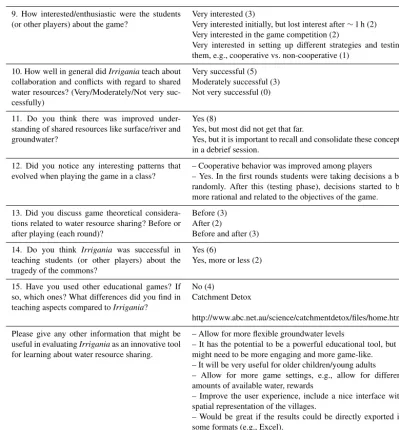
To evaluate the effectiveness ofIrriganiain teaching about water resource sharing, we carried out a survey, with an on-line questionnaire sent out to users (teachers) who had reg-istered to useIrrigania(since 2012; 18 in total). We asked these users 15 questions in total and received feedback from nine users (see Table A1). We asked users questions ranging from basic information on how they have used the game in their classrooms, or as an outreach tool, and how they have incorporated playing the game into their curriculum. We then asked for details on the educational level of their class, the type of course it was used in, and how many students played. As responses, teachers have usedIrriganiamainly at univer-sity level, for both bachelor and graduate courses, with one exception of using it for a high school geography course with 30 students. It has mainly been used in courses with a wa-ter resource focus (including departments of hydrology, en-vironmental engineering, and natural resource management). One group however, in the department of psychology, played it with students to better understand environmental decision making. Group sizes ranged from 20 students to 110.
This was followed by more detailed questions on the specifics of play (how many times they played with the same group, and with different groups, and duration of play). Al-though some groups played it only one time, most played it frequently, and some have incorporated it into their regu-lar class curriculum. Most groups played it once during the semester in a block of 2–4 h, but several also played it over several weeks, with up to one full semester for play.
[image:4.612.51.288.65.323.2]make it more interesting, and teachers commented that this would have likely held their attention for longer periods.
Questions to evaluate the effectiveness as a teaching tool were then asked, including how wellIrriganiataught about collaboration and conflicts with regard to shared water re-sources and whether there was improved understanding of shared resources like surface/river water and groundwater. All teachers (regardless of level) said thatIrriganiawas mod-erately (four replies) to very successful (five replies), when asked “how successful” (not; moderately; very) in teaching about collaboration and conflicts with regard to shared wa-ter resources. When asked about whether they thought there was an improved understanding of shared resources like sur-face/river water and groundwater, all answered that there was increased learning about shared water resources, but that a discussion session afterwards was key to solidifying the con-cepts learnt, especially for the high school and early level bachelor students.
SinceIrriganiais based on game theory, but is also sim-ple in its rules, it can be a good way to teach about game theoretical considerations related to water resource sharing (Seibert and Vis, 2012). As a follow-up after game play, we asked whether any interesting patterns had evolved and how much discussion the teachers incorporated into the process of playing the game (e.g., whether they had discussions on the topics before and/or after play). We then asked a few questions related to game theory, including whether game theoretical considerations related to water resource sharing were discussed (before and/or after playing) and whether Ir-riganiawas successful in teaching students (or other players) about the tragedy of the commons. Almost all teachers dis-cussed game theoretical considerations related to water re-source sharing briefly before play, but also in a final discus-sion after play, and this also helped to solidify learning con-cepts related to game theory. Almost all teachers also found that students understood, by the end of the session play, that cooperative behavior and communication were both key to succeeding. All teachers said that Irriganiawas successful in teaching students about the tragedy of the commons and supporting discussion of these concepts (all answered “yes” to this).
Additional questions were asked on whether the teacher had used other educational games and what differences they found in teaching aspects in these games compared to Irriga-nia. Four teachers used other games in the classrooms, and all said that in comparison,Irriganiawas very easy to use and required little preparation before using it in the class, which made it appealing. In a final question, we asked for general feedback that teachers thought would be useful for evaluat-ingIrriganiaas an innovative tool for learning about water resource sharing and suggestions for improving the game. Several suggestions were given; e.g., for younger students (high school), it was suggested that it should be more game-like and visually engaging. University level students however seemed to find it engaging enough, but also suggested that a
spatial interface be developed where villages could be rep-resented visually. It was also suggested that more game set-tings would make it more interesting, allowing students to explore more scenarios and play longer, e.g., by setting dif-ferent amounts of water from difdif-ferent sources and having rewards or punishments for level of sharing. Two teachers recommended that a more flexible groundwater level eval-uation be implemented by allowing the game to be played with different amounts of available water to start. Another commented that allowing the results to easily be exported would be an advantage for follow-up discussion and analysis of game play.
Overall, the feedback from the survey was positive, and all teachers felt thatIrriganiawas a good tool for teaching about both shared water resources and game theory. The re-sults highlight that the use ofIrriganiafor different levels of teaching is quite different, and that it seems to be best suited to higher bachelor level to masters level courses where stu-dents were the most engaged, it held their interest for longer, and teachers had less comments for improvements for these groups.
Additional analysis was carried out considering user data collected since July 2013, when user histories began to be saved; this excluded data collected during our own use of Irrigania. These data included how often users played Irrig-ania(number of games played), how long their rounds were (average game length), and over what period of time they played. The number of games played varied from only one game (users 8, 9) to 26 games played (user 10), with most users playing games with 10 years (the default setting), al-though user 10 played consistently shorter games, with an average of 5 years. For the game length, many users played over 1 day, but users 1 and 12 played over a 2-month period, with user 10 (with 26 games played) playing over the full pe-riod (July 2013–present). This agrees with some of the user feedback from the online questionnaire, where many teach-ers had used it once during the semester in a block of 2–4 h, and several also played it over several weeks, with up to one full semester for play.
3 Developing water games in the classroom
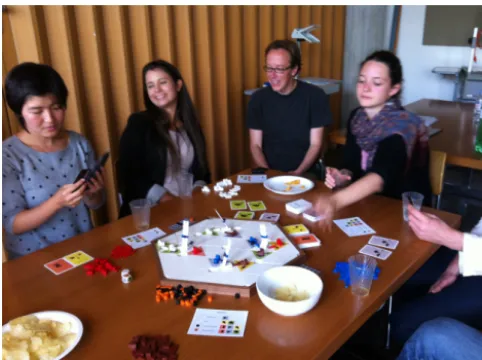
follow-Figure 2.Playing theWiapunaboard game in the final class.
ing, we first present the course as well as the design and de-velopment of two games by students that participated in the course, followed by an evaluation of learning outcomes from the course.
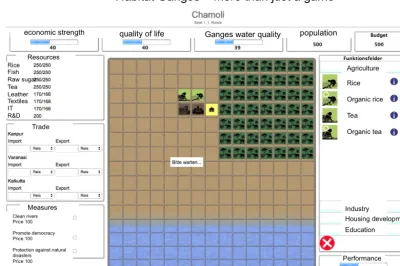
A first goal of the course was for the students to carry out a survey of existing water-related games, including both com-puter and board games. These games were then played and both positive and negative aspects of each game were dis-cussed, followed by an analysis of what makes a good game. Students also had a couple of lectures, with one on project management followed by two lectures on game theory, given by invited game theory experts, introducing students to game theory (whichIrriganiais based on). The second part of the course focused on the development of their own games, first through brainstorming ideas for new games, and then form-ing groups. The students then developed two different games: a board game,Wiapuna(Fig. 2), and a computer-based game, Habitat Ganges (Fig. 3), over a period of 6 months. Game development began with initial “idea boards” (Fig. 4) where students brainstormed possible game ideas, discussing as-pects of each in class, and further in working group sessions, to narrow down their ideas. Most ideas built upon already existing games that the students had reviewed and played in the first part of the course. The games were then developed over 3 months of group work with students organizing their own group time together (including summer). During game development, students also tested (played) the games with a couple of smaller groups of their intended target audiences, to get feedback and make improvements. In a final 3 h class, the games were played by the students in the class and other geographers in the department. Overall, the players enjoyed the games and comments for improvements or changes were discussed amongst the players.
Wiapuna:Wiapunawas developed as a multi-player board game (Fig. 2) for both family play or play in schools or as an outreach tool, for ages 10 and older. It is based on the
topic of water resource scarcity, and could be incorporated into a regular geography curriculum to supplement and en-hance regular lectures. InWiapuna, players build and develop settlements around four central wells (Fig. 5), where water is supplied by buying water pipes, and shared between neigh-bors using the same well. Natural resources (copper, gravel, wood and food, Fig. 5 right) are used to buy infrastructure. Water supply through wells is slowly depleted as more and larger houses are built around each well. New efficiency mea-sures need to be implemented to reduce the amount of water use (e.g., through buying drip irrigation, harvesting rainwa-ter for agriculture, and increasing efficiency in household ap-pliances). An element of uncertainty is introduced into the game with natural events that include global and regional heavy rainfall, water poisoning, floods, droughts, tornados, or storms. The board design is based on the well-known Set-tlers of Catanboard game, where players are also awarded points as their settlements grow, and likeSettlersis won by the first player to reach a certain number of points. Game play is approximately 70–100 min long, and thus could be incor-porated into the regular curriculum, where several sessions could be devoted to game play.
[image:6.612.47.288.66.246.2]Figure 3.A screenshot ofHabitat Ganges– more than just a game (Lebensraum Ganges – Mehr als ein Spiel). Shown is the game interface for the district of Chamoli, translated from the German. Note that the resources here can be related to those shown in the resource price list in Table 2.
Figure 4.Initial stages of game development with idea boards. Board 1 (left) shows a hypothetical game board with options for introducing a pipeline (Leitung), farmyard (Bauernhof), groundwater source (Grundwasser Feld), well (Brunnen), forest (Wald), and drought (Dürre) – > event card (Ereigniskarte). Board 2 (middle): game board development based on the FOEN, 2015 game. Board 3 (right): hypothetical game idea for a computer game based on the idea of upstream downstream river use and influence on each player (Spieler).
Evaluation of the “Water Games” course
Based on feedback we received after the course from the stu-dents, one of the main comments that most of the students had about this course was that the time (two full semesters) was not enough to get introduced to different games, get into groups, and finally develop, test, and produce their own games. In the end, the rush to complete a final project, and actually produce a game (especially the board game, which required a lot of technical expertise to produce) that could be played during the final session (and used later on as a teach-ing or outreach tool) meant that the game testteach-ing phase was
[image:7.612.100.497.402.499.2]pos-Figure 5.Board set-up forWiapunacentered around four wells (left). Settlements are developed on different land use tiles (right), corre-sponding to the natural resource cards (copper – Kupfer, gravel – Kies, wood – Holz, food – Nahrung, marsh – Sumpf, and desert – Wüste) that are used to buy infrastructure and energy efficiency measures.
Table 2.Each community inHabitat Gangesis given a sheet of paper indicating the list of prices for each resource (in arbitrary monetary units) together with the qualitative outcome (±) for each of the indicators (economy, life quality, and water quality) needed to win the game (here only “Agriculture/fisheries” and “Industry” are shown for Calcutta resource prices, as an example).
Resource Price/year Yield/year Effects Resource Budget Economy Quality
of life
Ganges water quality Agriculture/fisheries
Tea plantation 60 30 20 + 0 − −
Rice field 60 30 20 + + + 0 − −
Sugar cane plantation 60 30 20 + + + 0 − −
Fishery 60 30 20 + + + 0 –
Industry
Textile factory 80 50 60 + + + + + + − − −
Leather factory 80 50 60 + + + + + 0 − − − − −
IT firm 90 60 70 + + + + ++ + − − −
sibly more direction while developing ideas and forming the groups given.
Students commented that the lecture on game theory was maybe the least useful part of the course; although they found it interesting, several said that what they learned in the lec-tures was too theoretical and not useful for them to imme-diately apply in their game development. Following the lec-tures, the next part of the course, where students reviewed existing games, worked rather well, and the students all gave positive input about this part and said it was critical for them in developing their own game ideas. This was also clear in the development of the final games, since both of the games were based on existing games that they had reviewed during this part of the course. After this, when students were given time to get into groups, discuss ideas, and get down to work, this proved to be challenging – some students had quite strong ideas about how they wanted to proceed, and what type of game they wanted to develop (based on their skills, interests,
[image:8.612.117.476.286.479.2]their learning curve for the material was very steep, they had an excellent grasp of the topic after having developed their games.
The overall impression of the course from students was that they had put a lot of work into the course (for the given number of credit points received) – the group project was in-tense, requiring them to meet and work together frequently. The deadline for the final games to be submitted was also extended into summer and the next fall semester, but they nevertheless scrambled to get the games finished over the summer holiday. As mentioned, this course was meant to em-phasize practical aspects of what students learn during their masters curriculum, and students found the transition from theory to practice to be a more challenging step. Although they also had a course on project management, most of them felt that they could not apply the information learnt to their actual project. Indeed, working through the theory of project management is not likely useful without a concrete project to apply those theories to. This lecture could have maybe come later in the course, after they had formed groups, and final-ized their project ideas, and then finally applied some of the project management principles to their planning. Given these minor glitches, the students were quite satisfied with having taken the course, and produced their games, and it was defi-nitely a very new (learning) experience for everyone. A next step is to now to get others to play the games, either incor-porating the games into teaching curriculum for the age ap-propriate levels, or possibly during hydrology/water focused outreach events as a communication and teaching tool.
4 Discussion and conclusions
In this paper, we have presented a short evaluation of how both playing games and developing games can be effective ways to learn and communicate about water resource shar-ing. Using Irrigania, a multi-player, web-based game, we presented results from a survey carried out to evaluate the effectiveness of its use in the classroom to teach about wa-ter resource sharing. Our survey showed thatIrriganiais an effective tool for learning about
i. water resource sharing, and that both cooperation and communication are key factors for sustainable water use;
ii. different shared resources, including surface/river water and groundwater, and differences between them; and iii. tragedy of the commons and support discussion of these
somewhat theoretical and sometimes difficult concepts for students to grasp.
Overall, teachers foundIrriganiato be an effective and also easy tool to incorporate into curriculum, ideally for upper level bachelor to masters level students, studying either water resources or decision making.
Learning activated through both playing and developing serious games in the classroom can provide crucial skills for future professionals to solve complex water resource prob-lems. The complex learning through game play and game development emphasizes problem-solving, communication and collaboration, and critical reflection on wicked problems (Hummel et al., 2010), of which water resource management is one. In a review of learning outcomes of playing serious games, Wouters et al. (2009) found that serious game play improves the acquisition of knowledge and cognitive skills, and that it seems to be promising in accomplishing attitudinal change, likely an important aspect for future water resource professionals as they transition from an educational setting to the workplace, bringing new perspectives with them. In a study on using serious games in acquiring water resource management skills, Hummel et al. (2010) found that the as-pect of collaboration within serious games (in the classroom setting) can improve learning about certain problem situa-tions applied in the workplace, according to new modes of more active and experiential learning. The focus on coop-eration and communication inIrrigania, through its multi-player character and simple game set-up, where communica-tion between farmers is decided before game play, thus also likely leads to improved learning of water resource sharing concepts.
se-rious game development in the classroom and further insight into the learning outcomes as well as carry-on effects into the workplace would be an interesting research question that could shed light on whether just playing games (emphasizing the fun factor) might be enough to achieve similar learning effects to the full process of game development.
5 Data availability
Appendix A
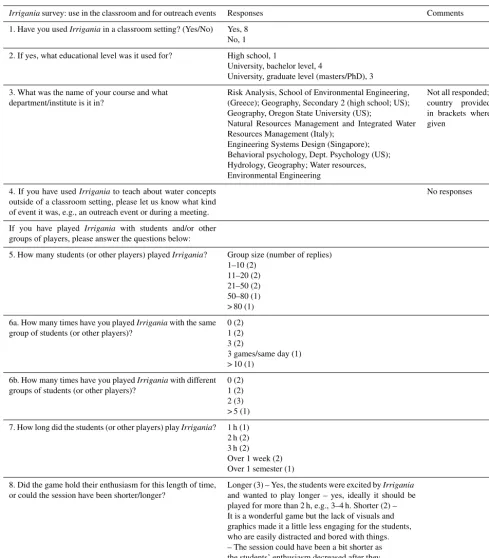
Table A1.TheIrriganiasurvey questions (16, left column) sent out to 18 Irrigania users. A total of nine users responded. Responses are shown for each question, and comments when given.
Irriganiasurvey: use in the classroom and for outreach events Responses Comments
1. Have you usedIrriganiain a classroom setting? (Yes/No) Yes, 8 No, 1
2. If yes, what educational level was it used for? High school, 1
University, bachelor level, 4
University, graduate level (masters/PhD), 3
3. What was the name of your course and what department/institute is it in?
Risk Analysis, School of Environmental Engineering, (Greece); Geography, Secondary 2 (high school; US); Geography, Oregon State University (US);
Natural Resources Management and Integrated Water Resources Management (Italy);
Engineering Systems Design (Singapore); Behavioral psychology, Dept. Psychology (US); Hydrology, Geography; Water resources, Environmental Engineering
Not all responded; country provided in brackets where given
4. If you have usedIrriganiato teach about water concepts outside of a classroom setting, please let us know what kind of event it was, e.g., an outreach event or during a meeting.
No responses
If you have played Irrigania with students and/or other groups of players, please answer the questions below:
5. How many students (or other players) playedIrrigania? Group size (number of replies) 1–10 (2)
11–20 (2) 21–50 (2) 50–80 (1) > 80 (1)
6a. How many times have you playedIrriganiawith the same group of students (or other players)?
0 (2) 1 (2) 3 (2)
3 games/same day (1) > 10 (1)
6b. How many times have you playedIrriganiawith different groups of students (or other players)?
0 (2) 1 (2) 2 (3) > 5 (1)
7. How long did the students (or other players) playIrrigania? 1 h (1) 2 h (2) 3 h (2) Over 1 week (2) Over 1 semester (1)
8. Did the game hold their enthusiasm for this length of time, or could the session have been shorter/longer?
Table A1.Continued.
9. How interested/enthusiastic were the students (or other players) about the game?
Very interested (3)
Very interested initially, but lost interest after∼1 h (2) Very interested in the game competition (2)
Very interested in setting up different strategies and testing them, e.g., cooperative vs. non-cooperative (1)
10. How well in general didIrriganiateach about collaboration and conflicts with regard to shared water resources? (Very/Moderately/Not very suc-cessfully)
Very successful (5) Moderately successful (3) Not very successful (0)
11. Do you think there was improved under-standing of shared resources like surface/river and groundwater?
Yes (8)
Yes, but most did not get that far.
Yes, but it is important to recall and consolidate these concepts in a debrief session.
12. Did you notice any interesting patterns that evolved when playing the game in a class?
– Cooperative behavior was improved among players – Yes. In the first rounds students were taking decisions a bit randomly. After this (testing phase), decisions started to be more rational and related to the objectives of the game.
13. Did you discuss game theoretical considera-tions related to water resource sharing? Before or after playing (each round)?
Before (3) After (2)
Before and after (3)
14. Do you think Irrigania was successful in teaching students (or other players) about the tragedy of the commons?
Yes (6)
Yes, more or less (2)
15. Have you used other educational games? If so, which ones? What differences did you find in teaching aspects compared toIrrigania?
No (4)
Catchment Detox
http://www.abc.net.au/science/catchmentdetox/files/home.htm
Please give any other information that might be useful in evaluatingIrriganiaas an innovative tool for learning about water resource sharing.
– Allow for more flexible groundwater levels
– It has the potential to be a powerful educational tool, but it might need to be more engaging and more game-like. – It will be very useful for older children/young adults – Allow for more game settings, e.g., allow for different amounts of available water, rewards
– Improve the user experience, include a nice interface with spatial representation of the villages.
Acknowledgements. We thank the students in GEO401: Water Games, Marc Vic for helping to create and continue managing
Irrigania, Sandra Pool for helping with pedagogical aspects of the Water Games course, and the H2K research group for playing games with us. Our water games can be found at http://www.geo.uzh.ch/en/units/h2k/services/water-games/.
Edited by: I. Stewart
Reviewed by: M. Jones and one anonymous referee
References
Burton, M. A.: Experiences with the irrigation management game, Irrig. Drain. Syst., 3, 217–228, 1989.
Burton, M. A.: The irrigation management game: a role playing ex-ercise for training in irrigation management, Irrig. Drain. Syst., 7, 305–318, 1994.
Corrigan, S., Zon, G. D. R., Maij, A., McDonald, N., and Martens-son, L.: An approach to collaborative learning and the se-rious game development, Cogn. Tech. Work, 17, 269–278, doi:10.1007/s10111-014-0289-8, 2015.
Cuadrado, E., Tabernero, C., Luque, B., and Garcia, R.: Water use strategies under competition and cooperation conditions, in: Ad-vances in Psychology and Psychological Trends Series: Psychol-ogy Applications and Developments, edited by: Pracana, C., in-Science Press, 289–296, 2014.
Deltares: World Water Game, http://world-water-game.de.softonic. com, last access: 18 November 2015.
Douven, W., Mul, M. L., Alvarez, B. F., Son, L. H., Bakker, N., Radosevich, G., and van der Zaag, P.: Enhancing capacities of riparian professionals to address and resolve transboundary is-sues in international river basins: experiences from the Lower Mekong River Basin, Hydrol. Earth Syst. Sci., 16, 3183–3197, doi:10.5194/hess-16-3183-2012, 2012.
FOEN: Der Umgang mit Wasser – mehr als ein Spiel, http://www. bafu.admin.ch/wassernutzung/07805/, last access: 18 November 2015.
Heins, B.: Nachhaltige Entwicklung – aus sozialer Sicht, Zeitschrift für angewandte Umweltforschung, 7, 19–25, 1994.
Hoekstra, A. Y.: Computer-supported games and role plays in teach-ing water management, Hydrol. Earth Syst. Sci., 16, 2985–2994, doi:10.5194/hess-16-2985-2012, 2012.
Hummel, H. G. K., van Houcke, J., Nadolski, R. J., van der Hiele, T., Kurvers, H., and Löhr, A.: Scripted collaboration in serious gaming for complex learning: Effects of multiple perspectives when acquiring water management skills, Brit. J. Educ. Technol., 42, 1029–1041, doi:10.1111/j.1467-8535.2010.01122.x, 2010.
Johnson, L., Adams, S., and Cummings, M.: The NMC Horizon Report: 2012 Higher education edition, Austin, Texas: The New Media Consortium, 36 pp., 2012.
Jones, N.: Video game: Playing with the planet, Nature Clim. Change, 1, 17–18, 2011.
Lecoutere, E., D’Exelle, B., and Van Campenhout, B.: Shar-ing Common Resources in Patriarchal and Status-Based So-cieties: Evidence from Tanzania, Fem. Econ., 21, 142–167, doi:10.1080/13545701.2015.1024274, 2015.
Madani, K.: Game theory and water resources, J. Hydrol., 381, 225– 238, doi:10.1016/j.jhydrol.2009.11.045, 2010.
Magombeyi, M. S., Rollin, D., and Lankford, B.: The river basin game as a tool for collective water management at community level in South Africa, Phys. Chem. Earth, 33, 873–880, 2008. Mansour, S. and El-Said, M.: Multi-player role playing educational
serious games: a link between fun and learning, Int. J. Learn., 15, 229–240, 2008.
Medema, W., Furber, A., Adamowski, J., Zhou, Q., and Mayer, I.: Exploring the Potential Impact of Serious Games on Social Learning and Stakeholder Collaborations for Transboundary Wa-tershed Management of the St. Lawrence River Basin, Water, 8, 175, doi:10.3390/w8050175, 2016.
Pierce, T. and Madani, K.: Online gaming for sustainable common pool resource management and tragedy of the commons preven-tion, in: Proc. 2013 IEEE International Conference on Systems, Man, and Cybernetics, 1765–1770, doi:10.1109/SMC.2013.304, 2013.
Prensky, M: Digital game-based learning, Comput. Entertain, 1, 1– 21, 2003.
Rajabu, K. R. M.: Use and impacts of the river basin game in implementing integrated water resources management in Mkoji sub-catchment in Tanzania, Agr. Water Manage., 94, 63–72, doi:10.1016/j.agwat.2007.08.010, 2007.
Ruben, B. D.: Simulations, games, and experience-based learning: The quest for a new paradigm for teaching and learning, Simulat. Gaming, 30, 498–505, 1999.
Seibert, J. and Vis, M. J. P.: Irrigania – a web-based game about sharing water resources, Hydrol. Earth Syst. Sci., 16, 2523–2530, doi:10.5194/hess-16-2523-2012, 2012.
Wouters, P., van der Spek, E. D., and van Oostendorp, H.: Cur-rent Practices in Serious Game Research: A Review from a Learning Outcomes Perspective, in: Games-Based Learn-ing Advancements for Multi-Sensory Human Computer Inter-faces: Techniques and Effective Practices, IGI Global, 232–250, doi:10.4018/978-1-60566-360-9.ch014, 2009.