www.hydrol-earth-syst-sci.net/14/1767/2010/ doi:10.5194/hess-14-1767-2010
© Author(s) 2010. CC Attribution 3.0 License.
Earth System
Sciences
Technical Note: Automatic river network generation for a
physically-based river catchment model
S. J. Birkinshaw
School of Civil Engineering and Geosciences, Newcastle University, Newcastle upon Tyne, NE1 7RU, UK Received: 10 May 2010 – Published in Hydrol. Earth Syst. Sci. Discuss.: 31 May 2010
Revised: 24 August 2010 – Accepted: 9 September 2010 – Published: 17 September 2010
Abstract. SHETRAN is a physically-based distributed mod-elling system that gives detailed simulations in time and space of water flow and sediment and solute transport in river catchments. Standard algorithms for the automatic genera-tion of river channel networks from digital elevagenera-tion data are impossible to apply in SHETRAN and other similar models because the river channels are assumed to run along the edges of grid cells. In this work a new algorithm for the automatic generation of a river channel network in SHETRAN is de-scribed and its use in an example catchment demonstrated.
1 Introduction
There is a long history of research that has been carried on the automatic generation of river networks from digital ele-vation models (DEM’s) (Jenson and Domingue, 1988; Tar-boton et al., 1991). There are three parts in a typical pro-cedure (Grimaldi, 2010). Firstly, to remove the pits from a DEM, secondly, to calculate the flow directions for each grid square and, thirdly, using the flow directions to tract the river channel network. A number of algorithms ex-ist for the removal of pits (Grimaldi et al., 2007) although some can result in flat areas which can cause problems when generating river networks (Nardi et al., 2008). A consider-able number of different methods exist for the calculation of flow directions; some of these are compared in Erskine et al. (2006). In a single-direction algorithm the upstream contributing area is calculated by considering that all the flow is transferred from one cell to its downslope neighbour, whereas in multiple-direction algorithms the flow can be por-tioned to several neighbouring cells. The D8 (O’Callaghan and Mark, 1984) method is a single flow direction method
Correspondence to: S. J. Birkinshaw
in which each cell discharges into one of its eight neigh-bours (4 sides and 4 vertices), the one located in the direc-tion of steepest descent. Theρ8 method is also a single flow direction method which randomly assigns the direction of flow to the downslope neighbours with the probability pro-portional to the slope. Multiple flow methods include the MD8 method (Quinn et al., 1991), DEMON (Costa-Cabral and Burges, 1994), D∞(Tarboton ,1997) and MD∞ (Seib-ert and McGlynn, 2007). Multiple flow methods appear to generally produce better results (Erskine et al., 2006; Wilson et al., 2007). The basic method to extract the river channel network is then to use the flow directions to calculate the upstream contributing area for each grid square and then ini-tialise a river channel when the upstream contributing area is greater than a threshold value (Montgomery, 1993). How-ever, automated methods are available for channel initiali-sation (Tarboton et al., 1991; Lin et al., 2006). For exam-ple, Tarboton et al. (1991) used a constant drop analysis for the identification of the channel initialisation threshold and then the river channel network is extracted using a curvature-based scheme (Tarboton and Ames, 2001).
Fig. 1. Gais Gill Catchment, Upper Eden, Northern England.
(a) SHETRAN mesh (50 m grid squares) (b) map of catchment.
and a channel is defined if the upstream contributing area is greater than a threshold value. In this case the entire grid square is considered to be a channel element. How-ever, in some physically based distributed models (PBDM’s), e.g. SHETRAN (Ewen et al., 2000) and MIKE SHE (Graham and Butts, 2006), the channel runs along the edge of the grid square. In these models the standard techniques used above to generate a river channel network do not work This work describes a new algorithm for the automatic generation of river channel networks for a PBDM where the river channel runs along the edge of grid squares. It is based on SHETRAN but could be applied to any similar model.
2 SHETRAN
SHETRAN (www.ceg.ncl.ac.uk/shetran) is a PBDM for wa-ter flow, sediment and solute transport in river catchments (Ewen et al., 2000) which includes hydrological components for simulating: rainfall interception by vegetation; evapora-tion and transpiraevapora-tion; snowpack formaevapora-tion and snowmelt; overland and channel flow; variably saturated subsurface flow; and river/aquifer interactions. It solves the govern-ing, physics-based, partial differential equations for flow and transport on a rectangular finite difference grid. Exam-ples applications include: Birkinshaw and Webb (2010) and Birkinshaw and Bathurst (2006).
The most convenient way of thinking about SHETRAN is that it represents the catchment as a set of columns, with each column divided into a stack of finite difference cells. The lower cells contain aquifer materials and groundwater, higher cells contain soil and soil water, and the uppermost cells
contain surface waters and the vegetation canopy. Figure 1a shows the tops of the columns in plan view, and also shows how the river channel network lies along the edges of the surface finite difference cells. Setting-up the river channel network has traditionally been carried out manually with the data input into text files. This time consuming activity was prone to error. For example, it was easy to define a catchment in which the river network was not connected or a catchment in which there was not a downward flow pathway for wa-ter in the river channel. A Graphical User Inwa-terface (GUI) for SHETRAN has been developed (Birkinshaw et al., 2010) and this allows a prototype simulation to be produced rapidly giving a starting point for detailed work. A key part of the GUI is the automatic generation of the river channel network and this is described here.
3 River network generation
The procedure for the automatic generation of the river chan-nel network in SHETRAN is different than typical approach (a “grid network”), because the river channels flow along the edge of the grid squares (an “edge network”). A simple method to produce the required “edge network” would be to follow an edge (say the “right bank”) of the “grid network” produced using a typical approach (Grimaldi, 2010). But methods attempted following this approach produced chan-nel networks that were not connected.
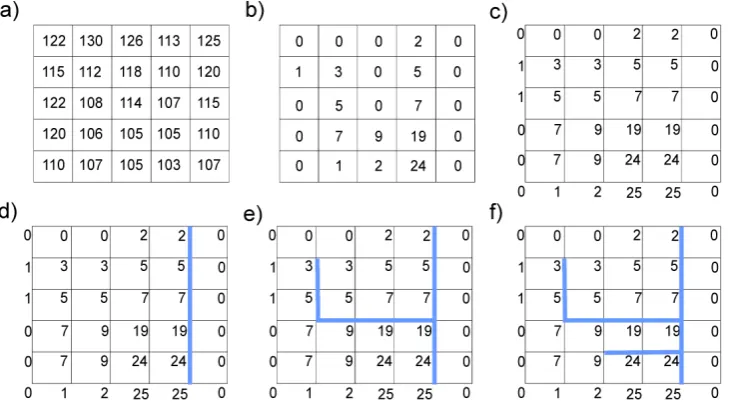
Therefore, the following procedure for the automatic gen-eration of the river channel network in SHETRAN has been developed. Initially this follows a typical approach (Grimaldi, 2010): the pits in the DEM are removed, the flow directions are calculated and this gives an upstream con-tributing area for each grid square, and a procedure for chan-nel extraction is defined (basic methods are used here and these are discussed in detail below). Figure 2 shows a sim-ple examsim-ple on a 5 by 5 grid, and assumes that all the grid cells are within the catchment and that the threshold value for channel initialisation is 2 grid squares. The algorithm proceeds as follows:
1. The lowest cell is assigned as the outlet. In Fig. 2a this is cell (4,1) at 103 m.
2. Remove DEM pits by increasing their elevation until they are higher than one of their neighbours. There are no pits in Fig. 2a.
3. Calculate the flow directions along the steepest downhill gradient (only north-south and east-west flows allowed), and use this to give the upstream contributing area for each cell (Fig. 2b).
Fig. 2. Automatic generation of river channel network for a 5 by 5 example. (a) DEM data (m), (b) upstream contributing area for each grid
cell, (c) upstream contributing area for each cell corner, (d) add first channel, (e) add second channel, (f) add third channel.
in the cells that meet at the corner (Fig. 2c). The up-stream contributing area in outlet corners (4,1) and (5,1) are increased by one.
5. Systematically work through all the cells, starting from the highest, initiating channels where appropriate. The details of the approach are demonstrated in “a” to “c” below and in Fig. 2b to 2f. For any cell, a river channel is initiated if the upstream contributing area is greater than or equal to the threshold value for channel initial-isation. This channel is then followed downhill, from corner to corner, taking the route of maximum upstream contributing area, until the outlet or another river chan-nel is reached.
(a) In Fig. 2b the first river channel starts at cell (4,5) with an elevation of 113 m and an upstream con-tributing area of 2. The channel (Fig. 2d) is located along the side of the cell, starting at corner (5,6) and going to corner (5,5) [the channel is located on the eastern side of the cell rather than the western side because the adjacent grid square has a lower elevation, 125 m at cell (5,5) compared to 126 m at cell (3,5)]. Of all the corners connected to (5,5) the highest accumulation is at (5,4), so the channel goes to (5,4), and so an all the way to the outlet at (5,1). (b) The next cell to initiate a channel is (2,4), with an elevation of 112 m and an upstream contribut-ing area of 3 (Fig. 2e). The process proceeds as before. To maximise the flow accumulation, the channel starts at corner (2,5) and goes to (2,4), then (2,3), (3,3) and (4,3). It is now only one cell away from the existing channel, Instead of following the
usual rule and going to (4,2), it goes to join the ex-isting channel at (5,3). The maximum upstream contributing area rule is here overridden by a rule demanding maximum connectedness.
(c) The third and final cell to initiate a channel is (3,2), with an elevation of 105 m and a flow accumulation of 2 (Fig. 2f). The channel starts at corner (3,2), uses the maximum flow accumulation rule to go to (4,2), then uses the maximum connectedness rule to go to (5,2).
The elevations and widths of the channels are calculated au-tomatically. The elevations are calculated during the above procedure by initially setting the base of the channel to be a set distance below the lowest adjacent grid cell (user de-fined parameter) and then, if necessary, reducing it so that it is lower than the upstream channel elevation (this procedure is fairly simple as the algorithm traces the channel network downstream, so it is easy locate the upstream channel and test to see if it has a higher elevation). A rectangular channel is assumed and the channel width is set as a function of the upstream contributing area (Leopold and Maddock, 1953).
similar to those shown on maps. This has allowed prototype simulations to be set-up and run very rapidly.
Although the procedure has to shown to be robust it can be criticised in a number of ways. In stage 2 above a basic pro-duce for pit removal is used. In this procedure elevations in a pit are increased until it is higher than one of its four neigh-bours. This can cause problems in large flat areas. However, due to the nature of the problems for which SHETRAN is applied and due to run-time problems if a very small grid sizes are used these large flat areas are rarely encountered. In stage 3 above, the flow directions were calculated using the D4 algorithm and this can make the results grid dependent and subject to distortion. However, the flow in SHETRAN is restricted to its four neighbours (i.e. diagonal flows are impossible) and tests with D8 algorithms show they do not work. Further tests using multiple direction D4 algorithms are planned. In stage 5 the channel is initialised if the up-stream contributing area is greater than a threshold value. This is a widely used technique and if a suitable value is se-lected this can give an appropriate channel network. How-ever, the extracted network is still spatially uniform. So, further tests using a curvature-based scheme (Tarboton and Ames, 2001) are also planned. In all these cases the algo-rithm specified above only produces prototype simulations (but the important point is that it is one in which the river channel network is always connected and with channel ele-vations that give a downwards flow pathway) and if the user is unhappy with the network produced these can be modified manually.
Theoretically the algorithm can be used for a DEM with any size and number of grid squares (unless the size of the grid squares in the DEM is so small and the catchment so large that the width of the river channels becomes larger than the size of the DEM). However, from a practical viewpoint the number of grid squares (and their corresponding size) needs to appropriate for SHETRAN as it is limited by the run time within SHETRAN. The maximum number of grid squares used in SHETRAN is a 200 by 200 grid. However, typically a 50 by 50 grid is used, with a one year simulation on a modern PC taking about 5 min.
4 Conclusions
SHETRAN is a powerful tool for studying hydrological and environmental impacts associated with land-use and climate change and land erosion and pollution. However, it has been difficult and time consuming to set-up for new catchments, the main problem being the production of the data set con-taining the river channel network and its elevations. This work has been performed to make it easier to use SHETRAN, a limited version of which can be freely downloaded at www.ceg.ncl.ac.uk/shetran. Using standard algorithms for the automatic generation of the river channel network has been impossible, as the river channels in SHETRAN run
along the edge of the grid squares. A new algorithm has been described here which is suitable for SHETRAN and other hy-drological models where the channels run along the edge of the grid squares. The algorithm has been shown to work well for the 1 km2 Gais Gill catchment, Upper Eden, Northern England producing a similar river channel network to that seen on the OS map.
Acknowledgements. The algorithm described here is designed to work with SHETRAN (Version 4.3.5), which was developed by the Water Resources Systems Research Laboratory, School of Civil Engineering and Geosciences, Newcastle University. The following are thanked for their contribution to the work on SHETRAN: Enda. O’Connell, John Ewen, Phil James, James Bathurst, Isabella Bovolo, Chris Kilsby, Greg O’Donnell, and Geoff Parkin. The following are also thanked for their valuable comments on the manuscript: John Ewen, Greg O’Donnell, Paul Quinn, Salvatore Grimaldi and an anonymous referree.
Edited by: A. Gelfan
References
Birkinshaw, S. J. and Bathurst, J. C.: Model study of the relation-ship between sediment yield and river basin area, Earth Surface Proc. Land., 31, 750–761, 2006.
Birkinshaw, S. J. and Webb, B.: Flow pathways in the Slapton Wood catchment using temperature as a tracer, J. Hydrol., 383, 269– 279, 2010.
Birkinshaw, S. J., James, P., and Ewen, J.: Graphical User Interface for Rapid Set-up of SHETRAN Physically-Based River Catch-ment Model. Environ. Modell. Softw., 25, 609–610, 2010. Costa-Cabral, M. C. and Burges, S. J.: Digital elevation model
net-works (DEMON): A model of flow over hillslopes for computa-tion of contributing and dispersal areas, Water Resour. Res., 30, 1681–1692, 1994.
Erskine, R. H., Green, T. R., Ramirez, J. A., and MacDonald, L. H.: Comparison of grid-based algorithms for computing upslope contributing area, Water Resour. Res., 42, W09416, doi:10.1029/2005WR004648, 2006.
Ewen, J., Parkin, G., and O’Connell, P. E.: SHETRAN: distributed river basin flow and transport modeling system, J. Hydrol. Eng., 5, 250–258, 2000.
Graham, D. N. and Butts, M. B.: Flexible integrated watershed modelling with MIKE SHE, in: Watershed Models, edited by: Singh, V. P. and Frevert, D. K., CRC Press, Boca Raton, 245– 272, 2006.
Grimaldi, S., Nardi, F., Di Benedetto, F., Istanbulluoglu, E., and Bras, R. L.: A physically-based method for removing pits in dig-ital elevation models, Adv. Water Resour., 30, 2151–2158, 2007. Grimaldi S., Petroselli A., Alonso G., and Nardi F.: Flow time estimation with spatially variable hills-lope velocity in ungauged basins, Adv. Water Resour., doi:10.1016/j.advwatres.2010.06.003, in press, 2010.
Leopold, L. B. and Maddock, T.: The hydraulic geometry of stream channels and some physiographic implications: U.S. Geol. Sur-vey Prof. Paper, 262, 1953.
Taiwan’s upstream watersheds, Hydrol. Process., 20, 289–306, 2006.
Jenson, K., and Domingue, J. O.: Extracting topographic structure from digital elevation data for geographical information system analysis, Photogramm. Eng. Rem. S., 54, 1593–1600, 1988 Maidment, D. R.: Arc Hydro: GIS for Water Resources, ESRI
Press, 203 pp., 2002.
Montgomery, D. R. and Foufoula-Georgiou, E: Channel network source representation using digital elevation models, Water Re-sour. Res., 29, 3925–3934, 1993.
Neumann, L. N., Western, A. W., and Argent, R. M.: The sensitiv-ity of simulated flow and water qualsensitiv-ity response to spatial het-erogeneity on a hillslope in the Tarrawarra catchment, Australia. Hydrol. Process., 24, 76–86, 2010.
Nardi, F., Grimaldi, S., Santini, M, Petroselli, A., and Ubertini, L.: Hydrogeomorphic properties of simulated drainage patterns us-ing DEMs: the flat area issue, Hydrolog. Sci. J., 53, 1176–1193, 2008.
O’Callaghan, J. F., and Mark, D. M.: The extraction of drainage networks from digital elevation data, Comput. Vision Graphics Image Process., 28, 323–344, 1984.
Olivera, F., Valenzuela, M., Srinivasan, R., Choi, J., Cho, H., Koka, S., and Agrawal, A.: ArcGIS-SWAT:A geodata model and GIS interface for SWAT, J. Amer. Water Res. As., 42, 295–309, 2006.
Quinn, P., Beven, K., Chevallier, P., and Planchon, O.: The predic-tion of hillslope flow paths for distributed hydrological modeling using digital terrain models, Hydrol. Process., 5, 59–79, 1991. Seibert, J. and McGlynn, B. L.: A new triangular multiple
flow-direction algorithm for computing upslope areas from grid-ded digital elevation data, Water Resour. Res., 43, W04501, doi:10.1029/2006WR005128, 2007.
Shaw, D. A., Martz, L. W., and Pietroniro, A.: A Methodology for Preserving Channel Flow Networks and Connectivity Patterns in Large-scale Distributed Hydrological Models, Hydrol. Process., 19, 149–168, 2005.
Tarboton, D. G.: A new method for the determination of flow direc-tions and upslope areas in grid digital elevation models, Water Resour. Res., 33, 309–319, 1997.
Tarboton, D. G. and Ames, D. P.: Advances in the mapping of flow networks from digital elevation data, in: World Water and En-vironmental Resources Congress, Orlando, Florida, 20–24 May, ASCE, 2001.
Tarboton, D. G., Bras, R. L., and Rodriguez-Iturbe, I.: On the ex-traction of channel networks from digital elevation data, Hydrol. Process., 5, 81–100, 1991.