Munich Personal RePEc Archive
How costly are debt crises?
Furceri, Davide and Zdzienicka, Aleksandra
2011
Online at
https://mpra.ub.uni-muenchen.de/30953/
1
• •• •
Davide Furceri
OECD
and
University of Palermo
ϒAleksandra Zdzienicka
CEPII
∞Abstract
The aim of this paper is to assess the short and medium-term impact of debt crises on GDP. Using an unbalanced panel of 154 countries from 1970 to 2008, the paper shows that debt crises produce significant and long-lasting output losses, reducing output by about 10 percent after 8 years. The results also suggest that debt crises tend to be more detrimental than banking and currency crises. The significance of the results is robust to different specifications, identification and endogeneity checks, and datasets.
Keywords: Output Losses, Debt Crises, Sovereign Defaults. JEL: G1, E6
•
The authors would like to thank Oscar Bajo, Charles Calomiris, Luiz de Mello, Markus Jorra,Yngve Lind, Javier Perez, Jean-Luc Schneider, Athanasios Tagkalakis, Dave Turner, Paul Van Den Noord, Luke Willard and other participants to the OECD Economics Department Seminar, the XVIII Meeting of Public Economics and the 3rd EMG Conference for Emerging Markets Finance for useful comments and discussions. The views expressed in this paper are those of the authors and do not necessarily represent those of the OECD or its member countries.
ϒ
Mailing address: OECD, 2 rue André-Pascal, 75775 Paris CEDEX 16, Email: [email protected].
∞
2
1. Introduction
The recent general increase in public debt levels and severe funding pressures facing by
some European countries have brought once again discussions on the problems of sovereign
debt. The discussions have mainly focused on the impact of banking crises and economic
slowdown on public debt1, rather than the costs of debt crises. Although it is a common view that
debt crises may be damaging and that large increase in public debt has frequently led to
sovereign defaults, with negative effects on output only few studies have tested the effect of debt
crises on output, and even less papers have focused on the timing of the recovery after debt crisis
episodes.2
The economic literature has identified three main channels through which sovereign
debt crises affect output.3 The first channel is through the exclusion from international capital
markets. Sandleirs et al. (2004) show that after the occurrence of a sovereign default, countries
were excluded from international capital markets for about four years on average. Similarly,
Richmond and Dias (2008) find that exclusions to international capital markets after a sovereign
default lasted on average 4 years (5.5 years for debt crisis episodes in the 1980s, 4.1 in the 1990s,
and 2.5 in the 2000s). The second channel is through an increase in the cost of borrowing. For
example, Borensztein and Panizza (2009) find that for 31 emerging market economies in the
period 1997-2004, in the year after a sovereign default episode spreads increased by about 400
1
The OECD Economic Outlook (2010) projects that the increase in the gross debt-to-GDP ratio for OECD economies during the period 2007-2014 around 35 percentage points. Similar results are provided by IMF Fiscal Monitor (2010). Furceri and Zdzienicka (2010c) analyzing a panel of 154 countries from 1980 to 2006, show that severe banking crises are associated with a significant and long-lasting increase of about 37 percentage points of the government gross debt-to-GDP ratio. Reinhart and Rogoff (2009) estimate that in the three years after the occurrence of a banking crisis the real value of government debt rose on average by 86%.
2
Cerra and Saxena (2008) Panizza et al., (2009).
3
3
basis points compared to tranquil times. The third channel is through international trade. Rose
(2005) finds a significant reduction in bilateral trade of approximately 8 percent per year
following the occurrence of a sovereign default.4 In addition to these channels, debt crises can
affect output indirectly by leading to banking and currency crises (De Paoli et al. 2009).
The results of the empirical literature on the relation between sovereign default and
growth have in general confirmed that debt crises may lead to significant output contractions.
Sturzenegger (2004), using cross-country and panel regressions finds that debt defaults are
associated with a reduction in output growth of about 0.6-2.2 percentage points. De Paoli et al.
(2009), comparing output growth five years before and after the occurrence of a debt crisis, find
that debt crises are associated with output losses of at least 5 percent per year and last about ten
years. In contrast, Levy-Yeyati and Panizza (2010) analyzing quarterly data for output growth
find that growth recovers in the quarters immediately after the occurrence of a debt crisis.5
The results of these growth regressions, however, should be interpreted with some
cautions since may suffer from two main biases. First, sovereign debt crises may be endogenous
to output contractions. Indeed, many of episodes of debt defaults have occurred in period of
strong output falls. Chiang and Coronado (2005) and Boreinsztein and Panizza (2010) attempt to
address this issue by using a two–step approach, in which the probability of sovereign defaults is
estimated in the first stage regression, and then used as a regressor in the second stage in the
growth regression. However, this approach does not fully address endogeneity problems given
the impossibility to find strongly exogenous instruments for debt crises. In addition, the results of
4
Sovereign default can also affect economic output thought domestic channels such as a reduction in consumption and investment or fall in total factor productivity.
5
4
the second stage regression may be very sensitive to the particular model used to estimate debt
crises probabilities.
The second form of bias comes from the indistinguishable connection that exists
between currency, banking and debt crises. This is particularly the case for emerging economies
that have been frequently hit by the simultaneous occurrence of banking, currency, and debt
crises. The simultaneous occurrence of these types of financial crises is often attributed to the
so-called “original sin” syndrome (Eichengreen et al., 2003), occurring when most of the private
and public debt is short-term denominated in foreign currency. Following large domestic
exchange rate depreciations associated with currency crises, public debt (when mostly foreign
denominated) can increase considerably and lead to defaults. Reinhart and Rogoff (2010a,b)
suggest the following causality: private sector defaults precede banking sector crises that
coincide or precede public debt defaults. At the same, the opposite may also occur: public debt
defaults may lead to banking crises when banks are the main holders of government debt.
Banking and debt crises could also lead to currency crises. For instance, third generation crises
theory (Krugman, 1999) underlines the role of maturity mismatches and currency disequilibria in
private (mostly banking sector) balance sheets as the main reason for the onset of currency
crises.
This paper tries to address these issues. In particular, its contribution to the existing
literature is fourfold:
• It analyzes the impact of debt crises on output both in the short and in the
medium-term.
• It attempts to address endogeneity and reverse causality by using two approaches. The
5
growth in a panel framework, consists of using a two-step GMM-system estimator.
The second approach consists of estimating the impact of debt crises on growth using
the two-step GMM only for those debt crises episodes that occurred in periods when
contemporaneous output did not fall.
• It tries to isolate the impact of debt crises from the effect of banking and currency
crises using two different estimation strategies. The first approach consists of
estimating the effect of debt crises on output together with the effect of currency and
banking crises. In this way, it is possible to quantify the marginal contribution of each
crisis to output. In the second strategy, the effect of debt crises on output is estimated
only for those episodes for which neither a banking nor a currency crisis occurred in
the 2 years before, during, or after the onset of a debt crisis.
• To check for the robustness of our results, it uses several datasets of starting dates for
debt crises episodes.
The estimates based on an unbalanced panel of 154 countries from 1970 to 2008 suggest
that debt crises are very costly to output both in the short and in the medium-term. In the
short-term, the results suggest that debt crises reduce contemporaneous output growth by 6 percentage
points. The results are robust to different specifications, and to different robustness checks to
control for endogeneity and identification of debt crises (vs. banking and currency crises). In
particular, focusing on those debt crisis episodes characterized by a contemporaneous
non-negative growth, the analysis suggests that debt crises reduce output growth by about 6-10
percentage points. Similarly, focusing on debt crisis episodes for which neither a banking nor a
currency crisis occurred in the two 2 years before, during, or after the onset of a debt crisis, the
6
growth, with a magnitude of the effect of about 8 percentage points. The results are also robust to
alternative datasets with a magnitude of the effect ranging from 5 to 10 percentage points.
Debt crises are also associated with significant output losses over the medium-term: 8
years after the occurrence of a debt crisis, output contracts by about 10 percent. The statistically
significance of the result is robust to the estimation procedures used (local projections and
ARDL) and to different specifications.
Finally, the paper presents empirical evidence that output growth is reduced not only by
the occurrence of a debt crisis, but also -although to a lesser extent- when public (total and
foreign) debt exceeds a particular threshold.
The rest of the paper is organized as follows. Section 2 describes the data and the
identification of debt crises episodes. Section 3 presents the empirical methodology used to
assess the short and medium-term effects of debt crises on output, and the results. Section 4
summarizes the main results and concludes with some issues for future research.
2. Data
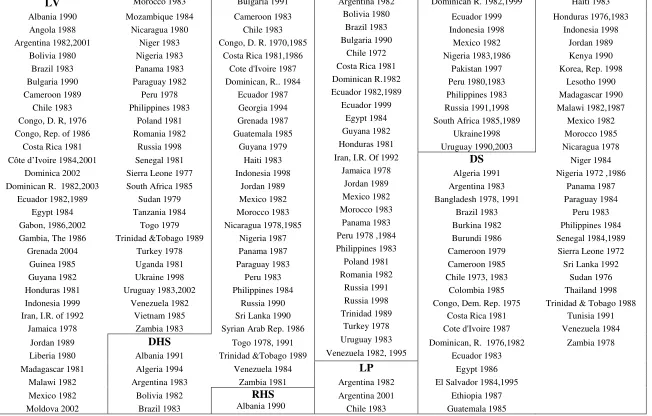
To identify debt crises episodes the paper relies on several datasets (Table 1):
• The first dataset is the one constructed by Laeven and Valencia (2008) who list the
starting date of debt crisis episodes as a compilation of years of sovereign defaults to private
lending and years of debt rescheduling. The authors rely on information from Beim and
Calomiris (2001), World Bank (2002), Sturzenegger and Zettelmeyer (2006), and IMF Staff
reports.6 Overall the authors identify 63 crises episodes, which mainly occurred in the 1980s: 7
6
7
episodes occurred in the period 1970-1979, 41 between 1980 and 1989, 7 in the period
1990-1999, and 8 after 1999.
• The second set of banking crises episodes is the one collected by De Paoli et al. (2006).
The authors identify 39 episodes of sovereign default over the period 1970-2000 when the
arrears on principal on external obligations towards private creditors reach at least 15 percent of
total commercial debt outstanding and/or there is a rescheduling with private creditors as listed in
the World Bank’s Global Development Finance.
• An alternative dataset of debt crises episodes is the one constructed by Reinhart et al.
(2003). The authors identify 31 debt crises episodes over the period 1970-2001 using the dates
reported in Beim and Calomiris (2001) on defaults and restructurings, and Standard and Poor’s
Credit Week information.
• A fourth dataset is Detragiache and Spillimbergo (2000) which covers 54 episodes of
debt crises. Defaults are identified when arrears of principal on interest on external obligations
towards commercial creditors exceed 5 percent of total commercial debt outstanding (excluding
the episodes that occur within four years of the previous defaults) and/or there is a rescheduling
with private creditors as listed in the World Bank’s Global Development Finance.
• Finally, the last dataset considered in the analysis is Levy-Yeyati and Panizza (2010).
The authors identify 20 default episodes over the period 1980-2003 (excluding the episodes that
occur within three years of the previous defaults). Episodes are classified as beginning years of
foreign currency bank or bond debt default, using information reported in Standard and Poor’s
Credit Week, World Bank’s Global Development Finance and the financial press.
8
Table 2 presents descriptive statistics for total and foreign public debt (as share of GDP),
and GDP growth in relation to the debt crises episodes identified in the datasets described above.
Looking at the table, it is immediately evident that starting dates of debt crises are associated
with periods of negative growth and relative high domestic and foreign public debt. In particular,
focusing on the first row of the table (for which more episodes and more observations for public
debt are available) debt crises generally occur when the gross public debt-to-GDP ratio is higher
than 80 percentage points, the public foreign gross debt-to-GDP ratio is above 55 percentage
points, and GDP growth is about - 2 percent.
Data for banking and currency crises episodes are taken from Laeven and Valencia
(2008). The authors determine the starting dates of banking crises combining quantitative
indicators measuring banking sector distress, such as a sharp increase in non-performing loans
and bank runs, with a subjective assessment of the situation. In particular, the database extends
and builds on Caprio et al. (2005) banking crises database and covers the universe of systemic
banking crises for the period 1970-2007. Currency crises episodes are identified when a currency
have a nominal depreciation of 10 percent in one year, and 30 percent overall (Frankel and Rose,
1996). Data for real GDP are taken from the World Bank Economic Indicators. Data for public
(domestic and foreign7) debt are taken from Panizza (2008).
3. Empirical Analysis
This section analyzes the impact of debt crises on short-term growth. The first part of the
section assesses the short-term effect of debt crises controlling for reversal causality,
identification of debt crises (vs. banking and currency crises) and providing several robustness
7
9
checks. Additionally, it investigates the impact of the (total and foreign) public debt-to-GDP
ratio on output and existence of debt thresholds. The second part of the section extends the
analysis to the medium-term, analyzing the response of output up to 8 years after the occurrence
of a debt crisis.
3.1 Short-term
Following previous studies in the literature on the short-term effects of banking and/or
currency crises on output, the methodological approach used in the paper consists of estimating
contemporaneous output growth against a dummy variable that takes value equal to 1 for the
occurrence of a crisis and 0 otherwise, and a set of variables influencing short-term growth. In
particular, the formal specification of the empirical model used for the short-term analysis is as
follows:
, , , , (1)
where , is the log of real GDP for country i at time t and zero otherwise, , is a dummy
variable that takes the value equal to 1 if a debt crisis occurred in country i at time t and 0
otherwise, are country-specific effects included to account for different growth trends among
countries, is a set of variables influencing growth in the short-term, and β represents the
marginal effect of the occurrence of a debt crisis on growth. The empirical literature on growth
has suggested numerous variables as possible determinants of growth (see, for example, Levine
and Renelt, 1992; Sala-i-Martin 1997, Sala-i-Martin et al. 2004). However, some of these
variables are likely to influence growth only over the medium–term, and are not available on a
yearly basis (e.g., human capital) over a long time span and for a large set of countries. Therefore
to keep the specification parsimonious, the variables included in the vector have been
10
population growth, (private) credit growth, real exchange rate growth and the initial (lagged)
level of GDP. In addition, given that the main concern is to introduce relevant control variables
into the regression so that the estimated impact of a debt crisis on output is not biased due to the
omission of variables, two lags of real GDP growth have been included.
To address endogeneity due to the presence of the lagged dependent variable among
regressors and to reverse causality from growth to the occurrence of debt crises, Equation 1 has
been estimated using the two-step GMM-system estimator. 8
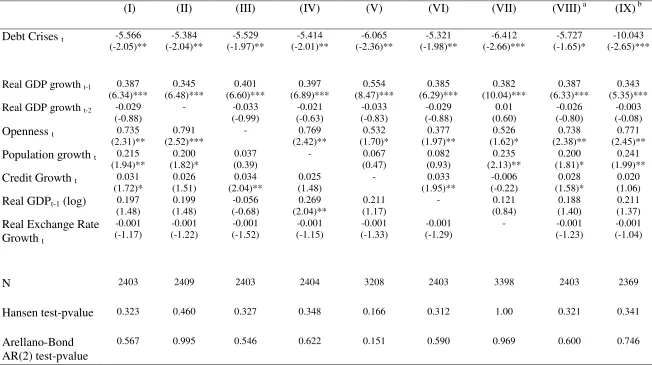
The results obtained estimating Equation 1 (column I, Table 3) suggest that debt crises
significantly reduce contemporaneous output growth by about 6 percentage points. The
significance of the results is robust across the different specifications with an estimated impact
that ranges from about 5 to 6 percentage points (column II-VII, Table 3).
The controls variables that have a positive and (most of the time) statistically significant
effect are trade openness, population growth, credit growth and the first lag of real GDP growth.
Consistency of the two-step GMM estimates has been checked by using the Hansen and the
Arellano-Bond tests. The Hansen J-test of over-identifying restrictions, which tests the overall
validity of the instruments by analyzing the sample analog of the moment conditions used in the
estimation process, cannot reject the null hypothesis that full set of orthogonality conditions are
valid (across the different specifications the p-value ranges from 0.3 to 1). The Arellano–Bond
test for autocorrelation cannot reject the null hypothesis of no second-order serial correlation in
8
11
the first-differenced error terms (across the different specifications the p-value ranges from 0.2 to
1).
Although these tests confirm the consistency of the GMM estimates, reverse causality
from growth to debt crises may be still an issue, since as shown in Table 2 debt crises tend to
occur in periods of negative growth, and because of the impossibility to find strongly exogenous
instruments for debt crises. To address this issue and to check the robustness of the results,
Equation 1 has been re-estimated excluding those debt crises episodes that occurred in periods
when contemporaneous output has fallen after a period of positive growth (growtht <0, growtht-1
>0 ). Two different specifications are estimated. In the first specification all observations are
considered. In the second one, the observations characterized by contemporaneous negative
growth and the occurrence of a debt crisis are dropped. The results obtained for both
specifications confirm that debt crises have a statistically significant and negative impact on
contemporaneous output growth (column VIII and IX, Table 3).9
To check for the robustness of the results, another approach to address reverse causality
from growth to debt crises, somewhat similar to the GMM approach, has been also carried out.
Following Chiang and Coronado (2005) and Boreinsztein and Panizza (2009), the approach
consists of estimating the probability of default using various predictors of debt crises, and then
using the predicted probability of default as a regressor in the growth regression. The results
obtained with this approach, not reported, confirm that debt crises have a significant and negative
effect on contemporaneous output growth. The magnitude of the effect, however, is very sensible
9
12
to the choice of specification used to estimate default probabilities, with point estimates that
range from 1 to 25 percentage points.
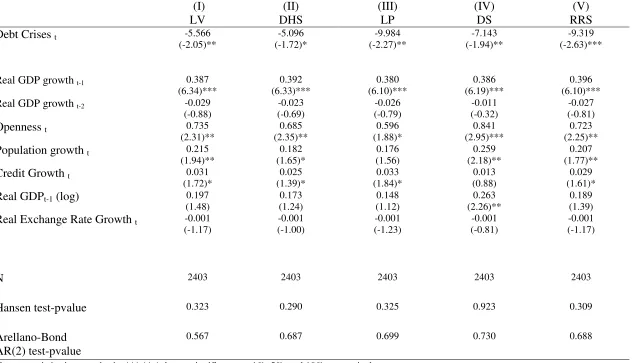
Finally, as additional robustness check, Equation (1) has been re-estimated using the
alternative datasets described in Section 2. The results reported in Table 4 provide robust
empirical evidence that debt crises have a significant and negative effect on contemporaneous
output. The magnitude of the point estimates varies across datasets, ranging from 5 to 10
percentage points. Since these datasets mainly differ for the composition of the countries for
which a debt crisis is attributed, rather than the dating of the crisis itself, it is likely that the
different estimates simply reflect the heterogeneous response of countries to the debt crises and
the different severity of the crises. However, these differences are not statistically significant.
3.1.1. Debt vs. Currency and Banking Crises
The close connection between currency, banking and debt crises, makes it particularly
difficult to isolate the impact of debt crises on the real output. For example, as pointed out by
Reinhart and Rogoff (2010b) it is possible that a banking (and/or currency) crisis may trigger a
debt crisis, in which case the estimated effect of debt crises on contemporaneous output growth
could be just interpreted as the lagged effect of banking (or currency) crises episodes. To address
this issue two different approaches have been carried out.
The first approach consists of estimating the effect of debt crises on output together with
the effect of currency and banking crises. In this way, it is possible to quantify the marginal
contribution of each crisis to output. To this purpose the following specification is estimated:
, , , , , , , , ,
13
where , ( , is a dummy variable that takes the value equal to 1 if a currency (banking) crisis
occurred in country i at time t, and zero otherwise. The (full) empirical specification includes
three types of twin crises: debt-currency ( , , , debt-banking , , , and currency-banking
( , , ). Similarly to Hutchinson and Noy (2005), twin crises are defined as those crises in
which the onset of a given crisis occurs 2 years before, during, or after the onset of another type
of crises. Finally, Equation (3) also includes triple debt-currency-banking crises , , , .
Analogously to the definition of twin crises, triple crises are defined as those crises in which the
onset of a given crisis occurs 2 years before, during, or after the onset of the other two types of
crises. The coefficients , , , , , and represent the marginal effect of debt, currency,
banking, twin and triple crises on output growth. Thus, if the "( coefficients are found to be
negative and statistically significant it implies that the occurrence of a twin (triple) crisis has an
additional negative impact on output growth above and beyond the combined effect of the two
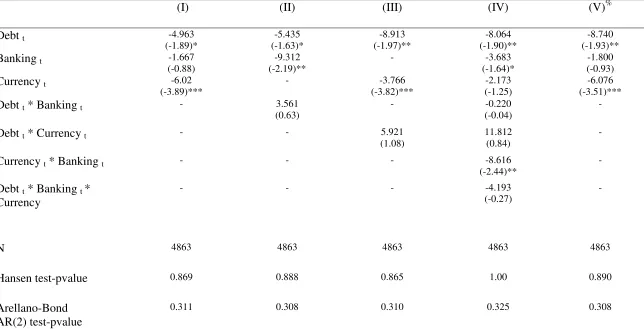
(three) types of crises. The results obtained estimating Equation 3 (Table 5) confirm that debt
crises significantly reduce output growth with an estimated impact that ranges across the
different specifications from 5 to 8 percentage points (column I-IV). More interestingly, looking
at the full specification the effect of debt crises seems to be more detrimental than the effect of
currency or banking crises. Among the twin and the triple crises dummy, only the twin
banking-currency crisis has a negative and statistically significant effect. The results are qualitatively
robust to different year windows (1 year and 3 years).
The second approach consists of estimating the effect of debt crises on output together
with the effect of currency and banking crises but only for those episodes for which neither a
banking nor a currency crisis occurred in the 2 years before, during, or after the onset of a debt
14
with this approach confirm that debt crises significantly reduce output growth (column V of
Table 4). In particular, the occurrence of a debt crisis, neither preceded nor followed by a
banking and/or a currency crisis, is found to reduce contemporaneous output growth by about 8
percentage points.
3.1.2 Debt thresholds
The results presented in the previous section have provided strong empirical evidence
that debt crises significantly reduce contemporaneous output growth. An interesting hypothesis
to test is also whether output growth is reduced not only by the occurrence of a debt crisis, but
also when public (total and foreign) debt exceeds a particular threshold. A first work in this
direction is Reinhart and Rogoff (2010a). The authors, analyzing a multi-country historical large
dataset on central government debt as well as data on external (public and private) debt, present
descriptive evidence showing that when the gross public debt-to-GDP ratio exceeds 90 percent,
median growth rates fall by one percentage points. Similarly, annual growth declines by about
two percentage points when external debt reaches 60 percent of GDP.
To test the Reinhart and Rogoff’s predictions a model specification similar to Equation
(1) has been estimated alternatively using the debt-to-GDP ratio (foreign debt-to-GDP) and a
dummy variable taking a value equal to 1 if the gross debt-to-GDP (foreign debt-to-GDP) ratio
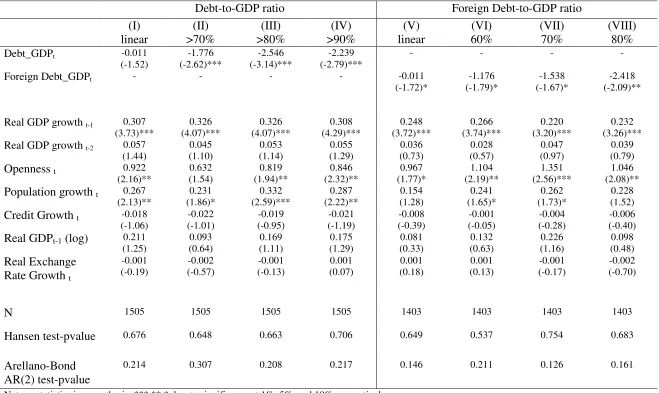
exceeds a given thresholds and zero otherwise. Table 6 reports the results obtained for the linear
and non-linear effects of debt on output growth. Starting with the debt-to-GDP ratio (column
I-IV), the results provide no statistically evidence of a linear relationship between growth and debt,
15
70 percentage points. Lower thresholds, tested but not reported, are found to be not statistically
significant, while the 80 and 90 percent thresholds are associated with a decline in output growth
greater than 2 percentage points. Similarly, higher thresholds are found to not contribute
significantly to additional negative effects. This finding is consistent with the evidence provided
in recent studies (Kumar and Woo, 2010; Checherita and Rother, 2010; and Carner et al. 2010).
The results for the foreign debt-to-GDP provide only weak statistical evidence of a linear
relationship between foreign debt and output growth, and show that output growth is reduced by
about 2.4 percentage points when the foreign debt-to-GDP ratio exceeds 80 percentage points.
Lower thresholds, such as 60 and 70 percent, are not statistically significant at 5 percent.
Similarly, higher thresholds are found to not contribute significantly to additional negative
effects.
Overall, the results seems to validate Reinhart and Rogoff’s predictions (i.e. the existence
of thresholds for the debt-to-GDP ratio and the foreign debt-to-GDP ratio above which output
growth starts to decline) although not in terms of the magnitude of these effects.
The analysis also suggests that the effect of high (total and foreign) debt is considerably
lower than the effect of debt crises, which indirectly implies that the channel through which debt
crises negatively affect output is not uniquely via a large debt burden.10
3.2 Medium-term
This paper also assesses whether the effect of debt crises on output is reverted over the
medium-term. In order to estimate the medium-term dynamic impact of debt crises episodes on
10
16
output, the paper follows the method proposed by Jorda (2005) and Teuling and Zubanov (2010)
which consists of estimating impulse response functions (IRFs) directly from local projections.
In detail, for each future period k the following equation has been estimated on annual data:
, #$ , $ %&'($ ∑+-, *+$∆ , + $ , $, (3)
with k= 1,..8, $ are country fixed effects, Timei are country-specific time trends and $
measures the impact of debt crises on the change of (the log of) the real output for each future
period k. The number of lags (l) has been chosen equal to two, even if the results are extremely
robust to different numbers of lags included in the specification. Corrections for
heteroskedasticity, when appropriate, have been applied using White robust standard errors.
Impulse response functions (IRFs) are then obtained by plotting the estimated $ for k= 0,1,..8,
with 95% confidence bands for the estimated IRFs being computed using the standard deviations
associated with the estimated coefficients $. While the presence of a lagged dependent variable
and country fixed effects may in principle bias the estimation of *+$in small samples (Nickel,
1981), this does not create a bias in the estimation of the coefficients of interest $ (Teulings and
Zubanov, 2010). In addition, the length of the time dimension mitigates possible concerns of
such a bias.11
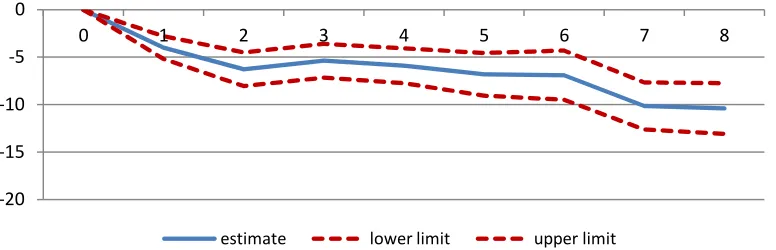
The results from estimating the medium-term impact of debt crises on output using
Equation (3) are presented in Panel A of Figure 1. The figure suggests that debt crises have
long-lasting effects, reducing output even 8 years after the occurrence of the crisis. In particular, the
estimates suggest that 8 years after the occurrence of a debt crisis output contracts by about 10
percent.
11
17
To check for the robustness of our results, Equation (3) has been re-estimated by
alternatively including a common time trend and time fixed effects (Annex 1). The results using
these different controls remain statistically significant and broadly unchanged. As an additional
robustness test the medium-term impact of debt crises on output has been re-estimated using an
ARDL (4, 4) equation12:
∆ / ∑0+- *+∆ , + ∑0 + , +
+-1 (4)
The impulse response functions (IRFs) are obtained by simulating a one year crisis and by
computing the response of output over time through the estimated coefficients, and 95-percent
level confidence bands are derived using Monte-Carlo simulations using one thousand of trials.
The results obtained estimating Equation (4) with both OLS and GMM confirms that debt crises
have long-lasting effects on output: 8 years after the occurrence of a debt crises output contracts
by about 9-12 percentage points (Annex 1).
Finally, in order to address possible reverse causality13 and identification problems
discussed in the previous section, Equation (3) has been re-estimated by alternatively
considering: i) those debt crises episodes with contemporaneous non-negative growth; ii) debt
crises episodes for which neither a banking nor a currency crisis occurred in the nine years
before, during, or after the onset of a debt crisis. The results for these two cases are shown in
Panel B add C of Figure 1, and corroborate the negative impact of debt crises on output over the
medium-term.
12
The approach was initially proposed by Romer and Romer (1989) and then recently applied by Cerra and Saxena (2008), Furceri and Mourougane (2009) and Furceri and Zdzienicka (2011) to assess the long-term impact of banking crises on economic activity. It is worth to stress that the IRFs derived using this approach may suffer from some problem such as i) to be sensible to the choice of the number of lags, making thus the IRFs less stable; ii) the significance of long-lasting effects on output can be simply driven by the use of one-type of shock models (Cai and Den Haan, 2009); iii) medium-term effects are more sensible to endogeneity problems, since are implicitly derived by estimating contemporaneous output growth.
13
18
4. Conclusions and issues for future research
The paper analyzes the short and medium-run effects of debt crises on output for an
unbalanced panel of 154 countries from 1970 to 2008. In the short-term, the results suggest that
debt crises are very damaging, reducing contemporaneous output growth by 6 percentage points.
The results are robust to different specifications, and to different robustness checks to control for
endogeneity and identification of debt crises (vs. banking and currency crises). In particular,
focusing on those debt crisis episodes characterized by a contemporaneous non-negative growth,
the analysis suggest that debt crises reduce output growth by about 6-10 percentage points.
Similarly, focusing on debt crises episodes for which neither a banking nor a currency crisis
occurred in the two 2 years before, during, or after the onset of a debt crisis, the results confirm
that debt crises significantly and negatively affect contemporaneous output growth, with a
magnitude of the effect of about 8 percentage points. The results are also robust to alternative
datasets with a magnitude of the effect ranging from 5 to 10 percentage points. Since these
datasets mainly differ for the composition of the countries for which a debt crisis is attributed,
rather than the dating of the crisis itself, it is likely that the different estimates simply reflect the
heterogeneous response of countries to the debt crises and the different severity of the crises.
These differences are, however, not statistically significant.
The medium term analysis confirms the negative effect of debt crises on output growth.
In particular, debt crises are associated with protracted output losses: 8 years after the occurrence
19
robust to the estimation procedures used (local projections and ARDL) and to different
specifications. These are large estimates and should alarm policy makers about the risk of
possible future debt crises.
Our study suggests that a number of interesting extensions can be pursued. First, as
suggested by the results obtained for different datasets, the response of output to debt crises may
vary across countries. Therefore, it would be useful to empirically examine the determinants of
this heterogeneity.
An additional promising direction would be to expand the investigation on whether
output is negatively affected not only by the occurrence of a debt crisis, but also when public
(total and foreign) debt exceeds a particular threshold. The results presented in the paper suggest
that output growth declines by about 1.8 percentage points (2.4 percentage points) when the
gross debt-to-GDP ratio (foreign debt-GDP ratio) exceeds 70 (80) percentage points. This
analysis could be extended by analyzing thresholds with non-parametric approaches, and by
looking at possible interactions between the share of public (total and foreign) debt and other
variables such as trade openness, domestic saving, financial integration, financial development,
20
References
Beim, D.,and Calomiris C., (2001). Emerging Financial Markets. Appendix to Chapter 1. New York: McGraw-Hill/Irwin Publishers.
Borensztein, E., and Panizza, U. (2009). “The Costs of Sovereign Default.” IMF Staff Papers,
56(4), 683-741.
Cai, X., and Den Haan W.J., (2009). “Predicting recoveries and the importance of using enough information”, CEPR Working Paper 7508.
Caprio, G., D. Klingebiel, L. Laeven, and Noguera, G. (2005). “Appendix:Banking Crisis Database,” in Patrick Honohan and Luc Laeven (eds.), Systemic Financial Crises: Containment and Resolution. Cambridge, U.K.: Cambridge University Press.
Carner,M, T. Grennes, and Koeheler-Geib, F. (2010), “Finding the Tipping Point-When Sovereign Debt Turns Bad”, World Bank Policy Research Working Paper 5391.
Cerra, V., and Saxena, S., (2008). “Growth Dynamics: The Myth of Economic Recovery”,
American Economic Review, 98, pp. 439-457.
Checherita, C., and Rother, P. (2010). “ The Impact of High and Growing Government Debt on Economic Growth: An Empirical Investigation for the Euro Area” ECB Working Papers forthcoming.
Chiang, G., and Coronado, J. (2005). “A Two Step Approach to Assess the Cost of Default for Latin America.” ww.urrutiaelejalde.org/Summer-School/2005/papers/coronadochiang.pdf.
De Paoli, B, S, Hoggarth, G and Saporta, V., (2006), “Costs of sovereign defaults”, Bank of EnglandFinancial Stability Paper No. 1, July.
De Paoli, B., Hoggarth G., and Saporta V., (2009). “Output costs of sovereign crises: some empirical estimates”, Bank of England Working Paper No. 362.
Detragiache E., and Spilimbergo A., (2001).”Crises and Liquidity - Evidence and Interpretation”,
IMF Working Papers 01/2.
Eichengreen, B., Hausmann, R., and Panizza, U., (2003). “Currency Mismatches, Debt Intolerance, and Original Sin: Why They Are Not the Same and Why It Matters”, NBER
Working Paper 10036.
Frankel, J., Rose A., (1996). “Currency Crashes in Emerging Markets: An Empirical Treatment”,
Journal of International Economics, Vol. 41, pp. 351-66.
Furceri, D., and Mourougane A., (2009). “The effect of financial crises on potential output: New
21
Furceri, D., and Zdzienicka A., (2010), “The Consequences of Banking Crises on Public Debt”,
OECD Economics Department Working Paper 801.
Furceri, D., and Zdzienicka A., (2011). “The Real Effects of Financial Crises in the European Transition Economies”, Economics of Transition,17, 1-25.
Hutchison, M., and Ilan, N., (2005). “How bad are twins? Output costs of currency and banking crises”, Journal of Money, Credit and Banking, 37(4),pp. 725-752.
IMF (2010). Fiscal Monitor, May 14.
Jorda, O., (2005). “Estimation and inference of impulse responses by local projections”,
American Economic Review, vol. 95, no. 1, pp. 161–82.
Krugman, P.,(1999). “Balance Sheets, the Transfer Problem, and Financial Crises,” International Tax and Public Finance, Springer, vol. 6(4), pages 459-472.
Kumar, M.S., and Woo, J. (2010). “Public Debt and Growth”, IMF Working Paper 10/174.
Leaven, L., and Valencia F., (2008). “Systemic banking crises: a new database”, IMF Working Paper, WP/08/224.
Levine, R., and Renelt D., (1992). “A sensitivity analysis of cross-country growth regressions”, American Economic Review, 82, 942–4.
Levy-Yeyati, E., and Panizza U., (2010). “The elusive costs of sovereign defaults”, forthcoming in Journal of Development Economics.
OECD Economic Outlook 87 (2010).
Panizza, Ugo. 2008. “The External Debt Contentious Six Years after the Monterrey Consensus.” G-24 Discussion Paper 51.
Panizza, U., Sturzenegger, F., and Zettelmeyer,J. (2009). “The Economics and Law of Sovereign Debt and Default,” Journal of Economic Literature, 47(3), 651-98.
Reinhart C., Rogoff K., and Savastano M., (2003). “Debt Intolerance”, NBER Working Paper
9908.
Reinhart, C., (2010).”This Time is Different Chartbook: Country Histories on Debt, Default, and Financial Crises”, NBER Working Paper 15815.
Reinhart, C., and Rogoff K., (2009). “The Aftermath of Financial crises”, American Economic Review 99, 466-472.
22
Reinhart C., Rogoff K., (2010b). “From Financial Crash to Debt Crisis” NBER Working Paper
15795
Richmond, C., and Dias, D. (2008). “Duration of Capital Market Exclusion: Stylized Facts and Determining Factors”
http://personal.anderson.ucla.edu/christine.richmond/Marketaccess_0808.pdf.
Romer, C., and Romer D., (1989). “Does Monetary Policy Matter? A New Test in the Spirit of
Friedman and Schwartz”, NBER Macroeconomics Annual, 4: 121-170.
Roodman, D., (2009). “How to do xtabond2: An introduction to difference and system GMM in Stata”, Stata Journal, vol. 9(1), pages 86-136.
Rose, A., (2005). “One reason countries pay their debts: renegotiation and international trade“,Journal of Development Economics, 77(1),189–206.
Sala-i-Martin, X., (1997). “I just Run Two Million Regressions”, American Economic Review
87, 178-183.
Sala-i-Martin, X., Doppelhofer, G. and Miller,R. (2004). “Determinants of Long-Term Growth:
A Bayesian Averaging of Classical Estimates (BACE) Approach,” American Economic Review,
vol. 94(4), 813-835.
Sandleris, G., G. Gelos, and Sahay, R.. (2004). “Sovereign Borrowing by Developing Countries:
What Determines Market Access?” International Monetary Fund Working Paper 04/221.
Sturzenegger, F. (2004). “Toolkit for the Analysis of Debt Problems.” Journal of Restructuring Finance, 1(1): 201–03.
Sturzenegger, F., and Zettelmeyer J., (2006). Debt Defaults and Lessons from a Decade of Crises. Table 1 in Chapter 1, Cambridge: MIT Press.
Teulings, C.N., and Zubanov N., (2010). “Economic recovery a myth? Robust estimation of impulse responses”, CEPR Discussion Papers,7800.
World Bank, Global Development Finance 2002, Appendix on Commercial Debt Restructuring.
23
Figure 1. The effect of debt crises on output-baseline
A. Debt crises
B. Debt crises with non-contemporaneous fall in output
C. Debt crises non-overlapping with other crises
Note: dotted lines represent 95% confidence bands.
-20 -15 -10 -5 0
0 1 2 3 4 5 6 7 8
estimate lower limit upper limit
-20 -15 -10 -5 0 5
0 1 2 3 4 5 6 7 8
estimate lower limit upper limit
-30 -20 -10 0 10
0 1 2 3 4 5 6 7 8
24
Table 1. Debt Crises Episodes
LV Morocco 1983 Bulgaria 1991 Argentina 1982 Dominican R. 1982,1999 Haiti 1983 Albania 1990 Mozambique 1984 Cameroon 1983 Bolivia 1980 Ecuador 1999 Honduras 1976,1983 Angola 1988 Nicaragua 1980 Chile 1983 Brazil 1983 Indonesia 1998 Indonesia 1998 Argentina 1982,2001 Niger 1983 Congo, D. R. 1970,1985 Bulgaria 1990 Mexico 1982 Jordan 1989
Bolivia 1980 Nigeria 1983 Costa Rica 1981,1986 Chile 1972 Nigeria 1983,1986 Kenya 1990 Brazil 1983 Panama 1983 Cote d'Ivoire 1987 Costa Rica 1981 Pakistan 1997 Korea, Rep. 1998 Bulgaria 1990 Paraguay 1982 Dominican, R.. 1984 Dominican R.1982 Peru 1980,1983 Lesotho 1990 Cameroon 1989 Peru 1978 Ecuador 1987 Ecuador 1982,1989 Philippines 1983 Madagascar 1990
Chile 1983 Philippines 1983 Georgia 1994 Ecuador 1999 Russia 1991,1998 Malawi 1982,1987 Congo, D. R, 1976 Poland 1981 Grenada 1987 Egypt 1984 South Africa 1985,1989 Mexico 1982 Congo, Rep. of 1986 Romania 1982 Guatemala 1985 Guyana 1982 Ukraine1998 Morocco 1985
Costa Rica 1981 Russia 1998 Guyana 1979 Honduras 1981 Uruguay 1990,2003 Nicaragua 1978 Côte d’Ivoire 1984,2001 Senegal 1981 Haiti 1983 Iran, I.R. Of 1992 DS Niger 1984
Dominica 2002 Sierra Leone 1977 Indonesia 1998 Jamaica 1978 Algeria 1991 Nigeria 1972 ,1986 Dominican R. 1982,2003 South Africa 1985 Jordan 1989 Jordan 1989 Argentina 1983 Panama 1987
Ecuador 1982,1989 Sudan 1979 Mexico 1982 Mexico 1982 Bangladesh 1978, 1991 Paraguay 1984 Egypt 1984 Tanzania 1984 Morocco 1983 Morocco 1983 Brazil 1983 Peru 1983 Gabon, 1986,2002 Togo 1979 Nicaragua 1978,1985 Panama 1983 Burkina 1982 Philippines 1984 Gambia, The 1986 Trinidad &Tobago 1989 Nigeria 1987 Peru 1978 ,1984 Burundi 1986 Senegal 1984,1989
Grenada 2004 Turkey 1978 Panama 1987 Philippines 1983 Cameroon 1979 Sierra Leone 1972 Guinea 1985 Uganda 1981 Paraguay 1983 Poland 1981 Cameroon 1985 Sri Lanka 1992 Guyana 1982 Ukraine 1998 Peru 1983 Romania 1982 Chile 1973, 1983 Sudan 1976 Honduras 1981 Uruguay 1983,2002 Philippines 1984 Russia 1991 Colombia 1985 Thailand 1998 Indonesia 1999 Venezuela 1982 Russia 1990 Russia 1998 Congo, Dem. Rep. 1975 Trinidad & Tobago 1988 Iran, I.R. of 1992 Vietnam 1985 Sri Lanka 1990 Trinidad 1989 Costa Rica 1981 Tunisia 1991
Jamaica 1978 Zambia 1983 Syrian Arab Rep. 1986 Turkey 1978 Cote d'Ivoire 1987 Venezuela 1984 Jordan 1989 DHS Togo 1978, 1991 Uruguay 1983 Dominican, R. 1976,1982 Zambia 1978 Liberia 1980 Albania 1991 Trinidad &Tobago 1989 Venezuela 1982, 1995 Ecuador 1983
Madagascar 1981 Algeria 1994 Venezuela 1984 LP Egypt 1986 Malawi 1982 Argentina 1983 Zambia 1981 Argentina 1982 El Salvador 1984,1995 Mexico 1982 Bolivia 1982 RHS Argentina 2001 Ethiopia 1987 Moldova 2002 Brazil 1983 Albania 1990 Chile 1983 Guatemala 1985
25
Table 2. Descriptive statistics
Datasets N. Crises Debt over GDP (%) Foreign debt over GDP (%) GDP Growth (%)
Average Max Min S.D. Average Max Min S.D. Average Max Min S.D.
LV 63 78.3 119.4 34.4 25.5 55.9 86.3 26.5 19.6 -2.1 7.5 -14.4 5.1
DHS 39 111.9 166.6 81.0 37.6 59.7 95.9 7.6 32.7 -2.5 10.6 -32.1 7.7
RRS 31 68.6 85.2 47.4 19.3 53.0 65.4 39.4 13.0 -2.2 5.9 -14.4 5.4
DS 54 63.8 142.0 10.8 39.7 41.0 70.6 6.0 23.3 0.7 15.4 -14.4 6.4
LY 21 64.5 96.6 21.0 26.1 46.7 78.4 21.0 20.9 -2.2 6.5 -14.1 5.3
Average 77.4 51.2 -1.7
26
Table 3. Output Growth and Debt Crises
(I) (II) (III) (IV) (V) (VI) (VII) (VIII) a (IX) b
Debt Crises t -5.566
(-2.05)** -5.384 (-2.04)** -5.529 (-1.97)** -5.414 (-2.01)** -6.065 (-2.36)** -5.321 (-1.98)** -6.412 (-2.66)*** -5.727 (-1.65)* -10.043 (-2.65)***
Real GDP growth t-1 0.387 (6.34)*** 0.345 (6.48)*** 0.401 (6.60)*** 0.397 (6.89)*** 0.554 (8.47)*** 0.385 (6.29)*** 0.382 (10.04)*** 0.387 (6.33)*** 0.343 (5.35)***
Real GDP growth t-2 -0.029 (-0.88)
- -0.033 (-0.99) -0.021 (-0.63) -0.033 (-0.83) -0.029 (-0.88) 0.01 (0.60) -0.026 (-0.80) -0.003 (-0.08)
Openness t 0.735
(2.31)**
0.791 (2.52)***
- 0.769 (2.42)** 0.532 (1.70)* 0.377 (1.97)** 0.526 (1.62)* 0.738 (2.38)** 0.771 (2.45)**
Population growth t 0.215
(1.94)**
0.200 (1.82)*
0.037 (0.39)
- 0.067 (0.47) 0.082 (0.93) 0.235 (2.13)** 0.200 (1.81)* 0.241 (1.99)**
Credit Growth t 0.031
(1.72)* 0.026 (1.51) 0.034 (2.04)** 0.025 (1.48)
- 0.033 (1.95)** -0.006 (-0.22) 0.028 (1.58)* 0.020 (1.06)
Real GDPt-1 (log) 0.197
(1.48) 0.199 (1.48) -0.056 (-0.68) 0.269 (2.04)** 0.211 (1.17)
- 0.121 (0.84)
0.188 (1.40)
0.211 (1.37)
Real Exchange Rate Growth t
-0.001 (-1.17) -0.001 (-1.22) -0.001 (-1.52) -0.001 (-1.15) -0.001 (-1.33) -0.001 (-1.29)
- -0.001 (-1.23)
-0.001 (-1.04)
N 2403 2409 2403 2404 3208 2403 3398 2403 2369
Hansen test-pvalue 0.323 0.460 0.327 0.348 0.166 0.312 1.00 0.321 0.341
Arellano-Bond AR(2) test-pvalue
0.567 0.995 0.546 0.622 0.151 0.590 0.969 0.600 0.746
Note: z-statistics in parenthesis. ***,**,* denote significance at 1%, 5%, and 10%, respectively.
GMM-System Estimator: Two-step using Windmeijer standard errors, Openness , lagged real exchange rate growth, lagged real credit growth, lagged credit growth and lagged debt crises as predetermined, other control variables considered as endogenous (instrumented using up to 3 lags).
a
Episodes of debt crises with contemporaneous non-negative output growth, and all growth observations.
b
27
Table 4. Output Growth and Debt Crises
(I) LV (II) DHS (III) LP (IV) DS (V) RRS
Debt Crises t -5.566
(-2.05)** -5.096 (-1.72)* -9.984 (-2.27)** -7.143 (-1.94)** -9.319 (-2.63)***
Real GDP growth t-1 0.387
(6.34)*** 0.392 (6.33)*** 0.380 (6.10)*** 0.386 (6.19)*** 0.396 (6.10)***
Real GDP growth t-2 -0.029
(-0.88) -0.023 (-0.69) -0.026 (-0.79) -0.011 (-0.32) -0.027 (-0.81)
Openness t 0.735
(2.31)** 0.685 (2.35)** 0.596 (1.88)* 0.841 (2.95)*** 0.723 (2.25)**
Population growth t 0.215
(1.94)** 0.182 (1.65)* 0.176 (1.56) 0.259 (2.18)** 0.207 (1.77)**
Credit Growth t 0.031
(1.72)* 0.025 (1.39)* 0.033 (1.84)* 0.013 (0.88) 0.029 (1.61)*
Real GDPt-1 (log) 0.197
(1.48) 0.173 (1.24) 0.148 (1.12) 0.263 (2.26)** 0.189 (1.39)
Real Exchange Rate Growth t -0.001
(-1.17) -0.001 (-1.00) -0.001 (-1.23) -0.001 (-0.81) -0.001 (-1.17)
N 2403 2403 2403 2403 2403
Hansen test-pvalue 0.323 0.290 0.325 0.923 0.309
Arellano-Bond AR(2) test-pvalue
0.567 0.687 0.699 0.730 0.688
Note: z-statistics in parenthesis. ***,**,* denote significance at 1%, 5%, and 10%, respectively.
GMM-System Estimator: Two-step using Windmeijer standard errors, Openness , lagged real exchange rate growth, lagged real credit growth, lagged credit growth and lagged debt crises as predetermined, other control variables considered as endogenous (instrumented using up to 3 lags).
LV= Laeven and Valencia (2008); DHS= De Paoli et al. (2006); LP=Levy-Yeyati and Panizza (2010); DS=Detragiache and Spillimbergo (2000); RRS= Reinhart
28
Table 5. Output Growth and Financial Crises: Debt vs. Banking and Currency
(I) (II) (III) (IV) (V)%
Debt t -4.963
(-1.89)* -5.435 (-1.63)* -8.913 (-1.97)** -8.064 (-1.90)** -8.740 (-1.93)**
Banking t -1.667
(-0.88)
-9.312 (-2.19)**
- -3.683
(-1.64)*
-1.800 (-0.93)
Currency t -6.02
(-3.89)***
- -3.766
(-3.82)***
-2.173 (-1.25)
-6.076 (-3.51)***
Debt t * Banking t - 3.561
(0.63)
- -0.220
(-0.04)
-
Debt t * Currency t - - 5.921
(1.08)
11.812 (0.84)
-
Currency t * Banking t - - - -8.616
(-2.44)**
-
Debt t * Banking t *
Currency
- - - -4.193
(-0.27)
-
N 4863 4863 4863 4863 4863
Hansen test-pvalue 0.869 0.888 0.865 1.00 0.890
Arellano-Bond AR(2) test-pvalue
0.311 0.308 0.310 0.325 0.308
Note: z-statistics in parenthesis. ***,**,* denote significance at 1%, 5%, and 10%, respectively. Control variables included but not reported.
GMM-System Estimator: Two-step using Windmeijer standard errors, Openness , population growth, openness and lagged crises as predetermined, other control variables considered as endogenous (instrumented using up to 3 lags).
%
29
Table 6. Output Growth, Debt-GDP and Foreign Debt-GDP ratios
Debt-to-GDP ratio Foreign Debt-to-GDP ratio
(I) linear (II) >70% (III) >80% (IV) >90% (V) linear (VI) 60% (VII) 70% (VIII) 80%
Debt_GDPt -0.011
(-1.52) -1.776 (-2.62)*** -2.546 (-3.14)*** -2.239 (-2.79)*** - - - -
Foreign Debt_GDPt - - - - -0.011
(-1.72)* -1.176 (-1.79)* -1.538 (-1.67)* -2.418 (-2.09)**
Real GDP growth t-1 0.307 (3.73)*** 0.326 (4.07)*** 0.326 (4.07)*** 0.308 (4.29)*** 0.248 (3.72)*** 0.266 (3.74)*** 0.220 (3.20)*** 0.232 (3.26)***
Real GDP growth t-2 0.057 (1.44) 0.045 (1.10) 0.053 (1.14) 0.055 (1.29) 0.036 (0.73) 0.028 (0.57) 0.047 (0.97) 0.039 (0.79)
Openness t 0.922
(2.16)** 0.632 (1.54) 0.819 (1.94)** 0.846 (2.32)** 0.967 (1.77)* 1.104 (2.19)** 1.351 (2.56)*** 1.046 (2.08)**
Population growth t 0.267
(2.13)** 0.231 (1.86)* 0.332 (2.59)*** 0.287 (2.22)** 0.154 (1.28) 0.241 (1.65)* 0.262 (1.73)* 0.228 (1.52)
Credit Growth t -0.018
(-1.06) -0.022 (-1.01) -0.019 (-0.95) -0.021 (-1.19) -0.008 (-0.39) -0.001 (-0.05) -0.004 (-0.28) -0.006 (-0.40)
Real GDPt-1 (log) 0.211
(1.25) 0.093 (0.64) 0.169 (1.11) 0.175 (1.29) 0.081 (0.33) 0.132 (0.63) 0.226 (1.16) 0.098 (0.48) Real Exchange Rate Growth t
-0.001 (-0.19) -0.002 (-0.57) -0.001 (-0.13) 0.001 (0.07) 0.001 (0.18) 0.001 (0.13) -0.001 (-0.17) -0.002 (-0.70)
N 1505 1505 1505 1505 1403 1403 1403 1403
Hansen test-pvalue 0.676 0.648 0.663 0.706 0.649 0.537 0.754 0.683
Arellano-Bond AR(2) test-pvalue
0.214 0.307 0.208 0.217 0.146 0.211 0.126 0.161
Note: z-statistics in parenthesis. ***,**,* denote significance at 1%, 5%, and 10%, respectively.
30
Annex 1
Common time trends Time FE
ARDL- OLS ARDL- GMM
Note: dotted lines represent 95 confidence bands. -20
-15 -10 -5 0
0 1 2 3 4 5 6 7 8
estimate lower limit upper limit
-20 -15 -10 -5 0
1 2 3 4 5 6 7 8 9
estimate lower limit upper limit
-20 -15 -10 -5 0
0 1 2 3 4 5 6 7 8
estimate lower limit upper limit
-20 -15 -10 -5 0
0 1 2 3 4 5 6 7 8