Munich Personal RePEc Archive
Assessing the determinants of Firms’
Competitiveness in Greece: A Structural
Equation Modeling Analysis
Metaxas, Theodore and Economou, Athina
U. of Thessaly, Department of Economics, Greece
2012
Assessing the Determinants of Firms’ Competitiveness in Greece:
A Structural Equation Modeling Analysis
Theodore Metaxas
Lecturer
Department of Economics, University of Thessaly, 43 Korai Str., 383 33, Volos, Greece Email: [email protected]
Tel: ++30 24210 74917 Fax: ++30 24210 74772 (Corresponded Author)
Athina Economou
Lecturer
Department of Economics, University of Thessaly, 43 Korai Str., 383 33, Volos, Greece Email: [email protected]
Tel: ++30 24210 74670 Fax: ++30 24210 74772
Assessing the Determinants of Firms’ Competitiveness in Greece:
A Structural Equation Modeling Analysis
Abstract
The paper investigates the importance of territorial characteristics/assets (i.e. agglomeration economies, urban infrastructure, factors of labor and cost, development policies, qualitative factors, inter alia) on small- and medium-sized firms’ competitiveness. The analysis uses primary data from 204 small- and medium-sized firms located in Thessaloniki (Greece). These firms operate in the sectors of industry, commerce and services. Through the use of Structural Equation Modeling (SEM) analysis, the importance of particular factors for the competitiveness of firms has been analyzed, coming out in valuable conclusions not only for the firms and the city of Thessaloniki considered but also for firms and areas with similar characteristics in Greece and the wider area of Balkans.
Key-Words: firms’ competitiveness, territorial characteristics/assets, Structural Equation Modeling (SEM) analysis, Greece
1. INTRODUCTION
There are two basic theories of strategic management, the Resource-Based View and the
Industrial Organization Theory, which focus on the investigation of firms’ competitiveness.
The first one refers to the internal environment of firms and their abilities and resources to be
competitive (Barney, 1991, 2001; Wernerfelt, 1984). The second one focuses on the external
dynamics of firms’ environment that affect their competitiveness (Porter, 2000) and their
ability to design strategically and to be effective (McLarney, 2001; Mukherji and Hurtado,
2001). Among the forces of the external environment, (the combination of) territorial
characteristics/assets (such as agglomeration economies, urban infrastructure, factors of labor
and cost, development policies, qualitative factors etc.) is of extreme importance (i.e. Deas
and Giordano, 2001; Maskell and Malmberg, 1999; Kresl and Singh, 1999; Keune, 2001;
Christiaans, 2002; Fujita and Thisse, 2003). Several studies, most of them by using statistical,
econometric and correlation analysis, measure firms’ competitiveness at the international
level. For instance, Bargegil and Modrego (2009) using sample of 2,357 firms in Spain,
measure Impact of R&D organizations on medium-sized firms, Bayyurt and Duzu (2008)
present a comparison of the relative efficiencies of manufacturing firms in China and Turkey,
Kumar and Chadee (2002) evaluate the competitiveness of Asian manufacturing firms, while
Parida (2008) using a sample of 1,471 ICT, conceptualize the dynamic capabilities, studied
the influence of ICT in related small Swedish firms. Finally, Henderson and Cockburn (1994),
through econometric and structural interviews, measure firms’ productivity and the nature of
competencies in pharmaceutical firms
By taking into consideration that the supply of a favorable business environment is crucial
for both the attraction of new investments and the development of the existing ones, the
paper, using Structural Equation Modeling (SEM) Analysis, focuses on the evaluation of the
located in Thessaloniki (Greece), operating in the sectors of industry, commerce and services.
The impact of the factors identified from the application of the SEM on the overall firms’
competitiveness is assessed econometrically. The contribution of the paper is of twofold
importance: a) the findings come from a primary research: the way the dataset is constructed
allows us to capture the local firms’ perceptions and opinions about the factors that affect the
competitiveness dynamics of the area under investigation and, b) the relationship between
local business environment and competitiveness in Greece and particularly in Thessaloniki
has drawn a limited amount of research in the past, thus the present analysis contributes to the
literature regarding the competitiveness determinants in the area of interest.
The next section of the paper presents literature review and in particular the variables
(factors) under consideration as well as the corresponding sources. The third section describes
the research profile and the methodology. The fourth sector presents the results of the SEM
for firms under consideration. The fifth section presents the results of the econometric
analysis as regards the determinants of firms’ competitiveness. The last section of the paper
offers the conclusions.
2. LITERATURE REVIEW: VARIABLES AND DATA SOURCES
The majority of previous studies in the field (Herrin and Pernia, 1987; Head et al., 1999;
Shagqin et al., 2009; Trofimenko, 2010, inter alia) use econometric analysis in order to
identify the factors that affect the location decision of (foreign) firms. In addition, most of
these studies use secondary data derived from official databases of international and European
organisations, banks or national statistical services. The current study follows a
methodological approach based on factor and reliability analysis but also econometric
The selection of the variables (factors), which constitute criteria for firms’ location in
specific areas, was mainly based on the report of CEC (1993), and, also, on the empirical
studies of Herrin and Pernia (1987) and Trofimenko (2010).
According to CEC report (CEC, 1993), in particular, industrial firms pay more attention,
comparing to the commercial/services ones, to the existence of agglomeration economies, to
the geographical location, to the existence of supporting services, and to the low taxes in an
area. In addition, factors associated to labour and to the existence of effective urban
infrastructure (i.e. airports, ports, telecommunications) are considered important to their
competitiveness. However, large commercial enterprises pay more attention to qualitative
factors, to the workforce, and to economic factors that concern the size of the markets and
their accessibility to customers and suppliers.
Herrin and Pernia (1987), on a basis of 34 criteria, which form 6 groups, and using
primary data, on a 1 to 5 Likert scale, from 100 local and foreign firms in Philippines, found
that closeness to major customers, easy road access, reliable electrical power, adequate
telephone/telex services, availability of a suitable plot of land, availability of a suitable
building, and adequate space for expansion are, more a less, equally important location factors
for local and foreign firms.
Trofimenko (2010), using data from the World Bank’s Study of Competitiveness,
Technology and Firm Linkages, for 1,409 exporters and foreign-owned firms in China,
examined 4 groups of location criteria. The empirical results indicated that exporters and
foreign-owned firms are attracted by the size of the local market, the quality of
telecommunications, and the supply of skilled labour, while the quality of the transportation
was not significant.
The aforementioned studies besides traditional economic factors, such as the size of local
non-conventional, factors, such as the quality of cultural and social infrastructure, the existence of
investment support agencies as well as partnerships among local public authorities and private
sector (Metaxas, 2011). This list of non-conventional factors can be enriched with input from
other studies, such as D’ Archy and Keogh (1999), Rogerson (1999), and Craglia et al.,
(1999), which use the variables of land use and values, quality of life, and international
connections, respectively. These studies examine how firms that belong to different sectors,
and located in particular areas, evaluate and exploit local and regional assets and policies in
order to support their development and competitiveness.
On the basis of the discussion held previously, the literature identifies several groups of
local/regional factors that affect firms’ competitiveness. Agglomeration Economies, including
proximity to customers/suppliers – market size – supporting services – availability of natural
resources - similar business existence (Crozet et al., 2004; Nachum and Keeble, 2003; Rocha
and Stenberg, 2005; Graham, 2007; Doeringer et al., 2004; Combes et al., 2008). In this case
clusters enhance firm access to specialized labour, materials, and equipment and enable lower
operating costs. Highly concentrated markets attract skilled local workforce by offering job
mobility and specialized suppliers and service providers by providing substantial business
opportunities in close proximity (Austrian, 2000; Keune, 2001; Alonso-Villar, 2002;
Trofimenko, 2010), while, the creation and application of innovative and entrepreneurial
knowledge locally, is held to especially critical for securing regional economic advantage (i.e.
Keeble and Wilkinson, 2000; Simmie, 2002; Karlsson et al 2008).
Furthermore, the management of labor relationships is related directly with the existence
of employees’ satisfaction that derives from this work. There are a number of studies stressing
the fact that the provision or the absence of motives influences the behavior of employees
and, consequently, the firms’ efficiency (Herzberg et al., 1959;Locke, 1976; Parsons and
and air connections, plays a crucial role on firms’ competitiveness as well as on cities’
development since it is strongly related with the direct distribution of goods, the easy access
to markets, the decrease of transport cost and, finally, the price of the goods (Vickerman,
1996; Wheeler and Mody, 1992; Glaeser, 1999; EC 2003). A number of studies support the
importance of transport cost and land use cost on firms’ decision making process for
establishment (Harrington and Warf, 1995; Zhu 2000). Finally, quality factors, including,
urban aesthetic, attractiveness of physical environment and quality of education, research and
training, contribute to business creativity, especially for SMEs, to the increase of their
productivity and the development of innovative actions (Keune, 2001;Twomey, 2002).
In the present analysis, a set of indicators grouped in three categories were chosen, in
specific the three categories constitute “Agglomeration Economies”, “Quality of Life /
Labour”, “Urban Infrastructure” . The indicators grouped under these three categories were
chosen based on their performance and significance in the estimated model, a total of nine
independent variables were finally included in the analysis.
Before turning to the methodological discussion, the next section presents the business
profile of the Thessaloniki area and the reasons for choosing this area to conduct our research.
3. WHY THESSALONIKI?
Thessaloniki, is the second-largest city in Greece and the capital of the periphery of
Central Macedonia as well as the de facto administrative capital of the Greek regions of
Macedonia and Thrace (Figure 1).
……….[insert Figure 1 about here]……….
According to the 2011 census the municipality of Thessaloniki today has a population of
322,240, while the Thessaloniki Urban Area (the contiguous built up area forming the "City
city in the Balkans and the second most populated city that is not a capital. Furthermore, the
Thessaloniki Metropolitan Area extends over an area of 1,455.62 km2 (562.02 sq mi) and its
population in 2011 reached a total of 1,006,730 inhabitants (National Statistical Service of
Greece, 2011). With a history of over 2,300 years, it is one of Europe's oldest cities.
Thessaloniki is Greece's second major economic, industrial, commercial and political centre,
and a major transportation hub for the rest of southeastern Europe; its commercial port is also
of great importance for Greece and the southeastern European hinterland. The city itself has
faced a rather severe “de-industrialization” over the period of the last two decades mainly due
to changes in the international industrial environment, the restructuring of the Greek
economy, the new priorities of the European Union and the unstable environment in the
Balkan States (RIMED Report No.9, 2005; Konsolas et al. 2002; Coccosis and Psycharis,
2008). The Port of Thessaloniki, is one of the largest ports in the Aegean and as a free port, it
functions as a major gateway to the Balkan hinterland. In the first six months of 2010, more
that 7.2 million tons of products went through the city's port, making it one of the largest and
most used ports in the Balkans. Recently Thessaloniki is also slowly turning into a major port
for cruising in the eastern Mediterranean (Thessaloniki Port Authority, 2010). The city is also
a major transportation hub for the whole of south-eastern Europe, carrying among other
things, trade to and from the neighboring countries. The economy of Thessaloniki is being
transformed into aservice economy with a rapidly grown logistic sector, whereas its
economic hinterland shows industrial concentration. Its exports (20% of total national
exports) are oriented to EU member countries such as Germany and the United Kingdom,
while in the last 15 years exports towards Eastern Europe and Balkans have been growing
rapidly. In 2009, the regional unit of Thessaloniki had a Gross Domestic Product of €21.321
billion (ranked 2nd amongst the country's regional units), comparable to Bahrain or Cyprus,
€22.998 billion (2nd) and €19,800 (15th) respectively. In terms of comparison with the
European Union average, Thessaloniki's GDP per capita indicator stands at 78% the EU
average and 84% in PPP. Overall, Thessaloniki accounts for 9.2% of the total economy of
Greece. In 2009 the economy contracted by –1.6% (Eurostat, 2010).
4. METHODOLOGY
Dataset
The dataset utilized in the study is drawn from a questionnaire survey to managers and
business owners of firms, as they are considered to be the most appropriate to answer
questions regarding specific firm characteristics related to their territorial environment,
development policies, future prospects and competitiveness issues. The survey was conducted
during the period in April 2007- June 2008, and the target of the survey is firms located in the
region of Thessaloniki in Greece. The method of programming was preferred, instead of
random interviewing, in order to sustain the chance of clarifying ambiguous questions, and to
avoid “quick” and “non-skeptical’” answers; A Likert scale from 1 to 10 (Stathakopoulos,
2005) was used. The dataset contains detailed information regarding the characteristics that
are addressed by the literature as the most important in assessing firms’ competitiveness. The
response rate ranged to approximately 90% (out of 227 questionnaires, 204 with complete
information). The vast majority of the firms responded was local (87,1%), something that
means that the appreciation of firms is extremely important, since they are aware of the
territorial environment (weaknesses and strengths) as well as of the development policies
applied by the local authorities, for the benefit of the cities and the firms. The firms that are
included in the sample were required to employ at least 20 employees. Interviews were made
with high level managers and also business-owners and each interview lasted 25-30 minutes.
Commercial and Industrial Chamber of Thessaloniki. Regarding the profile of the studied
firms, 32,3% of them belongs to the industrial/ manufacture sector, 25,9% to the commercial
sector, 22,0% to the services and 19,6% to the tourism sector. Furthermore, concerning the
number of employees the average is 62 employees. Consequently we report on small-medium
firms in total.
Variables
A large number of information regarding the most important determinants of firms’
competetiveness are included in the questionnaire. Based on the existing research, various
questions are asked about those indicators that are found consistently to affect firms’
competitiveness, namely Agglomeration Economies, Quality of Life and Labour
characteristics and Urban Infrastructure. The detailed definitions and variable names, along
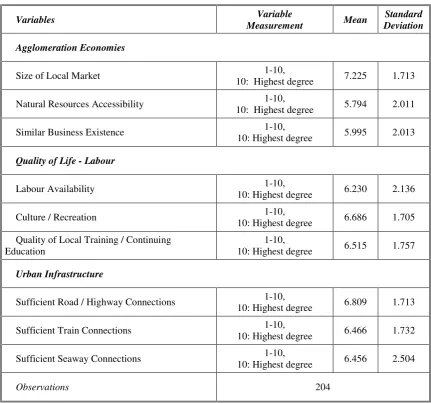
with the descriptive statictics of the variables utilised in the study are presented in Table 1.
Based on the mean values of Table 1, we observe that the mean values of the respondents’
answers are relatively low in most cases, just a little above of the cut-off value of six. The
lowest mean value is observed for the question regarding the existence of “Natural Resources
Availability”, indicating that in Greece there is not an efficient availability of natural
resources. The highest respective mean value is observed for the “Size of Local Market”.
……….[insert Table 1 about here]……….
The Model
Structural Equation Modeling (SEM) it can be viewed as a combination of factor analysis and
regression or path analysis (Hox and Bechger, 1998). The basic idea is that, after the indirect
and direct pathways that operate on the relationships of interest are defined, the latent
variables, though they cannot observed by the researcher, can be estimated by their relation to
Regarding firms’ competitiveness and management studies, SEM has been used in a variety
of scientific works. For instance, Ling et al. (2012) investigates in Porter’s ‘diamond’
environment the components of competitiveness, and develops and validates mathematical
models to predict the competitiveness levels of architectural, engineering and construction
firms headquartered in mainland China. Momeni et al. (2011) through questionnaire survey
and using factor and SEM analysis investigate the relationship between knowledge
management process capabilities and core competencies in Iranian companies. Furthermore,
Tong et al. (2010) used SEM analysis in order to evaluate the core competence of insurance
companies, Wu (2008) through empirical research in 108 Hong Kong-based China family
owned manufacturing firms and using regression and SEM analysis, examined the mediating
role of information sharing in the relationships between dimensions of social capital and firm
competitiveness. Finally, Graig et al. (2007) applied SEM in order to investigate how the
promotion of family-based brand identity influences competitive orientation (customer versus
product) and firm performance in family businesses. Generally, SEM models are applied in
order to simultaneously examine more complex relationships between observed and latent
variables and to incorporate the latent variable of “Firm Competitiveness” in the analysis.
A SEM model of the following form is utilized in order to examine the relationships of
interest, namely the relationships of firms’ competitiveness with factors that are established in
the empirical literature as important indicators of the former. In detail, the measurement and
the structural equation models described below are estimated:
i ij i i
y =λ η ε⋅ + (1) , 1, 2, 3 1
i ij j i i j
η =β η ζ⋅ + = = (2)
Where yi are the observed variables that are indicated by the latent variables as they are
Labour”, “Urban Infrastructure” are symbolized with ηi. The ηj variable is the latent
factor of “Firm Competitiveness”. λij are the factor loadings indicating the effect of the latent
variables on the observed indicators andεi are the measurement errors that are assumed to be
uncorrelated between measurement equations and with ηi, i.e. E
( )
εi =0, ,Cov(
ε ηi i)
=0. ζiare the measurement errors in the measurement and the structural equations respectively and
ij
β are the factor loadings indicating the effect of the latent variables “Agglomeration
Economies”, “Quality of Life / Labour”, “Urban Infrastructure” upon “Firm
Competitiveness”. The scale of the latent factor “Firm Competitiveness” is fixed by assuming
that it has a unit variance (Jöreskog and Sörbom, 2001). It is also hypothesized
thatE
( )
ζi =0, ,Cov(
ζ ηi j)
=0, ,Cov(
ε ζi i)
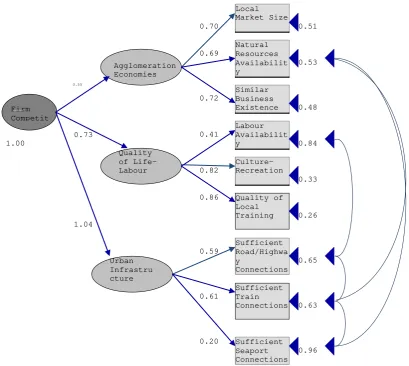
=0. The hypothesized SEM model estimated asdescribed above is presented in Figure 2.
……….[insert Figure 2 about here]……….
The method of estimation is Weighted Least Squares (WLS), analysing the matrix of
polychoric correlations. When the observed variables are ordinal with highly non-normal
distribution, WLS method should be preferred in order to produce correct estimates, standard
errors and goodness of fit statistics (Jöreskog and Sörbom, 2001). The estimated parameters
presented in the study are standardized since they are considered more appropriate for a
clearer interpretation and comparison of the estimated effects (Diamantopoulos and Siguaw,
2000; Moustaki and Knott, 2000). Furthermore, correlated error terms are introduced in the
models as sawn in Figure 2. While correlated error terms are generally viewed with suspicion
by researchers, however they can be justified in cases such as ours, where the observed
indicators come from similar wording questions, reflecting very close meanings
(Diamantopoulos and Siguaw,2000) and have been introduced in the past in a similar manner
5. RESULTS
The results of the SEM model are presented in Table 2. All estimated factor loadings are
positive and statistically significant. Regarding the latent factor “Agglomeration Economies”
we can see that it is positively related to all outcomes. In specific, Agglomeration is higher
among firms who operate in a market of larger size, enjoy higher availability of natural
resources and there exist other similar firms in the market as well. Actually, the estimated
correlation for the outcome variable “similar business existence” seems to be the highest
among the observed estimated correlations.
“Quality of Life” is also strongly related to its outcomes. In particular, firms enjoy with
“Quality of Life” with increasing levels of labour availability, quality of local training and
cultural factors that can affect the firms’ performance and productivity. The strongest
correlation is found for the outcome variable of “Quality of Local Training / Continuing
Education”.
Finally, “Urban Infrastructure” is, as expected, also strongly and positively related to its
outcome indicators. Firms enjoy higher levels of urban infrastructure with increasing
sufficiency of road/highway, train and seaway connections. For this factor of infrastructure,
the greater loading is observed for the outcome variable of train connections.
When the relationship of the latent factors is examined, it is evident that Firms’
Competitiveness is strongly and positively related to all three “Agglomeration Economies”,
“Quality of Life / Labour”, “Urban Infrastructure”, indicating that these factors are
important indicators for competitiveness of firms. A very high loading is observed for the
factor “Urban Infrastructure” in comparison to the remainder, revealing the very strong
correlation this factor has with competitiveness of firms. Based on the fit indices presented in
the last rows of Table 2, it seems that the model adequately fits the data.
6. CONCLUSIONS
The present study examines the external environment factors that affect firms’
competitiveness, in a regional area of Thessaloniki in Greece. A number of factors are used
namely “Agglomeration Economies”, “Quality of Life / Labour”, “Urban Infrastructure”,
that are considered to mainly affect competitiveness (Deas and Giordano, 2001).
All estimated relationships are found to be statistically significance and in accordance to
the findings of previous research. In detail, “Agglomeration Economies” are significantly
associated with local market size, availability of natural resources and similar business
existence in line with previous empirical findings (Crozet et al., 2004; Duranton and Puga,
2004; Nachum and Keeble, 2003; Rocha and Stenberg, 2005; Graham, 2007; Doeringer et al.,
2004; Combes et al., 2008). Similarly, “Quality of Life / Labour” is higher with higher values
of labour availability, greater cultural and recreational environment and higher quality of local
training. As the literature argues, these findings are expected since they are accompanied with
higher productivity and innovation in the production process (Keune, 2001;Twomey, 2002).
Finally, “Urban Infrastructure” is increased with higher availability of road/highway, train
and seaport connections. Based on existing research, these factors are identified as major
determinants of firms’ competitiveness since they facilitate firms’ ability to reach new
markets for its products and at the same time, decreases transportation costs and consequently
prices, leading to higher competitiveness advantages (Vickerman, 1996; Wheeler and Mody,
1992).
As expected, all the above mentioned three factors are significant indicators of firms’
competitiveness with “Urban Infrastructure” exerting the higher effect among all. Once
again, “Agglomeration Economies”, “Quality of Life / Labour”, “Urban Infrastructure”, are
greater availability and quality of labour force and availability of adequate connections will
facilitate production process, productivity and opening to other markets.
All in all, this study presents evidence on the factors that are major determinants of firms’
competitiveness at the regional level. Still, more research is needed with the use of large scale
surveys that will facilitate us to examine in more detail the main determinants of firm
competitiveness.
REFERENCES
Alonso-Villar O, 2002, “Urban agglomeration: Knowledge spillovers and product diversity” Annals of Regional Science 36(4) 551-573
Austrian Z, 2000, “Cluster Case Studies: The Marriage of Quantitative and Qualitative Information for Action” Economic Development Quarterly 14 (1):97-110.
Bargegil A, Modrego A. R, 2009, “The impact of research and technology organizations on firm competitiveness: measurement and determinants”, DRUIT Society Summer Conference, Copenhagen Business School, 17-19 June, Denmark
Barney J, 1991, “Firm resources and sustained competitive advantage” Journal of Management 17(1) 99-120.
Barney J, 2001, “Is the Resource-Based ‘View’ a useful perspective for management research?” Academy of management review, 26 (1), 41-46
Bayyurt N, Dozu G, 2008 “Performance Measurement of Turkish and Chinese Manufacturing Firms: A Comparative Analysis”. Eurasian Journal of Business and Economics, 1(2) 71-83
Commission of European Communities, Directorate General for Regional Policies, 1993. New location factors for mobile investment in Europe, Final report in cooperation with
Ernst-Young, Brussels, Luxembourg
Christiaans T, 2002, “Regional Competition for the location of new facilities” The Annals of Regional Science, 36 645-661
Coccossis H, Psycharis Y, 2008, “Regional Analysis and Policy: The Greek Experience”, Springer, Berlin
firm competitiveness and performance in family businesses” http://epublications.bond.edu.au/business_pubs/41
Craglia M, Leontidou L, Nuvolati G, Schweikart J, 1999, “Evaluation of the quality of life in European regions and cities”. European Communities, Belgium.
Crozet M, Mayer T, Mucchlielli J-L, 2004, “How do firms agglomerate?: A study of FDI in France” Regional Science and Urban Economics, 34 (1) 27-54
D’Arcy E, Keogh G, 1999, “The property market and urban competitiveness: a review” Urban Studies, 36 (5-6) 917-928
Deas I, Giordano B, 2001, “Conceptualizing and measuring urban competitiveness in major English cities: an exploratory approach” Environment and Planning A, 33 1411-1429 Diamantopoulos A, Siguaw J.A, 2000 “Introducing LISREL: A Guide for Uninitiated” Sage
Publications Ltd., London
Doeringer P, Evans-Klock C, Terkla D, 2004, “What attracts high performance factories? Management culture and regional advantage” Regional Science and Urban Economics, 34
591-618
European Commission 2003. Structural policies and European territories: Competitiveness, sustainable development and cohesion in Europe. From Lisbon to Gothenburg.
Luxembourg: Office for Official Publications of the European Communities Fujita M, Thisse J. F, 2003, “Does Geographical Agglomeration Foster Economic
Growth? ,And Who Gains and Losses From It?” The Japanese Economic Review 54(2) 121–145
Glaeser E, 1999, “Learning in Cities”, Journal of Urban Economics, 100, 254–77.
Graham J. D, 2007, “Agglomeration Economies and Transport Investment” Discussion Paper, no.2007-11, Imperial College, University of London, London
Harrighton W. J, Warf B, 1995 “Industrial Location, Principles, Practice and Policies”. London, Routledge
Head K, Ries C.J, Swenson D, 1999, “Attracting Foreign Manufacturing: Investment Promotion and Agglomeration” Regional Science and Urban Economics, 29(2) 197-218. Henderson R, Cockburn I, 1994 “Measuring Competence? Exploring Firm Effects in
Pharmaceutical Research” Working Paper, no. 3712, MIT, Sloan School of Management Herrin N. A, Pernia M. E, 1987 “Factors Influencing the Choice of Location: Local and
Foreign Firms in Philippines” Regional Studies, 21(6) 531-541
Hox J.J, Bechger T.M, 1998 “An Introduction to Structural Equation Modeling’ Family Science Review 11(4) 354-373
Joreskog K, Sorbom D, 2001, “LISREL 8: User's reference guide” (2 ed.). Lincolnwood, IL: Scientific Software International, Inc
Karlsson C, Johansson B, Stough R.R, 2008, “Entrepreneurship and Innovation in Functional Regions” CESIS Electronic Working Paper Series, Paper No.144
Keeble D, Wilkinson F, 2000, “High-technology SMEs, regional clustering and collective learning: an overview.” in: D. Keeble and F. Wilkinson (eds.) High-technology clusters, networking and collective learning in Europe. Aldershot: Ashgate, 1-20
Keune M, 2001, “Regions, regional institutions and regional development” SEED Working Paper, no.16, International Labour Office, Geneva
Konsolas N, Papadaskalopoulos A, Plaskovitis I, 2002, “Regional Development in Greece”, Springer, Berlin
Kresl K. P, Singh B, 1999, “Competitiveness and the Urban Economy: Twenty-four large US metropolitanareas” Urban Studies, 36 (5-6) 1017-1027
Kumar R, Chadee D, 2002, “International Competitiveness of Asian Firms: An analytical framework”, ERD Working Paper Series No. 4, February, Asian Development Bank Locke A. E, 1976, “The nature and causes of job satisfaction. In “Handbook of Industrial and
Organisation Psychology”, ed. Dunnette, D. Marvin, 1297-1349, Chicago, Rand McNally
Ling F.Y.Y. Li S, Low S.P, Ofori G, 2012, “Mathematical models for predicting Chinese A/E/C firms' competitiveness” Automation in Construction 24 40-51
Maruyama G.M, 1997, “Basics of Structural Equations Modelling” Sage publications, California
Maskell P, Malmberg A, 1999, “The competitiveness of firms and regions: ‘Ubiquitification’ and the importance of localized learning” European Urban and Regional Studies, 6 9-25 McLarney C, 2001 “Strategic planning-effectiveness-environment linkage: a case study”.
Management Decision, 39(10), 809 - 817
Metaxas T, 2011 “The Entrepreneurial Capacity Of Local Authorities In South-Eastern Europe - An Enterprise Perspective” Romanian Economic Business Review 6(1), 18-36 Momeni M, Monavarian A, Shaabani E, Chasemi R, 2011 “A Conceptual Model for
Moustaki I, Knott M, 2000, “Weighting for Item Non-Response in Attitude Scales Using Latent Variable Models with Covariates” Journal of the Royal Statistical Society, Series A, 163(3), 445- 459
Nachum L, Keeble D, 2003 “MNE linkages and localized clusters: foreign and indigenous firms in the media cluster of Central London” Journal of International Management, 9
171-192
National Statistical Service of Greece, 2010
Parida V, 2008 “Small Firm Capabilities for Competitiveness: An empirical study of ICT related small Swedish firms”, Doctoral Thesis, Lulea University of Technology Department of Business Administration and Social Science Entrepreneurship
Parsons E, Broadbridge A, 2006 “Job motivation and satisfaction: Unpacking the factors for charity shop Managers” Journal of Retailing and Consumer Services, 13 121-131
Porter E. M, 2000, “Location, competition and economic development: local clusters in the global economy” Economic Development Quarterly, 14 15-31
RIMED REPORT No. 9 2005 “An analysis of the economic structure and change in Skopje, Sofia, Tirana and Thessaloniki”, University of Thessaly, Department of Planning and Regional Development, South and East European Development Center (SEED), Volos, Greece
Rocha H, Stenberg S, 2005, “Entrepreneurship: The Role of clusters theoretical perspectives and empirical evidence from Germany” Small Business Economics 24(3) 267-292
Rogerson J. R, 1999, “Quality of Life and city competitiveness” Urban Studies 36(5-6): 969-985
Simmie J, 2002, “Trading Places: Competitive Cities in the Global Economy”, European Planning Studies 10(2), 201-214.
Shangqin H, McCann P, Oxley L, 2009, “Innovation in New Zealand: Issues of Firm Size, Local Market Size and Economic Geography”, Working Paper, no.4, Department of Economics, University of Canterbury, New Zeeland
Stathakopoulos V, 2005, “Market Research Methods”. Stamoulis (eds), Athens
Tong H, Ye Y, Pan Y, Lu S, Zhang J, 2010 “Analysis and Evaluation for Core Competence of Insurance Company Based on SEM” iBusiness 2 178-182
Twomey F. D, 2002 “Organisational Competitiveness: Building performance and learning”. Competitiveness Review, 12(2) 1-12
Van de Ven W.P.M.M, Van Der Gaag J, 1982, “Health as an unobservable: A MIMIC-model of demand for health care”, Journal of Health Economics, 1(2) 157-183
Vickerman R, 1996, “Location, accessibility and regional development: the appraisal of trans-European Networks”, Transport Policy, 2(4):225-234
Wernerfelt B, 1984 “A Resource-based view of the firm”, Strategic Management Journal, 5
171-180 (March)
Wheeler D, Mody A, 1992, “International Investment Location Decisions: The Case of U.S. Firms” Journal of International Economics 33, 57-76.
Wu W, 2008, “Dimensions of Social Capital and Firm Competitiveness Improvement: The Mediating Role of Information Sharing” Journal of Management Studies 45(1) 122-146 Zhu J, 2000, “The impact of industrial land use policy on industrial change”, Land Use
Table 1: Variable Definitions and Descriptive Statistics
Source: Authors’ calculations
Variables Variable
Measurement Mean
Standard Deviation
Agglomeration Economies
Size of Local Market 1-10,
10: Highest degree 7.225 1.713
Natural Resources Accessibility 1-10,
10: Highest degree 5.794 2.011
Similar Business Existence 1-10,
10: Highest degree 5.995 2.013
Quality of Life - Labour
Labour Availability 1-10,
10: Highest degree 6.230 2.136
Culture / Recreation 1-10,
10: Highest degree 6.686 1.705 Quality of Local Training / Continuing
Education
1-10,
10: Highest degree 6.515 1.757
Urban Infrastructure
Sufficient Road / Highway Connections 1-10,
10: Highest degree 6.809 1.713
Sufficient Train Connections 1-10,
10: Highest degree 6.466 1.732
Sufficient Seaway Connections 1-10,
10: Highest degree 6.456 2.504
Table 2: SEM Results on the Effects of Firms’ “Competitiveness” on Firms Characteristics (Completely Standardised Estimates), WLS
Ind. Variables
Agglomeration Economies
Quality of Life –
Labour Urban Infrastructure
Size of Local Market 0.701
Natural Resources
Accessibility 0.688 ***
Similar Business Existence 0.719 ***
Labour Availability 0.405
Culture / Recreation 0.821 ***
Quality of Local Training /
Continuing Education 0.859 ***
Sufficient Road / Highway
Connections 0.593
Sufficient Train
Connections 0.608 ***
Sufficient Seaway
Connections 0.198 ***
Dep. Variable Agglomeration
Economies
Quality of Life –
Labour Urban Infrastructure
Firm Competitiveness 0.550 *** 0.725 *** 1.043 ***
Chi square (prob.)
21.032 (0.335)
DoF 19
RMSEA 0.023
CFI 0.997
NNFI 0.994
GFI 0.992
Observations 204
a
The asterisks next to the coefficients indicate *** significance at 1%, ** significance at 5%, * significance at 10%.
b
Figure 1: The TEN-T (Trans European Transportation Network) in Greece (only roads shown).
Figure 2. SEM Model for Firms’ “Competitiveness” Firm Competit 1.00 Agglomeration Economies Quality of Life- Labour Urban Infrastru cture Local Market Size 0.51 Natural Resources Availabilit y 0.53 Similar Business Existence 0.48 Labour Availabilit y 0.84 Culture- Recreation 0.33 Quality of Local
Training 0.26
Sufficient Road/Highwa y Connections 0.65 0.63 0.96